

Not asked. Not requested. Told.
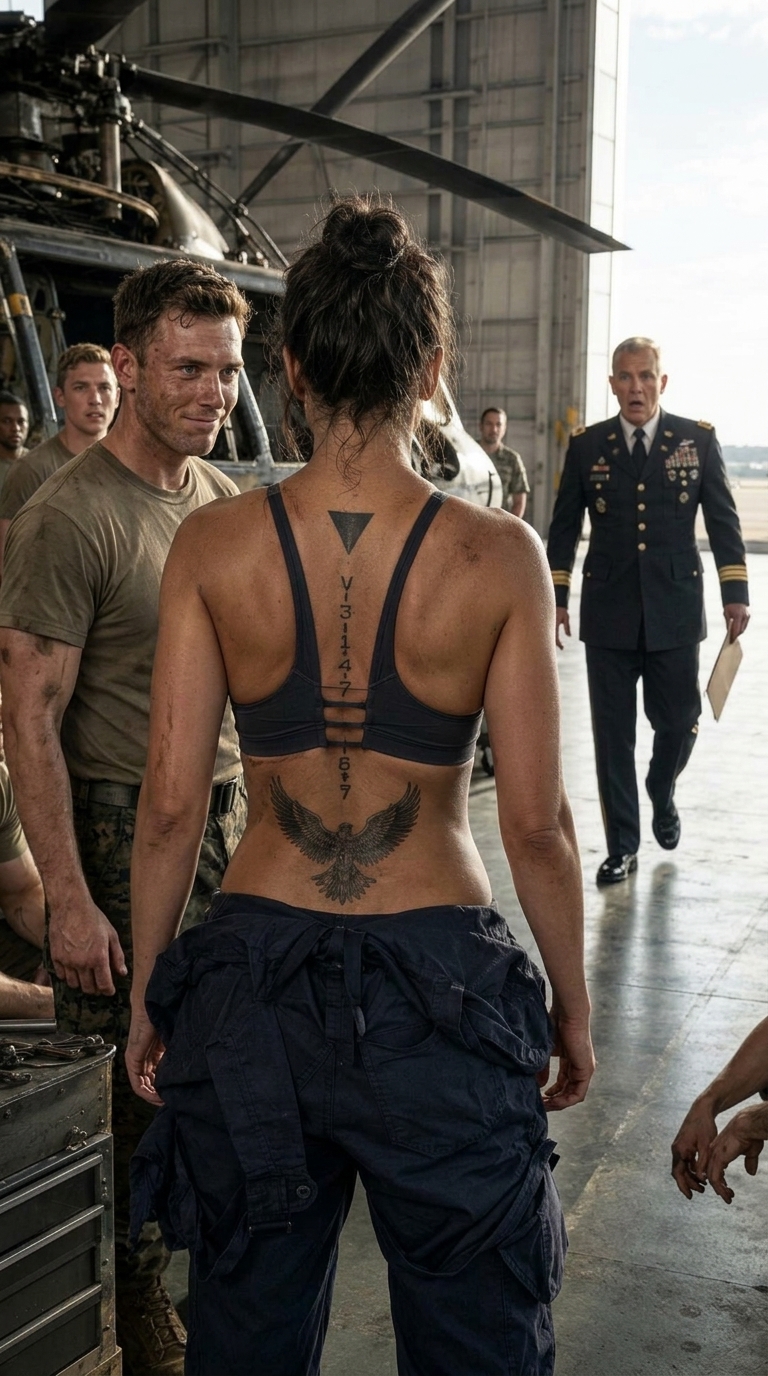
The concrete under my boots was still warm from the desert heat that had rolled in all morning, and the whole place smelled like jet fuel, hydraulic fluid, hot metal, and the stale coffee mechanics leave sitting too long on tool carts. Twenty men were in that hangar, some pretending not to stare, some not pretending at all. A Black Hawk sat behind me with its panels open like ribs. My clipboard was on a workbench. My T-shirt was on the floor.
And Corporal Dylan Brennan was circling me like he’d paid admission.
“Turn around,” he said. “Full inspection.”
His voice had that bright, ugly confidence some young men wear before life teaches them the price of being cruel. Twenty-two, maybe. Fresh rank on his sleeve. Boots polished to a mirror shine. The kind of kid who thinks authority means making someone else smaller.
I stood there in my sports bra and work pants, my coveralls tied around my waist, trying to keep my breathing even. My face felt cool. That part always surprises people. They think humiliation comes with shaking hands and watery eyes and pleading. But shame, when you’ve lived long enough with worse things than shame, goes cold first. Cold and sharp. Useful.
Around us, tools slowed. Conversations thinned. I heard a ratchet click once and stop. A radio in the back muttered static and country music. Somebody laughed under his breath and got quiet fast.
I knew what Brennan wanted. He wanted a show. He wanted the old woman contractor to obey in front of his friends. He wanted a story to tell over bad coffee and vending-machine sandwiches. He wanted the kind of cheap power that only works on people you think don’t matter.
I also knew what would happen if I refused.
They’d ask questions. Call supervisors. Verify credentials. Push deeper. Someone would notice that my paperwork was clean in the way only manufactured paperwork is clean. Someone would wonder why my background seemed to begin in 2012, why it came with layers that led nowhere, why a civilian aircraft inspector had military bearing she’d never bothered to hide very well.
So I made the choice I hated most. I stayed still.
“Turn around,” he repeated.
I turned.
Slowly. Deliberately. Owning every inch of it because if you cannot stop a thing, sometimes the only victory left is refusing to let it bend you.
My sports bra had a racerback cut. It left my spine bare from the base of my neck to my beltline.
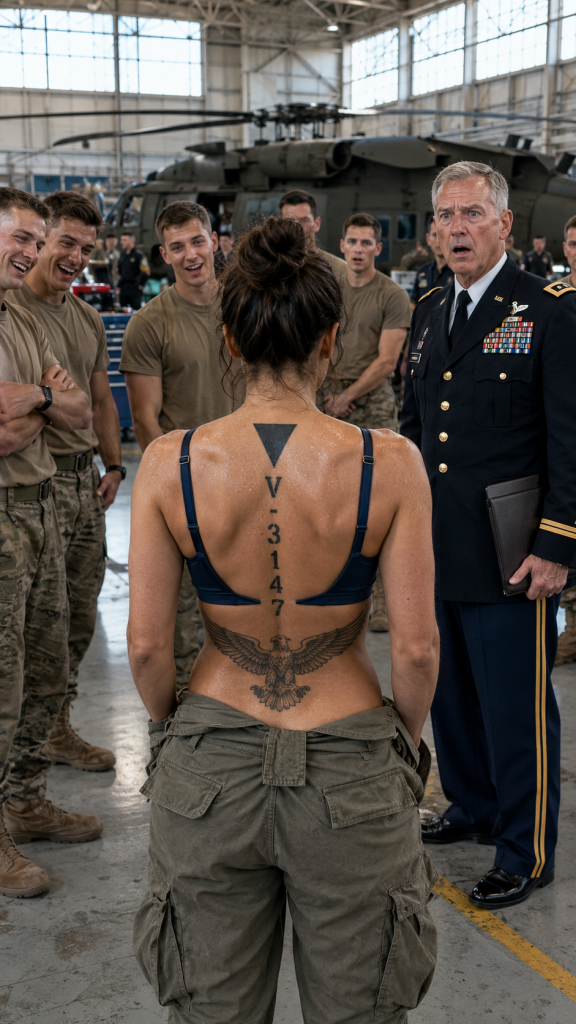
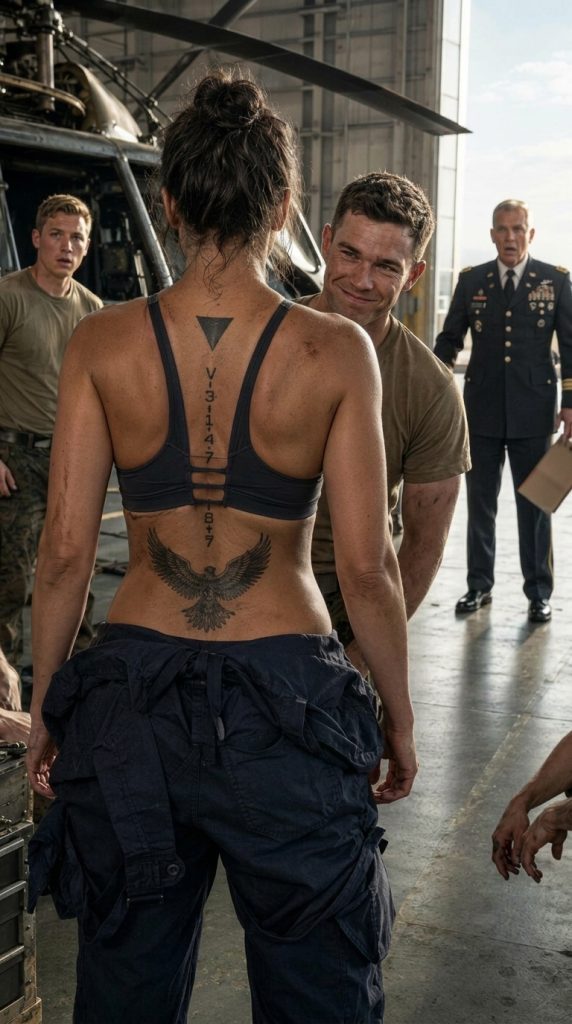
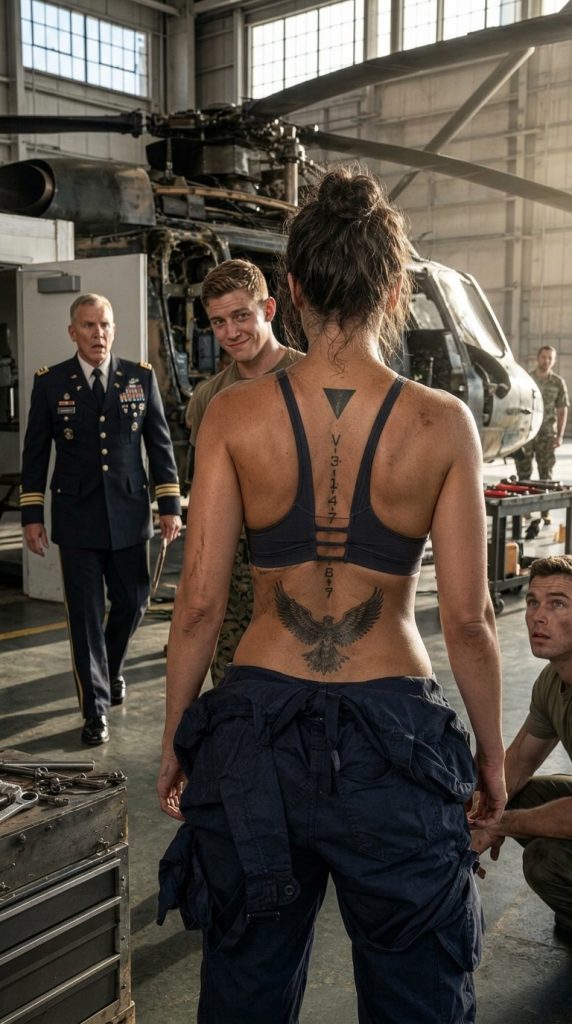
The tattoo runs straight down my back like a black crack in glass. At the top sits a downward-pointing triangle, clean-edged, precise, not decorative. Under it are the numbers V-3147 in stencil font. At the bottom, just above the waistband, a bird of prey with its wings spread and talons open.
The hangar changed in one breath.
The men who’d been watching for entertainment stopped breathing like spectators and started breathing like people who’d accidentally opened the wrong door. One of the younger mechanics let out a low whistle, then swallowed it halfway. Another muttered, “What the hell is that?” like he already knew he shouldn’t have asked.
Brennan stepped closer.
I could feel his eyes on my back, but now there was hesitation in them. Confusion. He’d expected something ridiculous. An old tattoo from a drunk summer. A faded rose. A biker mistake. Not this. Not the kind of ink that looked less like a decoration and more like an identification mark burned into a person for a reason.
“Ma’am,” somebody said from farther back, voice thin. “Maybe that’s enough.”
Brennan didn’t answer him. He was too busy pretending he still understood the room.
Then I heard the folder hit the floor.
Paper slapped concrete. Loud. Final. Wrong.
Every head turned toward the hangar doors.
Colonel Nathan Cross stood there in desert light, one hand half-open like he’d forgotten he was holding anything. He had two officers behind him and the look of a man who had just seen a ghost stand up from a grave and ask for a wrench.
He wasn’t young. Early fifties, maybe. Hard jaw, silver at the temples, ribbons on his chest, the careful stillness of someone who’d spent decades learning not to show surprise until surprise became impossible to hide.
His gaze wasn’t on my face.
It was fixed on my back.
On the triangle. The code. The bird.
And in that instant, I knew he understood enough to be dangerous.
Part 2
Colonel Nathan Cross did not move for three full seconds.
In a hangar, three seconds can become a room of its own. Long enough for the country music in the corner to sound obscene. Long enough for the desert wind to push dust across the open doors. Long enough for Corporal Dylan Brennan to realize the thing he had started had escaped the small cage of his imagination.
“Everybody out,” Cross said.
His voice was low. Not loud. That made it worse.
No one moved.
Cross turned his head slightly. “Now.”
The hangar broke apart.
Mechanics found urgent reasons to be elsewhere. Officers stepped backward. A sergeant near the tool chest suddenly remembered a form that needed signing on the other side of the base. Boots scraped concrete. Someone bumped into a cart and sent a wrench clattering to the floor, but nobody dared pick it up.
Brennan stayed where he was.
For one reckless moment, I thought he might try to argue. His mouth opened, his chin lifting with the fragile anger of a boy cornered by his own stupidity.
“Sir, this was a security inspection—”
Cross looked at him.
That was all.
The corporal’s words died. His face lost color in stages, like a photograph left too long in the sun.
“Outside,” Cross said.
Brennan swallowed. “Yes, sir.”
He left without looking at me.
The hangar doors remained open, but the room felt sealed. Cross bent slowly, picked up the folder he’d dropped, and held it against his side. His two officers had also vanished. Efficient men. Smart men. Men who understood when history had entered a room wearing work boots and a contractor badge.
I reached for my T-shirt on the floor.
“Don’t.”
One word.
My hand stopped.
Cross closed his eyes briefly, as if regretting the command the moment he gave it. When he opened them, he no longer looked like a colonel addressing a civilian. He looked like a man standing before an old wound.
“I need to confirm it,” he said.
“You already have.”
His jaw tightened.
The air between us smelled of oil and heat and memory.
“Turn around, Ms. Vale.”
I laughed once. It came out dry and humorless. “You know that’s not my name.”
“No,” he said. “I don’t.”
That made me look at him.
There are lies people tell to hide truth, and then there are lies people tell because truth has been stolen from them. Cross’s face had too much control in it, too much discipline packed over something raw. He knew the symbol. He knew the code. But he did not know me.
Not completely.
That was more dangerous than recognition.
I turned just enough for him to see the tattoo again.
The triangle. The number. The bird.
I heard his breath catch.
“V-3147,” he whispered.
No one had said that number aloud in sixteen years.
Not to my face.
Not and lived easily afterward.
“My name,” I said, “is Mara Vale. That is what it says on the badge. That is what you will use.”
Cross stepped closer, stopping a careful distance behind me. His shadow touched the floor beside my boots but not my skin.
“Operation Vesper,” he said.
The Black Hawk behind me ticked softly as it cooled.
I pulled my shirt over my head before he could tell me not to. The cotton dragged over the old ink and settled against my back like a door closing.
“You don’t get to say that here,” I said.
“I spent eleven years trying to find out who survived.”
“You spent eleven years looking in the wrong graves.”
His eyes shifted. Pain, guilt, calculation. All three passed over his face and vanished.
“Were there others?”
I picked up my clipboard from the workbench. My hand was steady. It always was when I wanted to break something.
“Depends who’s asking.”
“The commander of this base.”
“Then no.”
His mouth thinned.
“And if Nathan Cross is asking?” he said.
That name made the old hangar flicker.
For half a second, I was not in the desert. I was in a freezing corridor under a mountain, hearing alarms pulse through concrete walls. I was twenty-nine, bleeding through my sleeve, carrying a black case handcuffed to my wrist. Nathan Cross was younger then, not yet silver, not yet carved into authority. He had been on the other side of reinforced glass, shouting my name.
My real name.
The one I buried with everyone else.
I blinked and the hangar returned.
“If Nathan Cross is asking,” I said, “he should know better.”
He looked away first.
That pleased me less than I expected.
From outside came the distant murmur of men pretending not to gather near the doors. Stories were already being born. They would grow teeth by lunch and wings by nightfall. By morning, I would be either a spy, a criminal, a war hero, or someone’s deranged aunt with a classified tramp stamp. Soldiers were imaginative when bored.
Cross walked to the hangar entrance and barked a single order.
“Clear the apron!”
Feet scattered.
When he returned, his expression had hardened. “Come with me.”
“No.”
“Mara—”
“Ms. Vale.”
“Ms. Vale,” he corrected, with visible effort, “your cover is compromised.”
“My cover was compromised by a corporal with a power fantasy and no supervision. That sounds like a leadership problem.”
His face barely moved. “It is now a containment problem.”
I leaned against the workbench and folded my arms. “There it is.”
“There what is?”
“The man who sees a person and turns her into a situation.”
Cross absorbed that like he deserved it.
Maybe he did.
He lowered his voice. “Do you understand what that mark means if the wrong person saw it?”
“I understand better than you.”
“No. You don’t understand the current landscape.”
“The current landscape,” I said, “is that you have a base full of leaky mouths, one humiliated corporal, and a dead program tattooed down my spine.”
“Vesper isn’t dead.”
The words landed between us with the weight of a body.
For the first time all morning, my breathing changed.
Cross saw it. Of course he did. He had built a career out of noticing the smallest fractures in people before they became doors.
I forced myself to smile. “Try again.”
“I wish I were lying.”
“You are always lying. It’s only the size that changes.”
He reached into the folder and removed a photograph.
He did not hand it to me at first. He held it as if it might bite.
Then he placed it on the workbench.
The image was grainy, shot from above, maybe from a drone or satellite enhancement. A night road. A convoy burning. Men moving around the wreckage with weapons raised. In the center of the photograph, painted on the side of a black armored truck, was a downward triangle.
Beneath it:
V-3148.
The world narrowed.
Not enough air. Too much light.
I stared at the number until it blurred and sharpened again.
“Where?” I asked.
“North border. Three nights ago.”
“Who else saw this?”
“Joint Intelligence. Two analysts. Me.”
“And now?”
“Now you.”
I touched the edge of the photograph, not the number. Never the number.
“There was no 3148.”
“That’s why I came to Hangar 7,” Cross said. “We flagged an engine inspection order under your contractor profile. I didn’t know whether you were involved or being hunted.”
“You thought I staged this?”
“I didn’t know what to think.”
I looked up. “That must be new for you.”
He accepted the blow without flinching.
The old Nathan would have smiled at that. The old Nathan had been charming in the way knives are beautiful under certain lights. This one looked tired. Not weak. Never that. But tired in a place rank could not reach.
“What do you want?” I asked.
“Your help.”
“No.”
“You haven’t heard the rest.”
“I heard enough at Operation Vesper.”
His eyes darkened. “You think I don’t know what happened there?”
“I know you lived.”
“So did you.”
“Not the same thing.”
Outside, a helicopter lifted somewhere beyond the hangar, its blades beating the air into submission. The sound filled the silence for several seconds, giving both of us a place to hide.
When it faded, Cross said, “The convoy carried a body.”
I did not move.
“A woman. Late fifties. No identification. Her spine had been removed after death.”
My stomach tightened, but my face stayed empty.
No detail. No picture. Just the terrible shape of meaning.
“They took the tattoo,” I said.
“Yes.”
“Not a survivor, then. A message.”
Cross nodded.
“To me?”
“To us.”
“There is no us.”
“There was.”
That word opened another door.
There was.
There was a time when the world was colder and simpler. When five names were spoken only in sealed rooms. When we were not soldiers, not agents, not ghosts, but instruments sharpened for impossible work. Vesper had been sold to us as a shield, a program designed to stop disasters before they reached daylight. We believed in it because belief was easier than doubt, and because we were young enough to mistake secrecy for sacrifice.
Five operatives.
Five marks.
A triangle for the program. A number for the subject. A bird for extraction.
V-3147 was mine.
There had never been a V-3148.
Unless someone continued after the graves were filled.
Unless someone copied us.
Unless someone had lied about how many monsters lived in the dark.
I turned from the photograph.
“Give me Brennan,” I said.
Cross blinked. “What?”
“The corporal. Give him to me.”
“No.”
“Then we’re done.”
His eyes sharpened. “I won’t let you hurt him.”
“That’s sweet.”
“Mara.”
“I don’t want to hurt him.” I picked up my coveralls and tied the sleeves tighter around my waist. “I want to know who told him to inspect me.”
Cross went still.
There it was. The thing he had missed because guilt was loud and humiliation made excellent camouflage.
“He was following protocol,” Cross said, but now even he didn’t believe it.
“Contractors aren’t stripped in active hangars because a corporal feels inspired.”
“There was an alert.”
“Show me.”
He hesitated for half a second too long.
I smiled. “You haven’t seen it.”
Cross turned and walked to the nearest wall phone. He punched in a number with clipped precision.
“This is Cross. Bring Corporal Brennan to Hangar 7. Alone.”
He hung up.
Neither of us spoke while we waited.
I studied him in the quiet. The lines beside his mouth. The healed scar near his left ear. The wedding ring absent from his hand but pale memory of it still marked on his skin. A man can survive many things and still be haunted by what he chose over what he loved.
“You look older,” I said.
“You don’t.”
“Liar.”
His mouth almost moved.
Then Brennan came in.
He had found some of his color again, though not his confidence. His eyes flicked toward me and away. He stood before Cross with forced stiffness, trying to rebuild himself out of posture.
“Sir.”
“Who ordered the inspection?” Cross asked.
Brennan’s brow creased. “Sir?”
“Answer.”
“It came through security.”
“From whom?”
“Automated flag, sir. Contractor anomaly.”
“What anomaly?”
Brennan’s eyes shifted again.
Small movement. Huge mistake.
Cross saw it. I saw it. Brennan knew we saw it.
“The system flagged unauthorized access near Hangar 7,” Brennan said.
“Unauthorized access by whom?”
“Her, sir.”
“My access was logged and cleared,” I said.
Brennan’s mouth tightened. “The alert said otherwise.”
Cross extended a hand. “Device.”
Brennan looked confused.
“Your tablet. Now.”
He handed it over.
Cross opened the security log. His thumb moved once. Twice. Then stopped.
His face changed.
Not dramatically. Nathan Cross was not a man of dramatic reactions. But the air around him seemed to lose ten degrees.
“Where did this message originate?” he asked.
Brennan leaned forward, then froze. “I don’t know, sir.”
“You executed an invasive inspection order without verifying the source?”
“It had command priority.”
“Whose command?”
Brennan said nothing.
Cross turned the tablet so I could see.
The message was brief.
SUBJECT V-3147 ON SITE. CONFIRM MARK. DELAY UNTIL COMMAND ARRIVAL.
No signature.
No sender.
Just a black triangle in the corner.
My skin went cold under my shirt.
Brennan whispered, “I thought it was a classified security thing.”
“You thought humiliating a civilian in front of twenty men was classified security?” Cross asked.
Brennan looked at the floor.
For a moment, I almost pitied him. Almost. He had not invented the trap. He had only been eager enough to spring it.
That is how most cruelty gets done.
By people grateful for permission.
Cross handed the tablet back. “Report to Major Sloane. You are relieved of duty pending investigation. Speak to no one about what you saw.”
“Yes, sir.”
“And Brennan?”
The corporal stopped.
Cross’s voice lowered. “If a rumor leaves your mouth, I will know which teeth it passed through.”
Brennan’s throat moved. “Understood, sir.”
He left faster than he entered.
I stared at the empty doorway.
“Someone knew I was here,” I said.
“Yes.”
“Someone knew you were coming.”
“Yes.”
“Someone wanted you to see the tattoo.”
Cross nodded once. “Yes.”
The trap had not been for me alone. It had been theater. Hangar 7, the forced inspection, the public shame, the colonel arriving at the exact moment the mark was exposed. Someone had staged a resurrection and invited the only man alive who might understand it.
A message.
But messages have senders.
Cross gathered the photograph and tablet printout into his folder. “We need to move you to a secure room.”
“No.”
“This isn’t optional.”
“It is absolutely optional. I’ve spent sixteen years avoiding secure rooms built by men like you.”
His patience cracked. Just a hair. “There are people on this base who may be compromised.”
“Then I’m safer moving.”
“You don’t have transport.”
I picked up my clipboard. “I have a maintenance cart, two feet, and an excellent sense of when to leave.”
“Mara.”
I walked past him.
He caught my wrist.
Not hard. Not violently. But he should not have done it.
In a breath, I turned, stepped inside his balance, and pressed the edge of the clipboard against the soft place below his ribs. His hand released mine at once. His officers would have been impressed if they had been stupid enough to still be watching.
Cross did not defend himself.
That annoyed me most of all.
“I deserved that,” he said.
“You deserved worse.”
“I know.”
“No, Nathan. You really don’t.”
His eyes met mine then, and something old passed between us. Not warmth. Not forgiveness. Something heavier. The memory of two people trapped on opposite sides of a decision neither had survived intact.
“I opened the south gate,” he said quietly.
I froze.
“What?”
“At Vesper. That night. I opened the south gate.”
“No, you didn’t.”
“I did.”
“You were in Command.”
“I routed the lockdown away from the south corridor for six minutes. I thought you knew.”
I stared at him.
For sixteen years, I had believed I escaped because I was faster, meaner, luckier than the people sent to erase us. I had believed Nathan Cross stayed in Command while the program burned, while the others died, while I crawled through a drainage tunnel with half the mountain collapsing above me.
I had built hatred around that belief. Reinforced it. Lived inside it.
Now he was telling me a door had opened.
Not by accident.
By him.
“Why?” I asked.
His answer came too quickly, which meant he had been carrying it a long time.
“Because I couldn’t save all of you.”
That should have been nothing. Too little. Too late. A single sentence against a graveyard.
But grief is not fair. It takes what it can use.
For one dangerous second, my anger had no shape.
Then a phone rang.
Not the wall phone.
Mine.
I did not move.
The sound came from my coveralls pocket. A cheap contractor phone with three numbers stored and none that should have been calling.
Cross watched me.
I pulled it out.
UNKNOWN CALLER.
I answered without speaking.
For two seconds there was only static.
Then a woman’s voice said, “Hello, 3147.”
My bones remembered before my mind did.
The voice was older, rougher, scraped thin by time, but beneath it was a rhythm I knew. A calm I hated. The kind of calm that had once talked us through missions where fear was a luxury and hesitation was death.
Dr. Elian Voss.
Director of Operation Vesper.
Dead for sixteen years.
I looked at Cross.
His face had gone empty in the way soldiers’ faces go empty when the impossible begins giving orders.
The voice continued, almost amused.
“I see Nathan found you. Good. I was afraid the boy in the hangar might ruin the timing.”
My fingers tightened around the phone.
“Voss is dead,” I said.
A soft laugh. “Everyone says that when they lack better information.”
Cross stepped closer, listening.
“You staged this,” I said.
“I reminded you what you are.”
“I’m hanging up.”
“No, you’re not.”
I hated that she was right.
On the far side of the line, something hummed. Machinery perhaps. Or an aircraft. Or a room buried underground where the dead practiced speaking.
“I have something you want,” Voss said.
“There’s nothing.”
“V-3146.”
The hangar tilted.
Cross grabbed my arm—not to restrain me this time, but to steady me.
I let him.
V-3146.
Jonah.
The youngest of us. The loudest laugh. The best shot. The one who sang old songs off-key during surveillance because silence made him nervous. The one I had seen fall behind a wall of fire.
“No,” I said.
A pause.
Then another voice came on the line.
Hoarse. Weak. But alive.
“Mara?”
The phone nearly slipped from my hand.
Cross whispered, “God.”
The voice breathed once, unsteadily.
“Mara, don’t trust—”
A sharp sound cut him off.
Not loud. Not graphic. Just final enough to silence the room.
Voss returned.
“Still sentimental,” she said. “That may be useful.”
I could not speak. My throat had become stone.
Cross took the phone from my hand carefully. “Voss.”
“Colonel Cross. I wondered whether rank would make you sound less guilty. It doesn’t.”
“Where are you?”
“Close enough.”
“What do you want?”
“Exactly what I wanted sixteen years ago. Completion.”
Cross’s eyes went to me.
Voss said, “Bring 3147 to the old relay station by 2300 tonight. No escort. No drones. No cleverness. Nathan remembers what happens when clever men improvise.”
“You’re insane,” Cross said.
“No. I am patient.”
The line clicked dead.
For several seconds, neither of us moved.
Then the base siren screamed.
Not a drill tone. Not the neat pulsing wail of scheduled emergency practice. This was ugly and continuous, spreading across the airfield like a blade dragged along metal.
Cross ran to the hangar doors.
I followed.
Outside, soldiers poured from buildings. Vehicles started. Men shouted into radios. Far across the base, near the communications tower, a column of black smoke lifted into the hard blue sky.
Cross’s radio crackled at his shoulder.
“Command, this is Watchtower Three! We have an explosion at Signal Annex! Repeat, Signal Annex is hit. Systems are down. Unknown casualties. We need medical and fire response now!”
Cross pressed the transmitter. “Lock down all gates. Ground all aircraft. No one leaves this base.”
Static answered.
Then another voice broke through.
Calm. Female. Familiar.
“Too late, Nathan.”
Every radio in the hangar spoke with Voss’s voice.
Every channel.
Every speaker.
“Vesper is awake.”
The lights died.
For one breath, Hangar 7 became a cave full of hot metal and ghosts.
Emergency lamps blinked red along the walls. Shadows jumped over the Black Hawk. Outside, men ran through smoke and sunlight, their orders shredding into confusion.
Cross turned toward me.
In the red light, he looked less like a commander and more like the man behind the glass again, shouting while alarms screamed and the mountain burned.
“Mara,” he said, “we have to go.”
I looked down at the phone in my hand.
A new message glowed on the screen.
One image.
A man strapped to a chair, face turned away from the camera, a number tattooed along his spine.
V-3146.
Below it, six words:
BRING THE BIRD BACK TO NEST.
My old scar beneath the tattoo began to ache as if the ink itself had heard the call.
I looked at Cross and realized the worst part was not that Voss had survived.
The worst part was that she had never been hiding from us.
She had been waiting for me to be stripped down to the truth.
Part 3 — The Woman Washington Buried Alive
“They found the archive.”
For one terrible second, the hangar disappeared.
The heat, the staring men, the Black Hawk with its ribs open, Brennan’s pale face, Colonel Cross standing like a man with a bullet already lodged in his chest—all of it slipped away.
I was back in a room underground where the walls sweated cold water and the lights never turned off.
I was twenty-nine again.
My name was not Mara Vale then.
It was Captain Mara Voss, United States Army Intelligence, assigned to a unit that officially did not exist, attached to an operation Washington denied before it ever began.
Valkyrie.
That was what the triangle meant.
The numbers beneath it were not a serial code.
They were a grave marker.
V-3147.
Valkyrie asset. Third cycle. Fourteenth file. Seventh survivor.
Except there weren’t supposed to be survivors.
Colonel Cross must have seen the memory pass over my face because his voice softened, just slightly.
“Mara.”
The name hit me harder than Brennan’s humiliation ever could.
For fourteen years, no one had spoken it like that.
Not with grief.
Not with recognition.
Not with the awful tenderness of someone who remembered the person I had been before the world decided I was more useful dead.
A murmur moved through the hangar.
Brennan stiffened. “Mara?”
Cross turned on him so sharply the corporal took half a step back.
“Out,” Cross said.
“Sir?”
“Everyone out.”
No one moved fast enough.
Cross’s voice became a blade.
“Now.”
The hangar emptied in pieces—boots scraping, tools abandoned, men suddenly fascinated by the exits. Brennan lingered, his mouth opening as if stupidity still had one final argument to make.
Cross didn’t raise his voice.
“Corporal Brennan, if you remain in this hangar for three more seconds, I will personally ensure your next assignment involves counting frozen bolts in a storage depot north of nowhere.”
Brennan left.
Fast.
The moment the last man crossed the threshold, Cross’s shoulders lowered an inch. Not relaxed. Men like him did not relax. But the performance of command loosened enough for something human to appear underneath.
The officer with the tablet remained. Major Ellison, according to her name tape. Sharp eyes. Dark hair pinned too tightly. She looked at me as though I had become a classified document with a pulse.
Cross took the tablet from her and held it out.
I did not take it.
“Tell me,” I said.
His mouth tightened.
“Three hours ago, a sealed federal repository in Virginia triggered an unauthorized retrieval alarm. Someone accessed the Valkyrie archive.”
I felt the old coldness rise in me again.
“Who?”
“We don’t know.”
“Don’t lie to me, Nathan.”
He flinched at the sound of his first name.
Good.
He deserved to flinch.
Major Ellison looked between us, startled by the familiarity.
Cross drew a slow breath. “The retrieval originated from inside the Department of Defense network. It was authenticated with legacy command keys.”
My pulse changed.
Not faster.
Lower.
Heavier.
There are certain names the body remembers before the mind allows them in.
“No,” I said.
Cross looked away.
That was answer enough.
I laughed once. It was a horrible sound.
“Tell me he’s dead.”
No one answered.
“Nathan.”
Cross looked back at me.
“General Alaric Dane disappeared from federal custody eighteen months ago.”
The concrete beneath me seemed to tilt.
Dane.
The architect of Valkyrie.
The man who discovered that war could be fought not only with bullets, but with erased people. People stripped of records, families, names, legal existence. People trained until they became ghosts. People deployed into places politicians would later swear America had never entered.
And when Valkyrie began producing evidence of crimes too large to bury, Dane had solved the problem with stunning simplicity.
He ordered the unit erased.
Eighteen operatives died in the burning of Black Basin.
Five vanished.
One survived under a false identity with a tattoo down her spine and a death certificate in a sealed file.
Me.
I reached for the workbench and found it with my fingertips.
Cross stepped forward.
I raised one hand.
“Don’t.”
He stopped.
His face carried fourteen years of things he had no right to say.
“I thought you were dead,” he said anyway.
“That was the idea.”
“I searched.”
I smiled without warmth. “You searched where they allowed you to look.”
The words landed exactly where I meant them to.
Once, I had trusted Nathan Cross more than any man alive. Once, he had been my commander, my friend, and the only person who could calm me after operations where I returned with blood under my nails and foreign dust in my lungs.
Once, I had loved him in the quiet way soldiers love people they know they may never have the luxury to keep.
Then Black Basin burned, and Nathan Cross stood before a congressional panel and testified that Valkyrie had been “an unauthorized rogue initiative” with “no verified living assets.”
He said it because the alternative was career execution, prison, and possibly a bullet in a parking garage.
I knew why he had done it.
That did not make forgiveness easier.
Major Ellison cleared her throat.
“Sir, there’s more.”
Cross’s eyes stayed on mine. “Say it.”
She glanced at me, then back at him.
“The archive wasn’t just accessed. A file was extracted.”
“Which file?” I asked, though I already knew the answer. Fate has a taste. Metallic. Familiar.
Ellison swallowed.
“V-3147.”
A strange calm filled me.
The world had found my grave and noticed I wasn’t in it.
Cross lowered the tablet.
“We have to move you.”
“No.”
“Mara—”
“No,” I repeated. “You don’t get to move me like cargo.”
His jaw flexed. “Dane knows you’re alive.”
“Then Dane has a problem.”
“He’ll come for you.”
I stepped closer to him.
Let him see what remained beneath the contractor’s clothes and gray-streaked hair. Let him remember the woman who once crawled through a collapsed tunnel with two broken ribs and a stolen hard drive clenched between her teeth.
“Good,” I said. “I’m tired of hiding.”
At that exact moment, alarms began screaming across the base.
Red lights spun over the hangar doors.
A voice exploded through the loudspeaker.
“Security breach. East perimeter. All personnel shelter in place.”
Major Ellison turned toward the doors.
Cross grabbed his radio.
I looked toward the Black Hawk.
Its maintenance panels were still open. Fuel line exposed. Secondary avionics half-disassembled. Rotors locked.
Not flyable.
Not useful.
Then my eyes landed on the old utility cart beside it.
Battery pack. Welding torch. Emergency flare case. Three smoke canisters on a shelf meant for training exercises.
Not much.
But enough.
Cross saw my expression.
“No,” he said.
I was already moving.
“Mara, stand down.”
I pulled open the flare case.
He grabbed my wrist.
For one breath, we were not colonel and ghost. Not past and present.
We were two people who had once survived because we could read each other’s thoughts before they became words.
His fingers tightened.
Mine did not.
“You owe me fourteen years,” I said quietly. “Start paying by letting go.”
His hand opened.
Outside, gunfire cracked across the base.
Major Ellison went pale.
I shoved a flare into my waistband, grabbed the smoke canisters, and looked at Cross.
“Where’s Brennan?”
Cross blinked.
“What?”
“The corporal.”
“Why?”
“Because men like him either run toward danger to prove something or freeze where they can get others killed. Which one is he?”
Cross turned toward Ellison.
She checked the tablet, hands moving fast.
“Hangar 3 access corridor. He’s still inside the restricted zone.”
I cursed.
Cross stared at me.
After everything Brennan had done, even he seemed surprised.
I headed for the door.
Cross followed.
“Mara.”
I didn’t slow down.
“Don’t mistake me,” I said. “I’m not saving him because he deserves it.”
The first explosion hit before he could answer.
The hangar shook.
Dust fell from the ceiling.
Somewhere outside, men shouted.
I stepped into the burning afternoon and saw black smoke rising beyond the east fence.
And beneath the alarm, beneath the chaos, beneath the resurrected terror of a dead general reaching out from the past, I felt something I had not felt in fourteen years.
Not fear.
Not shame.
Purpose.
Part 4 — The Ghost Walks Back Into Fire
The base had turned into a machine trying to remember how to panic.
Humvees roared past in sprays of dust. Soldiers sprinted between buildings with weapons raised. Loudspeakers spat orders that overlapped until they became noise. Smoke rolled across the perimeter like a black curtain dragging itself over the desert.
Cross kept pace beside me.
He was older, yes. Slower by half a step. But not soft. The colonel still moved like command had been welded into his bones.
Major Ellison followed behind us, one hand on her sidearm, the tablet tucked under her arm.
“Security says three intruders breached the east fence,” she said. “Possibly more. Cameras went down ninety seconds before the alarm.”
“Dane’s people?” Cross asked.
“Unknown.”
I shook my head.
“Not unknown.”
They both looked at me.
I pointed to the smoke.
“That’s not an assault pattern. That’s a distraction. Dane isn’t here to take the base.”
Cross understood at once.
“He’s here for you.”
“No,” I said. “He’s here for what I know.”
We reached the access corridor between Hangar 3 and the supply depot. The lights inside flickered red. Somewhere beyond the bend, a young man was breathing too loudly.
Brennan.
He stood with his back against the wall, pistol in both hands, face shining with sweat. His earlier arrogance had vanished so completely it seemed impossible it had ever existed.
When he saw me, shame crossed his face.
Then relief.
Then shame again because he hated that relief.
“Ma’am,” he said.
I ignored the apology forming behind his teeth.
“Did you see anyone?”
He swallowed. “Two men. Black gear. No insignia. They moved past the corridor toward the comms building.”
Cross cursed softly.
Dane always loved communications first. Blind the eyes. Cut the tongue. Then remove the head.
“Can you walk?” I asked Brennan.
His pride tried to answer before his brain.
“I’m fine.”
I looked down.
Blood darkened his pant leg.
“No, you’re not.”
He glanced at it like he had only just noticed. “It’s nothing.”
“Then limp faster.”
We moved.
The corridor trembled with distant gunfire. Brennan tried not to show pain, which made him slower and more irritating. I shoved one smoke canister into his chest.
“Pull the pin only when I tell you.”
He stared at it. “What are we doing?”
“Making sure you live long enough to regret today properly.”
His face twisted.
“Ma’am, I—”
“Not now.”
“But I need to say—”
I stopped so suddenly he nearly ran into me.
“You wanted me small,” I said. “You wanted everyone to see it. Whatever apology you’re building, understand this: I don’t need it to keep walking. You need it so you can breathe easier. Earn that somewhere else.”
He looked like I’d struck him.
Good.
Some lessons should bruise.
At the corner, I lifted two fingers.
Cross halted.
Ellison halted.
Brennan, to his credit, stopped half a second later and didn’t speak.
Voices ahead.
Two men.
Professional cadence. Low. Controlled.
Not base personnel.
One said, “Package likely mobile. Dane wants confirmation before extraction.”
The other replied, “Command says Cross is compromised.”
The phrase hit the corridor like a thrown knife.
Cross’s expression did not change, but I felt the shift in him.
Compromised.
That meant Dane had expected him.
Expected me.
Maybe expected all of this.
I pulled the flare from my waistband and cracked it alive.
Red light burst in my hand.
Brennan whispered, “What are you—”
I threw it down the corridor.
“Smoke,” I said.
He pulled the pin.
The canister hissed and spat a thick gray cloud across the hall.
“Now move.”
We ran into blindness.
A gunshot cracked.
The round punched into the wall where my head had been.
I dropped low, slid through smoke, and drove my shoulder into the first intruder’s knees. He hit the ground hard. His rifle skittered away. He recovered fast—too fast for ordinary contractors—but Valkyrie had been built to kill fast men.
I struck his throat with the heel of my hand.
He made a soft choking sound and folded.
The second intruder came out of the smoke with a knife.
Cross intercepted him.
For three brutal seconds they were nothing but elbows, steel, and breath. Then Cross slammed him into the wall and Ellison drove the butt of her pistol into the man’s temple.
He dropped.
Brennan stared.
I took the rifle from the floor, checked the chamber, and looked at him.
“Still want routine inspection duty?”
He shook his head slowly.
“No, ma’am.”
“Good.”
A radio crackled on the fallen man’s vest.
“Unit Two, report. Has V-3147 been secured?”
The voice was old.
Calm.
Educated.
Every cell in my body recognized it.
General Alaric Dane had not raised his voice once in all the years I knew him. He did not need to. His cruelty never came heated. It came measured. Administrative. Signed in blue ink.
Cross’s face hardened.
I crouched and pressed the radio button.
“Hello, General.”
Silence.
Then a soft inhale.
“Mara.”
My name in his mouth made the air colder.
“I wondered whether death had improved your manners,” he said.
“Disappointed?”
“Not at all. I’m pleased. Truly. I dislike wasted investments.”
Brennan looked horrified.
Cross reached for the radio, but I shifted it away.
“You burned the investments at Black Basin.”
“A regrettable necessity.”
“You killed eighteen people.”
“I prevented a scandal from dismantling national security.”
There he was.
Same man.
Same monster dressed as a patriot.
I stared at the smoke thinning around my boots.
“What do you want?”
Dane chuckled.
“You still have it.”
Cross went very still.
I did too.
Because there was only one thing Dane could mean.
The Black Basin ledger.
Before the fire, I had stolen a drive from Dane’s private terminal. It contained names, payments, authorization chains, illegal operations, buried casualties, and proof that Valkyrie had not been rogue at all.
It had been funded, protected, and used by men whose portraits hung in government buildings.
Dane had searched for it for fourteen years.
He had never found it.
Because I had hidden it somewhere no soldier, spy, prosecutor, or assassin would think to look.
I smiled faintly.
“You sound nervous.”
“I sound patient,” Dane replied. “There is a difference.”
The base speakers suddenly died.
Every alarm cut off.
The silence after was worse.
Dane continued, “You have twelve minutes before my people reach the civilian housing block.”
Cross snatched the radio.
“You touch families and there is nowhere on earth—”
“Colonel Cross,” Dane said warmly. “Still performing virtue after all this time? Charming.”
Cross’s knuckles whitened.
Dane’s voice returned to me.
“The ledger, Mara. Or bodies.”
The radio clicked dead.
For a moment, none of us spoke.
Then Brennan said, very quietly, “This is my fault.”
I looked at him.
His face was gray.
“If I hadn’t stopped you… if I hadn’t made you—”
“No,” I said. “Dane was already coming.”
“But he found you because of the tattoo.”
I looked at Cross.
Cross looked away.
That was the answer.
Brennan had exposed my tattoo. Someone in the hangar had taken a photo. Or security footage had logged it. Or Cross’s reaction had triggered dormant surveillance.
Humiliation had become a beacon.
Brennan’s lips parted as the realization crushed him.
“I’m sorry,” he whispered.
This time, I believed him.
But belief did not save families.
Action did.
I turned to Cross.
“How many civilians in housing?”
“Forty-two.”
“Children?”
He hesitated.
“Eleven.”
My grip tightened on the rifle.
Dane had chosen well. He always did.
I handed Brennan the second smoke canister.
“You wanted authority,” I said. “Here it is. You stay behind us. You do exactly what I say. You question nothing.”
He nodded once.
Cross looked at me.
“You have a plan?”
“No.”
Ellison frowned.
“That’s not reassuring.”
I smiled.
“Plans are what Dane predicts. We’re going to give him a mistake.”
Part 5 — The Ledger Hidden in a Lullaby
We reached the civilian housing block under a sky bruised with smoke.
The building sat low and beige against the desert, the sort of place designed by people who believed families could live anywhere as long as the paperwork said “temporary.” A tricycle lay overturned near the entrance. Someone had dropped a grocery bag; oranges rolled across the walkway like small suns escaping disaster.
Two military police officers were down near the front steps.
Alive.
Barely.
Major Ellison rushed to one while Brennan moved to the other, his face changing when his hands came away red. He looked younger kneeling there. Not like a corporal. Like somebody’s son.
Cross scanned the upper windows.
“No movement.”
“That’s what worries me,” I said.
Dane did not storm rooms.
He arranged them.
Inside, the lobby lights flickered. A child was crying somewhere above us, muffled quickly by an adult hand. The sound went through me with unexpected force.
I had spent fourteen years staying away from children because children ask simple questions.
What’s your name?
Where’s your family?
Why are you sad?
Questions like bullets.
We climbed the stairwell in silence.
Second floor.
Third.
On the landing, a phone buzzed.
Not mine.
Cross pulled a device from one of the intruders’ confiscated vests. The screen showed a live video feed.
A room.
Families seated on the floor.
Hands bound.
Children pressed against parents.
Three armed men.
And standing among them, smiling faintly at the camera, was General Alaric Dane.
Older. Thinner. White-haired now. But his eyes were unchanged—pale, intelligent, empty of anything that might inconvenience ambition.
He spoke through the phone.
“Time disappoints everyone eventually, but I must admit, Mara, you aged with dignity.”
I stared at the screen.
“You aged like prison food.”
A small smile touched his mouth.
“There she is.”
Cross leaned close.
“Where are you?”
Dane ignored him.
“Mara, I will make this simple. The ledger, delivered personally, or I begin reducing the number of witnesses in this room.”
On the screen, a woman tightened her arms around a boy of maybe six.
The boy was trying not to cry and failing.
My throat closed.
Dane saw it.
Of course he did.
“You always had that flaw,” he said. “You pretended to be steel, but you bled for strangers.”
I said nothing.
“Tell me where you hid it.”
Cross looked at me sharply.
I felt the past press against my ribs.
The ledger.
The one thing that had kept me alive because Dane could never be certain whether killing me would bury it or release it.
For fourteen years, I had hidden it in plain sight.
Not in a bank.
Not in a safe house.
Not encrypted in some digital dead drop.
I had hidden it inside a music box.
A cheap wooden music box shaped like a cottage, tucked in a dusty storage unit under a dead woman’s married name.
Inside the hollow base was a microdrive wrapped in oilcloth.
And engraved beneath the lid were the opening notes of an old lullaby my mother used to sing before she forgot my name.
The safest hiding place was not where no one could reach. It was where no one cruel would think to care.
Dane studied my silence.
“Ah,” he said. “You do still have it.”
“I can get it,” I said.
Cross turned fully toward me.
“No.”
I ignored him.
“But not in twelve minutes.”
Dane’s smile thinned.
“Then persuade me to extend the deadline.”
“I’ll trade myself first.”
Cross grabbed my arm.
“Mara.”
This time I did not pull away.
I looked at him.
There was fear in his eyes.
Not for the base.
Not for the families.
For me.
Fourteen years ago, that fear might have saved us both if he had let it become courage.
Now it was late.
But not useless.
I covered his hand with mine and squeezed once.
Then I faced the phone.
“You want confirmation? You get me. In person.”
Dane tilted his head.
“And why would I trust you?”
“Because you trained me not to waste leverage.”
His eyes gleamed.
“Come alone.”
“No.”
His expression hardened.
I lifted my chin.
“Cross comes with me. You always wanted him to watch.”
That landed.
A shadow crossed his face—old resentment, old calculation. Dane had hated Nathan Cross because Cross had been loved by his soldiers without needing to terrify them. Men like Dane consider loyalty stolen when it isn’t purchased with fear.
“Very well,” Dane said. “Third-floor recreation room. No weapons.”
The screen went black.
Cross released me as though his hand had been burned.
“This is a trap.”
“Obviously.”
“You can’t give him the ledger.”
“I’m not going to.”
“Then what are you doing?”
I looked down the hallway toward the recreation room.
“Buying seconds.”
“For what?”
Before I could answer, Brennan spoke from the stairwell.
“For us.”
We turned.
He stood with Ellison. His injured leg trembled, but he remained upright.
His face was pale, frightened, and steadier than before.
“You said give him a mistake,” Brennan said. “Let me be it.”
I almost laughed.
Not because it was funny.
Because the boy who had humiliated me in front of twenty men now looked ready to limp into gunfire for strangers.
People are rarely one thing forever.
That is both the danger and the miracle of them.
“What are you offering?” Cross asked.
Brennan swallowed.
“I know the building. I did safety drills here last month. There’s a maintenance crawlspace behind the laundry room. It connects to the rec room ceiling panels.”
Ellison’s eyes sharpened.
“Can you reach it?”
“With help.”
His gaze flicked to me.
“I owe you more than an apology.”
For a moment, I saw him as he had been in the hangar: smug, cruel, certain.
Then I saw him now: bleeding, ashamed, terrified, choosing better while there was still time.
I nodded.
“Fine. But you listen to Major Ellison. You do not improvise heroically unless dying stupidly becomes part of the mission.”
A faint, shaky smile appeared.
“Yes, ma’am.”
Ellison checked her pistol.
“I’ll take him.”
Cross stared at me as she and Brennan moved toward the laundry access.
Then he stepped closer.
“Mara, where is the ledger?”
I held his gaze.
“You’re asking fourteen years too late.”
Pain crossed his face.
“I know.”
“No,” I said softly. “You know you failed. That’s not the same as knowing what it cost.”
He took the words without defending himself.
That surprised me.
The Nathan I remembered always had reasons. Orders. Pressure. The lives of others. The machinery of command. All true, maybe. But truth can still be a coward’s coat if worn too long.
“I signed your death,” he said.
The hallway hummed around us.
“I stood in that hearing and buried you because they told me it was the only way to keep others alive. And then I spent fourteen years pretending survival was the same thing as honor.”
His voice broke on the last word.
Just slightly.
Enough.
I looked away first.
Not because I forgave him.
Because forgiveness was too large to carry into a room with hostages.
“Come on,” I said.
We walked to the recreation room door.
Inside, General Dane waited among the bound families like a priest at a sacrifice.
His men took our weapons.
One patted Cross down.
Another reached toward me.
I leaned close and whispered, “Be careful. I bite.”
He hesitated.
Dane smiled.
“Still theatrical.”
“Still alive,” I replied.
His smile vanished.
For the first time, I saw it.
Not confidence.
Not entirely.
Fear.
Dane was afraid of me.
Not because I could kill him.
Because I could prove what he was.
And men like Dane fear exposure more than death.
He stepped forward until we were face to face.
“Tell me where it is.”
I looked past him.
At the families.
At the children.
At the ceiling panels above them.
A tiny screw shifted.
Almost invisible.
Brennan.
I smiled.
Dane’s eyes narrowed.
“What?”
I leaned closer and whispered the first true thing I had said to him in fourteen years.
“You should have killed me when I was still willing to die.”
The ceiling exploded downward.
Part 6 — The Room Where Monsters Begged
The first panel crashed onto Dane’s shoulder.
He staggered.
Brennan fell with it.
Not gracefully.
Not heroically.
He dropped out of the ceiling like a sack of laundry with elbows, hit the floor hard, and still managed to swing the metal flashlight Ellison had given him into the nearest gunman’s face.
The man went down screaming.
Ellison came through the gap after him, firing twice before her boots touched the floor.
Chaos filled the recreation room.
Parents shoved children down.
Cross lunged for the guard nearest the windows.
I drove my knee into another man’s stomach, stripped the knife from his belt, and cut the plastic ties from the closest father’s wrists.
“Move,” I shouted.
He moved.
So did everyone.
Fear became motion.
Motion became survival.
Dane recovered faster than I expected. Old did not mean weak. He snatched a pistol from beneath his jacket and aimed—not at me, not at Cross, but at the small boy who had been crying on the video.
Of course.
Always leverage.
Always the softest target.
I threw the knife.
It struck Dane’s forearm.
His shot went wide, shattering a window.
The boy screamed.
His mother pulled him beneath her body.
Cross tackled Dane.
They hit the floor together.
For one wild second, fourteen years collapsed into one room: Cross and Dane, loyalty and corruption, the man who buried me and the man who made burial necessary.
Dane struck Cross across the jaw with the pistol.
Cross reeled.
Dane aimed at him.
I crossed the room and kicked the gun from his hand.
It skidded under a couch.
Dane looked up at me from the floor, blood running down his wrist.
And smiled.
“You always did come back for doomed men.”
I grabbed him by the collar and hauled him up.
He was lighter than I remembered.
That angered me.
Monsters should not become frail. They should remain large enough to match the damage they caused.
But age had thinned him.
His crimes remained enormous.
His body had become merely human.
“You lost,” I said.
He laughed softly.
“Did I?”
A sound came from the hallway.
Boots.
More than one pair.
Ellison turned toward the door, weapon raised.
Dane’s smile widened.
“I didn’t come here with three men.”
The door burst open.
Base security flooded in.
For half a second, relief sparked through the room.
Then I saw their muzzles.
Not pointed at Dane.
Pointed at us.
Cross froze.
The captain leading them wore base security insignia and a face carefully emptied of doubt.
“Colonel Cross,” he said, “stand down.”
Cross stared. “Captain Reeves, what the hell are you doing?”
Reeves did not blink.
“By order of emergency command authority, you and the civilian female are to be detained.”
Civilian female.
Dane chuckled behind me.
There it was.
The second trap.
Dane had not needed to control the whole base. Only enough of its command structure to turn rescue into arrest.
Cross stepped forward.
“You are taking orders from a fugitive.”
Reeves’s expression tightened.
“I’m taking orders from Washington.”
That phrase again.
Washington.
The faceless city where guilt goes to become policy.
Dane leaned close to my ear.
“You see, Mara? You brought a knife to a bureaucracy.”
The security team advanced.
Brennan, blood running from his hairline now, pushed himself upright.
“She saved those people,” he said.
Reeves ignored him.
“She saved us,” Brennan insisted, louder.
Still nothing.
Then the little boy stood.
His mother tried to pull him back, but he slipped free, cheeks wet, fists clenched.
“She stopped the bad man,” he said.
The room went silent.
Reeves looked uncomfortable for the first time.
Not moved.
But disrupted.
A child’s truth is difficult to process through a corrupt chain of command.
Dane sighed.
“Captain, remove them.”
Reeves lifted his hand.
Before he could give the order, every screen in the recreation room switched on.
The wall-mounted television.
The children’s game monitor.
Even the cracked tablet on the floor.
All of them flashed blue.
Then a woman’s voice filled the room.
Older.
Warm.
Recorded.
Singing softly.
A lullaby.
My mother’s lullaby.
My breath stopped.
Cross looked at me.
Dane’s smile disappeared.
On the screens, text appeared:
BLACK BASIN LEDGER — RELEASE PROTOCOL ACTIVE
Dane whispered, “No.”
I stared at the words, unable to move.
Because I had not triggered it.
No one here had.
The lullaby continued, thin and sweet through the speakers.
Then files began opening.
Names.
Dates.
Payments.
Orders.
Video testimony.
Medical logs.
Satellite coordinates.
Authorization signatures.
A complete anatomy of Valkyrie.
And at the top of the command chain, displayed in clean black type, was General Alaric Dane’s name.
Beneath it were others.
Senators.
Contractors.
Defense officials.
People who had slept well for fourteen years because the dead do not testify.
Except one dead woman had hidden a music box.
And someone had found it.
Dane lunged toward the television as if he could strangle light itself.
“No!”
The screens kept changing.
A message appeared:
IN MEMORY OF CAPTAIN MARA VOSS, WHO WAS NOT SUPPOSED TO LIVE.
My knees nearly gave.
Cross caught my elbow.
This time, I let him.
Dane turned on me, face transformed. Not calm now. Not polished. Not the architect of nations.
Just an old man watching his empire burn.
“You did this.”
I shook my head slowly.
“I didn’t.”
And that was what terrified me.
Because if I had not released the ledger…
Then someone else had found the music box.
Someone who knew the lullaby.
Someone who knew my dead name.
Captain Reeves lowered his weapon.
So did one of his men.
Then another.
The families watched the screens in stunned silence.
Major Ellison stepped forward and took Dane’s fallen pistol.
“General Alaric Dane,” she said, voice shaking but clear, “you are under arrest.”
Dane laughed.
Not with amusement.
With disbelief.
“You think this ends with handcuffs? You think you can arrest what I represent?”
I stepped close to him.
For fourteen years, I had imagined killing him.
In deserts.
In dreams.
In the dark behind my eyelids.
But now, looking at him, I felt something stranger than mercy.
I felt disinterest.
He had shaped my life by force, fear, fire, and absence.
And suddenly he seemed very small.
“No,” I said. “It ends with everyone seeing you.”
That broke him more than a bullet could have.
Outside, helicopters thundered toward the base.
Not attack birds.
News helicopters.
Federal ones too, probably.
The ledger had not released privately.
It had gone everywhere.
Someone had made sure of that.
Dane stared at the screens, mouth open.
Cross looked at me.
“Mara… who had the music box?”
I could not answer.
Because the storage unit had been under the name of a dead woman.
My mother.
Eleanor Voss.
A woman who had died six years earlier in a care facility, forgetting her own reflection before she forgot how to breathe.
A woman who could not have opened a storage unit.
Could not have found the drive.
Could not have released the truth.
The lullaby ended.
A final line appeared across every screen:
SHE KEPT HER PROMISE.
My heart stopped.
Because my mother had said those exact words to me once.
The night before Valkyrie took me away.
She had held my face between her hands and whispered, “No matter what they turn you into, Mara, come back to me.”
I had promised.
I had failed.
Or thought I had.
Dane was dragged from the room shouting names that no longer frightened anyone.
Brennan sat down hard against the wall and began to cry silently.
Cross stood beside me while the world I had hidden from finally cracked open.
And somewhere inside that impossible message, a ghost had answered mine.
Part 7 — The Daughter of the Dead Woman
By sunset, the base no longer belonged to the military.
It belonged to questions.
Federal agents arrived in dark vehicles. Journalists gathered beyond the gates. Phones rang until no one answered them. Officers who had treated silence as survival suddenly began remembering details. Men who had once called Valkyrie rumor now spoke of “troubling historical evidence” and “urgent accountability.”
Language dressed itself in clean clothes as always.
But the truth underneath was filthy.
Dane was taken under guard to a secure transport. He did not look at me as they led him past.
I was grateful.
I did not want his last look to matter.
Brennan was carried to medical after refusing twice. Before they loaded him into the ambulance, he called my name.
Not Mara.
He didn’t know whether he had earned that.
“Ma’am.”
I turned.
He lay pale beneath a thermal blanket, one eye already swelling, blood dried near his temple.
“I can’t fix what I did,” he said.
“No.”
He swallowed.
“But I’ll testify. About everything. The hangar. The tattoo. The photo. Whatever they need.”
I studied him.
In the morning, he had wanted witnesses for my humiliation.
By evening, he was offering himself as witness against it.
That did not erase the harm.
But it meant something.
“Then testify well,” I said.
His mouth trembled.
“Yes, ma’am.”
The ambulance doors closed.
Major Ellison approached with two paper cups of coffee that tasted like burned regret. She handed one to me.
“Figured you’d need this.”
I took it.
“Is there whiskey in it?”
“No.”
“Then I don’t need it.”
She almost smiled.
Then her expression turned careful.
“Someone from Justice wants to speak with you.”
“I’m sure many people do.”
“They’re saying you may be entitled to reinstatement, back pay, formal recognition—”
I laughed so sharply she stopped.
Recognition.
A medal, perhaps.
A ceremony.
A folded apology printed on government letterhead.
What do you give a woman for fourteen stolen years?
A plaque?
A pension?
A handshake from someone whose predecessor helped erase her?
Cross stood near the perimeter, speaking to agents. His posture remained controlled, but exhaustion had carved deep lines into him.
Ellison followed my gaze.
“He never stopped looking,” she said.
I said nothing.
“I don’t mean that as a defense.”
“Good.”
“He kept a file in his personal safe. Your name, Black Basin maps, old witness statements. Every year he requested access to sealed records. Every year he was denied.”
I stared into the coffee.
“Did he tell you to say that?”
“No.”
“Then why say it?”
Ellison looked toward the horizon, where the smoke had thinned into purple evening.
“Because sometimes the truth matters even when it isn’t enough.”
I hated how much I respected that answer.
A black SUV pulled up near the hangar.
An older woman stepped out.
Not military. Not agent. Civilian coat, sensible shoes, silver hair twisted in a loose knot. She carried a worn leather satchel and moved with the contained urgency of someone who had waited years and now feared arriving late.
My body reacted before my mind understood.
The woman turned.
Her face was unfamiliar.
Her eyes were not.
Gray-green.
My mother’s eyes.
The cup slipped from my hand.
Coffee splashed across the dirt.
Cross saw the woman too. He stopped mid-sentence.
The woman approached slowly.
“Mara Voss?”
My throat worked.
No sound came out.
She clutched the satchel strap.
“My name is Clara Whitcomb. I was Eleanor Voss’s nurse.”
The world narrowed.
The base, the agents, the vehicles, the fading sirens—all of it pulled away until only this woman remained.
“My mother died six years ago,” I said.
Clara nodded.
“Yes.”
“Then how did she keep her promise?”
Clara’s eyes filled.
“She didn’t forget you.”
The words struck me so deeply I nearly stepped back.
I had sat beside my mother in that facility under a false name, pretending to be a volunteer because approaching her as a daughter might expose us both. She had looked at me with kind confusion and asked whether I worked there.
I had believed the disease took me from her completely.
Clara opened the satchel and withdrew something wrapped in blue cloth.
A wooden music box.
Small.
Cheap.
Shaped like a cottage.
My hand covered my mouth.
“She knew,” Clara said. “Not every day. Not always. But some days she knew. She called you her brave girl. She said bad men had made the world lie about you.”
I could not breathe.
Clara held out the music box.
“She gave this to me before she died. She told me there would come a day when people would look for the dead girl with a bird on her back. She said when that happened, I had to open it and follow the instructions inside.”
Cross came closer, silent.
I took the music box with both hands.
The wood was warm from Clara’s grip.
My thumb found the tiny scratch near the lid, the one I remembered making as a child with a kitchen knife because I wanted to know whether wood felt pain.
“She remembered the tattoo?” I whispered.
Clara smiled through tears.
“She remembered your spine. She said she kissed every bone when you were a baby to make sure courage grew straight.”
Something broke in me then.
Not loudly.
Not dramatically.
A quiet internal collapse, like snow falling from a roof after years of weight.
I had thought myself abandoned by memory.
But my mother had carried me through the fog of her own fading mind, hidden me inside a lullaby, and waited beyond death for the world to need her.
Inside the music box was a folded letter.
The paper was thin.
The handwriting trembled.
But it was hers.
My Mara,
They told me not to speak your name after the men came. They told me grief would be safer than hope. But mothers are poor students of fear.
Some days I cannot remember the nurse’s name. Some days I cannot remember breakfast. But I remember this: you came back to me once and pretended to be a stranger because you loved me enough to stay away.
I knew your hands.
A mother always knows.
I kept your secret because you were alive. I kept your proof because the dead deserve justice. And I kept my promise because you were my child before you were their soldier.
When the world finally calls you by your name again, do not answer as a weapon.
Answer as a woman.
Come home.
Love,
Mama
I folded over the letter and pressed it to my chest.
For fourteen years, I had believed survival meant staying empty enough not to shatter.
I was wrong.
I shattered because I was no longer empty.
Cross stood nearby, eyes wet.
“I’m sorry,” he said.
This time, the words were not a defense.
Not a request.
Just truth.
I looked at him for a long time.
“I know.”
His breath caught.
It was not forgiveness.
Not yet.
But it was a door no longer locked from both sides.
Above us, the first stars appeared.
The base lights flickered on, one row at a time.
And for the first time since Black Basin, my real name existed in the open air.
Mara Voss.
Daughter.
Soldier.
Survivor.
Not dead.
Not buried.
Not theirs.
Part 8 — The Tattoo Becomes Wings
Three months later, they asked me to stand on a stage.
I almost refused.
The ceremony was held in Washington, of course. Cities love to host the redemption of crimes they helped commit. The hall was polished marble and flags, full of officials wearing solemn faces carefully arranged for cameras.
The Valkyrie hearings had split the country open.
Dane testified for three days before realizing confession would not make him legendary. Then he stopped speaking altogether. Others did not. Documents led to indictments. Indictments led to resignations. Resignations led to names carved out of power like rot from wood.
The dead of Black Basin were no longer “unverified losses.”
They were people.
Photographs lined the stage.
Eighteen faces.
Some smiling.
Some stern.
Some impossibly young.
I stood before them in a dark suit that felt stranger than armor.
My tattoo was covered.
Not hidden.
Just mine.
Colonel Nathan Cross sat in the front row, no longer in uniform. He had resigned two weeks after the hearings began. Publicly, he accepted responsibility for his testimony fourteen years earlier. Privately, he handed investigators every file he had collected since.
He looked older now.
Lighter too.
As if disgrace, honestly worn, weighed less than honor falsely kept.
Major Ellison stood near the aisle, promoted and deeply uncomfortable with the attention.
Corporal Dylan Brennan sat at the back with a cane and a face still marked by healing. He had testified exactly as promised. No excuses. No softness. He described what he had done in Hangar 7 before anyone else could minimize it for him.
His career had not survived unchanged.
But he had.
Sometimes that is the beginning of a better punishment.
And Clara Whitcomb sat beside an empty chair reserved for my mother.
On that chair rested the music box.
When they called my name, the room stood.
Not everyone.
Some remained seated out of pride, politics, or guilt.
That was fine.
I had not come for applause.
I walked to the podium.
The lights were too bright.
The microphones waited like insects.
A senior official began reading from a prepared statement.
“Captain Mara Voss represents extraordinary courage in the face of institutional failure—”
I lifted one hand.
He stopped, startled.
I took the papers from the podium and turned them over.
The room rustled.
Cameras clicked.
I looked at the eighteen photographs.
Then at my mother’s music box.
Then at the people who had gathered expecting grief to behave politely.
“My name is Mara Voss,” I said.
My voice did not shake.
“For fourteen years, my government called me dead because my survival was inconvenient.”
The room went still.
“Eighteen members of my unit were murdered at Black Basin. Their families were given lies. Their service was buried. Their killers were promoted, protected, and invited into rooms like this one.”
Someone in the front row looked down.
Good.
“I was asked to accept a medal today.”
A murmur moved through the hall.
I looked at the small velvet case on the table beside me.
Then I closed it.
“I will not.”
The shock was almost physical.
I continued.
“Not because courage should go unrecognized. But because medals are too often used to end conversations that justice has barely begun.”
Cross watched me with something like pride and sorrow braided together.
I turned toward the families of the dead seated together near the front.
“The names of Valkyrie will be restored. Their families will receive the truth. Their children will know what happened. That is not a gift from the government. That is a debt.”
My throat tightened, but I held steady.
“As for me, I spent many years believing I had survived because I was too hard to break. I was wrong.”
I looked at Clara.
“At the end, I was saved by a woman who forgot many things but never forgot love.”
Clara pressed a hand to her mouth.
“My mother kept the proof inside a lullaby. She trusted that one day, someone would listen.”
I opened the music box.
The melody began.
Soft.
Tiny.
Unreasonable in that vast marble room.
And everyone listened.
When the final note faded, I stepped back from the podium.
No dramatic bow.
No salute.
Just a woman finished being a ghost.
Afterward, in a side corridor away from cameras, Brennan approached me.
He looked terrified.
Not of danger this time.
Of being seen.
“I wanted to tell you,” he said, “I’m transferring out of command track. I requested victim advocacy training. I don’t know if they’ll approve it.”
I studied him.
“Why?”
He swallowed.
“Because I know what it looks like when someone abuses power and calls it procedure.”
The old anger stirred.
But it did not rule me.
“Remember this,” I said. “Shame can become either a chain or a compass. Choose carefully.”
He nodded.
“I will.”
He left without asking for forgiveness.
That was how I knew he had changed.
Cross waited near the exit.
For a moment, we simply stood there, two survivors of different cowardices, different wounds.
“I’m leaving Washington,” he said.
“Good choice.”
A faint smile touched his mouth.
“I bought a place in Montana. Too much sky. Not enough people. Seemed appropriate.”
“That sounds like exile.”
“Maybe.” He paused. “Maybe it’s peace.”
I looked at him.
Fourteen years ago, I would have crossed oceans for that man.
Three months ago, I would have left him bleeding in my memory.
Now, he was simply Nathan.
Flawed.
Sorry.
Alive.
“What will you do?” he asked.
I thought of the storage unit, now empty. The base. The hangar. My mother’s letter. The eighteen photographs. The boy in the recreation room who had called Dane bad because children do not need clearance to recognize evil.
“I’m going home,” I said.
“Where is that?”
I almost said I didn’t know.
But then Clara stepped from the hall, holding the music box carefully in both hands.
And I realized I did.
Home was not a place waiting unchanged.
Home was anything love had guarded until I was ready to return.
Six months later, Hangar 7 was renamed.
Not after a general.
Not after a politician.
After the eighteen.
A memorial wall stood where Brennan had once ordered me to turn around. Their names were etched in black stone beneath a bronze bird of prey, wings spread wide—not attacking, not falling, but rising.
I attended the dedication in jeans, boots, and a plain black shirt with the back cut low enough for the tattoo to show.
People stared.
Let them.
The triangle was still there.
The numbers too.
But the bird at the base of my spine looked different now. For years, I had thought its talons were open to strike.
Standing in the sun, I understood.
They were open because it had finally let go.
After the ceremony, a little girl approached me. She had pigtails, serious eyes, and a gap where a front tooth should have been.
“My dad says you were a ghost,” she said.
I crouched to her level.
“Your dad says dramatic things.”
She considered this.
“Were you scared?”
I looked at the memorial wall.
At the names.
At the reflection of my own face in polished stone.
“Yes,” I said. “Very.”
“But you did it anyway?”
I smiled.
“Most brave things are done scared.”
She nodded as though adding this to a private manual for life.
Then she pointed behind me.
“Is that your family?”
I turned.
Clara stood in the shade with Cross beside her, both arguing gently about whether the music box should be kept in a museum or with me. Major Ellison was pretending not to laugh. Brennan was helping an older veteran find a chair.
An impossible group.
An accidental one.
Mine, somehow.
“Yes,” I said softly.
The girl ran back to her father.
I stayed crouched for a moment, feeling the heat of the concrete through my boots, smelling jet fuel and desert dust, hearing the living move around the dead with reverence.
Once, in this hangar, they had tried to make me small.
Instead, they revealed the mark that brought an empire down.
Cross came over and offered me the music box.
“Clara says it belongs with you.”
“And you?”
He smiled faintly.
“I’ve learned not to argue with nurses.”
I took it.
The tiny cottage fit perfectly in my palm.
For the first time in years, I imagined my mother young. Laughing in a kitchen. Singing off-key. Kissing each bone down a baby’s spine, foolish enough and wise enough to believe courage could be planted by love.
I wound the key.
The lullaby played.
Above the memorial wall, the bronze bird caught the sunlight.
For one breath, its wings seemed to move.
And I understood the final surprise life had kept from me.
The happy ending was not that the world became fair.
It had not.
The dead were still dead. The stolen years were still gone. The scars remained.
The happy ending was that I was no longer alone inside them.
I had my name.
I had the truth.
I had my mother’s promise.
And when I walked out of Hangar 7, no one ordered me to turn around.
I did it anyway.
Not for them.
For the wall.
For the dead.
For the woman I had been.
Then I faced the open desert, lifted my chin, and stepped into the sunlight as Mara Voss—alive, unburied, and finally free.
The End
