

Part 1: The Gilded Cage and the Violet Bruise
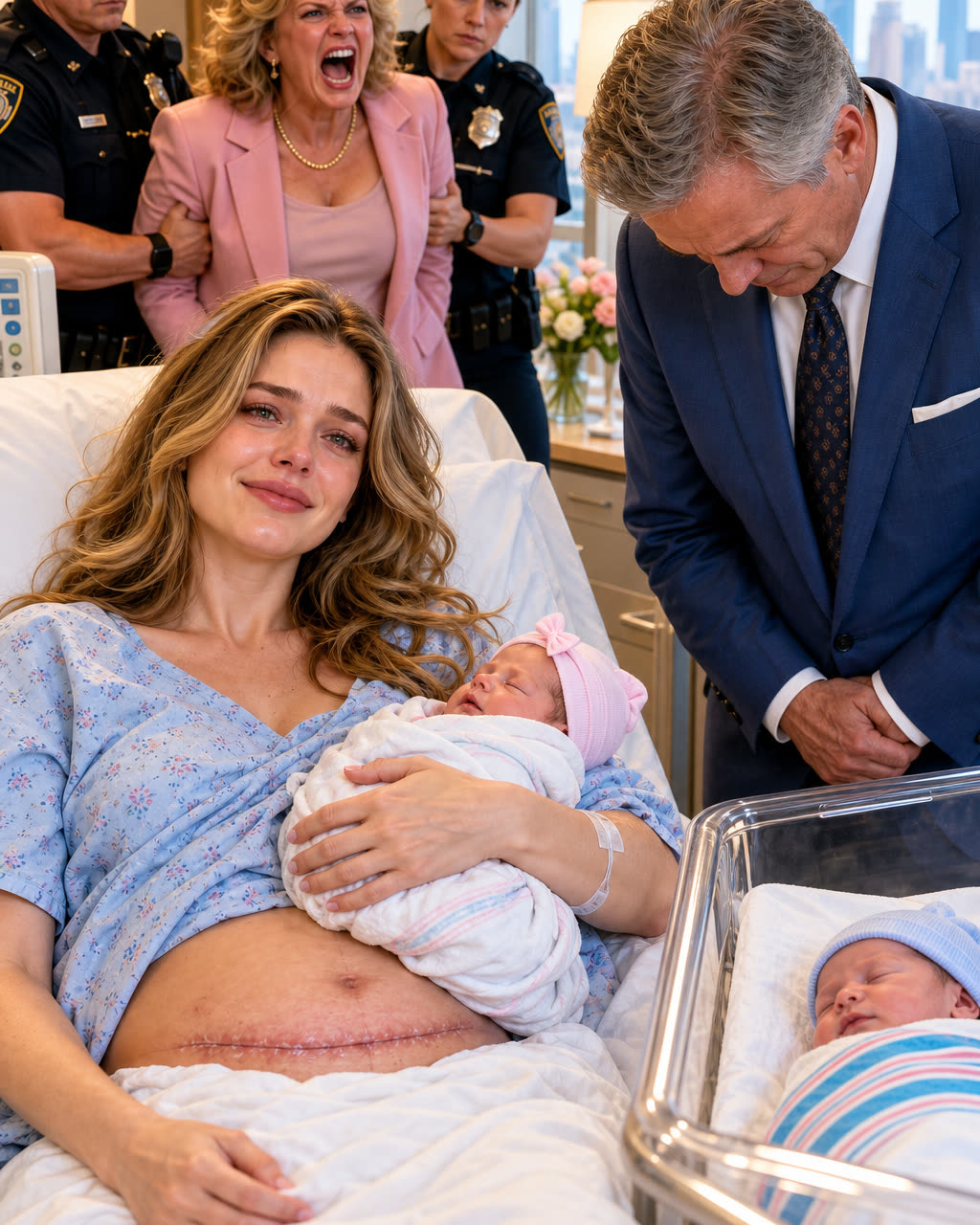
The recovery suite at St. Mary’s Medical Pavilion had been built to feel like a five-star hotel instead of a hospital. It was a wide room with soft recessed lighting, thick cream carpet that swallowed every footstep, and floor-to-ceiling windows overlooking a rain-slicked city skyline. The filtered air carried a faint, manufactured scent of lavender and fresh linen. It was a poor disguise for the metallic undertone of iodine, blood, and medical trauma beneath it.
I lay in the middle of the mechanical bed, pinned in place by painkillers and the sheer physical wreckage of an emergency, life-saving C-section. My body felt as if it had been torn open and hurriedly sewn shut, which, medically speaking, was exactly what had happened. Each shallow, shaky breath sent white-hot fire spreading out from the deep incision across my lower abdomen. The epidural had worn off completely. I was now brutally familiar with every severed muscle and every raw, bruised inch of tissue holding my insides together.
And still, through all that pain, my eyes stayed fixed on the two clear plastic bassinets parked just two feet from my bedrail. Inside them slept my newborn twins, Noah and Nora. They were perfect: small, fragile, red-faced miracles wrapped in crisp white swaddles, their tiny chests rising and falling in a matching, peaceful rhythm. When I looked at them, the agony in my belly faded to a distant hum. I was a mother. After thirty-four years in the cutthroat, cynical world of federal law, I had finally made something pure.
Earlier that morning, I had quietly asked my nurses to take away the enormous, ostentatious floral arrangements delivered to my room. I told them to donate the towering white orchids sent by the District Attorney’s Office, and the rare lilies sent straight from the chambers of a Supreme Court Justice, to the general maternity ward down the hall. I wanted no attention. I wanted no fanfare at all.
For the four years of my marriage to Grant Whitmore, I had carefully built a facade. I wanted to stay just “Olivia,” the quiet, accommodating, supposedly “jobless” wife that my husband’s arrogant old-money family needed me to be. Grant’s whole identity rested on the brittle foundation of his ego. He founded a tech startup that generated more debt than revenue, yet he demanded the look of a titan and needed to be the undisputed king of his castle. When we met, I was already a respected federal prosecutor on the fast track to a judgeship. But I saw how my success intimidated him, how my intellect made him shrink and my salary made him bitter. So, driven by a foolish, toxic hunger to be loved and to build a traditional family, I made myself small.
I hid my promotions. When I was appointed to the federal bench as one of the youngest judges in the district, I let Grant’s family keep believing my “government job” was a low-level administrative post that I had quit to start a family. I paid the mortgage on our sprawling estate through a blind trust. I propped up his failing company with anonymous shell investments. I let his mother, Margaret, look down her aristocratic nose at me, swallowing her constant micro-aggressions and open insults, all to protect the illusion that her son was a god and I was lucky to stand in his presence. I was willing to be small so that my family could be whole.
That illusion was shattered, violently and permanently, at exactly 2:14 PM. The heavy, soundproofed door of the VIP suite did not simply open. It flew inward with arrogant force and bounced off the rubber wall stop with a loud thwack.
My mother-in-law, Margaret Whitmore, swept into the sanctuary. She used her wealth like a blunt instrument. Though the autumn weather was mild, she wore a heavy, knee-length mink coat, and her silver hair was set in a severe, immovable helmet. She brought with her the suffocating scent of Chanel No. 5 and pure malice. Behind her, hovering nervously at the door frame, stood her daughter Karen, Grant’s older sister, whose last decade had been defined by a bitter, very public, and ultimately unsuccessful fight with infertility. Margaret did not look at the bassinets. She did not look at my pale, sweat-drenched face. She looked at the room itself, and her upper lip curled in disgust.
“A VIP recovery suite?” Margaret scoffed, her voice shrill enough to spike my heart rate on the monitor beside the bed. She marched to the center of the room, stripping off her leather gloves. “My son works himself to the absolute bone, grinding his fingers to dust to provide for you, and this is how you thank him? Living like absolute royalty on his dime while contributing absolutely nothing to the household? This room must cost three thousand dollars a night. It is grotesque.” I drew a slow, painful breath and tried to find the soft, pacifying tone I had used for four years. “Margaret, please,” I rasped, my throat raw from the breathing tube used during surgery. “My insurance covered the room. Grant didn’t pay for it. Please, lower your voice. The babies just fell asleep.” “Do not speak to me about money you do not have, Olivia,” Margaret snapped, stepping aggressively close to the side of my bed.
Before I could register what she meant to do, Margaret lifted her designer boot and kicked the heavy metal frame of my hospital bed, hard and on purpose. The impact jolted the entire mattress, and a searing, blinding wave of pain ripped through my freshly cut abdomen, as if a serrated hunting knife had been dragged through my organs. A strangled, pathetic gasp escaped me. I curled inward, hands flying to my bandaged stomach to protect my torn muscles. Margaret did not flinch. She did not apologize. She studied my writhing body with the cold curiosity of a scientist watching an insect pinned to a board. Then she reached into her $10,000 Hermès handbag, drew out a thick stack of legal papers printed on premium bond paper, and flicked her wrist. They landed on my rolling tray table with a heavy smack. “Sit up and sign these,” Margaret commanded, her tone shifting from insulting to purely transactional.
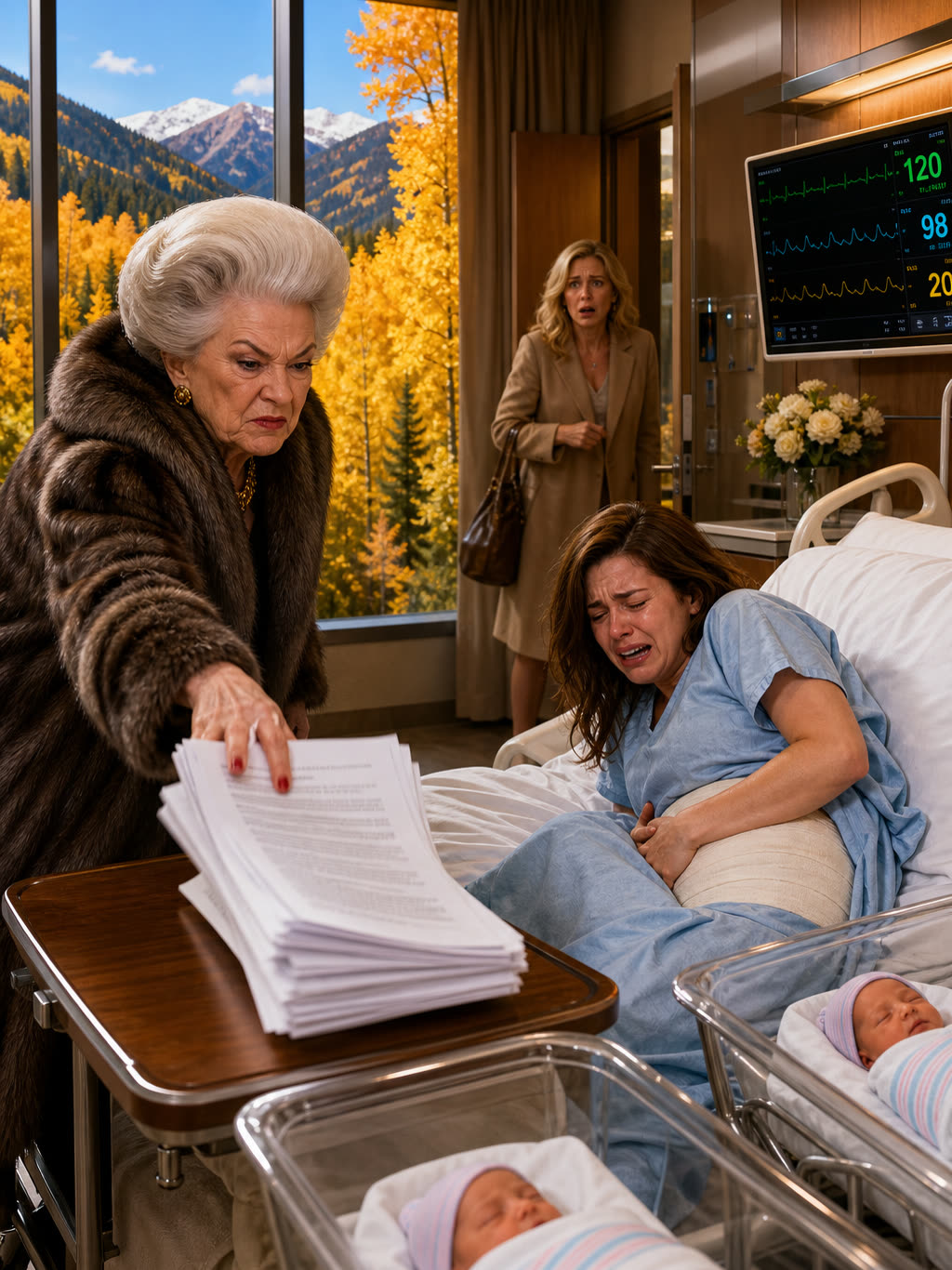
I blinked through the tears of pain and forced myself to read. The bold black text across the top page said: Voluntary Surrender of Parental Rights and Consent to Intra-Family Adoption. My mind rejected the words at first. The narcotics in my blood made the letters swim, but the horror of what I was holding slowly came into focus.
“A parental rights waiver?” I whispered, my voice shaking, unable to grasp the sociopathic audacity of the paperwork. “What is this?”
“It is a solution, Olivia,” Margaret stated casually, pacing to the foot of my bed. She gestured toward her daughter, who still lingered by the door, wringing her hands, looking both terrified and sickeningly eager. “Karen cannot have children. Her husband, David, is threatening to leave her because she cannot produce an heir. You, on the other hand, have somehow managed to produce two.”
Margaret turned to look at the two plastic bassinets. “We have discussed it thoroughly as a family,” she went on, as if reallocating a stock portfolio. “You are an unemployed, lazy woman who is barely capable of taking care of herself, let alone twins. It is mathematically and logically sound. You can keep the girl. We have no use for a girl. But you will sign over all legal and physical rights of the boy, Noah, to Karen and David. They will raise him as their own. He will have a proper, wealthy upbringing, and Karen’s marriage will be saved.”
The air seemed to be sucked out of the room. The breathtaking depravity of the demand froze my voice. She was not merely insulting me. She was calmly trying to carve up my children, separating them at birth, treating my newborn son as a commodity to be handed to her barren daughter to save a failing marriage. To her, my womb was a factory that had turned out surplus inventory.
“You’re talking about my son,” I whispered. The pain in my abdomen was forgotten, burned away by a rising, primal terror. “You are out of your mind. Get out of my room.”
“I’m talking about what is best for the Whitmore family!” Margaret shot back, her aristocratic facade cracking to show the rabid, entitled creature underneath. “You are nothing but an incubator who got lucky! You owe this family!”
Without another word, she marched to the bassinets. She skipped little Nora and plunged her hands straight into Noah’s crib. She lifted my newborn son into her arms, and startled by the sudden motion and the cold air, he began to wail, a high, desperate cry of distress. “Put him down!” I screamed.
The quiet, submissive wife I had pretended to be for four years died on that mattress. I ignored the tearing agony in my abdomen, threw the heavy blankets off my legs, and forced my broken body upright, trying to swing my legs over the rail and physically fight the woman holding my child. Margaret did not step back. As I sat up, vulnerable and off-balance, she stepped forward. With unhinged ferocity she raised her free hand and struck me with a closed fist across the left side of my face.
The blow was staggering. My head snapped sideways, and my temple crashed against the metal side rail with a sickening thud. The room dissolved into dark, jagged static, and a high-pitched ringing filled my ears. I fell back onto the pillows, blood pooling in my mouth where my teeth had cut the soft tissue inside my cheek. A dark, throbbing bruise began to rise on my cheekbone.
“You ungrateful, pathetic little fool,” Margaret hissed, standing over me and adjusting her grip on my screaming son. She looked down at my bleeding, dazed form with unchecked superiority. “I am his grandmother. I have the bloodright. I decide what happens to him. You will sign those papers, or I will have my lawyers prove you are an unfit, mentally unstable, violent mother, and I will take them both.”
The ringing in my ears faded, replaced by a deeper, colder, far more dangerous sound. It was the sound of a heavy iron vault door slamming shut inside my mind. The invisible, accommodating wife was incinerated in that flash of pain. The woman who had dimmed her own light to protect a mediocre man’s ego was dead. With a shaking, blood-stained hand, I did not reach for my crying son. I did not scream for help. I did not beg for mercy. I reached blindly for the wall panel beside my pillow, found the large red emergency button, and slammed the heel of my palm against it with every ounce of strength I had left.
The silent alarm triggered instantly. Above the door a strobe began to flash urgent red, and at the nurses’ station and in the hospital’s central security hub, a blaring siren went off. CODE GRAY. SECURITY TO VIP MATERNITY SUITE 612. CODE GRAY. Margaret froze and looked up at the flashing light. A flicker of surprise crossed her face before it cooled into a chilling mask of confidence. She believed her wealth and status made her untouchable, and that she could talk her way out of anything.
“Oh, good,” Margaret sneered, adjusting her mink coat and stepping away from the bed with my son still clutched in her arms. “Let them come. Let the security guards see exactly what a hysterical, unstable, violent woman looks like. They need to see how unfit you are to hold this child.” She had no idea that the men rushing down the hallway were not coming to rescue her from a hysterical mother. They were coming to witness her legally and financially destroy her entire existence.
The heavy, soundproofed door was shoved violently inward. Four heavily built security officers in dark tactical uniforms, radios in hand, rushed in, their boots squeaking on the linoleum. They were led by a towering, broad-shouldered man with a stern, deeply lined face: Chief of Security, Daniel Ruiz. The instant they breached the room, Margaret began the performance of a lifetime, a masterclass in weaponized, wealthy, aristocratic fragility.
“Officers! Help me! She’s dangerous!” Margaret cried, her voice trembling perfectly as she clutched my newborn son tighter and backed into the corner as if terrified for her life. She spun a seamless web of gaslighting. “My daughter-in-law attacked me! She’s having a psychotic break! I came to check on my grandchildren, and she lunged at me! She’s not well—she could hurt the baby! I had to take him to protect him!”
The four officers hesitated. I watched human psychology unfold in real time. They saw a polished, well-dressed older woman holding a screaming infant and looking frightened. They saw Karen in the doorway, weeping fake tears and nodding along with her mother. And then they looked at me. I was lying in a hospital bed with sweat-matted hair, in a cheap generic gown, with blood dripping from the corner of my mouth down my chin and staining the collar. A dark purple welt was swelling on the side of my face. I looked chaotic. I looked broken. I looked exactly like the unstable, violent patient Margaret was describing. The wrong picture was forming in their minds, and the bias of appearances was taking hold.
“Ma’am, I need you to calm down and keep your hands where we can see them,” said one of the younger officers, taking a slow, cautious step toward my bed, one hand resting nervously on his radio. He was treating me as the active threat.
Then Chief Daniel Ruiz stepped forward. He was a veteran of the local police force who had spent thirty years inside the criminal justice system before retiring into private hospital security, and his eyes had seen every flavor of human deception. He did not look at my blood. He did not look at my messy hair. He looked directly and deeply into my eyes, and the whole suffocating atmosphere of the room shifted.
I watched the recognition click behind his gaze like the tumblers of a bank vault falling into place. I had presided over three major federal corruption cases in this city. I had sent dozens of organized crime figures to maximum-security prisons. My face rarely appeared in the tabloids, but within the inner circles of law enforcement I was a known, feared, and deeply respected name.
“Judge… Olivia Carter?” Ruiz’s voice dropped. It was not a question. It was a realization, heavy with shock and an immediate wave of respect.
I held his gaze. The pain in my abdomen, the sting in my cheek, the terror of the last ten minutes all receded behind a wall of cold judicial authority. “Yes, Chief Ruiz,” I said quietly, my voice ringing with a metallic clarity that demanded silence. “It is.” Across the room, Margaret’s smile faltered for the first time, and I realized the next sixty seconds would decide everything.
Part 2: The Dropped Mask and the Execution of Authority
Ruiz removed his peaked cap at once and held it against his chest. “Stand down,” he ordered his team, his voice cracking like a whip. “All of you, stand down right now.” The younger officers froze in their tracks, bewildered by their commander’s sudden change in posture. They looked from me to Ruiz, and their hands dropped from their radios.
Margaret blinked in arrogant confusion. Her flawless performance had hit a brick wall and she could not process the data. “What is going on?” she demanded, her voice shrill with rising panic. “Why are you standing down?! Arrest her! She attacked me! Did you not hear what I said?!”
Chief Ruiz did not give her the deference she expected. He stepped forward and planted his large body between Margaret and the door, his tone rigid with the steel of a man who knew he stood in the presence of a federal magistrate. “Ma’am,” Ruiz barked, pointing a thick, calloused finger at her chest. “I need you to step forward and carefully, immediately return that child to his mother. You are currently holding an infant without the legal guardian’s consent in a restricted medical facility.”
Margaret let out a sharp, ugly, incredulous laugh, the laugh of a woman whose privilege had shielded her from reality her entire life. “Excuse me? No. Absolutely not,” she sneered, retreating a step and clutching Noah tighter, which made him scream louder. “I just told you—she’s unstable. She doesn’t even have a job! She’s a gold-digger who trapped my son! She has been lying to all of you. You work for me, essentially. I am a major donor to this hospital wing! I demand you remove her from this room!”
I reached up with a remarkably steady hand and wiped the blood from my chin. Then I pushed myself higher on the pillows and sat upright, ignoring the screaming in my sliced muscles. “I was helping my family!” Margaret shrieked, pointing at the officers. “I am protecting my bloodline from a lunatic!”
“I am a United States Federal Judge,” I stated. The words landed like physical blows in the dead-silent room, and the weight of the title seemed to drain the air. “And you, Margaret,” I continued, my eyes locking onto hers with the unblinking focus of an apex predator, “are seconds away from committing a very serious, very permanent federal crime.”
The color left Margaret’s face all at once, turning it the shade of wet, powdery ash. Her mouth opened, but no sound came. The arrogant, untouchable matriarch was suddenly standing on a trapdoor, and she could hear the lever being pulled. “You’re bluffing,” Margaret whispered weakly, her eyes darting to Karen, who had slipped out into the hallway and abandoned her mother. “Grant told me… he told me you were just an administrative assistant before you quit to get pregnant…”
I did not answer her. I did not need to justify myself to a parasite. I simply applied the law. “Chief Ruiz,” I said clinically, addressing him without breaking eye contact with my mother-in-law. “This woman brought unauthorized, coercive legal documents into a restricted medical facility. She attempted to actively pressure and extort a patient under severe medical distress into surrendering her child. When she was refused, she committed aggravated physical battery against a post-operative patient, resulting in visible facial trauma.” I paused and let the charges hang in the air like a guillotine blade. “And currently,” I finished, my voice dropping to a terrifying whisper, “she is committing attempted kidnapping of a minor across a threshold.”
At a sharp hand signal from Ruiz, two officers stepped forward. They did not ask politely, and they did not negotiate. One firmly pried Margaret’s manicured hands apart, lifted my screaming, terrified son from her grasp, and carried him over to settle him gently against my chest. The second officer took Margaret by the upper arm and turned her roughly toward the door.
“You’ll regret this,” Margaret hissed, her aristocratic mask gone, replaced by a wild, feral desperation as the officers walked her toward the exit. “When my son gets here, he will destroy you. You are nothing without him. You are nothing without his money.” “No, Margaret,” I replied smoothly, rocking my son and feeling an intoxicating rush of power run through my veins. “I won’t regret a single second of this.”
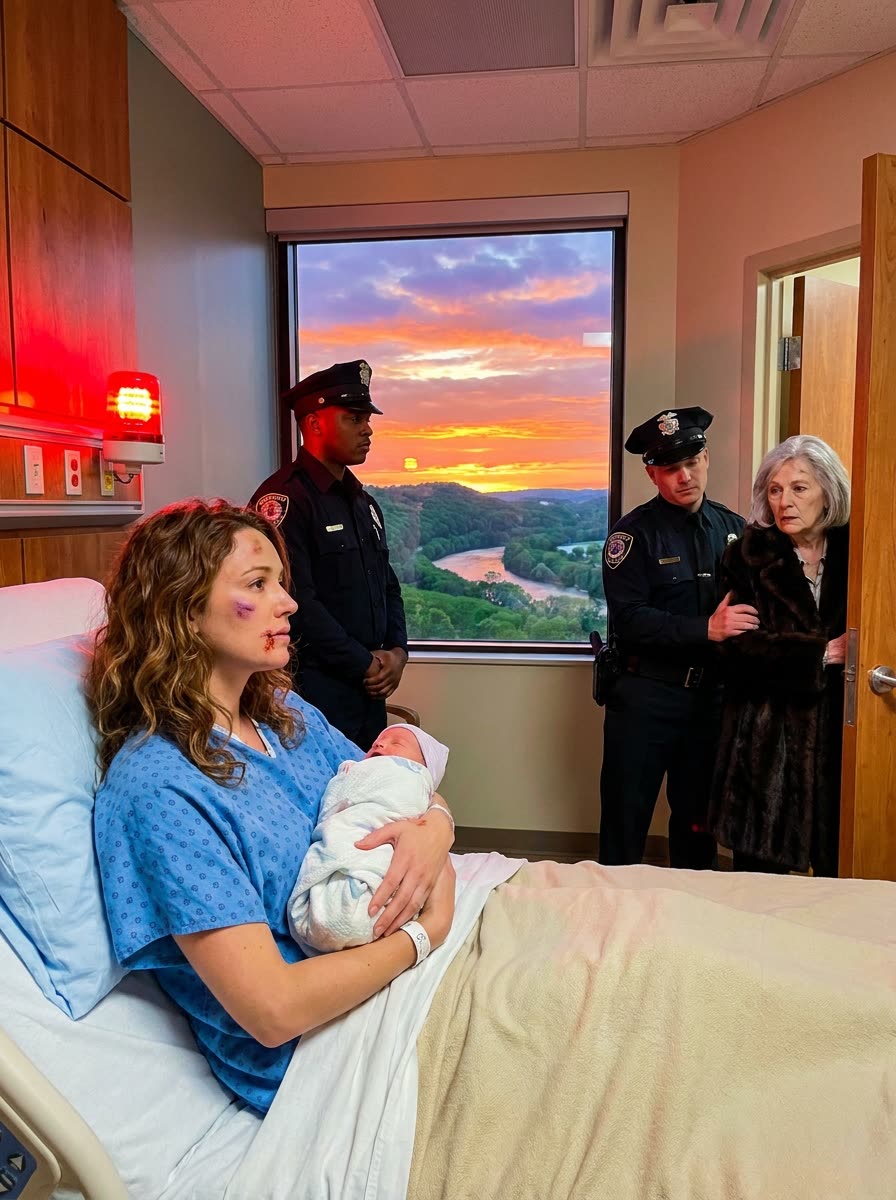
The ringing quiet in the recovery room lasted exactly twenty-two minutes. I spent that time nursing Noah and calming his frantic cries until he drifted back to sleep beside his sister. Chief Ruiz had posted an armed officer directly outside my door, with orders that no one, not even medical staff, enter without my explicit, verbal authorization.
Then the door burst open. My husband, Grant Whitmore, practically fell into the room. He dropped the expensive leather overnight bag he had supposedly gone home to fetch, and it hit the floor with a loud thud. He did not rush to my side. He did not look at the twins sleeping in their bassinets. He did not even notice the dark purple and blue bruise blooming across my left cheekbone, or the dried blood on my gown. His face was twisted into a mask of irritated, suffocating panic.
“Olivia, what the hell did you do?!” Grant hissed loudly, pacing at the foot of my bed and dragging his hands through his perfectly styled hair. “My mother is sitting in a holding cell at the local precinct! Her lawyer just called me! Call hospital security right now and tell them you made a mistake! Tell them you were on painkillers and you hallucinated!”
I stared at the man I had married, the man whose whole life I had secretly subsidized for four years. I felt the last fragile thread of my love for him snap. The illusion of our marriage dissolved into dust. “She assaulted me, Grant,” I said, my voice eerily calm and devoid of any warmth. “She physically struck me in my bed. And she tried to steal Noah. She brought a parental waiver into this room and tried to force me to sign it.”
“She didn’t steal him! We talked about this!” Grant shouted, halting mid-pace, his eyes wide and wild with desperation. “It was just a proposition! We discussed it as a family!” The monitors beside my bed spiked, their erratic beeping echoing my shock. We discussed it. He had not merely enabled his mother’s insane entitlement or turned a blind eye to her cruelty. He had knowingly taken part in the plot to strip me of my child.
But why? Grant was arrogant and obsessed with status and appearances, but he had always wanted a son to carry on his name. Why would he willingly hand his newborn son to his barren sister? My mind, trained to spot complex financial fraud and criminal motive, began to assemble the pieces. I needed data. “Hand me my phone, Grant,” I commanded softly. “I am not handing you anything until you call the police and drop the charges against my mother!” he roared, stepping toward the bed.
I did not argue. I pressed the intercom button and spoke to the officer in the hallway. “Officer, my husband is becoming aggressive. Please enter the room.” The armed guard stepped inside at once, hand on his utility belt, and stared Grant down. Grant froze, his arrogance evaporating in the face of physical authority. He backed away, visibly trembling, and pointed to my purse on the side table.
I took out my encrypted judicial smartphone and dialed a highly secure number. Marcus Vance was the lead forensic investigator for the federal district court, a man who owed his career to my mentorship and could pull any financial record on the planet in under five minutes. “Marcus,” I said when he answered. “I need an immediate, deep-dive forensic audit on Grant Whitmore’s tech startup, Apex Solutions. I need to know the current operational liquidity, the debt-to-income ratio, and any recent, massive influx of private capital or pending venture agreements.”
Grant’s face turned the color of wet chalk. He lunged to snatch the phone, but the security officer intercepted him and shoved him back against the wall. “What are you doing?!” Grant shrieked, sheer panic replacing his anger. I put the phone on speaker and rested it on my chest. “Judge Carter,” Marcus’s voice crackled, crisp and efficient. “Give me sixty seconds.” The silence in the room was deafening. Grant hyperventilated against the wall, staring at the phone as if it were a live grenade.
“Okay, I have the data,” Marcus announced. “Grant Whitmore’s startup, Apex Solutions, is functionally bankrupt. They are burning through capital at an unsustainable rate. They are over leveraged by six million dollars in short-term, high-interest commercial loans. They are facing imminent corporate foreclosure.” I closed my eyes. The picture was sharpening painfully. “However,” Marcus continued, “I see a pending, unexecuted contract in their secure server. A private equity transfer. Two million dollars, structured as a non-dilutive capital injection. The funding source is a blind trust, but the guarantor listed on the documents is David Davis—Karen’s husband.”
I opened my eyes and looked straight at the man I had vowed to spend my life with. “Karen and David are going to fund my startup!” Grant suddenly yelled, tears of cowardly desperation streaming down his face as he tried to justify the unforgivable. “It’s an exchange! It’s a strategic partnership! They get the boy they’ve always wanted, and we get the capital to keep the company afloat and keep the house! We already have a girl, Olivia! It’s a win-win for everyone!”
He saw my body as an asset to liquidate. He saw our son as a bargaining chip to trade in order to save a failing company he lacked the business sense to run. He had sold his own flesh and blood to his mother and sister. “You sold him,” I whispered, as horror hardened into freezing rage. “I saved our lifestyle!” Grant retorted, stepping off the wall and jabbing a finger at me, his narcissism blinding him to his own ruin. “You don’t understand how the real world works, Olivia! You just sit at home! I am the provider! Now call the police, drop the charges against my mother, and sign those papers, or I swear to God, I am taking both these kids right now and you will never see them again!”
He had no idea who he was threatening. He had just crossed the Rubicon. I picked up the phone, but I did not call the local police or hospital security. I dialed the direct, unlisted emergency number of the United States Marshals Service liaison assigned to protect the federal judges of my courthouse.
“Director Hayes,” I said, my voice empty of emotion, with the lethal calm of an executioner. “I have a Level One domestic threat. I need an emergency, armed security detail dispatched to St. Mary’s Medical Pavilion, VIP Suite 612, immediately.” I watched the arrogant expression on Grant’s face begin to crumble, replaced by creeping terror as he grasped the scale of the forces I was summoning. “And,” I continued, staring into the dead eyes of my husband, “I am formally requesting the drafting of an emergency, Ex Parte protective order against my husband, Grant Whitmore. The grounds are conspiracy to commit human trafficking, extortion, and severe domestic endangerment.”
Grant staggered backward into the doorframe, the breath knocked out of him. “Child trafficking? Human trafficking?!” he gasped, his voice a high, hysterical whine. “Olivia, you’re insane! I’m your husband! I’m the father of those children! You can’t do this to me!” “You were a terrible investment, Grant,” I corrected clinically, my voice as cold as the bottom of the ocean. “And I am calling in the debt.” Outside in the corridor, heavy footsteps thundered closer, and I knew the people coming for him would not stop at his door.
Part 3: The Gavel and the Ashes of an Empire
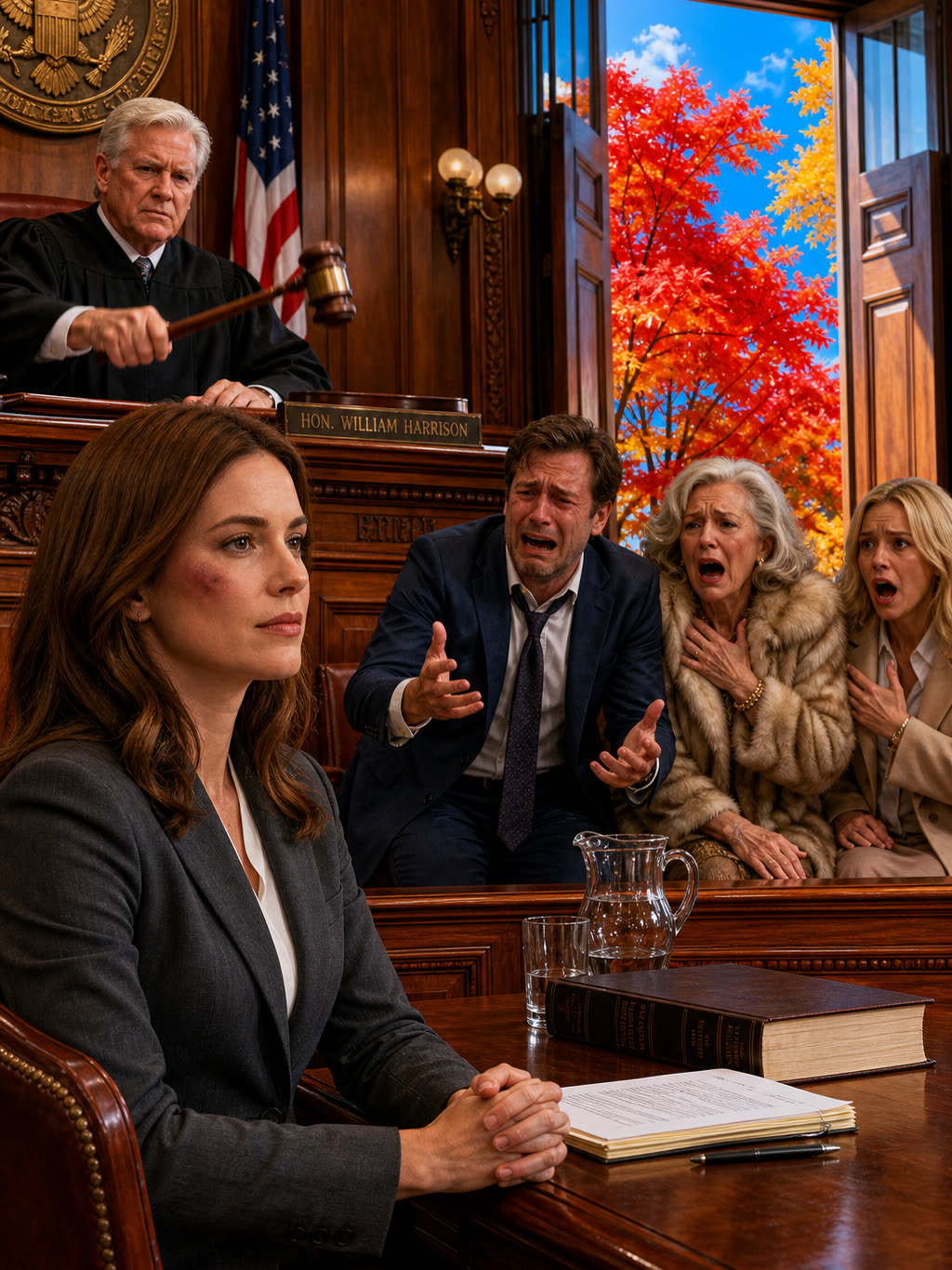
The emergency family court hearing convened exactly seventy-two hours later. It was held in a private, heavily secured, windowless chamber of the federal courthouse, far from the public and the media. I sat at the petitioner’s table, no longer in a hospital gown but in a sharp, impeccably tailored charcoal-gray suit. The dark purple bruise on my cheek was plainly visible, uncovered by makeup, a physical and undeniable testament to the violence I had survived. I sat perfectly still, hands folded on the polished oak, radiating terrifying, untouchable authority.
Across the aisle, at the respondent’s table, sat my soon-to-be ex-family. Grant sat in the middle, exhausted, his expensive suit wrinkled, his eyes darting around the austere room. To his right sat Margaret, who had been bailed out of county jail the previous day, her face tight, angry, and humiliated. To his left sat Karen, wringing her hands, looking terrified.
They were flanked by a flashy, arrogant, high-priced divorce attorney whom Grant had likely hired with funds from a credit card I was about to cancel. They wore smug, confident expressions. Despite the arrests and the police involvement, their generational narcissism convinced them they were still in control. They truly believed they could use their wealth, their social standing, and their lawyer to bully an “unemployed, hysterical housewife” into surrendering her children and dropping the charges to keep the peace. They had no idea they were sitting in my arena, sheep who had wandered into a slaughterhouse without seeing the butcher behind them.
The heavy, carved oak doors at the back of the chamber swung open. The presiding judge, the Honorable Marcus Hayes, strode in with his black robes billowing behind him. He had been my mentor for a decade and had a reputation as a ruthless, uncompromising, brilliant legal mind. He did not nod politely. He did not treat me like a standard civilian litigant. He stepped up to the bench, looked directly at me, and gave a deep, respectful nod.
“Good morning, Judge Carter,” Hayes said, his voice booming through the silent chamber and fixing my title in the official court record. The illusion my in-laws had clung to for four years shattered instantly into a million jagged pieces. Grant’s lawyer, who had planned to cross-examine a fragile housewife, physically flinched. The blood drained from his face as he looked at me, then at the judge, and understood the catastrophic imbalance of power he had walked into. He was not fighting a desperate mother. He was fighting the federal judiciary.
“Your Honor,” the lawyer began, his voice trembling and his collar visibly damp as he tried to rescue his doomed case. “My client and his family are victims of a gross misunderstanding. Mr. Whitmore merely suggested an intra-family, completely legal adoption to ease the immense physical and emotional burden on his wife following a traumatic birth—”
“Your client,” I interrupted smoothly, my voice cutting through his defense like a surgical laser, “attempted to sell his biological infant son for a two-million-dollar capital injection into a failing, functionally bankrupt tech startup.” I reached into my leather briefcase and pulled out a thick, red-stamped federal financial dossier that my forensic team had compiled over the last three days. I slid it across the polished oak, and it landed directly in front of the judge.
“Inside that dossier, Your Honor,” I stated, the entire room hanging on my every syllable, “are the recovered, time-stamped, encrypted emails between Grant Whitmore, Margaret Whitmore, and Karen Davis. You will find them meticulously negotiating the financial price of my newborn son. You will find the drafted, unexecuted venture capital contracts proving the quid pro quo. And, most importantly, you will find the fraudulent parental waivers Margaret brought into my hospital recovery room immediately prior to physically assaulting me.”
Karen shrieked, a high, panicked sound of terror, and shoved her chair back from the table as if it were on fire. She understood that they had left a digital paper trail of a felony. Margaret clutched her chest, hyperventilating, her eyes wide with horror as the depth of their exposure was laid bare in a court of law. She was not untouchable. She was trapped. Judge Hayes opened the dossier and read the first three pages. Then he closed the folder slowly and looked up, his face twisted in profound disgust. “This court has seen many things,” he said, his voice a low, dangerous rumble that echoed like thunder in the small chamber. “But the sheer, breathtaking depravity of this conspiracy is unprecedented.”
He picked up his wooden gavel. “I am granting immediate, sole, irrevocable legal and physical custody of both minor children to Judge Olivia Carter,” Hayes ordered, striking the gavel with a loud crack. “The respondent, Grant Whitmore, is stripped of all parental rights, both physical and legal, effective immediately. He is granted zero visitation. A permanent, five-year restraining order is hereby issued against all three respondents.” Grant let out a strangled sob and buried his face in his hands.
“Furthermore,” Judge Hayes continued relentlessly, leaning over the bench to glare at the three shattered people before him, “based on the irrefutable documentary evidence of attempted human trafficking, wire fraud, and extortion presented today, I am formally forwarding these entire proceedings, the transcripts, and the financial dossiers directly to the United States District Attorney for immediate criminal prosecution.”
The heavy oak doors at the back of the courtroom swung open again. Three armed detectives from the city’s Major Crimes Division, accompanied by two federal agents, marched in, badges flashing under the fluorescent lights. “Grant Whitmore and Karen Davis,” the lead detective barked, pulling heavy steel handcuffs from his belt. “You are both under arrest for conspiracy to commit human trafficking, extortion, and felony child endangerment. Margaret Whitmore, your bail is officially revoked by order of this court. You are returning to county lockup.”
As the officers wrenched Grant’s arms behind his back and snapped the cold steel around his wrists, he dropped to his knees on the courtroom floor, weeping openly, the arrogant CEO entirely annihilated. “Olivia, please! Please, I have nothing!” Grant sobbed, looking up at me with tears streaming down his face, begging mercy from the woman he had tried to destroy. “I’m their father! You can’t take them from me! I’ll do anything!”
I looked down at the pathetic, greedy coward who had tried to sell my flesh and blood to save a failing company. “You’re an inmate,” I whispered, my eyes as cold, dark, and unforgiving as the bottom of the Mariana Trench. I turned to the judge. “Court is adjourned,” I said. I picked up my briefcase, turned my back on the wreckage of my former family, and walked out of the courtroom, unbothered, unaware that I had never once asked what Grant’s last words in the corridor would be, or who else had been listening to the plan.
Over the next six agonizing, highly publicized months, the carefully curated, aristocratic legacy of the Whitmore family was completely and spectacularly incinerated. The fallout was brutal in its efficiency. Faced with the irrefutable digital evidence of the emails, the financial contracts, and the hospital security footage of the assault, their expensive defense attorneys took one look at the discovery file and urged them to surrender. There was no defense. They had caught themselves in a digital bear trap of their own making, and the federal government was holding the chain.
Grant, terrified of a jury that would surely hand him a life sentence for attempted human trafficking, pleaded guilty to all charges to avoid the maximum. He received eight years in a medium-security state penitentiary, his reputation annihilated and his startup bankrupt and liquidated by creditors. Margaret, convicted of aggravated assault on a vulnerable patient and accessory to extortion, was sentenced to five years. The massive civil suits I filed against her estate for physical and emotional damages bankrupted her. Stripped of her tailored suits, her stolen wealth, and her unearned superiority, she was forced to spend her twilight years in a concrete cell.
Karen’s husband, David, immediately filed for divorce to distance himself from the radioactive scandal. She received three years of federal probation and was ostracized from the high-society circles she had worshipped all her life, a social pariah erased from that world. They were left profoundly isolated, forced to live the same nightmare of helplessness and terror that they had so casually tried to force onto me in that hospital room.
My own reality was anchored in brilliant light. I finalized the divorce with unrelenting efficiency. Using the evidence of his financial fraud, I legally erased Grant’s name from the birth certificates so my children would never carry the stain of his legacy. I secured one hundred percent of the marital assets, leaving him with nothing but his prison commissary account. I did not hide in the shadows to lick my wounds, and I did not retreat in shame. I returned to the federal bench. I put on my black robes, climbed the stairs to my courtroom, and brought my gavel down with the resonant authority of a woman who had survived the worst of human betrayal and emerged unbreakable. My rulings were sharp, fair, and deeply empathetic to victims of abuse, fueled by the fires of my own survival.
My physical scars healed beautifully. The C-section incision faded to a thin, pale silver line, a proud testament to my endurance and to the birth of my greatest joys. Noah and Nora thrived. They defied the darkness that surrounded their birth, growing plump, healthy, and happy. Their bright, musical laughter filled the sun-drenched, vaulted rooms of a sprawling, heavily secured coastal home that I now fully owned, untouched by the presence of a coward.
I sat in the beautifully decorated nursery in a plush rocking chair, holding them both against my chest and listening to their soft, synchronized breathing. The chronic, heavy anxiety of never being “enough” for my husband’s arrogant family was gone for good. I had spent years hiding my power, shrinking my intellect, and diminishing my light just to make a mediocre, insecure man feel significant in his own home. The assault in the hospital did not break me. It shattered the leaden illusion I had built around myself. It was the violent, necessary catalyst that saved my children, my financial future, and my life from parasitic ruin. I had lain in that hospital bed a vulnerable, weeping, compliant victim. I rose from it an apex protector, a titan who held the keys to her own kingdom.
I was seated behind the enormous, gleaming mahogany desk in my home office, with the wide windows standing open to welcome the fragrance of ocean salt and flowering jasmine into the room. Beyond the house, the steady rhythm of waves breaking against the distant cliffs created a peaceful, familiar melody that accompanied my everyday life.
My eyes settled on the inexpensive, flimsy sheet of yellow-ruled paper showing through the clear window of an envelope lying on my immaculate desktop.
The sender’s address, printed in severe black institutional lettering, displayed the unmistakable, impersonal inmate identification number belonging to a state correctional institution.
Across the middle of the envelope, Grant had scribbled my name in his unmistakably careless handwriting.
There was little doubt that the pages inside contained some lengthy, frantic, humiliating declaration. It was almost certainly a tearful, spineless effort to resurrect the obedient, compliant, endlessly accommodating wife who had long since disappeared from existence. Perhaps he wanted me to transfer money into his prison commissary account so he could purchase instant coffee. Maybe he was desperately requesting a letter supporting his character for an early parole hearing that had virtually no chance of succeeding, or begging to visit the children he had once so heartlessly attempted to exchange for a technology startup.
Twelve months earlier, simply seeing his name written in that familiar handwriting might have triggered a sudden wave of lingering terror, a painful reminder of his betrayal, or the poisonous, deeply conditioned impulse to tear open the envelope, absorb his fabrications, and defend myself through an angry, emotionally charged response.
But today, the letter represented nothing beyond a trivial, meaningless inconvenience requiring disposal. It was unwanted correspondence sent by someone who had become a ghost.
I made no effort to lift the envelope flap or examine even its opening sentence. I had absolutely no interest in his explanations, his expressions of regret, or his pitiful attempts to regain control over me. I had no need to seek emotional resolution from a man who had ceased to exist in my world.
I lifted the envelope from the desk, bent slightly forward, and fed it straight into the powerful industrial cross-cut paper shredder positioned beside my chair.
I switched on the machine. A wonderfully satisfying mechanical grinding sound filled the office as his sentences, his justifications, his desperate requests, and the final tangible reminder of his place in my existence were shredded into countless tiny, worthless fragments that fell into the plastic collection container.
Three years later.
Brilliant summer sunshine poured across the vast, carefully maintained lawn behind my home. The cheerful atmosphere of a lively summer barbecue filled the warm afternoon air. Food crackled over the hot grill, energetic music drifted gently from speakers around the patio, and the entire backyard echoed with spontaneous, heartfelt, delighted laughter.
I had invited an enormous gathering of the family I had chosen for myself—trusted friends, exceptionally talented colleagues from the legal profession, and steadfast mentors who honored my personal boundaries, rejoiced in my accomplishments, and cared for my children with the same fierce devotion I felt for them.
Standing near the patio’s edge with a chilled glass of white wine in my hand, I watched my twins playing.
Noah and Nora had reached their third birthday, growing into intelligent, remarkably self-assured, endlessly energetic little children who dashed excitedly over the lawn, shrieking with laughter as they pursued a playful golden retriever puppy. They were protected. They were surrounded by unconditional affection. And they would never, under any circumstances, experience the harsh, merciless truth of love offered only under certain conditions, or the contemptuous expressions of relatives who regarded them as objects to be traded.
The world repeatedly teaches women to endure humiliation without protest. It expects us to surrender our self-respect, personal limits, and physical security simply to preserve the appearance of a flawless, intact family. People mistake the vulnerability following childbirth, and the immense physical suffering involved in bringing a child into the world, for lasting helplessness and diminished intelligence. They imagine that a woman who remains silent must be obedient, broken, and prepared to surrender to the entitlement of a dishonest, abusive household.
They interpret her quietness as proof that she lacks strength.
Yet Grant, Margaret, Karen, and every other monster who resembles them will never truly comprehend the frightening, magnificent, irresistible transformation that occurs when a mother discovers the authority of the gavel rests in her own hands.
When you attack a woman who is bleeding in her hospital bed, when you try to take away her child in pursuit of money, and when you discard her humanity like worthless trash merely to satisfy your miserable pride, you are not establishing control. You are not emerging victorious from the battle.
Instead, you extinguish every remaining trace of her compassion toward you.
You show her how to turn her silence into a weapon. You teach her to examine every hidden wrongdoing, to close the formidable iron doors of the federal justice system around your lives, and to stand aside while you sink beneath the immense, unavoidable ocean of legal consequences you were arrogant enough to believe you could control.
A genuine smile spread across my face as I looked toward my friends, lifting my wine glass in a quiet, victorious salute across the backyard, embracing without hesitation the radiant, boundless promise of the years awaiting us.
A profound calm filled my heart, supported by the absolute, unquestionable understanding that the deadliest and most formidable weapon in the world is neither a firearm, a blade, nor an entire military force.
It is a mother who finally chooses to stop begging others to hear her defense and begins pronouncing the irreversible, ultimate judgment herself.
Disclaimer: This story is a work of fiction inspired by real-life themes. Names, characters, places and events are fictionalized, and any resemblance to real persons is purely coincidental. Images are for illustration purposes only.
