

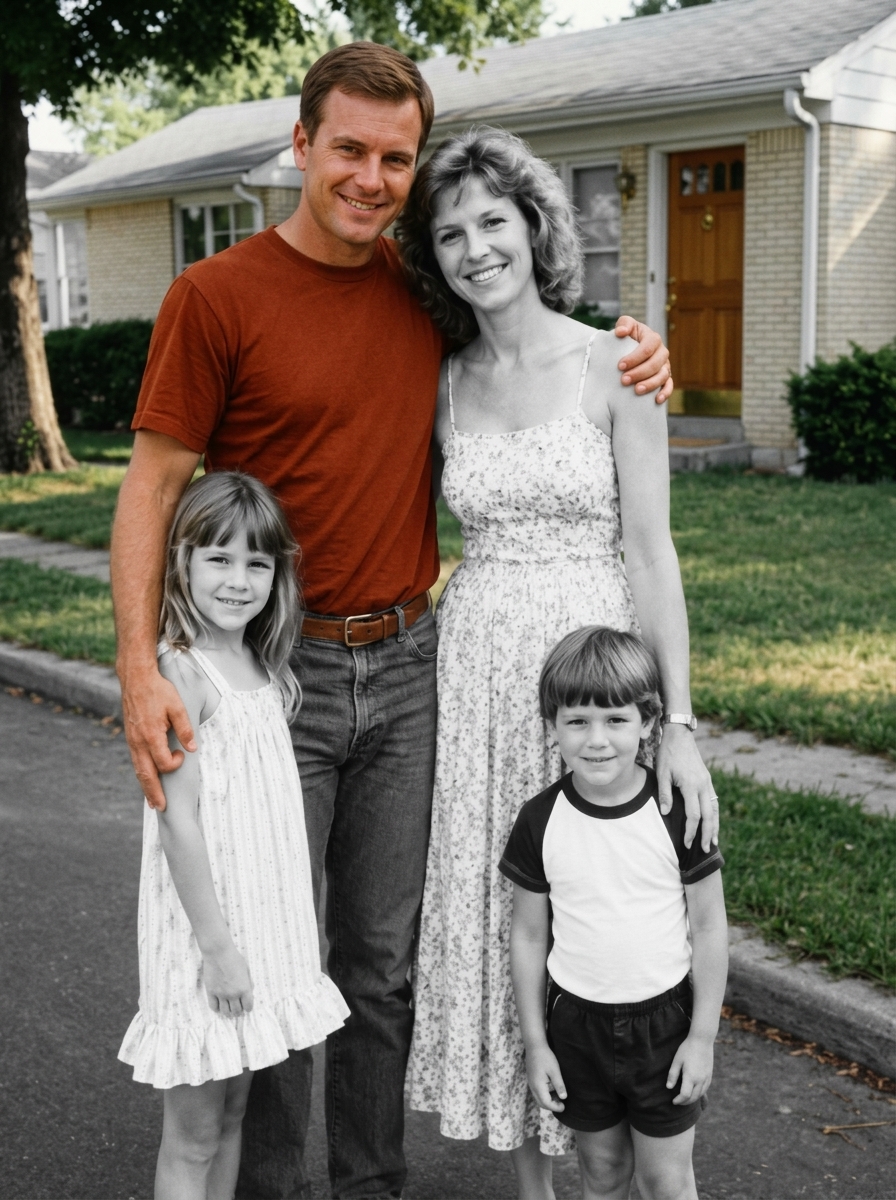
I spent four decades mourning the family I thought I had lost in one devastating night. When my declining health finally forced me to sort through the rooms I had kept untouched all these years, I found evidence that destroyed everything I believed and revealed a betrayal far closer than I ever expected. Forty years after my wife left with our children for a short trip and vanished, I uncovered a hidden box inside my daughter’s mattress. The first words of Clara’s letter left my hands shaking.
“Andrew, if you’re reading this, something has happened to me. Read everything carefully. Don’t trust Gwen.”
For forty years, I believed my family had died in the river.
Now I discovered that someone had buried the truth inside my own house.
That morning, my nephew Jackson arrived with twelve empty boxes and almost no patience left for my excuses.
“You were on the kitchen floor for three hours, Uncle Andrew,” he said.
“Two and a half.”
He stared at me.
“That correction is exactly why you can’t live alone.”
“I slipped.”
“And you couldn’t reach your phone. The doctor said that next time, you could be there overnight.”
At seventy-three, I knew Jackson had a point. He wanted me to sell the house and move into his place.
I agreed, but only under one condition.
“Nothing gets thrown away without my permission.”
“Fine. You still have receipts from 1989.”
“Paper remembers better than people.”
Jackson picked up a box.
“Where do we start?”
“Shaun’s room.”
Shaun was six years old when he disappeared. His toy cars and blue blanket remained exactly as he had left them.
I lifted the silver watch beside his lamp and wound it.
Jackson watched in silence.
“Does that thing still work?”
“It loses four minutes a day.”
“Then why keep winding it?”
“Because Shaun hated it when it stopped.”
I placed the watch into my pocket. Then we walked into Aria’s room.
She was nine when she vanished. She loved making dresses for her dolls, although every stitch leaned because she always pulled the thread too tightly.
Her unfinished dollhouse still sat beside the window, its front door hanging unevenly.
“Don’t touch that,” I said.
“You’ve had 40 years to fix it.”
“I know.”
My knees weakened, and I lowered myself onto Aria’s bed.
Something cracked beneath me.
Jackson turned around.
“Was that the frame?”
“No.”
“How do you know?”
“I repaired wood for 45 years. That sound came from inside the mattress.”
We turned it over and found a carefully stitched seam with uneven thread.
“Aria did this,” I said. “She always pulled the thread too tight.”
I cut through the stitching, reached inside, and pulled out a small wooden box covered in dust.
Inside were several photographs, a letter from Gwen, a birthday card, and two folded notes.
The photographs showed me standing beside a woman from work. In one picture, my hand rested on her arm. In another, we were entering a café together.
I understood how those images looked.
But it was Clara’s handwriting on the first page that stole the air from my lungs.
“Andrew, if you’re reading this, something has happened to me. Read everything carefully. Don’t trust Gwen. There’s something you never knew.”
The note ended there.
Underneath was another page written in purple crayon.
“Daddy, I hid Mommy’s letter because I didn’t want you to be mad. I’m sorry. Please don’t let her leave.”
I read those words again and again.
Jackson sat beside me.
“Aria hid the box.”
“She thought Clara was leaving me.”
He picked up the photographs.
“Who is this woman?”
“Someone I worked with.”
“Was there an affair?”
“I never touched her.”
“I didn’t accuse you, Uncle Andrew.”
“Your face did.”
“Then explain.”
Sarah had been afraid of losing her job after being treated unfairly, so she asked to meet me privately.
“Did Clara know?” Jackson asked.
“No. It wasn’t my story to tell.”
“You could’ve told her enough.”
I looked away.
Years earlier, Clara had questioned why I kept arriving home late.
“Is there something you need to tell me?” she’d asked.
“Nothing you need to worry about,” I’d said. At that moment, I thought keeping quiet was the right thing to do.
Now, it felt like my silence had built a wall between Clara and me.
Jackson opened Gwen’s letter.
Inside were instructions to reach Gwen’s home and a suggestion to stop at a motel if the children became tired.
Clara had taken Aria and Shaun for a brief trip to visit her sister.
My work had consumed so much of my time that they went without me.
When Clara still hadn’t called by nine that night, I contacted Gwen.
“Is Clara there?”
“Andrew, they never arrived.”
I stood so quickly that my chair crashed into the wall.
“Check with the neighbors. Shaun may have gotten sick.”
“She would’ve called.”
“Check anyway.”
By midnight, the police had Clara’s intended route and the details of her vehicle.
The next day, they discovered it beneath a river bridge. The parking brake had failed after Clara pulled over onto the shoulder. Divers found no bodies, but years later, the court officially declared all three of them dead.
Gwen’s letter gave us the first possible location where Clara may have stopped.
“We’re going there,” I told Jackson.
“Not until you take your medication,” Jackson replied, picking up my coat.
“I’ve already lost 40 years.”
“Then don’t collapse before you get an answer. I’ll drive.”
The motel had eventually been converted into an apartment building. An elderly woman in the lobby examined Clara’s photograph carefully.
“I remember her. Her son had a fever, and she kept trying to call her husband.”
I showed her Gwen’s picture.
“Did this woman come here?”
“Yes. They argued. Your wife wanted to go home and hear the truth from her husband.”
“I’m the husband. What did Gwen tell her?”
“She said you’d already left town with another woman.”
A sharp pain tightened in my chest.
“That was a lie.”
Jackson immediately pulled a chair toward me.
“Sit.”
“I need one more answer.”
I turned back toward the woman.
“Did Clara leave willingly?”
“Yes, but she looked dizzy when she got into the car.”
PART 2
After my breathing returned to normal, Jackson drove me to Sarah’s home.
I placed Gwen’s photographs on her table.
“Clara saw these.”
The color disappeared from Sarah’s face.
“She thought we were together?”
“She left believing that.”
Sarah brought out documents proving every photograph had been taken during official work meetings.
She looked directly at me.
“I told you to explain enough to Clara.”
“I couldn’t reveal your situation.”
“You could’ve protected me without shutting your wife out. You left an empty space, Andrew. Gwen filled it.”
On the drive back, I watched the passing streets without speaking.
I had confused silence with doing the right thing.
Clara had asked for reassurance, and I answered with distance that Gwen later used against both of us.
When we returned home, I unfolded Aria’s crayon note once again.
“She carried this guilt.”
“We don’t know that,” Jackson said.
“A child who writes something like this doesn’t simply forget it.”
My goal changed.
I still needed the truth, but before anything else, I needed to find my daughter before she spent another day believing she had ruined our family.
Three days later, Jackson discovered a school counselor whose records matched Clara’s maiden name, the town, and Aria’s age.
In the photograph, she held one elbow the same way Aria always did whenever she felt anxious.
“That’s her.”
“Because she looks like Clara?”
“No. Because she looks like herself.”
Jackson offered to contact her for me, but I refused.
I erased two drafts—one that sounded too distant, another that carried too much anger.
Finally, I wrote:
“Aria, I don’t know what you were told.
I only know that I loved you when you left, and I’ve loved you every day since.
I found the note you hid. Nothing that happened was the fault of a nine-year-old girl. I won’t come unless you ask me.”
I added my phone number and address, then pressed send and waited.
She called that night.
After a long silence, she finally asked,
“Did you know where we were?”
“No.”
“You never came.”
“I didn’t know where to go.”
“Gwen said you left with another woman.”
“She lied.”
I heard her breathe sharply.
“Meet me tomorrow.”
“Where?”
“The auditorium where I work.” “I’ll be there.”
“Come alone.”
The following afternoon, I found her arranging rows of chairs that were already perfectly straight.
For one brief second, I saw the little girl I had lost.
Then the woman she had become stepped away.
“You came.”
“I promised.”
“Why did you stop looking?”
My first reaction was to defend myself.
Instead, I sat down.
“Tell me what you remember.”
She remembered Clara crying at the motel while Gwen kept insisting I had chosen another woman. Shaun repeatedly asked when I would come. After Clara’s car overheated near the bridge, Gwen took them away in her own vehicle.
That night, Clara suffered a stroke that damaged her speech and memory. Gwen relocated them to another state, controlled Clara’s phone calls and letters, and convinced them that I knew where they were but had chosen not to find them.
They lived using Clara’s maiden name, which Aria eventually legally adopted. No one ever connected them to the family everyone believed had died in the river.
Aria waited for me.
I never arrived.
“When I got older, I remembered the mattress,” she said. “I knew you’d never seen the note.”
Her voice shook.
“It was my fault.”
“No.”
“I hid it.”
“You were nine.”
“Being nine doesn’t change what I did.”
“It changes who was responsible. I hid the truth too.”
She looked at me silently.
I told her about Sarah and about the questions Clara had asked me years earlier.
“You hid a letter because you were afraid,” I said. “I hid behind silence because I was proud. Only one of us was an adult.”
Aria covered her face.
“I ruined our family.”
“The adults around you made choices. You didn’t make them for us.”
She slowly lowered her hands.
“Did you really search?”
I opened my bag and placed police reports, newspaper articles, letters, and private investigator receipts across the table.
“I never stopped.”
Aria picked up one article, then reached for my hand.
Shaun refused to meet me.
I didn’t force him.
Instead, I mailed him the silver watch.
My note said:
“It still loses four minutes a day. I kept winding it anyway.”
Three days later, he called.
“You really wound this every week?”
“Every Sunday.”
“Aria says you searched.”
“I did.”
“Then you weren’t very good at it.”
“No,” I answered. “I wasn’t.”
He became quiet.
“I don’t know how to call you Dad.”
“Andrew will do until you’re ready.”
Before he ended the call, he asked,
“Did you ever have another family?”
“No.”
“Why not?”
“Because I already had one.”
PART 3
Near the final years of her life, Clara discovered a newspaper article about the memorial I held at the bridge every year.
When she realized I had never stopped searching, she recorded a message asking Gwen to help the children find me.
Aria later found the recording hidden among Clara’s belongings inside a box Gwen had packed.
“Play it,” I said. “Peace built on a lie isn’t peace.”
Clara’s fragile voice filled the room.
“Aria. Shaun. Your father loved you. Gwen believed she was protecting me, but fear isn’t truth. I should’ve asked your father for the truth.”
Aria covered her mouth.
“Gwen said you caused Mom’s stroke,” Shaun said from the doorway. “She said Mom collapsed because you chose another woman.”
My hand tightened around my cane.
“And after Mom struggled for years, Gwen said she’d lost the will to recover because of you,” Aria added. “We blamed you when she died.”
I looked at both of them.
“You were children living inside the only story an adult allowed you to hear.”
Then I called Gwen.
“I found Clara’s note.”
“What do you want, Andrew?”
“You’ve spoken for my wife long enough. Tomorrow, you listen.”
The family gathered the next evening.
Gwen stood at the head of the table.
“I did what Clara needed.” “No,” I said. “You did what kept Clara dependent on you.”
“I protected her from you.”
“You photographed me, assumed the worst, then hid behind the car accident.”
I turned toward Aria and Shaun.
“I failed your mother too. She asked me what I was hiding, and I answered with silence. I believed being faithful was enough.”
Gwen lifted her chin.
“Exactly.”
I looked back at her.
“That was my failure. The next 40 years were your choice.”
Aria placed Sarah’s records on the table.
“Did Dad ever say he was leaving us?” she asked.
“No.”
“Did you learn that he was searching?”
Gwen lowered her gaze.
“Eventually.”
Shaun rested his arm on the table, the old watch clearly visible on his wrist.
“You let us hate him.”
“I thought the truth would destroy you.”
“You’d already taught us who to blame,” he said.
I played Clara’s recording.
When it finished, nobody spoke in Gwen’s defense.
I picked up the recorder.
“You don’t get to decide what Clara believed anymore. You don’t get to speak for my children. You don’t get to call control love.”
The following morning, Aria and Shaun came with me to the bridge.
I untied the faded ribbon I had replaced every year.
“This was where I came to mourn you,” I said.
Shaun touched the watch around his wrist.
“What happens now?”
“Now I stop grieving people who are standing beside me.”
Back at the house, Aria ran her fingers along the stitches in the mattress.
“I thought that seam ruined us.”
“No. Adults did that.”
Shaun lifted one side of the mattress.
“Then let’s get rid of it.”
Inside, I opened Aria’s dollhouse.
The front door was still hanging crooked.
I reached for my screwdriver.
Aria stopped me.
“It doesn’t have to be fixed tonight, Dad.”
Shaun picked up the second screwdriver.
“And you don’t have to fix it alone.”
For forty years, I had waited for the children I thought I had lost forever.
Aria and Shaun returned carrying anger, guilt, and four decades of stolen moments.
I looked at them both, then placed the screwdriver down.
This time, we would rebuild together.
