

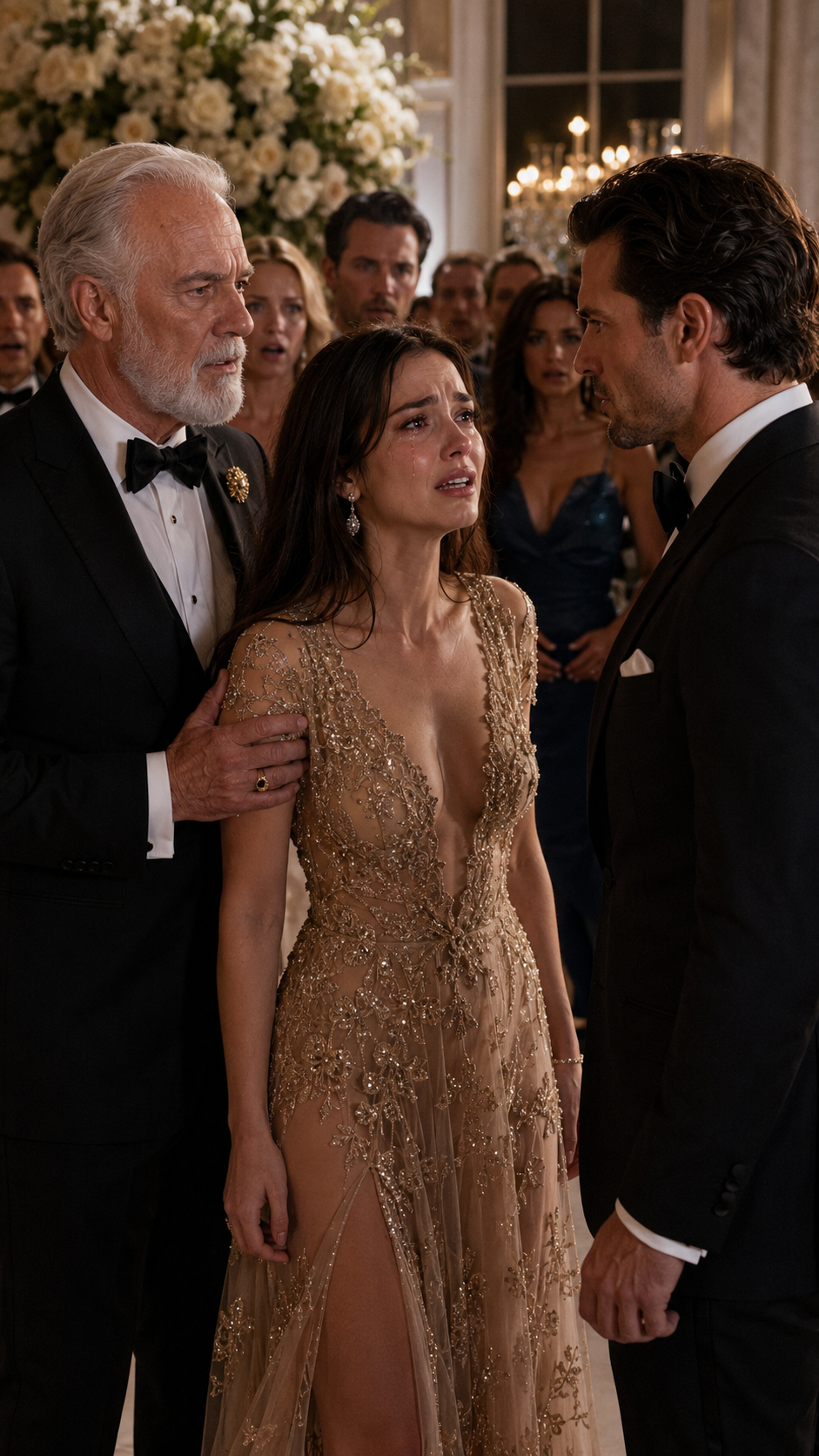
For several seconds, no one in the ballroom moved.
The Grand Astoria Hotel in New York City, which only moments before had been shimmering with champagne flutes, television cameras, donors, diplomats, and polished political smiles, seemed to freeze around Marisol Bennett. Her husband, Daniel Rhodes, stood near the stage with his mouth slightly open, still holding the champagne flute he had lifted to celebrate the public end of his marriage. The same guests who had laughed softly when he called Marisol an orphan without a name now watched in stunned silence as King Ernest of Valdoria held her broken locket in trembling hands.
Marisol could hear her own breathing.
She had spent twenty-eight years believing she belonged to no one.
Now a king stood before her with tears in his eyes and called her daughter.
“No,” she whispered.
The word barely reached the air, but the king heard it. He flinched as though he had expected the blow and believed he deserved it. His guards remained behind him in deep crimson and gold, yet he did not look like a monarch in that moment. He looked like an old man who had finally arrived at a door he had been searching for for nearly three decades.
“I know this is impossible to hear,” he said. “But I have searched for you since the night you disappeared.”
Daniel stepped forward abruptly, regaining just enough arrogance to mistake a miracle for an opportunity.
“Your Majesty,” he said, forcing a smile so tight it looked painful, “there must be some misunderstanding. My wife grew up in foster care in Pennsylvania. She has no royal connection. She has no documents, no family record, no—”
The king turned his head.
Daniel stopped speaking.
It was not anger that silenced him. It was authority. The kind that did not need volume because generations had already trained rooms to listen.
“I was not speaking to you,” King Ernest said.
A ripple moved through the guests. One camera operator slowly raised his lens. Another whispered into a headset. Several phones lifted from tables as people realized that the humiliation Daniel had staged for his wife had shifted into something far larger than a political promotion gala.
Marisol stood perfectly still.
Her fingers felt empty without the locket. It had been the only thing she had ever owned from the beginning of her life. Nuns at the orphanage in Pittsburgh had told her she had been found as a baby during a winter storm, wrapped in a white blanket with a torn ribbon and that broken locket around her neck. No one came for her. No one claimed her. No one left a letter.
She had learned early that children without answers should not ask too loudly.
Now the answer had walked into the ballroom wearing a crown upon his crest.
King Ernest opened the locket with a small gold key taken from his own neck. The click was so soft only Marisol and those closest heard it, yet it sounded to her like a door inside her chest breaking open.
Inside were two miniature portraits.
One showed a younger King Ernest, dark-haired and smiling. The other was a woman with warm brown eyes, soft curls, and a beauty so familiar that Marisol felt dizzy.
It was like staring into a mirror that remembered a life she had never lived. “My wife,” the king said, his voice breaking. “Queen Valeria Rose.”
Marisol raised a hand to her own face without realizing it.
The same eyes.
The same mouth.
The same small birthmark near the jawline, visible in the portrait and hidden beneath Marisol’s makeup.
A low murmur spread through the room, growing louder by the second.
Daniel stared at the locket, then at Marisol, then at the cameras. His expression moved rapidly through disbelief, calculation, and panic. Only minutes earlier, he had declared she was not enough for his future. Now the future itself seemed to be pointing directly at her.
Marisol turned to the king. “If you are my father,” she said, voice trembling but steady, “where were you?”
The question cut through the ballroom more sharply than any royal decree.
The king closed his eyes.
“When you were six months old,” he said, “there was an attack on the royal convoy during a diplomatic visit in Boston. Your mother was killed. You were taken. The official report said you died in the fire that followed.”
Marisol swallowed.
“Then why look for me now?”
“Because I never believed the report,” he said. “Your body was never found. Your locket was never recovered. For twenty-eight years, I searched through private investigators, embassy records, adoption agencies, orphanages, foster files, hospitals, and every rumor cruel enough to offer hope and then take it away.”
His gaze dropped to the locket.
“Three weeks ago, an archivist in Pennsylvania digitized intake records from a closed orphanage. There was a note describing a baby girl found with a gold locket engraved E.M. and V.R. The file had been misclassified for decades. We traced it to you.”
Marisol’s knees weakened.
King Ernest reached out instinctively, then stopped himself, as though aware he had not earned the right to touch her yet.
“Elena Marisol,” he whispered. “That was your name.”
Her throat tightened.
Elena.
Not just Marisol. Not “the orphan girl.” Not the girl without a name. A name chosen before loss swallowed everything.
Daniel let out a nervous laugh that drew immediate attention.
“Well,” he said loudly, “this is extraordinary. Truly extraordinary. Marisol, darling, I had no idea. None of us did. Obviously, what I said earlier was taken out of context.”
Silence fell again.
Marisol slowly turned toward him.
For three years, she had ironed Daniel’s shirts while he rehearsed speeches about public service. She had worked double shifts at a used bookstore in Brooklyn so he could attend donor events they could not afford. She had skipped medical appointments, sold earrings gifted by a foster mother, and eaten instant noodles while Daniel wore custom suits on borrowed ambition. She had believed his future included hers.
And fifteen minutes earlier, he had called her an orphan without a name in front of New York’s political elite.
“Taken out of context?” she asked.
Daniel’s smile flickered. “Marisol, love, emotions are high. This was meant to be a private transition.”
“You announced our separation on stage.”
“I was trying to be honest.”
“You used my childhood as entertainment.”
His face flushed.
King Ernest’s gaze moved from Marisol to Daniel with quiet, terrifying stillness.
“This man is your husband?”
Marisol did not answer immediately.
She looked at Daniel’s champagne glass, his tailored suit, his polished shoes, the donor pin on his lapel, the audience he had chosen over her dignity. Then she looked at the king holding the locket that had waited longer than she had.
“Legally,” she said. “For now.”
A sharp gasp rippled through the crowd.
Daniel’s jaw tightened.
The king nodded once to a man behind him. An older official stepped forward carrying a leather folder embossed with the Valdorian crest.
“Ms. Bennett,” the official said gently, “we have preliminary DNA evidence based on medical records obtained through lawful channels and samples from royal archives. It strongly indicates a biological match. Formal confirmation can be completed within forty-eight hours with your consent.”
Daniel cut in. “Medical records? That sounds highly questionable. Marisol, you should let me review this before you sign anything.”
Marisol laughed.
It was quiet. Unamused. The first sound in years that belonged entirely to her.
“You just publicly ended our marriage because I was beneath you,” she said. “Why are you suddenly concerned with protecting me?”
A camera flashed.
Daniel lowered his voice. “Do not embarrass me.”
The old Marisol would have understood the threat beneath it. She would have smiled, swallowed it, and waited to break in private. She had done it enough times to recognize the shape of silence.
But that version of her had already ended between Daniel’s toast and the king’s tears.
“Embarrass you?” she asked. “Daniel, you invited an entire ballroom to watch you discard me.”
His eyes hardened. “Be careful.”
King Ernest stepped between them before anyone else could react.
“No,” he said softly. “You be careful.”
Daniel went pale.
What began as a celebratory promotion gala collapsed into disorder. Reporters shouted questions. Donors spoke into phones. Staff tried to control the cameras, but the moment had already escaped the room. Within minutes, clips of Daniel’s speech spread online, followed by footage of the king recognizing Marisol.
By midnight, her face was known across America.
By morning, across the world.
But recognition did not ease shock.
That night, Marisol sat in a presidential suite under embassy protection, perched on the edge of an oversized bed that made her feel smaller than ever. Elena, the Valdorian chief of protocol, offered tea, counsel, doctors, and silence. Marisol chose only silence.
King Ernest did not impose himself. He requested permission to enter.
That alone mattered.
When she agreed, he came in without guards and stood near the door like a man entering a place where he had no right to be.
“I do not expect you to call me father,” he said.
Marisol studied him. In daylight, he looked older than in the ballroom, as though hope itself had aged him.
“What do you expect?” she asked.
“Nothing,” he said. “I hope. But I expect nothing.”
That answer broke something in her.
Not loudly. Not theatrically. Just a quiet fracture that had been waiting years for permission to exist. The king did not touch her. He simply sat at a distance and let her cry without trying to claim the moment. When she was finally able to speak again, Marisol asked about her mother.
King Ernest clasped his hands tightly.
“Valeria was brave,” he said. “Too brave sometimes. She hated ceremony but loved duty. She played piano badly and insisted it was modern music. She wore red when protocol demanded blue. She said if we ever had a daughter, she wanted her to know both kindness and teeth.”
Marisol smiled through her tears.
“Kindness and teeth?”
“Yes,” he said softly. “A woman must have both.”
For hours, he spoke of everything. How Queen Valeria had been born in Miami to a Valdorian-American family. How she met Ernest at a charity event in Washington, D.C. How she despised being called delicate. How she laughed with her whole body. How she chose the name Elena Marisol because Elena was Ernest’s grandmother and Marisol meant sea and sun—two things Valeria said no cage could ever hold.
Marisol listened as if she were drinking water after years of thirst.
Even so, love did not arrive simply because blood did.
When King Ernest showed her baby photographs, she trembled. When he revealed the official portrait of Queen Valeria holding an infant wrapped in white, Marisol had to rise and move toward the window. The baby in the image wore the same locket.
Her locket.
Her life had not started in abandonment.
It had been taken.
That truth was both relief and injury.
The next day, Daniel tried to reach her.
He arrived at the hotel lobby with flowers, a publicist, and the look of a man who had not slept, because his future was slipping away. Security blocked him before the elevator.
From upstairs, Marisol watched the lobby feed.
Daniel lifted the flowers toward the camera, as though the gesture alone could cross the building and rewrite everything.
“He has called twenty-three times,” Elena said.
Marisol glanced at the phone on the table. “Let him call.”
“He is also requesting a joint statement.”
“Of course he is.”
Daniel’s messages came in waves.
“Marisol, we need to talk.”
“I was under pressure.”
“You know I didn’t mean it that way.”
“This is bigger than us now.”
“Do not let foreign advisors turn you against your husband.”
“We can still make this work.”
“We are legally married. You cannot shut me out.”
By noon, he stopped pretending.
“You owe me privacy after everything I did for you.”
Marisol stared at the message for a long time.
Everything he did for her.
He meant the apartment lease in his name because her credit had been thin when they first married. He meant introducing her to people who never remembered her name. He meant letting her sit silently at events while he received praise for speeches she had shaped. He meant tolerating the orphan girl as long as she remained useful.
She forwarded every message to her new attorney.
By evening, Daniel’s appointment was “under review.”
The mayor’s office released a statement distancing itself from “personal remarks inconsistent with the administration’s values.” Donors who once smiled through his speeches suddenly became unreachable. A cable panel replayed his line “an orphan without a name” six times.
Daniel called again.
This time, Marisol answered.
He spoke before she could greet him.
“Finally. Listen to me carefully. You are overwhelmed. These people are using you. That king shows up with a story, and suddenly you believe you’re royalty? Do you understand how insane that sounds?”
Marisol looked at the locket on the table. “Do you understand how convenient it is that I sounded sane to you when I was paying your bills?”
He went silent.
“You never paid my bills,” he snapped.
“I paid rent twice when your campaign consulting clients were late. I paid your tailor in cash because your card declined. I used my savings to cover your networking trip to London. I wrote half the speech you gave before you humiliated me.”
“That is marriage.”
“No,” she said. “That was labor.”
He lowered his voice. “Marisol, do not turn ugly now.”
There it was again.
The warning.
Be grateful. Be quiet. Be useful. Be small.
Marisol looked out at the city lights.
“I want a divorce,” she said.
Daniel exhaled sharply. “You are making a mistake.”
“No. I made a mistake three years ago. I am correcting it.”
Then she hung up.
The DNA results arrived the next afternoon.
99.98 percent probability of parentage.
Marisol Bennett, foster child from Pennsylvania, bookstore clerk from Brooklyn, humiliated wife from a New York gala, was Princess Elena Marisol of Valdoria.
Yet she refused the title at first.
That surprised everyone except King Ernest.
“I do not know how to be a princess,” she said.
The king sat across from her in a private embassy room, staring at results neither could deny.
“I do not need you to know how,” he said. “I need you to know you have a choice.”
Marisol’s eyes filled.
Choice.
That word had been absent from most of her life. Foster homes decided whether to keep her. Caseworkers decided where she would go. Daniel decided when she was useful and when she was disposable. Even the public now tried to choose her story: lost princess, abandoned orphan, wronged wife, Cinderella, scandal.
“What if I choose not to go with you?” she asked.
King Ernest swallowed, then nodded.
“Then I will keep loving you from wherever you allow me.”
That was when Marisol began to believe him.
Not because he proved anything.
But because he gave her power.
Two weeks later, Marisol stood in a private hangar at JFK Airport with one suitcase, one lawyer, one embassy official, and a father she was not ready to name as father. The plane ahead bore the Valdorian crest: a crowned lion holding a rose. Cameras waited beyond barricades, shouting questions she refused to answer.
Daniel arrived just before boarding.
He had no flowers this time.
Only desperation.
Security moved to stop him, but Marisol lifted a hand. “Let him speak.”
Daniel stepped closer, looking thinner, his suit less precise. Without the ballroom, donors, and microphones, he seemed reduced.
“Marisol,” he said, voice breaking, “please. We can fix this.”
She studied him.
“What do you want to fix, Daniel? Our marriage or your reputation?”
His face tightened. “That’s unfair.”
“No,” she said. “Unfair was announcing a separation before asking for one. Unfair was using my childhood to elevate yourself. Unfair was deciding I was good enough to build your future but not good enough to stand in it.”
He looked past her at the plane.
“I loved you.”
Marisol’s expression softened briefly. Not because she fully believed it, but because some part of him may have loved the version of her that cost him nothing publicly and everything privately.
“You loved being loved by me,” she said.
He flinched.
King Ernest stood a few steps behind her, silent. This was Marisol’s moment, not his.
Daniel’s eyes filled. “If you leave like this, everyone will think I’m the villain.” Marisol gave him a sad smile.
“Daniel, you had a microphone. You introduced yourself.”
Then she turned and walked away.
Valdoria turned out to be smaller than she had imagined.
In her mind, kingdoms belonged to fairy tales—endless castles, gold carriages, mountains carved by ancient wars. Valdoria had those in postcard corners, but it also had traffic, schools, bakeries, hospitals, apartment blocks, and ordinary people walking dogs beneath weathered stone balconies. The capital, Rosavelle, looked like history had learned to coexist with coffee shops and electric buses.
When Marisol stepped off the plane, bells rang across the city.
She hated it at first.
People lined the streets holding roses, flags, and signs bearing her name. Not Marisol Bennett. Elena Marisol. Some cried. Some called her princess. Some simply watched with the quiet reverence reserved for wounds belonging to an entire nation.
King Ernest had warned her.
“You were not just my daughter,” he said on the plane. “You were Valeria’s last gift to this country. Losing you became part of our history.”
Marisol did not know how to carry a nation’s grief when she could barely carry her own.
At the palace, she was taken to a suite that had been locked for twenty-eight years.
Her nursery.
It had not been turned into a museum, but preserved like a prayer no one dared abandon. A white crib. A painted mural of roses and stars. A rocking chair near the window. Shelves of children’s books in English, Spanish, and Valdorian. On the wall, an embroidery framed in glass: Elena Marisol, beloved beyond measure.
Marisol stood in the doorway and broke.
This time, King Ernest held her—only because she reached for him first.
The days that followed were nothing like a fairy tale.
They were paperwork, historians, security briefings, language tutors, medical files, DNA reports, constitutional meetings, and endless verification. Parliament had to confirm her identity. The royal court had to revise succession records. International press tracked every movement.
Marisol learned that being found did not undo being lost.
Some mornings she still reached for Brooklyn. Some days she flinched when officials corrected her posture. She still felt like an impostor when people bowed. She still missed the bookstore—the smell of paper, the quiet certainty of shelves.
And she still grieved the life she might have had if she had been loved openly from the beginning.
One evening, she found King Ernest in the chapel beneath a stained-glass image of Queen Valeria.
He looked up as she entered.
“I don’t know if I can do this,” Marisol said.
He nodded. “Neither did I, most days.”
“You’re a king.”
“I am a man who lost his wife and child in the same night, then had to stand on a balcony the next morning while an entire country watched me bleed politely.”
Marisol sat beside him.
Silence settled between them.
Then she said, “I’m angry.”
“You should be.”
“At you too.”
His eyes closed briefly. “I know.”
“You lived in palaces while I aged out of foster care with two trash bags.”
“Yes,” he said, voice breaking.
“You had guards, money, investigators. I had caseworkers who forgot my birthday.”
“I know.”
“You loved a version of me that never had to survive being real.”
A tear slipped down his cheek.
“I cannot give you those years back,” he said. “I would give my crown, my life—anything. But I cannot.”
Marisol turned toward the stained glass. Queen Valeria’s face glowed faintly in the moonlight—beautiful, distant.
“What can you give me?”
“The truth,” he said. “Protection. Time. And the right to decide what kind of daughter, woman, and princess you become.”
It wasn’t enough.
But it was something.
Back in New York, Daniel’s world continued to collapse.
His appointment was withdrawn. His firm placed him on indefinite leave. Reporters uncovered debts, inconsistencies, and speech drafts that matched metadata from Marisol’s laptop. The donor he planned to appear with after the separation quietly erased him from her life.
Then came the divorce.
Daniel expected money.
That expectation became its own kind of indictment.
Through his lawyer, he claimed emotional damages, reputational harm, and entitlement to compensation tied to Marisol’s “transition into royalty.” He even suggested a role in her future media rights.
Marisol laughed when she heard it.
Then she stopped.
“Fight everything,” she said.
During deposition, Daniel was asked why he announced the separation publicly without informing his wife.
“I believed transparency was important given my position,” he said.
Marisol’s attorney replied, “Was calling your wife an orphan without a name transparent?”
“No.”
“Kind?”
“No.”
“True?”
A pause.
“Was it true?”
“No,” Daniel said.
That single word mattered more than public outrage.
Not because it changed who he was.
Because it was said under oath.
Nine months after the gala, the divorce was finalized. No royal settlement. No spousal privilege. The court recognized Marisol’s financial contributions during the marriage and ordered partial repayment of debts she had covered under false pretenses.
It wasn’t revenge.
It was closure.
Marisol returned to Brooklyn once.
Not for Daniel.
For the bookstore.
It still smelled of rain, paper, and old coats. Ruth cried when she saw her. The bell above the door rang exactly as she remembered.
In the back office, she touched the desk where she had once eaten alone while rewriting Daniel’s speeches.
Ruth placed something in her hands.
“We kept this,” she said.
Her old name tag.
MARISOL.
No title. No crown.
Just her name.
That night, she stood across from the apartment she once shared with Daniel. Someone else lived there now. Plants in the window. A different life already written over hers.
She didn’t go in.
Some places didn’t need goodbye.
A year after the gala, Valdoria held a public ceremony recognizing her as King Ernest’s daughter.
From the palace balcony, Marisol stood in a white suit instead of a gown. Her mother’s repaired locket rested at her throat. Her old name tag was tucked inside her pocket.
Before stepping out, Ernest offered his arm.
She took it.
The crowd roared.
For a moment, the sound almost swallowed her. Then she saw not a crowd, but people—women holding children, elderly men wiping their eyes, young faces looking up as if something lost in their own lives had just been named.
“My people,” King Ernest said, “for twenty-eight years we mourned a princess we believed stolen by death. Today we welcome back a woman who survived what she was not protected from. She returns not as a symbol of the past, but as proof that stolen truth can come home.”
Then he turned to her.
“My daughter,” he said, “your mother would be proud.”
Marisol stepped forward.
She was given a prepared speech.
She folded it.
A nervous ripple passed through the officials behind her.
“My name is Elena Marisol,” she said. “But for most of my life, I was just Marisol.”
She spoke of foster homes. Two jobs. Bookstores. A marriage where love meant disappearance.
Then her voice steadied.
“I am grateful to be found,” she said, “but I want every person who has ever been made to feel like they do not matter because they have no name, no family, no money, no proof—”
She paused.
“You mattered before anyone recognized you.”
The square fell silent.
“You mattered before the test. Before the apology. Before the crown. You mattered when people laughed. You mattered when people left. You mattered when all you had was yourself.”
The applause began slowly, then broke like thunder.
“And if someone only sees your worth after the world applauds you,” she added, “remember—they are not seeing you. They are seeing what they can gain.”
That clip traveled farther than anything Daniel ever said.
Later, she founded the Valeria Rose Trust—for foster youth, housing, education, legal aid, and identity recovery.
When asked why, she said, “Because no one should need a crown to be protected.”
King Ernest supported it completely.
Their bond did not heal in grand moments, but in ordinary ones—breakfasts, arguments, awkward holidays, shared grief, long silences that slowly became safe.
The first time she called him Dad, it slipped out without warning.
“Dad, who took this photo?”
He froze.
So did she.
Then he began to cry quietly, covering his face.
She reached across and held his hand.
Neither corrected it.
Daniel heard about it later, secondhand.
Marisol never confirmed it.
She no longer needed to.
Two years later, at a summit in Washington, she attended as Princess Elena Marisol of Valdoria.
Across the room, she saw Daniel.
Older. Smaller. No longer untouchable.
An aide approached her. “He requested a private meeting.”
She already knew.
“No,” she said.
Across the room, Daniel watched her refusal come back.
Their eyes met.
He smiled faintly, pleading.
Marisol turned away and continued speaking with foster care advocates.
That was the last time she saw him.
People liked to say a king saved an orphan from a cruel husband.
Marisol never accepted that version.
It was too neat. Too comforting. Too wrong.
The truth was simpler.
The girl had already survived.
The king had only arrived in time to tell her who she was.
Years later, she stood beneath Queen Valeria’s portrait as snow fell outside the palace windows. A letter lay on the table from a teenager in foster care who wrote: For the first time, I feel like my future is mine.
Marisol read it twice.
Then smiled.
She was no longer waiting to be chosen.
She had already chosen herself.
