

For a decade, Michael Carter built his empire with relentless precision. Deals. Figures. Boardrooms. Private jets. Dinners with people who smiled easily and meant very little. By forty-six, he was among the most powerful investment developers on the East Coast. His name unlocked doors. His signature shifted markets.
Yet every night, when the mansion fell silent and his footsteps echoed through halls too vast for one man, the same emptiness crept back.
A nursery that had never been used.
A name never spoken aloud.
A laugh that had never filled his home.
That afternoon, something made him stop in a place no one ever did.
His driver, Ethan, took a detour through a struggling neighborhood to avoid traffic. Michael’s black Mercedes glided forward, as if the world were still something he could control.
Then he saw it.
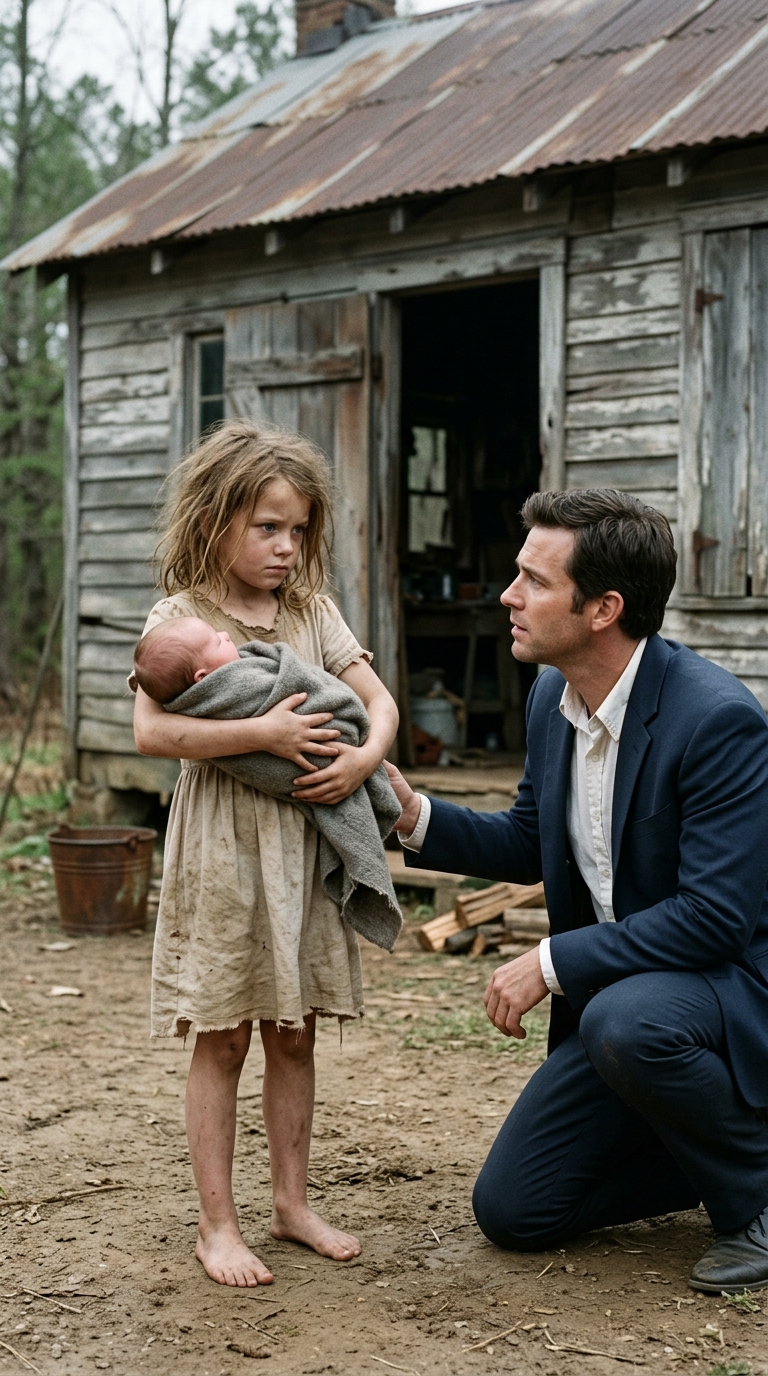
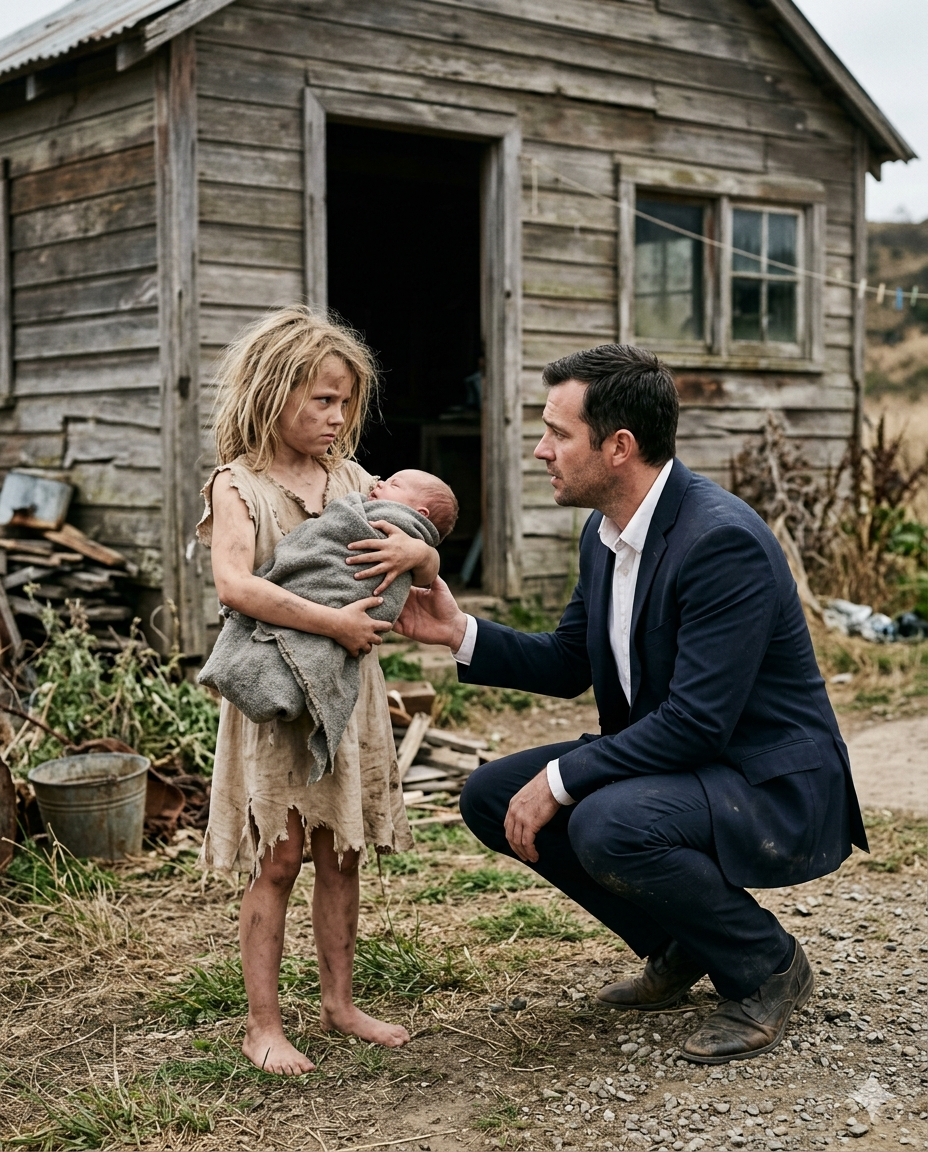
An abandoned wooden structure, nearly swallowed by weeds. Rotten walls. A roof caved in where rain must pour straight through like knives.
And at the entrance—two small figures.
Something tightened in Michael’s chest before he could explain it.
“Stop the car,” he said.
He stepped out in his pristine suit and walked into the mud, as though something there had called his name.
The girl couldn’t have been more than six. Her hair was tangled, her face streaked with dirt, her eyes far too old for someone so small. In her arms, she held a newborn wrapped in torn cloth, clutching him like the only thing she had left.
The baby whimpered—weak, exhausted.
She didn’t loosen her hold for a second.
Michael dropped to his knees without thinking. The damp earth soaked through his clothes, but he didn’t notice.
“Are you… here alone?” he asked softly, afraid to shatter something fragile.
She didn’t answer. Her grip only tightened, her fingers whitening.
Michael recognized that look.
It wasn’t just fear.
It was survival.
The same look he’d worn in ruthless negotiations—except for her, it wasn’t about winning. It was about staying alive.
“My name is Michael,” he said gently, extending his hand like one would to a frightened animal. “What’s yours?”
She stepped back, pressing against a splintered board, her eyes locked on him.
“Emma,” she whispered after a moment.
Something shifted inside him at the sound.
“And the baby?”
Her expression softened just slightly.
“My brother. Noah.”
Noah stirred and let out a quiet cry, as if apologizing for needing anything at all. Emma rocked him instinctively. There was no milk. No blanket. No food.
Only her.
“Our mom left three days ago,” Emma said flatly. “She said she’d come back. She didn’t.”
Michael felt something inside him fracture.
He had known sadness.
But this child knew hunger.
And real hunger makes sadness feel like a luxury.
“Are you… hungry?” he asked.
Her eyes flickered—just for a second—to his jacket pocket where a silk handkerchief peeked out. Not greed. Need.
Then she looked away, ashamed.
Michael stood slowly. His suit suddenly felt obscene.
He called his driver.
“Bring the car here. Now.”
Then he turned back to her.
“Emma, you can’t stay here. It isn’t safe.”
She glanced at the broken walls, the damp wood, the open sky above.
“I know,” she said quietly. “But we don’t have anywhere else.”
The car rolled closer. Emma stiffened, ready to run if she had to.
Michael raised his hands slightly.
“I won’t hurt you. I’m going to get you food. Somewhere warm. Then we’ll talk.”
She frowned.
“Why?”
One word—heavy with everything she’d already learned about disappointment.
Michael couldn’t explain the years of loss. The empty rooms. The silence.
So he chose the simplest truth.
“Because you need help,” he said. “And I can help.”
The driver opened the door, stunned to see his composed employer kneeling in the mud beside two children.
“Sir… are you alright?”
“I am,” Michael said. “Open the door. They’re coming with us.”
Emma hesitated, staring at the clean leather seats.
“I’ll make it dirty,” she said, looking at her bare feet.
Something inside him cracked.
“I don’t care about the car,” he said quietly. “I care about you.”
He knelt again, meeting her eyes.
“Trust me this once. If you don’t like it… I’ll bring you back. I promise.”
It was a risky promise.
But not making one would have been worse.
Emma stepped forward. Then another.
She climbed in carefully, still clutching Noah as if the seat might vanish beneath her. Michael sat across, giving her space.
The car pulled away.
Emma watched every street, memorizing everything. Noah began to cry.
“He’s hungry,” she said softly. “I gave him water, but—”
“Ethan,” Michael said quickly, leaning forward. “Find the nearest pharmacy. We need formula, bottles, diapers—everything. And food.”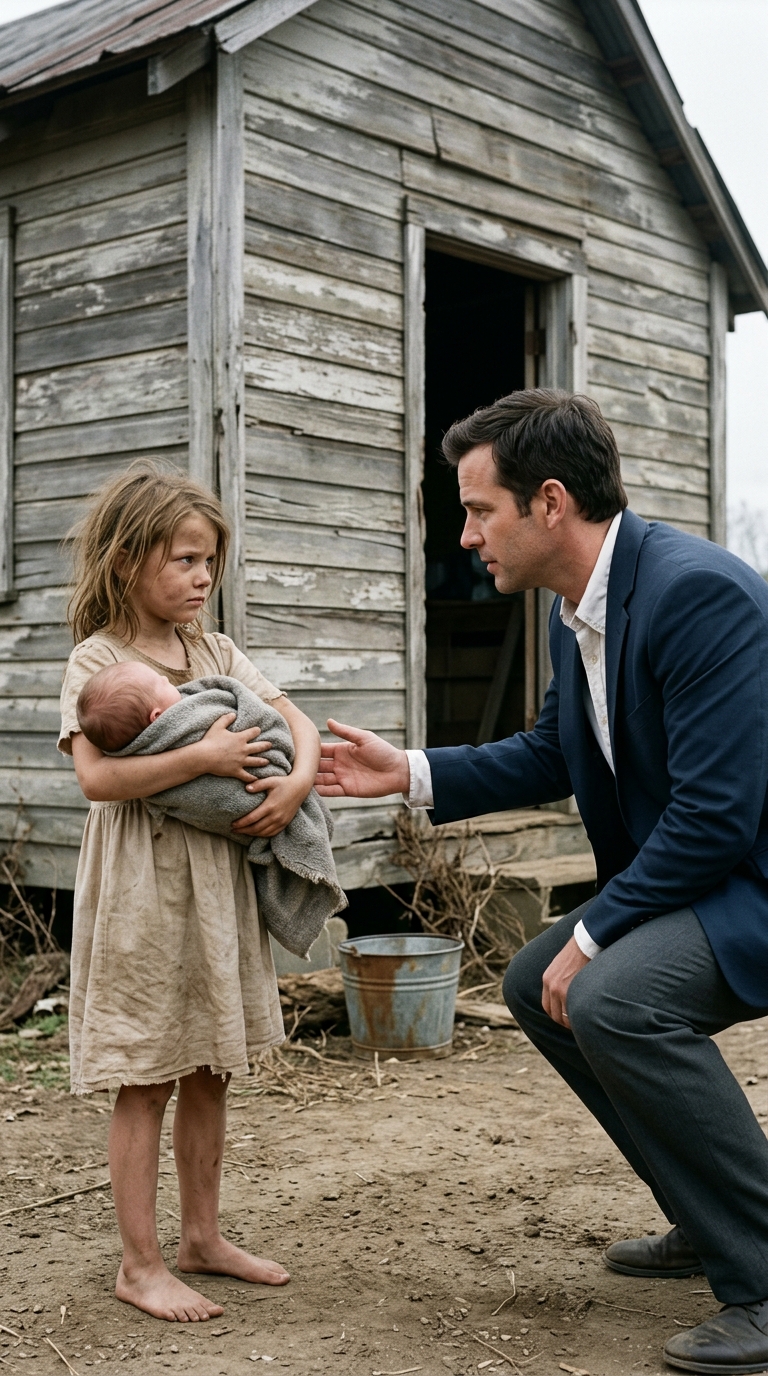
Then, to Emma:
“Anything you want.”
She looked at him, confused.
“We eat whatever we find,” she said simply.
Michael swallowed, thinking of the breakfast he hadn’t touched that morning.
At the pharmacy, he stood awkwardly in aisles of baby products. He didn’t know brands or sizes. He only knew time mattered.
“I need everything for a newborn,” he told the clerk. “And for a little girl. Clothes. Shoes. The best you have. Price doesn’t matter.”
Emma stared at the bags when he returned.
“All of that… for us?”
“For you,” he said. “To start.”
At a gas station, he prepared the formula with unsteady hands, testing it on his wrist. When he handed it over, Emma held it like something precious.
Noah drank desperately.
For the first time, Emma’s face softened.
Relief.
“Thank you,” she whispered.
“You don’t have to thank me,” Michael replied. “Every child deserves to eat.”
Emma fell asleep against the window on the drive. Michael wondered how long it had been since she’d rested without fear.
When they reached the mansion, reality returned.
“Sir,” Ethan said carefully, “Mrs. Carter is home.”
Michael closed his eyes briefly.
Laura.
His wife. Elegant. Controlled. Quietly worn down by years of loss.
“I’ll speak to her,” he said.
The door opened. Laura stepped out—perfect, composed—until she saw him, muddy, beside a small girl holding a baby.
“Michael,” she said slowly. “What is this?”
“They were abandoned,” he said. “They need help.”
Her eyes moved to Emma. Then to Noah’s fragile face.
Something shifted deep within her.
“They need a bath,” she said softly. “Clean clothes. Food.”
Then she looked at Michael.
“And then we talk.”
Inside, Emma moved cautiously, as if she had stepped into another world—marble floors, chandeliers, silence. Laura guided her to a guest room.
“You can bathe here,” she said gently. “Do you need help?”
“I can do it,” Emma replied quickly.
“And Noah?” Laura hesitated, then extended her arms.
“May I… hold him?”
Emma glanced at Michael. He nodded.
She placed Noah into Laura’s arms like handing over something fragile and irreplaceable. Laura held him carefully, her hands trembling.
“He needs a doctor,” she said after a moment. “Both of them do.”
Michael was already making the call.
That night, behind closed doors, Michael and Laura spoke—not about blame, not about what they had lost, but about what stood before them.
“This isn’t about filling a void,” Michael said quietly. “It’s about doing something that matters.”
Laura’s eyes filled with tears.
“I’m scared,” she admitted. “Of loving them… and losing them.”
Michael held her.
“Our life was already breaking,” he said softly. “Maybe this is how we rebuild.”
She nodded.
“But we do it the right way,” she said. “No shortcuts.”
The days that followed were chaotic and beautiful—bottles, doctor visits, small clothes drying in the sun. Emma began to relax. She laughed. She slept peacefully.
Laura began to change too.
Paperwork followed. Social workers. Court dates. Uncertainty.
One night, Emma asked quietly, “Are you going to send us away?”
Michael knelt beside her.
“Never,” he said.
The judge eventually ruled in their favor.
Adoption approved.
Years passed—birthdays, scraped knees, homework, laughter filling every corner of the house.
One evening, Emma hugged Michael and said,
“You gave me a home where I don’t have to be afraid.”
Michael smiled, tears in his eyes.
“And you gave me the chance to be a father.”
From the doorway, Laura watched, holding Noah close.
Some fortunes don’t belong in vaults.
They sit around a table.
With food.
With noise.
With life.
And with the quiet certainty that, at last—
they were safe.
