

Ashton Caldwell pulled his black sedan through the wrought-iron gates of his Silverwood Park estate just as evening faded into a heavy gray sky. His shoulders were tense beneath a tailored navy suit, still carrying the weight of meetings, figures, and deals that never seemed to end.
He stepped out without really seeing the manicured hedges or the marble fountain he once took pride in. His briefcase hung from his hand like armor as he braced himself for what usually waited at home: silence. Expensive, perfect silence.
But that day… it was gone.
Before he even reached the living room, he heard laughter.
Bright. Unrestrained. Alive.
A child’s laughter.
And beneath it—soft, uneven guitar notes, warm and real in a way nothing in his house ever sounded before.
Ashton stopped.
For a moment, he wondered if he had entered the wrong home.
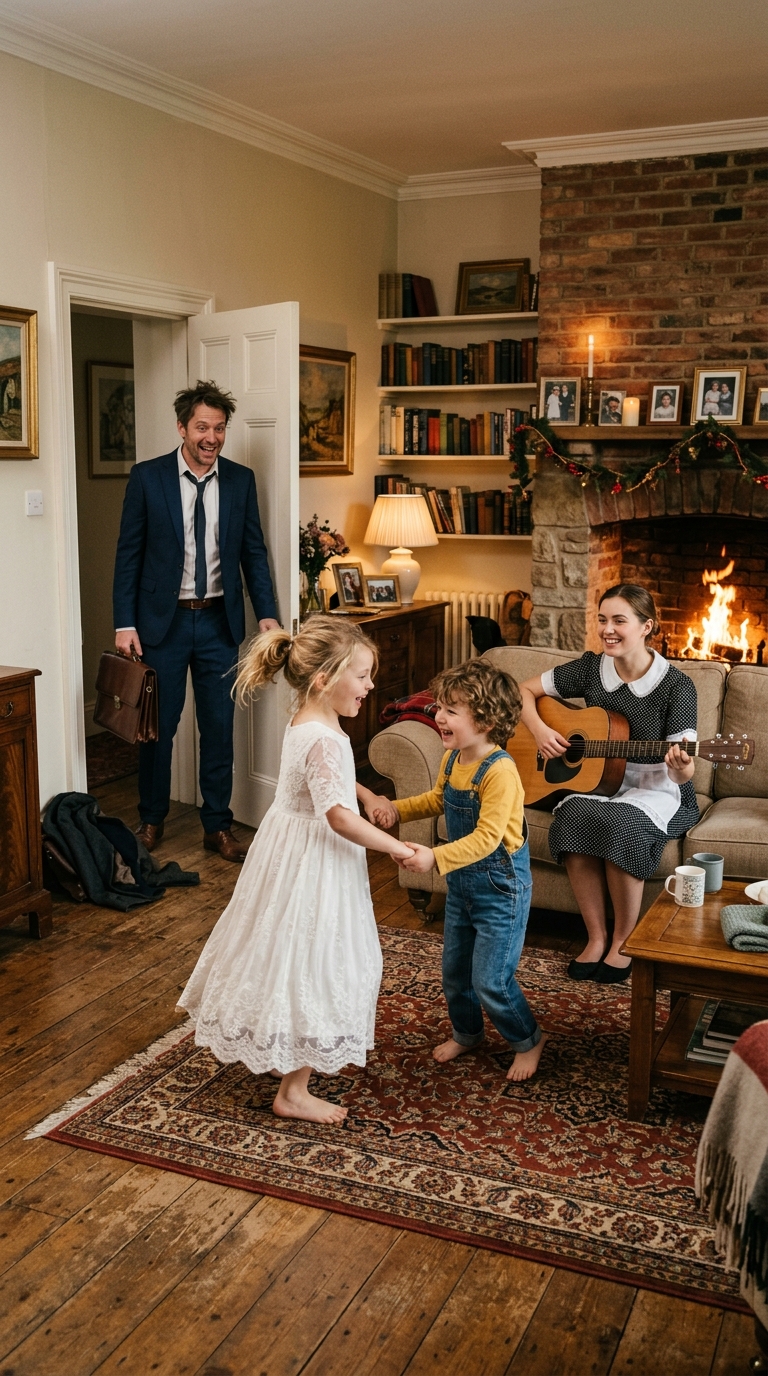
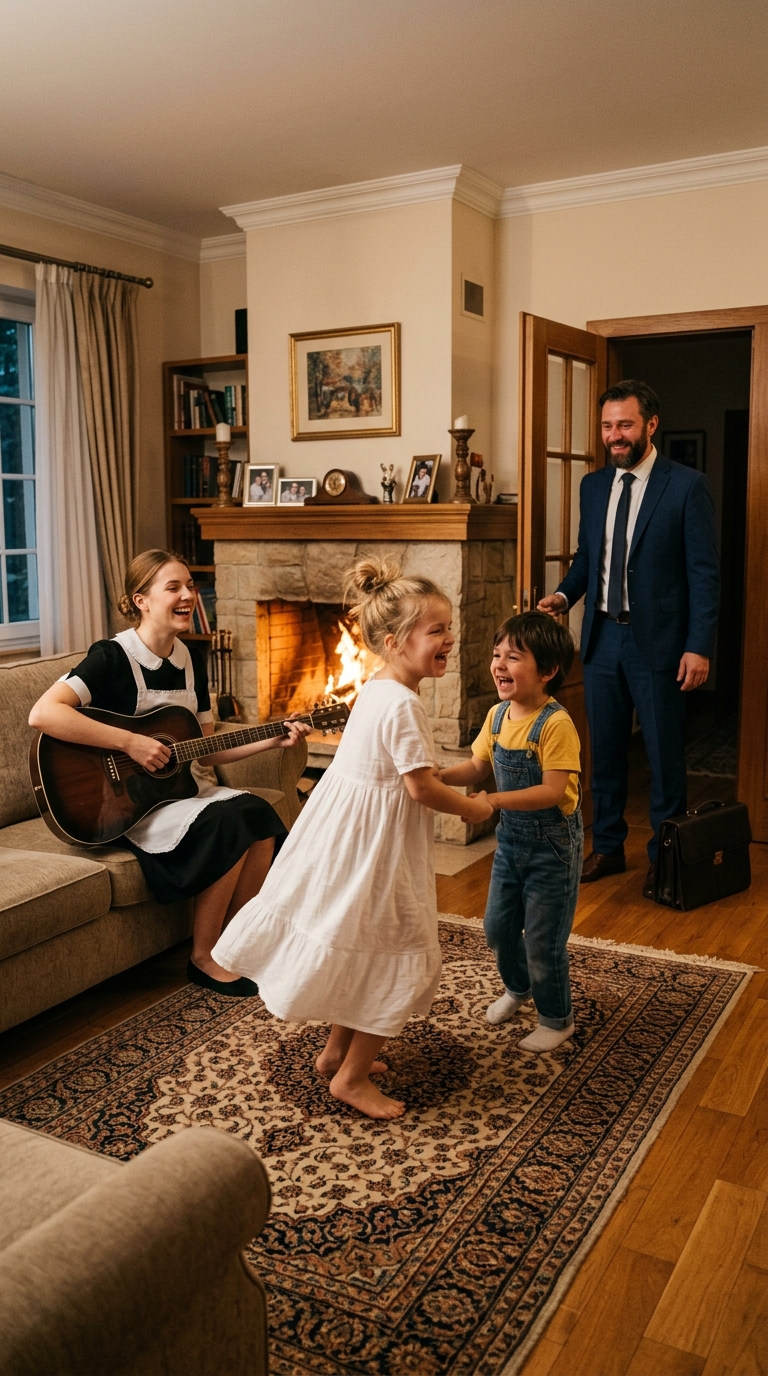
Inside, on the wide rug in front of the fireplace, his five-year-old daughter Clara spun in circles, her white dress floating around her as she laughed freely.
A boy about her age held her hand—careful, focused, like their game mattered more than anything else in the world.
On the couch, Marisol Bennett, the housekeeper, sat with a guitar in her lap. She wasn’t just playing notes—she was playing something gentle and intentional, like a memory she refused to lose.
Nearby, Daniel Harper, the driver, watched quietly, as if he already understood what Ashton was only beginning to see.
No one noticed him standing there.
Then his briefcase hit the floor.
The sound broke everything.
The music stopped.
Clara turned first.
“Daddy! You’re home!”
She ran into his arms, and Ashton instinctively knelt to catch her. Her small body pressed against him tightly, like she had been waiting far longer than a few hours.
Something in his chest tightened.
She held him like she was afraid he might disappear again.
The boy stood frozen, uncertain.
Marisol quickly rose, hands tightening at her sides. “Mr. Caldwell… I didn’t expect you back so soon. I’m sorry, I—”
Ashton raised a hand slightly.
Not anger.
Confusion.
Clara leaned in and whispered, “Daddy, this is Oliver. He’s my friend. He came because I was alone again.”
Again.
That single word stayed with him.
He knew what it meant.
Too many hours alone. Too many evenings filled with silence. A house too large for a child to grow up inside without feeling it.
His empire had been built for her future.
But it had cost her the present.
The boy—Oliver—stood with careful posture, like he had already learned not to take up too much space.
Marisol spoke quietly. “Sir, Oliver is my son. I couldn’t leave him alone today. I thought I could keep him out of the way… but your daughter found him.”
She braced for consequences.
Daniel added softly, “She’s done excellent work here, sir.”
Ashton barely heard them.
He was staring at the boy.
At his daughter.
At the life happening inside his house without him.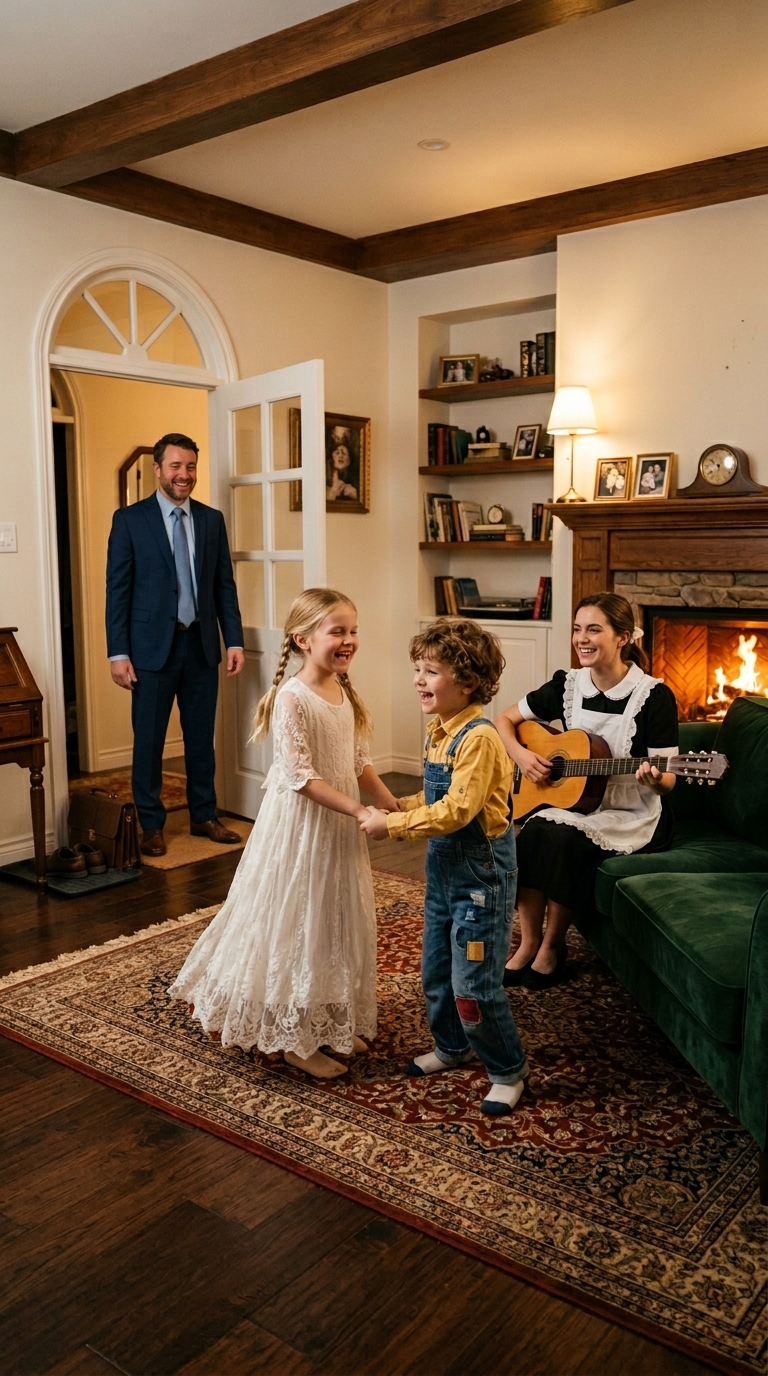
“How long have you worked here?” he asked finally.
“Eleven months,” Marisol replied.
“And I’ve never once asked about your life?” he said quietly.
Silence answered him.
He already knew.
He had built systems, not relationships. Order, not connection.
Clara tugged his sleeve. “Can Oliver stay for dinner?”
In the past, the answer would have been no.
Rules. Boundaries. Structure.
But something had shifted.
Ashton looked at Oliver. “Do you like soccer?”
The boy hesitated. “A little, sir.”
“There’s a ball outside that hasn’t been used in a long time,” Ashton said. “Go on.”
For the first time, the house moved differently.
Lighter.
Alive.
Later, Marisol tried to refuse help, her voice unsteady. “I can’t accept charity.”
“This isn’t charity,” Ashton said. “It’s correction.”
Because for the first time, he was seeing clearly.
A child needed presence more than security.
A home needed warmth more than perfection.
That night, four plates sat at the dining table instead of one.
And the silence that once ruled the mansion… never returned the same way again.
Days turned into weeks.
Ashton came home earlier.
Not because he had to—but because he wanted to.
Clara and Oliver filled the house with noise that no longer felt like disruption. It felt like life returning.
Marisol began to relax, slowly at first, as though she didn’t fully trust peace.
One afternoon, flour covered the kitchen counter. Clara laughed. Oliver corrected Ashton’s clumsy attempts at cracking eggs. Marisol watched them with quiet disbelief.
The cake burned slightly.
No one cared.
“Can Marisol always eat with us?” Clara asked.
And this time, Ashton didn’t hesitate.
“Yes,” he said simply.
Months passed.
Truths surfaced.
Marisol had dreams she abandoned. Ashton admitted he had been afraid of connection, believing distance would protect him from loss.
“I thought if I stayed busy, nothing could hurt me,” he said one evening.
Marisol looked at him gently. “But it already had.”
And for the first time in years, he didn’t look away.
What grew between them wasn’t sudden.
It was steady.
Real.
And fragile in a way neither of them wanted to break.
When whispers came from outside the estate, Ashton didn’t respond to them.
He chose presence instead.
One evening, Clara said simply, “I like our family like this.”
And that was enough.
Years later, when people asked Ashton about success, he never mentioned wealth.
He looked at his children. At Marisol in the kitchen. At the home that once echoed with silence.
And he said:
“The moment I came home and heard laughter instead of emptiness… that’s when everything changed.”
Because he had built an empire to secure a future—
but found something far more valuable in the process.
A home that finally felt like one.
And a life that began the moment he stopped measuring it in money… and started measuring it in presence.
