

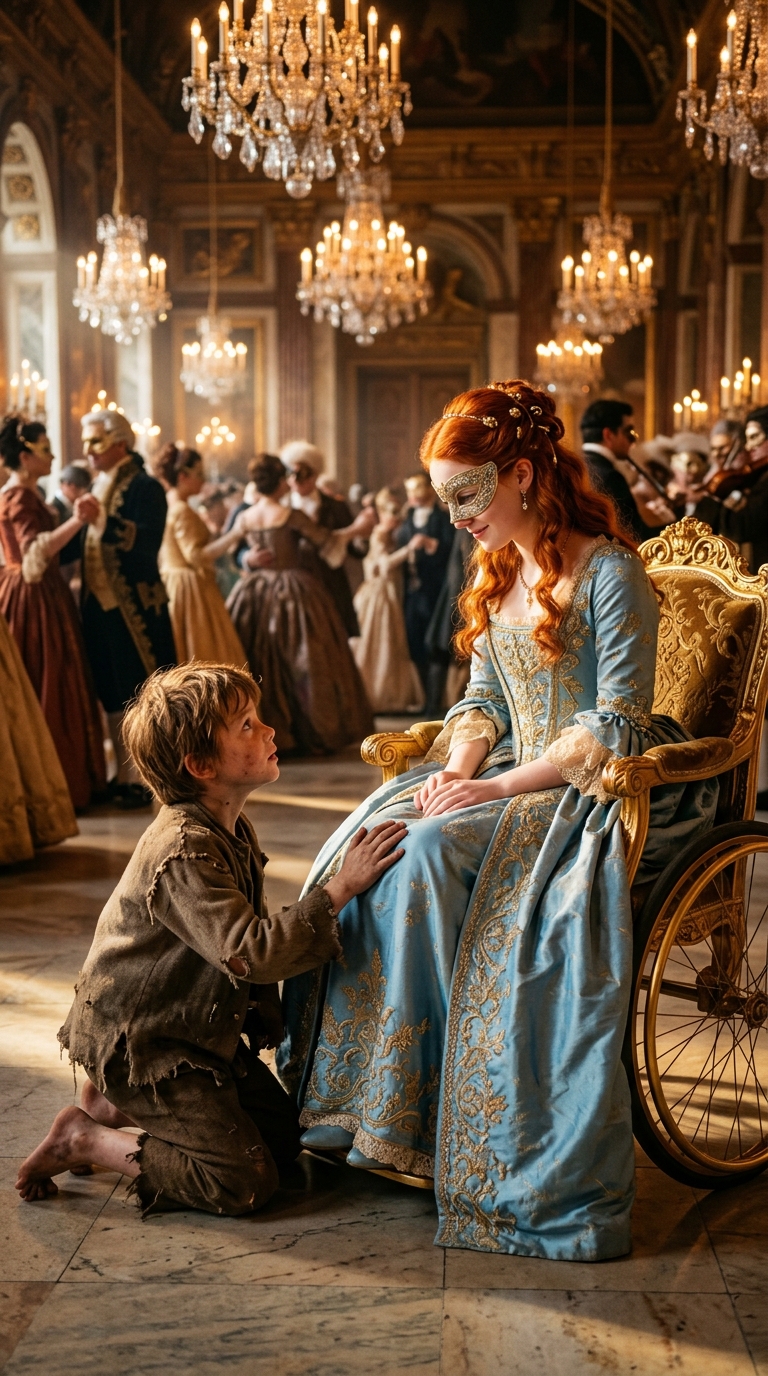
For nine long years, Princess Isolde of Aldermere had not taken a single step. The fever had come like a thief in the night when she was twelve, burning through her body with merciless heat and leaving her legs lifeless. At first, the court physicians had been optimistic. “A passing sickness,” they declared, prescribing bitter tonics and warm compresses. But the weeks turned to months, and the months to years. By the time she reached twenty-one, every healer in the seven realms had tried and failed.
Emissaries returned from the steaming southern jungles with rare herbs that smelled of earth and lightning. Holy sisters from the mountain monasteries knelt for days in prayer, their chants echoing through the marble corridors. Sacred waters from the springs of Lys were carried in crystal vials across treacherous passes, only to be poured over her skin with no effect. Once, a blind astronomer from the distant eastern isles had been brought before her. He placed glowing crystals along her spine while murmuring star-touched incantations, then wept silently when the light faded and her legs remained still.
King Eldric, her father, had grown desperate. He offered half the royal treasury to anyone who could restore his daughter’s ability to walk. Messengers carried the proclamation to every corner of the known world. Charlatans came in droves, promising miracles for gold, but the treasury stayed full. And Princess Isolde remained seated in her gilded wheelchair, watching the world move around her while she stayed perfectly, achingly still.
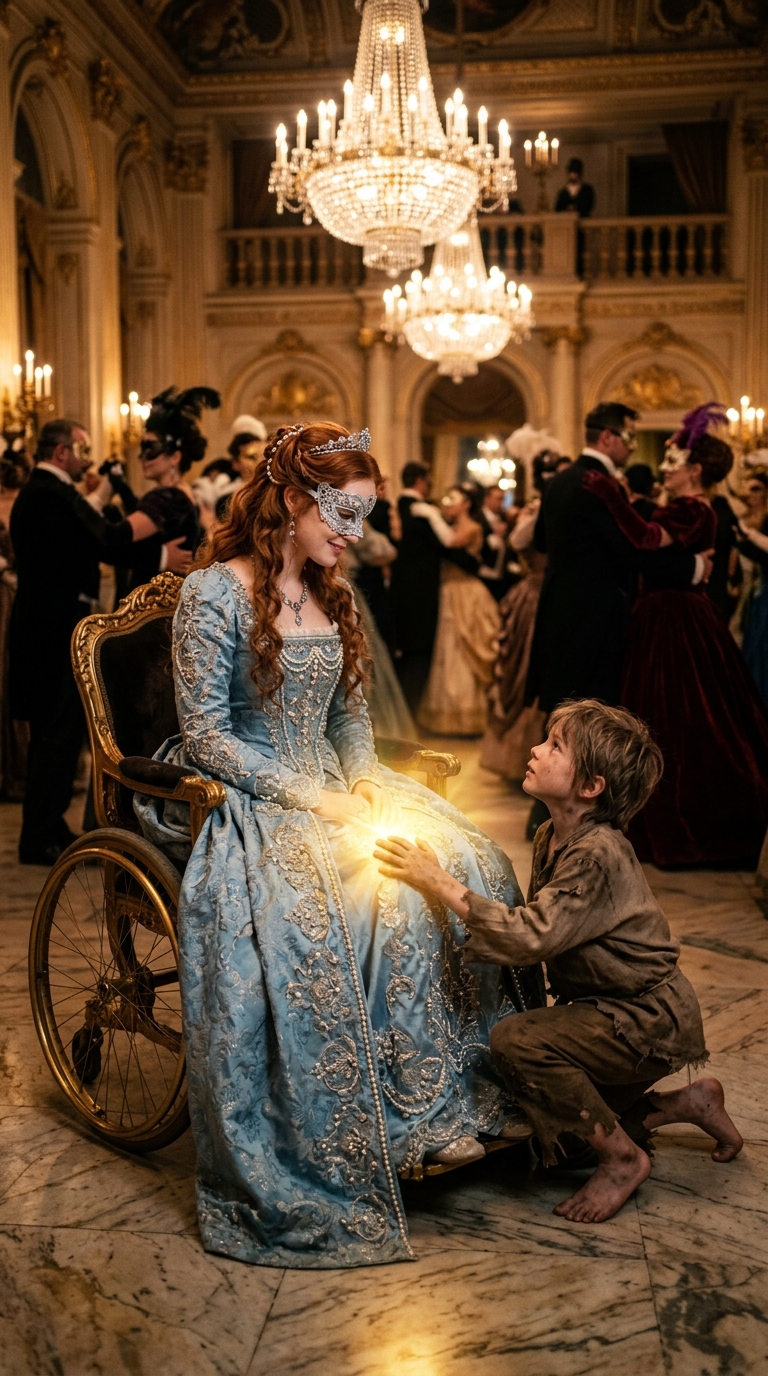
On the night of her twenty-first birthday, the great hall of Aldermere shimmered with life. A thousand candles burned in chandeliers of wrought silver, their flames dancing like captured stars. Nobles from every realm had gathered for the masquerade: lords in velvet doublets, ladies in gowns of silk and gossamer that whispered as they moved. Masks hid their faces—elaborate creations of lace and gold leaf, peacock feathers and painted porcelain. The air was thick with the scent of white roses, freshly cut from the royal gardens, and the slow, sweeping notes of a waltz floated down from the musicians’ gallery.
Isolde sat near the western pillars, her chair positioned just far enough from the dance floor to spare her the pain of watching others glide so freely. She wore a gown of the palest blue silk, embroidered with threads of silver that caught the candlelight like frost on a winter window. A delicate half-mask of white porcelain, adorned with tiny sapphires, covered the upper half of her face. An embroidered shawl of deepest indigo lay across her lap, concealing legs that had not carried her weight since childhood.
She had learned, over the years, how to smile through the ache. It was a skill as necessary as breathing in the world of courts and politics. So she smiled when Lord Aldric, a handsome young baron from the western marches, bowed over her gloved hand and murmured compliments about her gown. She smiled when her grandmother, the Queen Mother, passed with her retinue, offering the same gentle but empty words of encouragement she had repeated for nearly a decade. She even managed a gracious nod as a pair of laughing young nobles whirled past, so lost in each other and the music that they barely noticed the still figure beside the pillars.
When the moment of solitude finally came, Isolde let the smile slip away. Just for a breath. Just long enough to feel the weight she carried in secret—the quiet grief of a life lived at the edges of joy.
That was when she felt the gentle tug at the edge of her shawl.
She looked down.
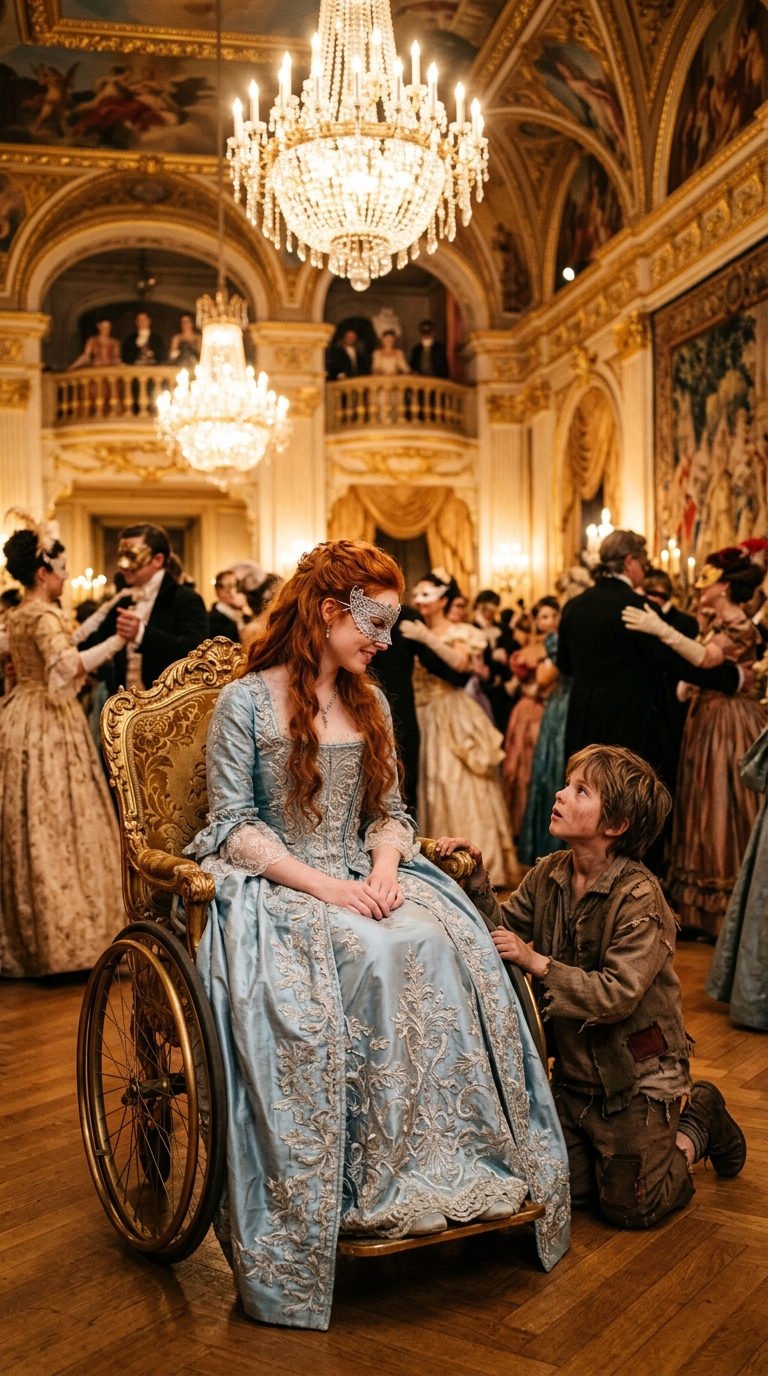
A small boy knelt beside her chair. He could not have been more than eight years old. His simple brown tunic was patched at the elbows and hem, and his bare feet were streaked with dust from the road. Smudges of dirt marked one cheek, and his black hair fell in wild tangles around his face. He wore no mask, no finery. He should not have been inside the hall at all—guards patrolled every entrance, and servants would have ushered out any intruder. Yet there he was, looking up at her with eyes the color of pale moonlight on still water. Luminous grey, unafraid, and impossibly calm.
“I can help you walk again,” he said simply. His voice was soft, steady, like a child stating that the sun would rise tomorrow.
Isolde had heard those words countless times before—from physicians with their potions, priests with their blessings, and desperate con artists chasing the king’s reward. She had learned to recognize the hollow ring of hope in them, the careful calculation of lies. But this boy’s voice held none of that. Only truth, plain and quiet.
“Who are you?” she whispered, leaning forward despite herself.
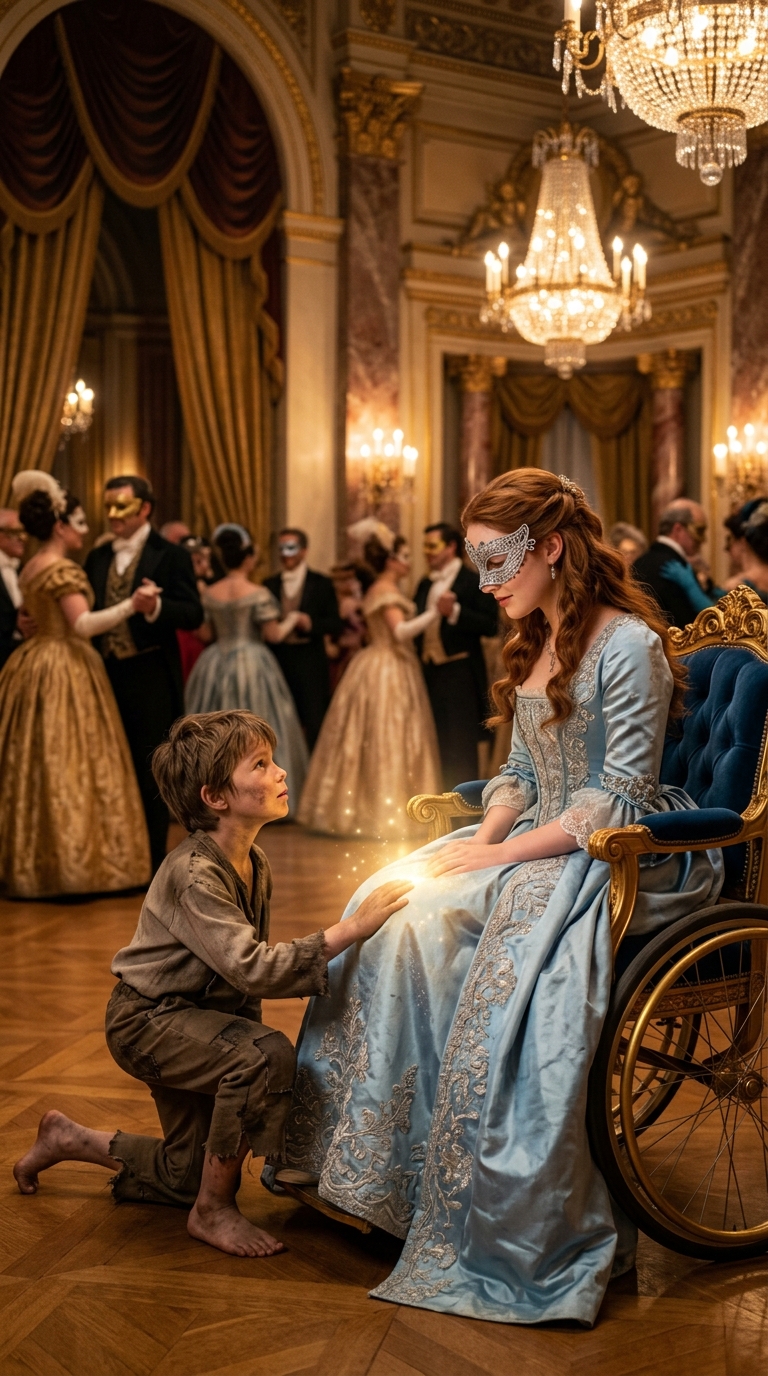
He did not answer with a name. Instead, he reached out with one small, grubby hand and placed it gently on her knee, just above where the shawl had slipped. His palm radiated warmth—far more than a child’s hand should hold on a cool spring night. She felt it through the silk of her gown, sinking into muscle and bone that had slept for nine long years. It was like sunlight breaking through after an endless winter, gentle yet insistent.
The boy closed his eyes.
“One,” he said.
A strange hush gathered around them. The music continued, the dancers still turned, yet the space between her chair and the nearest pillar felt suddenly private, as though the world had drawn a breath and held it.
“Two.”
Something stirred deep inside her legs—not pain, but an ancient awareness. Nerves that had forgotten their purpose began to remember. A tingling warmth spread upward, like roots unfurling in fertile soil after drought.
“Three.”
The warmth bloomed outward, flooding her body like a second heartbeat. Isolde’s hands gripped the armrests of her chair. The indigo shawl slipped from her lap and pooled silently on the marble floor. Her entire frame trembled—not from fear, but from a profound recognition. Her body remembered what it meant to stand.
She rose.
Slowly at first. Her silk slippers touched the cool stone. Her knees, unused for so long, held steady. Her legs—thin from years of stillness—supported her weight as though they had never forgotten how. The ballroom seemed to tilt and spin around her as she straightened to her full height for the first time in nine years. A sound escaped her throat—half gasp, half joyful laugh that carried across the sudden quiet.
A noblewoman nearby dropped her crystal goblet. It shattered against the floor with a sound like breaking ice. Heads turned. The musicians’ bows faltered one by one. Dancers slowed, then stopped entirely. Two hundred masked faces turned toward the pale blue figure standing beside the empty gilded chair. A great, reverent hush fell over the hall of Aldermere.
Tears blurred Isolde’s vision behind her porcelain mask. She looked down, ready to thank the boy, to lift him into her arms, to call for her father and demand he be given every comfort the castle could offer for the rest of his life.
But the boy had vanished.
In the place where he had knelt, only a single white feather remained on the marble. It glowed faintly with a golden inner light that dimmed even as she watched, until it lay ordinary and still. The guards at the great doors later swore under oath that no child had entered the hall that night. No child had left it. Stewards searched the kitchens, the stables, the gardens, and the village beyond the walls. No beggar boy was found. No footprints led away from her chair except the new, tentative ones made by Isolde herself.
In the weeks that followed, the miracle became legend. Isolde relearned to walk with patient determination, first with assistance from her ladies, then alone through the long corridors of the castle. Her muscles strengthened, her balance returned. The king wept openly the first time she walked unaided into the throne room. Yet whenever anyone pressed her for details about the boy, she would only smile softly and say, “He was a gift. Some gifts do not wish to be named.”
Years passed. When King Eldric passed the crown to his daughter, Queen Isolde ruled Aldermere with a wisdom forged in stillness and restored in wonder. She negotiated fair treaties with the seven realms, opened schools for children of every class, and ensured that healers—true ones—were supported rather than rewarded with empty promises. Her people loved her not only for her justice, but for the quiet compassion that seemed to flow from some deep, personal well of understanding.
Every year on the eve of her birthday, Queen Isolde ordered the castle gates thrown wide open. Any traveler, no matter how ragged or poor, was welcomed with warm bread, hearty stew, and a place at the feast tables. No one was turned away. Servants were instructed to look especially for small, barefoot boys with dark hair and luminous grey eyes, though she never explained why.
Sometimes, on the quietest winter nights, a servant passing the great hall would pause. There, in the soft glow of a single candle, they would see the Queen standing beside the old gilded wheelchair that no one else was permitted to use. Her hand would rest gently on its carved armrest, her gaze searching the shadows between the pillars, as if waiting for a small figure to step out of the darkness and speak her name once more.
The feather she kept in a small crystal box on her bedside table never lost its faint, inner glow. And though she ruled wisely and was beloved across the realms, part of her heart remained forever tethered to that single moment of impossible grace—a reminder that miracles, like certain children, sometimes arrive without fanfare, heal without expectation, and disappear before gratitude can be fully spoken.
In time, the story of the barefoot boy became part of the kingdom’s lore, told to children at bedtime and whispered among travelers. Some said he was a spirit of the old forests. Others claimed he was an angel who had taken mortal form for one night. Queen Isolde never confirmed nor denied any tale. She simply kept the gates open, the feast prepared, and her heart ready.
For she knew, deep in the bones that had once failed her, that kindness given freely could return in the most unexpected of ways. And on certain starlit nights, when the candles burned low and the music of memory played softly in her mind, she would close her eyes and feel again that gentle, sun-warm touch on her knee—and smile, knowing the boy had never truly left her.
