

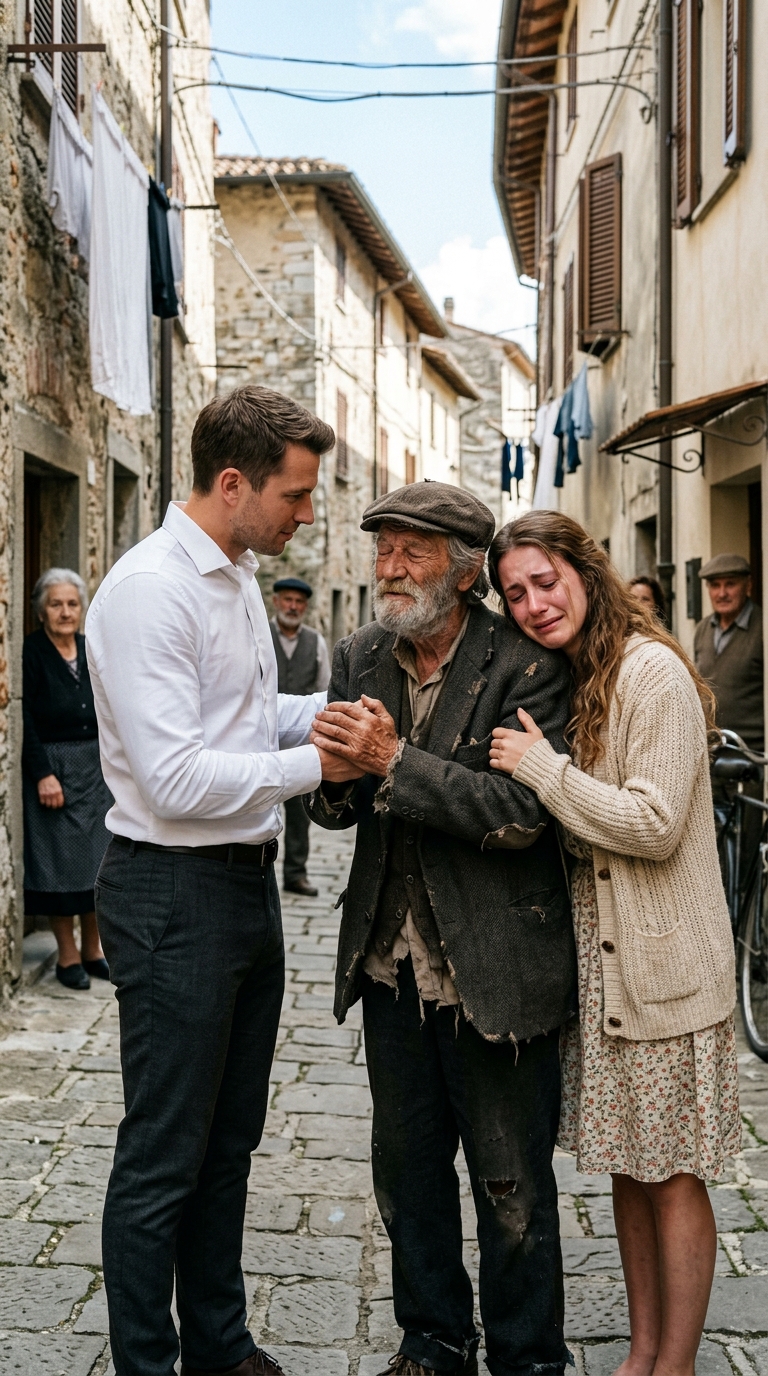
The battered aluminum pot slipped from Alice’s fingers and struck the hard dirt floor with a sharp metallic crash, sending the rice she had been rinsing scattering in every direction. The shack’s wooden door burst open violently. She turned, her pulse racing, and saw her father, Valdir—shaking, drenched in sweat. His face no longer held the look of a man who had simply lost their last bit of money at a gambling table. What twisted his expression now was something far more terrifying—raw, primal fear so intense it seemed to suffocate the cramped room. At eighteen, Alice already carried a burden far too heavy for her years. Since her mother died—claimed by an illness no money could cure—she had become the pillar of the house. She scrubbed floors, cleaned office bathrooms, and woke before sunrise to polish tiles, all just to keep food on the table. But nothing could have prepared her for the broken whisper that left her father’s lips.
“They came,” he said, pressing himself against the cracked wall as if his strength had abandoned him. “Marco Aurélio’s men. If I don’t pay one hundred and twenty thousand reais by noon tomorrow, they’ll kill me.” Alice felt the color drain from her face. Marco Aurélio was not a man who made empty threats; he was the most feared loan shark in the region, known for destroying lives and tearing families apart without hesitation. One hundred and twenty thousand reais was impossible—a bottomless pit that no amount of labor could ever fill. Anger surged through Alice like fire. She screamed, cried, and threw every sacrifice she had made back at him—every sleepless night, every ounce of effort wasted while he gambled everything away. Valdir wept too, but his tears carried something darker: resignation. There was a solution, he murmured, unable to look at her. A businessman. A man unimaginably wealthy and unbearably alone had offered to clear the debt—and even give more—on one condition: he wanted a wife. Young. Pure. Devoted only to him.
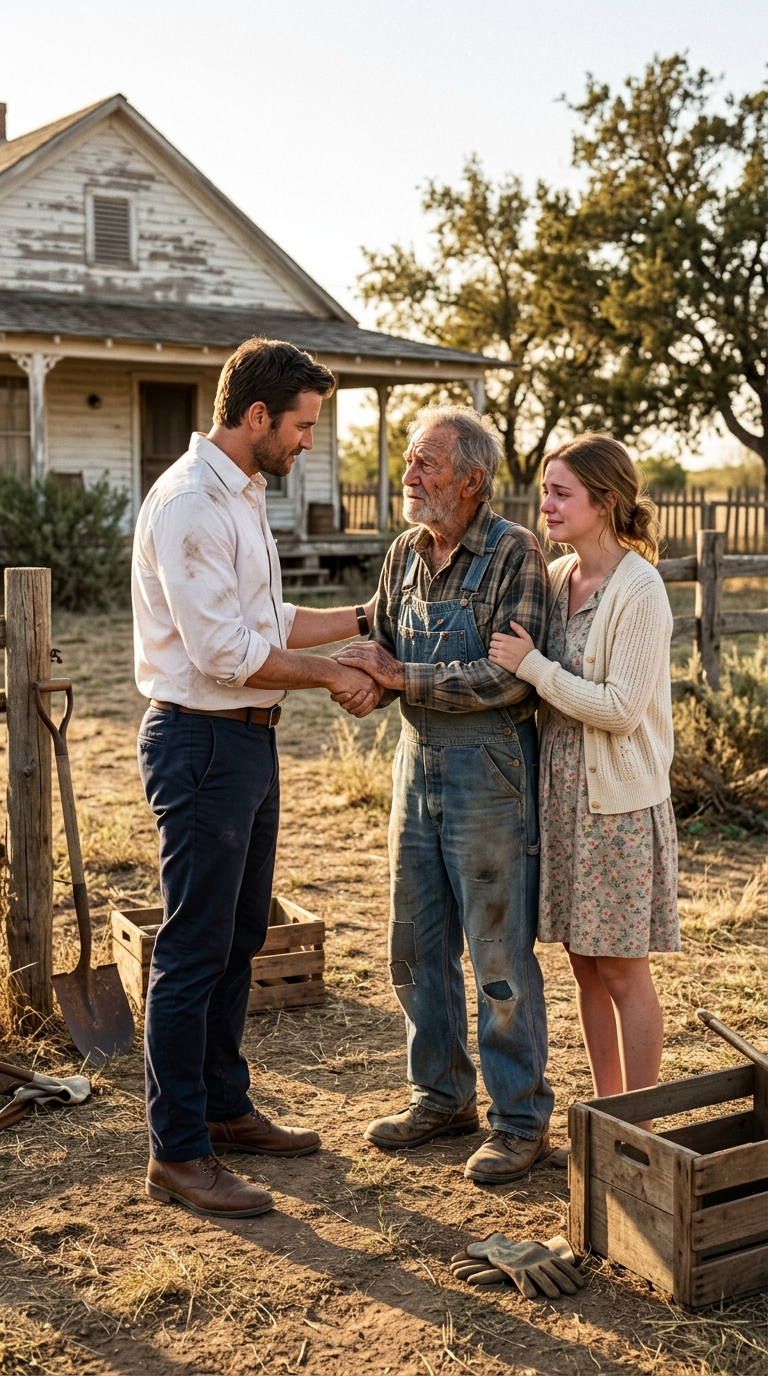
It took Alice several agonizing seconds to understand the horror of what he was saying. Her own father—the man who should have protected her—was offering her like a commodity. Payment for his debt. Her refusal came instantly, sharp and furious, breaking through the silence of the favela. Was she meant to become a prisoner? A slave to some repulsive old man’s desires? But reality can be cruel. If she refused, Valdir would die—and his blood would stain her conscience forever. She might be free, but she would carry the weight of his death for the rest of her life. The silence that followed felt like something inside her breaking. With dry eyes and a heart turned to stone, Alice agreed. But she made one final promise to Valdir: that moment would be the last time he would ever see her. She would pay with her future, her life—but to her, he ceased to exist in that instant.
The next morning, the rising sun exposed every crack in the fragile shack. Alice hadn’t slept. She put on her best jeans and a simple white blouse she had washed by hand, packing only three precious items into a worn bag: a photo of her mother, an old rosary, and a small notebook filled with her thoughts. When the loud knock echoed at the door, time seemed to stop. The man waiting outside was not the wrinkled monster she had imagined surrounded by guards. Instead, he was in his thirties—tall, dressed in an immaculate suit that looked absurd among the poverty around him. Bernardo Carvalho. His brown eyes were intense, yet behind them was a hollow darkness, an emptiness so deep it sent a chill through her. He didn’t look at her with cruelty, but with quiet calculation, as if trying to understand her. He paid the debt with cold efficiency, humiliating Valdir with cutting words, then extended his hand toward the girl he had just claimed. Alice walked to the luxury car under the stunned gaze of the neighbors. But as she sat on the cold leather seat and watched the doors close, sealing her away from everything she had ever known, she realized the true fear wasn’t what she had left behind. It was sitting beside her: a man with lifeless eyes, broken by losses she couldn’t yet understand, who now held control over her life. The engine roared, and the car moved forward into the unknown, carrying Alice into a storm she never imagined she would face.
Bernardo’s mansion wasn’t just a home—it felt like a mausoleum of marble and silence. The hallways stretched long and cold, lined with furniture draped in white sheets like ghosts of a happiness long gone. When he showed her the vast bedroom that would be hers, the distance between them was clear. In a flat, emotionless tone, he explained the rules: the marriage would last two years, nothing more than an arrangement. She would have everything—clothes, food, education. He would never take anything she didn’t freely give. At the end of those two years, the divorce would leave her with enough money to start over. Alice listened quietly, clutching her bag tightly. His coldness unsettled her, yet there were cracks beneath it. The handkerchief he offered when she cried in the car. The protective way his hand briefly rested on her back as he guided her out of the favela. He was a man of ice hiding something still alive underneath.
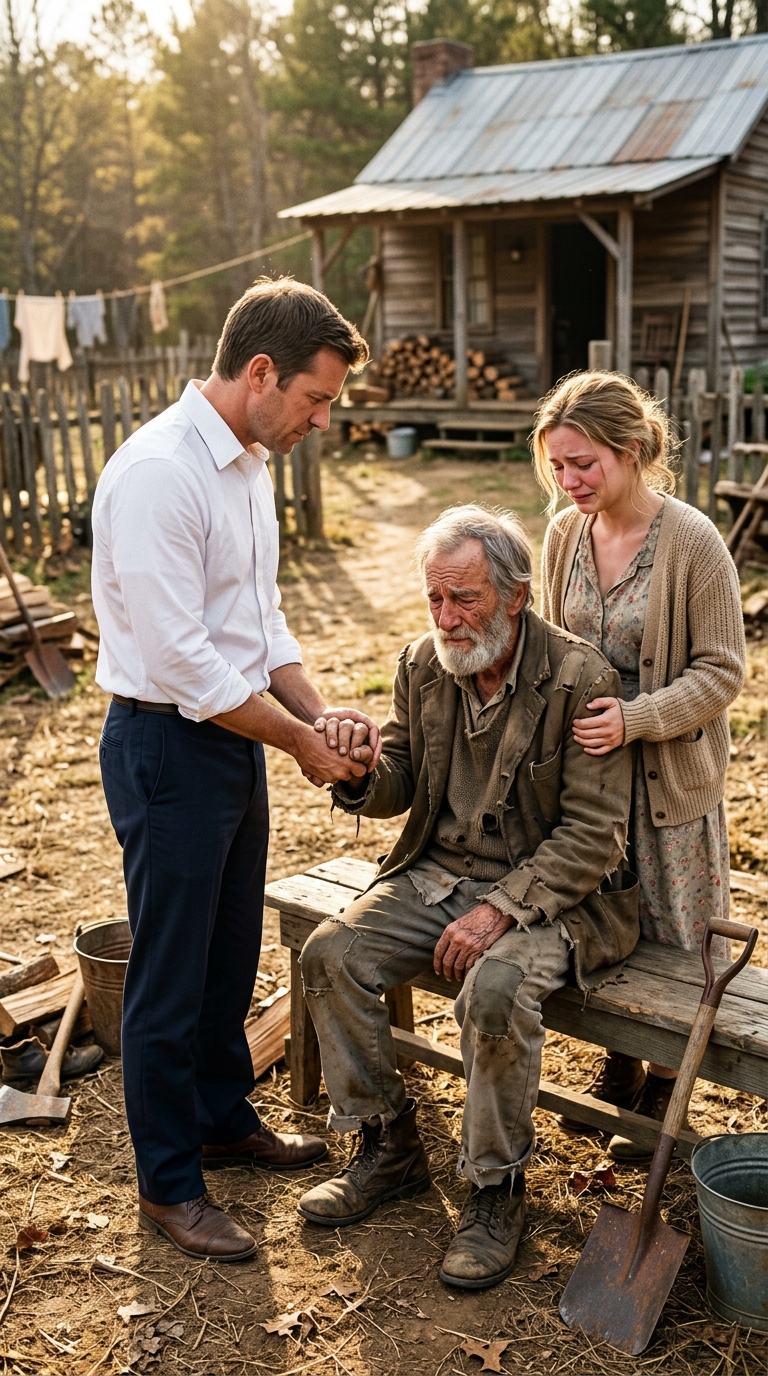
Adjusting to the mansion was painfully isolating. Alice met Dona Marta, the kind housekeeper who quickly became her only source of warmth. It was Marta who revealed the tragedy that haunted Bernardo. He had once been a brilliant surgeon, a man with steady hands and a generous heart, until a devastating truck accident took his wife, Camila, and their three-year-old son, Miguel. The grief shattered him so deeply that his hands began to tremble, forcing him to abandon surgery forever. He turned to business instead, buying hospitals and burying himself in work to escape the silence of his home. Bernardo wasn’t cruel. He was simply afraid to feel again.
Slowly, their relationship began to shift through small moments, quiet clashes that broke the stillness of the house. Alice was not submissive. One suffocating night, after he abruptly left dinner to avoid her presence, she confronted him in the garden. She challenged the walls he had built, accusing him of hiding from life. His response came with raw honesty. He hadn’t bought her out of desire—he had discovered her situation, seen her being destroyed by her father’s debt, and used his power to rescue her, legally protecting her from ever being exploited again. The truth shook Alice to her core. He had saved her while drowning in his own pain. Without thinking, she stepped closer and wrapped her arms around him. Bernardo froze, his heart pounding, until something inside him finally broke. The untouchable man collapsed, releasing years of buried grief into the arms of an eighteen-year-old girl who understood sacrifice all too well. That night, beneath the hidden stars of São Paulo, the contract between them quietly disappeared.
Their growing closeness became a fragile, dangerous dance. Bernardo started coming home earlier. His eyes, once lost in emptiness, now searched for her in every corner of the house. When Alice found the old family photo albums, instead of retreating, Bernardo sat beside her, telling stories about Camila and Miguel, letting a faint light reach wounds that had long stayed open. His defenses finally shattered in the early hours of one morning, when desperate cries echoed through the mansion. Alice rushed to his room and found him caught in a nightmare, reliving the accident. Without hesitation, she climbed into the bed and held him, calming the violent tremors running through his exhausted body. When he begged, his voice thick with fear, for her to stay, Alice didn’t pull away. She remained beside him—not as a debt to be paid, but as a woman deeply in love with a broken man.
But the past never releases its grip so easily. Their fragile peace collapsed the moment Valdir appeared at the gates of the mansion. Drunk, worn down, pretending to care, he came back only to demand more money from the daughter he had once sold. Anger and pain surged inside Alice, threatening to break her. Before she could fall under that weight, Bernardo stepped in. His fury was no longer controlled or distant—it was the rage of a man protecting what mattered most. With cold, final words, he forced Valdir away, making it clear that Alice was his wife, his family, and that any further attempt to return would destroy him. As they walked back inside, Alice shaking, Bernardo pulled her close. He confessed that for the first time in years, looking at her made him want to breathe again, to live, to believe in a future. The kiss that followed wasn’t hesitant—it was desperate, overwhelming, the complete collapse of two hearts that had been guarded for too long. They kissed like survivors finally reaching land after a never-ending storm. The contract no longer meant anything. The two-year limit disappeared. Only one truth remained—their decision to love, despite knowing how much it could cost.
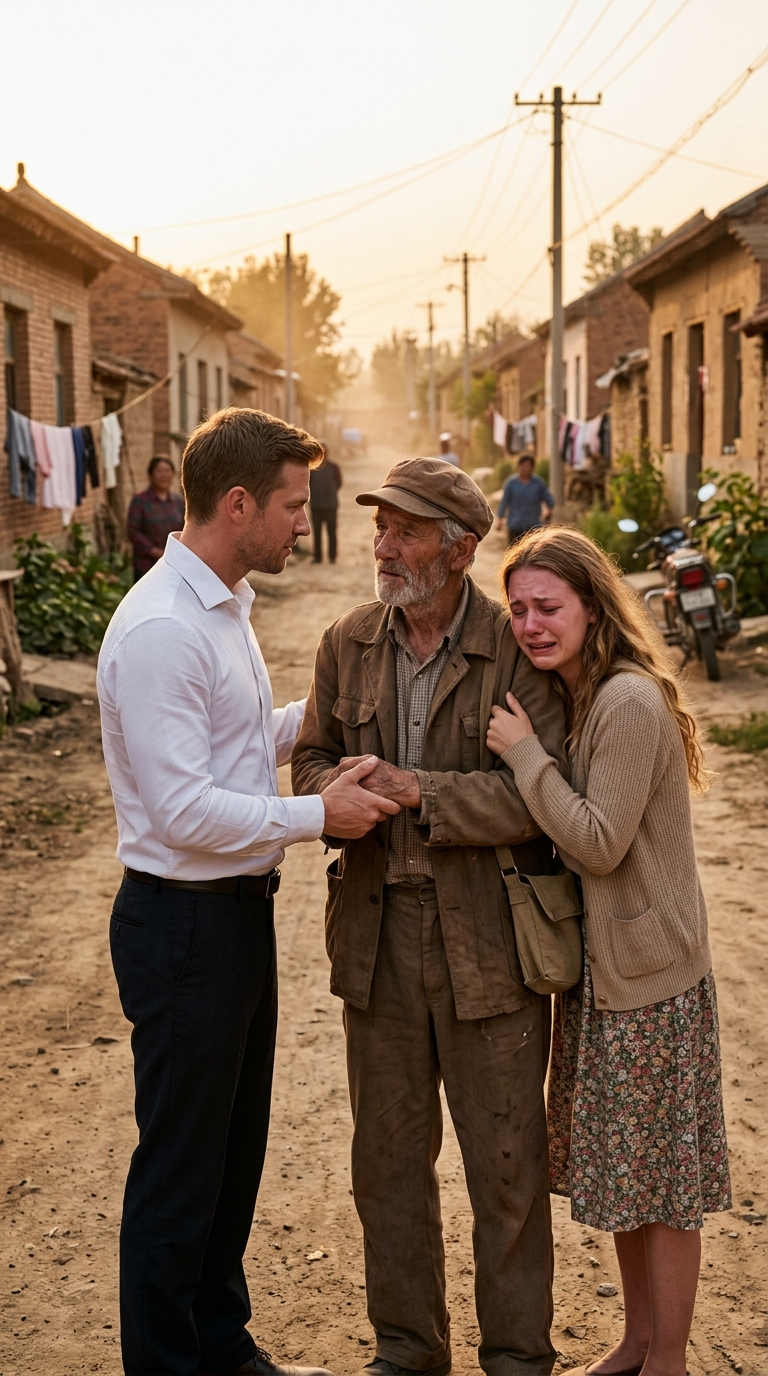
The months that followed were not easy, but they were honest. Their love didn’t erase the memory of Camila and Miguel; it transformed that pain into something meaningful. With Bernardo’s steady support, Alice entered nursing school, turning her natural kindness into a purpose that could change lives. Bernardo, inspired by her strength, created the Miguel Carvalho Institute, using his wealth to provide care and education to children in need, especially the orphans Alice cared for so deeply. The most powerful moment of his healing came inside a hospital room. While Alice waited outside, holding her breath, Bernardo washed his hands, put on his gloves, and picked up a scalpel for the first time in five years. His hands didn’t shake. He saved a baby’s life. And when he stepped out, exhausted and trembling, he held Alice tightly, knowing she was the reason he had found his way back.
The love that grew from pain eventually needed to be made real. Bernardo didn’t kneel with grand gestures or extravagant diamonds. He held out a simple ring, asking her to marry him—not as part of an agreement, but as a true choice, leaving behind the shadow that had once bound them. Their wedding wasn’t held in the mansion, but in the garden of the orphanage, filled with light and laughter. Alice wore a simple dress adorned with white flowers her mother had once embroidered, saved for the happiest day of her life. Dona Marta walked beside her. There were no formal vows, no rehearsed promises—only words shaped by everything they had survived together. They promised to be each other’s shelter on the darkest nights, and to cherish every sunrise they were given.
When the first real winter settled over the mansion, bringing an unusual chill that fogged the tall living room windows, Alice gently guided the surgeon’s warm hand to rest on her belly. The news of the pregnancy struck them in stunned silence, which quickly dissolved into overwhelming tears—joy intertwined with fear. But this time, they would face that fear together. They would love together. The girl who had once been handed to a man with lifeless eyes realized that beneath his cold exterior lived the most loyal and compassionate heart she had ever known. And the man who had locked himself inside his grief found his freedom in the calloused, hardworking hands of a girl who once cleaned floors to survive. Their story was not a perfect fairy tale—but it became something far more powerful: proof that the deepest wounds we carry are not the end of us. They are the very cracks through which light finds its way in, bringing healing, love, and the courage to truly live again.
