

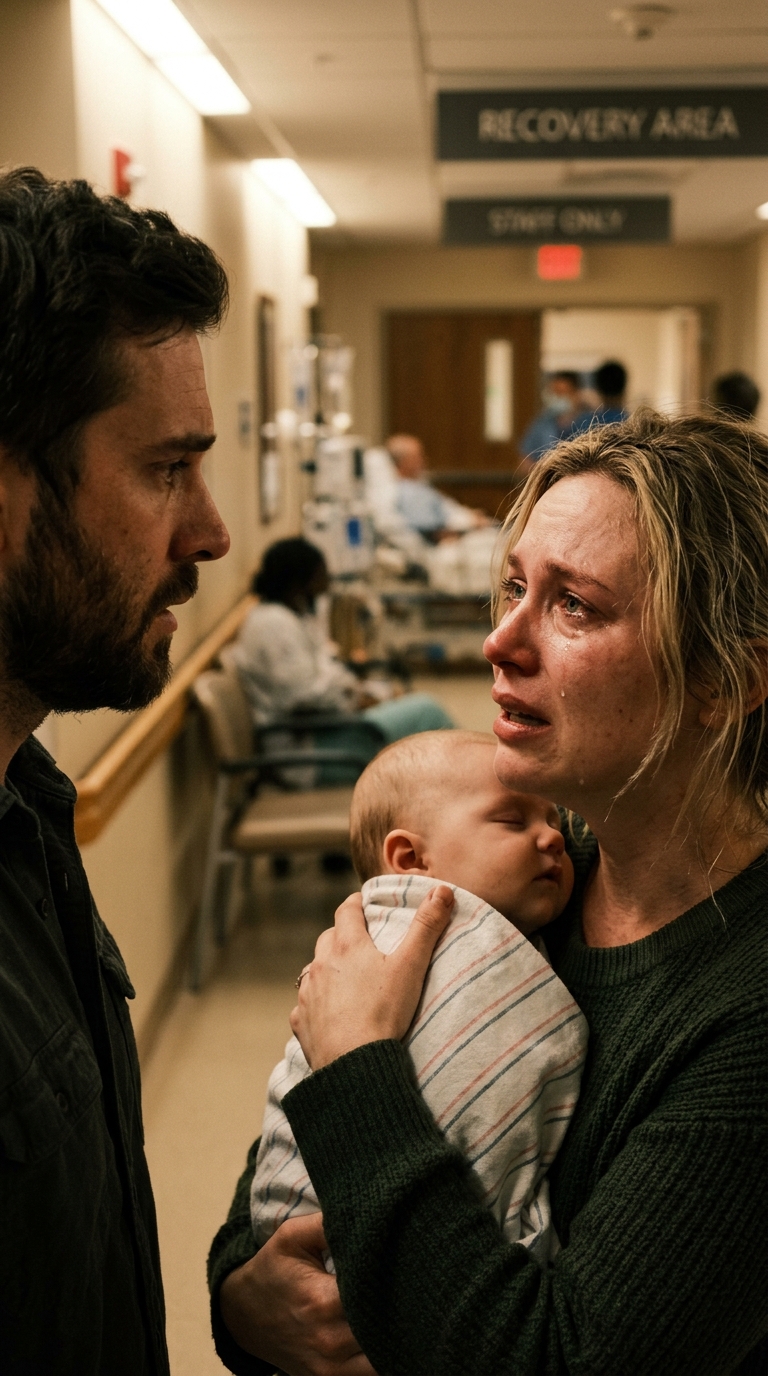
Fifteen months after my divorce, I rushed into the hospital with my baby convulsing in my arms, soaked from the rain and barely breathing through my own panic. Then an employee looked me up and down and said, “Without the father here, I’ll have to call social services.” I picked up the one number I had sworn to erase forever… and twenty minutes later, a helicopter landed on the roof, carrying the man I had run from — and the truth everyone had been hiding.
PART 1
“If the father doesn’t show up in ten minutes, I’m calling child services.”
Mariana Torres felt those words hit harder than the fever burning through her son’s tiny body.
Her seven-month-old baby was blazing hot in her arms, wrapped in a blue blanket soaked with rain. She had run into the emergency entrance of Hospital Ángeles del Pedregal with mud on her sneakers, wet hair stuck to her cheeks, and a heart pounding so violently it felt like it was trying to break out of her chest.
“Please,” she begged. “My son is having a seizure.”
A nurse took the baby immediately.
“Name?”
“Emiliano.”
“Age?”
“Seven months.”
“Any allergies?”
“Not that I know of.”
A doctor appeared behind the stretcher and didn’t waste a second.
“Take him to pediatrics. I need temperature, IV access, and labs now.”
Mariana tried to follow them, but a woman in a gray suit stepped directly in front of her, holding a tablet like it was a court order. Her name badge read: Patricia Roldán, Administrative Supervisor.
She was not a doctor.
She was not a nurse.
But she spoke like every life in that building depended on her approval.
“Mother of the minor, I need complete information.”
“I’ll give it to you later. I need to be with my son.”
“The hospital requires legal guardianship details.”
“I am his mother.”
Patricia looked her up and down.
The cheap blouse.
The worn-out diaper bag.
No wedding ring.
The pale face of a woman who had spent too long learning not to ask anyone for help.
“And the father?”
Mariana froze.
She had spent fifteen months avoiding that question.
Fifteen months hiding in a small apartment in Narvarte.
Fifteen months convincing herself that disappearing from Santiago Beltrán’s life had been the safest decision she could ever make.
Because Santiago was not just an ex-husband.
He was the most feared man in Monterrey.
Owner of construction companies, hotels, and private security firms.
A man people called “sir” even when they hated him.
A man who never entered any room alone.
A man whose family had too many graves buried beneath respectable last names.
“He isn’t here,” Mariana said.
Patricia lifted one eyebrow.
“Name?”
“It doesn’t matter.”
“Of course it matters. If the child needs major procedures, we need medical history from both parents.”
At that moment, the doctor stepped back into the hallway.
“Mrs. Torres, we’re concerned about a possible neurological infection. We need family medical history from both sides. Can you contact the father?”
Mariana felt the floor disappear beneath her.
She had promised herself she would never call him.
Not when Emiliano was born.
Not when she ran out of money.
Not when she cried alone at three in the morning, holding a baby with Santiago’s same dark eyes.
“I don’t have his number,” she whispered.
Patricia gave a dry little laugh.
“How convenient.”
Mariana turned to her.
“My son is sick.”
“And I need to know whether you actually have the right to authorize everything.”
The room went silent.

People started looking.
The humiliation burned in Mariana’s throat.
Then she said the name she had buried for more than a year.
“His father is Santiago Beltrán Rivas.”
Patricia stopped smiling.
A nurse looked up.
The doctor blinked.
Everyone in Mexico had heard that last name at least once.
Five minutes later, an old divorce attorney found Mariana a number she had once begged him never to give her again.
She called with trembling fingers.
Three rings.
Then a cold voice answered.
“Who is this?”
“Santiago.”
Silence.
“Mariana.”
Another pause.
“What do you want?”
“I need your medical history.”
His voice changed immediately.
“What happened?”
“Our son is in the emergency room.”
The silence stretched so long Mariana thought the call had dropped.
Then Santiago asked one question.
“Where are you?”
“Hospital Ángeles del Pedregal.”
“Put the doctor on the phone.”
Twenty minutes later, the entire building trembled.
The windows shook.
The thunder of helicopter blades roared over the roof.
Someone whispered, “That’s a helicopter.”
Mariana closed her eyes.
Because she knew exactly who had just arrived.
The hallway doors swung open.
Three men in black entered first.
Then Santiago appeared.
Dark suit.
Rain in his hair.
A stare sharp enough to cut through glass.
Every person in the emergency room went still.
He walked straight toward Mariana, but his eyes shifted to Patricia.
And in a voice so calm it was more terrifying than shouting, he asked:
“Who threatened to take my son away from his mother?”
Mariana could barely breathe.
Because she knew Santiago had not come alone.
And she had no idea what truth he was about to expose.
PART 2
Mariana could not believe what was about to happen.
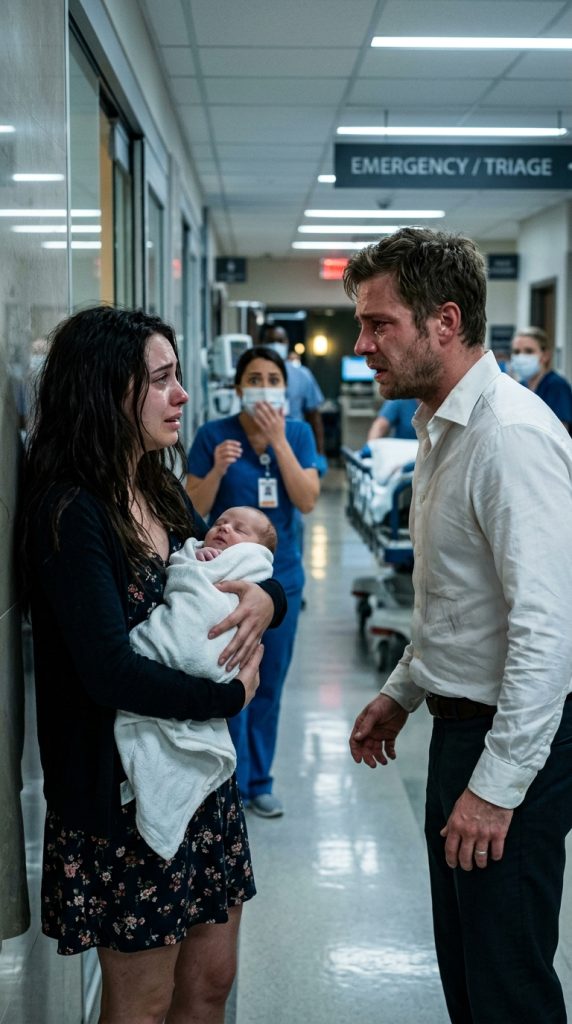
Santiago Beltrán Rivas stood in the middle of the emergency hallway like a storm wearing a black suit. Rain still clung to his shoulders. His jaw was tight, his eyes cold, and behind him, the three men in black didn’t move unless he did.
Patricia Roldán’s face had lost every bit of color.
For the first time since Mariana had entered that hospital, the woman with the tablet was silent.
Santiago looked at her again.
“Who threatened to call social services on my son?”
Patricia swallowed.
“Señor Beltrán, I was only following hospital protocol.”
“No. Protocol is asking questions. What you did was threaten a terrified mother while her baby was convulsing.”
His voice never rose.
That made it worse.
The doctor stepped forward carefully.
“Señor Beltrán, with respect, the child is being treated. We need family medical history immediately.”
Santiago turned to him, and something changed in his face. For one second, the powerful man disappeared. What remained was a father who had just learned he had a child.
“How is he?”
The doctor hesitated.
“His fever is dangerously high. We stopped the convulsion, but we are concerned about a neurological infection or an inherited inflammatory condition. We need to know if there is any history of seizures, immune disorders, infant fevers, sudden inflammatory episodes—”
Santiago’s face went still.
Too still.
Mariana saw it.
“What?” she whispered.
He didn’t answer her.
Instead, he looked at one of his men.
“Where is the case?”
The man opened a black leather medical case and handed Santiago a sealed folder wrapped in plastic.
Mariana stared at it.
“What is that?”
Santiago’s eyes did not leave the doctor.
“My medical records from infancy. And my brother’s.”
The doctor took the folder quickly.
“You brought them?”
“They landed with me.”
Patricia blinked.
“You came here by helicopter… with medical records?”
Santiago turned his head slowly toward her.
“When my son is in danger, I don’t come empty-handed.”
Mariana felt her knees weaken.
His son.
He had said it like the word already belonged to his blood, his breath, his bones.
But anger rose in her before hope could.
“Don’t say that like you were there.”
Santiago looked at her.
The hallway went silent again.
Mariana’s voice cracked, but she didn’t stop.
“Don’t stand here like a hero because you arrived in a helicopter. You weren’t there when I was pregnant. You weren’t there when I signed those papers. You weren’t there when your mother told me that if I came near you, she would bury me in court.”
For the first time, Santiago looked truly confused.
“My mother did what?”
Mariana let out a bitter laugh.
“Don’t pretend.”
“Mariana.”
His voice softened, and somehow that hurt more.
“What papers?”
Before she could answer, the doctor opened the folder and froze.
He turned a page. Then another.
His expression sharpened.
“Who else knows about this family condition?”
Santiago’s eyes darkened.
“No one outside my family physician.”
“Your son may have the same pattern.”
Mariana stepped closer.
“What pattern?”
The doctor spoke carefully, but quickly.
“Señora Torres, Santiago had a rare inflammatory syndrome as an infant. High fevers, convulsions, neurological symptoms that mimicked infection. His younger brother also showed symptoms at almost the same age.”
The hallway tilted around Mariana.
“And nobody told me?”
She looked at Santiago.
“You knew this could happen to a child?”
“No.”
“You just handed him the records.”
“Because I knew something like this existed in my family, not because I knew we had a son.”
Mariana’s mouth opened, but no sound came.
Santiago took one step toward her.
“Mariana, I swear to you on everything I still have left, I did not know you were pregnant.”
The words hit her harder than Patricia’s threat.
Fifteen months of anger rose inside her like fire.
“You signed the divorce settlement.”
“I signed because you disappeared.”
“I disappeared because your lawyer sent me a document saying you wanted me gone.”
Santiago’s eyes narrowed.
“What lawyer?”
“Manuel Cárdenas.”
One of the men behind Santiago shifted.
Santiago did not look away from Mariana, but his voice dropped.
“Find him.”
The man nodded and left the hallway.
Mariana hugged herself, suddenly cold.
“He came to my apartment. He said you knew about the pregnancy. He said you didn’t want a scandal. He said if I fought, the Beltráns would prove I was unstable and take my baby after birth.”
Santiago looked like someone had cut the air from his lungs.
“Pregnancy?”
Mariana stared at him.
“Don’t.”
“You were pregnant when you left?”
Tears burned in her eyes.
“Seven weeks.”
His face changed completely.
The powerful man vanished again.
He looked lost.
Wounded.
Almost young.
“Mariana… I never received anything. No call. No message. No letter.”
“That’s not true.”
“I called you for two months.”
“No, you didn’t.”
“I went to your mother’s house.”
“My mother told me your people warned her not to open the door.”
Santiago closed his eyes for half a second.
Then he turned toward Patricia.
“Who told you to stop her?”
Patricia jerked back.
“No one.”
“You knew my name before she said it.”
Her lips parted.
Mariana looked at Patricia.
That was true.
When Mariana had whispered Santiago’s name, Patricia’s fear came too fast. Too specific.
Santiago took one slow step closer.
“You weren’t following protocol. You were waiting for her.”
Patricia clutched the tablet.
“That is absurd.”
A new voice cut through the hallway.
“It is not absurd.”
Everyone turned.
An older man in a white coat walked toward them with the hospital director beside him. His hair was silver, his face pale, and his eyes went straight to Santiago.
“Señor Beltrán.”
Santiago’s tone sharpened.
“Doctor Salazar.”
Mariana noticed something strange.
Santiago didn’t sound relieved to see him.
He sounded dangerous.
Doctor Salazar looked at Mariana, then toward the pediatric doors.
“I should examine the child.”
The younger pediatrician stepped in front of him.
“You are not on the child’s care team.”
Salazar’s mouth tightened.
“I am the Beltrán family physician.”
Santiago looked at him.
“You were.”
One word.
Were.
The director tried to intervene.
“Señor Beltrán, we should move this discussion to a private room.”
“No. My son was almost used as leverage in a hallway. Everyone here can hear the truth.”
Doctor Salazar looked at Patricia.
That tiny glance was enough.
Mariana saw it.
So did Santiago.
He smiled without warmth.
“There it is.”
Patricia whispered:
“Doctor, I did what I was told.”
The hallway exploded into murmurs.
Mariana felt the blood leave her face.
“What does that mean?”
Patricia covered her mouth, realizing too late that she had confessed.
Santiago’s voice became ice.
“Who told you?”
No answer.
“Patricia.”
She trembled.
“Your mother.”
Mariana’s body went numb.
Santiago didn’t move.
But the three men behind him did.
One blocked the exit.
One stood beside Patricia.
One stood near Doctor Salazar.
The hospital director raised both hands.
“Please, this is a hospital—”
“Then act like one,” Santiago said. “Because right now it looks like my mother’s private office.”
At that moment, the pediatric doors opened.
The doctor came out fast.
Mariana forgot everyone else.
“Emiliano?”
“He is stable for now. The fever is coming down slightly. We started treatment based on the records your father brought. We need to observe him closely, but this may have saved us crucial time.”
Mariana pressed a hand to her chest.
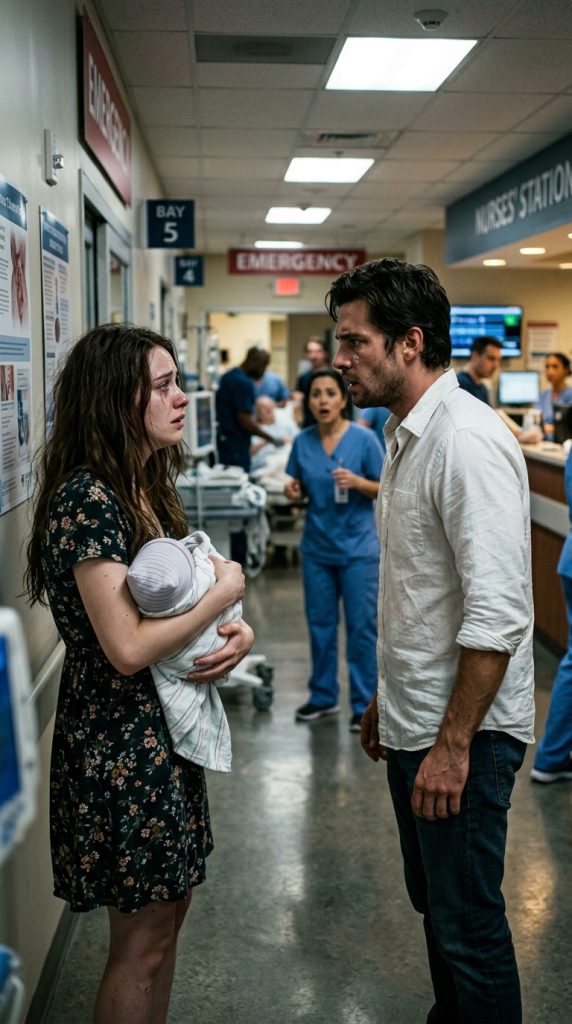
Santiago closed his eyes.
Renata barely reacted.
That was when Mariana understood the whole truth.
Renata had not come because Emiliano was sick.
She had come because Santiago knew.
The baby was a chess piece to her.
Nothing more.
Santiago opened his eyes and looked at Doctor Salazar.
“Tell her.”
Salazar’s lips trembled.
Renata snapped:
“Doctor, you work for me.”
Santiago smiled faintly.
“Not anymore.”
Salazar stared at the floor.
“Señora Beltrán knew Mariana was pregnant before the divorce was finalized.”
Mariana’s breath stopped.
Salazar continued, voice breaking.
“She ordered a private test through bloodwork from a clinic visit. She learned the pregnancy was viable. She said the child would complicate the succession structure.”
Santiago stepped closer.
“And the medical records?”
Salazar swallowed.
“She ordered me to seal the family history. She did not want Mariana to know the child might need monitoring.”
Mariana felt a sound escape her throat.
Not a cry.
Not a scream.
Something deeper.
Santiago turned to his mother.
“You risked his life.”
Renata lifted her chin.
“I protected this family.”
“He is this family!”
The shout shook the room.
Everyone went silent.
Renata stared at him, shocked.
Santiago’s chest rose and fell.
When he spoke again, his voice was low.
“You kept my son’s medical history from his mother. You paid a lawyer to forge my consent. You placed an administrator in this hospital to intimidate her. You tried to create a record that she was unstable so you could take him if he survived this night.”
Mariana’s knees weakened again.
If he survived this night.
The words were too heavy.
Renata’s expression did not break.
“You are emotional.”
“No, Mother. I am awake.”
She stepped closer to him.
“That woman left you. I saved you from humiliation.”
Santiago looked toward the glass where Emiliano slept.
“No. You robbed me.”
His voice cracked.
Only Mariana heard it.
“You robbed me of her pregnancy. His birth. His first breath. His first cry. Seven months of his life. You took those from me and called it protection.”
Renata’s jaw tightened.
“You would throw away your empire for her?”
Santiago looked at Mariana.
Then at the baby.
“I would burn it before I let it buy my child.”
For the first time, Renata looked afraid.
The attorney stepped forward.
“Señora Beltrán, based on what has been stated here, we will be filing criminal complaints for document fraud, coercion, unlawful interference, and endangerment.”
Renata laughed.
“You think you can drag me into court?”
Santiago answered:
“I think Mariana can.”
Everyone looked at her.
Mariana’s heart pounded.
For so long, she had been surviving. Changing apartments. Taking cash jobs. Avoiding cameras. Raising a baby with one hand and holding her fear with the other.
She had imagined this woman as a mountain.
Untouchable.
Unmovable.
But now Renata stood in front of her, not as a mountain.
As a woman who had harmed her child.
And that changed everything.
Mariana stepped forward.
“Yes.”
One word.
But it landed like thunder.
Renata’s eyes sharpened.
“Be careful, niña.”
Mariana lifted her chin.
“No. You be careful. Because the poor girl you tried to scare is the mother of the child your entire empire depends on.”
Santiago looked at her with something like pride.
Renata’s lips parted.
Mariana continued:
“I don’t want your money. I don’t want your house. I don’t want your name. I want my son safe. And if that means standing in court against every Beltrán lawyer you can buy, then start buying, Señora. Because I’ve already survived the worst thing you could do to me.”
Renata’s face twisted.
“You are nothing without my son.”
Mariana didn’t even blink.
“No. I became everything without him.”
Silence filled the room.
Then a tiny sound came from behind the glass.
A soft cry.
Mariana turned instantly.
The pediatrician opened the door.
“He’s waking up.”
Mariana ran inside.
Santiago followed, stopping at the door again until she nodded.
Emiliano’s eyes fluttered open.
Dark eyes.
Santiago’s eyes.
He whimpered weakly.
Mariana picked him up carefully, wires and all, holding him close while tears slid down her face.
“Hi, mi amor. Mommy’s here.”
Emiliano’s little hand moved.
Santiago stepped closer.
The baby looked at him.
Just looked.
Like babies do.
Without judgment.
Without history.
Without knowing that the man beside him had arrived in a helicopter carrying the truth his grandmother had buried.
Santiago reached out slowly.
Emiliano grabbed his finger again.
This time Santiago did not hide the tear that fell.
“Hello, Emiliano,” he whispered. “I’m sorry I’m late.”
Mariana’s heart broke and softened at the same time.
She hated that.
She hated how love could survive even when trust had been buried.
Behind them, Renata stood outside the glass.
Watching.
For the first time, she was not in control of the room.
A police officer arrived fifteen minutes later.
Then another.
Patricia was questioned first.
Doctor Salazar asked for an attorney.
Renata refused to speak.
But her silence no longer had power.
By dawn, the storm had passed.
The hospital windows glowed with gray morning light. Mariana sat in a chair beside Emiliano’s bed, her baby sleeping against her chest. Santiago sat on the floor a few feet away, still in his ruined suit, his tie loosened, his eyes red from staying awake.
He had made no demands.
Not once.
He had not asked to take Emiliano.
He had not asked Mariana to forgive him.
He had only stayed.
When the doctor finally said Emiliano was out of immediate danger, Mariana closed her eyes and cried quietly.
Santiago stood, then stopped.
“Can I?”
She didn’t answer right away.
Then she nodded.
He knelt beside her chair.
Not like a billionaire.
Not like a Beltrán.
Like a man who had lost more than he knew how to name.
“I won’t take him from you,” he said.
Mariana looked at him.
“I need to hear that again.”
“I won’t take him from you. Not today. Not ever. If a judge gives me one hour a week, I’ll take one hour. If you need months before you trust me, I’ll wait. If you never love me again, I’ll live with that. But I will not become another person who scares you.”
Her lips trembled.
“You believed I left you.”
“Yes.”
“And you never came?”
His pain flashed across his face.
“I did. But not enough. I trusted the wrong people. I let my pride believe what my mother wanted me to believe.”
Mariana looked down at Emiliano.
“He almost paid for it.”
Santiago lowered his head.
“I know.”
For a long moment, neither spoke.
Then Mariana whispered:
“His favorite blanket has a moon on it. He hates carrots. He likes when I hum old songs. He wakes up every night at 3:12 like he has an appointment with the ceiling fan.”
Santiago smiled through the sadness.
“3:12?”
“Every night.”
“Then I’ll learn 3:12.”
Mariana almost smiled.
Almost.
The door opened quietly.
Santiago’s attorney stepped in.
“Sorry. There’s something else.”
Santiago stood.
“What?”
The attorney looked at Mariana, then back at Santiago.
“When we pulled the trust documents, we found an amendment your father made before he died. It names Mariana as temporary guardian of the child’s shares if anything happens before his first birthday.”
Renata’s plan had not only failed.
It had protected the one woman she tried to destroy.
Mariana stared.
“Why would your father name me?”
Santiago looked just as stunned.
The attorney handed him a sealed envelope.
“It was written before the divorce. Addressed to Mariana. Your father’s signature is verified.”
Mariana took it with shaking hands.
On the front, in elegant handwriting, were four words:
For my grandson’s mother.
She opened it.
Inside was one page.
Mariana read silently.
Then her hand covered her mouth.
Santiago stepped closer.
“What does it say?”
She looked at him with tears in her eyes.
“Your father knew.”
Santiago froze.
Mariana read the final line aloud:
“If Renata ever tries to remove you from this family, remember this: the Beltrán bloodline does not belong to the cruel. It belongs to the child, and to the mother brave enough to protect him.”
Outside the room, Renata Beltrán was still sitting in the waiting area, surrounded by lawyers, pretending she had not lost.
But when Santiago walked out holding that letter, her face changed.
Because she knew that handwriting.
She knew that signature.
And she knew one more secret had just risen from the grave of the man she thought she had silenced.
Santiago stood in front of her.
Mariana stood beside him, Emiliano asleep in her arms.
For the first time, they looked like what Renata had tried to prevent.
A family.
Broken.
Wounded.
But standing.
Santiago held up the letter.
“Father knew what you were.”
Renata’s lips trembled.
“You don’t understand what I sacrificed.”
Mariana answered before Santiago could.
“No. We understand exactly what you sacrificed.”
She looked down at her son.
“You sacrificed a baby’s safety for power.”
Renata looked away.
And in that moment, Mariana knew the war was not over.
A woman like Renata did not fall in one night.
But something had changed.
Mariana was no longer running.
Santiago was no longer blind.
And Emiliano was no longer a secret.
As the sun rose over Mexico City, Mariana carried her son back into his hospital room. Santiago followed, stopping at the doorway like he still understood that forgiveness was not a door he could force open.
Mariana looked back at him.
“You can come in.”
He did.
Not as the man she had escaped.
Not as the billionaire everyone feared.
But as the father who had finally arrived.
And maybe, just maybe, as the man who would spend the rest of his life proving that this time, he would stay.
PART 3
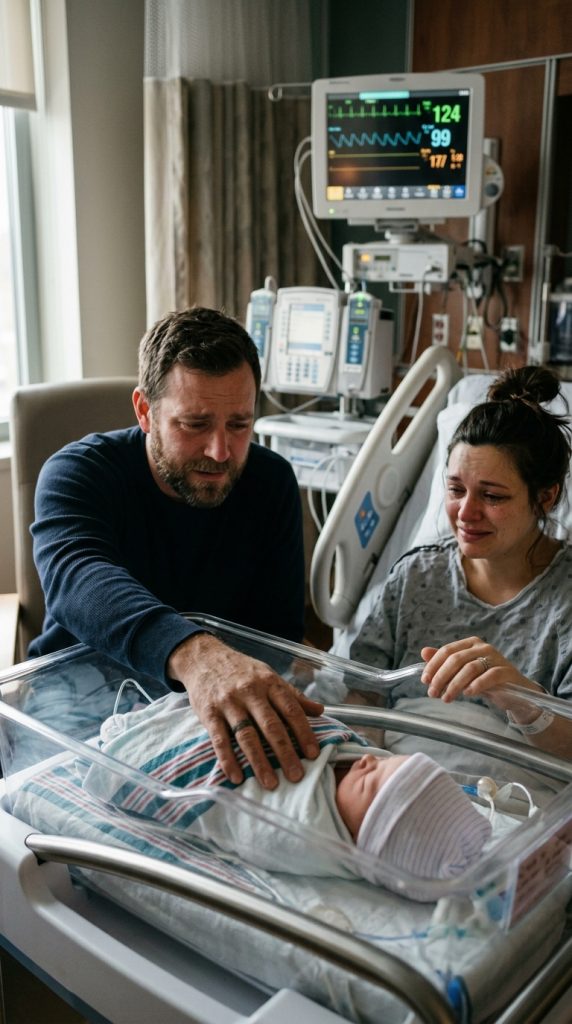
The hospital room smelled of antiseptic and quiet hope. Morning light filtered through half-drawn blinds, casting gentle stripes across Emiliano’s crib. The monitors beeped steadily now, no longer frantic. Mariana sat in the worn armchair, her son nestled against her chest, his small hand curled around the fabric of her damp shirt like an anchor. She hadn’t slept. She couldn’t. Every breath he took felt like a gift she had nearly lost.
Santiago entered slowly, as if the room were made of fragile glass. He had shed the black suit jacket somewhere along the way; his white shirt was wrinkled, sleeves rolled up, revealing forearms marked by years of tension. He stopped a respectful distance from the chair, eyes fixed on the baby—their baby—before lifting them to Mariana’s face.
“You don’t have to let me stay,” he said, voice low and rough. “But I’m asking anyway.”
Mariana studied him. The man who once commanded rooms with a glance now looked uncertain, almost humbled. Fifteen months of silence, of carefully constructed walls, cracked inside her. She remembered the nights she had whispered stories to her growing belly, promising the child safety away from the Beltrán shadows. Yet here, in the exhaustion of dawn, those shadows had names and faces—mostly Renata’s—and Santiago had chosen to stand in the light beside her.
“Come closer,” she whispered. “He should know his father’s voice.”
Santiago knelt beside the chair again, this time without hesitation. He reached out, his large hand hovering before gently brushing a strand of dark hair from Emiliano’s forehead. The baby stirred, letting out a soft, sleepy sigh that tugged at something deep in both their chests.
“I missed everything,” Santiago murmured, the words heavy with regret. “The first kick. The first cry. The way you must have fought alone.” He paused, swallowing. “I built empires, Mariana, but I failed at the one thing that mattered most. Protecting what was mine—ours.”
Tears slipped down Mariana’s cheeks, but she didn’t wipe them away. “I was so scared of becoming another casualty in your family’s games. Your mother made it clear: I was temporary. Replaceable. When the lawyer came with those papers… it felt like confirmation.”
Santiago’s jaw tightened, but his touch on the baby remained feather-light. “I’ve already started the process. Manuel Cárdenas will answer for what he did. So will the others who helped bury this. But more than justice, I want you to know—I’m not here to reclaim anything by force. Not you. Not him. I want to earn the right to be in your lives.”
Over the next hours, as Emiliano’s fever continued to retreat under the tailored treatment from the family records, small truths unfolded like fragile bridges. Santiago spoke of the months after she vanished: the unanswered calls, the private investigators who hit walls built by his own mother’s influence, the gnawing doubt he had buried under work. He had thrown himself into projects across Monterrey, convincing himself that her departure proved she never truly belonged in his world.
Mariana shared her side—the lonely ultrasound appointments, the cash-only jobs cleaning houses in Narvarte, the way she sang old rancheras to Emiliano to calm his colic. She told him about the moon blanket, the hatred of carrots, the 3:12 a.m. wake-ups that now felt like tiny miracles rather than burdens. Each detail humanized the chasm between them, turning abstract loss into shared tenderness.
By midday, the legal machinery Santiago’s team had set in motion began to yield results. Renata was formally questioned. Evidence of forged signatures, hidden medical files, and the planted hospital administrator painted a damning picture—not just of coercion, but of a calculated effort to erase Mariana and control the next generation of the Beltrán legacy. Yet Mariana refused to let hatred consume her.
“I don’t want to destroy your family,” she told Santiago quietly while Emiliano napped. “I want our son to grow up knowing strength doesn’t come from power or money. It comes from choosing kindness when cruelty is easier. From showing up, even when it’s late.”
Santiago nodded, eyes glistening. “Then teach me how. I have resources, but you have the heart I lost somewhere along the way.”
In the weeks that followed, Emiliano recovered fully, his episodes monitored with the care his grandmother had tried to withhold. Santiago honored his word. He took only the time Mariana offered—short visits at first, then longer afternoons in neutral parks where bodyguards kept their distance. He learned to change diapers with clumsy determination, hummed the same rancheras off-key, and sat through sleepless nights when the 3:12 wake-up arrived.
Renata’s influence waned. The amendment from Santiago’s late father—revealing a man who had quietly seen Mariana’s quiet strength—ensured the child’s future was protected beyond any one person’s greed. It was a final act of quiet rebellion from the grave, a reminder that bloodlines endure not through control, but through love and integrity.
One evening, months later, as golden light bathed their small balcony in Narvarte, Santiago held Emiliano on his lap while Mariana watched from the doorway. The baby laughed at a silly face his father made, reaching for the moon on his favorite blanket.
“I’m still afraid sometimes,” Mariana admitted softly. “Of trusting too much. Of the world you come from.”
Santiago looked up, his expression open and steady. “Then we face it together. No helicopters unless it’s for a vacation. No more buried truths. Just us—figuring out how to be a family the right way.”
Mariana stepped forward, placing her hand over his. In that touch, the weight of betrayal lifted, replaced by something harder-won: cautious hope, rebuilt trust, and the profound human truth that even the deepest wounds can heal when two people choose the child’s light over old darkness.
Emiliano cooed between them, unaware of the storms that had nearly claimed him. But his parents knew. And in protecting him, they had begun to save each other too.
