

Part 1: The Eighty Cents
“Mom, just buy one sandwich. Willa and I can share it.”
The words came from a girl of barely four, small and serious, her chin hardly clearing the glass of the pastry case. They stopped Weston Hale in his tracks a few steps from the counter, his hand still on the brass door handle and the little bell above him still trembling.
Only an hour earlier he had sat at the head of a glass conference table, negotiating the purchase of three luxury buildings on the Gold Coast. He had shaken hands, checked his watch, and slipped into this neighborhood only because his driver had taken a wrong turn and the smell of baking bread had drifted through a cracked window. Now he was looking at something he never could have imagined.
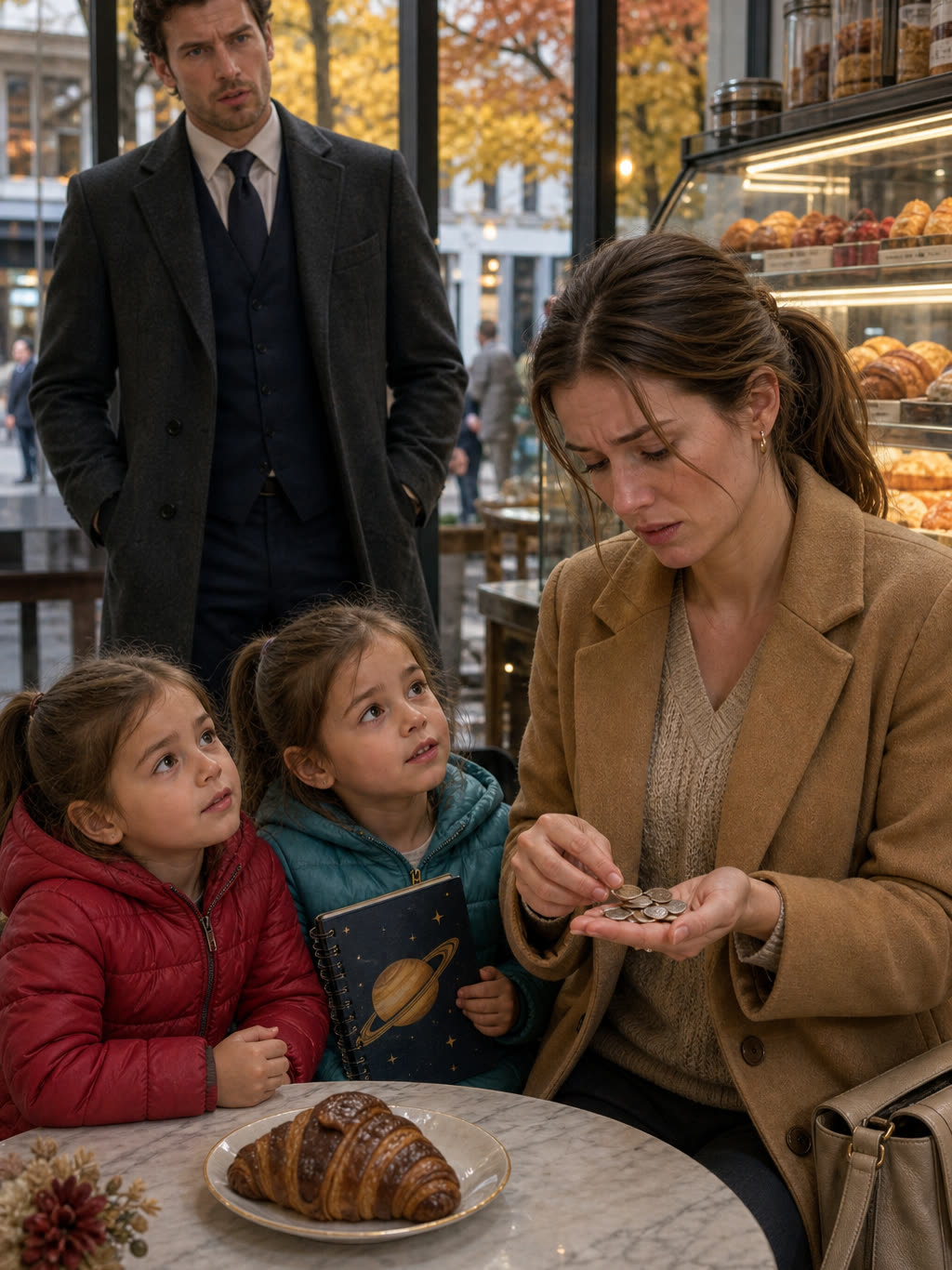
His ex-wife, Delia Rowe, was counting dimes and quarters on the counter of a small bakery on the South Side.
She wore a worn coat, old sneakers, and her hair pulled back in a hurry. The coat had been a good one once, camel-colored and well cut, but the cuffs had frayed and one button did not match the rest. She pushed the coins into little columns with a fingertip, the way a person does when she has made the same sum many times and still hopes it might come out differently.
Beside her stood two identical little girls with dark eyes and brown hair. One stared at the chocolate croissants with a longing that broke your heart. The other hugged a notebook full of drawings of planets, pressing it to her chest as though someone might try to take it away.
“Josie, sweetheart, you don’t have to share anything,” Delia whispered. “Mommy has enough for both of you.”
But Weston watched her count the coins again. Her lips moved without a sound. Her shoulders rose, held, and slowly fell.
She was eighty cents short.
The baker, an older man named Walt, pretended to check the register. He tapped keys that did not need tapping and frowned at a receipt tape that was perfectly fine, the performance of a man who had done this more than once and was not about to be caught at it.
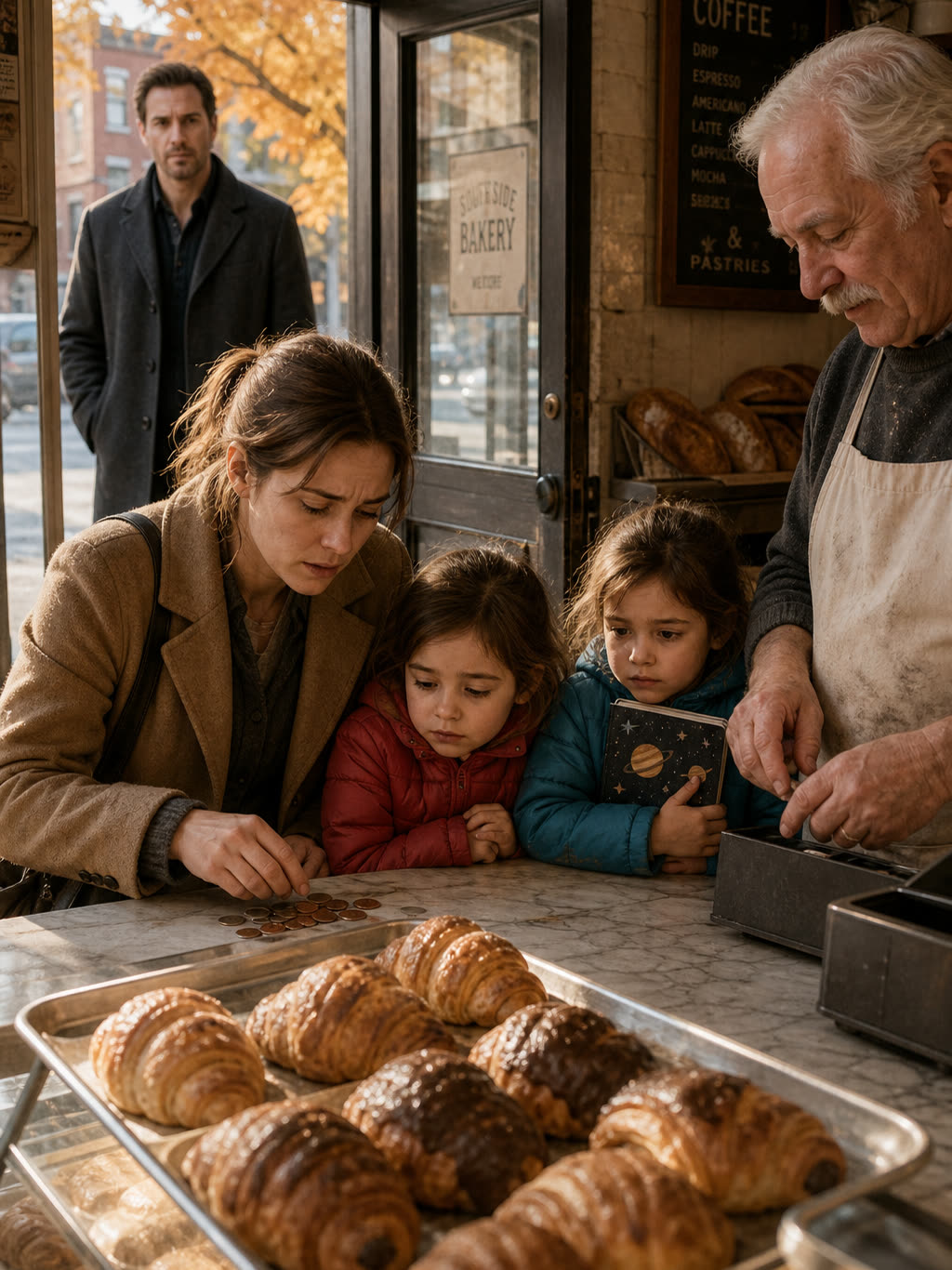
“Go on, Delia, we’ve got a special today. Both croissants are on the house.”
“Walt, I can’t keep accepting…”
“And I can’t keep arguing with such a stubborn teacher.”
The girls grinned. Delia lowered her eyes, grateful and ashamed at the same time, and Weston saw the color rise in her cheeks the way it always had when someone was kind to her and she felt she had not earned it. He knew that blush. Once, a long time ago, he had been the one to bring it to her face.
He backed toward the door as quietly as a man in a three-thousand-dollar coat could manage. He did not want her to turn and find him there. He did not want to explain himself, and he honestly did not know what he would have said.
It had been five years since he had seen her. The last time, Delia had walked out of his Lake Forest mansion dragging a single suitcase, after hearing a sentence he still remembered perfectly. He had said it in the marble foyer, under a chandelier that cost more than her yearly salary, without even raising his voice.
“If you can’t learn your place at my side, you’d better disappear from my life.”
And she had disappeared. She hadn’t slammed a door or thrown a vase. She had simply looked at him for a long moment, nodded as if he had confirmed something she had already known, and gone out into the rain.
For years, Weston told himself it had been the right thing. He needed a wife ready to accompany him to receptions, meetings with investors, and international trips. A wife who would smile in photographs and remember the names of donors’ children. Delia only wanted to keep teaching science, to spend her evenings grading lab reports at the kitchen table and her weekends taking students to look through telescopes on cold fields outside the city.
He had called her stubborn. He had called her small-minded. He had never once considered that she might simply have known better than he did what a life was for.
Now, seeing her, he understood that he had confused ambition with happiness. The realization landed in his chest like a stone dropped into still water, and the ripples spread everywhere.
He slipped outside and stood on the sidewalk with the cold wind tugging at his collar. Through the fogged window he could see the girls climbing onto stools, each with a croissant held in both hands, chocolate already on their chins. Delia stood behind them, one hand resting lightly on each small head, her eyes closed for just a second as if she were allowing herself a single breath of rest.
But what truly froze his blood was one detail.
One of the girls laughed, tipped her head back, and raised a single eyebrow, exactly the way her father did when he was excited. It was a crooked, mischievous arch, impossible to mistake and impossible to teach.
The way Weston did.
He stood there so long that his driver stepped out of the car and asked if he was all right. Weston said he was fine. He got into the back seat and stared at nothing the whole ride to Michigan Avenue, doing arithmetic that had nothing to do with money.
Twin girls, perhaps four. Five years since the divorce. The numbers wouldn’t sit still in his head, and every time he tried to make them mean something else, they slid right back into the same terrible shape.
That night, from his office on Michigan Avenue, with the city lights spread beneath him like spilled jewelry and the lake a black void beyond them, he called his trusted attorney.
“Gerald, I need you to find out whether Delia Rowe has children.”
“Weston, after all this time?”
“Please. Just do it.”
There was a pause on the line, and then the sound of Gerald, who had known him for fifteen years, deciding not to ask. “I’ll have something by morning.”
Weston did not go home. He sat in the leather chair with his coat still on and the lights off and watched the red taillights crawl along Lake Shore Drive. Twice he picked up his phone to call her. Twice he set it down, because he had no right.
He thought about the way Delia had counted those coins. He thought about the way she had said Mommy has enough for both of you, in a voice made of pure, practiced calm, a voice designed so that no child would ever hear the fear underneath it. He knew that voice. He had heard his own mother use it on his father, in the years when the money had been uncertain, and he had hated it then too.
He never closed his eyes. When dawn came gray over the lake, he was still sitting there, and he realized he had not been this afraid since he was a boy.
The next morning he got his answer. Delia had two twin daughters, Josie and Willa Rowe. They had been born prematurely, seven months after the marriage ended.
Weston felt the air leave his lungs. He read the line again, and again, as though the words might rearrange themselves if he were patient enough. The dates fit. The ages fit. And that look…
“Who’s listed as the father?”
Gerald took a few seconds to answer. His voice had changed, becoming careful, the voice of a man walking out on thin ice. “No father is recorded.”
Weston closed his eyes. Somewhere in the building a door opened and shut, and an elevator hummed. He thought of Willa and her notebook of planets, and of Josie’s eyebrow, and he thought: they were three feet away from me, and I walked out.
Then a second message arrived from his lawyer.
There’s more. I found documents from the old firm that handled your divorce. Delia tried to contact you while she was pregnant.
Weston sat bolt upright. The chair rolled back and struck the window. “Then why did I never receive anything?”
He waited. The silence stretched so long he checked the screen to make sure the call hadn’t dropped. When Gerald finally spoke, he sounded like a man who had read the answer a dozen times and still could not make himself say it aloud.
Gerald’s answer sent a chill through him.
“Because…”
Part 2: The Locked Drawer
“Because someone in your own family made sure it never reached your hands.”
Weston demanded the name. His voice came out low and flat, and it frightened him a little, because it sounded exactly like his father’s.
Gerald did not answer over the phone. He arrived forty minutes later with his coat still buttoned and his face the color of ash, and he placed on Weston’s desk a copy of a letter dated five years earlier.
It was written in a neat, careful hand, the handwriting of a woman who had spent years teaching children how to form their letters. In it, Delia announced that she was pregnant and asked to speak with her ex-husband in person. She did not ask for money. She did not ask for anything except a conversation, and every line was so restrained, so painfully polite, that Weston felt it like a blow.
On the last page was a signature acknowledging receipt: Marguerite Hale.
His mother. The same woman who had always considered Delia a schoolteacher without enough standing to belong in the family. The woman who had once, at a Christmas dinner, asked Delia in front of twenty guests whether she planned to keep working “as a hobby.”
Weston stared at the signature until the letters swam. It was the same graceful loop he had seen on birthday cards and thank-you notes his whole life, the signature of a woman who never wrote anything carelessly.
He picked up the phone and called her immediately.
“Did you know Delia was pregnant?”
Silence on the other end. It lasted long enough that he could hear a clock ticking somewhere behind her. “Son, it’s not wise to stir up the past.”

“I asked you a question.”
“Son, it’s not wise to stir up the past,” Marguerite repeated, and then she did something she never did. She hesitated.
“Mother. Five years. Two little girls. Tell me what you did.”
“I did what I had to do to protect our fortune.” Her voice was cool and clipped, as if she were reading a quarterly report. “That woman had nothing. No family, no money, no name. A pregnancy at that moment was a lever, Weston. Today it’s a baby. Tomorrow it’s a lawsuit, a claim on the Hale trust, a scandal in the Tribune. I made sure it never became any of those.”
“You made sure I never met my own daughters.”
“I made sure you stayed yours.” A pause. “You were about to close the Harbor Point acquisition. You needed to be clean.”
She believes this, Weston thought. That was the worst part. There was no malice in her voice, only the serene conviction of a woman who had never once been told no.
He could picture her exactly: seated upright in the sunroom in Winnetka, one hand on the teacup, the other resting on the arm of her chair, her eyes fixed on some point just past the person she was speaking to. She had used that tone with servants, with board members, with the little boy he had once been when he cried over a broken toy. Stop that. It is only a thing.
He hung up without another word.
He sat in the dark office for an hour. The city lights came on one by one across the window, then the traffic thickened and thinned, and still he did not move. He thought of the hospital bracelet that might have been, and of every birthday and first step and fever he had not been told about. He thought of Delia, eight months pregnant, alone, waiting for a phone to ring in an apartment he had never seen.
Then he opened his laptop, pulled up the term sheet for the $600 million deal, and wrote one line to his partners.
Cancel it. All of it.
His phone started ringing before he had finished typing. He let it ring. It rang again, and then a third time, the screen lighting up with names that, until yesterday, would have made him sit up straighter. He turned the phone face down on the desk and watched the light leak out around its edges until the ringing finally stopped.
He did not sleep. At some point near dawn he found himself standing at the window with his forehead against the glass, whispering the names Josie and Willa as though they were words in a language he was only beginning to learn.
Gerald arrived at seven the next morning with two coffees and a thick folder.
“You realize you just walked away from the biggest deal of your career,” he said.
“I realize it.”
“The board will want an explanation.”
“They’ll get one.” Weston rubbed his eyes. They felt full of sand. “Gerald, I need to know everything. Not just the letter. Everything my mother touched in those years.”
Gerald nodded slowly and opened the folder. His hands, Weston noticed, were not quite steady. “I’ve been digging since you called. Your mother paid the firm that handled the divorce a retainer for ‘ongoing correspondence management.’ Anything addressed to you from Delia was intercepted. Letters, certified mail, even a courier package.”
“A package?”
“Eight months into the pregnancy. Delia sent something to your office. It was signed for by your mother’s assistant and, according to the log, forwarded to the family estate in Winnetka.” Gerald slid a photocopy across the desk. The signature on the courier slip was smudged but legible. “It’s still there, Weston. Marguerite doesn’t throw anything away.”
Weston was already standing. He did not remember deciding to stand. He took his coat from the back of the chair and was through the door before Gerald had finished closing the folder.
The drive north took fifty minutes. He did not turn on the radio. Along the lakeshore the trees had gone to flame, red maples and gold oaks standing against a hard blue sky, and he noticed none of it until the gates of the Winnetka estate rose in front of him, black iron and familiar.
The house smelled like lemon polish and old money.
Marguerite received him in the sunroom, a silver tea service on the table, her posture perfect. If she had been rattled by his call, nothing showed. Her pearls lay straight against her collarbone. Her hair was immaculate.
“You’re making a scene,” she said.
“I’m going to your study,” Weston said. “You can come or not.”
He didn’t wait. The corridors he had walked as a boy seemed narrower now, the portraits of dead Hales watching him pass with their painted, disapproving eyes. Her study was exactly as it had been when he was a child: dark wood, leather chairs, a mahogany desk with a locked bottom drawer. He had never once seen it open. As a boy he had thought it held secrets about money. It had never occurred to him that it might hold secrets about him.
He broke it with a letter opener. The wood splintered with a crack that echoed through the quiet house.
Inside lay a bundle of envelopes tied with a ribbon, every one addressed to him in Delia’s neat teacher’s handwriting. There were dozens. Beneath them was a padded courier envelope, still sealed.
Marguerite appeared in the doorway. For the first time in his life, she looked her age. The light from the hall fell across her face and showed every line.
“Don’t,” she said quietly.
Weston tore it open.
Inside was a small hospital bracelet, the kind they put on newborns, labeled Baby A Rowe. Beneath it lay a single folded sheet. His hands were shaking so badly that he had to set it on the desk to flatten it.
Weston,
I know you told me to disappear, and I will. But I won’t let you hear about this from a stranger. The doctors say I’m carrying twins. Girls. I’m scared, and I’m doing it alone, and I would give anything for you to be the man I thought you were when we met.
If you want to be their father, call me. If you don’t, I’ll understand, and I’ll never ask again.
I named the first one Josephine, after my grandmother. The second I haven’t decided. Maybe you’d like to help.
Delia
The paper shook in his hands. He read it twice. Then he read the last line a third time.
She had left the second name open for him.
“She was going to let me name our daughter,” he whispered. His throat closed around the words, and for a moment he could not breathe.
Marguerite said nothing.
“And you put it in a drawer.”
The sentence hung in the air between them. Outside the window a gardener’s mower droned across the lawn, absurdly cheerful. Weston pressed the bracelet to his palm, so small, so light, the kind of thing that should have been measured against a newborn’s wrist and had instead been measured against five years of silence.
He turned to leave, and that was when he saw it.
There was one more envelope at the bottom of the drawer, older than the others, yellowed at the edges. It had been pushed far into the back corner, as if someone had wanted it to be the last thing found.
It wasn’t from Delia.
It was addressed to Weston in his father’s handwriting. Richard Hale had died when Weston was twenty-six. Weston turned it over. The seal had never been broken.
“Your father left it with his lawyer,” Marguerite said, her voice thin. “It was to be given to you on your thirtieth birthday. I told the lawyer you’d already received it.”
Part 3: Saturdays
“You lied about my father’s letter?”
“I read it,” she said. “I knew what it would do.”
He opened it with fingers that no longer felt like his own. The paper was brittle, and the seal gave way with a soft crackle, as if it had been waiting sixteen years for exactly this moment.
The handwriting was unmistakable, heavy and slanted, the same hand that had signed a thousand contracts and, apparently, one letter that mattered.
Weston,
If you’re reading this, I’m gone, and your mother has probably done her best to keep you from the one thing I wanted you to know. I made my fortune by being hard. I lost my brother, my friends, and nearly my wife that way. Don’t repeat it.
When you find someone who loves you for who you are rather than what you own, don’t let anyone, including me, including your mother, talk you out of her. Money is only worth what it lets you protect.
There is a trust in your name that has nothing to do with the company. It was meant for your family. Use it for them.
Dad
Weston lowered the letter slowly. His eyes burned. He read the words again in his head, hearing them, for the first time in his life, in a voice that sounded almost gentle.
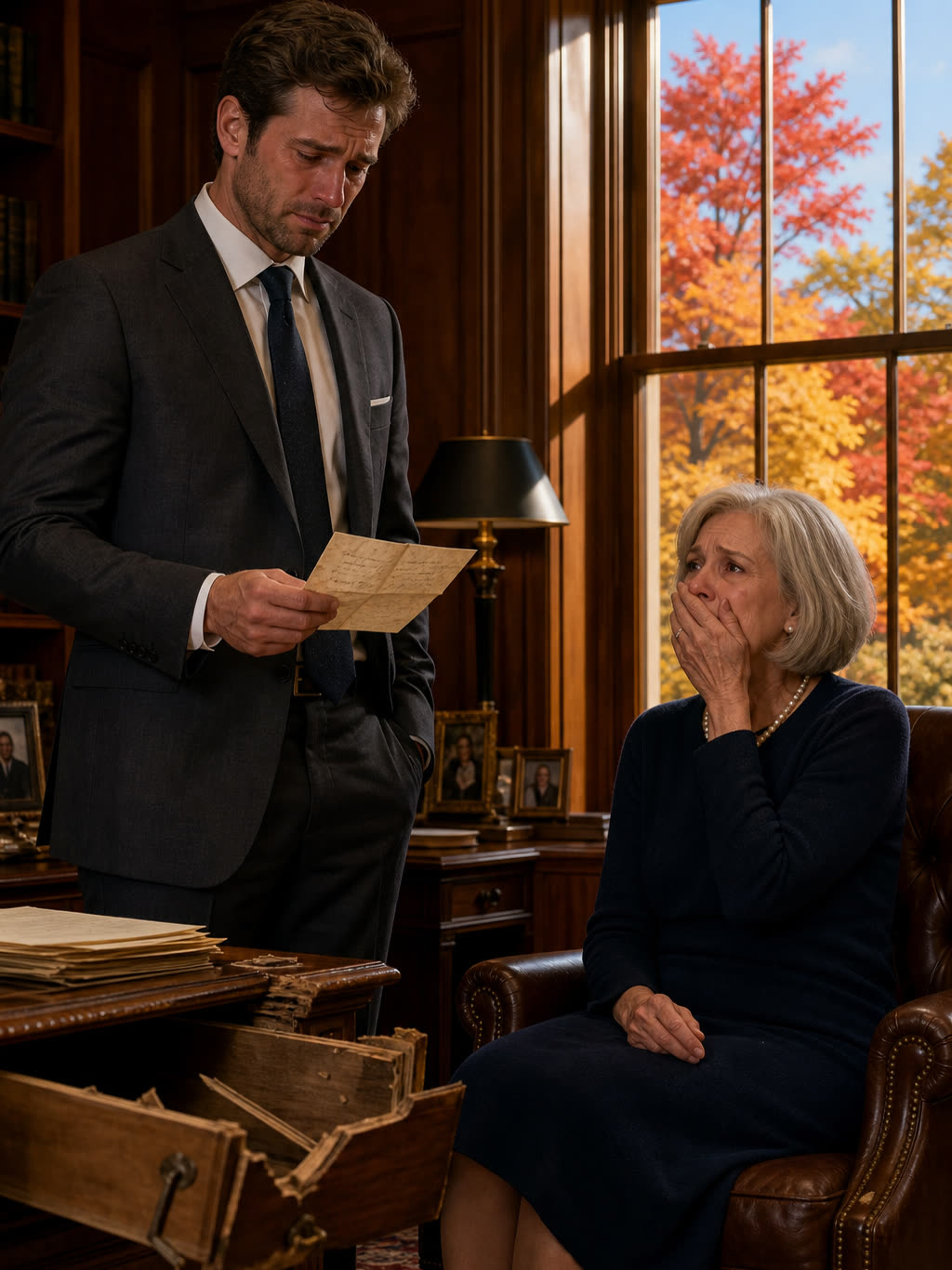
His whole life he had believed his father was a ruthless man whose approval he could never earn. He had spent decades chasing a nod, a handshake, a single sentence of praise. And here was the one sentence his father had wanted him to hear, kept from him for sixteen years by the woman now standing in the doorway.
“Why?” Weston asked.
Marguerite’s composure finally cracked.
“Because I was afraid,” she said, and her voice broke. “Your father nearly left me for a woman who loved him the way that girl loved you. I spent thirty years making sure it never happened again. I couldn’t stand to watch you become him.”
“You became worse,” Weston said, not unkindly. “You just did it quietly.”
She flinched as if he had struck her. Then she lowered herself into one of the leather chairs, her hand over her mouth, and for a long time neither of them spoke. The mower outside droned on. A clock in the hall chimed the quarter hour. Somewhere in the house a door closed softly, and the silence afterward felt enormous.
He wanted to feel rage. He had expected rage, had driven fifty minutes with it burning in his chest like a coal. But what he felt instead was a vast, exhausted sorrow, for her, for his father, for the boy who had grown up in this house learning that love was a thing you could lose by wanting it too openly.
“I’m taking these,” he said, gathering the letters, the bracelet, his father’s note. “And I’m going to find out whether Delia will ever speak to me again.”
He did not wait for her answer.
Delia agreed to meet him in the park across from the bakery. It had taken three phone calls and a message left with Walt, who had looked at Weston across the counter for a very long moment before writing down the number.
He arrived forty minutes early and sat on a bench with the letters in his lap, rehearsing sentences that all sounded wrong. The park was ablaze with autumn. Maples dropped scarlet leaves onto the path, and beyond the trees the lake glittered under a clean, high sky. He had never noticed this park, though it was twenty minutes from his office.
She came with the girls, one hand in each of theirs, wearing the same worn coat. Her face was guarded. Josie spotted the bag of croissants he’d brought and tugged her mother’s hand. Willa, the quieter one, clutched her planet notebook and watched him with Delia’s careful eyes.
“Hello, Delia.”
“Weston.”
He stood. Neither of them moved. A gust of wind lifted the leaves between them and let them fall again.
“I have something that belongs to you,” he said, and held out the bundle of envelopes.
She recognized her own handwriting and went pale. “Where did you…”
“My mother kept them. All of them. I never saw one until yesterday.”
Delia sank onto the bench beside him. She untied the ribbon with shaking hands. When she reached the hospital bracelet, she covered her mouth.
“I thought you knew,” she whispered. “I thought you read them and decided. For five years I told myself you chose not to call.”
“I didn’t know. I’m not asking you to forgive me for what I said when you left. I said it. It was mine.” His voice shook. “But I’d like to try to be what you hoped I’d be. Slowly. However you want.”
She looked at the girls, who were already negotiating over the croissants, Willa carefully breaking hers in half so Josie could have the bigger piece.
“They don’t know who you are,” Delia said.
“Then tell them when you’re ready. Or never, if that’s what you decide. I’ll help either way. Money, time, anything. But I’m not walking away again.”
Delia wiped her eyes and nodded once.
“Saturdays,” she said. “Here. One hour. We’ll see.”
“Saturdays,” he said.
The first Saturday, he barely spoke. He sat on the bench and watched Josie chase pigeons while Willa drew rings around a planet in her notebook, and when the hour ended he thanked Delia as though she had handed him a kingdom. She watched him go with an expression he could not read.
It took a year before Willa climbed into his lap without being asked.
It took two before the girls called him Dad. Josie said it first, absently, over a bowl of cereal, and then looked up to see him frozen with the spoon halfway to his mouth.
“Are you crying?” she asked.
“No,” Weston said, which was a lie.
He used his father’s trust to endow a science scholarship at Delia’s school and to buy the little bakery on the South Side outright, then quietly deeded it to Walt. He sold Harbor Point’s competitor at a loss and slept better than he had in a decade.
Marguerite wrote him a letter. He read it, kept it, and didn’t answer it for a long time. Eventually he invited her to Josie’s sixth birthday, with Delia’s permission, with ground rules. She came, sat very straight, and brought the girls a telescope.
Willa pointed it at the moon that night and went silent for ten minutes.
“Dad,” she said finally. “It’s real.”
“It’s real,” he said.
Delia stood beside him on the porch, her shoulder against his, not quite touching, not quite apart. They were not rebuilt. They were something newer, slower, and honest.
He had walked out of a $600 million deal because he saw a woman counting coins. It was the best bad deal he ever made.
THE END
Disclaimer: This story is a work of fiction inspired by real-life themes. Names, characters, places and events are fictionalized, and any resemblance to real persons is purely coincidental. Images are for illustration purposes only.
