

The Woman Who Arrived with a Suitcase
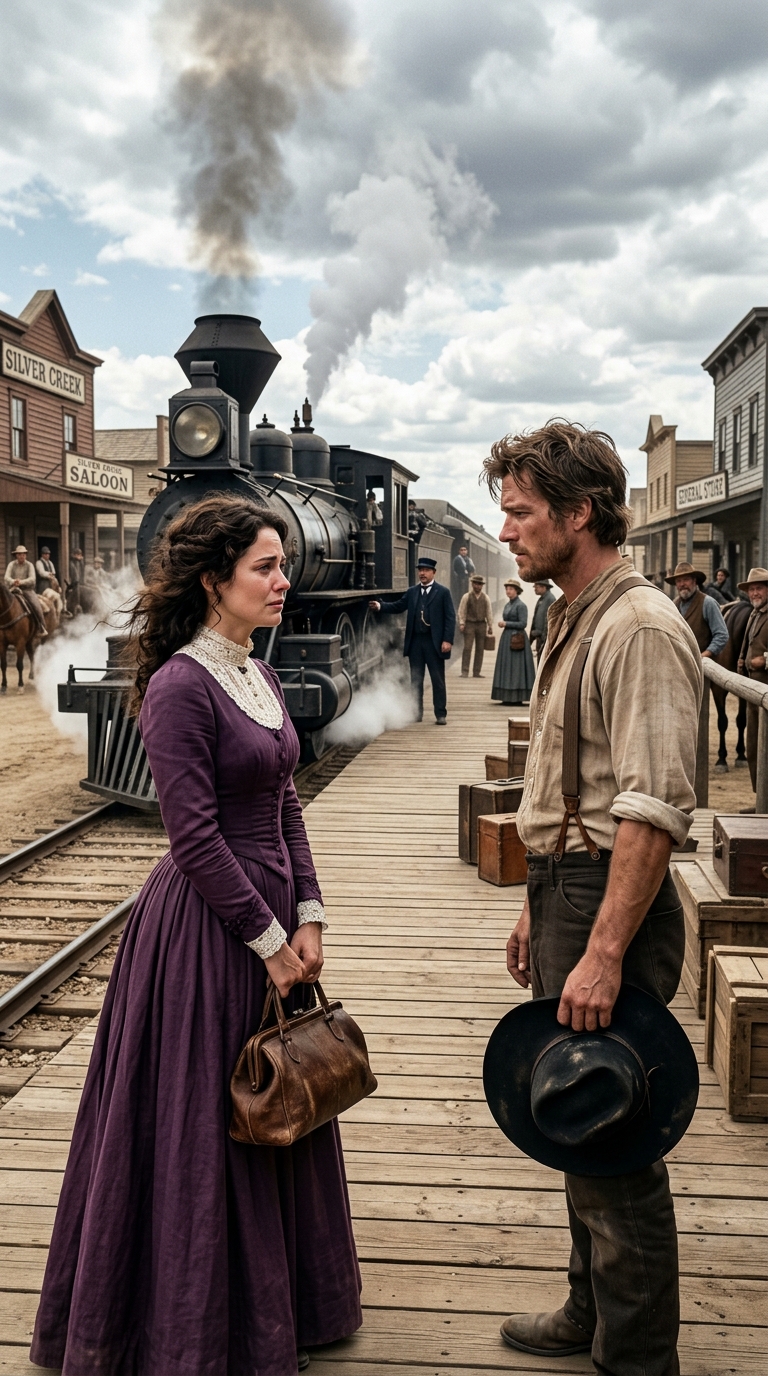
Amalia Robles arrived in San Jacinto on a Wednesday at two-thirty in the afternoon, when the train released a cloud of steam over the platform and the dust from the road clung to the shoes of everyone who was waiting.
She was the last to get off.
She carried a single worn leather suitcase, a dark blue dress that had been carefully ironed before the trip and now showed wrinkles in the skirt, and a way of keeping her chin raised that was not pride, but defense. She was twenty-five years old, with empty hands and the eyes of a woman who had decided, before setting foot on unknown ground, that she would not fall apart in front of anyone.
At the other end of the platform, Aurelio Peñafiel was waiting for her.
Amalia recognized him by his gray felt hat and by the folded paper he held between his fingers. They had exchanged letters for eight months through a marriage agency in Guadalajara. He had written that he was a merchant, that he had a respectable house, and that he was looking for an honest wife. She had replied from the Santa Clara orphanage, where she had been raised and where, after turning eighteen, she stayed sewing other people’s clothes, washing sheets, and saving coin by coin to one day have a life of her own.
When Aurelio’s proposal arrived, Amalia read it three times. It was not love, but it was a door. And a door, for a woman without family, could look very much like salvation.
She spent the last money she had on the ticket.
Aurelio approached slowly. He did not smile. He did not offer his hand either.
“Miss Robles,” he said, looking at the paper and not at her face. “I cannot go through with this.”
The murmur of the platform fell as if someone had thrown a blanket over the entire town.
Amalia did not answer.
Aurelio took a deep breath, like a man who had already rehearsed his cowardice and still hoped it would sound dignified.
“I have changed my mind. I am not obligated to marry. It was an agreement by letter, nothing more. I will pay you… well, not now, but later perhaps I can return part of the ticket fare.”
He said it loud enough for the telegraph operator’s wife, two mule drivers, the luggage boy, and a group of boys pretending to arrange sacks to hear.

That was the real cruelty: not leaving her alone with the humiliation.
Amalia felt the heat rise to her neck, but she did not lower her gaze. Aurelio waved the agency papers as if they could justify a woman traveling for days only to be abandoned before the first hour.
“You will understand,” he added.
Amalia thought of the cold dormitories of the orphanage. Of the younger girls watching her leave as if she had won a new life. She thought of the last coin she had handed over for the ticket. She thought that she had no money to return.
“I understand perfectly,” she said at last.
Aurelio blinked. Maybe he had expected pleading. Maybe tears. He received neither.
He put the papers in his coat and left without looking back.
The platform began to empty around her. People pretended to be in a hurry, but everyone turned one more time before crossing the street. By dinnertime, half of San Jacinto would know that the mail-order bride had been abandoned. By the next morning, even the priest would know.
Amalia stood with her suitcase at her feet.
On the other side of the street, a man came out of the hardware store with a bag of nails and hinges. He stopped on the wooden step. He was thirty-two years old, with broad shoulders, carpenter’s hands, and sawdust stuck to his sleeve. His face was serious, tired—not from a difficult day, but from several years combined.
His name was Tomás Cárdenas.
He saw the woman on the platform, the suitcase, the straight back, the empty space where another man had just shown his smallness. He asked nothing. He crossed the street.
He stopped at the foot of the steps.
“My name is Tomás Cárdenas,” he said. “I have two children and a house that needs order. I work as a carpenter three days a week. There is a room next to the kitchen, with its own door. I am not offering you marriage or charity. I am offering you a roof, food, and fair pay until you decide what to do.”
Amalia looked at him carefully.
She had learned to measure men by what they did with their hands while they spoke. Tomás was not trying to touch her, he was not smiling too much, he was not looking at her body or her suitcase. He was simply waiting for an answer.
“Are your children small?” she asked.
“The oldest is ten. The girl is six.”
“Do they know how to obey?”
For the first time, something like a smile crossed Tomás’s face.
“The oldest thinks he does. The girl thinks everything can be fixed by asking.”
Amalia picked up her suitcase.
“Then let’s go.”
They walked together off the platform. Behind them, the town watched in silence and saved the scene to comment on later.
Tomás’s house was on the edge of San Jacinto, near some mesquite trees and a small corral. It had a fence that needed repair, an old horse tied in the shade, and a loose front step that Amalia noticed without saying anything.
Inside, the house was clean but without tenderness. Everything was useful, nothing was decorative. There was a square table, an iron stove, tools neatly arranged against the wall, and on a shelf, a sewing basket with a wooden lid that seemed untouched for a long time.
“It belonged to my wife,” Tomás said, though Amalia had not asked. “She died two years ago.”
She nodded.
“I won’t touch what I shouldn’t touch.”
“The room is yours,” he indicated. “My children eat at six. I come back when I finish work.”
At that moment the boy appeared.
His name was Julián. He was ten years old and had a look that was too serious for his age. He observed Amalia as if she were a repetition of something that had already gone wrong. Then he looked at his father.
“Another one?” he asked.
Tomás hardened his face.
“Julián.”
But Amalia raised a hand.
“It’s all right. I would have asked the same thing.”
The boy did not know what to do with that answer. He left without saying more.
The girl appeared later, almost without a sound. Her name was Lupita. She had a ribbon neatly tied in one braid and the other hanging like a defeat. She looked at Amalia with wide-open eyes.
“Do you know how to make atole?” she asked.
“I know how to make it,” Amalia replied. “But I need to know if anyone here knows how to grind cinnamon without spilling it.”
Lupita raised her hand immediately.
“I do.”
“Then come, Miss Helper.”
That first dinner was beans, cornbread, and a simple broth that smelled better than it should have with so few ingredients. Tomás came in from the corral and paused for a second at the door. Something moved across his face, something he did not want to show.
Julián ate in silence. Lupita looked at her plate, then at Amalia, then at her plate again, as if she feared the food would disappear if she stopped watching it.
In the middle of dinner, the girl said:
“The lady who came before burned everything.”
“Lupita,” Tomás murmured.
Amalia did not look up.
“Burned beans are a serious matter. We are not going to take it lightly here.”
Julián lowered his head, but Amalia saw the corner of his mouth twitch slightly.
The next day, Tomás stepped on the front step and stopped. It no longer moved. Someone had fixed it at dawn with a wooden wedge and two nails.
He entered the kitchen, poured two cups of coffee, and left one near Amalia.
He did not say thank you.
She did not say you’re welcome.
That was how it all began.
The days found their rhythm. Amalia washed, cooked, mended clothes, organized the pantry, and placed wildflowers in a broken jug she found behind the corral. Julián tested her on the fifth day by not bringing the firewood she had asked for.
“Julián, the firewood,” she said from the kitchen.
“In a minute.”
“No. Now, please.”
The boy looked at her, searching for anger, threat, or false sweetness. He found none. Only firmness.

He got up and brought the firewood.
“Thank you,” she said.
Julián stood still for a moment, as if that word had touched a part of him he did not know how to defend.
With Lupita it was different. The girl stuck to Amalia like a little shadow. She followed her everywhere, asking her about sewing, soups, buttons, stars, and the scars of the world. One afternoon, while Amalia read her a story by the stove, Lupita rested her head on her arm with such complete trust that Amalia had to look toward the window to keep from crying.
Tomás saw everything and spoke little.
One cold morning, Lupita tripped on the kitchen threshold and fell on her hands. First she made a sound of surprise. Then she decided it deserved crying.
Amalia knelt immediately, took her small palms, blew on them gently, and held her.
“It’s over, my girl. It’s over.”
Lupita, through her tears, said the word without thinking:
“Mommy…”
The whole house fell silent.
Amalia did not move for a second. Then she hugged the girl to her chest and rocked her until the crying stopped.
Tomás was standing in the hallway doorway. He had heard. Julián, sitting at the table, stopped carving a piece of wood. No one said anything, but something changed in the house forever.
The news did not take long to spread.
In San Jacinto, the women did not need proof to pass judgment. All it took was a cup of chocolate and three phrases spoken in a low voice.
One afternoon, in the grocery store, Doña Beatriz Solórzano positioned herself next to Amalia with a churchgoing smile.
“There are things a woman must be careful about, my dear. People talk. A widower, a woman alone, confused children… Don’t get too used to a place that doesn’t belong to you.”
Amalia counted her coins on the counter, one by one.
“Thank you for your concern.”
“I’m saying it for your own good.”
Amalia raised her gaze.
“No. You’re saying it to feel superior.”
Doña Beatriz was left speechless. The shopkeeper coughed to hide a laugh.
That night, Tomás noticed that Amalia was quieter. While she washed the dishes, he stoked the fire.
“Are you all right?” he asked.
Amalia thought before answering.
“I’m tired of other people deciding what I am.”
Tomás nodded.
“You don’t have to prove anything to me here.”
She continued washing.
“That’s new for me.”
Almost a month of calm passed.
Then Aurelio returned.
The news had reached him at the cantina. A mule driver mentioned that the woman abandoned on the platform was now living in Tomás Cárdenas’s house, that the children were better, that the house smelled of food, and that the youngest girl already called her mom. Aurelio listened with wounded pride. He had not wanted Amalia, but he could not stand that another man had taken her in where he had left her.
He arrived on a Thursday morning, when Tomás and Amalia were leaving the post office together. She carried a letter from the orphanage in her hand. He carried a wood order.
Aurelio planted himself in the middle of the street with the agency papers.
“This is not over,” he said loudly. “I paid the registration fee. There was an agreement. This woman came to marry me.”
The street came to a stop.
Amalia felt the past trying to put a hand on her neck.
Aurelio raised the papers.
“You cannot simply move into another man’s house and pretend to be decent.”
Tomás did not move at first. Then he looked at Amalia.
“Do you want me to speak?”
She took a deep breath.
“Not yet.”
She stepped forward.
“You left me on the platform in less than an hour, Don Aurelio. In front of the whole town.”
“I regretted it, that’s different.”
“No. You made a choice. And I survived your choice.”
Aurelio clenched the papers.
“The agency can demand compensation.”
“Then we will go to the judge,” Amalia said. “But do not call me ‘this woman’ again as if I were a mule bought at a fair.”
People murmured. Aurelio turned red.
“I have rights.”
Tomás stepped forward then. His voice came out low, but everyone heard it.
“Not over her.”
They went to the municipal courthouse that same day. Half the town followed them discreetly and the other half without shame.
The judge, Don Anselmo Quiroga, read the papers with round glasses. He cleared his throat.
“Here there are processing fees, not a mandatory marriage contract. No woman can be forced to marry by correspondence. Even a donkey wearing a hat knows that.”
Some people laughed.
Aurelio lost color.
“But I paid.”
Tomás took out a bag of coins and bills. They were his savings of two years, kept to buy a larger workshop.
He placed them on the table.
“There is the cost of the processing and the ticket. It buys nothing. It only removes your last excuse.”
Amalia looked at him, surprised.
“Tomás…”
He did not take his eyes off Aurelio.
“Take it and go.”
Aurelio looked at the money, then at Amalia, then at the townspeople gathered at the door. He understood that there was no longer a scene where he could leave as a respectable man.

He took the money with a trembling hand and left.
When the courthouse door closed, Amalia felt the air enter her fully for the first time since that Wednesday on the platform.
But the surprise was not over.
The judge picked up another paper.
“Miss Robles, this arrived for you. It came in the mailbag and I thought I would give it to you later, but perhaps it’s better now.”
It was a letter from the Santa Clara orphanage.
Amalia opened it carefully. The handwriting was from the Mother Superior.
“Amalia: before dying, Mrs. Inés Valdivia left a small sum to the young women who helped sustain the orphanage. Your share is not large, but it is yours. She also wrote that you were always more a daughter of that house than an employee. If you ever find a home, do not doubt that you deserve it.”
Amalia had to sit down.
It was not a fortune, but it was enough to repay Tomás the money he had just given. Enough to buy fabrics, seeds, a dairy cow. Enough to not feel like a burden.
Tomás approached.
“You didn’t have to go through this alone,” he said.
Amalia looked at him. She saw the man who crossed the street when no one else did. The man who left coffee without asking for gratitude. The father who suffered in silence and still set the table for his children. The man who had just handed over his savings not to buy her, but to make it clear that no one could.
“I want to stay,” she said.
Tomás swallowed.
“As housekeeper, you can stay as long as you need.”
Amalia shook her head gently.
“No. I want to stay if you want me as your wife. And if Julián and Lupita accept me not as a replacement, but as someone who also loves them.”
Tomás breathed as if he had been holding his breath for years.
“I want you, Amalia. I have since before I knew how to say it.”
Julián, who had entered without anyone noticing, spoke from the doorway:
“Lupita already accepted her. I… I do too.”
Amalia turned toward him.
The boy tried to stay serious, but his eyes betrayed him.
“I just didn’t want you to leave like the other people.”
Amalia knelt and opened her arms. Julián hesitated for a second. Then he ran to her and hugged her tightly, like the child who could finally stop pretending to be a man.
The wedding was simple, two weeks later, at the parish church of San Jacinto. Lupita carried crooked flowers in a basket. Julián walked beside Tomás with his chest held high. Doña Beatriz attended in the front row, not out of kindness, but because she could not miss the end of the story she had commented on so much. But when she saw Amalia enter in an ivory-colored dress, with her straight back and calm eyes, she lowered her gaze.
After the ceremony, Tomás did not buy a ranch or a large workshop. With Amalia’s small inheritance and what they recovered little by little, they fixed the house. They installed new windows, painted the kitchen, planted a vegetable garden, and opened a carpentry workshop next to the corral. Amalia began sewing dresses for the women of the town, even for those who had once judged her.
Years later, when someone asked how Doña Amalia had come to San Jacinto, Lupita would answer with pride:
“She arrived by train, with a suitcase. But my dad says that she actually arrived with an entire house inside her heart.”
One afternoon, Amalia found the old sewing basket on the shelf. Tomás took it down for her without saying anything.
Inside were threads, buttons, and a silver thimble that had belonged to his first wife. Amalia held it with respect.
“I don’t want to erase anyone,” she whispered.
Tomás took her hand.
“You haven’t. You taught us that a heart can hold more than one love without betraying any.”
From the kitchen came Lupita’s laughter. Julián was hammering something in the workshop, already almost as tall as his father. Outside, the wind moved the mesquite trees and the sun fell golden over the house.
Amalia thought of the platform, of the humiliation, of Aurelio walking away with his useless papers. She thought of the woman who had been left alone with a suitcase at her feet.
Then she smiled.
Because that day she thought she had lost everything.
And in reality, without knowing it, she had just arrived at the place where she would finally be chosen.
