

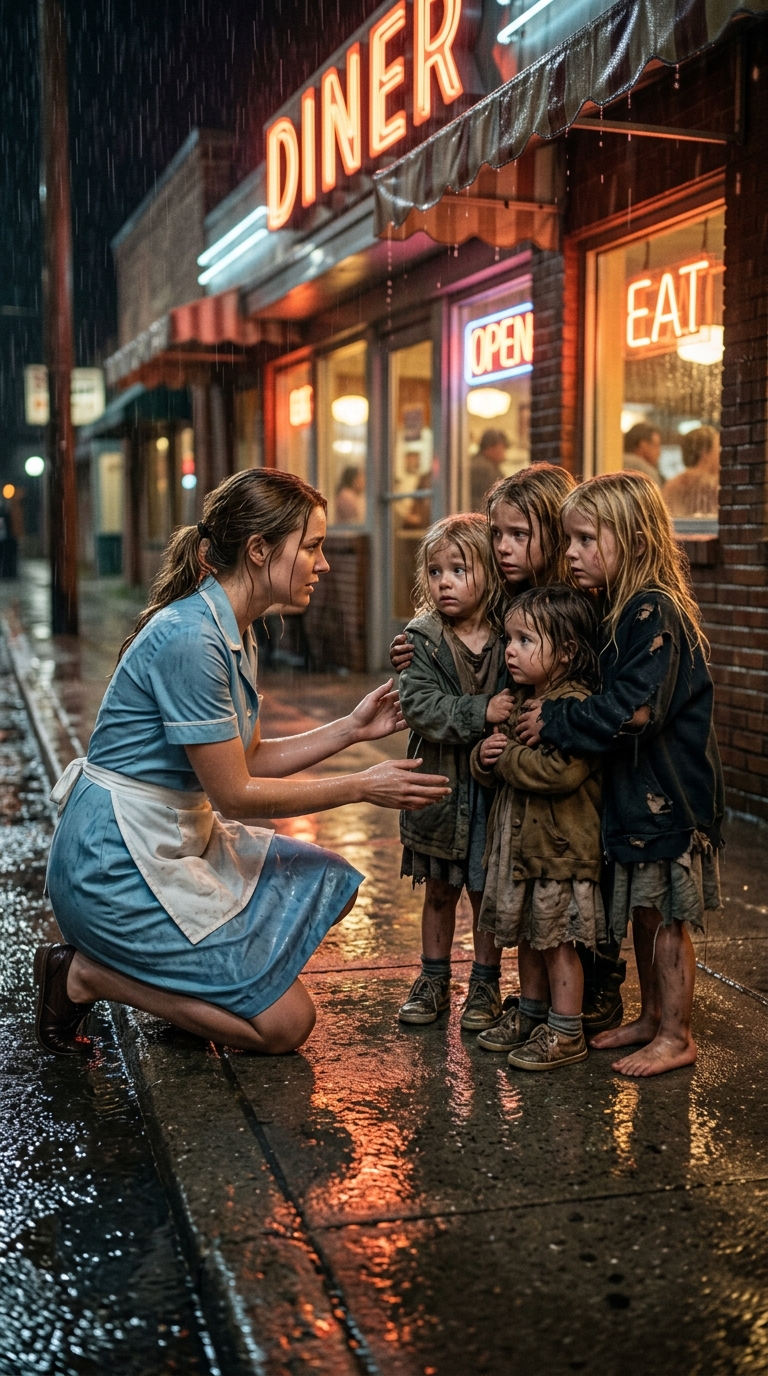
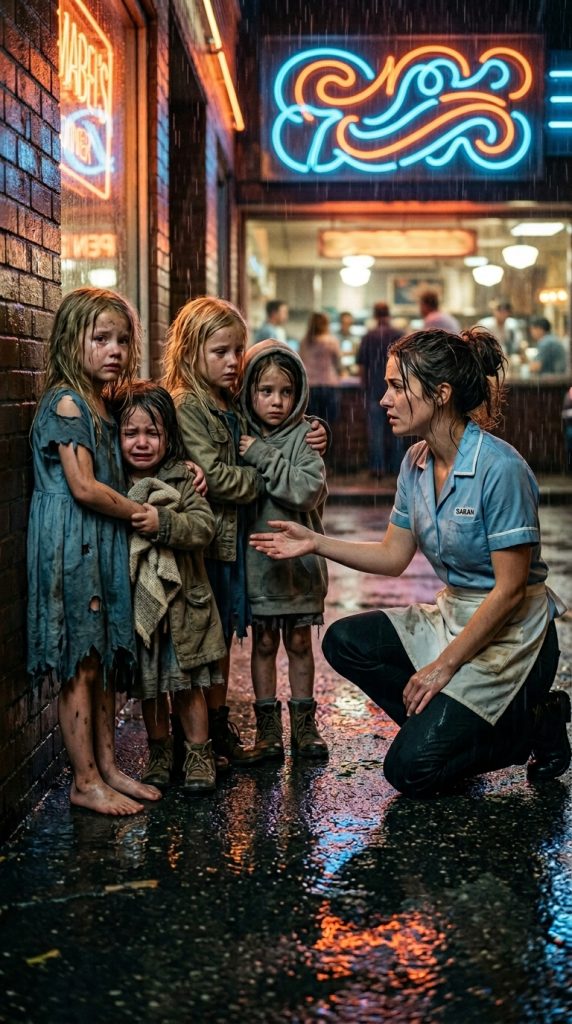
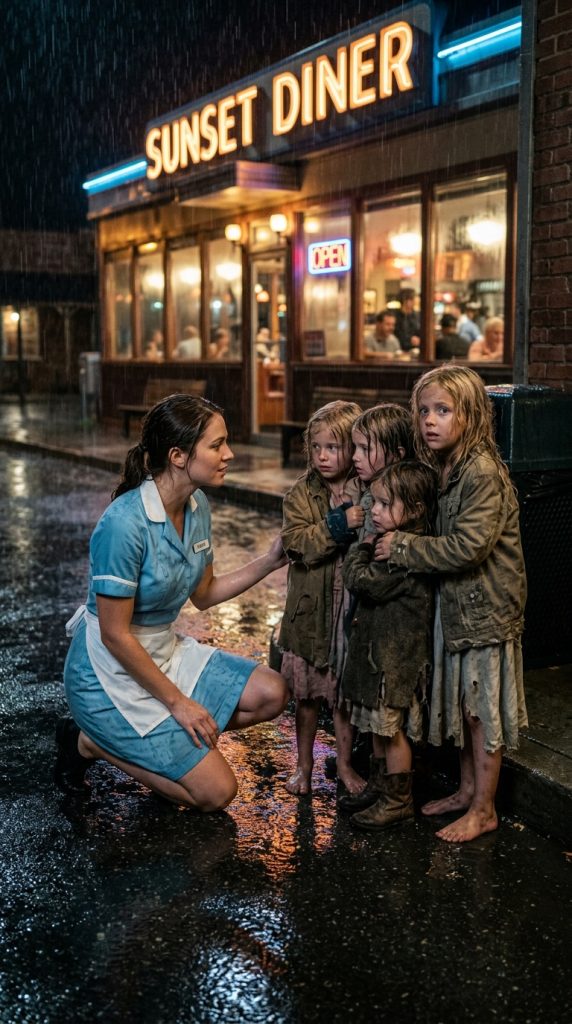
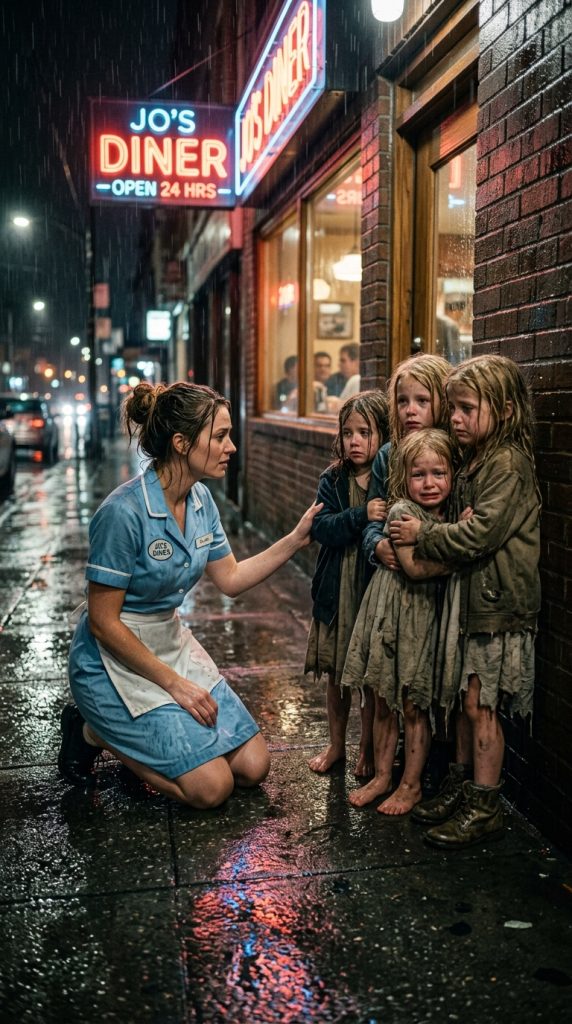
On a stormy evening in a small, quiet town, Emily Parker, a young waitress, spotted four little girls huddled together outside the window of her diner. Their clothes were ripped, their faces drained of color, and their eyes held the quiet burden of hunger and loneliness. Emily’s heart tightened. These children had no one—no parents, no shelter, no warmth waiting for them.
Without hesitation, she stepped out into the rain, her apron dampened by the drizzle. “Sweethearts, what are you doing out here in the rain?” she asked gently, lowering herself to meet their fearful eyes.
The oldest girl murmured, “We… we don’t have anywhere to go.”
Emily felt her chest constrict. “Oh, my dear,” she said softly, brushing damp hair away from the child’s forehead. “You must be freezing. Come inside, all of you.”
The youngest paused, gripping her sister’s hand tightly. “Are we allowed? We don’t have money.”
Emily offered a warm, reassuring smile. “You don’t need money tonight. What you need is a hot meal and somewhere safe to sit. Come on, I’ll take care of you.”
The girls exchanged unsure looks, but Emily reached out her hand. “Trust me,” she said quietly. “You’re safe here.”
Slowly, they followed her inside. She seated them in a booth near the window and rushed to the kitchen. Soon, she returned with four steaming plates and set them gently in front of the girls. “Eat as much as you like,” she said tenderly. “No one should go hungry.”
The oldest looked up at her, eyes wide with disbelief. “Why are you helping us?”
Emily paused, emotion rising in her chest. “Because everyone deserves kindness. And because tonight, you’re my girls.”
That single moment of compassion would unknowingly shape the next twelve years of her life.
From that night on, Emily quietly committed herself to caring for the girls. After long hours at the diner, she saved part of her tips to buy them food. She found secondhand clothing, gathered school supplies, and even taught them to read and write at her kitchen table.
For ten years, Emily supported them like a mother, never asking for anything in return. She struggled herself—working double shifts, skipping meals, and putting aside her own dreams.
But whenever she saw the girls smiling with full stomachs, she knew every sacrifice was worth it. Still, life was not always gentle.
Neighbors whispered that she was throwing her life away on children who weren’t hers. Some ridiculed her for spending her hard-earned money on kids they believed would never succeed.
Even Emily sometimes questioned how much longer she could endure. Yet whenever the girls clung to her hand and called her “Mama Emily,” she chose love over doubt.
One evening, after a long day, she sat in her small wooden chair sipping tea when the distant growl of a powerful engine echoed down her quiet street. She leaned forward in confusion—luxury cars never came to this neighborhood.
The sound grew closer until a sleek black SUV rounded the corner, its polished exterior gleaming as if from another world.
Emily’s heart skipped. She had never seen such a vehicle stop near her house. As the SUV slowed in front of her weathered home, her hands trembled while she set her teacup down. Questions raced through her mind. Who could this be? Was something wrong? Was she in trouble?
The driver’s door opened, and a tall man in a suit stepped out, moving swiftly to open the back doors. Emily held her breath as four elegantly dressed young women stepped out, their eyes scanning her modest house.
At first, she didn’t recognize them. They looked so different—so grown, so accomplished. Then suddenly, her heart understood what her eyes struggled to accept. It was them. The four orphan girls she had once fed and raised.
Tears clouded her vision as she whispered, “It can’t be… could it really be them?”
The young women turned toward her with radiant smiles. Before Emily could react, they were already running toward her porch. The old wooden steps creaked beneath their hurried footsteps, and Emily stood frozen, overwhelmed by the sight.
“Mama Emily!” one of them cried, her voice brimming with joy and gratitude.
Those words broke the final barrier in Emily’s heart. Tears streamed down her face as the girls wrapped their arms around her, hugging her so tightly she nearly lost her balance. She sobbed uncontrollably, overcome with emotion.
When she finally found her voice, it trembled. “Look at you, my beautiful girls. What have you become?”
One of the young women stepped back slightly, still holding Emily’s hands, her eyes shining. “We became who we are because of you.”
Another reached into her purse, pulled out a small silver key, and gently placed it into Emily’s shaking palm. Confused, Emily stared at it, then at them, unable to speak. One of the girls smiled and gestured toward the SUV.
“That car is yours now, Mama Emily. And it’s only the beginning.”
Emily gasped, her knees weakening as she tried to grasp the magnitude of the gift. Then another spoke softly. “We’ve also bought you a new home. You’ll never have to struggle again.”
In that instant, Emily understood. Her years of sacrifice had blossomed into something more beautiful than she had ever imagined. Her heart pounded as the four young women stood before her, their eyes filled with love, admiration, and deep respect. Words failed her.
One of the girls said gently, “You gave us hope when we had none. You gave us love when the world turned its back.”
Another squeezed her hand and whispered, “You were the mother we prayed for every night.”
Tears flowed freely down Emily’s face, her feelings too powerful to contain. She remembered the nights she went to bed hungry so the girls could eat. She remembered sewing their torn clothes with exhausted hands after long shifts. She remembered holding back tears when people mocked her for wasting her life. And now, standing before her, were the living results of her sacrifice—strong, successful, beautiful women.
One of them softly wiped her tears and said, “All the good you poured into us, Mama Emily, has come back to you.”
Emily shook her head and whispered, “I never expected anything. I just wanted you to have a chance.”
The girl smiled and replied, “And because of you, we have more than just a chance. We have a future.”
They gently guided her toward the SUV, treating her like something precious, while neighbors peeked from behind their curtains. The same neighbors who once mocked her now stared in astonishment, whispering among themselves.
Emily settled into the leather seat, her fingers brushing over the stitching, her mind still struggling to comprehend what was happening. One of the girls leaned close and said, “This is just the beginning. We want to give you the life you deserve.”
Soon, they drove her to a beautiful new home—larger than anything she had ever dreamed of. The house stood proudly on a peaceful street, its garden blooming with flowers in the sunlight. Emily stepped out of the SUV, her legs unsteady. “Is this really mine?” she whispered.
All four girls nodded eagerly, their faces glowing with happiness. “We bought this for you, Mama Emily,” one said. “This is where you’ll live from now on.”
Emily covered her face with both hands and broke down in tears, her body trembling with gratitude. The girls embraced her again, holding her just as tightly as they had twelve years earlier when they were small and frightened children.
In that moment, Emily realized her love had not only transformed their lives but had also reshaped her own fate. She understood that true wealth is not measured by money, but by the lives changed through kindness. Her story, once marked by hardship, had become living proof that love never returns empty.
As the sun dipped behind her new home, Emily whispered through tears, “God answered my prayers. He gave me daughters, and He gave me a family.”
And that night, for the first time in years, Emily fell asleep not with worry, but with peace—surrounded by love, and finally home.
