

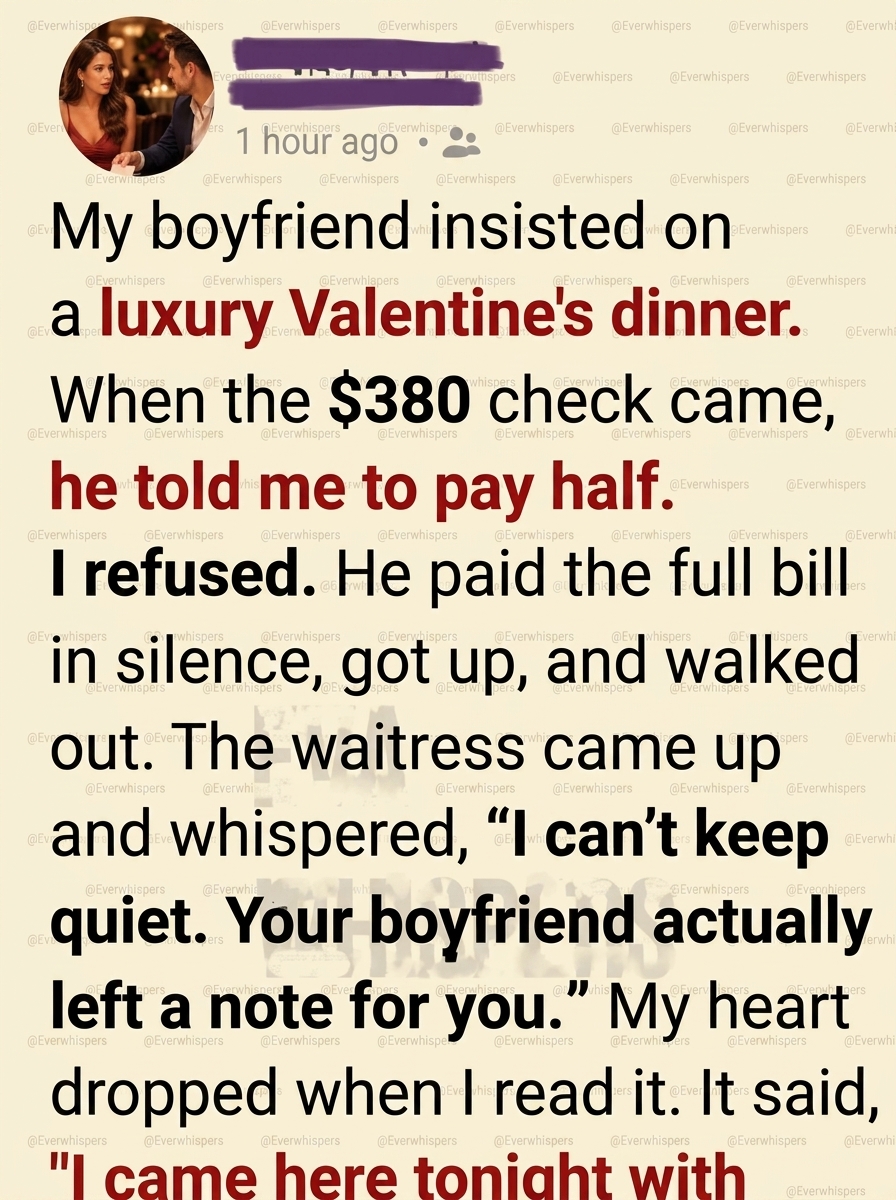
After seven years together, a woman arrived at a Valentine’s dinner holding a quiet sense of hope. Her boyfriend had arranged the evening himself, selected an elegant restaurant, and repeatedly suggested that the occasion carried significance.
The atmosphere felt meaningful, and as they exchanged memories from the years they had spent together, she naturally began to wonder whether their relationship was about to move into a new chapter… The evening continued warmly.
They talked about challenges they had overcome, dreams they had once shared, and the future they had envisioned together. By the time dessert was served, she felt more and more convinced that a proposal might be on the way.
Then the bill arrived.
When the check was placed on the table, her boyfriend suggested they split the cost equally. The request left her surprised.
It wasn’t the expense itself that shocked her. She was fully able to cover her share. What disturbed her was the situation surrounding it.
He had planned the evening as a special surprise, invited her as the guest of honor, and presented it as an important occasion. In that moment, she wasn’t certain whether he was referring to finances, expectations around marriage, or something else entirely.
Before the discussion could fully develop, silence settled between them.
Instead of explaining his point of view or asking about hers, he settled the bill himself and walked out of the restaurant.
Confused and hurt, she stayed seated, trying to process what had just occurred.
A few moments later, a server came over with a note.
Inside, her boyfriend disclosed that he had brought an engagement ring to dinner. The evening, he explained, had also been a test.
He believed her reluctance about splitting the bill revealed something significant about her values, and he had chosen not to propose.
The letter ended by asking her not to reach out to him again.
The words were painful to read. Yet beneath the disappointment lay a deeper realization.
Marriage demands difficult conversations about money, responsibility, expectations, and sacrifice. Those discussions matter because they shape daily life. But healthy relationships grow through honesty, not concealed evaluations.
Questions about finances deserve openness. Concerns deserve discussion.
Doubts deserve conversation.
When major judgments are made without allowing the other person a chance to understand, respond, or clarify, trust begins to erode.
As the shock of the evening faded, she found herself looking beyond the lost proposal and toward a broader truth.
A lifelong commitment should not feel like navigating hidden traps.
A person should not constantly wonder whether an ordinary response will secretly decide the future of the relationship.
Real partnership is not built on passing tests. It is built on learning how to face uncertainty together.
Over time, her sadness shifted into clarity. The end of a seven-year relationship was painful. There was no easy way around that reality. Yet she also understood that discovering a serious incompatibility before marriage was better than finding it years later.
The evening had not given her the future she expected.
But it had revealed something important about the foundation that future would have required.
Sometimes disappointment carries a quiet mercy. It prevents us from building a life on assumptions that were never truly shared.
As she left the restaurant, she walked away not with an engagement ring, but with a clearer sense of the kind of relationship she hoped to find: one built on trust, honest communication, mutual respect, and a love that seeks understanding before judgment.
That lesson, though costly, would stay with her far longer than the evening itself.
