

PART 1
“Break up this welfare birthday party. These people don’t belong in our park.”
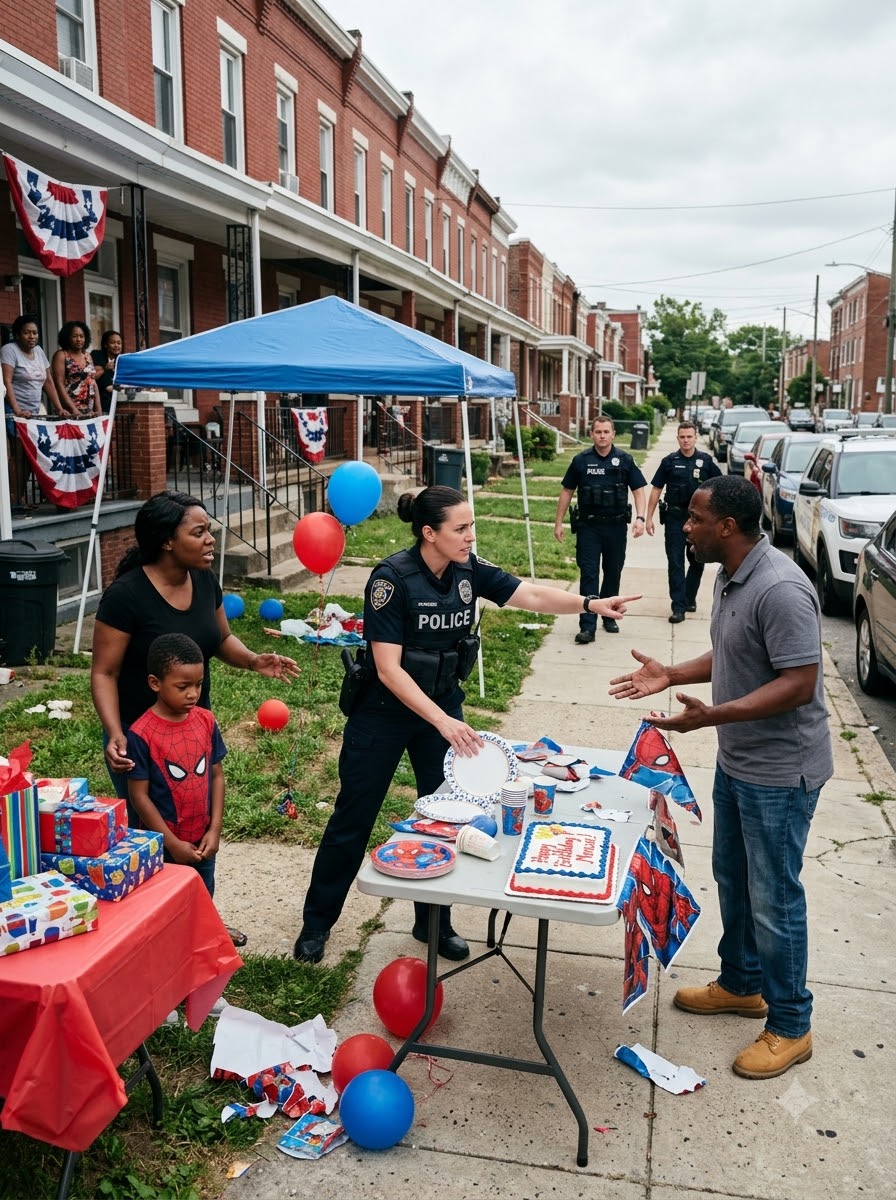
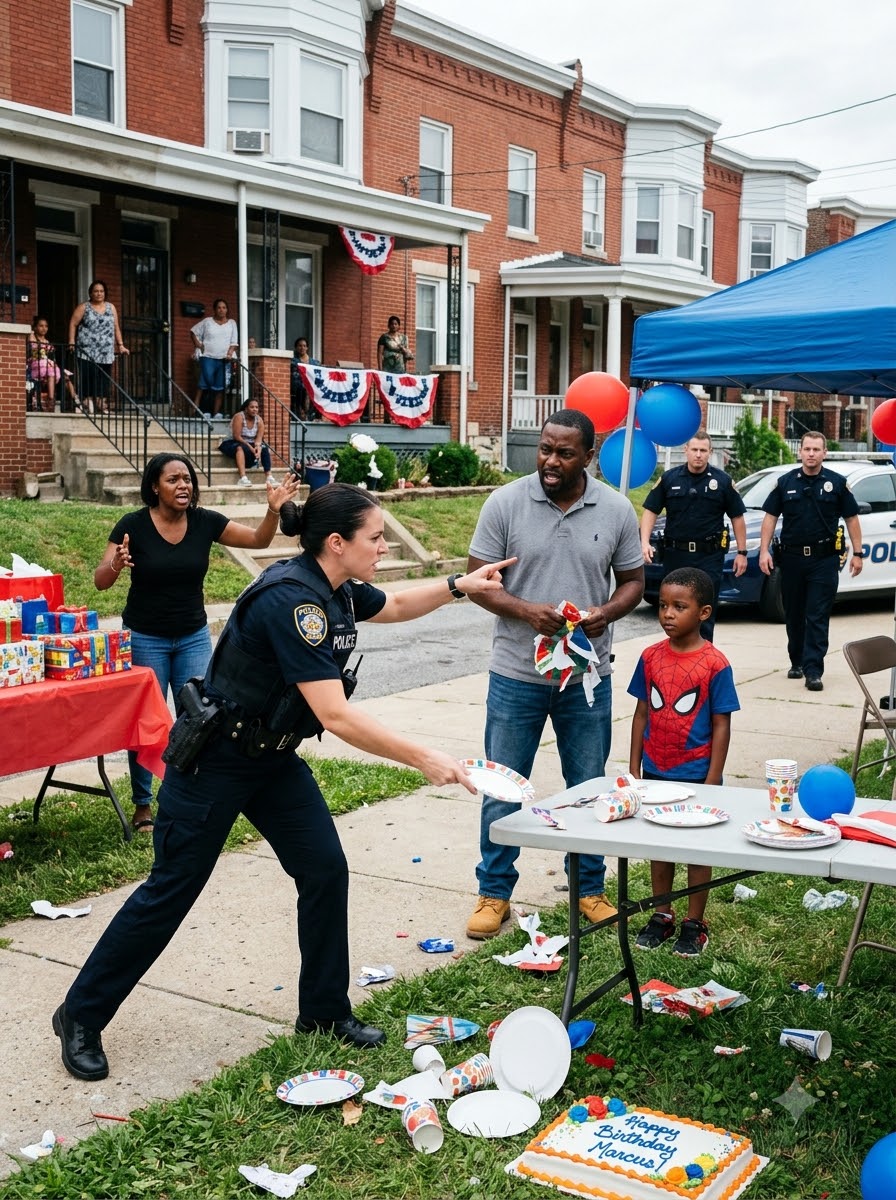
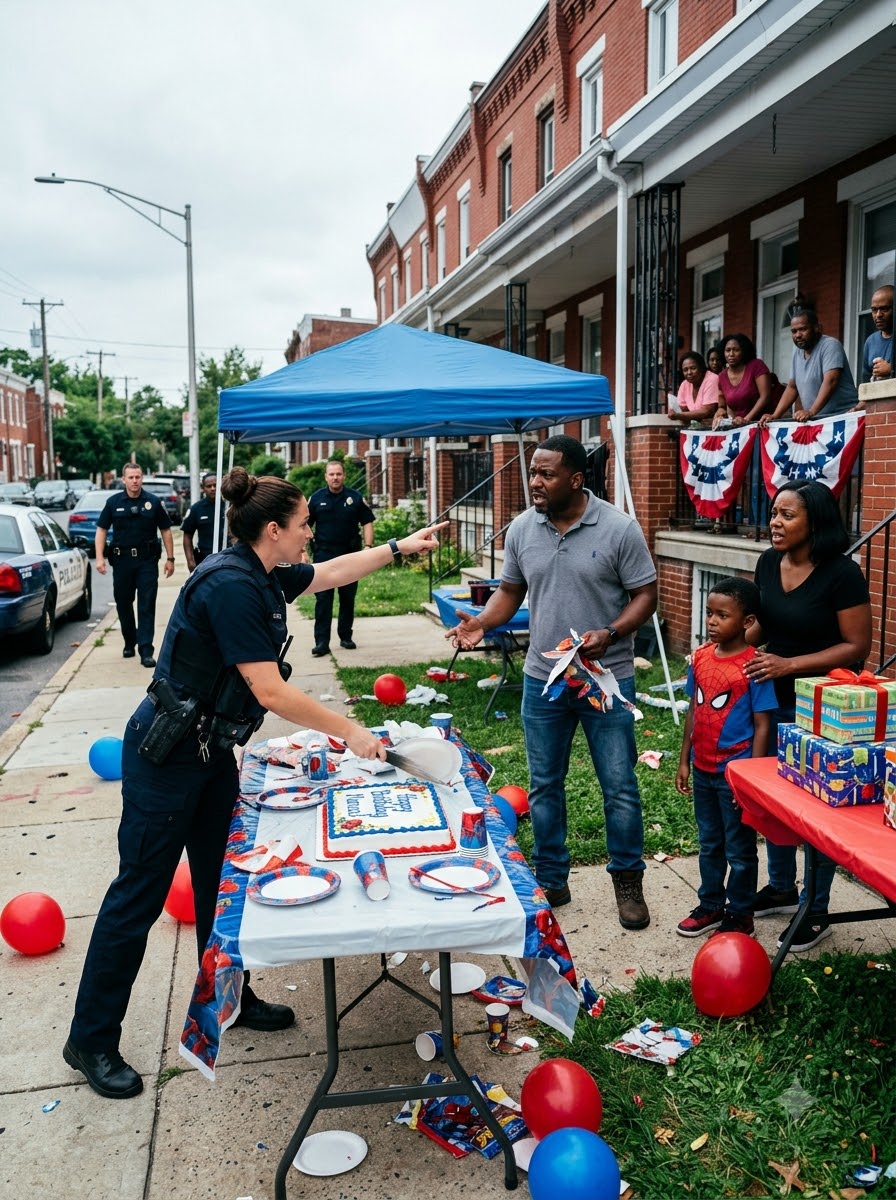
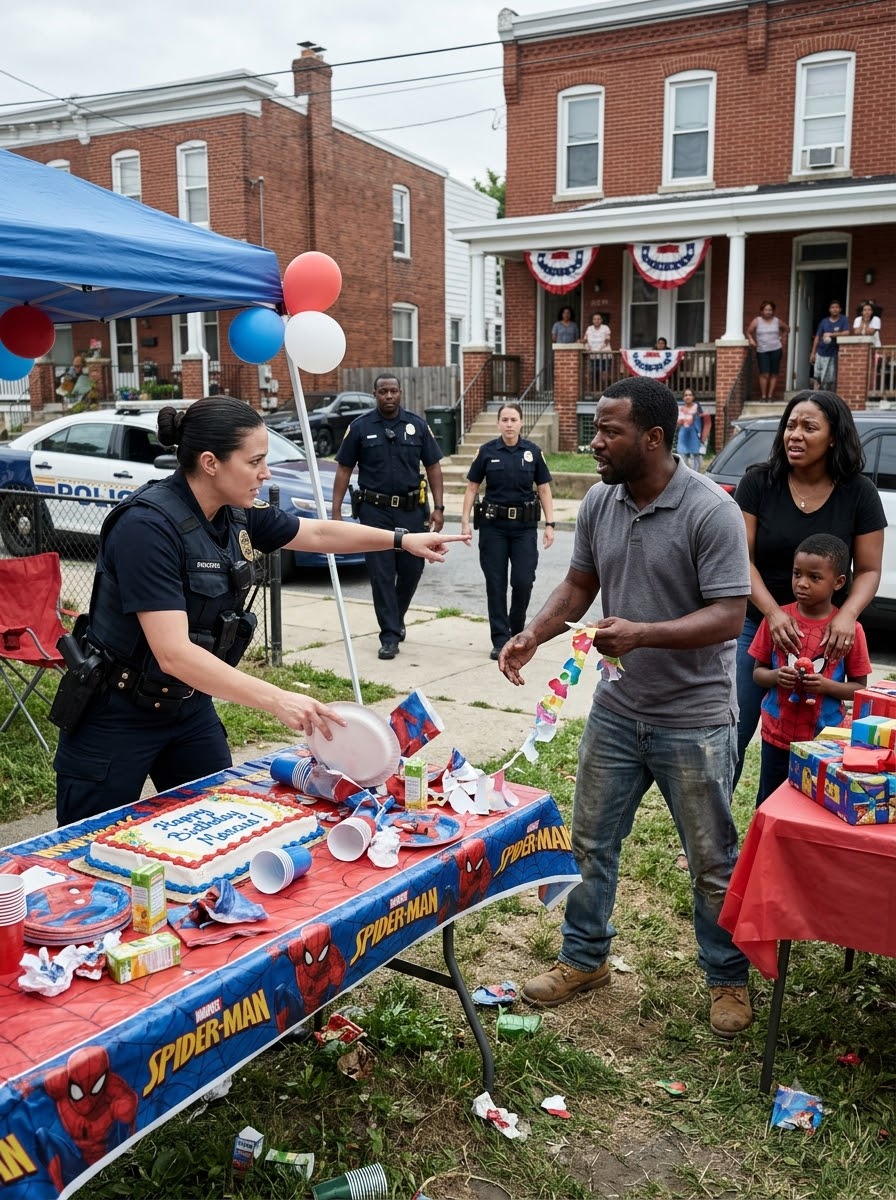
Lieutenant Sarah Mitchell marched toward the celebration, her face twisted with contempt. Without hesitation, she overturned the birthday table.
Eight-year-old Marcus Thompson watched in horror as his Spider-Man cake crashed onto the concrete. Plates of food scattered everywhere. Wrapped presents tumbled to the ground, and officers deliberately crushed the boxes beneath their boots.
“Look at all this food bought with taxpayer money while hardworking Americans struggle.”
Parents rushed to protect their children as Mitchell’s officers knocked over chairs, ripped down decorations, and destroyed everything the families had spent hours preparing.
Near the pavilion stood a tall Black man who had been hanging streamers only moments earlier.
James Thompson turned slowly.
His hands trembled, but his expression remained controlled as he stared at the wreckage of his son’s birthday party.
“You the one responsible for this ghetto circus, boy? Time to shut it down and learn your place.”
Mitchell had no idea who she was speaking to.
And one phone call would soon change everything.
Two hours earlier, Druid Hill Park had been filled with excitement.
James Thompson moved carefully around the pavilion, checking every detail of his son’s eighth birthday celebration.
Red and blue streamers hung from the beams. Folding chairs surrounded the picnic tables. A colorful Spider-Man banner stretched across the entrance.
James adjusted one corner of the banner, stepped back, and inspected his work.
“Baby, you’re being obsessive again,” Maya called from the opposite side of the pavilion.
Her teasing voice carried the warmth of eight years of marriage.
She was arranging party favors, each bag decorated with Marcus’s name, but she noticed something familiar in her husband’s behavior.
James kept watching the entrance.
Then the parking lot.
Then the trees.
Even while preparing a birthday party, he seemed unable to stop checking his surroundings.
Fifteen years in federal law enforcement had made vigilance second nature.
But nobody at the celebration knew that.
To the neighbors, James was a construction worker who had moved into their community eight months earlier.
To Marcus, he was simply Dad.
“I just want everything perfect for Marcus,” James answered, straightening the banner one final time. “He’s been talking about this party for weeks.”
Families had already begun arriving.
James greeted them all by name.
Mrs. Washington, a seventy-three-year-old retired teacher, brought her famous potato salad despite the arthritis that made carrying anything difficult.
The Johnson twins arrived with their father, who worked two jobs to keep his family afloat.
Kesha’s grandmother came with homemade cornbread, refusing to miss another neighborhood celebration even though her eyesight was failing.
James knew their struggles.
He knew which families were behind on bills, which children needed school supplies, and which elderly residents had nobody to drive them to appointments.
Those relationships had begun as part of his assignment.
But they had become something real.
For eight months, James had lived undercover in East Baltimore while investigating a network of corrupt police officers led by Lieutenant Sarah Mitchell.
He had attended church services, repaired neighbors’ porch steps, and volunteered at community gatherings.
Every friendship made the deception harder.
These people trusted him.
And he had grown to love them.
“Dad!”
Marcus came racing across the grass, his Spider-Man shirt already stained from playing with his cousins.
He threw himself against James’s legs, nearly knocking over a cooler.
“This is the best birthday ever!”
James laughed and crouched beside him.
“All my friends are here, and Mom made my favorite cake with the web design, and you even got the Spider-Man decorations I wanted!”
Marcus barely paused for breath.
“And Mrs. Johnson brought those cookies that taste like heaven!”
James smiled, feeling a familiar ache in his chest.
“You deserve the best birthday, champ. You only turn eight once.”
He ruffled Marcus’s hair.
“Did you thank Mrs. Johnson for those cookies?”
“Already did! And I helped Grandma Washington set up her folding chair because her hands were hurting today.”
James looked at his son with pride.
Marcus was growing into exactly the kind of person he hoped to raise.
Kind.
Thoughtful.
Unconcerned with the differences that adults too often used to divide one another.
But as Marcus continued talking, James noticed movement near the park entrance.
His hand drifted instinctively toward his jacket.
Inside was his FBI badge.
His service weapon.
And an emergency beacon disguised as his wedding ring.
Eight months of undercover surveillance had already uncovered evidence that could destroy Mitchell’s career and send dozens of officers to federal prison.
Photographs showed her accepting envelopes of cash from drug dealers.
Recorded conversations revealed officers discussing how to intimidate Black families.
Financial records connected police supervisors to narcotics operations.
James had documented a system in which corrupt officers used their badges to protect criminals while terrorizing ordinary residents.
“James.”
Maya’s voice interrupted his thoughts.
She recognized the tightening of his jaw.
The way his shoulders changed.
The distant expression that appeared whenever his instincts detected danger.
“Not today. Whatever you’re thinking. Not today. This is Marcus’s day.”
James looked at his wife.
She was right.
He pulled her close and kissed her forehead.
“Today, I’m just Dad.”
For a few precious minutes, he allowed himself to believe it.
Marcus led him toward the treasure hunt James had arranged around the pavilion.
Spider-Man stickers and little toys were hidden beneath benches and behind trees.
Children rushed around laughing, comparing clues and shouting whenever someone discovered another prize.
Then James’s phone vibrated.
A message from his FBI handler appeared.
Mitchell’s unit just received a dispatch to your location. Anonymous noise complaint filed 20 minutes ago. This wasn’t random. Your cover may be blown. Abort if necessary.
James stopped walking.
His blood went cold.
Someone inside the Baltimore Police Department knew where he was.
Someone had deliberately sent Mitchell to his son’s birthday party.
He scanned the park.
Children were laughing.
Parents were talking.
Maya was preparing to light the candles on Marcus’s cake.
None of them knew they had been placed directly in the path of a corrupt police unit.
James considered evacuating everyone.
But before he could act, sirens sounded in the distance.
Three patrol cars entered the park.
They moved quickly toward the pavilion.
Lieutenant Sarah Mitchell stepped out first.
Officers Barnes and Cruz followed, their hands resting near their weapons.
Mitchell looked at the decorations with open disgust.
“Well, well, well. Look what we have here.”
The laughter faded.
Parents pulled their children closer.
“Anonymous complaint about noise violations and illegal gathering,” Mitchell announced. “Funny how you people always seem to think the rules don’t apply.”
She surveyed the tables.
“This whole setup reeks of welfare fraud. Who’s paying for all this food? Hardworking taxpayers, I bet.”
Mrs. Washington rose carefully from her chair.
“Officer, this is just a child’s birthday party. We have every right to be here.”
Mitchell turned toward her.
“Did I ask you to speak, Grandma? Sit your welfare ass back down before you get yourself in trouble.”
Several parents gasped.
James felt his jaw tighten.
He had heard Mitchell speak this way on recordings.
But hearing her insult someone he cared about was different.
Officer Barnes approached the buffet.
“Looks like a health code violation to me, Lieutenant.”
Mitchell smiled.
“You’re absolutely right, Barnes. Public safety hazard. Better dispose of it properly.”
Barnes swept his arm across the table.
Fried chicken, potato salad, macaroni, and homemade desserts crashed onto the concrete.
Then he shoved the cake.
Marcus’s beautiful Spider-Man birthday cake hit the ground.
Chocolate frosting splattered across the pavement.
Marcus screamed.
“My cake!”
Barnes shrugged.
“Oops. Accidents happen when you don’t follow proper food safety protocols.”
Cruz overturned the gift table.
Wrapped presents scattered across the grass.
A soccer ball rolled toward the parking lot.
Books, art supplies, and toys spilled from their packages.
Mitchell watched with satisfaction.
“This is what happens when Section 8 people try to have nice things. Reality has a way of reminding you where you belong in society.”
James remained still.
His instincts urged him to reveal his credentials immediately.
But doing so could compromise the entire federal investigation.
Eight months of work.
Dozens of suspects.
An organized corruption network extending far beyond this park.
Maya stepped beside him and touched his arm.
“James,” she whispered. “Don’t. Think about Marcus.”
Mitchell noticed him.
Unlike the other adults, James had not retreated.
He had not pleaded.
He had not lowered his eyes.
She walked directly toward him.
“You got something to say, boy?”
James met her stare.
“Just trying to give my son a birthday party, officer. No trouble intended.”
“Your son?”
Mitchell looked toward Marcus.
“So you’re the one responsible for this illegal gathering?”
“The pavilion was properly reserved through the city,” James replied.
Mitchell laughed.
“Reserved by who? With what money?”
She opened her citation book.
“Unlawful assembly. Disturbing the peace. Failure to maintain proper food safety standards.”
She raised her eyes.
“Should I keep going?”
Nearby, Barnes dumped a cooler containing purses, keys, and phones onto the ground.
“Searching for contraband.”
Mr. Johnson protested.
“That’s an illegal search without probable cause.”
Cruz stepped toward him.
“Your attitude just gave me probable cause, smart mouth. You want to end up in handcuffs in front of your kids?”
The intimidation continued.
Officers demanded identification.
They questioned teenagers about gangs.
They searched elderly women’s belongings.
They suggested that fathers attending the party were probably violating parole.
James watched every moment.
He knew these tactics.
He had documented them for months.
But now they were being used against his own family.
Finally, Mitchell returned to him.
“You know what bothers me about you?”
She circled him slowly.
“You’re too calm. Too controlled.”
James said nothing.
“Most people get nervous around real authority. But you’re standing there like you think you’re equal to me.”
She stopped inches from his face.
“Time to teach you some respect.”
PART 2
Mitchell studied James with growing irritation.
For years, she had learned to recognize the exact moment when fear defeated resistance.
She knew how to make people lower their eyes.
How to make parents feel helpless in front of their children.
How to turn a police badge into a weapon of humiliation.
But James’s composure unsettled her.
“What’s wrong with you?” she demanded. “Cat got your tongue, boy? I’m talking to you.”
“I’m listening, officer,” James replied.
“Listening?”
Mitchell laughed.
“Your son’s watching you be a coward right now. What kind of man are you? What kind of father lets this happen without saying a word?”
Marcus stood near the ruined cake.
Chocolate frosting stained his Spider-Man shirt.
His face was wet with tears.
James forced himself to remain calm.
“Officer, I’m just trying to give my son a birthday party. We’re not causing any trouble.”
“Not causing trouble?”
Mitchell repeated the words with exaggerated disbelief.
She accused him of occupying public property without permits, creating health hazards, disturbing the peace, and disrespecting authority.
Then she pulled out her handcuffs.
“Maybe some time in lockup will teach you about the proper way to address your betters.”
Maya stepped forward.
“Please, officers, there’s no need for this. We’ll clean up and leave quietly.”
Mitchell turned toward her.
“Did I ask you to speak, sweetheart? Seems like this whole family has problems with authority.”
“Leave my wife alone,” James said quietly.
Something in his voice made Barnes move his hand closer to his weapon.
“Or what?” Mitchell challenged.
She glanced around at the families watching.
“Everyone, watch this. This is what happens when people forget their place in society.”
She grabbed James’s shoulder and shoved him downward.
“Down where you belong.”
James assessed the officers surrounding him.
Barnes stood behind him.
Cruz was positioned to his left.
Mitchell was directly in front.
Any physical resistance could endanger the children nearby.
So he slowly lowered himself to his knees.
His hands shook with rage.
Not fear.
“That’s better,” Mitchell announced. “This is the natural order. Authority on top, criminals on their knees.”
She began searching him.
Her movements were deliberately rough.
Then her fingers reached his jacket pocket.
She found a leather credential case.
“Well, well, what do we have here?”
James felt his stomach tighten.
Mitchell opened the case.
Inside was a genuine FBI badge.
She stared at it.
Then burst out laughing.
“Look at this. Pathetic.”
She held it up for the other officers.
“This fool has a fake FBI badge. Probably bought it online to impress his welfare girlfriend.”
She threw the credentials into the dirt beside the destroyed birthday cake.
“Fake police badge possession. That’s another felony charge.”
Barnes laughed.
“Probably thinks he’s in some kind of movie.”
Cruz smirked.
“Maybe we should call the real FBI.”
Mitchell pressed her boot onto the credential case.
“Stop pretending to be somebody important. You’re nothing but another unemployed baby daddy living off government handouts.”
Marcus could no longer remain silent.
“Leave my daddy alone!”
He ran toward the officers.
Maya caught him before he reached them.
“Marcus, no! Stay with Mommy!”
Mitchell turned toward the crying boy.
“Control your little criminal or I’ll do it for you. Maybe some time in foster care would teach him proper respect for authority.”
James raised his head.
“Don’t you dare threaten my child.”
Mitchell smiled.
“I don’t make threats, boy. I make promises.”
She lifted her radio.
“Dispatch, this is Unit 23. I need child services for a welfare check. Suspected neglect and endangerment. Parents appear to be under the influence and creating unsafe environments for minors.”
Maya stared at her.
“You can’t do that. We haven’t done anything wrong.”
“I can do whatever I want,” Mitchell replied. “I’m the law here.”
She requested additional officers and listed charges she intended to invent.
Disorderly conduct.
Resisting authority.
Impersonating a federal officer.
James remained on his knees.
His genuine badge lay in the dirt.
His son cried in his mother’s arms.
And the lieutenant he had investigated for eight months believed she had finally broken him.
More police cars arrived.
The officers began destroying whatever remained of the party.
Barnes ripped down streamers and crushed balloons.
Cruz dumped a cooler of party favors onto the pavement.
Another officer kicked Marcus’s new bicycle, bending its front wheel.
“Abandoned property,” he announced.
Mrs. Washington protested again.
“This is a legal gathering in a public space.”
Mitchell marched toward her.
“You think you have rights? You think your welfare benefits come with constitutional protections?”
She ordered the elderly woman to stand.
Maya pleaded with her.
“She has arthritis. She can barely stand without help.”
“I said stand up now!”
Mrs. Washington struggled painfully to her feet.
Even then, she refused to lower her eyes.
Mitchell smiled.
“See how much more civilized things are when everyone knows their place.”
James watched the humiliation continue.
He had enough evidence to put these officers away for years.
But he also knew that Mitchell’s network included powerful people who might escape if the investigation ended prematurely.
Then Barnes moved closer to Maya and Marcus.
“The kid’s got some mouth on him,” he said.
Cruz joined him.
“Maybe some time away from bad influences would set him straight.”
Maya tightened her grip on her son.
“Stay away from my child.”
Mitchell laughed.
“Who do you think they’re going to believe? Upstanding police officers or welfare criminals?”
She returned to James and seized his arm.
She hauled him upright, then shoved him down again.
His knees struck the concrete.
Maya saw the change in his expression.
She knew that look.
James was no longer simply enduring the situation.
He was preparing to act.
“James,” she whispered. “Think about Marcus.”
But Mitchell had already crossed the final line.
She grabbed Marcus by the arm and pulled him away from his mother.
“Maybe some time in the system will teach this little criminal proper respect.”
Marcus screamed.
“Daddy, help me! Make her let go!”
Something inside James snapped.
He rose smoothly from the ground.
His movements were controlled.
Precise.
The helpless father Mitchell believed she had humiliated disappeared.
In his place stood a man with fifteen years of federal law enforcement experience.
“Take your hands off my son.”
Mitchell hesitated.
“What did you just say to me?”
“I said, take your hands off my son. Right now.”
“Or what?”
James reached into his jacket.
The officers tensed.
But he withdrew only his phone.
“No,” he answered. “I’m going to make a phone call.”
Mitchell laughed.
“A phone call to who? Your lawyer? Your mommy?”
James dialed a number he knew by heart.
The call connected after one ring.
“This is Special Agent James Thompson, badge number 2847,” he said clearly. “I need immediate federal backup at Druid Hill Park, Baltimore. My cover has been compromised, and my family is under threat from corrupt Baltimore PD officers.”
Silence fell across the pavilion.
Mitchell’s grip on Marcus loosened.
Barnes and Cruz exchanged uncertain looks.
“Federal investigation of Lieutenant Sarah Mitchell’s narcotics conspiracy has been ongoing for eight months,” James continued.
“I have documented evidence of civil rights violations, drug trafficking, and systematic corruption. Request immediate arrest and federal charges.”
Mitchell shook her head.
“You’re lying.”
James ended the call.
He picked up his FBI credentials and wiped chocolate frosting from the gold shield.
“Eight months,” he said.
“Eight months of watching you terrorize innocent families. Eight months of documenting your crimes. Eight months of waiting for enough evidence to put your entire corrupt unit in federal prison.”
A distant rumble grew louder.
Helicopters.
Mitchell looked toward the sky.
James held up his badge.
“That would be my backup arriving.”
He looked at her hand gripping his son.
“I suggest you release my son and step away from my family.”
But Mitchell refused.
She pulled Marcus closer.
Her other hand moved toward her service weapon.
“Nobody’s going anywhere until I figure out what’s really happening here.”
James’s expression turned cold.
“Lieutenant Sarah Mitchell,” he said, “you are under arrest.”
The sound of helicopters filled the sky.
Mitchell stared upward in disbelief.
James stood at his full height.
“Lieutenant Mitchell, badge number 4471. Twenty-three years with Baltimore PD. Currently assigned to the Eastern District.”
He recited details from her personnel records and surveillance files.
Mitchell’s face drained of color.
“How do you know that?”
“Eight months of federal surveillance.”
James described recorded conversations with drug dealers, monthly protection payments, and financial records showing more than $200,000 in unexplained income.
Barnes swallowed.
“Sir, we didn’t know. We were just following orders.”
James looked at him.
“The same excuse you’ve used for eight months of systematically terrorizing this community.”
He reminded Barnes of the drugs planted on sixteen-year-old Kevin Johnson and the $40,000 taken from the Rodriguez family.
Then FBI tactical agents entered the park.
“FBI! Nobody move!”
Special Agent Sarah Carter approached the pavilion.
“Agent Thompson. Status report.”
James answered calmly.
“Lieutenant Mitchell and her unit just committed multiple federal crimes in front of approximately thirty witnesses. Civil rights violations, intimidation of a federal officer, destruction of property, and threats against a minor.”
He gestured toward the people recording on their phones.
“All of it documented.”
Mitchell finally released Marcus.
The boy ran into Maya’s arms.
Agent Carter approached with handcuffs.
“Lieutenant Sarah Mitchell, you’re under arrest for federal civil rights violations, conspiracy to distribute controlled substances, extortion, and intimidation of a federal officer.”
Mitchell protested.
“This has to be entrapment!”
James shook his head.
“Undercover operations are legal when investigating ongoing criminal conspiracies.”
Barnes tried to move away.
Federal agents blocked him.
“I want to cooperate,” he said quickly.
“You’ll have that opportunity from federal custody,” Carter replied.
Cruz stared at James’s badge.
“The fake badge,” he whispered. “That was real?”
James held it up.
“Special Agent James Thompson. Badge 2847. The same badge you spent ten minutes mocking while you destroyed a child’s birthday party.”
Federal agents arrested the officers.
Mitchell spat near James’s shoes.
“This isn’t over. There are dozens of us.”
James looked at her.
“You don’t understand. This isn’t one arrest.”
He showed her surveillance photographs and financial documents on his phone.
“Thirty-four officers are being arrested simultaneously across the city. Your entire network is finished.”
As the corrupt officers were led away, the families watched in stunned silence.
Marcus approached his father.
“Daddy, are you really a policeman?”
James knelt beside him.
“I’m an FBI agent, buddy. And my job is to catch bad policemen who hurt good people.”
Above them, news helicopters joined the federal aircraft.
The story was already spreading.
And Baltimore was about to discover just how deep the corruption went.
PART 3
Within fifteen minutes of Mitchell’s arrest, footage from the birthday party appeared online.
Mrs. Washington’s granddaughter, Kesha, had been livestreaming when the officers arrived.
Her camera captured the destroyed cake.
The overturned presents.
The racial insults.
James being forced to kneel.
And the astonishing moment when he revealed his FBI identity.
The video spread rapidly.
Fifty thousand views.
One hundred thousand.
Two hundred thousand.
Then millions.
A hashtag mocking Mitchell’s command to “know your place” began trending nationwide.
Maya watched the numbers climb from the back of an FBI vehicle.
“James, look at this. Someone already made a compilation of everything she said.”
The edited footage showed Mitchell’s cruelty followed by the arrival of federal agents.
Comments poured in.
Some viewers celebrated the arrests.
Others questioned the undercover operation.
Political commentators argued over the meaning of the footage.
The Baltimore Police Department initially defended its officers, claiming they had responded to legitimate complaints and followed established procedures.
That statement only intensified public anger.
Community members began sharing their own experiences.
One family described a graduation party Mitchell’s unit had disrupted.
Another posted documents showing money confiscated during a traffic stop.
A pastor revealed years of harassment at church fundraisers.
Then anonymous sources inside the police department began releasing records.
Mitchell had faced seventeen previous complaints involving excessive force and racial profiling.
Those complaints had been dismissed or buried.
Financial records revealed expensive purchases that could not be explained by her salary.
An $80,000 boat.
A vacation home.
Designer handbags.
Luxury purchases funded, investigators alleged, by criminal proceeds.
The police union held an emergency press conference.
Union President Robert Hayes insisted the officers had acted appropriately.
When reporters questioned him about Mitchell’s racial insults, he claimed he had not seen verified evidence.
Kesha stood up.
“I have a question. Would you like to watch the video?”
She played the recording through a portable speaker.
Mitchell’s voice filled the room.
The reporters turned their cameras toward Hayes.
His confidence disappeared.
“We’ll have to review all available footage,” he stammered.
Within hours, the FBI released its own statement.
Special Agent Thompson’s eight-month investigation had produced federal charges against thirty-four Baltimore police officers.
The alleged crimes included civil rights violations, drug trafficking conspiracy, and organized corruption.
International news organizations picked up the story.
Protesters gathered outside police headquarters.
Families who had suffered for years under Mitchell’s unit demanded accountability.
Others defended the officers and criticized the federal investigation.
James watched the arguments from an FBI safe house, where his family had been moved for protection.
His undercover identity was gone.
His private life had become national news.
And Marcus’s ruined birthday had become a symbol in a much larger debate.
“I never wanted to be famous,” James told Maya.
He watched Marcus playing with FBI agents who had volunteered to keep him entertained.
“I just wanted to catch the bad guys and go home to my family.”
Maya showed him messages from neighbors.
“You gave people hope.”
Three days after the arrest, Special Agent Sarah Carter stood before an enormous evidence board at the Baltimore FBI field office.
Photographs, financial documents, audio transcripts, and surveillance records covered four whiteboards.
Federal prosecutors and Justice Department officials had traveled from Washington to review the case.
“Thirty-four officers,” Carter began.
“Thirty-four sworn law enforcement officers participating in an organized criminal enterprise operating under the color of law.”
She displayed Mitchell’s photograph.
Financial analysis showed that Mitchell had received more than $200,000 in drug-related payments over three years.
But she was not the leader.
The network extended into senior police management.
Agent Rodriguez, James’s technical specialist, played a recording captured at a community cookout.
Mitchell’s voice filled the room.
“These animals need to be reminded who runs this city. Every gathering is a potential riot waiting to happen.”
Carter explained that the event had celebrated a teenager’s acceptance to Morgan State University.
James had attended as a neighbor while secretly recording the officers.
US Attorney Patricia Williams leaned forward.
“How many community gatherings were targeted?”
“Forty-seven documented incidents over eight months,” Rodriguez answered.
Birthday parties.
Graduations.
Church fundraisers.
Youth sports celebrations.
The officers deliberately disrupted events that brought people together.
Another recording revealed Deputy Chief Robert Morrison discussing how to conceal the harassment.
“The federal heat is getting stronger,” Morrison warned Mitchell. “We need to be smarter about how we handle community relations.”
Mitchell asked what they should do when residents resisted.
Morrison described using arrests, court appearances, and legal expenses to wear people down.
“Fear is more effective than bullets.”
The room fell silent.
This was not merely individual misconduct.
It was an organized system.
Financial specialist Amanda Foster presented bank records linking drug proceeds to police union accounts, political campaigns, and businesses connected to officers’ families.
Investigators identified several judges whose campaigns had received money tied to the corruption network.
The officers were not simply accepting bribes.
They were protecting drug distribution operations.
One photograph showed Mitchell shaking hands with heroin dealer Marcus Williams outside a warehouse.
The Williams organization allegedly paid $15,000 a month for police protection.
In exchange, officers warned dealers about raids and targeted their competitors.
The evidence also revealed lists of community leaders marked for harassment.
Pastors.
Parents.
Organizers.
Activists.
Anyone capable of mobilizing residents against police misconduct.
James Thompson’s name appeared on one of those lists.
The notation was dated six months before the birthday party.
Monitor closely.
Carter turned toward the prosecutors.
“They suspected him long before the arrest.”
The anonymous complaint had been deliberate.
Mitchell’s unit had been sent to pressure James until he either revealed his identity or submitted to their control.
US Attorney Williams studied the evidence.
“This is RICO territory.”
Carter nodded.
The investigation had expanded into racketeering, money laundering, civil rights violations, and narcotics conspiracy.
Additional leads pointed to similar operations in neighboring Maryland jurisdictions.
At least forty officers outside Baltimore had been identified for further investigation.
When James entered the conference room, he looked exhausted.
Three days of questioning had followed eight months of living a double life.
“My son asks why I lied about my job,” he admitted.
“My neighbors wonder whether every conversation we had was secretly recorded.”
He paused.
“Some of them feel betrayed. I understand that.”
Then he played a voicemail.
Mrs. Washington’s voice filled the room.
“James, this is Mrs. Washington. I want you to know that every Sunday you sat in our church, every time you helped fix my porch steps, every conversation we had about keeping our children safe, all of that was real.”
She paused.
“The job was pretend, but the man was real, and that man is a hero to this community.”
Several officials lowered their eyes.
The investigation had produced thousands of photographs and more than two thousand hours of audio recordings.
But that voicemail reminded them what the case was really about.
People.
Families.
Communities that had been denied the protection they deserved.
The federal evidence showed forty-seven disrupted gatherings during the eight-month investigation, 138 allegedly false arrests over three years, and hundreds of thousands of dollars in legal expenses imposed on families.
Investigators also traced more than $8 million in criminal proceeds over five years.
Internal affairs had dismissed the overwhelming majority of complaints against the officers.
James looked at the evidence board.
“Every conversation I recorded, every photograph I took, every financial transaction I documented, it all happened because these officers believed they were untouchable.”
US Attorney Williams stood.
“Then our responsibility is to prove that they were wrong.”
Six weeks after the birthday party, the investigation gained another crucial witness.
Officer Luis Rodriguez, a fifteen-year Baltimore police veteran, entered a secure FBI interview room carrying a Manila folder.
He had secretly gathered evidence for two years.
His decision to cooperate would end his police career and place his family at risk.
But he could no longer remain silent.
“I couldn’t watch what happened to that family,” he told Williams.
“That little boy was crying over his birthday cake while Mitchell laughed about it. That federal agent was forced to kneel in dirt while she called him boy. I’ve got kids the same age.”
Rodriguez explained that he had begun recording colleagues after Mitchell’s unit assaulted his nephew Miguel during a traffic stop.
Miguel was a respiratory therapist returning home from work.
He had committed no crime.
The incident convinced Rodriguez that remaining silent made him part of the problem.
His recordings revealed an organized strategy.
Officers monitored social media for upcoming community gatherings.
They arranged anonymous complaints.
They coordinated dispatch responses.
Then they used minor allegations to justify aggressive interventions.
They called it “community management.”
One recording captured Mitchell training younger officers.
“The goal isn’t arrests,” she explained. “Arrests create paperwork and potential legal challenges. The goal is humiliation.”
She described making parents feel powerless in front of their children.
Breaking trust.
Destroying community solidarity.
Rodriguez looked at Williams.
“We weren’t protecting and serving. We were occupying and controlling.”
His evidence documented more than two hundred disrupted community events over five years.
Mitchell had even kept records of her interventions.
Thirty-seven disrupted gatherings in a single month had been her personal record.
Rodriguez also confirmed that James had been deliberately targeted.
“They suspected he was federal law enforcement,” he said.
“They wanted to humiliate him, arrest him in front of his son, and then pressure him into informing on his neighbors.”
Williams reviewed the recordings.
“Why come forward now?”
Rodriguez’s eyes filled with tears.
“Because I watched Agent Thompson take all that abuse to protect his investigation. If he could sacrifice eight months of his life for justice, I could sacrifice my career.”
His testimony changed the prosecution.
Other officers began cooperating.
Residents who had been afraid to speak came forward.
A federal grand jury reviewed recordings, financial documents, internal communications, and testimony from forty-seven community members.
The resulting indictments covered thirty-four officers, three judges, two prosecutors, and five civilians.
Ninety-seven federal felony counts were brought.
The charges included civil rights violations, racketeering, drug trafficking, conspiracy, and obstruction of justice.
Marcus, now nine years old in the story’s later proceedings, asked to testify.
His parents supported him after prosecutors considered the emotional consequences.
“The bad policeman made my daddy kneel in the dirt on my birthday,” Marcus told the grand jurors.
“But my daddy was really a good policeman all along, and he was protecting everyone.”
He looked around the room.
“The bad policeman didn’t know that good always wins.”
Mrs. Washington attended the proceedings in a wheelchair while recovering from hip surgery.
Outside the courthouse, she held a sign.
Justice for all God’s children.
Deputy Chief Morrison resigned before his scheduled grand jury appearance.
Mitchell continued to deny wrongdoing.
Her lawyers challenged the prosecution.
But the evidence continued to grow.
The case that began with one ruined birthday party had exposed a corruption network that had operated for years.
And the people who once believed they had no voice were finally being heard.
PART 4
Three months after the arrest at Druid Hill Park, the federal courthouse in Baltimore was packed.
Families filled the gallery.
Reporters lined the walls.
Outside, hundreds of residents gathered with signs demanding justice.
US Attorney Patricia Williams stood before the court.
“Today marks a reckoning.”
She announced that the proceedings had resulted in ninety-seven federal felony convictions involving thirty-four police officers, three judges, two prosecutors, and five civilian conspirators.
Lieutenant Sarah Mitchell sat at the defense table.
Her police uniform was gone.
She wore an orange prison jumpsuit.
The woman who once marched through neighborhood celebrations with absolute confidence now faced decades in federal prison.
Judge Katherine Martinez reviewed the sentencing documents.
“Lieutenant Mitchell,” she began, “you have been convicted of conspiracy to violate civil rights, racketeering, drug trafficking conspiracy, and obstruction of justice.”
She looked toward the families seated in the courtroom.
“But before I pronounce sentence, I want you to understand exactly what you’ve done to this community.”
Marcus sat between James and Maya.
He wore his best suit and held a drawing of FBI helicopters above a birthday cake.
Judge Martinez addressed Mitchell.
“You terrorized a federal agent and traumatized his eight-year-old son on what should have been one of the happiest days of his young life.”
Then James was invited to speak.
He rose slowly.
“Lieutenant Mitchell, you called my son’s birthday party a ghetto circus.”
He looked directly at her.
“You forced me to my knees in front of my child and called me boy. You threw my federal credentials in the dirt and laughed about it.”
He paused.
“But the worst part wasn’t what you did to my family.”
His voice grew stronger.
“The worst part was realizing that you’d been doing this to innocent families for years.”
Families without federal badges.
Families without connections.
Families who had been forced to choose between enduring humiliation and risking arrest.
“You asked me what kind of man I was,” James continued.
“I’m the kind of man who spent eight months living in a community, building genuine relationships, protecting people I’d grown to love while documenting your crimes.”
He turned toward the judge.
“Your Honor, Lieutenant Mitchell used her badge as a weapon against the people she was sworn to protect.”
Mrs. Washington stood with the assistance of her walker.
At seventy-four, she had spent much of her life teaching children to believe in their future.
“That woman destroyed my grandson’s graduation party,” she said.
“He was celebrating his acceptance to medical school. She called it a gang gathering.”
Her hand trembled as she pointed toward Mitchell.
“You tried to break our spirits. You tried to make us afraid to celebrate our children’s achievements.”
She lifted her chin.
“But we’re still here. Our children are still succeeding. And your reign of terror is over.”
For two hours, victims described what Mitchell’s unit had done.
Parents recalled ruined birthday parties.
Pastors described disrupted fundraisers.
Teenagers recounted humiliating searches and false arrests.
Small business owners explained how officers had extorted money from them.
Maya spoke about the cost to her family.
“I watched my husband carry the weight of pretending to be helpless while documenting injustice.”
She looked toward Marcus.
“And I watched our son process the trauma of seeing his father humiliated by someone who was supposed to protect us.”
Finally, Marcus approached the witness stand.
“The bad police woman ruined my birthday party,” he said.
“She made my daddy kneel down and called him bad names. She made me cry and scared all my friends.”
He looked at Mitchell.
“But my daddy was really a hero all along. He was pretending to be regular so he could catch the bad police and keep everyone safe.”
His voice remained steady.
“I’m proud of my daddy for being so brave.”
Mitchell’s attorney requested leniency.
He argued that she had followed department practices and orders from her superiors.
Judge Martinez rejected that explanation.
“Miss Mitchell’s crimes were not momentary lapses in judgment.”
She described the recordings, the financial evidence, and the deliberate targeting of community celebrations.
Then the courtroom became silent.
“Sarah Mitchell, you are hereby sentenced to twenty-five years in federal prison, without the possibility of parole, and ordered to pay $200,000 in restitution to community victims.”
People began crying.
Mitchell’s face twisted with anger.
Officer Barnes received eighteen years.
Detective Cruz received fifteen.
Deputy Chief Morrison received twelve years after cooperating with prosecutors.
Other members of the corruption network received substantial sentences.
But the case would not end with imprisonment.
Federal oversight was established to address the institutional failures revealed by the investigation.
New accountability measures included civilian review, independent monitoring, and access to department records.
Outside the courthouse, families gathered for a celebration.
Mrs. Washington stood before the crowd.
“Today is Marcus’s real birthday party.”
Tables had been arranged with the same foods served at the original celebration.
Potato salad.
Fried chicken.
Homemade desserts.
And at the center stood a beautiful Spider-Man birthday cake.
Marcus stared at it.
For the first time since that terrible afternoon, the memory of his eighth birthday began to feel less painful.
James stood beside him.
This time, nobody knocked the cake over.
Nobody ordered the families to leave.
Children laughed as they ran between the tables.
During the celebration, James was honored for his work and appointed to a community relations leadership position within the FBI.
His speech focused on the future.
“Lieutenant Mitchell and her conspirators believed they were untouchable.”
He looked across the crowd.
“Today proves that no one is above the law.”
Maya announced the creation of the Marcus Thompson Community Justice Foundation.
The organization would help families facing police harassment, provide legal resources, and support neighborhood advocacy.
“My family paid a price for justice,” Maya told the crowd.
“But we paid that price so other families wouldn’t have to suffer what we suffered.”
Marcus stepped toward the microphone.
“The bad police thought they could scare us.”
He glanced at his father.
“But good always wins when people are brave enough to do what’s right.”
The crowd applauded.
A year after Mitchell’s sentencing, Druid Hill Park hosted its first annual Justice Day celebration.
The event brought together families, community leaders, federal officials, and officers committed to rebuilding trust.
The gathering was exactly the kind of celebration Mitchell’s unit had once tried to destroy.
Two years after the original birthday party, the park was filled with laughter again.
A bronze plaque marked its new community justice dedication.
Marcus, now ten years old, stood at a podium before a crowd of neighbors.
“Two years ago, bad police came to my birthday party and tried to scare my family,” he began.
“They didn’t know my daddy was really an FBI agent working to protect everyone.”
He paused.
“They thought they could be mean to people and never get in trouble.”
Then he smiled.
“But good people fought back, and now kids can have birthday parties without being afraid.”
The crowd erupted in applause.
Marcus cut the ribbon on a new community center named in his honor.
The Marcus Thompson Community Justice Center would provide legal assistance, police accountability education, and conflict resolution services.
Its funding came from federal grants, restitution payments, and community fundraising.
James watched his son with pride.
Marcus had endured public attention, courtroom testimony, and the loss of a normal childhood moment.
But he had also become a voice for other children.
“Every day I’m reminded why this work matters,” James told the crowd.
“Two years ago, my family experienced the worst of what policing can become when officers forget they serve the community.”
He gestured toward officers helping children with balloons and face painting.
“Today, we’re celebrating the best of what law enforcement can be when accountability and community partnership guide our actions.”
The department had undergone extensive reforms.
Body cameras became mandatory.
Civilian oversight gained authority.
Complaint procedures became more transparent.
Officers participated in community events as neighbors and public servants rather than treating gatherings as threats.
Officer Jennifer Martinez, a young recruit from East Baltimore, spoke with teenagers considering careers in law enforcement.
“The old department saw community gatherings as potential threats to be controlled,” she explained.
“The new department sees them as opportunities to build relationships and earn trust.”
Maya now directed the foundation full-time.
It had helped more than two hundred families navigate complaints, obtain legal assistance, and understand their rights.
“Healing doesn’t happen automatically after bad people are arrested,” she told supporters.
“Communities need resources, support, and ongoing advocacy.”
Luis Rodriguez, whose evidence had helped expose the conspiracy, volunteered as a youth basketball coach and attended neighborhood meetings.
“I spent fifteen years being part of the problem,” he admitted.
“Now I’m spending whatever time I have left being part of the solution.”
Mrs. Washington, now seventy-six, helped children with homework at the new community center.
She shared stories about the civil rights movement and the generations who had fought for equality.
“This little celebration reminds me of the freedom schools we ran in Mississippi during the 1960s,” she told visitors.
“Back then, we were fighting for the right to vote and attend integrated schools.”
She looked toward the children playing.
“Today, our children are fighting for the right to celebrate birthdays without harassment from people who are supposed to protect them.”
Inside the center, an exhibit displayed photographs from Marcus’s original birthday party.
Beside them were documents from the federal investigation and drawings created by neighborhood children.
One picture showed FBI helicopters delivering a birthday cake.
Another showed police officers and families holding hands around a picnic table.
Justice Department officials visited the center to study the reforms.
Attorney Michael Chang explained that Baltimore’s experience demonstrated the importance of federal enforcement combined with community participation.
Reported complaints against officers had fallen by sixty-eight percent.
Surveys showed community trust increasing from twenty-three to fifty-seven percent.
Positive interactions between police and residents had risen substantially.
But James knew statistics could not measure everything.
They could not capture the fear Marcus had felt when Mitchell grabbed his arm.
They could not erase the humiliation Mrs. Washington had endured.
They could not return the innocence of that destroyed birthday party.
What they could show was progress.
During a quiet moment, Marcus approached his father.
“Dad?”
James looked down.
“What’s up, buddy?”
“Sometimes kids at school call me the FBI boy.”
James listened.
“They think it’s cool that you caught bad guys,” Marcus continued. “But I just want them to know I’m regular, too.”
James knelt beside him.
“Being regular and being special aren’t opposites, buddy.”
He smiled.
“You helped make things better for lots of families. That’s special.”
Then he gently tapped Marcus’s shoulder.
“But you’re also just Marcus who likes Spider-Man and hates Brussels sprouts. That’s regular.”
Marcus laughed.
As the celebration ended, families began packing away chairs and cleaning the tables.
Police officers helped carry supplies and sweep the pavilion.
Nobody ordered the children to stop playing.
Nobody treated the gathering as a crime.
Near the entrance, fresh flowers rested beneath the bronze plaque.
Its inscription carried Marcus’s words:
“Good always wins when people are brave enough to do what’s right.”
Mitchell remained in federal prison, still maintaining her innocence.
But the community she had once terrorized was moving forward without her.
The foundation continued helping families.
The justice center remained open.
And the park that had witnessed Marcus’s worst birthday had become a place where children could celebrate freely.
That evening, the Thompson family drove home together.
Marcus fell asleep in the back seat, wearing his Justice Day shirt and holding a balloon shaped like an FBI shield.
Maya watched him through the rearview mirror.
James drove slowly past the park.
Through the windows, he could still see residents and officers working together to secure the grounds for the night.
Two years earlier, he had knelt on that same ground while corrupt officers mocked his family.
Now his son had stood there before an entire community and spoken about courage.
James glanced at Maya.
She reached across the console and took his hand.
Neither needed to speak.
The birthday party had been destroyed.
But something greater had grown from its ruins.
A community had found its voice.
A corrupt system had been exposed.
And a little boy had learned that courage was not always about fighting back with force.
Sometimes it meant standing firm.
Sometimes it meant telling the truth.
And sometimes it meant a father enduring humiliation until the moment he could protect not only his own child, but every family around him.
As the car disappeared into the evening, Druid Hill Park remained peaceful behind them.
Children would return tomorrow.
Families would gather again.
And the people entrusted with protecting them would be expected to earn that trust every day.
Justice was no longer just a promise. It was something the community could see, protect, and build upon.
Hope lived there now.
