

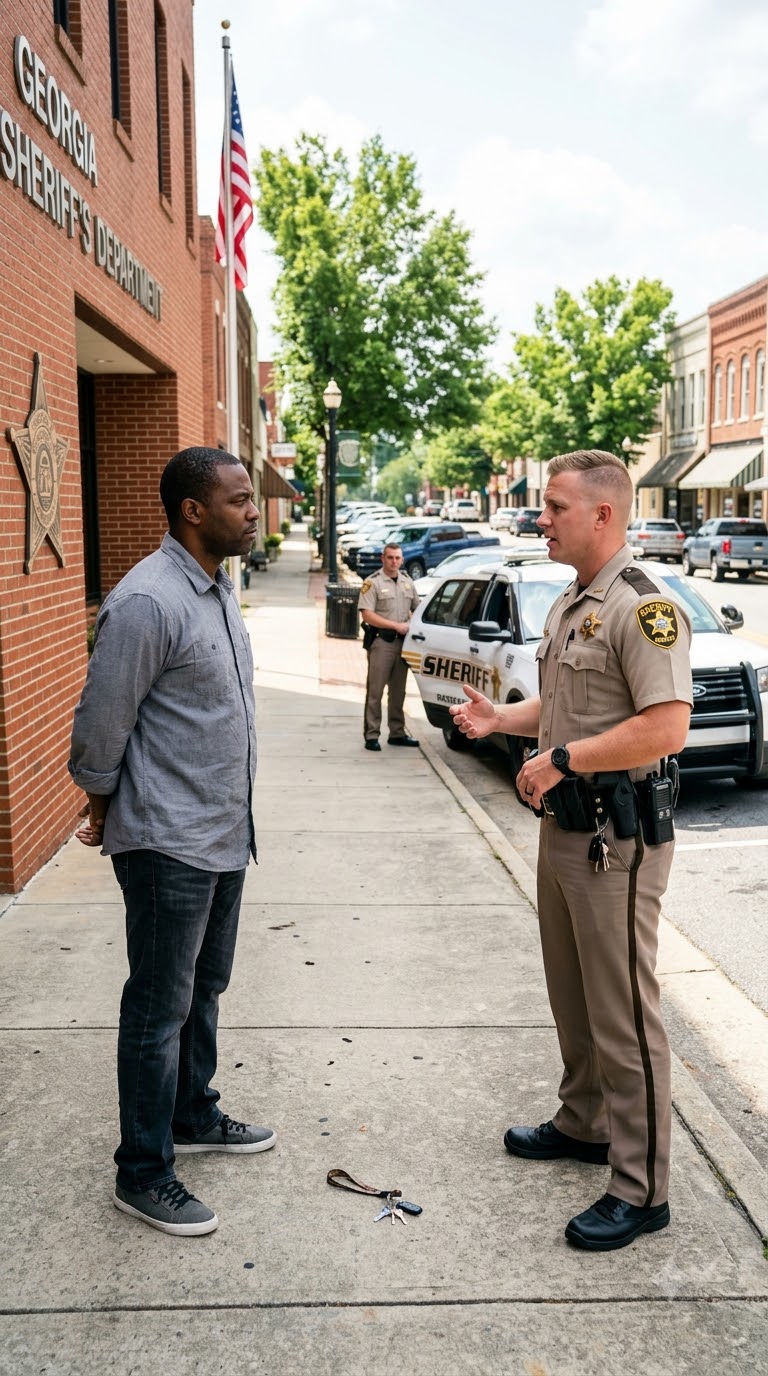
PART 3: THE BOX THAT HELD NINE YEARS OF TRUTH
That Sunday, Arnold entered First Baptist Church five minutes after the service began.
He slipped into a pew near the back.
The sanctuary was full.
Every row held worshippers.
Folding chairs lined the walls.
Several people stood at the rear holding their programs.
Reverend Dexter Randall stood at the pulpit.
For a long moment, he said nothing.
Then he reached down and lifted a familiar cardboard box.
It was the same box he had carried into the courthouse conference room.
The same box that contained complaints from fourteen families.
The same box he had preserved for nine years.
Randall held it carefully.
“Nine years,” Randall said.
His voice carried across the sanctuary.
“Nine years I have been carrying this box. Nine years of names and dates and statements and evidence that this community was being robbed in broad daylight by the very people paid to protect it.”
Nobody moved.
Randall continued.
“Nine years of filing the right paperwork and sending it to the right offices and being told, one way or another, that nobody was listening.”
He paused.
Then spoke more softly.
“Somebody listened.”
He stepped away from the pulpit.
Carried the box down the steps.
And placed it on the altar.
He used both hands.
He lowered it gently.
As though setting down a burden he had carried for far too long.
Arnold remained seated in the back.
His forearms rested on his knees.
His jaw tightened.
He watched Reverend Randall.
He understood that the box represented years of frustration, fear, and persistence.
The families had followed the procedures they were told to follow.
They had written complaints.
Collected records.
Provided names.
Preserved evidence.
Yet no one in authority had acted.
Until now.
Arnold knew the investigation had not repaired every loss.
But for the first time, those files were no longer being ignored.
They had become evidence in a federal case.
And the people who had carried them could finally see that someone was taking their experiences seriously.
Other changes followed.
They were not always dramatic.
Some occurred in courtrooms.
Others appeared in official letters.
Still others arrived quietly in people’s homes.
For the victims, those moments often mattered more than the headlines.
Darius Moran received his letter on a Friday.
He was thirty-four years old.
Nine years earlier, when he was twenty-five, Palmer’s department had pressured him into signing a confession.
The resulting felony conviction changed his life.
He spent four years in prison.
After his release, he struggled to rebuild.
Three jobs disappeared when employers discovered his record.
An apartment application was rejected.
A relationship collapsed under the strain of incarceration and its consequences.
Darius had spent years trying to explain a conviction that should never have existed.
On the morning the letter arrived, he was standing at his kitchen counter in Atlanta.
He was eating cereal.
The mail seemed ordinary.
Bills.
Advertisements.
An official envelope.
He opened it.
Then stopped.
His conviction was being formally vacated.
The compensation board would receive his case within thirty days.
The attorney general’s office would contact him about the next steps.
Darius read the letter once.
Then again.
He placed the paper on the counter.
Covered his face with both hands.
And cried.
For nine years, his conviction had followed him everywhere.
It had closed doors before he could reach them.
Now, for the first time, a door had opened in his direction.
The letter could not return the years he had lost.
It could not undo prison.
It could not restore every opportunity.
But it formally acknowledged that the conviction should not have stood.
For Darius, that acknowledgment meant something.
It meant the record would no longer define him in the same way.
It meant he could begin rebuilding without carrying a false conviction into every job interview and housing application.
And it meant someone had finally listened.
The investigation also forced Dellwood County to confront the scale of the forfeiture abuses.
Families who had once believed their complaints were hopeless began receiving requests for documentation.
Old cases were reopened.
Financial records were examined.
Seized property was traced where possible.
The process was slow.
Some records were incomplete.
Some assets had already been sold.
Some money had passed through too many accounts to be recovered easily.
The harm could not be repaired with a single announcement.
But the official silence had ended.
Dorothy Elias’ complaint was no longer a forgotten folder.
Her husband’s truck and the four thousand dollars intended for his funeral were now part of a documented investigation.
Other families began seeing their experiences recognized as connected rather than isolated.
A traffic stop that once appeared to be an unfortunate individual encounter could now be examined within the broader pattern.
A missing vehicle was not simply an administrative error.
A forfeiture with no criminal conviction was no longer automatically accepted as routine.
Investigators were asking questions that local authorities had avoided for years.
Where had the money gone?
Who approved the transfers?
Who benefited?
Who knew?
And why had so many complaints been closed without meaningful review?
Arnold understood that answering those questions would take time.
But he also understood that the evidence had changed the conversation.
The residents were no longer being asked merely to prove that something had happened to them.
Investigators were now examining how the same things had happened repeatedly.
A month later, Arnold sat across from the director of the FBI’s Atlanta field office.
A commendation letter lay on the desk.
Beside it was a promotion offer.
Senior supervisory agent.
An administrative position.
Regular hours.
A corner office.
Less time traveling between counties.
Fewer nights in roadside motels.
Fewer dangerous undercover assignments.
After twenty-four years of federal service, Arnold had more than earned the opportunity.
The director looked at him.
“You’ve earned this, Arnold,” the director said.
Arnold studied the documents.
He thought about his wife, Rosalie.
He thought about how she had answered Pat’s call that Saturday.
He knew she had spent years accepting the uncertainty that came with his work.
He knew a quieter position would make life easier for both of them.
Then he remembered Reverend Randall.
The cardboard box on the church altar.
The fourteen families.
Dorothy Elias.
Darius Moran.
The frightened witnesses who had wondered whether speaking would only make their lives harder.
He thought about the way Iverson had knocked his badge onto the sidewalk.
And about the officers who believed they could decide which complaints deserved attention.
Arnold placed one hand on the promotion documents.
Then gently slid them back across the desk.
“I appreciate it,” Arnold said. “But I’d like to stay in the field.”
The director studied him.
Arnold stood.
He buttoned his jacket.
At the doorway, he paused.
“We opened pattern reviews on three more counties last week,” he said. “I’d like to see those through.”
Then he left.
The director remained behind the desk.
The commendation letter was still there.
So was the promotion offer.
Arnold had chosen a different kind of reward.
He wanted to continue the work.
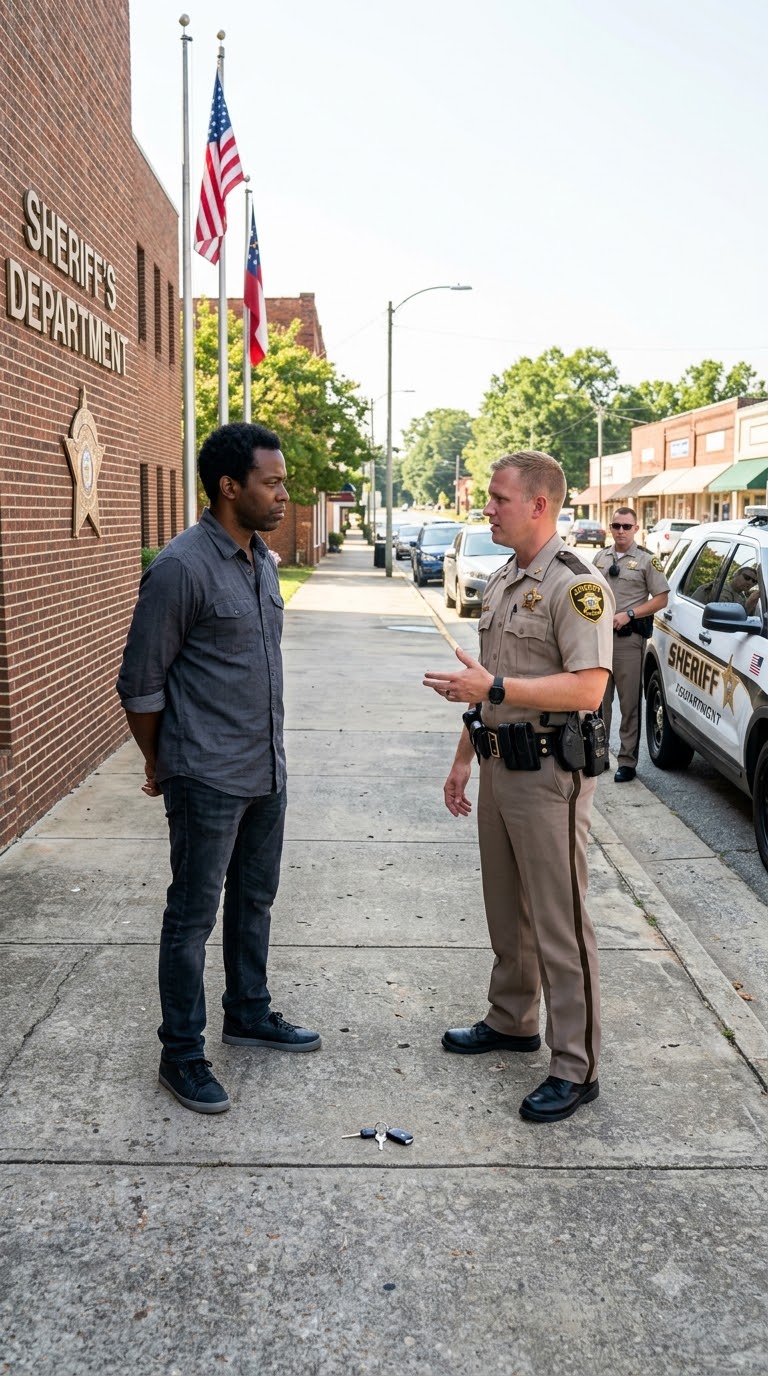
People would later tell the story of what happened on the sidewalk outside Ray’s Diner.
They liked the dramatic details.
A quiet Black man wearing jeans produced an FBI badge.
A sheriff’s sergeant knocked it from his hand.
Handcuffs clicked shut.
The man was marched across Main Street.
A scheduled telephone call went unanswered.
Federal agents arrived.
And within hours, the men responsible lost their badges.
That version was memorable.
It had a beginning, a confrontation, and a reversal.
The powerful men who believed they controlled Dellwood suddenly discovered they had challenged someone with the authority to investigate them.
But Arnold never considered that the whole story.
The arrest was only one visible moment in a much larger pattern.
Long before Arnold entered Ray’s Diner, people in Dellwood had been losing property.
Cash had been taken from glove compartments.
Vehicles had been seized.
Families had been pressured into accepting questionable charges.
Young men had signed statements they later said were coerced.
Residents had filed complaints and waited for responses that never came.
The people responsible had learned how to use procedure as protection.
They knew which forms to complete.
Which accounts to use.
Which supervisors would close a complaint.
Which officials could be relied upon to defend the department publicly.
And which residents were least likely to have the money or influence to challenge them.
The scheme depended on silence.
It depended on people believing that nobody outside the county would care.
Reverend Randall had refused to accept that.
For nine years, he preserved the documents.
He recorded the names.
He kept the dates.
He collected the statements.
Even when nothing changed, he refused to throw the files away.
Arnold understood why.
Destroying the box would have meant surrendering the only record some families had left.
Randall kept it because he believed the truth might eventually matter.
The investigation succeeded because different people acted when they had opportunities to do so.
Arnold refused to panic when he was handcuffed.
Pat recognized that his missed check-in was a warning.
Rosalie provided information that helped confirm where he had been working.
Vanessa obtained the court order.
Reverend Randall brought forward the evidence he had preserved.
Wilkin eventually admitted what he had witnessed.
Each action mattered.
No single person uncovered the entire scheme alone.
Arnold had experience.
Pat had persistence.
Vanessa understood the legal strategy.
Randall had the trust of his community.
Wilkin possessed information that helped expose the coordination.
And the families had kept speaking, even when their complaints seemed to disappear into offices where nobody listened.
Together, those pieces formed a record that was difficult to dismiss.
The truth had not suddenly appeared when Arnold was released from the holding cell.
It had existed for years.
In financial ledgers.
In seized-property records.
In complaint forms.
In witness statements.
In the memories of people who had been mistreated.
What changed was that the evidence was finally being connected.
Arnold thought often about the moment Iverson knocked his badge onto the sidewalk.
He remembered the silver metal striking the concrete.
The identification card sliding beside it.
The shoppers passing without intervening.
The old man reading his newspaper across the street.
The sound of the handcuffs closing.
But he did not remember that moment because his authority had been challenged.
He remembered it because it revealed something important.
A badge could identify a federal agent.
It could give him the legal authority to investigate crimes.
It could open doors.
But it could not guarantee that someone would respect the truth.
Iverson had seen the badge.
He had chosen not to examine it.
Palmer had been given the opportunity to verify Arnold’s identity.
He had chosen to stage a telephone call instead.
The officers had not lacked information.
They had rejected information that interfered with their purpose.
That was what made the encounter so revealing.
The same pattern appeared throughout the forfeiture scheme.
Residents had supplied documents.
Filed complaints.
Explained what had happened.
But the people controlling the system had decided not to listen.
Arnold’s arrest was not separate from those experiences.
It was another example of authority being used to silence someone who threatened the operation.
The difference was that Arnold had a federal team waiting for his call.
Many Dellwood residents had spent years waiting for someone to answer theirs.
After the case, Arnold continued traveling.
He visited other counties.
Reviewed more financial records.
Interviewed more witnesses.
He drank coffee in small diners.
Sat in courthouse waiting rooms.
Read documents in motel rooms long after midnight.
Sometimes the work was tedious.
Sometimes it was dangerous.
Often, progress came slowly.
A missing receipt might lead to a bank account.
A forgotten complaint might identify another victim.
A routine telephone record might expose coordination that someone believed was invisible.
Arnold had learned that corruption rarely depended on a single dramatic act.
More often, it survived through small decisions repeated over years.
A supervisor closed a complaint without investigation.
A clerk accepted an incomplete form.
An officer ignored contradictory evidence.
A witness became frightened and withdrew.
An official offered a reassuring explanation that nobody bothered to verify.
Each decision helped the larger system continue.
And each could become an opportunity to interrupt it.
Arnold did not believe institutions were automatically honest simply because they had official names and seals.
He believed their integrity depended on the people willing to question them.
Sometimes those people worked inside the institutions.
Sometimes they were residents who had been ignored.
Sometimes they were frightened young deputies deciding whether to tell the truth.
Sometimes they were elderly pastors who refused to throw away a cardboard box.
The story of Dellwood County was not simply about a sergeant losing his badge.
Nor was it only about a deputy chief facing federal charges.
It was about the consequences of allowing authority to operate without accountability.
For years, people had been told that their complaints were misunderstandings.
That their property had been seized according to procedure.
That their concerns had been reviewed.
That nothing improper had happened.
The paperwork appeared orderly.
The official explanations sounded confident.
But beneath them, money was disappearing.
Families were suffering.
And people with power were protecting one another.
Arnold’s arrest exposed the system because the people involved became too confident.
They believed they could detain a federal investigator as easily as they had intimidated local residents.
They believed his credentials could be ignored.
They believed Palmer’s staged verification call would provide a sufficient explanation.
They believed the investigation could be delayed until the evidence lost its force.
For a time, their tactics worked.
Iverson returned to duty.
A witness changed his statement.
A judge imposed a procedural stay.
The case appeared to be losing momentum.
But the evidence remained.
Pat found the leak.
Wilkin came forward.
Randall’s files continued supporting the victims’ accounts.
And the financial records eventually connected the people who had benefited.
The system did not collapse because one man was important.
It collapsed because enough people preserved the truth and refused to abandon it.
Arnold Parsons never described himself as a hero.
He did not believe that was his role.
He had been given a badge.
He had taken an oath.
He had spent twenty-four years learning how to investigate difficult cases.
To him, the work was a responsibility.
Not a performance.
He knew that one successful investigation could not repair every injustice.
He knew some victims would never recover everything they had lost.
He knew that criminal proceedings could take years.
And he knew that even a strong case could be delayed by people with money, influence, and experienced attorneys.
But he also knew that documented evidence could survive attempts to bury it.
A witness statement could be preserved.
A telephone record could establish timing.
A financial ledger could expose a pattern.
A complaint ignored for nine years could become the foundation of a federal investigation.
The truth did not always win quickly.
Sometimes it had to wait.
Sometimes it had to withstand intimidation.
Sometimes it had to be carried in a cardboard box from one office to another.
But it could still matter.
Arnold returned to work.
County by county.
File by file.
Pattern by pattern.
There would be more cold coffee.
More long drives.
More reluctant witnesses.
More officials offering polished explanations.
More people using the word misunderstanding when the evidence suggested deliberate obstruction.
He expected all of it.
He also expected moments of progress.
A witness deciding to speak.
A family receiving a long-overdue letter.
A conviction being vacated.
A missing financial record finally being located.
A community discovering that its complaints had not been forgotten.
Those moments rarely attracted the same attention as an arrest.
But they were why Arnold continued.
He had learned that a badge could be knocked to the ground.
A federal agent could be handcuffed.
An investigation could be delayed.
Evidence could be challenged.
Witnesses could be frightened.
And powerful people could spend enormous sums trying to protect themselves.
Yet carefully preserved truth could survive all of it.
In Dellwood County, it survived in a partner who noticed a missed call.
In a deputy who finally told the truth.
In families who refused to stop documenting what had happened.
And in a pastor who carried fourteen folders for nine years.
The quiet man arrested outside Ray’s Diner did not need to shout to prove who he was.
He walked out of the holding cell.
Accepted his badge.
Returned to the evidence.
And kept working until the people who believed they owned Dellwood County were forced to answer for what they had done.
The handcuffs had come off in less than an hour.
The first two careers had collapsed within three hours and seven minutes.
But the real victory took longer.
It came when the people who had been ignored finally began receiving answers.
Because power survives when people believe nobody is listening.
And justice begins when someone finally does.
