

PART 1
For years, Officer Daniel Briggs and Officer Mark Keller had exploited the authority their badges provided. False reports were quietly buried, complaints mysteriously vanished, and every accusation of excessive force was explained away. They believed themselves untouchable, certain that no one could challenge their power.
Then they encountered a woman they had gravely underestimated.
A blind Black woman was taking her service dog on a peaceful morning walk through an affluent neighborhood. To the officers, she seemed vulnerable, someone whose objections could easily be ignored.
Just another complaint destined to disappear.
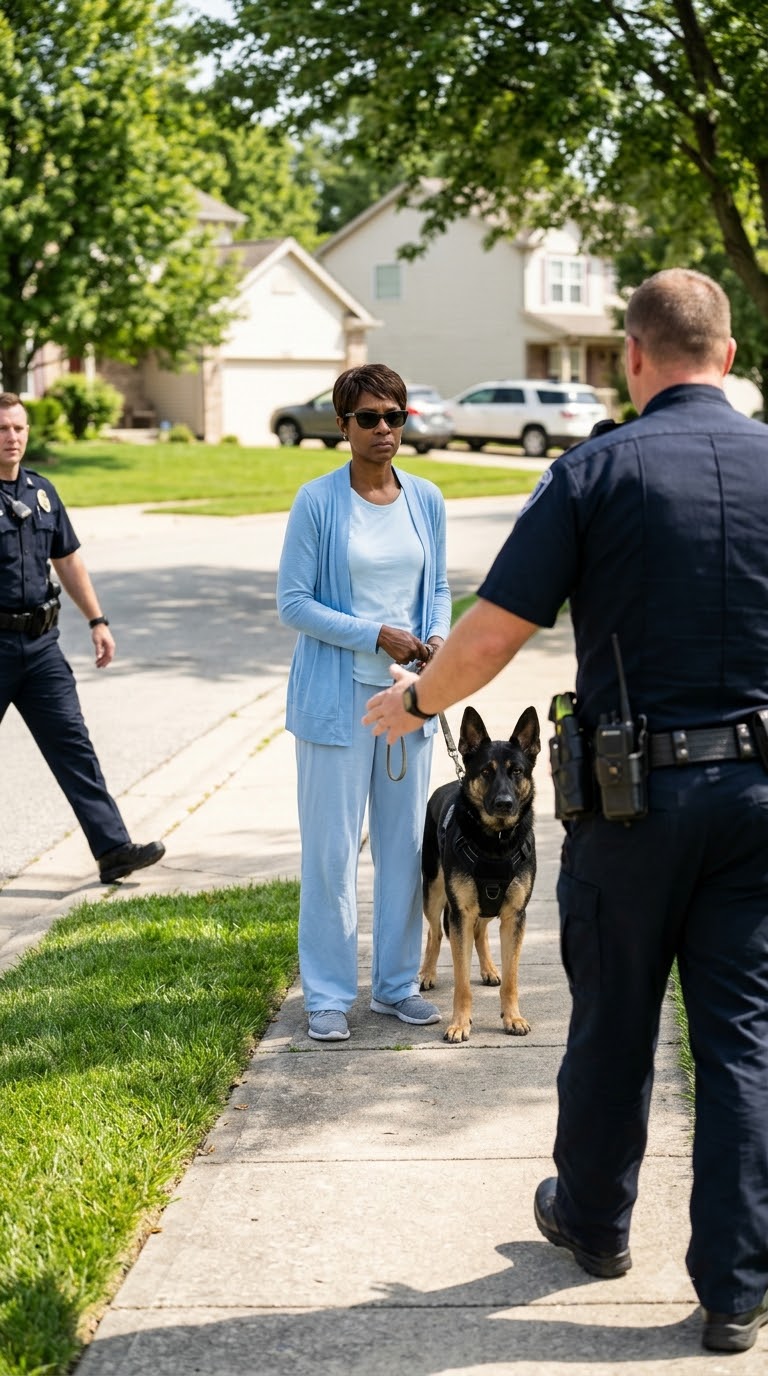
What they couldn’t see behind her dark glasses was the authority of a federal judge. She carried no weapon. Her strength came from her knowledge of the law, her unshakable resolve, and the people who trusted her judgment.
When the officers’ arrogance led one of them to shoot her loyal service dog, they set in motion a confrontation that would expose years of corruption and bring their carefully protected careers crashing down.
And it would all begin with one simple demand.
His badge number.
PART 1
The morning sun slipped between the tall trees of Oakidge Estates, casting long shadows across the neighborhood’s immaculate sidewalks.
Judge Mariah Ellison walked her familiar route at a steady pace, her left hand resting comfortably on Justice’s harness. The German Shepherd moved beside her with the quiet confidence of a companion who had spent years learning her movements.
Their steps were so perfectly synchronized that they seemed to share a single rhythm.
“Good morning, Mrs. Chen,” Mariah called, recognizing the distinctive sound of garden shears trimming roses nearby.
“Judge Ellison. Beautiful morning, isn’t it?” Mrs. Chen replied cheerfully.
“Justice looking handsome as always.”
Mariah smiled, reaching down to stroke the dog’s back. The morning sunshine had already warmed his thick coat.
He knows it, too. Gets extra proud when people compliment him.
Justice wagged his tail as they continued along the sidewalk.
The neighborhood smelled of freshly cut grass and jasmine blossoms. Mariah had memorized every cracked section of pavement, every driveway, and every fire hydrant along their route. Although she had lost her vision fifteen years earlier, she had developed an extraordinary understanding of the world through sound, touch, memory, and careful attention.
“Three steps to the miller’s driveway,” she murmured, repeating a small habit she had established after becoming blind.
The words were no longer necessary, but they provided a familiar sense of comfort.
At the next intersection, Justice stopped automatically.
Mariah listened for traffic, waited until the street was quiet, and gave him the signal to cross.
They were halfway across Maple Street when she felt the German Shepherd grow slightly tense.
His pace slowed.
Someone was approaching.
Heavy footsteps sounded against the pavement, followed by the unmistakable smell of cigarette smoke.
Harold Whitaker.
Mariah recognized him immediately.
Her shoulders tightened.
Morning, she greeted him politely, despite knowing from experience that he rarely returned her courtesy.
For three years, Harold had made his hostility toward her impossible to misunderstand.
He responded with a sound halfway between a grunt and a snort.
Yeah.
Justice remained close to Mariah’s leg, ignoring the man as they passed.
Mariah held her head high.
Fifteen years on the federal bench had taught her that dignity could be a form of armor, particularly when confronting people determined to deny it to others.
Behind her, Harold muttered loudly enough to be heard.
Doesn’t belong here. bringing down property values.
He wanted those words to reach her.
Mariah continued walking without responding, although anger stirred beneath her calm expression.
Justice sensed the change in her mood and shifted closer, his warm body offering silent reassurance.
They had nearly reached the end of the block when a squirrel darted across the sidewalk.
Justice gave one sharp bark and briefly pulled against his harness.
It was the only interruption to his otherwise impeccable behavior that morning.
“Easy, justice,” Mariah said softly, resting her hand on his head. “Leave it.”
The dog immediately obeyed, returning to his trained position.
Mariah smiled proudly.
She reached into her pocket, retrieved a small treat, and rewarded him.
Several yards behind them, Harold Whitaker watched the entire exchange with narrowed eyes.
His expression hardened.
He had been waiting for an opportunity like this.
The excuse did not have to be convincing. It only had to be sufficient to bring trouble to Mariah’s doorstep.
He pulled out his phone and dialed 911.
“Emergency services!” the dispatcher answered.
Harold immediately made his voice sound frightened.
“Yes, I need to report a dangerous situation. There’s a black woman who can’t control her aggressive dog.
It’s lunging at everything. Nearly attacked me.
He turned away from the road, speaking more quietly.
She’s blind. Can’t see what that animal is doing.
There are kids in this neighborhood. They’re not safe with that beast around.
The dispatcher asked for his location.
Harold supplied it quickly.
“Hurry before someone gets hurt. The dog’s a German Shepherd. big one. She’s heading east on Maple toward the park.
After ending the call, Harold stared in Mariah’s direction with unmistakable satisfaction.
A thin smile crossed his face.
She had always walked through Oakidge Estates as though she had every right to be there.
His neighborhood.
His street.
Yet she never lowered her eyes, never apologized for her presence, and never reacted to his insults the way he wanted.
Justice’s harmless bark had simply given him a convenient opening.
The real object of his resentment was Mariah herself.
Her success.
Her independence.
Her refusal to be intimidated.
We’ll see how proud you are now, he murmured, slipping his phone back into his pocket.
Across town, the police dispatch radio crackled to life.
Unit 47, we’ve got a call about an aggressive dog threatening neighborhood children at Oakidge Estates. Maple Street near Park View Lane.
Officer Daniel Briggs picked up the radio.
Unit 47 responding. Details on the dog.
German Shepherd. Handler reported as a blind black female heading toward the park area.
Briggs glanced at his partner, Officer Mark Keller, who was finishing his coffee.
Got a dog call. Guess we’re animal control today.
Keller tossed his empty cup into the trash.
Better than writing tickets. What’s the situation?
Some shepherd going crazy. Owner can’t control it.
Briggs stood and checked the equipment on his belt.
Apparently, she’s blind. Recipe for disaster right there.
Keller adjusted his cap, grinning mockingly.
Blind person with an aggressive dog. What could go wrong?
His voice dripped with sarcasm.
Let’s go before some kid gets their face chewed off.
The two officers headed outside and climbed into their patrol cruiser.
Briggs took the driver’s seat.
“You know the protocol on dangerous animals,” he remarked, his tone suddenly serious.
Keller nodded, his face hardening.
“If that dog makes one wrong move.”
“Exactly.”
Briggs started the engine and activated the siren.
Better safe than sorry.
As they drove, Keller searched for information about the neighborhood on his phone.
Oakidge Estates. Fancy area. Probably some rich lady who got a guard dog she can’t handle.
Don’t matter how rich she is, Briggs replied, gripping the steering wheel tightly.
Laws the law. Dog goes after someone. We do what needs doing.
The cruiser accelerated through morning traffic.
Neither officer had spoken to the woman.
Neither had witnessed the alleged threat.
Yet both had already decided that the dog was dangerous and that its handler was incapable of controlling it.
Their judgment had been shaped by Harold’s fabricated complaint, their own prejudices, and years of operating within a department where aggression had too often gone unchallenged.
“5 minutes out,” Briggs announced, pressing harder on the accelerator.
Keller watched the homes become increasingly expensive as they entered Oakidge Estates.
“Let’s get this over with.”
Sunlight glinted off their badges as the cruiser turned toward Maple Street.
Ahead of them, Mariah and Justice remained unaware of the confrontation approaching.
The patrol car stopped abruptly beside the curb, its tires scraping across loose gravel.
Briggs switched off the siren but left the emergency lights flashing.
Red and blue reflections swept across the peaceful street.
Both officers climbed out quickly, slamming their doors almost together.
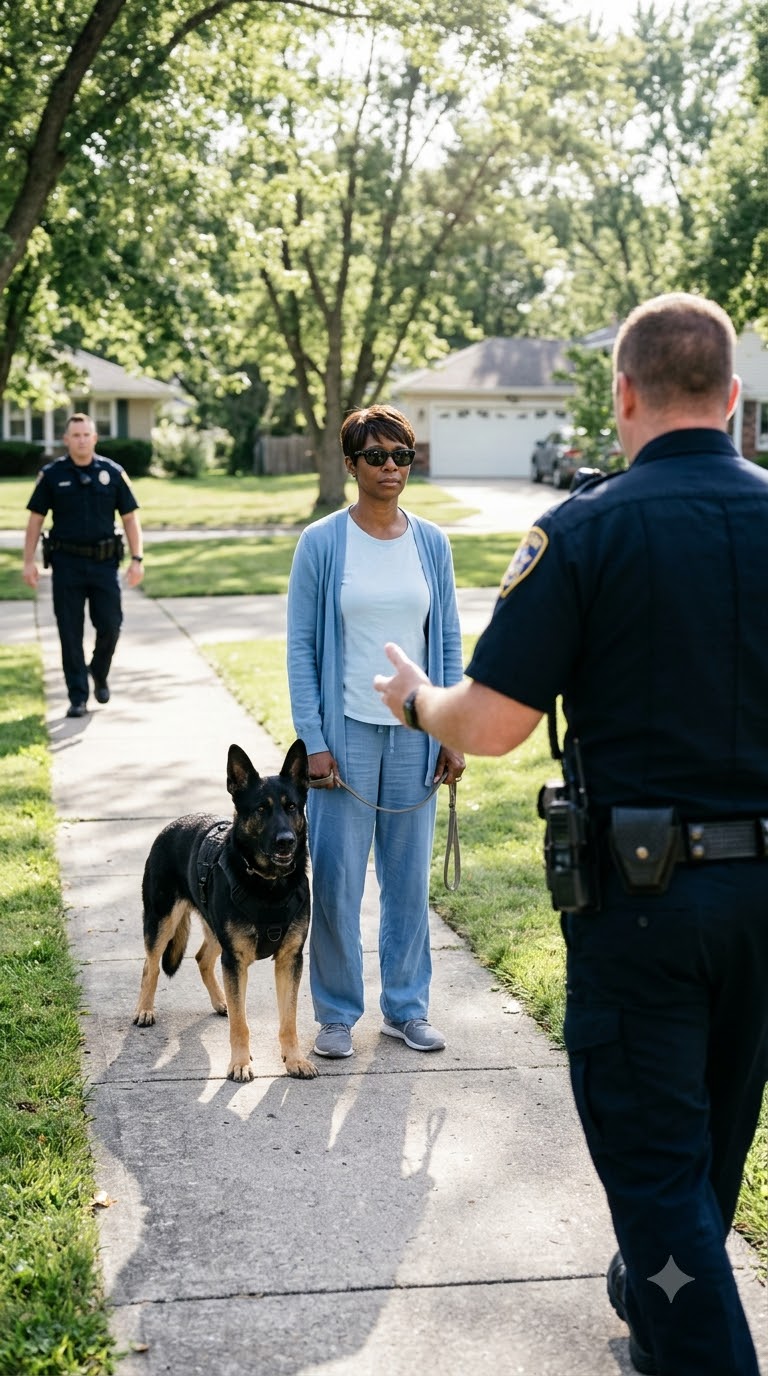
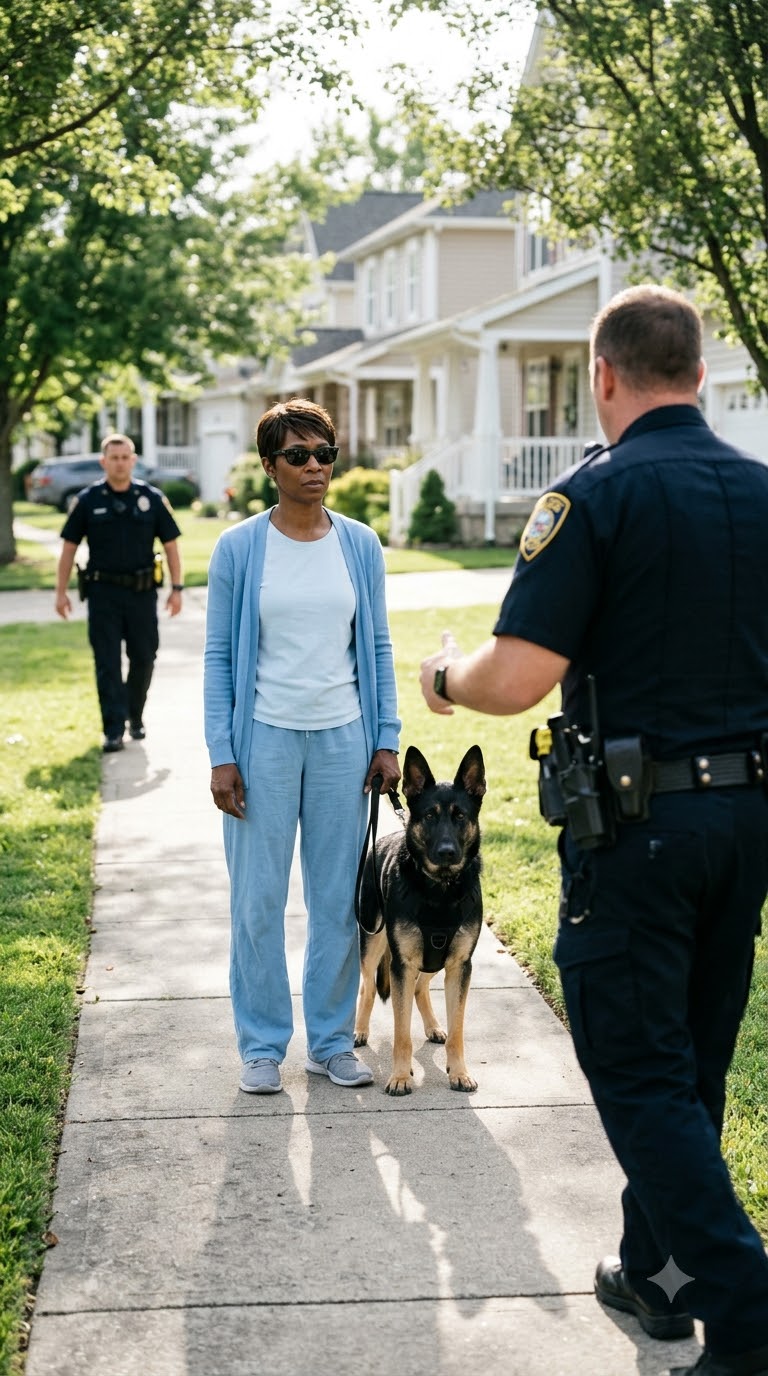
Mariah stood near the entrance to the small neighborhood park, holding Justice’s harness.
The German Shepherd sat calmly at her side.
They had paused to enjoy the gentle breeze carrying the scent of freshly mowed grass and flowering dogwood.
“Something’s happening,” Mariah whispered, turning her head toward the sound of car doors and approaching footsteps.
Justice’s ears rose.
He remained seated.
Briggs advanced with one hand resting near his holster, planting his feet in an unnecessarily threatening stance.
Keller approached from the opposite side.
Neither officer paused to evaluate the scene.
A blind woman.
A seated service dog.
An empty sidewalk.
No frightened children.
No evidence of an attack.
“Step back from the dog, ma’am!” Briggs shouted.
Mariah turned toward his voice.
“Officer, this is my service animal. His name is Justice, and he’s under my control.”
“I didn’t ask for his name,” Briggs snapped. “I told you to step away.”
Mariah tightened her fingers around the harness.
“I am blind. Separating me from my guide dog without a safe alternative would place me in danger.”
Keller laughed.
“Then maybe you shouldn’t be walking around with a dangerous animal.”
Mariah’s expression changed.
Not because she was frightened.
Because she recognized the contempt in his voice.
“Justice is not dangerous,” she answered firmly. “He’s a professionally trained guide dog. He’s sitting quietly beside me.”
Briggs took another step.
“We received a report that your dog attacked someone.”
“That report is false.”
“You calling the witness a liar?”
“I’m telling you what happened. My dog barked once when a squirrel crossed the sidewalk. He immediately responded to my command.”
Keller looked at Briggs.
“She’s got an answer for everything.”
Mariah heard the remark.
“Officer, I am cooperating with you. But I need you to explain exactly what you intend to do.”
Briggs pulled a hand away from his belt.
“First, you’re going to release that harness.”
“No. Not while you’re approaching him aggressively.”
“That’s an order.”
“And I’m asking you to give me a lawful reason.”
For a moment, the street fell quiet.
Briggs had expected confusion, pleading, perhaps tears.
He had not expected a woman who understood precisely how to question his authority.
His jaw tightened.
“You think you’re a lawyer or something?”
Mariah remained composed.
“I know my rights.”
Keller stepped closer to Justice.
The German Shepherd shifted slightly, positioning himself between Mariah and the approaching officer.
His movement was controlled and deliberate.
He did not growl.
He did not lunge.
He simply stood.
“See that?” Keller shouted. “He’s getting aggressive.”
“He’s responding to your movement,” Mariah explained. “Please step back.”
Briggs drew his weapon.
The sound of the pistol leaving its holster reached Mariah before she understood what was happening.
Her stomach tightened.
“Officer, do not point a firearm at my service dog.”
“Control him!”
“He is controlled!”
Justice remained beside her.
Keller suddenly moved forward and reached toward the harness.
Mariah instinctively pulled it closer.
Justice turned his head toward the movement.
Briggs fired.
The gunshot shattered the morning silence.
Birds exploded from the nearby trees.
Mariah felt a violent jolt through the harness.
Then Justice cried out.
It was a sound she had never heard him make before.
A terrible, frightened yelp.
His weight collapsed against her leg.
“Justice?”
Her voice broke.
“Justice!”
She dropped to her knees, her hands searching desperately through the air until they found his body.
His breathing was rapid.
His fur was wet.
Warm liquid covered her fingers.
Blood.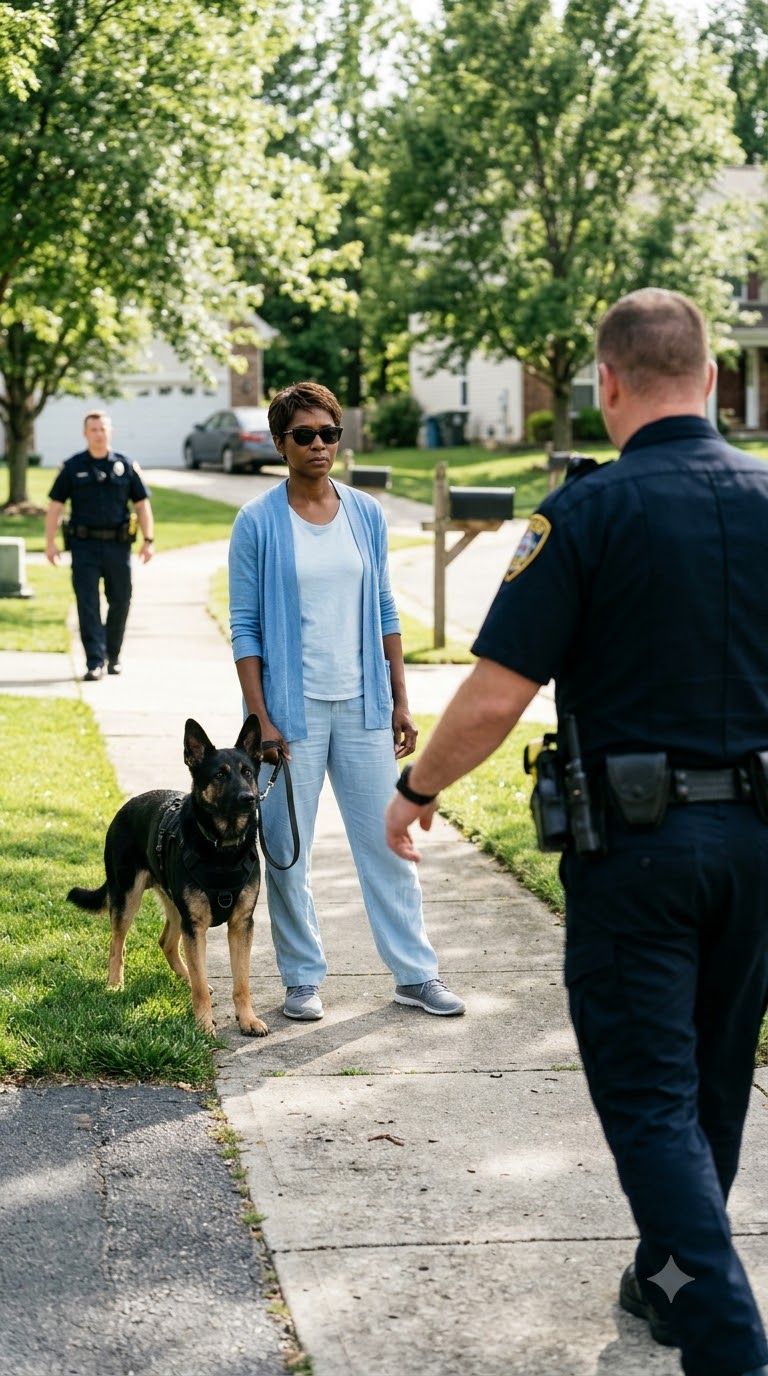
“No. No, sweetheart. Stay with me.”
Justice whimpered and tried to move closer to her.
Mariah bent over him, shielding his body with her own.
“Please. Stay with me.”
Briggs stood several feet away, his weapon still raised.
Keller stared at the wounded dog.
For the first time, his expression revealed uncertainty.
“He moved,” Briggs said sharply.
Mariah lifted her head.
“He was standing beside me.”
“He lunged.”
“No, he did not.”
“You need to calm down.”
Mariah’s face turned toward the officer’s voice.
Her grief was unmistakable.
But something else had entered it.
An anger so controlled that it made her next words almost frighteningly quiet.
“Put your weapon away.”
Briggs hesitated.
“Ma’am—”
“Put it away. My dog is injured, and he needs emergency veterinary care.”
Keller shifted his weight.
“Briggs, maybe we should call—”
“Quiet,” Briggs snapped.
Mariah continued pressing her hand gently against Justice’s wound.
“Call an emergency veterinarian. Call your supervisor. And preserve every second of your body-camera footage.”
Briggs gave a contemptuous laugh.
“You don’t get to give us orders.”
Mariah slowly raised her chin.
“Then answer one question.”
Neither officer spoke.
“What is your badge number?”
Briggs stared at her.
“What?”
“Your badge number, Officer. State it clearly.”
“That’s none of your business.”
“It became my business when you fired at my service dog.”
Keller glanced toward the surrounding houses.
Several doors had opened.
Neighbors were emerging onto porches.
Mrs. Chen stood near her rose bushes, one hand covering her mouth.
Across the street, a teenage boy held up his phone.
Mariah heard the growing movement around her.
She knew people were watching.
And she knew that whatever happened next could no longer be hidden as easily as Briggs believed.
“Officer,” she repeated, “I am asking you to identify yourself.”
Briggs stepped closer.
“You need to stop making demands.”
Mariah’s voice became sharper.
“My name is Mariah Ellison.”
Briggs shrugged.
“Good for you.”
“I am a United States District Judge.”
The silence that followed was immediate.
Keller’s face drained of color.
Briggs blinked.
For several seconds, neither man seemed capable of responding.
Mariah remained kneeling beside Justice, her bloodstained hands resting against his fur.
“And now,” she said, each word deliberate, “I want your badge number.”
PART 2
Briggs recovered first.
He let out a short, disbelieving laugh.
“Anybody can claim they’re a judge.”
Mariah did not move.
“Then verify my identity through dispatch.”
Keller looked toward the cruiser.
“Daniel, maybe we should—”
“I said she’s lying.”
Mariah heard the desperation beginning to creep into Briggs’s voice.
He had expected an anonymous woman whose complaint could be dismissed.
Instead, he was confronting someone who understood the legal system far better than he did.
But Justice’s breathing was growing weaker, and Mariah refused to waste another moment arguing.
“Mrs. Chen,” she called.
The older woman hurried forward.
“I’m here, Judge Ellison.”
“Please call the nearest emergency veterinary hospital. Tell them a service dog has suffered a gunshot wound. Ask whether they can send help or prepare for immediate arrival.”
Mrs. Chen’s voice trembled.
“Of course.”
“And please call 911 again. Request medical assistance and a supervising officer.”
“I’m doing it right now.”
Briggs stepped toward her.
“Nobody needs to make another call.”
Mrs. Chen froze.
Mariah turned sharply.
“Do not interfere with her.”
Keller placed a hand on Briggs’s shoulder.
“Daniel, there are witnesses.”
Briggs jerked away.
“I know what I’m doing.”
But he did not.
He was beginning to understand that the usual tactics would not work.
Across the street, the teenage boy continued recording.
His name was Ethan Morales, and he had stepped outside after hearing the gunshot.
His phone had captured Justice lying wounded, Mariah kneeling beside him, and Briggs refusing to provide his badge number.
More importantly, the home’s security camera had recorded the confrontation before the shot.
PART 2
Ethan did not yet understand how important those recordings would become.
He only knew that a woman was begging for help while two armed officers stood over her.
“Officer,” Mariah said, “your supervisor needs to be notified immediately.”
Briggs finally reached for his radio.
“Dispatch, Unit 47. Animal discharged on scene. Request supervisor.”
Mariah heard his wording.
“Animal discharged?” she repeated.
Briggs ignored her.
Keller shifted uncomfortably.
“Shots fired at an animal,” he corrected into his own radio. “One injured service dog. No human injuries reported. Request emergency veterinary assistance.”
Briggs glared at him.
But Keller was no longer looking at his partner.
He was staring at the blood spreading across the pavement.
Within minutes, another patrol vehicle arrived.
Sergeant Rebecca Torres stepped out and surveyed the scene.
Her expression tightened when she saw Justice.
“What happened?”
Briggs answered immediately.
“Aggressive German Shepherd charged me. I discharged my weapon to prevent an attack.”
Mariah lifted her head.
“That statement is false.”
Torres turned toward her.
“Ma’am, I’m Sergeant Torres. Are you injured?”
“Not physically. My service dog has been shot. He needs immediate treatment.”
Torres knelt several feet away.
“Understood. An emergency veterinary team is being contacted.”
Then Mariah spoke again.
“My name is Judge Mariah Ellison. I want this scene preserved. I want the officers separated for independent statements. And I want the available recordings secured.”
Torres went still.
She recognized the name.
Judge Ellison had presided over major federal cases involving public corruption and civil rights.
Her reputation for careful reasoning and unwavering impartiality was well known.
“Judge Ellison,” Torres said quietly, “I’m very sorry.”
Mariah shook her head.
“Don’t apologize yet. Help my dog.”
Torres immediately turned to another responding officer.
“Get a transport vehicle here. Now.”
Then she faced Briggs.
“Secure your firearm. You’re relieved from the scene pending review.”
Briggs stiffened.
“Sergeant, you don’t understand—”
“I understand that a firearm was discharged and an animal is critically injured. We will determine the facts.”
Keller looked away.
Briggs’s face reddened.
“You can’t just take her word over mine.”
“I’m not taking anyone’s word. I’m preserving evidence.”
Those words changed everything.
For years, Briggs had been accustomed to supervisors accepting his explanations without asking difficult questions.
Torres was doing the opposite.
She was asking for proof.
Justice gave another weak whimper.
Mariah immediately bent toward him.
“I’m here, sweetheart.”
She pressed her forehead gently against his head.
“You’ve always taken care of me. Let me take care of you now.”
The German Shepherd’s tail moved once against the pavement.
Mariah began crying.
Not loudly.
Not dramatically.
Tears simply slipped beneath her dark glasses as she held the companion who had guided her through countless streets, court buildings, airports, and unfamiliar places.
He had been beside her through the death of her father.
Through her mother’s illness.
Through the most difficult decisions of her judicial career.
He had given her independence without ever asking for anything in return.
Now he was bleeding because two officers had refused to see him for what he was.
A trained service animal protecting his handler.
When the emergency veterinary transport arrived, the team carefully lifted Justice onto a stretcher.
Mariah kept one hand against his head until the last possible moment.
“Please don’t let him die,” she whispered.
The veterinarian crouched beside her.
“We’re going to do everything we can.”
Mariah nodded.
Then she asked Sergeant Torres to arrange transportation to the hospital.
Torres agreed immediately.
As the vehicle pulled away, Mariah heard Briggs arguing behind her.
“This is ridiculous. I followed procedure.”
Torres’s answer was firm.
“Then the evidence will support you.”
Mariah said nothing.
She had learned long ago that the truth did not require shouting.
It required preservation.
Documentation.
And the willingness to follow facts wherever they led.
At the veterinary hospital, Dr. Samuel Reed examined Justice and ordered emergency surgery.
The bullet had entered near his shoulder.
Fortunately, it had missed his heart, but it had damaged muscle and caused significant bleeding.
Mariah sat in a quiet consultation room while the medical team worked.
Her hands had been cleaned, yet she could still feel the blood against her skin.
Every few minutes, she reached toward the empty space beside her chair.
Each time, her fingers found nothing.
The absence was unbearable.
Her longtime friend and federal court colleague, Judge Thomas Avery, arrived shortly afterward.
“Mariah?”
She rose at the sound of his voice.
Thomas embraced her.
For the first time since the shooting, she allowed herself to tremble.
“They shot Justice.”
“I know.”
“He wasn’t attacking anyone.”
Thomas held her shoulders.
“I believe you.”
Mariah stepped back.
“Belief isn’t enough. We need evidence.”
Thomas nodded.
“I’ve already contacted an attorney who can advise you personally. You cannot handle this as a judge.”
“I know.”
Her voice was steady again.
“I want this investigated properly. No special treatment. No shortcuts. And no one deciding the outcome because of my position.”
Thomas studied her.
“You’re worried they’ll accuse you of using your authority.”
“They will.”
“And?”
Mariah’s jaw tightened.
“Then they can make that accusation. I will not allow it to stop me from seeking accountability.”
By afternoon, the first video appeared online.
Ethan Morales had uploaded his recording after giving a copy to investigators.
The footage showed Mariah kneeling over Justice.
It captured Briggs’s refusal to identify himself.
And it recorded the moment Mariah announced that she was a federal judge.
The clip spread rapidly.
Thousands of viewers demanded to know why the officer had shot a service dog.
Others asked why his first reaction had been to challenge the woman’s identity instead of arranging medical care.
But the most important recording had not yet been released.
It belonged to Mrs. Chen.
Her home security system covered a wide portion of Maple Street.
Its camera had captured Justice sitting peacefully before the officers approached.
It showed Keller reaching toward the harness.
And it showed Briggs drawing his weapon before Justice made any sudden movement.
Mrs. Chen gave the original recording directly to investigators.
Sergeant Torres watched it twice.
Then a third time.
She leaned back in her chair.
“That’s not what Briggs reported.”
Beside her, Detective Angela Price studied the screen.
“No.”
Torres looked at the written incident report.
Briggs had claimed that the dog lunged with exposed teeth and that he fired while retreating from an immediate threat.
The recording showed something different.
Justice had risen from a seated position and turned toward Keller’s hand.
Briggs had not retreated.
And the dog had never charged.
Price paused the footage.
“We need the body cameras.”
Torres’s expression darkened.
“Briggs says his malfunctioned.”
“What about Keller?”
“His was active.”
“Then let’s see it.”
Keller’s recording revealed another disturbing detail.
Before stepping out of the cruiser, Briggs had said something that contradicted his later account.
“One wrong move and that dog is done.”
The words were captured clearly.
So was Keller’s nervous laugh.
Price stared at the monitor.
“This wasn’t an unavoidable split-second reaction.”
Torres did not answer immediately.
She had served in the department for eighteen years.
She knew Briggs’s reputation.
She knew Keller’s.
And she knew that complaints against them had repeatedly disappeared.
For a long time, she had accepted the explanations offered by supervisors.
Now she wondered how many of those explanations had been lies.
That evening, Police Chief Robert Hensley called an emergency meeting.
The department’s legal counsel attended.
So did internal affairs.
Torres presented the recordings.
When the video ended, nobody spoke.
Hensley rubbed his forehead.
“How many complaints have we had against Briggs?”
The internal affairs lieutenant hesitated.
“Several.”
“Define several.”
“Over the years? Twenty-three formal complaints.”
Hensley looked up sharply.
“Twenty-three?”
“Most were closed as unsubstantiated.”
“And Keller?”
“Seventeen.”
The chief stared at the two files.
Forty complaints.
Two officers.
Almost no disciplinary consequences.
“Who reviewed them?”
The lieutenant said nothing.
Hensley’s voice hardened.
“Who reviewed them?”
“Captain Warren.”
The name hung in the room.
Captain Richard Warren had supervised Briggs and Keller for nearly a decade.
He had also signed off on the initial report from that morning.
And he had already told the chief that the shooting was justified.
Hensley closed the folder.
“Place both officers on administrative leave. Secure every complaint file. Nobody alters, deletes, or removes anything.”
Then he turned to the department attorney.
“We need an independent investigation.”
Across town, Mariah sat in the veterinary hospital waiting room.
She had refused to leave.
At 9:17 that evening, Dr. Reed approached.
Mariah stood immediately.
“Justice?”
The veterinarian paused.
“The surgery was successful.”
Mariah covered her mouth.
Dr. Reed continued.
“He lost a significant amount of blood, and the next forty-eight hours are important. But the bullet missed his vital organs. We have reason to be cautiously optimistic.”
Mariah began to cry.
This time, the tears came with relief.
“Can I see him?”
“Yes. Just for a few minutes.”
A technician guided her into the recovery area.
Justice lay beneath a warm blanket.
His breathing was slow but steady.
Mariah reached down and touched his head.
“Hello, my brave boy.”
His ears twitched.
Then his tail moved faintly.
Mariah smiled through her tears.
“That’s right. I’m here.”
She rested her hand against his cheek.
“You don’t have to protect me right now.”
For several minutes, she remained beside him, listening to the steady rhythm of his breathing.
Then her phone vibrated.
Thomas had sent a message.
The department has opened a formal investigation. Federal authorities have also been notified.
Mariah read the message through her phone’s screen reader.
She closed her eyes behind her glasses.
This was no longer simply about Justice.
It was about every person who had encountered Briggs and Keller without the resources, credibility, or public attention she possessed.
And Mariah had a terrible feeling that there were many.
PART 3
Three days after the shooting, a woman named Denise Carter called the attorney representing Mariah.
Her voice shook as she explained why.
Two years earlier, Officer Daniel Briggs had stopped her nineteen-year-old son, Marcus, while he was walking home from work.
Briggs claimed Marcus matched the description of a robbery suspect.
There had been no robbery in the area that evening.
Marcus had asked why he was being detained.
According to Denise, Briggs shoved him against a patrol car, handcuffed him, and arrested him for resisting.
Keller witnessed the entire encounter.
Both officers submitted reports claiming Marcus had been aggressive.
The charges were eventually dismissed.
But the arrest remained a painful part of his life.
Marcus had lost his job after missing several shifts while dealing with court appearances.
His family had spent thousands of dollars on legal assistance.
And the department had rejected their complaint.
Denise had kept every document.
Every letter.
Every photograph.
Every unanswered request for an explanation.
When she saw the video of Mariah and Justice, she recognized Briggs immediately.
“I knew he would do it again,” she told the attorney.
Her case was not the only one.
Within a week, more than a dozen people contacted investigators with allegations involving Briggs, Keller, or both.
A delivery driver described being threatened during a traffic stop.
A retired teacher recalled an officer refusing to identify himself after an aggressive encounter.
A young father said Keller had pressured him to sign a statement he had not written.
Not every accusation could immediately be verified.
Some accounts conflicted.
Others lacked supporting records.
But several contained details that matched archived complaints.
The investigators began noticing a pattern.
Similar language appeared in incident reports from different years.
Suspects supposedly made the same threatening gestures.
Witnesses supposedly used identical phrases.
In multiple cases, Briggs described people as becoming “suddenly aggressive” immediately before force was used.
Detective Angela Price spread the reports across a conference table.
“This wording is almost identical.”
Sergeant Torres examined two documents.
“Same description. Different people. Different dates.”
Price placed a third report beside them.
“And the same supervisor approved all three.”
Captain Richard Warren.
The investigation expanded.
Independent state investigators joined the review, while federal authorities began examining whether the officers had violated civil rights laws.
Mariah was kept informed through her attorney, but she remained outside the investigative process.
She refused to contact prosecutors privately.
She did not request access to confidential evidence.
She did not use her judicial position to direct the case.
Her lawyer, Eleanor Brooks, had warned her from the beginning.
“They will try to portray this as revenge.”
Mariah understood.
“Then we give them nothing that supports that argument.”
“You have every right to demand accountability.”
“And I intend to exercise that right as a citizen.”
Meanwhile, Briggs was furious.
He paced his living room while television commentators discussed the shooting.
His badge and service weapon had been temporarily surrendered.
His department email access had been suspended.
PART 3
And reporters had begun gathering outside his home.
Keller sat on the couch, staring at his phone.
“We should’ve called for a supervisor,” Keller muttered.
Briggs stopped pacing.
“Don’t start.”
“I’m serious.”
“That dog moved.”
“It stood up.”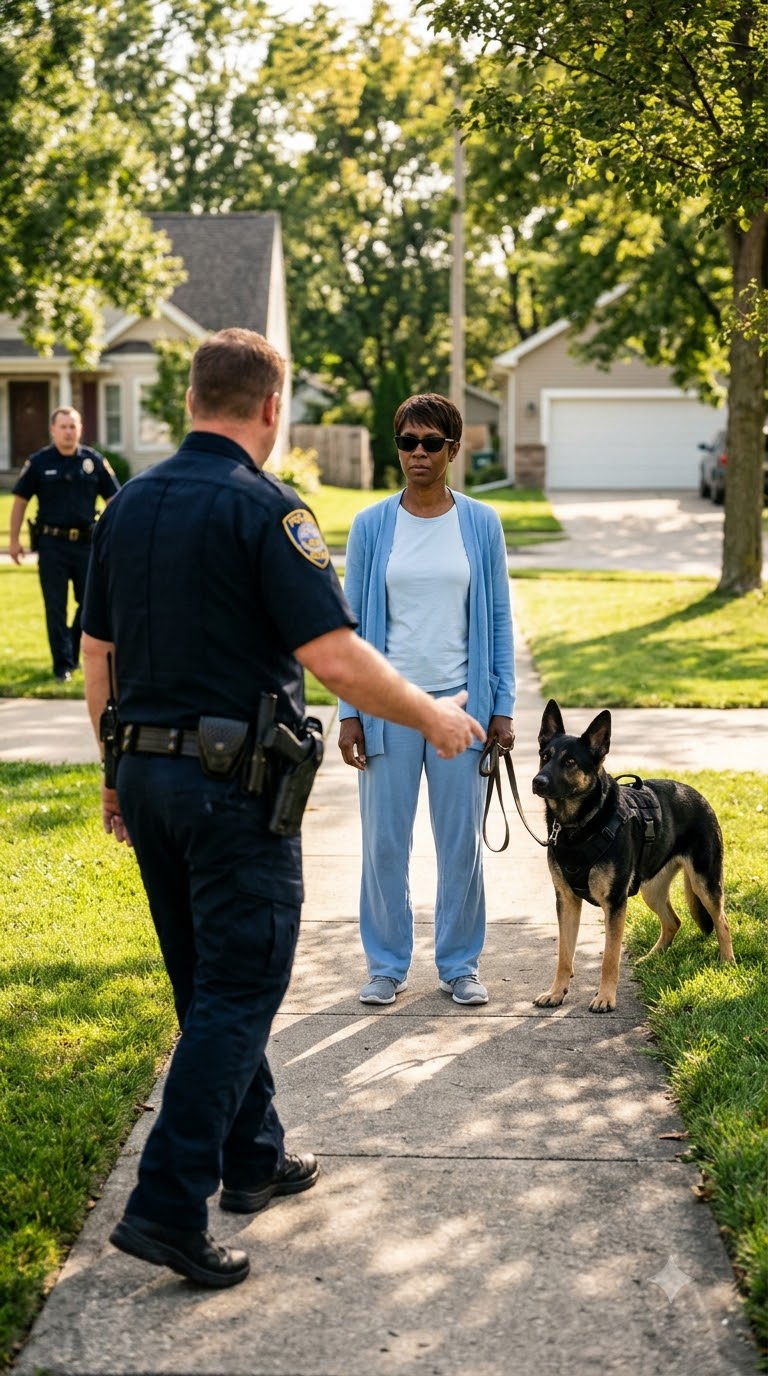
Briggs glared at him.
“Same difference.”
“No, Daniel. It isn’t.”
The room fell silent.
Keller looked exhausted.
For years, he had supported Briggs through questionable arrests, confrontations, and reports that did not entirely reflect what had happened.
He had told himself that loyalty was part of the job.
That police officers had to trust one another.
That outsiders could never understand the decisions made on the street.
But now he had watched a harmless service dog nearly die.
He had heard Mariah crying over him.
And he had seen the video.
He knew what it showed.
Briggs stepped closer.
“You better remember whose side you’re on.”
Keller looked up.
“I’m trying to keep us out of prison.”
Briggs’s expression hardened.
“Then keep your mouth shut.”
That evening, Keller received a call from Captain Warren.
The captain did not waste time with greetings.
“We need to make sure everybody remembers the incident the same way.”
Keller felt his stomach tighten.
“What do you mean?”
“You know exactly what I mean.”
“I already gave my statement.”
“And you’re going to stand by it.”
Keller glanced toward the window.
Outside, a news van was parked across the street.
“What if the video contradicts it?”
Warren’s voice became cold.
“Videos don’t always show what an officer perceives.”
Keller said nothing.
“Briggs saw a threat. You saw a threat. That’s what happened.”
After the call ended, Keller sat motionless.
He had heard those instructions before.
Different incidents.
Different victims.
The same pressure.
Protect the report.
Protect the department.
Protect each other.
For the first time, he wondered what would happen if he stopped.
Two days later, Keller requested a meeting with an attorney of his own.
Then, through counsel, he contacted the investigators.
He agreed to provide information about previous incidents and report alterations, subject to his legal rights.
The investigators did not promise immunity.
They did not guarantee that he would avoid prosecution.
But they agreed to hear what he had to say.
Keller arrived carrying a small folder.
Inside were copies of messages he had saved over several years.
Some showed Briggs asking him to change descriptions of arrests.
Others contained instructions from Captain Warren.
One message was particularly damaging.
Make sure the reports match before you submit them.
Another referred to a civilian complaint.
We handled this already. No reason to reopen it.
Keller admitted that he had participated in false reporting.
He acknowledged that he had remained silent when Briggs used unnecessary force.
And he admitted that, on the morning Justice was shot, he had known the dog was not attacking anyone.
Detective Price leaned forward.
“Why didn’t you intervene?”
Keller stared at the table.
“Because I was afraid of what would happen if I challenged him.”
Price waited.
Keller swallowed.
“And because, after a while, I stopped questioning things I should’ve questioned.”
His statement changed the direction of the investigation.
It did not erase his responsibility.
But it gave investigators a clearer understanding of how misconduct had been concealed.
Search warrants were obtained for relevant departmental records.
Investigators examined internal communications, archived reports, complaint histories, and evidence-handling logs.
Several files contained unexplained changes.
Others had been closed without interviews with available witnesses.
In one case, video evidence had been listed as unavailable even though a backup copy existed.
The evidence suggested that Captain Warren had repeatedly protected Briggs and Keller from scrutiny.
When investigators confronted Warren, he denied wrongdoing.
He insisted that he had merely supported officers making difficult decisions.
But the messages and records told a more troubling story.
The department could no longer describe the matter as an isolated shooting.
It was facing allegations of systematic misconduct.
And the public was demanding answers.
At a crowded city council meeting, residents lined up to speak.
Denise Carter stood before the microphone holding a photograph of her son.
“Two years ago, I came to this department asking for someone to listen.”
Her voice trembled.
“They told me the officers had done nothing wrong.”
She looked toward the council members.
“My son lost his job. He lost his confidence. For months, he was afraid every time a police car drove behind him.”
The room was silent.
Denise lifted the photograph.
“Why did it take a federal judge’s dog getting shot before anyone decided to look at what these officers were doing?”
No one had an easy answer.
Mariah watched the meeting through an accessible online stream.
Justice was resting beside her couch.
He had returned home from the veterinary hospital several days earlier.
His shoulder remained bandaged.
He could walk short distances, but Dr. Reed had warned that his recovery would take time.
Mariah ran her fingers gently through his fur.
Denise’s question stayed with her.
Why had it taken this?
She had spent much of her career believing that the justice system could correct itself when people were willing to confront wrongdoing.
But she also understood that access to justice was not equally distributed.
She had resources.
Professional connections.
An attorney she trusted.
Neighbors whose cameras preserved the truth.
A reputation that made powerful people pay attention.
Many of the earlier complainants had possessed none of those advantages.
That realization troubled her more deeply than the public attention surrounding her own case.
She turned toward Thomas, who had come to visit.
“Justice survived,” she said softly.
Thomas nodded.
“Thank God.”
“But how many people went home after encounters with those officers and never got an answer?”
Thomas was quiet.
Mariah continued.
“I don’t want this to end with two officers losing their jobs.”
“What do you want?”
She rested her hand against Justice’s head.
“I want the system that protected them to change.”
PART 4
Six weeks after the shooting, prosecutors announced criminal charges against Daniel Briggs, Mark Keller, and Captain Richard Warren.
The charges differed according to each man’s alleged conduct.
Briggs faced charges connected to the unjustified shooting, false statements, and civil rights violations.
Keller faced charges related to his participation in false reporting and previous misconduct.
Warren was accused of obstructing investigations and helping conceal evidence.
All three were entitled to the presumption of innocence.
Their cases would be heard in court.
The announcement drew enormous public attention.
Reporters gathered outside police headquarters.
Civil rights advocates demanded independent oversight.
Police officers who had previously remained silent began describing a workplace culture in which challenging certain colleagues could damage a career.
Some defended the department and warned against assuming that every officer was corrupt.
Others argued that the evidence demonstrated exactly why meaningful oversight was necessary.
Chief Hensley announced a review of the department’s complaint procedures, evidence retention policies, and use-of-force training.
An independent oversight panel was established with access to disciplinary records and authority to recommend changes.
Body-camera compliance rules were strengthened.
Supervisors would be required to document the reasons for closing complaints.
And officers responding to incidents involving service animals would receive additional training on disability rights, animal behavior, and de-escalation.
Mariah welcomed the reforms cautiously.
She knew that written policies were only as effective as the people responsible for enforcing them.
Meanwhile, Harold Whitaker had become increasingly isolated.
His false emergency call had been discovered during the investigation.
The recording clearly captured his claim that Justice had lunged at him and threatened neighborhood children.
Security footage contradicted those statements.
Investigators interviewed Harold.
At first, he insisted he had been frightened.
Then they played the recording of Justice calmly walking past him.
He shifted his explanation.
He claimed the dog had looked dangerous.
When asked why he had reported an attempted attack, he had no convincing answer.
Eventually, Harold admitted that he had exaggerated the situation.
But the investigators had also obtained messages he had sent to a friend before making the call.
One read:
I’m tired of that woman acting like she owns the street.
Another stated:
Maybe the cops can finally teach her a lesson.
Those messages gave investigators reason to examine whether his call had been deliberately malicious.
Harold was charged under the applicable state law for knowingly making a false emergency report.
His attorney argued that he had never intended for the dog to be shot.
That distinction mattered legally.
But it did not change the fact that his dishonest call had initiated the encounter.
For Mariah, the discovery was painful rather than surprising.
She had known Harold disliked her.
She had not imagined he would knowingly manufacture an emergency to bring armed officers into her path.
Mrs. Chen visited her that evening.
The older woman sat beside her at the kitchen table.
“I’m sorry I didn’t say something sooner,” she whispered.
Mariah turned toward her.
“About what?”
“Harold. The things he said about you. The way he talked about this neighborhood.”
Mariah reached across the table.
“You didn’t make that call.”
“But I heard him say things before. I should have spoken up.”
Mariah was quiet for a moment.
Then she answered.
“Sometimes people think silence keeps the peace. But silence can also give cruelty room to grow.”
Mrs. Chen squeezed her hand.
“I won’t stay silent again.”
Months passed.
Justice slowly recovered.
At first, he could only walk from the living room to the kitchen.
Then he managed short trips into the garden.
Eventually, Dr. Reed approved gentle walks along familiar paths.
Mariah celebrated every small improvement.
The first time Justice successfully guided her around the furniture again, she laughed and cried at once.
“Look at you,” she whispered. “Still showing off.”
Justice wagged his tail.
But his recovery was not entirely simple.
He sometimes startled at sudden loud noises.
Mariah noticed that she, too, became tense whenever she heard a police siren.
She had always understood trauma intellectually.
Now she understood the way it could settle into ordinary moments.
The sound of a car door.
A stranger’s footsteps.
An unexpected shout.
She began working with a counselor, not because she considered herself weak, but because she refused to allow the shooting to define the rest of her life.
Justice received veterinary rehabilitation and careful behavioral evaluation.
The trainers reassured her that his responses were improving.
Still, Mariah understood that his long-term welfare mattered more than her desire to return to normal.
If Justice could no longer work comfortably, she would retire him and arrange for another guide dog.
He had already given her more than she could ever repay.
One afternoon, Dr. Reed called with the results of his latest assessment.
“Judge Ellison, I have good news.”
Mariah held her breath.
“Justice is healing exceptionally well.”
She smiled.
“Does that mean he can return to work?”
“Gradually, with supervision and continued evaluation. We want to be certain he’s comfortable and confident.”
Mariah lowered her head.
“Thank you, Doctor.”
“He’s a remarkable dog.”
She laughed softly.
“I’ve been telling people that for years.”
PART 4
By the time the criminal proceedings began, the case had become a symbol of something larger than one morning in Oakidge Estates.
The prosecution presented the video evidence, forensic findings, communications, and testimony from witnesses.
Mrs. Chen described what she had seen.
Ethan Morales explained how he had recorded the aftermath.
Sergeant Torres testified about the inconsistencies between Briggs’s initial account and the available footage.
Dr. Reed described Justice’s injuries.
And Mariah took the witness stand.
She entered the courtroom using a white cane while Justice rested at home.
She had requested that he not be brought into the stressful environment.
The courtroom fell silent as she approached the stand.
The presiding judge greeted her formally.
Mariah took the oath like any other witness.
She was not there to decide the case.
She was there to tell the truth.
The prosecutor began with simple questions.
Where had she been walking?
What had Justice been doing?
What had the officers said?
Mariah answered carefully.
She described the peaceful morning.
The sound of the approaching cruiser.
The officers’ demands.
Keller’s movement toward the harness.
And the gunshot.
When she reached that moment, her voice faltered.
She paused.
Then continued.
“I heard Justice cry out. I felt him fall against my leg. When I touched him, there was blood on my hands.”
The prosecutor allowed her a moment.
Mariah drew a steady breath.
“I kept telling him to stay with me.”
The courtroom remained completely quiet.
Then the prosecutor asked why she had demanded Briggs’s badge number.
Mariah lifted her chin.
“Because identification is the beginning of accountability. I needed to know who had fired the shot, and I wanted the incident documented accurately.”
The defense questioned her closely.
Briggs’s attorney suggested that she could not know every movement Justice made because she was blind.
Mariah did not become angry.
Instead, she explained how a guide dog’s harness communicated movement, position, and changes in behavior.
She described Justice’s training and the difference between a controlled turn and an aggressive lunge.
Then she added something the courtroom would remember.
“My blindness does not make me incapable of understanding what happens around me. And an officer’s ability to see does not guarantee that he has interpreted what he sees correctly.”
The attorney paused.
There was no easy response.
The recordings had already shown that Justice had not charged Briggs.
Mariah’s testimony simply explained what she had experienced.
When asked whether she believed the officers had targeted her because she was Black and blind, she answered with care.
“I cannot testify to what was inside their minds. I can testify to their words, their actions, and the way they treated me. The court must evaluate the evidence.”
That answer carried more weight than an accusation would have.
She refused to speculate.
She refused to exaggerate.
She gave the court exactly what she knew.
And nothing more.
PART 5
The trials unfolded over several months.
Keller’s cooperation provided investigators with additional evidence, but it did not free him from responsibility.
He ultimately entered a guilty plea to charges arising from false reporting and his participation in misconduct.
At his sentencing, he addressed the court.
“I spent years telling myself I was being loyal to my partner.”
He paused.
“But loyalty became an excuse for dishonesty.”
He looked toward the gallery.
“I saw things I should have stopped. I signed reports I knew weren’t accurate. And when that dog was shot, I knew we had crossed a line.”
His voice grew strained.
“I should have recognized that line long before.”
The judge considered his cooperation, his admissions, and the harm caused by his conduct.
Keller received a custodial sentence followed by supervised release, and he was permanently separated from the police department.
Captain Warren’s case exposed the administrative machinery that had protected the officers.
Former employees testified about pressure to close complaints.
Digital records showed changes to reports after supervisors had reviewed them.
Messages demonstrated efforts to coordinate accounts before formal interviews.
Warren maintained that he had been protecting the department from unfounded accusations.
But the evidence established that he had knowingly interfered with legitimate investigations.
He was convicted of obstruction-related offenses and sentenced accordingly.
Briggs continued to deny wrongdoing.
He insisted that Justice had posed a threat.
He argued that the shooting was a difficult but necessary decision.
Yet the evidence repeatedly contradicted his version of events.
The security video showed Justice’s controlled movement.
Keller’s body camera captured Briggs’s earlier statement about shooting the dog if it made one wrong move.
Witnesses described the officers’ aggressive approach.
And the forensic evidence did not support Briggs’s claim that he had fired while retreating from a charging animal.
After deliberation, the jury returned guilty verdicts on the principal charges supported by the evidence.
Briggs stood motionless as the verdicts were read.
For years, he had believed his badge could protect him from consequences.
Now he faced them without it.
At sentencing, Mariah submitted a victim-impact statement.
She did not ask for vengeance.
She described what had been taken from her.
The sense of safety she had felt walking through her own neighborhood.
The trust she had placed in the people sworn to protect the public.
And the months of pain endured by an animal whose only purpose had been to guide and protect her.
She also spoke about the people who had contacted investigators after the shooting.
Families who had spent years trying to be heard.
Citizens whose complaints had been dismissed.
People who had begun to believe that the truth did not matter when the person contradicting them wore a badge.
“Justice survived,” she said.
Her voice remained steady.
“But his survival does not erase what happened.”
She paused.
“Nor does my position as a judge make this injustice more serious than the suffering of someone without a title.”
Several people in the gallery lowered their heads.
Mariah continued.
“The law must protect the person whose name nobody recognizes just as faithfully as it protects the person whose name appears on a courtroom door.”
Briggs was sentenced to prison.
His law-enforcement career was over.
The sentence could not restore the months Mariah had spent fearing for Justice’s life.
It could not undo the harm suffered by earlier complainants.
But it established that his actions had consequences.
Outside the courthouse, reporters crowded around Mariah.
Microphones extended toward her.
“Judge Ellison, do you feel vindicated?”
She considered the question.
“I feel grateful that the evidence was heard.”
“Do you think justice has been served?”
“Part of it has.”
“What remains?”
Mariah turned toward the sound of the reporter’s voice.
“Making certain that people who are not federal judges receive the same attention when they report wrongdoing.”
Then she stepped away.
She had no interest in becoming a celebrity.
Her goal had never been public recognition.
It was accountability.
The civil proceedings continued separately.
Through her attorney, Mariah pursued compensation for Justice’s medical care, rehabilitation expenses, the interruption to her mobility, and other legally recognized harms.
The city eventually reached a settlement without requiring her to surrender her right to speak about the incident.
Mariah directed a substantial portion of the proceeds toward establishing an independent assistance fund.
The fund would help people obtain legal guidance when they believed their civil rights had been violated.
It would also support service-animal handlers facing emergency veterinary expenses after traumatic incidents.
She named it the Justice Access Initiative.
Thomas Avery attended the small announcement ceremony.
He listened as Mariah explained its purpose.
“Justice is the name of my dog,” she told the gathering.
A few people smiled.
“But justice is also something that should never depend on wealth, status, race, disability, or the ability to attract public attention.”
The initiative began modestly.
Its first cases involved people seeking assistance with records requests, complaint procedures, and referrals to qualified attorneys.
Denise Carter became one of its community advisers.
Her son Marcus had finally received a formal review of the encounter that had changed his life.
The review could not give him back the years he had spent struggling with the consequences.
But it corrected the official record and opened a path toward resolving his claims.
When Denise met Mariah at the initiative’s opening event, she embraced her.
“I don’t know how to thank you.”
Mariah shook her head.
“You don’t owe me thanks.”
Denise’s voice trembled.
“If Justice hadn’t been shot, I don’t think anyone would’ve listened to us.”
Mariah was silent for a moment.
Then she answered softly.
“That’s exactly what we have to change.”
A year after the shooting, Oakidge Estates looked much as it always had.
The lawns were carefully maintained.
The sidewalks remained clean.
The jasmine still bloomed along the garden walls.
But something about the neighborhood had changed.
People greeted one another more openly.
Residents had organized meetings about accessibility, community safety, and the importance of reporting harassment.
Mrs. Chen had become one of the most outspoken participants.
Harold Whitaker no longer lived on Maple Street.
Following the criminal proceedings and the public disclosure of his false report, he had sold his home and moved away.
Mariah rarely spoke of him.
She had no desire to spend the rest of her life measuring her happiness against his downfall.
One bright morning, she stood at her front door with Justice beside her.
The German Shepherd had completed his rehabilitation and passed the evaluations required to resume his guiding duties.
His shoulder bore a small scar beneath his thick fur.
His movements were a little more deliberate than before.
But his confidence had returned.
Mariah fastened his harness.
“Ready, handsome?”
Justice wagged his tail.
She laughed.
“I’ll take that as a yes.”
They stepped onto the sidewalk.
The air smelled of freshly cut grass.
Somewhere nearby, birds sang from the trees.
Mariah felt the familiar pressure of the harness against her hand.
Justice moved forward.
One step.
Then another.
Their rhythm returned naturally, as though it had been waiting for them all along.
Near Mrs. Chen’s garden, the sound of pruning shears stopped.
“Good morning, Judge Ellison!”
Mariah smiled.
“Good morning, Mrs. Chen.”
“And how’s our handsome boy today?”
Justice’s tail began wagging.
Mariah laughed.
“He knows it, too. Gets extra proud when people compliment him.”
Mrs. Chen chuckled.
“Some things never change.”
Mariah continued down Maple Street.
At the intersection, Justice stopped.
She listened for approaching cars.
The street was quiet.
She gave him the signal to proceed.
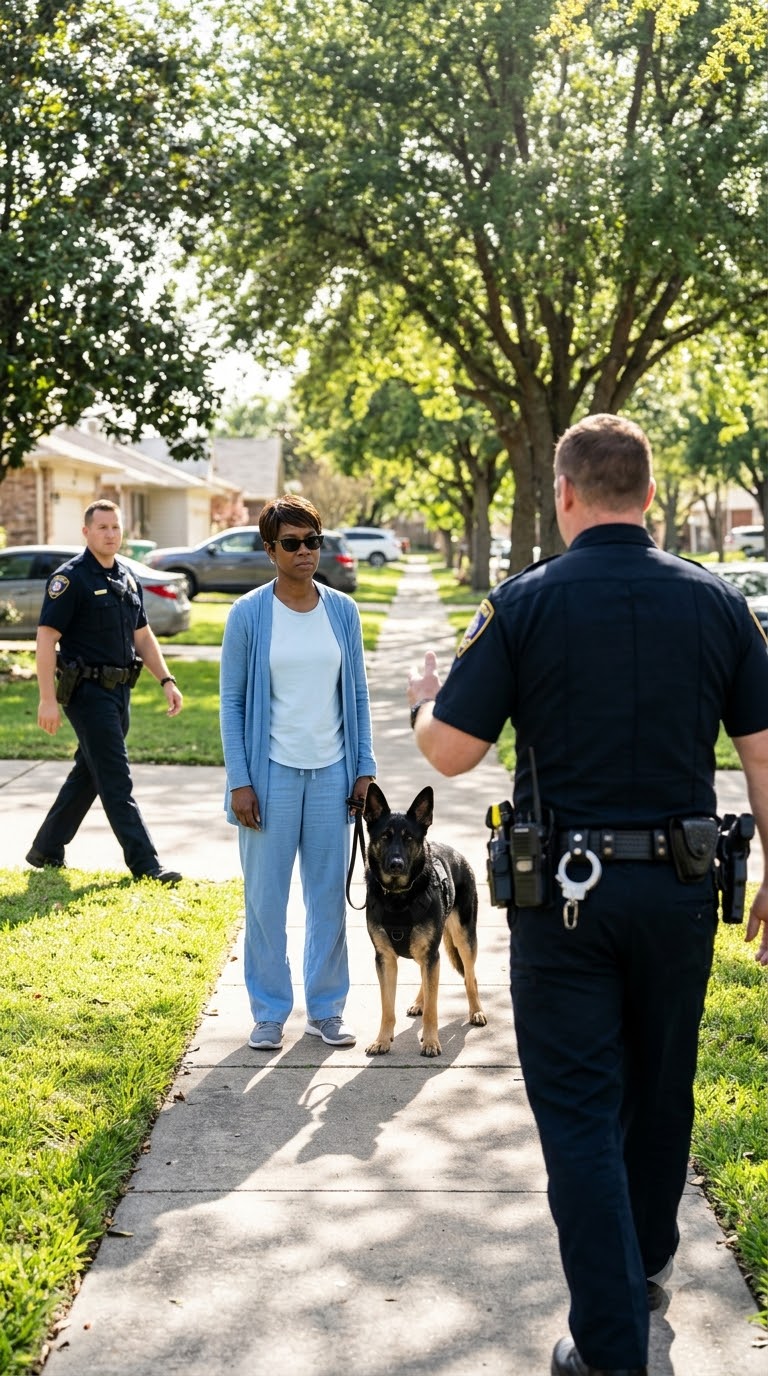
Halfway across, a police cruiser approached slowly.
Mariah heard the engine and felt her body tense.
Justice paused.
The vehicle stopped at a safe distance.
A window lowered.
“Good morning, Judge Ellison.”
Mariah recognized Sergeant Torres’s voice.
“Good morning, Sergeant.”
“How’s Justice doing?”
“Better every day.”
“I’m glad to hear it.”
There was a brief silence.
Then Torres added something unexpected.
“I wanted you to know that the department completed its first independent complaint audit last month.”
Mariah listened.
“We found problems,” Torres continued. “Some serious ones. But this time, they’re being documented and addressed.”
Mariah nodded slowly.
“That’s a beginning.”
“Yes, ma’am.”
“And Sergeant?”
“Yes?”
“Please make sure it continues.”
Torres’s voice was firm.
“We intend to.”
The cruiser moved away.
Mariah stood quietly for a moment.
She knew one investigation could not repair every failure.
One conviction could not eliminate prejudice.
One settlement could not undo years of institutional neglect.
Real change required people willing to challenge wrongdoing even when doing so was uncomfortable.
It required supervisors who questioned suspicious reports.
Officers who refused to protect misconduct.
Witnesses who came forward.
And communities that demanded fairness for everyone, not only for those with influence.
Justice gently pressed against her leg.
Mariah smiled.
“You’re right. We’ve got places to be.”
They continued toward the park.
As they approached the entrance where the shooting had occurred, Mariah slowed.
Justice stopped beside her.
For a moment, she heard the gunshot again in her memory.
The cry.
The sudden weight of his body.
The terrible fear that she was losing him.
Her fingers tightened around the harness.
Then she knelt and rested her hand against his chest.
His heartbeat was strong.
Steady.
Alive.
“You stayed with me,” she whispered.
Justice leaned into her touch.
Mariah swallowed the emotion rising in her throat.
“And I kept my promise to you.”
She stood.
Together, they walked into the park.
Children laughed somewhere in the distance.
A breeze rustled the leaves overhead.
Justice guided her along the winding path with the same devotion he had shown for years.
And Mariah understood that the most meaningful victory was not watching Daniel Briggs lose his badge.
It was knowing that his badge had never given him the right to place himself above the law.
He had looked at a blind Black woman and mistaken her dignity for weakness.
He had seen a service dog and mistaken its loyalty for aggression.
He had believed that authority meant never having to answer questions.
But when Mariah demanded his badge number, she had done something far more powerful than reveal her own identity.
She had demanded that he be accountable for his.
And that simple demand had opened the door for many others to finally be heard.
As the morning sunlight warmed her face, Mariah smiled and gently touched Justice’s harness.
“Come on, Justice. Let’s go home.”
The German Shepherd stepped forward.
And together, they walked on—not because the world had suddenly become fair, but because they had helped make it a little harder for injustice to hide
