

The Night She Asked to Sleep in the Barn
She didn’t ask for charity.
People who have spent half their lives begging too much eventually learn a cruel lesson: one day the voice simply falls silent on its own. Not out of pride, but out of exhaustion. An old exhaustion, buried deep in the bones, made of closed doors, favors charged at a high price, and looking at others knowing that no one is waiting to save you.
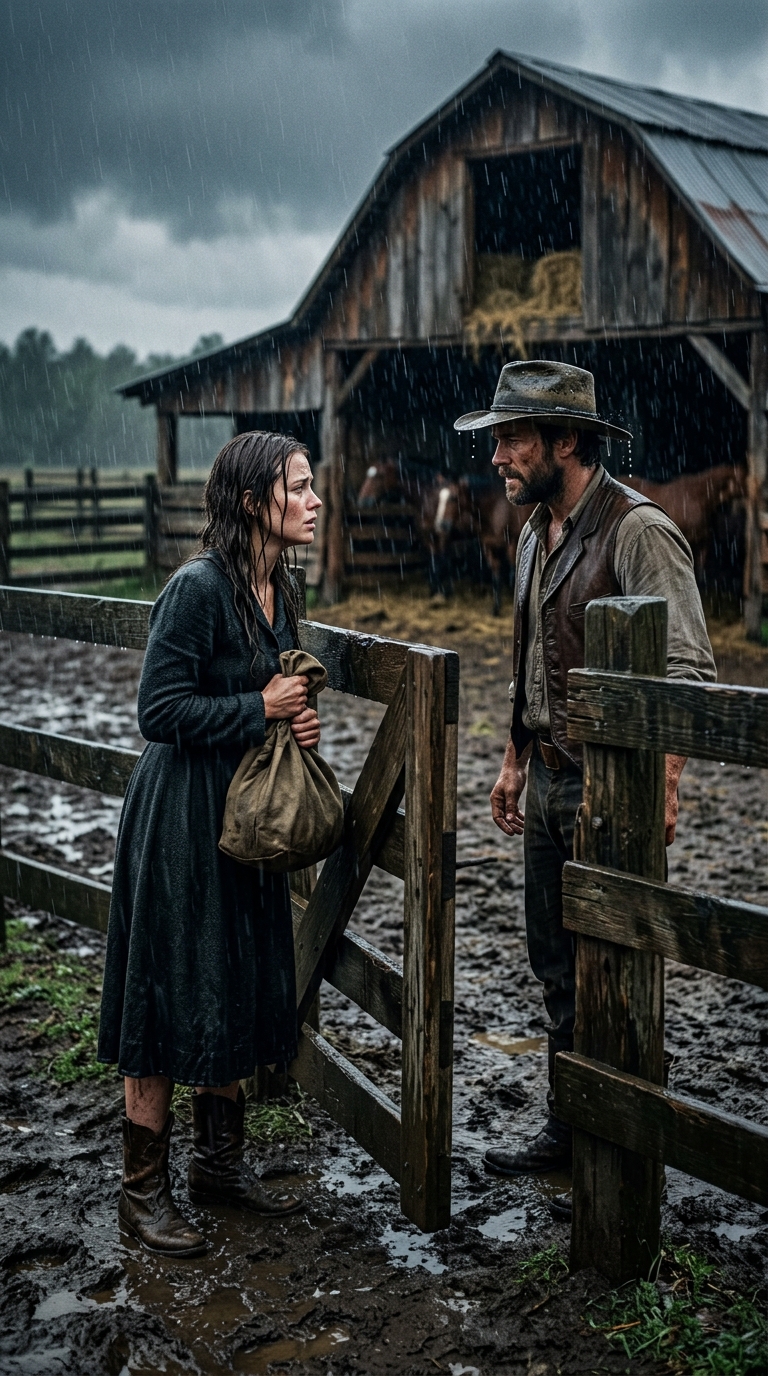
That was why, when Marina staggered up to the cedar gate of the ranch at the end of the dirt road, she didn’t cry, didn’t invent a story, and didn’t try to inspire pity. She simply stood still under the mountain rain, clothes clinging to her body, lips cracked, and a canvas bag hanging from her shoulder.
On the other side of the gate, the man watched her without coming closer.
Marina held his gaze with what little strength she had left and said the only thing she could still ask without breaking inside:
“Let me sleep in the barn. I’ll work for food.”
The man looked at the sky, then at her. He was in his early forties, broad-shouldered, with an unkempt beard and the quiet hardness of men who live too far from everything. There was no cruelty in his eyes, but no immediate tenderness either. Only a serious way of measuring the world.
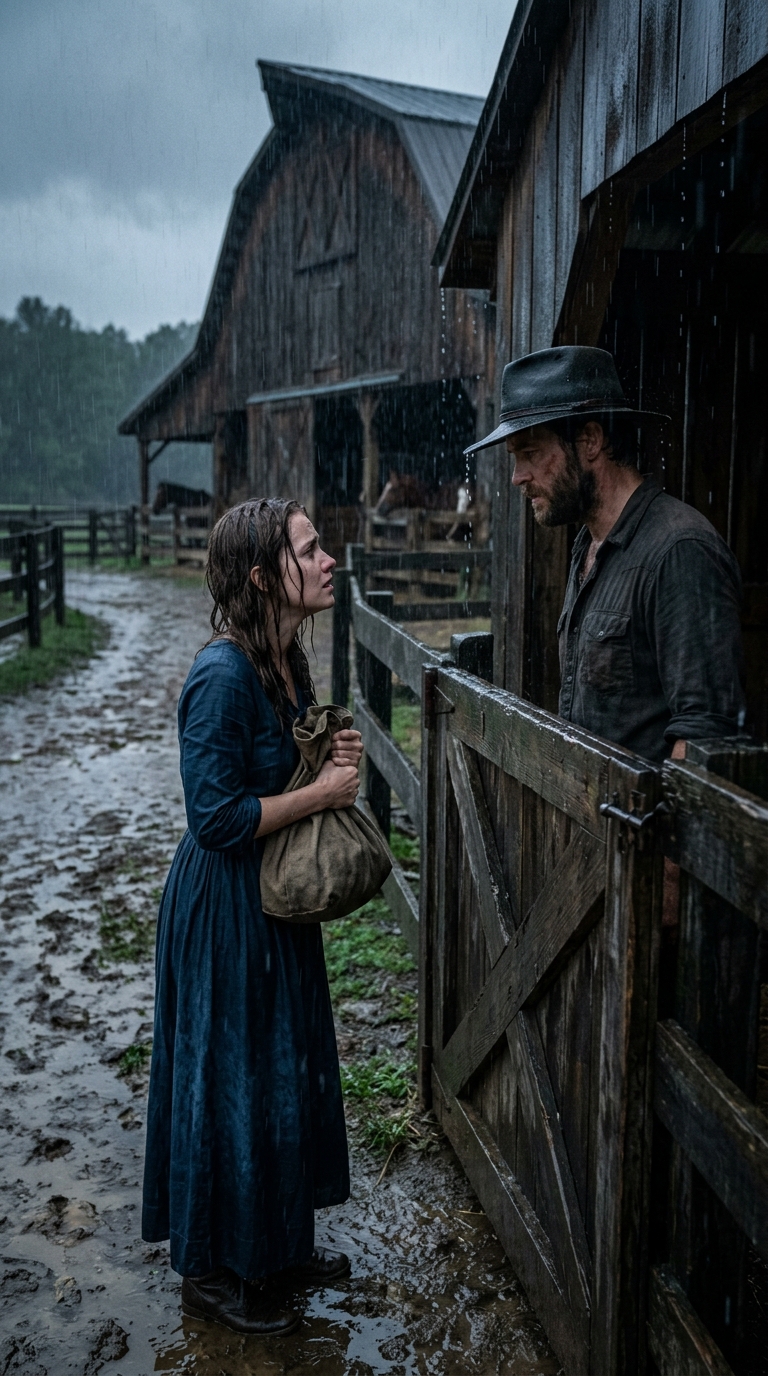
“You can stay,” he said at last. “There’s dry straw at the back. And a lamp hanging from the beam. If the downpour gets heavy, you won’t get wet in there.”
Marina nodded. She didn’t even have the strength to thank him. She crossed the gate without looking back and walked toward the barn, her feet sinking into the mud.
The man followed her with his eyes until she disappeared inside.
His name was Arturo Salvatierra. He was forty-three years old and had been living almost three years alone on that remote ranch lost in the mountains of Durango. Years earlier, the place had been full of life: loose chickens, a vegetable garden, horses, smoke rising from the kitchen, and a woman’s laughter that filled the house. Then Clara, his wife, died in a premature birth during a stormy night. The road to town was destroyed, the truck got there too late, and by the time they reached the hospital it was already too little, too late. Both she and the baby died.
Since then Arturo had kept breathing, but little more. He sold part of the livestock. Let the garden fill with weeds. Repaired only what was absolutely necessary. He cooked when hunger pressed hard and spoke as little as possible. The house wasn’t dirty, but it was profoundly empty.
That night the downpour hammered the tin roof with fury. Arturo closed the door of his house and, for some reason he didn’t want to examine, took longer than usual to slide the bolt.
The next morning he was awakened by an impossible smell.
Coffee.
Not the reheated or quick coffee of solitary men, but real pot coffee, thick and genuine, the kind that hits you first through the nose and then in the chest.
Arturo lay motionless in bed, confused. It had been months since anyone had made coffee like that in that kitchen. He pulled on his boots and walked to the kitchen.
Marina was standing in front of the stove, stoking the fire with one hand and holding a pot with the other. On the table there was a steaming mug and a piece of cornbread made with old flour that Arturo had forgotten in the cupboard. There was also a clean cloth spread in the center, as if someone had wanted to remember that a table could be more than a board where one eats in silence.
Marina turned slightly.
“I found flour in the back. I made bread. I hope you don’t mind.”
Arturo looked at the kitchen, the mug, and then at her.
“I don’t mind.”
He sat down and took the coffee with both hands. He took a slow sip. The strong, bitter taste brought back a memory so vivid he had to lower his gaze to hide it.
He said nothing more, but he finished the mug down to the last drop.
That was how it began.
She told him her name while washing the mug.
“My name is Marina.”
He nodded.
“Arturo.”
They asked no questions. Both of them knew, by different paths, that there are pains that only speak when they feel safe.
The first few days they shared the space as if they had been doing it for years. Marina swept the patio, gathered the eggs, mended rags, lit the stove with damp firewood, and cooked whatever little she could find. Arturo repaired fences, checked the corral, straightened a door, or cleaned a water channel. They crossed paths in the patio, in the chicken coop, by the well, and a short phrase was enough for them to understand each other. The silence between them wasn’t uncomfortable. It was rest.
On the third day, Arturo saw her bend down to pick up some eggs and noticed how she placed a hand on her knee before straightening up. He also saw the brief dizziness that crossed her face, that quick shadow that someone accustomed to suffering learns to hide in a second.
At lunch, Marina left the fork halfway and brought her hand to her belly. It was a quick, almost involuntary gesture.
Arturo saw it.
He said nothing, but something stirred inside him with the violence of memory.
That afternoon, while clearing weeds near the stream, he couldn’t stop thinking about it. It wasn’t just tiredness. It wasn’t just hunger. He knew that gesture. He had seen it in Clara.
The idea hit him like a stone in his chest.
The next day Marina went down to the stream with a bucket and laundry. The path was steep, surrounded by tall grass and roots jutting out of the earth. Below, the water ran over dark stones, cool and silent, and for a while she felt something close to peace.
She washed her dresses, the kitchen rags, and two of Arturo’s shirts that had been left by the washtub. She did it slowly, her body weary but her hands steady. Then the dizziness came.
First a heat at the back of her neck. Then a hollow feeling in her legs. Then a deep nausea, different, as if her body were trying to tell her something her mind had been refusing to hear for days.
She leaned on the wet stone, closed her eyes, and, almost without realizing it, placed her hand on her belly.
There, alone by the water, she understood.
The tears came silently, without sobs, without drama. They simply rolled down her cheeks like water over rock.
Up among the trees, Arturo watched her from a distance. He had come down for a forgotten tool and found her there, small against the vastness of the mountain, crying without a sound, her hand on her belly.
He didn’t go down.
He understood that sometimes the deepest way to care for someone is not to intrude on the moment when they finally face their truth.
He waited hidden among the pines until she stood up and began to climb back with the bucket.
That night, during dinner, Arturo set his fork down on the table and chose his words with a gentleness he didn’t even know he still possessed.
“Doña Nora lives in the village,” he said. “She’s a midwife. She knows about these things… about women. If you want, I’ll take you to see her tomorrow.”
Marina looked up. She studied him for a long time, as if trying to find a hidden trap in the offer.
There wasn’t one.
“All right,” she whispered.
They went to the village very early, before the heat grew strong. Arturo saddled the only horse he had left and Marina mounted behind him, stiff at first, careful not to lean on him. The path wound down through pines, curves, and ravines. He didn’t speak. Neither did she.
Doña Nora lived in a little blue house at the end of the main street. She had large hands, completely white hair, and eyes that seemed to have seen half the state of Durango born.
The moment Marina sat down, the old woman understood.
“Tell me, daughter.”
And Marina spoke.
Not everything, but enough: her dead mother, the stepfather who had thrown her out, the closed doors, the long road, the hunger, the fear. She didn’t speak about the baby’s father. She didn’t even say his name. It was enough to say:
“He’s not here. And he won’t be.”
Doña Nora examined her with the calm of someone who touches life without being afraid of it.
“You’re a little over two months along,” she said at the end. “The baby is fine. You’re not so much. You need food, rest, and to stop carrying everything alone.”
Marina looked out the window at Arturo’s horse tied to the post and at the man waiting outside, still and patient, as if someone else’s time deserved respect.
“Am I safe here?” she asked, more to herself than to the old woman.
Doña Nora followed her gaze and smiled faintly.
“That’s something you already know.”
When they left, Arturo asked no questions. He simply offered her his hand to help her mount the horse. Marina accepted it.
Halfway back, with the sierra stretching out silently around them, she said it softly:
“I’m going to have a baby.”
Arturo didn’t flinch.
“I know.”
She turned her head slightly.
“Since when?”
“Since the first day.”
Marina didn’t reply, but the knot in her chest loosened a little.
That afternoon Arturo went into the pantry, checked sacks, grains, jars, and tools. Then he stood in the patio for a long time looking at the abandoned garden. After that he picked up the hoe and began clearing the earth.
Marina watched him from the window while peeling potatoes.
She understood what it meant.
He wasn’t just clearing a garden.
He was preparing food for someone who hadn’t even been born yet.
The days settled in the way true things do: without announcement, without grand promises, only with repetition and care. The water bucket was full before she had to carry it. A lighter broom appeared by the barn door. Dry firewood was stacked near the stove. A small bench was placed outside the kitchen so she could rest when the nausea left her trembling.
In return, she gave him attention in ways Arturo had forgotten existed: hot soup at midday, a shirt mended at the elbow, a clean handkerchief beside the bed, coffee ready at dawn.
They didn’t say much.
But everything was being said.
The big storm came early one Wednesday morning. It wasn’t rain; it was punishment from the sky. The stream roared so loudly it could be heard from the house. Arturo knew immediately that the barn was too low.
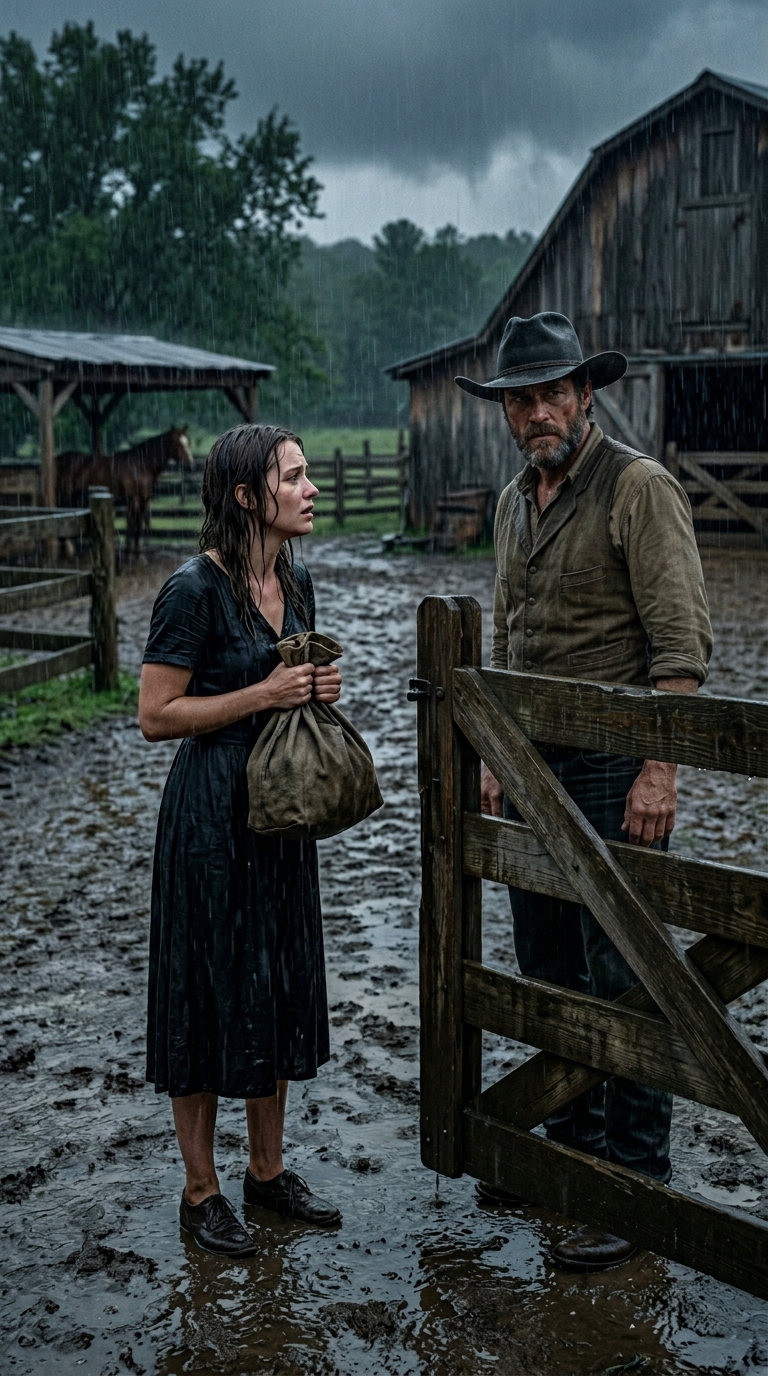
He pulled on his boots, grabbed a lamp, and crossed the downpour.
He pounded on the door.
“Marina, open up!”
She opened right away.
“The stream is going to overflow. You can’t stay here tonight. Come to the house.”
Marina hesitated.
“I don’t want to be in the way.”
Arturo looked at her with calm firmness.
“You’re not in the way. There’s a free room.”
It was Clara’s room.
Since her death no one had slept there. The bed was still made with a patchwork quilt sewn by her own hands. Arturo raised the lamp to light the doorway.
“Sleep here. I’m right next door.”
Marina lay down with the rain beating against the windows and, for the first time in many months, slept deeply. Under a real roof. Without fear. Without her body ready to run.
From that night on she never returned to the barn.
They never talked about it. It simply happened.
The months continued. Her belly grew. The garden turned green again. The chickens grew plump. The house began to sound different. More alive. More inhabited.
Then the past arrived.
One Wednesday night the dog began barking with the fury it reserved for strangers. Arturo went out with the lamp and saw two men by the gate. One was older, bony, with hard eyes and a false air of authority.
Marina recognized him instantly.
Néstor, her stepfather.
She felt the air turn to ice.
“We’ve come to talk,” he shouted. “The house where you grew up is in probate. You need to sign some papers. There’s money for you.”
Marina stepped out onto the porch with one hand on her belly.
“I have nothing to sign.”
Néstor took a step forward, but Arturo moved between him and the house.
“She already spoke,” he said in a voice like stone. “The gate is closed. Good night.”
Néstor tried to insist, tried to push with the old words that had always carried fear, but this time Marina was not alone.
He understood.
And he stepped back.
When they disappeared down the road, Arturo returned to the porch. He turned off the lamp. Marina was still there, quiet, her heart still racing.
Then she did something she hadn’t done with anyone in years: she rested her head on Arturo’s shoulder.
He didn’t move.
He stood firm, holding her without asking for explanations, while above them the night filled with stars and below the stream kept telling its story of water against stone.
The birth came in August, under a black predawn sky. Marina had been in pain for hours but hadn’t wanted to say anything until she could no longer bear it. Arturo was at her door in seconds.
“How long?”
“Three hours… maybe more.”
“No. You’re not having this baby here without help.”
He saddled the horse in the darkness. He lifted her carefully. He mounted behind her, holding the reins on both sides of her. All the way Marina pressed her lips together and didn’t cry out once. Arturo felt every contraction tighten her body.
They reached Doña Nora’s house in the dead of night.
“You stay outside,” the old woman ordered Arturo.
He waited on the porch for two and a half hours, hat in his hands, heart pounding like a hammer. When he finally heard the sharp cry of a newborn, he closed his eyes and let out a breath he seemed to have been holding for three years.
Doña Nora came out smiling.
“It’s a boy. And he’s strong. So is she.”
Arturo entered slowly.
Marina was sweaty, exhausted, but with a new light in her eyes. In her arms, wrapped in a white blanket, was a tiny, angry baby facing the world.

“His name is Jacobo,” she whispered. “After my grandfather.”
Arturo looked at the child, at his tiny fists clenched tight, at the fierce way he clung to life, and felt something open inside him.
It wasn’t just tenderness.
It was return.
They returned to the ranch at dawn. The sierra was violet and the birds were beginning to sing. Marina held Jacobo in her arms. Arturo walked beside the horse, guiding it with one hand.
As they crossed the gate, he remembered the first time she had passed through it: soaked, silent, asking only for a corner in the barn.
Now she entered with a son.
And, without anyone declaring it, she entered as the owner of a home.
Jacobo grew quickly, the way loved children do. Soon he was smiling at the sound of Arturo’s voice and stopping his cries when Arturo picked him up. One morning Marina placed him in Arturo’s arms while feeding him in the kitchen.
The baby opened his hand and gripped Arturo’s thumb with surprising strength.
Arturo froze.
Marina saw him clench his jaw to keep from crying.
She said nothing.
Months later, on a clear afternoon while the coffee was boiling and the child slept in a basket near the stove, Arturo repaired the last loose board on the gate. Then he stood there, looking at it.
Marina came out with a mug in her hand.
“It doesn’t creak anymore,” she said.
“No, it doesn’t.”
She took a step closer.
“That night I only asked to sleep in the barn.”
Arturo looked at her for a long time.
“And I thought I was only giving shelter to a stranger.”
Marina smiled. It was a small smile, but complete.
“Looks like we were both wrong.”
Arturo took the mug she offered him, and this time, when their hands brushed, neither looked away.
Outside, the stream kept running over the stones as it always had. But now its sound was no longer one of loneliness.
It was the sound of a living house.
Because in the end Marina understood something no one had ever taught her: home isn’t always the place where you are born. Sometimes it’s the place where someone opens a gate, asks no useless questions, and decides to stay.
And Arturo understood something else: even the most beaten earth will bear fruit again when someone works it with patience.
And so, on a remote ranch in the mountains, a woman without a voice, a broken man, and a child who arrived in the middle of a storm became a family.
Not all at once.
Not with grand promises.
But with coffee at dawn, hands offered in silence, and the courage to remain when the easiest thing would have been to keep going alone.
That was the miracle.
Not that the pain disappeared.
But that, at last, it was no longer alone.
