

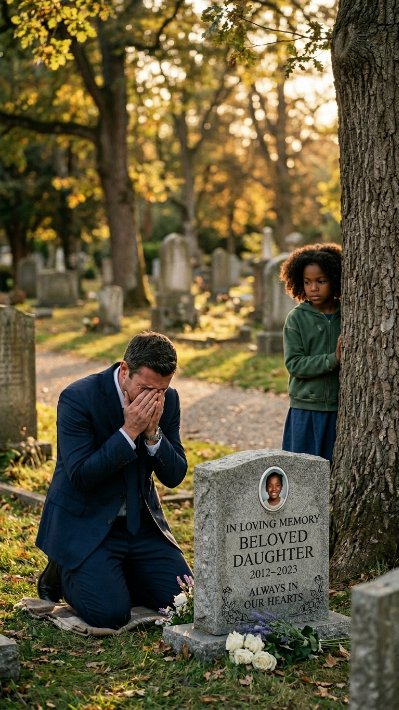
The cemetery held a hush that only places of grief can carry, where even the wind seemed to tread lightly, slipping between rows of aged headstones as though careful not to disturb the sorrow resting there. Beneath a tall maple tree near the edge of Greenwood Memorial Park, a man in a flawless black coat dropped to his knees before a gleaming headstone, his composure finally breaking into uncontrollable tremors.
Michael Lawson had faced rooms full of investors without flinching, had sealed deals worth hundreds of millions with steady confidence, had endured scrutiny and doubt without ever lowering his gaze—yet now his shoulders shook as tears fell onto the cold marble bearing the name of the daughter he believed he had lost forever.
“I failed you,” he rasped, pressing his hand against the stone as if it might respond. “I was supposed to protect you. I was supposed to keep you safe.”
What Michael didn’t realize was that he wasn’t alone in his grief. Just beyond the bend in the path, partly hidden behind the thick trunk of the maple tree, a small figure stood perfectly still, wrapped in a jacket too large for her, arms folded tightly as she fought both the cold and the fear churning inside her. Her hair was tangled, her shoes worn thin, and faint scratches marked her face—silent proof of a story no child should ever endure.
She was alive. Her name was Aurora Lawson, and she was nine years old.
For six months, the world had believed she died in a devastating fire that reduced a guest house on her father’s estate to ashes. The funeral had drawn politicians, executives, and dignitaries, all offering condolences to the grieving billionaire who once seemed unbreakable. The investigation had been swift, concluding the blaze was an accident caused by faulty wiring.
Only Aurora knew the truth. She had been taken from her bed that night, her mouth covered, something bitter forced between her lips before darkness claimed her. When she woke, she was no longer safe at home—but locked inside a decaying farmhouse hidden far from anyone who could help her.
For months, she lived in a single room with boarded windows and a locked door that opened only when the man she called the watcher brought food. She studied everything—his footsteps, his routines, the rhythm of his movements. She listened when he spoke on the phone, especially to one voice that chilled her more than the isolation ever could.
That voice belonged to Sylvia Lawson, her stepmother.
Aurora didn’t understand every word—but she understood enough. She understood her father was being weakened slowly, medication disguised as care. She understood his grief was being nurtured, not healed. And she understood she was being kept alive not out of kindness—but because she might still be useful.
“She stays hidden,” Sylvia had said once through the static. “We may need her later.”
Three weeks ago, the watcher dropped a key while drunk. Aurora hid it beneath her mattress, waiting with a patience sharpened by fear. When she finally escaped, running barefoot through dark fields guided only by instinct and distant lights, she knew exactly where she needed to go.
Not home. Not the police.
But the one place her father would be.
Now, watching him kneel before her false grave, something inside her cracked. She wanted to run to him, to throw herself into his arms, to hear him say her name as proof she still existed. But fear held her back. What if someone was watching him? What if Sylvia was still pulling strings from the shadows?
Then Michael spoke again, his voice barely holding together.
“I can’t keep going without you,” he said. “I’m so tired, my little star. Maybe it’s time I rest.”
Aurora stepped forward before she could stop herself.
“Dad.”
The word was soft, fragile—but in the stillness, it rang clear.
Michael froze. He didn’t turn right away. Hope had betrayed him too many times. He had heard her voice in dreams, in crowds, in the quiet before sleep—and every time, reality followed with silence.
Then she spoke again.
“I’m here.”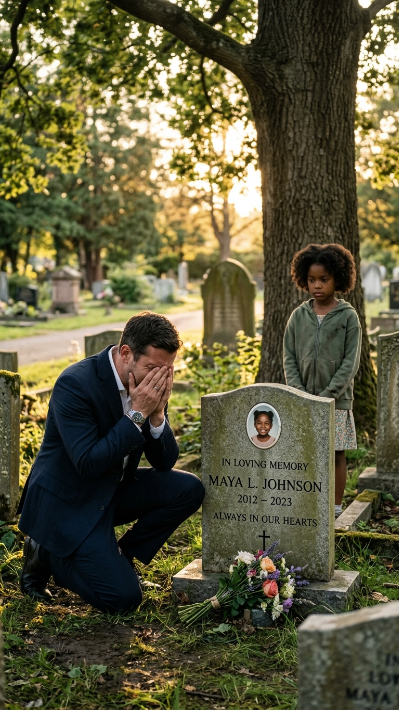
He turned slowly, breath catching—and there she stood. Smaller. Thinner. Dirt on her face. But unmistakably his.
“Aurora,” he whispered.
She nodded, tears falling freely. “It’s me. I didn’t die.”
He crossed the distance without thinking, dropping to his knees before her, his hands hovering near her face as if she might disappear.
“You’re real,” he murmured.
She took his hands and pressed them against her cheeks. “I’m real,” she said. “And you’re in danger.”
He pulled her into his arms, holding her with desperate force, sobbing as months of grief collapsed into relief, rage, and gratitude. When he finally pulled back, something in him had changed—grief sharpened into resolve.
“Tell me everything,” he said.
As Aurora explained—her captivity, the conversations, the slow poisoning hidden behind concern—Michael felt a cold clarity settle over him. The woman he trusted had been orchestrating his downfall, aided by his own brother, Paul Lawson.
“We can’t go to the police yet,” Aurora said firmly. “They’ll warn her. She’ll make me disappear again.”
Michael didn’t hesitate.
“We’ll outthink them,” he said. “And we’ll stop this.”
What followed demanded patience and deception. Aurora was hidden in a secure apartment owned by Thomas Reed, a trusted legal advisor. Michael returned home alone, playing the broken man, accepting Sylvia’s care while secretly discarding every drink, every pill, every false gesture.
Hidden cameras captured whispered calls, careless confessions, and celebrations that came too early. Three weeks later, Michael staged his collapse—declared dead in a carefully orchestrated moment.
At the inheritance hearing, Sylvia sat composed beside Paul, ready to claim everything. But as the judge prepared to finalize it, the courtroom doors opened.
Michael Lawson walked in—alive.
Beside him stood Aurora.
Gasps filled the room. Sylvia screamed. Paul turned pale.
“I believe there are objections,” Michael said calmly.
The evidence was undeniable. Arrests followed before the day ended. The story spread nationwide, but Michael refused every interview.
Healing wasn’t for headlines.
Weeks later, father and daughter returned to the cemetery. The false headstone was gone, the lie erased, leaving only open ground beneath a clear sky.
“I’m still here,” Aurora said softly.
Michael took her hand.
“And I always will be,” he replied.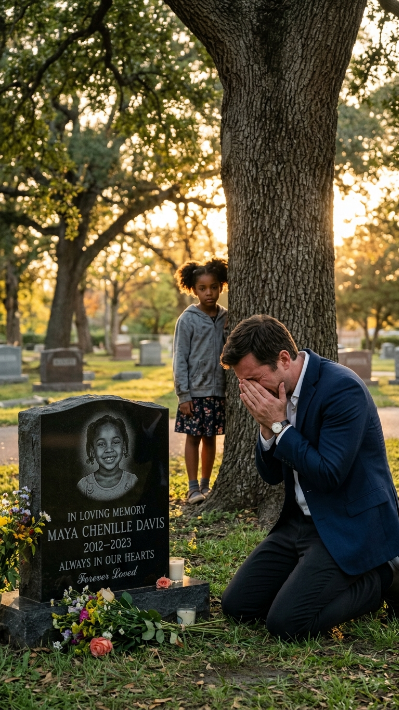
Together, they walked away—not toward forgetting, but toward a future rebuilt with truth, resilience, and a love that refused to be buried.
