

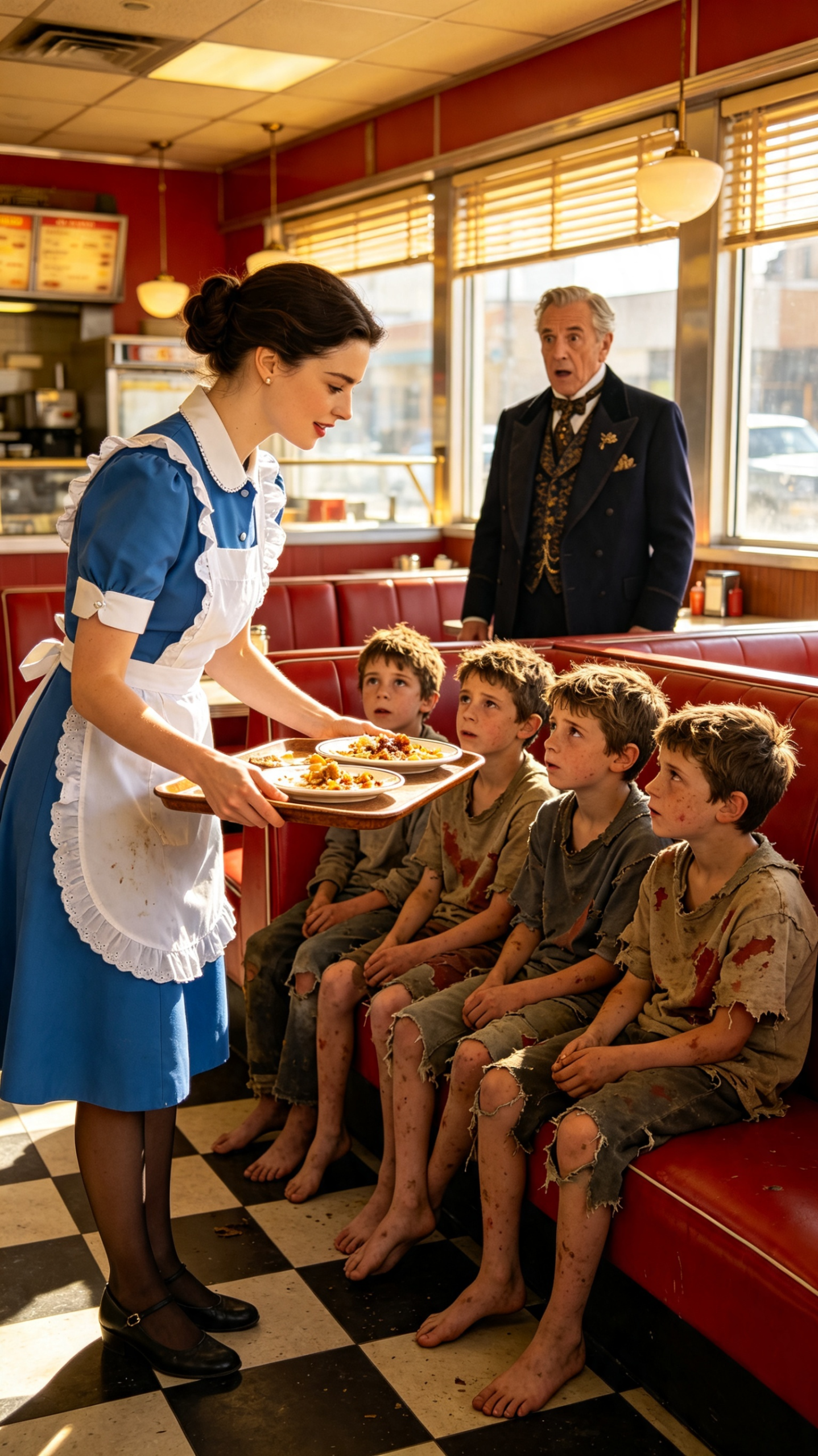
In the heart of a city, inside a high-end restaurant, a 26-year-old woman worked quietly night shifts to support her mother with heart disease and her school-aged younger brother. One night, she came across four children rummaging through a trash bin and began secretly bringing them leftover food. But her silent kindness caught the eye of the restaurant’s CEO. He followed her, ready to expose her, only to uncover a truth that will change his company’s policies forever.
In the glittering core of Southside Baltimore, where glass towers loomed over crumbling row houses and Teslas zipped past sleeping bags on cracked sidewalks, there stood a place that didn’t quite belong. The Blue Lantern was one of those contradictions the city excelled at. An upscale 24-hour restaurant nestled between a failing flower shop and a shuttered bookstore. Its blue neon sign flickering like it couldn’t decide if it still believed in itself.
Inside, the chandeliers were polished to a gleam, the linens crisp, and the menus printed on card stock thick enough to cut steak with. But those who kept it running knew another rhythm, one less glamorous, more human. At 10:06 p.m., just after the second dinner rush, Malaya Brooks moved through the dining room with silent purpose. Her curls were pinned neatly beneath a navy bandana, a name tag reading M. Brooks glinting under the soft lights.
She wore the same crisp uniform as everyone else, but the sleeves of her blouse were frayed at the elbows, and her sneakers, though clean, had soles that remembered every long shift. At 26, Malaya carried herself like someone who didn’t have the luxury of collapsing. Her back was straight, her steps economical, her face unreadable unless you looked closely. Then you might catch the faint tightness around her eyes, the kind etched by worry that never really slept.
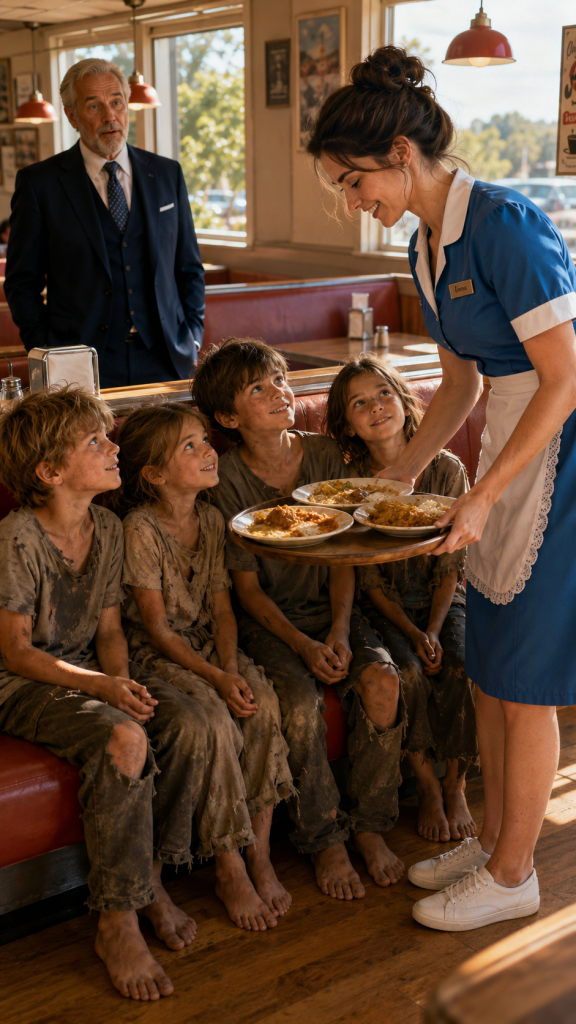
As her co-workers chatted idly near the dessert station, Malaya slipped into the kitchen where the remnants of the night’s service waited in silence. There was a half pan of roasted chicken, two untouched bread baskets, a container of butternut squash soup that hadn’t even been opened, and slices of apple tart cooling beside the stove. Most would have tossed it all into the compost bins without a second thought. The Blue Lantern prided itself on being waste conscious after all.
But Malaya approached the food like it was sacred. With practiced care, she packaged it into two cloth bags she pulled from her locker. The larger of the two she filled with warm rolls, chicken thighs, a tub of soup, and the tarts. The smaller she tucked away a bit more carefully: two rolls, a small container of soup, one piece of chicken—just enough for her mother and younger brother.
She moved quickly, glancing around to make sure the cameras in the back hallway weren’t angled her way. They never were. She knew this routine by heart, had tested it weeks ago. She wasn’t stealing, not really. This food would be trash in less than an hour, discarded by hands that never once worried about skipping meals.
Still, she moved with the guiltless guilt of someone doing good in a world that punished it anyway. She slipped through the side exit and stepped into the alley where the smell of garlic and motor oil clung to the damp brick. The street lights hummed above her, casting her shadow long and thin across the pavement. Her heart beat steadily, not fast, because she knew she was doing something right, necessary.
She turned left toward the fence behind Emerson Hope Community Shelter, the first stop before heading home. Malaya hadn’t planned to become someone’s secret lifeline. It had started four weeks ago on a rainy Tuesday after a long double shift. She had cut through the alley to avoid the leaking pipe in her mother’s bathroom.
That’s when she saw them. Four kids, no older than 9 or 10, crowded around a dented garbage can, their skinny arms elbowed deep in greasy takeout bags. Malaya froze. Something in her tightened—anger maybe, or memory. She hadn’t always lived in a building with locks or eaten food that came hot.
She stepped forward, careful not to startle them.
“Hey,” she said softly.
The kids flinched.
“Wait,” she raised her hands. “I’m not here to stop you. I just have something better.”
They eyed her wearily as she reached into her bag and pulled out food, leftovers from the shift before. She didn’t say much more, just handed the food over and watched them devour it in silence. Before she left, she pointed to the iron gate behind them.
“Same time behind this gate tomorrow. I’ll be here.”
She didn’t expect them to come. But they did. And the next day and the day after. They never said much, just waited, accepted, whispered a thank you. That was enough. Now it was part of her life, part of her purpose, every night. One bag for the four children who shouldn’t have to starve in a city built on indulgence. One bag for her family, the brother who slept with his textbook under his pillow and never asked why dinner came late.
As Malaya crossed the street that separated glass towers from cracked sidewalks, she didn’t see herself as a hero. She wasn’t saving anyone. Not really. She was just making sure someone made it through another night.
Julian Hart didn’t believe in delegation when something smelled off. Not in his restaurants and certainly not in his numbers. At 35, he was already a known name in the hospitality business, founder and CEO of Heartline Foods, a growing empire of mid to upscale dining spots across the East Coast. He had built his company from the bones of his father’s failed diner, turning lessons learned in Greece and failure into strategy and structure. Julian was exacting, unsentimental, and ruthlessly efficient. What set him apart wasn’t charm or charisma. It was instinct. He could walk into a room and know within minutes who cut corners, who kept secrets, and who could be trusted when the kitchen got too hot.
So, when the quarterly report for the Blue Lantern flagged two things—above average food over production, and below average waste disposal costs—he didn’t send an email or call a manager. He went to Baltimore himself. It didn’t matter that the Blue Lantern was one of their newer, sleeker properties, polished with its clean lines and artful plating. Numbers didn’t lie, and something about this location wasn’t lining up.
By 9:30 p.m., Julian was seated at a booth in the back corner, dressed like any night drifter with too many tabs open and nowhere else to be. His laptop sat unopened in front of him. The coffee he ordered went untouched, cooling beside his elbow. He had a clear view of the floor, the service lanes, and the corridor leading to the kitchen. He watched as servers floated through the space with practiced ease, as the bartenders polished glasses with one eye on the TV and the other on tips, as the host stood near the door, feigning interest in the reservation tablet. It was smooth, pleasant, but Julian didn’t come looking for ambiance.
And then he saw her. Not because she was out of place. If anything, she blended in too well. Malaya Brooks, according to the name stitched neatly on her collar, moved through the restaurant like part of the architecture, unobtrusive, precise, and unremarkably efficient. She didn’t smile unnecessarily. She didn’t chat at the bar. She worked. There was something in the way she cleared a four-top and reset it in minutes like someone on a clock no one else could hear. She vanished into the back hall just past 10, slipping through the kitchen doors with a backpack slung over one shoulder. When she returned 5 minutes later, that bag was heavier. She didn’t pause, didn’t draw attention, just finished her shift, nodded to a line cook, and exited through the side door like she always did. No one said goodbye. No one noticed her go. But Julian did.
He didn’t leave right away. He waited, eyes on the clock, mind already sorting possibilities. Staff meal leftovers, maybe. Petty theft, possible, but too quiet. When the room emptied, and the late night stragglers faded into the city noise, Julian finally rose, tossed a few bills on the table, and stepped out into the crisp night. He stayed half a block behind her, moving without sound, keeping to shadows, instincts sharpened by years of reading people before they ever spoke.
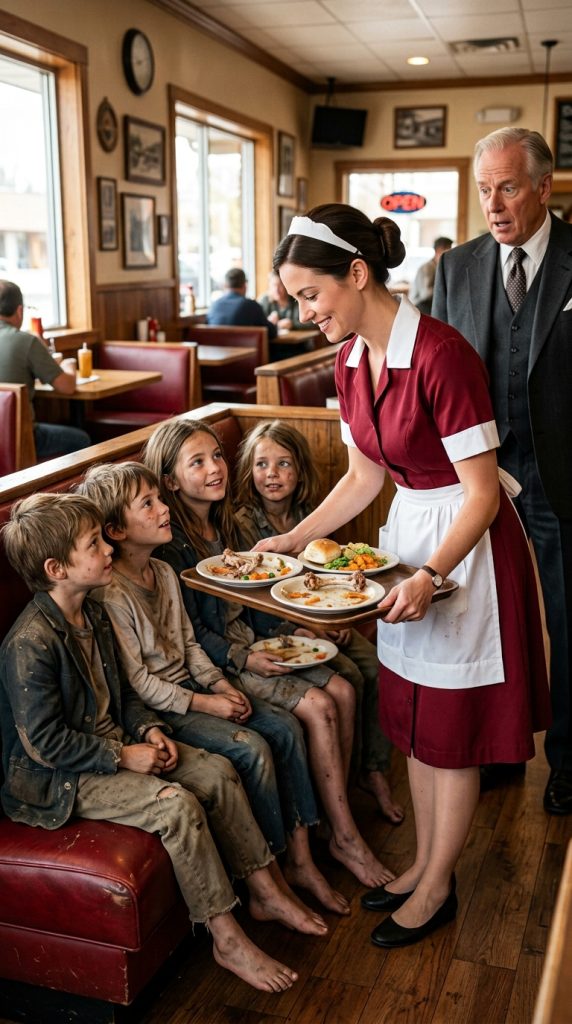
Malaya walked with intent, not in a hurry, but with a destination and a purpose etched into her spine. She didn’t check her phone. She didn’t stop. Past closed storefronts, around two corners, then through a narrow alley behind a crumbling rec center with a rusted gate. Julian ducked behind a recycling bin just as she approached the fence. And then it hit him—four thin figures, alert, familiar with fear. Malaya knelt, opened her backpack and carefully handed each of them food, individually wrapped, thoughtfully divided. Julian couldn’t hear her words, but he saw the way they looked at her like she was more than a waitress, more than a girl with leftovers. She was their anchor, their promise, their someone. She gave them the food, tousled a boy’s hair, and was gone before the gate stopped creaking.
Julian didn’t move. Not for a long time. The night was suddenly colder, the city quieter. What he’d witnessed didn’t fit into the tidy categories of loss prevention or inventory tracking. It didn’t belong in the spreadsheet. He hadn’t found a thief. He’d found something else entirely.
The next night, Julian returned to the Blue Lantern. Same hoodie, same scuffed jeans, same cold cup of coffee he had no intention of drinking. But this time, he didn’t come for confirmation. He already knew. He came back because he couldn’t stop thinking about what he’d seen. The girl in the dark. The food passed hand to hand like a secret. The quiet trust exchanged in the shadows behind the shelter. It gnawed at the framework of profits and policies, but because it did something worse. It made him feel. That unsettled him more than he cared to admit.
Malaya showed up for her shift right on time, hair pulled back, uniform pressed with the precision of someone who understood the value of appearances. She moved through the dining room just as she had the night before, calm, unnoticed, efficient. But now Julian watched with new eyes. He saw how she adjusted the placement of a water glass without looking. How she gave the older man at table 6 a second lemon wedge without being asked. None of it was loud. None of it was for show. But it was all intentional.
At 10:03 she disappeared into the back. And just like the night before, she emerged minutes later, backpack slightly heavier, steps a little quicker. She exited through the side door without a word, and Julian followed. Careful, silent, deliberate. This time he didn’t stay far behind. He traced her route again, past the same shuttered florist, the same alley with the flickering street light. But something in him shifted as he walked. It wasn’t suspicion anymore. It was something quieter, heavier.
Not far behind Emerson Hope, she knelt again. The same four children appeared tonight. Malaya unzipped her bag, and this time Julian saw the contents clearly. Sandwiches wrapped in foil, apples, a thermos. She handed each item out with care, dividing the food with practiced precision. She didn’t take a bite.
“You share this with Amory, okay?” she said to the girl, her voice low, but clear enough for Julian to hear from where he stood.
The girl nodded solemnly. “We will. Thank you, Miss M.”
Malaya smiled faintly, brushing a loose curl from the child’s cheek, then stood and glanced over her shoulder just once before heading off into the night.
Julian pressed himself against the shadows, watching her vanish around the corner. He didn’t follow. Not this time. Instead, he stepped toward the gate. The children froze. Julian raised his hands slightly.
“Hey,” he said gently, crouching to their eye level. “I’m not here to stop anything.”
The boy in the hoodie narrowed his eyes. “You a cop?”
Julian shook his head. “No, just a friend.”
The girl with the cornrows stepped forward, her body still tense, but curious. “You know Miss M?”
The little girl tilted her head. “She helps us.”
Julian nodded, throat tight. “Yeah, I saw that.” He reached into his pocket and pulled out a crisp 20, folding it once before holding it out. “For you guys, just in case.”
The boy snatched it, still wary, but said nothing. The youngest giggled softly. The girl looked at Julian for a long moment, then whispered, “She comes every night. Even when it rains, even when it’s cold. She says, ‘We got to eat if we’re going to grow strong.'”
Julian felt something crack deep and quiet. He stood, murmured a quiet thank you, and walked away, the sound of their small voices echoing behind him like a song too fragile to replay.
He didn’t go back to his hotel. Instead, he found himself driving without purpose. The roads a blur of street lights and restless thoughts. What was she sacrificing to keep this going? Who was this woman really?
By morning, he was back in his high-rise office, staring out at a city that no longer felt quite so indifferent. His assistant, Margot, stepped in, coffee in one hand, tablet in the other, ready to run through the day’s agenda.
“I need a file,” Julian said. “Her name is Malaya Brooks. She works at the Blue Lantern. I want everything.”
By noon, the file landed on Julian’s desk. Slim but heavy with meaning. Margot didn’t ask questions. She never did. When he used that clipped, measured tone. She simply set it down, tapped the corner once, and said, “It’s all in there. Background records, local references. I even called the building superintendent.”
Quietly, Julian opened the folder like it might bleed. The first page was a standard employment profile. Malaya Brooks, age 26, born and raised in Baltimore. Graduated high school early with honors, no college listed, no criminal record, no gaps in employment, just an uninterrupted list of jobs that painted the picture of someone who hadn’t rested in years. Waitress, care aid, receptionist, line cook. Back to waitress, always in motion, always surviving.
He turned the page. She lived in a one-bedroom walk-up on East Preston, a neighborhood that had been promised revitalization since the last mayoral campaign, and still smelled like hot concrete and damp insulation. Rent was listed as delinquent, 60 days. Utilities flagged as inconsistent. The building manager mentioned a younger brother, about 14, and an older woman, mother, mostly indoors. Further down, a post-it stuck to a printout. Lorraine Brooks, chronic heart failure, no insurance on file. Kendrick Brooks, attending public school, currently in academic probation due to unpaid fees.
Julian leaned back in his chair, fingers steepled beneath his chin. The room was quiet except for the low buzz of the city outside. Cars threading between glass towers, people rushing through routines that felt weightless in comparison to this. Malaya wasn’t just giving away food. She was giving away her lifeline. Every sandwich, every portion of soup, every wrapped-up tart handed off behind that gate was a portion she could have fed her own family. And yet, according to the records, she did both. Somehow, impossibly, she carved out a life where no one went hungry on her watch, even if it meant splitting dinner five ways and walking home with aching feet and an empty stomach.
Julian stood, walked to the window, and let the city blur beneath him. For the first time in a long time, he felt like the numbers had failed him. Not because they were wrong, but because they couldn’t tell the whole story. They never could. Real support system would choose to become a lifeline for four children who didn’t even know her last name.
That night, he returned to the Blue Lantern. No hoodie, no disguise, just himself in a tailored navy coat, polished boots, and the kind of presence that turned heads even before the door finished closing behind him. The hostess looked up, startled. The bartender straightened. A server dropped a tray. Julian didn’t pause. He walked straight to the middle of the floor, scanning until he saw her. Malaya balancing a tray of three burgers, moving with the same quiet determination that had caught his eye the first time.
“Miss Brooks,” he said, and the sound of his voice cut through the low murmur of conversation like glass on tile.
She stopped, the tray wobbling in her grip. Her eyes found his, and recognition flashed across her face like a flood light snapping on in the dark.
“I,” she started, already bracing.
“I’m Julian Hart,” he said, voice steady, measured. “I own this place.”
The room fell quiet.
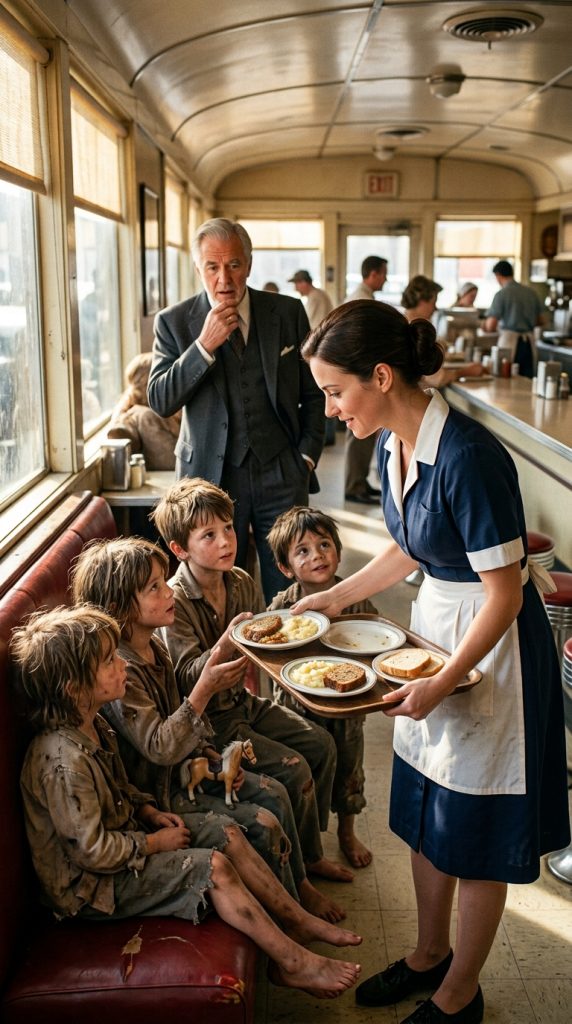
She swallowed hard. “I didn’t take anything,” she said, her voice rough with panic. “The food, it was going to be thrown out. I swear I wasn’t selling it. I never sold a bite.”
“Stop,” he said softer now, stepping closer. “I know what you’ve been doing and what it’s been costing you.”
She didn’t speak. The tray in her hands began to tremble. Then one of the plates tipped, a burger sliding to the floor with a soft thud. She didn’t even flinch.
Julian glanced at the kitchen staff watching from behind the swinging doors, then turned back to her. “As of tonight,” he said, voice loud enough for the room, “Malaya Brooks is the new night manager of the Blue Lantern. Her salary is tripled. Her mother’s medical bills and her brother’s school fees will be paid in full, effective immediately.”
A collective gasp rippled through the room like wind through tall grass. A spoon clattered in the distance. The tray slipped from Malaya’s hands entirely now, hitting the floor with a clatter she didn’t seem to hear. She stood frozen, eyes wide, lips parted. A single tear slid down her cheek unnoticed.
“Why?” she whispered, not to him exactly, but to the air, to the universe, to whatever force had finally decided to turn its face toward her.
“Because you’re worth it,” Julian said quietly. “Because you’ve done more with less than most people ever will, and because someone should have seen you sooner.”
The silence held for another moment before someone in the kitchen began to clap tentatively, then louder. A second voice joined, then a third, until the room broke into applause, awkward and raw, but real.
Malaya didn’t move. Not yet. She just stood in the center of it all, tears streaming freely now, the weight she’d carried for so long finally beginning to lift.
A week later, the chill in the air had softened, but Malaya still wore her denim jacket like armor, sleeves rolled to the elbows, fingers buried deep in the fraying pockets. The night was quiet, unusually so, the kind of stillness that made the city feel like it was holding its breath. She stood outside the rusted gate behind Emerson Hope, but this time she didn’t come with leftovers wrapped in foil or bread rolls gone hard at the edges. Tonight she held two reusable grocery bags stuffed full. Fresh fruit, deli sandwiches, cartons of milk, bags of chips, even juice boxes—not scraps, not castoffs. Real food bought with her own money from her first manager’s paycheck. It felt strange. It felt right.
The four children came before she had to call. Leah, with her cornrows tightened since last week, Marcus, whose eyes didn’t dart around as much now, little Evan, and the youngest one bundled in a jacket three sizes too big, but smiling like he owned the night. They ran to her, arms outstretched, voices bright with something she hadn’t heard from them before. Joy without caution. They crowded around the bags, peeking in, their excitement bubbling over as she handed out sandwiches and apples, cartons of chocolate milk, even a couple of protein bars for later. Leah gasped when she saw the snack-sized Oreos and clutched them like treasure.
“Miss M, this is real food,” Marcus said wide-eyed.
Malaya laughed, a sound that felt foreign in her own throat. “You all think I’d forget you once I got promoted.”
Evan tilted his head. “What’s a promo, Miss M?”
“It means she’s the boss now,” Leah said. Proud like it reflected on her, too. “She got big money.”
Malaya snorted. “Not that big, but big enough to make sure no one’s eating out of trash cans. Not while I’m around.”
She didn’t tell them how strange it felt to have a steady paycheck, to open her fridge and not see light bulbs in a half empty bottle of ketchup. She didn’t explain how her mother’s breathing had already improved thanks to the new medication Julian’s team arranged, or how Kendrick had walked into school that morning with a new backpack and clean shoes, holding his head higher than he had in months. She didn’t need to. The kids’ smiles were enough.
A shadow moved in the alley and for a moment Malaya tensed. Julian appeared in jeans and a dark jacket, casual but deliberate, carrying a mesh duffel bag over one shoulder. When he reached her side, he set it down with a grunt and unzipped it. Inside were six brand new soccer balls, some cones, and a few worn-in cleats in different sizes.
“I figured they’d run faster on full stomachs,” he said, his grin crooked, almost sheepish.
The kids whooped in delight, already pulling the bag open, arguing about who would be goalie. Malaya turned to him.
“You really didn’t have to do that.”
“I know,” Julian replied softer now, “but I wanted to.”
She studied him, searching for the angle, the price tag, the expectation, but there was none. Just him showing up, standing beside her, not in front.
“You’re not who I expected,” she said finally.
Julian shrugged. “Neither are you.”
For a moment, they just stood there watching the children kick the soccer balls down the alley, laughing too loud, too freely. The gate creaked again, and a few more kids trickled out, drawn by the noise, the food, the feeling that something good was happening. Malaya handed out the remaining snacks, her movements sure and graceful, like this had always been her place, her purpose.
Julian leaned against the fence, arms folded, voice low. “I’ve been thinking,” he said, “about the Blue Lantern, about what it could be, what we could make it.”
Malaya glanced at him sideways. “You trying to make me your partner now?”
He smiled. “Maybe not yet, but I am planning a new policy. Starting next week, every Heartline location, including the Blue Lantern, will host one community dinner per week. No bills, no IDs, just food. Real food for whoever needs it.”
Her breath caught, chest tightening around something too big to name. Hope maybe or relief or just the feeling that for once the world was tilting in the right direction.
“That’s a start,” she said quietly.
“It’s your start,” he corrected.
The laughter echoed around them, bouncing off brick and metal and memory. Malaya looked up at the sky where the stars barely pierced the city haze. Still, they were there, steady, unseen by most, just like her, until someone finally looked closer. And now she wasn’t invisible anymore.
Three months later, the Blue Lantern didn’t look all that different. Same soft blue glow outside, same polished silverware and clean white napkins, same calm jazz humming through the speakers, but shared space with newcomers. Teachers fresh out of night class, single moms balancing toddlers on their hips. Weary day laborers clutching folded baseball caps, and teenagers who didn’t order much, but always finished what was on their plates. And no one batted an eye because every Friday night, just as the sun dipped behind the skyline, and the street lights flickered on. The sign by the door flipped from open to community night. All are welcome, and they meant it.
Word had spread like good news usually does. Quiet at first, a whisper between friends, a post on a local forum, a mention in a neighborhood newsletter, and then like wildfire, a local reporter ran a piece with the headline, “From surplus to shelter, the diner feeding Baltimore with heart.” Within days, donations arrived, canned goods, fresh produce, volunteers. The phone wouldn’t stop ringing. Reservations during the week surged, not in spite of the policy, but because of it. People wanted to eat somewhere that fed more than just appetites. They wanted their dollars to mean something.
Julian had to hire two new servers. He expanded the pantry. A local food bank partnered with the restaurant. And still, every Friday night, Malaya stood by the host stand. No longer just a server. Not even just a manager, but a leader, a symbol, a reason. She walked the floor with ease. Now her steps lighter, her eyes sharper. She remembered names, asked about job interviews and sick relatives, swapped jokes with teens and prayers with elders. On other days, she was still hands deep in operations, inventory counts, vendor calls, broken dishwashers. But on Fridays, she belonged to the people.
One night, as the restaurant buzzed with its now familiar rhythm of clinking glasses and quiet laughter, Kendrick walked in with his backpack slung over one shoulder, a school project in hand. He waved at his sister from across the room, flashing his A+ like a trophy. Malaya mouthed, “I’m proud of you.” before turning back to a guest, hiding the tears that pricked her eyes. Lorraine, their mother, sat in the corner booth, sipping tea. Color finally returned to her cheeks, breathing easier than she had in years. She watched her daughter with a quiet pride that didn’t need to be spoken aloud.
Julian, as always, stayed in the background. No spotlight, no speech, but every once in a while his eyes would find Malaya’s, and she’d nod. They understood something now. Not a partnership built on contracts or titles, but something older, stronger, shared purpose yes, but most came for what had grown inside these walls. Dignity, connection, a seat at the table. The Blue Lantern had become more than a place to eat. It had become a place to belong, a beacon in a city that forgot how to slow down, a light that didn’t flicker anymore. And this time, it wasn’t going out.
