

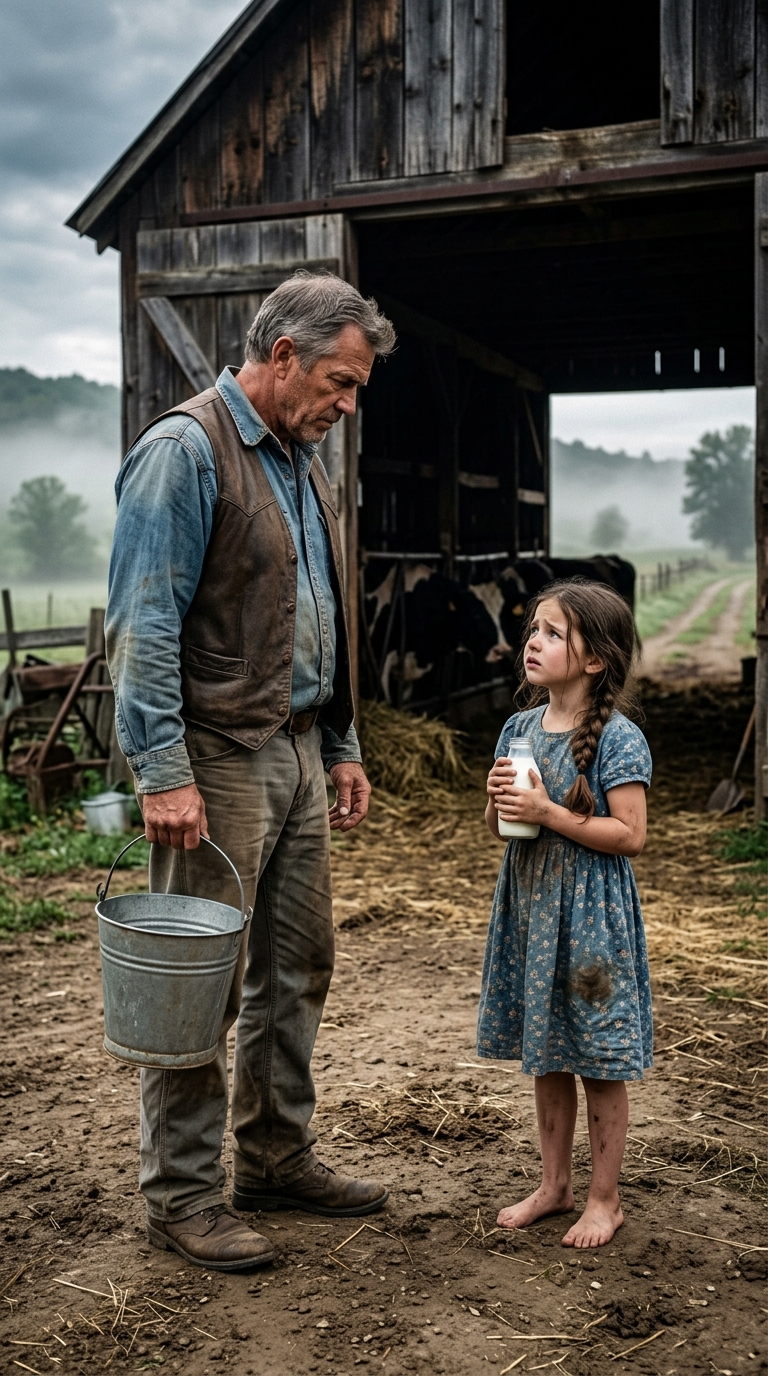
The morning Lily appeared at my barn door, everything felt as ordinary as it always had.
The sky hung low and gray, stretched across the pasture like damp wool. The cows shifted lazily in their stalls, their breath rising in soft clouds against the cold. The sharp smell of hay and soil filled the air, and my boots echoed against the worn barn floor in the steady rhythm of a life I’d been living for sixty-three years.
Nothing about that hour hinted that by sunset, I’d be standing in a sheriff’s office holding a locked metal box, listening to a dying man’s recorded confession—and realizing the little girl who had walked onto my ranch hadn’t come by accident.
I was pouring feed into the trough when I noticed her.
She stood just inside the barn doorway—small, pale, and too still, like a fragile bird that had flown through a storm and somehow made it out alive. Her sandals were too big, worn thin at the edges. A dark braid rested over one shoulder. In both trembling hands, she clutched an empty baby bottle.
When she spoke, her voice was so quiet I almost didn’t hear it.
“I’m sorry, Mister,” she whispered. “I don’t have any money for milk.”
I froze.
Even now, I can still hear the sound the metal scoop made when it slipped from my hand and hit the trough. A hollow clang. Sharp. Wrong.
“What did you say, sweetheart?”
She dropped her gaze quickly, like even looking at me might get her in trouble. “My brother’s hungry.”
There are moments in a man’s life when his body understands before his mind does.
This was one of them.
Something tightened in my chest so suddenly it felt like a fist closing around my heart.
I stepped toward her slowly, careful not to startle her. Up close, she looked worse than I’d thought—not dirty the way kids get from playing outside, but neglected. Damp patches stained her faded blue dress. Her lips were chapped. And her eyes… they carried a kind of exhaustion no seven-year-old should ever know.
“Where’s your mama?” I asked gently.
Her mouth pressed into a thin line.
“Where’s your daddy?”
Nothing.
“Where’s your brother?”
A pause.
Then: “Close.”
That single word unsettled me more than anything else. It wasn’t just fear—it was practiced fear. The kind that comes from being told exactly what not to say.
“I’ve got milk,” I said softly. “You don’t need money.”
Relief rushed across her face so fast it hurt to see.
But she still didn’t smile.
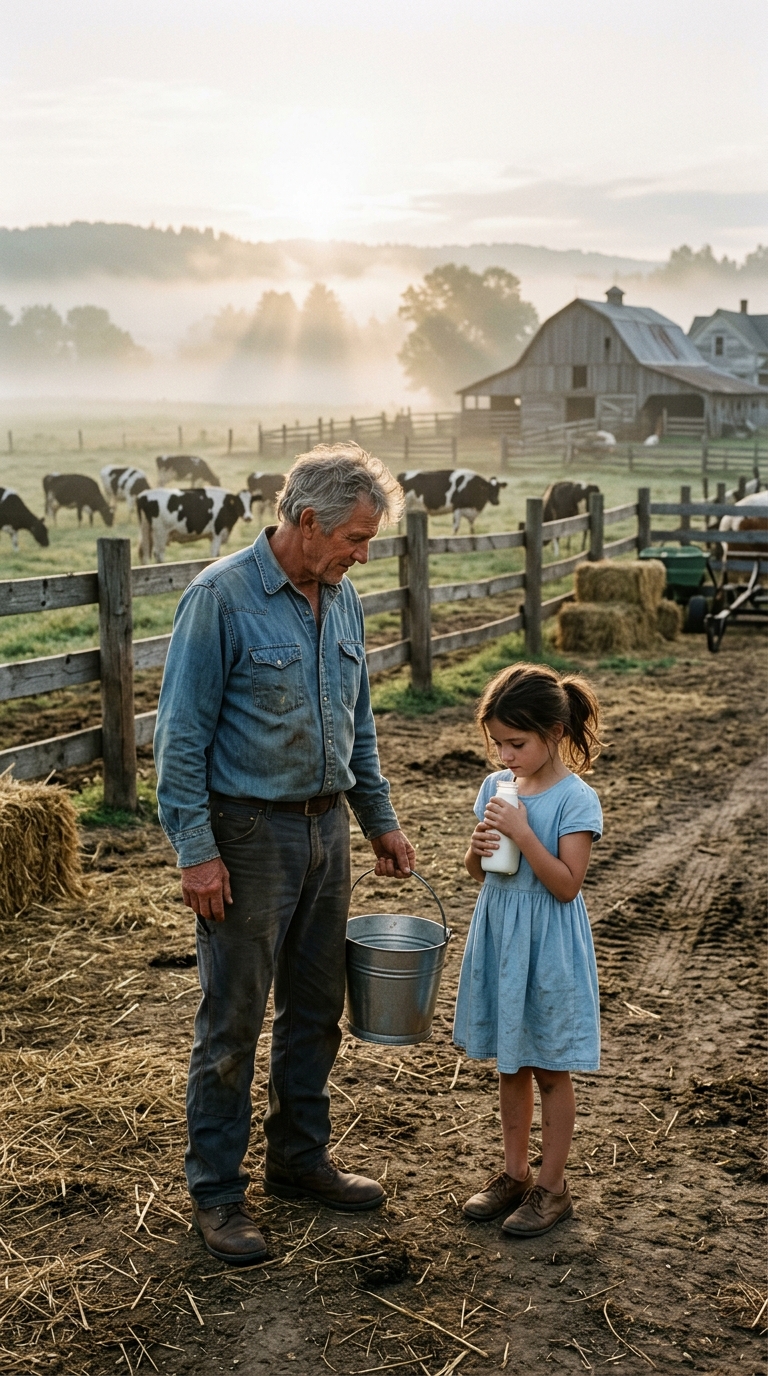
Inside the farmhouse kitchen, I warmed the milk while she stood in the doorway, her eyes flicking between the back door and the windows, never settling. Like she expected someone to come bursting in.
Or worse—like she expected me to change.
“What’s your name?” I asked.
“Lily.”
“That’s a pretty name.”
Silence.
When I handed her the bottle, her fingers wrapped around it instantly. “Thank you, Mister.”
“Earl,” I said. “You can call me Earl.”
She nodded, then turned immediately toward the door.
“Hold on,” I said. “Let me walk you.”
Her entire body stiffened.
“I won’t hurt you,” I added quickly. “I just want to make sure you get there safe.”
For a long moment, she studied me, like she was weighing the promise.
Then she gave the smallest nod.
She didn’t head toward town.
Didn’t go toward any house.
Instead, she passed the north pasture and slipped through a line of overgrown brush behind the creek, moving with the certainty of someone who had taken that hidden path more than once. Branches scratched against my shirt as I followed. The deeper we went, the colder the air seemed to get.
Then I saw the old equipment shed.
The place had been falling apart for years. One hinge hung loose, rusted through. The roof sagged in the middle like it had given up holding itself together. No one had used it since before my wife passed.
Lily pushed the crooked wooden door open.
And there he was.
A baby boy—maybe six months old—lying on a bed of straw, wrapped in a thin gray blanket. His cheeks were hollow. His tiny fists lifted weakly in the air. When Lily rushed to him and guided the bottle to his mouth, he latched on desperately, making those frantic swallowing sounds babies make when hunger has gone too far.
I had to steady myself against the doorframe.
“How long have you been here?” I asked.
“Three days.”
The words hit like a blow.
“Three days?”
She nodded without looking up.
“Where are your parents?”
“They said we were going on a trip,” she murmured. “Then they left. They said they’d come back.”
“Did they leave food?”
She pointed to a crumpled fast-food bag in the corner.
It was empty.
My jaw tightened so hard it hurt.
“Lily,” I said, kneeling beside her, “what’s your brother’s name?”
“Ben.”
I looked at the boy again. Ben. Small, fragile, still alive by sheer stubborn will.
“Why didn’t you go into town?”
Her eyes widened in panic. “Mama said not to tell anyone where we were. She said if we told, they’d split us up forever.”
There it was.
Not just abandonment.
Control.
Whoever had left those children there had planted fear deep enough in that little girl to keep her silent while her brother starved.
“Did she say when she’d come back?”
Lily smoothed the blanket over Ben’s chest. “She said… when things got better.”
I stood slowly. My thoughts were racing too fast to settle. Too many things were wrong all at once. No diaper bag. No proper blankets. No bottles except the one Lily carried. No note.
But one thing was certain.
No decent parent leaves a baby in a shed for three days.
“Lily,” I said, keeping my voice steady, “I’m going to help you both. But I need to make a call.”
Her face went pale.
“No!” she cried. “Please, don’t let them take Ben!”
I crouched again, making sure she was looking at me. “Listen to me. No one is taking your brother away from you today. I promise.”
It took nearly an hour to get her into my truck.
I wrapped Ben in one of Martha’s old quilts I kept behind the seat, and Lily held him the whole way to the clinic, whispering to him like a mother twice her age. The doctor on duty, Miriam Cole, took one look at them and called the sheriff before I had even finished explaining.
By noon, the first version of the truth began to fall apart.
The names Lily gave—Caroline and Dean Mercer—didn’t match any family in the county. Deputies checked records, plates, schools, birth certificates.
Nothing.
No Mercers. No children matching Lily or Ben. No hospital records nearby.
It didn’t make sense.
If the parents were real, they had either vanished completely… or never existed under those names at all.
Sheriff Dalton, a blunt man with a coffee-stained mustache and a habit of talking too fast, leaned against the wall outside the clinic room.
“Could be drifters. Could be fake names. Could be they’ve already crossed state lines.”
But Lily, sitting on the exam bed with Ben in her arms, heard enough to start shaking again.
“They were real,” she insisted. “Mama sang when it rained. Daddy had a scar on his hand. They were real.”
I believed her.
Children invent monsters.
They don’t invent the details of a scar… or the sound of a woman singing in another room.
Miriam finished checking Ben and stepped out, her face tight with concern.
“He’s dehydrated. Weak, but stable now. She’s underfed, exhausted, and terrified. And Earl—there’s something else.”
“What?”
She lowered her voice. “When I changed the baby, I found a strip of cloth sewn into the blanket seam.”
My stomach dropped.
“Sewn?”
She nodded and handed it to me in a clear evidence bag.
At first glance, it looked like nothing—a narrow piece of worn, cream-colored fabric, no bigger than my thumb. But along one edge, stitched in faded blue thread, were two letters:
E.M.
My breath caught.
Martha’s maiden initials.
Eleanor Mayfield.
For a moment, the room seemed to tilt.
The same shade of blue thread. The same careful stitching. Martha had embroidered like that for years—on blankets, towels, quilts she gave away to new mothers every Christmas at church.
But Martha had been gone for twelve years.
“Earl?” Miriam said softly.
I didn’t answer.
Because something buried a long time ago had just shifted beneath my feet.
Martha and I never had children. Not for lack of trying. Loss after loss hollowed that part of our lives until we stopped speaking about it. But there had been one winter—one terrible winter—when Martha became consumed with helping a young woman from the edge of town named Rose Hale.
Rose was nineteen. Pregnant. Scared. Involved with a man whose name people only spoke in lowered voices: Gideon Voss.
Voss owned half the trucking routes in the county—and acted like he owned the rest. Money. Influence. Men who did favors without questions.
Rose disappeared before her baby was born.
No one ever found out where she went.
No one except… maybe Martha.
My hands were shaking by the time I got home.
The house looked exactly the same as I’d left it: coffee cup in the sink, chair pushed back from the table, Martha’s old recipe box still sitting above the refrigerator where I had never moved it.
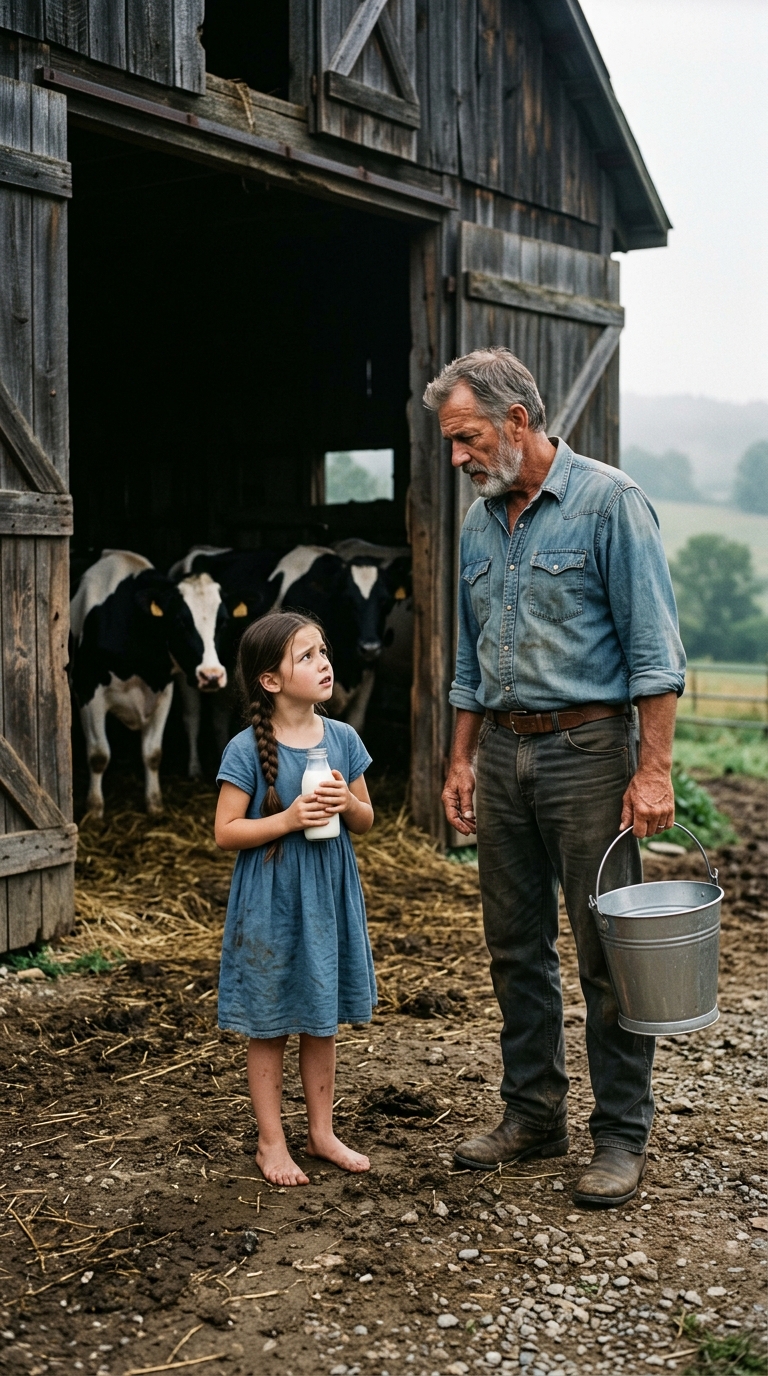
I climbed into the attic and opened the cedar chest where I kept her sewing things.
At the very bottom, beneath old fabric and yellowed patterns, was an envelope with my name in Martha’s handwriting.
If anyone ever comes asking about Rose’s baby, open this only with the sheriff present.
I stared at it for a long moment.
Then I sat down hard on the attic floor.
By the time I got back to town, Sheriff Dalton had Lily asleep under a blanket in the clinic’s back room and Ben resting in a bassinet near the nurses’ station. Miriam locked her office door behind us as I handed him the envelope.
Inside was a letter.
And a small brass key taped to the back.
Dalton read it aloud while I sat there, feeling my pulse pounding in my throat.
The letter was dated eleven years earlier.
Rose Hale had come to our ranch the night before a blizzard—pregnant, bleeding, terrified. She claimed Gideon Voss wanted the baby because the child’s father—not Voss, but his older brother Harold—had died weeks earlier in a suspicious crash. Harold had recently changed his will, leaving control of a hidden land trust to “the lawful issue of my bloodline.” If the child lived, that child would inherit land worth millions.
Voss, according to Rose, intended to make sure that child never existed.
Martha had hidden Rose for two weeks in a room above the tack shed. When labor came early and turned dangerous, she smuggled her to a retired midwife over the county line.
Rose gave birth to a girl.
Lily.
I closed my eyes.
Dalton kept reading.
Rose begged Martha to help her disappear. Martha arranged safe passage through a church contact in Missouri and sent her away with the baby. Before leaving, Rose promised she would return once she had enough proof to expose Voss and reclaim Harold’s estate for Lily.
But she never came back.
Instead, ten months later, a man left a lockbox at the church with instructions that it be given only if Rose or her child resurfaced. Martha, trusting no one, hid it in the sheriff’s office under an alias after the old sheriff agreed to keep it secret.
The brass key, Martha wrote, opened Box 214 in the courthouse basement archive.
“And if Lily has returned,” Dalton finished quietly, “then Rose is likely dead, and Gideon Voss has found them.”
The room went silent.
Somewhere down the hall, Ben gave a soft cry.
I looked at Dalton.
“Open the box.”
He didn’t argue.
The courthouse basement smelled of dust and cold metal. Box 214 sat in the back row, plain and unnoticed behind a rusted gate. Dalton unlocked it with the brass key.
Inside were three things.
A birth certificate.
A bundle of legal papers.
And a cassette recorder.
The birth certificate read: Lillian Rose Hale, mother—Rose Hale, father—Harold Voss.
Dalton’s face turned gray as he scanned the documents. Quitclaim transfers. Trust declarations. Survey maps. Signatures. Everything Harold had hidden from his brother.
Then he pressed play.
A man’s voice crackled through static.
“This is Noah Pike. If you’re hearing this, Rose didn’t make it safe.”
I didn’t recognize the name, but Dalton did—an old accountant who had worked for Harold Voss.
Noah spoke in rushed, uneven fragments. Harold had uncovered Gideon laundering money through fake land deals. When Harold threatened to expose him, Gideon arranged the crash. Noah helped Harold hide the trust documents, but before anything could be done, Harold was dead and Rose was already running.
Then came the part that made the hair on my arms rise.
“Gideon won’t search court records for the child,” Noah said. “He’ll look where Rose trusted most. The rancher’s wife. Eleanor. If the girl ever returns there, it means Gideon has flushed her out. Do not take the children to county services before state investigators arrive. Gideon owns half this town.”
Dalton slowly lowered the recorder.
For the first time since I’d known him, he looked afraid.
“Who knows Lily’s here?” I asked.
He muttered a curse under his breath. “Too many.”
The sound of tires crunching on gravel came from outside.
Fast. More than one vehicle.
Dalton killed the basement lights.
We froze.
A moment later, footsteps thundered across the courthouse floor above us.
Then a voice echoed faintly through the vent.
“Sheriff? You down there?”
Dalton’s jaw tightened. “That’s Deputy Mercer.”
The name hit me cold.
Mercer.
The same last name Lily had been taught to use.
Not random.
A warning.
Mercer wasn’t family, but he’d worked under Dalton for six years. Quiet. Efficient. The kind of man who blended in too well.
Dalton drew a slow breath. “He was the one who pushed for county services.”
My palms went cold.
Upstairs, another voice joined in. Smooth. Controlled. Familiar in all the wrong ways.
Gideon Voss.
“I know you’re in there, Sheriff,” he called. “Let’s not make tonight ugly.”
Dalton looked at me, then at the documents in my hands. For one terrible second, I thought we were already too late.
Then I heard something else.
Not footsteps.
Sirens.
Distant at first.
Then closer.
More than one.
Dalton’s eyes widened. “Miriam.”
I stared at him.
He nodded once. “She wasn’t calling county services earlier. She was calling someone at the state bureau.”
The courthouse above us erupted—doors slamming, voices shouting, boots running in every direction. Dalton shoved the recorder and papers back into my arms.
“Stay with me.”
We climbed the basement stairs just as the front entrance burst open and state investigators flooded the lobby in dark jackets.
Deputy Mercer ran for the side hall—and was tackled before he made three steps.
Gideon Voss didn’t run.
He stood in the center of the lobby in a camel coat that probably cost more than my truck. His silver hair was perfect. His expression calm. For a moment, he even smiled when he saw me, like we were two old acquaintances meeting at church.
Then Dalton lifted the birth certificate.
And that smile cracked.
Just slightly.
But enough.
By midnight, Lily and Ben were placed under emergency protective custody—with Miriam offering her home until the state sorted out the legal mess. Gideon Voss was led away in handcuffs, still insisting there had been a misunderstanding, still pretending power could pass for innocence.
But it wasn’t over.
Not yet.
Two days later, state police found Rose Hale.
Not alive.
Buried under a false name outside St. Louis, dead for six years.
Beside her, in a storage locker, they found a worn duffel bag filled with children’s clothes, old photographs—and one final letter.
Not addressed to Lily.
To me.
Earl, it began, if Lily ever reaches you, then Martha kept her promise. I wanted to come back. God knows I tried. But if I fail, tell my daughter this: I did not leave her. I ran so she could live. And tell her that her brother Ben was born later, after I learned Gideon was still hunting what Harold left behind. Ben is not part of the estate. He is only Lily’s brother, and he is innocent of all of it. Keep them together. That is the only inheritance that matters.
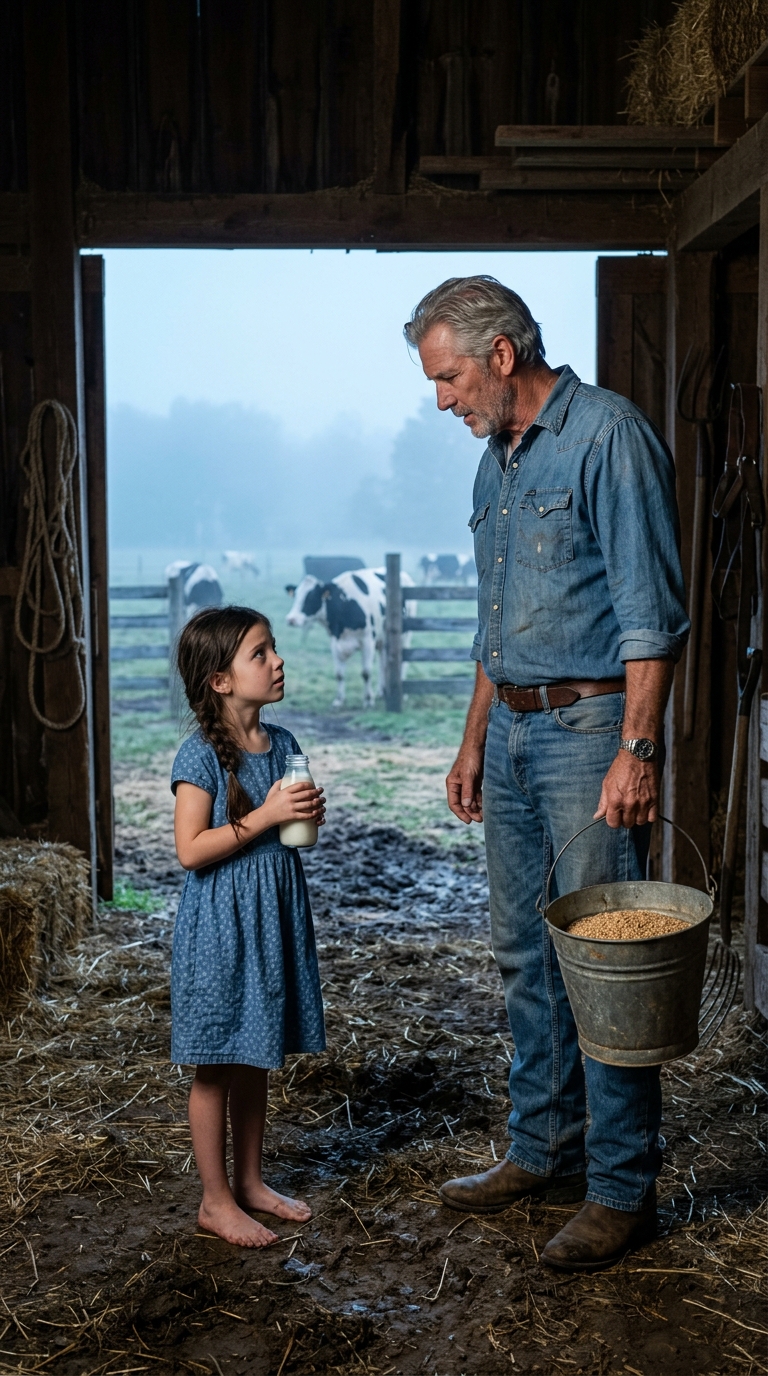
I read that letter three times before I could see straight.
That evening, I sat on Miriam’s porch while Lily drew crooked flowers across the steps with chalk, and Ben slept in a basket near her feet. The sun dipped low, painting the sky in pale gold.
Lily looked up at me.
“Are they coming back?” she asked.
I knew exactly who she meant.
The lies. The fear. The shadows.
I shook my head. “No, sweetheart. Not this time.”
She was quiet for a moment.
Then she asked, “Did my mama really love me?”
Some questions are too pure for a child to carry.
I swallowed hard. “More than her own life.”
Lily nodded, like some part of her had always known.
Then she picked up the last piece of blue chalk from the porch, crawled over, and placed it in my hand.
“Can you draw a house?” she asked.
My throat tightened.
I looked at the chalk… then at the little girl Martha had once saved, the baby boy she had carried through hunger and fear, and the fading light over the fields beyond town.
For the first time in twelve years, something stirred in that empty place inside me where grief had lived too long.
So I bent down on Miriam’s porch and drew one.
A square house. A crooked fence. Two children in the yard.
And when Lily smiled—truly smiled—I finally understood the last twist in it all.
The miracle wasn’t that she had found my ranch.
The miracle was that, after everything meant to erase her, she had found her way home.
