

PART 3: FIVE CHILDREN, ONE HOME, FOREVER
The first week nearly destroyed every romantic idea I’d ever had about keeping a family together.
There was nothing cinematic about doing laundry at one in the morning.
Nothing heroic about scraping applesauce from a wall.
Nothing noble about calling Denise because I couldn’t get Jack to drink enough formula.
There were pediatric appointments, dental visits, school enrollment forms, therapy evaluations, court-required training sessions, medication records, and home inspections.
One inspector checked our smoke detectors.
Then another arrived because the first had recorded the wrong model number.
My foreman, Luis, took over most of the carpentry jobs.
I handled estimates, invoices, and scheduling from home.
My income dropped.
My expenses climbed.
And sleep became something I remembered fondly.
But gradually, I began learning the children.
Noah walked quickly, always with purpose.
Caleb dragged his left heel when he was tired.
Lily skipped every third step.
Emma ran everywhere.
Jack crawled so quietly that he could terrify me simply by disappearing behind the couch.
Lily hated peas but loved green beans.
Caleb liked pancakes only when the syrup was served separately.
Emma called spaghetti “red noodles.”
Jack fell asleep when someone gently rubbed the center of his back.
And Noah always saved food.
Crackers disappeared into his pockets.
Half a sandwich would be wrapped in a napkin.
I found a banana beneath his pillow.
The first time, I almost questioned him.
Then I remembered a foster home where I’d hidden dinner rolls under my mattress because breakfast hadn’t always been guaranteed.
The following day, I placed a basket in the bedroom.
Granola bars.
Crackers.
Applesauce packets.
I told all five children, “This is yours. Nobody needs permission.”
Noah watched the basket for two days.
On the third morning, two granola bars were missing.
I replaced them without saying anything.
By the following week, he stopped hiding food beneath his pillow.
The basket remained.
The food stayed visible.
That was how trust began.
Not through speeches.
Through crackers that nobody needed to conceal.
The county visits continued.
One Tuesday evening, Denise arrived without warning.
Emma was wearing nothing except rain boots.
“Should I come back?” Denise asked.
“No.”
Emma ran past us shouting, “PANTS ARE BAD!”
Denise struggled not to laugh.
“I see.”
I rubbed my eyes.
“We are discussing pants.”
“How is that going?”
“Poorly.”
Noah appeared behind me.
“We’re okay.”
Denise looked toward him.
“I asked Ethan.”
Noah frowned.
I’d noticed he no longer called me Mr. Carter unless he was angry.
That felt like progress.
Denise checked the bedrooms, reviewed medication records, inspected our food supplies, and spoke with each child privately when appropriate.
Then she asked me to join her on the porch.
“You look terrible.”
“Thank you.”
“I’m serious.”
“So am I.”
She crossed her arms.
“How much are you sleeping?”
“Enough.”
“Ethan.”
I glanced through the window.
Noah was helping Caleb complete a puzzle.
“Not much.”
“You need respite.”
“No.”
The answer came too quickly.
Denise noticed.
“That’s not optional forever.”
“I’m not sending them somewhere else.”
“Respite doesn’t mean separating them.”
“They’ll think it does.”
“Then we prepare them.”
“No.”
Her expression hardened.
“This is exactly what the county was worried about.”
I looked at her.
“What?”
“You trying to prove you’re the one adult who never needs help.”
“I’m not.”
“You’re working from home, doing nighttime care, attending training, transporting five children, and refusing respite.”
“I can handle it.”
“That sentence usually comes right before someone can’t.”
Anger rose in my chest.
“I said I’m fine.”
The moment I heard myself say it, I thought of Noah.
I’m fine.
Denise heard it too.
Her expression softened.
“Sound familiar?”
I looked away.
She sat on the porch step.
After a moment, I joined her.
“I don’t want them waking up somewhere else.”
“Then don’t send them somewhere else.”
I frowned.
“Approved respite can happen here. Someone can come to the house. Someone can take all five to the park for three hours while you sleep.”
I rubbed my face.
“I didn’t know that.”
“Because you stopped listening when you heard the word respite.”
She was right.
“I know what it felt like when adults said a move was temporary.”
“Ethan, getting help is not leaving.”
I stared across the yard.
A cheap plastic slide stood beside the porch.
Two weeks earlier, the same space had been filled with lumber.
Now chalk drawings covered the walkway.
Denise continued.
“The safest thing you can teach Noah may not be that one person can hold everything together.”
She glanced through the window.
“It may be that he doesn’t have to.”
That evening, I asked Noah whether he wanted to help choose someone from the county’s approved support list.
He immediately refused.
I explained that nobody would move.
Nobody would sleep anywhere else.
A caregiver would occasionally come to our house.
I would still be there.
“Why?” he asked.
“Because I’m tired.”
He looked genuinely surprised.
“Adults get tired?”
“Constantly.”
He thought about that.
“Mom did.”
“I’m sure she did.”
He looked toward Lily.
“She still took care of us.”
“I bet she also got help sometimes.”
He nodded.
“Grandma came.”
It was the first memory he’d offered without being asked.
“What was Grandma like?”
Noah almost smiled.
“She cheated at cards.”
“That’s serious.”
“She said she didn’t.”
“Even worse.”
For a brief moment, he smiled.
A real smile.
Then it disappeared.
But I’d seen it.
I began trauma-focused counseling myself.
I hated it at first.
The therapist asked questions I’d spent decades avoiding.
What happened after my siblings and I were separated?
How had I survived?
What did I believe about adults?
Why did I avoid close relationships?
Why had I built an entire life around never needing anyone?
Every answer made me angry.
Then exhausted.
Then, little by little, less afraid.
Three weeks into the placement, Martin Hale came to my house.
I opened the door and stared at him.
“This feels ominous.”
He lifted a folder.
“Review preparation.”
“Do county attorneys usually do home visits?”
“No.”
“Then this is definitely ominous.”
He almost smiled.
Denise stood beside him.
The children watched from the living room.
Martin stepped inside.
He looked at the drawings covering the refrigerator.
The overflowing laundry basket.
The line of shoes near the door.
The dents Emma had somehow created in a wall using a wooden spoon.
“This looked different in the inspection photographs.”
“Yes.”
“It was cleaner.”
“There were no children.”
He nodded.
“Fair.”
Noah approached cautiously.
He recognized Hale from court.
“Are you taking us?”
Hale went still.
“No.”
“You wanted us separate.”
The accusation hung between them.
Hale could have denied it.
He didn’t.
“I recommended separate licensed placements because I was worried putting all five of you here might not be safe.”
“We’re safe.”
Hale glanced toward me.
Then back at Noah.
“I’m glad.”
Noah studied him.
“Are you changing your mind?”
Hale paused.
“I’m collecting information.”
Noah frowned.
Adults loved phrases like that.
He crossed his arms.
“You talk weird.”
Denise coughed to hide her laughter.
Hale nodded.
“My daughter says the same thing.”
Noah seemed surprised that he had a daughter.
Hale remained for nearly two hours.
He asked about school, therapy, food, sleep, finances, business arrangements, and support.
Then he asked what had gone wrong.
I told him everything.
Lily’s nightmares.
Caleb’s silence.
Emma’s tantrums.
Jack’s feeding difficulties.
Noah hiding food.
My exhaustion.
The therapy appointment I’d forgotten.
The morning I’d lost my temper because three children refused to put on shoes.
And how I’d immediately apologized after seeing fear in Noah’s eyes.
I concealed nothing.
At the end, Hale closed his folder.
“You know, most applicants spend these reviews trying to convince me everything is perfect.”
“Everything is not perfect.”
“I noticed.”
Emma had just placed a sticker on his briefcase.
A glittery pink dinosaur.
I waited for him to peel it off.
He didn’t.
“Why tell me about losing your temper?”
“Because I did.”
“You’re not concerned it makes you look unprepared?”
“I am unprepared for some things.”
I looked toward the living room.
“But I’m learning.”
Hale followed my gaze.
Noah was reading a picture book to Caleb, badly but enthusiastically.
“What happens if the court extends placement?”
“We keep going.”
“And if it doesn’t?”
The question chilled me.
I’d tried not to imagine that possibility.
“I fight.”
“Legally.”
“Obviously.”
Hale raised an eyebrow.
“Good clarification.”
I leaned forward.
“But I won’t tell the children something is guaranteed when it isn’t.”
He nodded.
Judge Miller’s warning had remained with me.
I had followed it.
When Noah asked whether they could stay forever, I never promised they could.
I said, “I’m trying.”
When Lily asked whether I’d be there tomorrow, I said yes when I knew I would.
When Caleb asked whether the judge could separate them later, I told him the truth.
“He could.”
Caleb cried.
Later, alone in my bedroom, I cried too.
But I wouldn’t build their trust on promises I couldn’t keep.
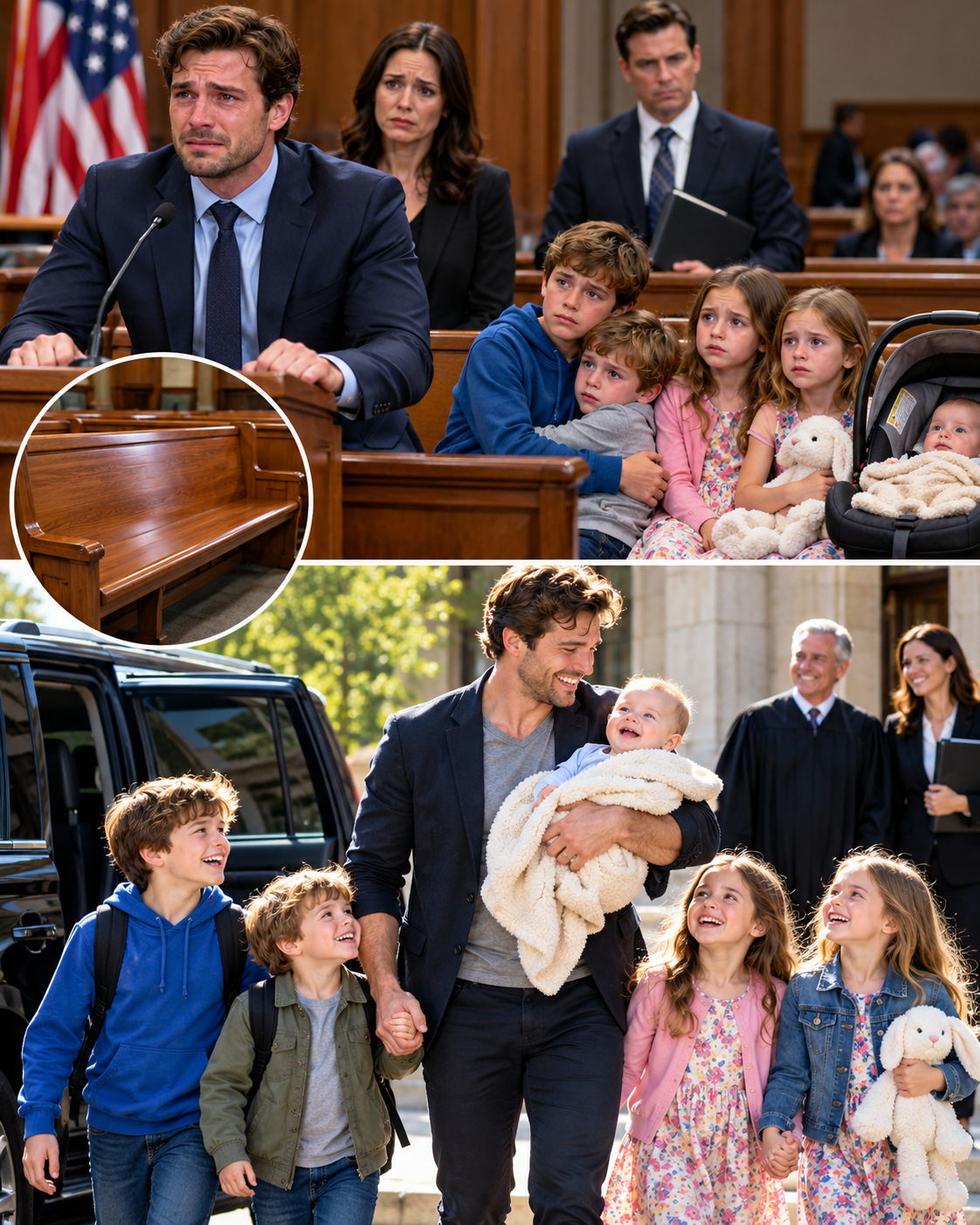
The thirtieth day arrived.
We returned to court.
The same building.
The same hallway.
The same wooden bench.
Noah stopped when he saw it.
His hand reached for mine.
It was the first time he’d taken my hand without needing anything.
I looked down.
“You okay?”
“No.”
“Me neither.”
He studied our joined hands.
“Do we have to sit there?”
“No.”
Rachel had arranged for us to wait in a conference room until the hearing.
Noah nodded.
We walked past the bench.
This time, all five children remained together.
The hearing lasted ninety minutes.
Denise testified first.
She described the difficulties honestly.
Then she described the progress.
The children were attending appointments.
No safety concerns had been observed.
School enrollment was complete.
Developmental referrals had been made.
I’d completed required training.
An approved in-home respite caregiver had been arranged.
My therapist confirmed that I was actively addressing my childhood trauma.
The county still had concerns.
But its recommendation had changed.
Hale stood.
“Your Honor, the department recommends extending placement for an additional ninety days.”
I closed my eyes.
Not forever.
But not four cars.
Judge Miller approved the extension.
Three more months.
That was how our life continued.
Thirty days.
Then ninety.
Then another review.
The children didn’t understand legal timelines.
I tried not to build our lives around them.
Winter arrived.
The house changed.
Fingerprints covered the windows.
My grocery bill became ridiculous.
I learned to cook six meals well and three very badly.
Noah started first grade.
Caleb entered kindergarten.
Lily began attending preschool several mornings a week.
Emma discovered the phrase “absolutely not” and used it whenever possible.
Jack took his first independent steps between the couch and my knees.
When he fell, I cried harder than he did.
At Christmas, the children made ornaments.
Noah created one shaped like a house.
Seven figures stood in front of it.
Five small.
One tall.
And shapes floating above.
I stared at the ornament.
“Who’s that?”
He pointed toward the sky.
“Mom and Dad.”
My throat tightened.
“And who’s the tall one?”
He rolled his eyes.
“You.”
“Oh.”
I looked again.
“You made me extremely tall.”
“You’re giant.”
“I’m six feet one.”
“Giant.”
I laughed.
Then I noticed two separate shapes in the sky.
“Two?”
“Mom and Dad.”
I nodded.
Of course.
Noah studied me carefully.
“You’re not replacing them.”
It wasn’t a question.
“No.”
“Okay.”
He returned to coloring.
A minute later, he added, “You can still be here.”
I turned away because my eyes had filled.
That became the promise I allowed myself to make.
Not forever.
Not yet.
Just here.
Almost six months after the first hearing, we experienced our hardest night.
By then, anyone looking through our windows might have assumed everything was going well.
In many ways, it was.
But grief hadn’t finished with us.
Grief doesn’t disappear because people start laughing again.
It waits inside ordinary objects.
A smell.
A song.
A photograph.
A school assignment asking children to draw their family.
For Noah, it was a blue coffee mug.
I found it in one of the boxes the county eventually released from his parents’ home.
The children received several containers of belongings.
Clothes.
Photographs.
Toys.
Their mother’s recipe notebook.
Their father’s baseball cap.
And a blue ceramic mug with a chipped handle.
Noah saw it and froze.
“Dad’s.”
I stopped moving.
He picked up the mug with both hands.
Then it slipped.
The mug struck the kitchen tiles and shattered.
Noah screamed.
He dropped to the floor and grabbed at the broken pieces.
“Noah!”
I rushed toward him.
“Don’t touch those.”
“I broke it!”
“It’s okay.”
“No!”
A sharp fragment sliced his palm.
Blood appeared.
He didn’t seem to notice.
“I broke Dad’s cup!”
I wrapped a towel around his hand.
“Noah, look at me.”
“It was his!”
“I know.”
“It’s gone!”
He struggled against me.
I held his shoulders.
“It’s a cup.”
“No!”
“It’s not your dad.”
He stopped.
The words sounded cruel.
I almost took them back.
Then I understood what I needed to say.
“It’s not your dad, Noah.”
He stared through his tears.
“Breaking it doesn’t break him.”
His breathing hitched.
“You didn’t lose him again.”
His face crumpled.
I pulled him against my chest.
For months, Noah had cried quietly.
That night, he screamed into my shirt until his throat became raw.
“I want him.”
“I know.”
“I want Mom.”
“I know.”
“I don’t want you!”
There it was.
The sentence I’d been warned about in court.
If he rejects you?
I remembered my answer.
I stay.
“I know.”
He struck my chest with both fists.
“I hate this house!”
“I know.”
“I hate you!”
I held him only firmly enough to prevent him from reaching the broken ceramic.
“Okay.”
He looked shocked.
“Okay?”
“You can hate me.”
His mouth opened.
“I’m still cleaning your hand.”
That made him angrier.
He sobbed.
“I want Dad.”
“I know.”
“Bring him back!”
My own childhood rose inside me.
The impossible bargains.
The anger toward adults who couldn’t reverse death.
The desperate belief that somebody powerful enough should be able to fix everything.
But I couldn’t fix it.
So I didn’t pretend.
“I can’t.”
Noah sagged against me.
“I wish I could.”
The other children had gathered in the doorway.
Caleb was crying.
Lily held Emma.
Jack, almost two now, stood behind them.
Noah saw his siblings.
Immediately, he tried to pull away.
His old instinct.
Protect everyone.
Hide his own pain.
I stopped him gently.
“You don’t have to take care of them right now.”
“They’re scared.”
“So are you.”
“I have to.”
“No.”
He stared at me.
That word had become the center of our lives.
No.
You don’t have to be their father.
No.
You don’t have to count the food.
No.
You don’t have to watch every door.
No.
You don’t have to hold everyone together by yourself.
I looked toward the other children.
“I’ve got them.”
Noah’s face collapsed again.
“You promise?”
The question terrified me.
Not because I didn’t want to answer.
But because I understood the weight of a promise.
Judge Miller’s warning had remained in my mind for months.
Do not make promises the law may prevent you from keeping.
But this promise wasn’t about a court order.
“I promise you don’t have to hold everybody together alone.”
Noah stared at me.
“What if they leave?”
“Then you won’t face it alone.”
“What if you leave?”
Something inside me broke open.
“I won’t choose to.”
It was the most honest answer I could give.
He nodded.
That night, all five children slept in my bedroom.
There was no storm.
No new nightmare.
They simply refused to separate after Noah’s breakdown.
Lily and Emma slept sideways at the foot of my bed.
Caleb curled up inside a sleeping bag.
Jack slept in a portable crib.
Noah lay on the floor beside my bed.
At two in the morning, I woke and found him sitting upright.
“What?”
He whispered, “Nothing.”
I looked around the room.
Everyone was there.
He was counting.
I reached down and touched his shoulder.
“Five.”
He looked at me.
“Five,” I repeated.
He lay back down.
The following morning, we glued the broken mug together.
It looked terrible.
Thin cracks ran along every side.
The handle leaned slightly.
It would never hold coffee again.
Noah placed it on the bookshelf beside a photograph of his parents.
“Don’t throw it away,” he said.
“I won’t.”
He studied the cracks.
“It’s broken.”
“Yes.”
“But it’s still his.”
“Yes.”
Noah thought about that.
Then he said, “Some broken things stay.”
I don’t know how a six-year-old learned to say something like that.
Perhaps grief teaches children a language adults spend years trying to avoid.
Spring arrived.
Then another court review.
By then, we’d lived together long enough that the word temporary had become almost unbearable.
There were still legal requirements.
Home studies.
Permanency planning.
Searches for extended family.
Evaluations.
Reports.
Nothing in child welfare moved as quickly as children grew.
Jack learned three new words while adults discussed jurisdiction.
Emma outgrew two pairs of shoes while paperwork moved between offices.
Lily stopped screaming every night.
Caleb began talking so much that I sometimes forgot how worried we’d once been about his silence.
And Noah stopped counting every hour.
I noticed it one afternoon in the grocery store.
All five children had spread out around me.
Caleb was choosing cereal.
Lily and Emma were arguing about yogurt.
Jack sat in the shopping cart.
Noah was reading comic books.
For one terrifying second, I thought someone was missing.
I counted.
One.
Two.
Three.
Four.
Five.
Then I looked toward Noah.
He wasn’t counting.
He was reading.
Just reading.
I gripped the cart because my knees felt weak.
He looked up.
“What?”
“Nothing.”
“Why are you looking at me weird?”
“I’m old.”
“You’re twenty-nine.”
“Exactly.”
He rolled his eyes.
For Noah, safety had finally started becoming boring.
And that was the greatest success of my life.
Not happiness every day.
Not perfect behavior.
Boredom.
A child becoming annoyed in a supermarket because nothing terrible was happening.
At the next permanency hearing, I wore the same suit I’d worn on the first day.
It fit differently.
I’d lost weight.
There was a faint applesauce stain near one cuff that dry cleaning hadn’t managed to remove.
Rachel noticed.
“You own other suits.”
“Not ones the kids know.”
She smiled.
The children waited nearby with Denise.
The old wooden bench still stood outside the courtroom.
I’d revisited it hundreds of times in my mind.
That day, I touched the backrest.
The wood was smooth.
I wondered how many children had sat there believing their futures depended entirely on whether adults wanted them.
Rachel stood beside me.
“You ready?”
“No.”
“Good.”
“Good?”
“Every time you tell me you’re ready, something catches fire.”
“Nothing has caught fire.”
“The toaster.”
“That was smoke.”
“The toaster had flames.”
“Small flames.”
She shook her head.
We entered the courtroom.
Martin Hale was already there.
He carried only one folder.
Much thinner than the stack he’d brought to the first hearing.
He nodded toward me.
“Ethan.”
“Martin.”
Somehow, we’d reached first names.
Judge Miller entered.
Everyone stood.
Then sat.
The hearing began with reports.
Stable placement.
School progress.
Medical compliance.
Therapy participation.
Adequate financial management.
Strong sibling attachment.
A growing attachment to their caregiver.
No substantiated safety concerns.
The words sounded clinical.
But behind each one lived a thousand ordinary moments.
Bandages.
Bedtime stories.
Spilled cereal.
Fevers.
Nightmares.
Homework.
Birthday candles.
Arguments about brushing teeth.
Jack saying my name for the first time.
Lily asking whether I’d attend her preschool performance.
Caleb falling asleep against me during a movie.
Noah leaving his bedroom door open at night.
Judge Miller turned toward Hale.
“County’s recommendation?”
I stopped breathing.
Hale stood.
He looked toward the judge.
Then at me.
“The department recommends that the children remain together in Mr. Carter’s home.”
I exhaled.
He continued.
“We further recommend movement toward permanent placement, subject to completion of the remaining statutory requirements.”
Rachel gripped my wrist.
I couldn’t look at her.
Judge Miller nodded.
“Any reservations?”
Hale paused.
“Yes.”
My heart stopped again.
He looked directly at me.
“Raising five children will remain difficult. Mr. Carter will continue needing substantial support. The children will continue to experience grief, developmental transitions, and trauma responses.”
He glanced at his notes.
“However, the original concern before this court was whether Mr. Carter’s desire to keep these siblings together was driven primarily by emotion and whether that emotion would survive reality.”
He closed the folder.
“It did.”
My throat tightened.
“No,” Hale corrected himself.
“The emotion changed.”
I looked at him.
“What began as identification with their loss appears to have developed into a functioning family relationship.”
He faced Judge Miller.
“The department does not believe sibling separation is in these children’s best interest.”
For months, I’d imagined hearing those words.
They were quieter than I’d expected.
Judge Miller approved the permanency plan.
More steps followed.
More home visits.
More paperwork.
More waiting.
The final adoption hearing came almost a year after I first saw the children’s photograph.
All five walked into the courthouse with me.
No county cars waited outside.
No bags of belongings sat beside the door.
Nobody whispered about available beds.
Noah was seven now.
The same age I’d been.
That realization stayed with me all morning.
We passed the wooden bench.
He stopped.
So did I.
The others continued until they noticed we weren’t following.
Lily turned around.
“Come on!”
“In a minute,” Noah said.
She shrugged and followed Denise.
Noah stared at the bench.
“You sat on one like that?”
I’d gradually shared some of my childhood with him.
Not everything.
Children shouldn’t have to carry adult pain.
But enough.
“Yeah.”
“With your brother and sister?”
“Yeah.”
“What were their names?”
I’d never told him.
I wasn’t sure why.
The names had always felt sacred.
Or dangerous.
Maybe both.
I told him.
He repeated them carefully.
“Do you miss them?”
“Every day.”
He looked at the bench.
“Even now?”
“Especially now sometimes.”
He nodded.
Then he asked, “Is that why you took us?”
I considered giving him an easier answer.
Because I wanted to help.
Because you needed a home.
Because I had enough room.
Instead, I told him the truth.
“It’s why I called.”
He looked at me.
“But it’s not why I stayed.”
His eyes narrowed.
“Why’d you stay?”
I smiled.
“Because you’re Noah.”
He tried not to smile.
“And Caleb is Caleb.”
A slight smile appeared.
“Lily is Lily.”
It grew.
“Emma is completely insane.”
He laughed.
“And Jack bites.”
“He does.”
“And somehow all of you keep eating food I paid for.”
Noah laughed harder.
I crouched in front of him.
“I didn’t stay because you’re the children I lost.”
His laughter faded.
“I stayed because you’re you.”
He stared at me.
I could see that the difference mattered.
“Okay.”
Then he looked toward the bench.
“I used to count everybody.”
“I remember.”
“I don’t do it much now.”
“I noticed.”
He pushed his hands into his pockets.
“I still do sometimes.”
“Me too.”
He looked surprised.
“You count us?”
“Constantly.”
“Why?”
“Because there are five of you and somebody is always wandering off.”
He rolled his eyes.
But I understood the deeper reason.
And so did he.
He reached for my hand.
“Come on.”
We entered the courtroom together.
The final hearing was unexpectedly simple.
After everything we’d experienced, I’d imagined something dramatic.
Thunder.
Music.
Some visible sign that the universe understood how important the moment was.
Instead, Jack tried to crawl beneath a table.
Emma asked Judge Miller why he was wearing “a black dress.”
Lily loudly corrected her.
Caleb whispered that he desperately needed the bathroom after insisting five minutes earlier that he didn’t.
Noah sat beside me, swinging his legs.
Judge Miller smiled more than I’d ever seen him smile.
He asked me several formal questions.
Did I understand the legal responsibilities?
Yes.
Did I understand adoption was permanent?
Yes.
Was I prepared to provide care, support, education, medical attention, and a stable home?
I looked toward the five children.
“Yes.”
Judge Miller turned toward Noah.
“Do you understand what today means?”
Noah nodded.
“What does it mean?”
He thought carefully.
Then answered.
“No more thirty days.”
Silence filled the room.
Judge Miller’s expression softened.
“No,” he said quietly. “No more thirty days.”
“Or ninety?”
“No.”
Noah turned toward me.
“Forever?”
My chest tightened.
This time, I could answer.
I didn’t have to say I’m trying.
I didn’t have to say we’ll see.
I didn’t have to protect him from a promise the law might prevent me from keeping.
I leaned closer.
“Forever.”
His eyes filled.
He quickly looked down.
Judge Miller signed the adoption order.
One signature.
That was all.
One signature transformed temporary into permanent.
Five case numbers became my sons and daughters.
Noah Carter.
Caleb Carter.
Lily Carter.
Emma Carter.
Jack Carter.
They weren’t required to change their names.
I’d explained that repeatedly.
But Noah wanted to.
The others chose to follow him.
Not because I was replacing their parents.
I never would.
Their mother and father remained present in photographs, stories, recipes, habits, and familiar expressions.
Sometimes Lily laughed in a way that made Noah say, “Mom laughed like that.”
Caleb had inherited his father’s habit of tapping his fingers while thinking.
We kept the photographs.
We talked about their parents.
Love didn’t require erasing anyone.
That was something I wished somebody had taught me when I was seven.
After the hearing, we returned to the hallway.
The bench was still there.
I expected to hate it.
But I didn’t.
It was wood.
Nothing more.
Wood didn’t separate families.
Adults did.
Systems did.
Circumstances did.
Fear did.
Sometimes necessity did too.
And sometimes, when people were willing to reconsider what was practical, adults could choose differently.
Martin Hale walked past carrying his briefcase.
The pink dinosaur sticker was still attached.
I pointed toward it.
“You kept that?”
He glanced down.
“My daughter says it improves the case law.”
Emma heard him.
“I GAVE YOU THAT!”
Everyone in the hallway turned.
Martin sighed.
“Yes, Emma.”
She ran toward him.
“You like dinosaurs?”
“I have developed an appreciation.”
She handed him another sticker.
This one was purple.
He accepted it with the expression of a man receiving a court summons.
I laughed.
Denise cried openly.
Rachel pretended she wasn’t crying.
Judge Miller disappeared into his chambers before any child could give him a sticker.
Smart man.
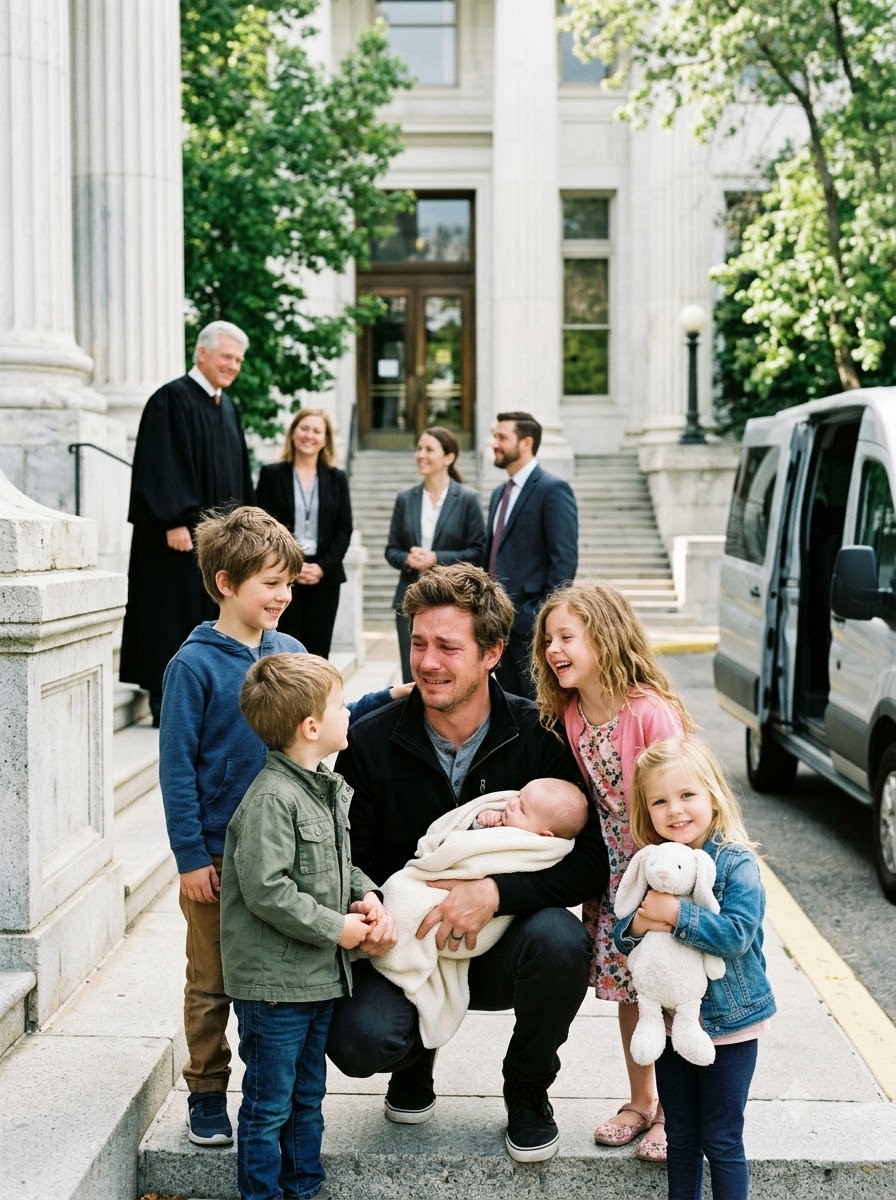
We walked outside.
Five children rushed toward my van.
My van.
The used passenger van I’d purchased after selling the pickup truck everyone said I’d regret losing.
Sometimes I did miss the truck.
Usually when somebody spilled chocolate milk between the van seats.
But I never regretted selling it.
I stood in the parking lot while the children argued about who should sit where.
Noah climbed into the second row.
Then stopped.
“Ethan?”
I looked toward him.
He had never called me Dad.
Not yet.
I’d told him he never had to.
“Yeah?”
He glanced back toward the courthouse.
Then at his siblings.
“Count.”
I understood.
I pointed toward Jack.
“Jack.”
Jack slapped the side of his car seat.
“One.”
“Emma.”
“Two!”
“Lily.”
“Three.”
“Caleb.”
“Four.”
Then I looked at Noah.
He watched me carefully.
“And Noah.”
He smiled.
“Five.”
One.
Two.
Three.
Four.
Five.
All together.
All leaving in the same vehicle.
I closed the van door.
Years earlier, when I was seven, I’d sat on a courthouse bench and watched my family disappear through different doors.
For most of my life, I’d believed that was simply how stories like mine ended.
You survived.
You grew older.
You stopped expecting people to stay.
You built a life strong enough that nobody could hurt you by leaving, because nobody was allowed close enough to matter.
Then five children I’d never met appeared in a photograph.
A little boy stood behind his siblings with one hand resting on his brother’s shoulder.
And the walls I’d spent twenty-two years building suddenly became useless.
People later told me I’d saved those children.
They said it at school events.
At church fundraisers.
At the hardware store.
Reporters even said it once after someone learned about the case.
I always disliked that word.
Saved.
It made everything sound too simple.
I didn’t save Noah.
He’d been fighting to protect his siblings before I knew their names.
I didn’t save Caleb.
He found his own voice.
I didn’t save Lily from grief.
I learned to sit beside her when it came.
I didn’t save Emma.
Most days, I was simply trying to stop her from climbing furniture.
And I certainly didn’t save Jack.
Jack spent his first year with me attempting to eat things that weren’t food.
What I did was open a door.
They walked through it together.
And somewhere along the way, they opened another door for me.
I thought I was offering five children a home.
What they gave me was something I’d stopped believing existed.
A family that didn’t disappear when visiting hours ended.
Years later, I still occasionally dreamed about that first courthouse.
In the dream, I was seven again.
My feet didn’t reach the floor.
Adults whispered.
Doors opened.
Cars waited outside.
I tried to count my brother and sister.
One.
Two.
Three.
Then someone said it was time to leave.
But after Noah, the dream changed.
Now, before the cars could drive away, I heard footsteps.
Five sets.
Noah appeared first.
Older.
Smiling.
Caleb beside him.
Then Lily.
Emma.
Jack.
They walked toward the frightened boy sitting on the bench.
And somehow, although dreams rarely make sense, I was both people.
The child waiting.
And the man who finally came.
I’d wake in my own house.
Sometimes thunder rolled outside.
Sometimes everything was silent.
Usually someone was snoring.
I’d walk into the hallway.
One bedroom door.
Then another.
Then another.
I’d check even when I knew there was no reason to worry.
Caleb.
Lily.
Emma.
Jack.
Then Noah.
Five.
One night, years after the adoption, Noah woke while I was standing near his doorway.
He was almost ten.
“What are you doing?”
“Nothing.”
He squinted at me.
“Were you counting us?”
“No.”
“You were.”
“Go back to sleep.”
He grinned.
“One, two, three, four, five?”
I leaned against the doorframe.
“Maybe.”
He pulled his blanket higher.
“You know we’re not going anywhere.”
The words struck me unexpectedly.
For years, I’d been trying to teach him that.
Somewhere along the way, he’d learned it well enough to teach me.
“I know.”
Noah yawned.
“Ethan?”
“Yeah?”
He hesitated.
Then said, “Good night, Dad.”
I stopped breathing.
He’d already closed his eyes.
Maybe he’d planned to say it.
Maybe the word had simply slipped out.
I didn’t ask.
I stood in the darkness with one hand gripping the doorframe.
Twenty-nine when I first met him.
Thirty-two now.
Still learning.
Still frightened sometimes.
Still carrying a seven-year-old version of myself somewhere inside me.
But no longer alone.
“Good night, Noah.”
I walked back toward my room.
Behind me, five children slept beneath the same roof.
Five lives that had almost been divided among four cars.
Five siblings who’d once believed the only way to remain together was for a six-year-old boy to physically hold everyone close.
He didn’t have to anymore.
Neither did I.
Because real family, I finally learned, wasn’t one person holding on tightly enough.
It was everyone discovering they could loosen their grip without losing one another.
And for the first time in my life, when I counted the people I loved, I knew exactly where they’d be the following morning.
One.
Two.
Three.
Four.
Five.
Still here.
