

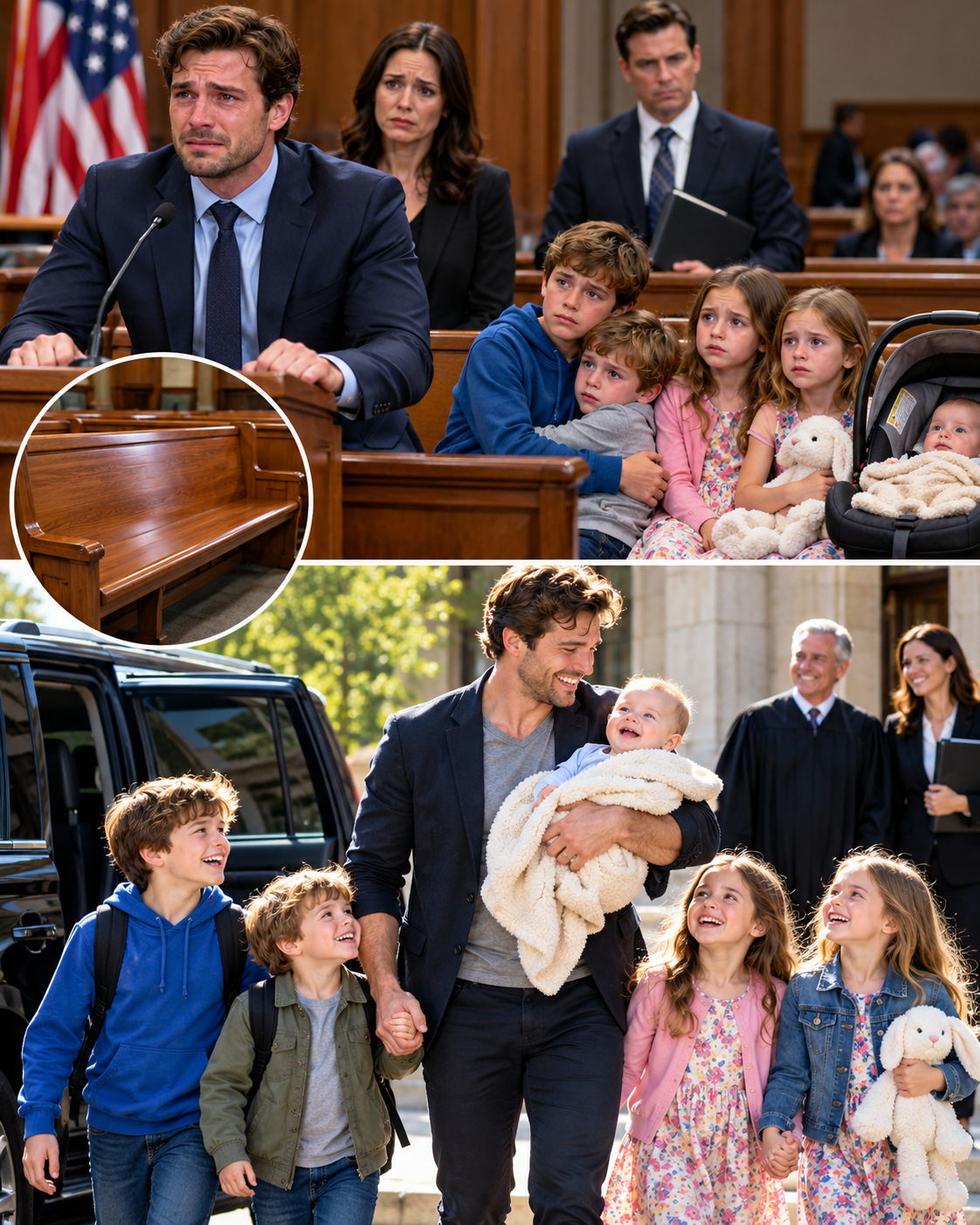
PART 2: THE BOY WHO NEVER STOPPED COUNTING
For several seconds, nobody moved.
I’d imagined revealing my past before.
Usually late at night.
Usually after someone asked an innocent question that came too close to the truth.
In those imaginary conversations, I always spoke calmly.
Like a grown man reporting facts.
But standing before Judge Miller, I wasn’t twenty-nine anymore.
I was seven.
I could almost smell damp wool, floor cleaner, and stale coffee.
I could hear children crying somewhere down a hallway.
Judge Miller placed his glasses on the desk.
“What do you mean?”
I forced myself to breathe.
“I entered foster care when I was seven.”
Rachel stared at me.
So did Hale.
My application had disclosed my time in state care because the county required my complete background.
But the file contained dates, agency names, and placement records.
It didn’t contain what those years had felt like.
Records rarely do.
Judge Miller glanced toward a document.
“I see references to childhood placements.”
“Yes, sir.”
“Were you removed with siblings?”
The word nearly broke me.
Siblings.
I looked toward Noah.
“Yes.”
“How many?”
I closed my eyes.
“Two.”
My voice was quiet.
“My brother was five. My sister was three.”
Noah tightened his arms around Lily.
I continued before fear could silence me.
“There wasn’t a foster home available for all three of us.”
Judge Miller waited.
“So they told us it would be temporary.”
I almost laughed.
It would have been an ugly sound.
“Adults say temporary differently from children. To adults, it means the arrangement can change later. To a kid, temporary means somebody is coming back tomorrow.”
My fingers tightened around the podium.
“No one came back tomorrow.”
The memory returned with terrifying clarity.
I remembered a social worker kneeling in front of us.
Her perfume smelled like oranges.
She explained that my brother and I would be going to different homes.
My little sister was crying so hard she kept hiccuping.
My brother repeatedly asked whether we’d done something wrong.
I was seven.
And I understood only one thing.
If I cried too, there would be nobody left to comfort them.
So I didn’t cry.
Not until much later.
“What happened?” Judge Miller asked.
“We were separated.”
“Did you maintain contact?”
I stared at the wood grain.
“For a while.”
My voice barely carried.
“We had visits.”
I swallowed.
“Then placements changed. People moved. Caseworkers changed. One visit got canceled because someone’s car broke down. Another got canceled because one foster family had an appointment. Then my brother was moved farther away.”
I paused.
“The visits became less frequent.”
The courtroom seemed to vanish.
I remembered cheap visitation rooms.
Plastic toys missing pieces.
A clock ticking above the door.
Every reunion began with excitement.
Every goodbye ended with someone crying.
“My sister was too young to understand why we kept leaving.”
I forced another breath.
“After a while, she’d cry when she saw us because seeing us meant eventually watching us go again.”
Noah looked down.
I wondered whether I should stop.
But after twenty-two years of silence, the truth wouldn’t stay buried.
“By the time I was ten, we weren’t being raised as siblings anymore.”
Nobody interrupted.
“We were three separate foster cases who happened to share a last name.”
My mouth went dry.
“That’s what separation does.”
Hale’s expression had changed.
He didn’t look defeated.
He looked human.
I faced him.
“You were right about me.”
His eyebrows lifted.
“I am inexperienced. I don’t know how to raise five children. I know that.”
My eyes burned.
“But I know what it feels like when adults decide your relationship with your brother or sister is something that can be scheduled for two hours on Thursday.”
I turned toward Judge Miller.
“I know what it feels like to forget the sound of your own sister’s laugh.”
Rachel covered her mouth.
I hadn’t planned to say that.
But it was true.
“Mr. Carter,” Judge Miller said carefully, “are you in contact with your siblings now?”
“No.”
That answer hurt more than anything else.
“My brother and I found each other once when we were teenagers.”
Once.
A hamburger restaurant halfway between our foster homes.
Two teenage boys sitting opposite each other.
Trying desperately to behave normally.
Unable to stop staring at how much the other had changed.
We promised to call.
And for a few months, we did.
Then his number stopped working.
He aged out of the system before I did.
For years, I searched casually enough that I could pretend I wasn’t searching.
I never found my sister.
Maybe she’d changed her last name.
Maybe she was married.
Maybe she lived nearby.
Maybe she was gone.
I didn’t know.
And that uncertainty had become part of the foundation of my life.
Judge Miller leaned back.
“You believe these children remind you of your own siblings.”
“No, sir.”
The answer came immediately.
“No?”
“They remind me of what happened to us.”
I looked toward Noah.
“But they’re not us.”
I needed the judge to understand that difference.
“I know I can’t fix my childhood by taking them home. I know they don’t owe me anything because of what happened to me.”
My voice steadied.
“They don’t have to love me. They don’t have to call me Dad. They don’t even have to like me.”
A quiet sound came from the bench.
Caleb had lifted his head.
For the first time, I could see his face clearly.
“I just don’t want them to lose each other because the system can’t find one house with enough beds.”
Hale slowly stood.
“Your Honor, may I?”
Judge Miller nodded.
Hale approached.
His tone was no longer confrontational.
“Mr. Carter, I appreciate what you’ve shared.”
I nodded.
“But your history raises a concern.”
“I know.”
“Do you?”
He stopped several feet away.
“Children who have experienced trauma can sometimes trigger unresolved trauma in adults. Your identification with Noah, in particular, appears very strong.”
My stomach tightened.
I’d known this question would come.
“Yes.”
“If he rejects you?”
“I stay.”
“If he tells you he hates you?”
“I stay.”
“If he refuses to listen?”
“I stay.”
“If he lies?”
“I deal with the lie.”
“If he destroys something?”
“I deal with what he destroyed.”
“If he tells a caseworker he doesn’t want to live with you?”
That one hurt.
I looked toward Noah.
“Then I listen to why.”
Hale held my gaze.
“What if these children cannot give you the emotional outcome you seem to be seeking?”
“I’m not asking them to heal me.”
“Are you certain?”
“No.”
The courtroom shifted.
Rachel turned sharply toward me.
Hale looked surprised.
I continued.
“I’m certain I don’t want to use them to heal me.”
I drew a breath.
“I’m not certain about much else.”
Judge Miller’s expression softened slightly.
I kept speaking.
“If you want me to tell you I won’t make mistakes, I can’t. If you want me to promise I won’t lose my patience, get overwhelmed, cry in the laundry room, forget a lunch, miss an appointment, or wonder what I was thinking, I can’t promise that either.”
Rachel briefly closed her eyes.
Perhaps it wasn’t the answer an attorney wanted her client to give.
But I was finished pretending I had everything figured out.
“I can promise I won’t disappear because things get hard.”
I looked at Noah.
“I can promise I won’t punish him for being scared.”
Noah stared back.
“I can promise I won’t ask him to be grateful.”
Something changed in his expression.
Almost nothing.
But I noticed.
“And I can promise that if he wakes up tomorrow morning in my house, his brothers and sisters will still be there.”
Lily had stopped crying.
Judge Miller turned toward the caseworker.
“Ms. Harper.”
Denise Harper rose from the second row.
She was the woman who had first told me my plan was unrealistic.
She looked exhausted.
Everyone involved in the case looked exhausted.
“Your Honor.”
“Have the children been told about Mr. Carter’s request?”
“Only in general terms. We did not want to create an expectation before the hearing.”
“Does Noah understand what is happening today?”
Denise hesitated.
“More than we would like.”
Judge Miller looked toward the bench.
“Would speaking to the child be appropriate?”
Hale nodded.
Rachel agreed.
Denise approached Noah.
“Noah?”
He immediately stiffened.
She crouched beside him.
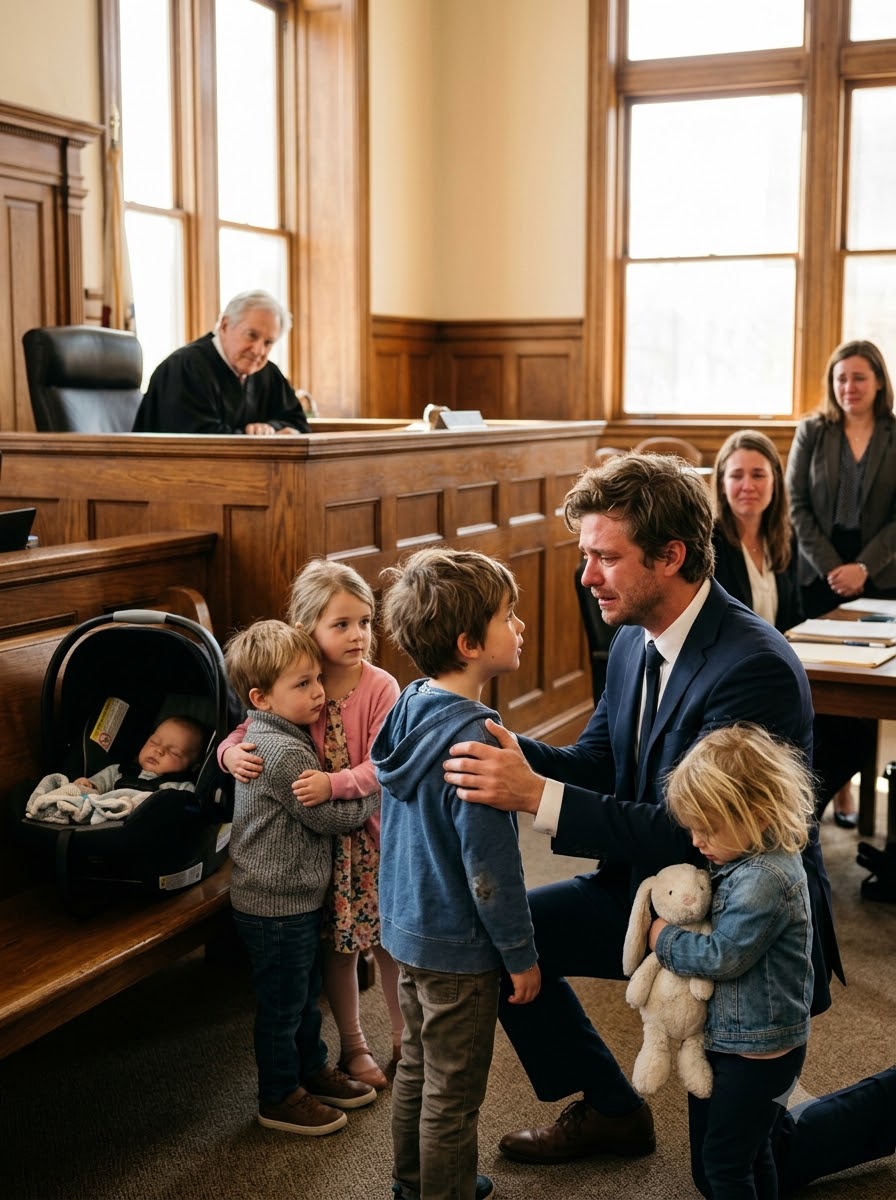
“The judge wants to ask you a question. You don’t have to answer anything you don’t want to answer.”
Noah looked at his siblings.
Then at me.
Then toward Judge Miller.
He stood.
He was so small.
That realization struck me harder than anything else.
From across the courtroom, surrounded by four younger children, Noah had seemed older.
But standing alone, he was simply a six-year-old boy wearing shoes with Velcro straps.
Denise walked beside him.
He stopped at the microphone.
Judge Miller softened his voice.
“Hello, Noah.”
Noah said nothing.
“My name is Judge Miller.”
“I know.”
A few adults smiled.
Judge Miller nodded solemnly.
“I suppose you do.”
Noah gripped the microphone stand.
“I only want to ask you one thing.”
Noah waited.
“What are you most worried about today?”
Every adult already knew the answer.
Hearing it still hurt.
Noah looked behind him.
Caleb.
Lily.
Emma.
Jack.
Then he faced the judge.
“Which one goes first?”
Judge Miller frowned.
“Which one goes first where?”
“In the cars.”
Nobody moved.
Noah’s voice remained quiet.
“If they’re taking us different places, which one goes first?”
Lily started crying again.
Noah’s chin trembled.
“If Jack goes first, Emma will cry. If Emma goes first, Lily will think she’s not coming back.”
He looked toward Caleb.
“Caleb doesn’t talk when he’s scared.”
Caleb immediately lowered his eyes.
Noah swallowed.
“So I should go last.”
My vision blurred.
“Why?” Judge Miller asked, although I suspected he already understood.
“So they don’t see me leave.”
The courtroom seemed to break apart.
Not with shouting.
Not with dramatic noise.
Just the sound of adults struggling to hold back tears.
Rachel turned away.
Denise covered her mouth.
Even Hale looked down.
Judge Miller remained silent for several seconds.
Then he spoke.
“Thank you, Noah.”
Noah nodded.
He turned toward the bench.
Halfway there, he stopped beside me.
He didn’t look at my face.
He studied my hands.
Perhaps he noticed the sawdust still caught near one thumbnail despite how carefully I’d scrubbed that morning.
Perhaps he saw them trembling.
Then he whispered, “Do you really have five beds?”
I couldn’t answer immediately.
“Yes.”
He finally looked up.
“All in the same house?”
“Yes.”
His eyes searched mine.
“Jack too?”
“Jack too.”
Noah nodded once.
Then returned to his siblings.
Judge Miller called a recess.
I walked into the hallway.
I barely made it around the corner before my legs refused to carry me farther.
I sat on a radiator beneath a courthouse window.
Rachel followed.
For a while, she didn’t say anything.
Then she sat beside me.
“You could have told me.”
“I know.”
“I am your attorney.”
“I know.”
She exhaled.
“That was legally relevant information.”
“I know.”
She looked at me.
“Are those the only two words you have?”
I laughed once.
It sounded broken.
“No.”
“Good.”
She waited.
Then asked, “Why didn’t you tell me?”
I looked down the hallway.
“Because if I told you, it became real again.”
Rachel’s expression softened.
“It was already real.”
“I know.”
There were those words again.
She sat quietly.
Finally, she said, “The judge is going to be concerned about unresolved trauma.”
“He should be.”
“The county will probably request additional safeguards if he even considers placement.”
“Fine.”
“Home visits. Therapy. Training. Respite care. Maybe in-home support.”
“Fine.”
“You realize saying fine does not make any of that easy?”
“I don’t need easy.”
Rachel studied me.
“What do you need?”
I looked toward the courtroom.
Through the open door, I could faintly hear Noah counting.
One.
Two.
Three.
Four.
Five.
“I need them not to get in those four cars.”
Twenty minutes later, everyone returned to the courtroom.
Judge Miller entered carrying a yellow legal pad covered in handwriting.
We stood.
Then sat.
He looked toward the county attorney.
Then Rachel.
Then me.
Finally, he looked at the children.
“The court is not going to approve the county’s proposed separate placements today.”
I stopped breathing.
So did Noah.
Hale stood.
“Your Honor?”
Judge Miller raised his hand.
“That is not the same as granting Mr. Carter unrestricted placement.”
My heart pounded.
“The court has serious concerns regarding Mr. Carter’s lack of parenting experience and incomplete licensing process. Those concerns are valid.”
Hale nodded.
“However, the court also finds that sibling separation presents a significant and immediate emotional risk.”
Noah stared straight ahead.
“The county will conduct an emergency final review of Mr. Carter’s home this afternoon.”
I gripped Rachel’s sleeve.
“Subject to approval of that review, I am authorizing a temporary supervised emergency placement of all five children with Mr. Carter for thirty days.”
The words barely registered.
Rachel whispered, “Breathe.”
I couldn’t.
Judge Miller continued.
“Conditions will include frequent unannounced home visits, completion of foster-parent training, trauma-informed counseling for Mr. Carter and the children as recommended, approved daycare, continued case management, and an identified respite provider.”
“Yes, Your Honor,” I said too loudly.
Several people turned.
Judge Miller almost smiled.
“Mr. Carter, I am not finished.”
“Sorry.”
“This is not an adoption.”
“I understand.”
“It is not a reward for your past.”
“I understand.”
“It is not proof that your intentions are sufficient.”
“I understand.”
He leaned forward.
“This is an opportunity to demonstrate that your preparation can become responsible care.”
My throat tightened.
“Yes, sir.”
“If at any point the placement becomes unsafe, the court will reconsider.”
I nodded.
Judge Miller glanced toward Noah.
Then back at me.
“Do not make promises to these children that the law may prevent you from keeping.”
The warning struck deeply.
I remembered all the promises adults had made me.
Temporary.
Soon.
Next week.
We’ll see.
I nodded again.
“I won’t.”
Judge Miller signed the order.
His pen barely made a sound.
But to me, it sounded like four car doors that would never open.
At 4:17 that afternoon, five children arrived at my house.
I’d imagined that moment countless times.
In my imagination, they’d step through the front door and instantly understand that they were safe.
Reality arrived carrying plastic bags.
Their belongings were packed into mismatched grocery sacks and two small suitcases.
Noah held a backpack.
Caleb carried nothing.
Lily clutched a pink blanket.
Emma still had her plastic rabbit.
Jack was asleep.
Denise stood on my porch beside another caseworker, holding enough paperwork to cover my dining table.
Suddenly, my house felt smaller.
“You still sure?” Denise asked quietly.
Noah stood close enough to hear.
His shoulders stiffened.
I looked directly at him.
“Yes.”
Denise noticed.
“All right.”
She carried Jack inside.
The others followed cautiously.
Noah entered last.
My living room looked ridiculous.
I’d prepared far too much.
Board games meant for older children.
A basket overflowing with stuffed animals.
Children’s books.
Three kinds of juice because I didn’t know what they liked.
A whiteboard covered with emergency numbers.
I’d labeled every dresser drawer.
I’d even made wooden name signs for their beds.
Noah.
Caleb.
Lily.
Emma.
Jack.
I’d carved and painted them myself at two in the morning.
Noah noticed the signs.
He didn’t smile.
But he stared at his name for a long time.
The converted workshop opened onto the hallway beside the kitchen.
Once, it had been the loudest room in the house.
A table saw.
A planer.
An air compressor.
A radio.
Now the walls were painted blue.
Two bunk beds stood along opposite sides.
A toddler bed sat beneath the window.
Jack’s crib occupied the corner nearest the door.
I’d worried the room would feel crowded.
The children seemed relieved.
“Whose bed?” Caleb whispered.
It was the first time I’d heard his voice.
I turned toward him carefully.
“You can choose.”
He looked at Noah.
Noah pointed toward a lower bunk.
“That one.”
Caleb walked over.
Lily chose the bed directly above him.
Emma climbed onto the toddler mattress without removing her shoes.
Noah remained standing.
“Which do you want?” I asked.
He pointed to the upper bunk nearest Jack’s crib.
“That one.”
I understood why.
From there, he could see everybody.
I wanted to tell him he didn’t need to keep watch anymore.
But I didn’t.
Trust couldn’t be created by a speech.
Denise reviewed medication instructions, emergency contacts, court conditions, appointments, school forms, and Jack’s feeding schedule.
She talked for nearly an hour.
I wrote everything down.
Twice.
Noah watched me.
At six o’clock, Denise prepared to leave.
The children reacted immediately.
Emma began crying.
Lily grabbed Denise’s coat.
Caleb crawled beneath his bed.
Jack woke and started screaming.
Noah went rigid.
I realized they believed someone was about to take one of them away.
“No one’s leaving with Denise,” I said quickly.
Noah looked at me.
“Nobody?”
“Nobody.”
Denise crouched beside him.
“You’re all staying here tonight.”
“Tomorrow?” Noah asked.
Her eyes flicked toward me.
“Tomorrow too.”
“How many?”
I knew what he meant.
“All five,” I said.
Noah stared at me.
“One, two, three, four, five?”
“One, two, three, four, five.”
His expression changed.
He looked as though he desperately wanted to believe me but was afraid of what believing might cost.
Denise left.
I closed the front door.
Five children turned toward me.
The silence lasted approximately six seconds.
Then everything happened at once.
Jack screamed.
Emma demanded her rabbit, which she was already holding.
Lily announced that she was hungry.
Caleb said he wasn’t hungry.
Noah insisted Caleb was hungry.
I burned the grilled cheese sandwiches.
Jack refused his bottle.
Emma threw peas.
Lily cried because I’d cut her sandwich diagonally instead of “the other way.”
I cut it again.
She cried harder because now there were four pieces.
Noah refused to eat.
“Not hungry?” I asked.
He shook his head.
Caleb glanced toward him.
That was when I noticed something.
Every time I served food, Noah counted the portions.
I placed another sandwich on his plate.
“There’s more.”
He didn’t move.
“Enough for everybody?”
“Yes.”
“Tomorrow?”
The question went straight through me.
“Tomorrow too.”
Only then did he take a bite.
At seven thirty, I attempted bath time.
That was when I discovered five children could produce enough water to flood an entire neighborhood.
Caleb refused to undress while the bathroom door was open.
Lily couldn’t find the pajamas she wanted.
Emma escaped naked and ran down the hallway.
Jack cried whenever I put him down.
Noah insisted he could bathe himself.
I let him.
I waited outside the bathroom door.
“Mr. Carter?”
The name startled me.
“Yeah?”
“Is the door locked?”
“The front door?”
“Yes.”
“Yes.”
“Back door?”
“Yes.”
“Windows?”
“Locked.”
Silence.
Then, “Okay.”
Bedtime started at eight.
It didn’t end until after midnight.
Lily wanted the hallway light on.
Caleb wanted it off.
Emma wanted both.
I had no idea how to accomplish that.
Jack refused to sleep in his crib.
Noah kept climbing down to check on him.
Finally, I sat in a secondhand rocking chair, holding Jack against my chest.
His little body was warm and heavy.
Gradually, his crying slowed.
Noah watched from the top bunk.
“You can sleep,” I whispered.
“I’m not tired.”
His eyes were nearly closed.
“I’ll watch him.”
Noah didn’t answer.
“I won’t leave.”
Still nothing.
“I’ll be right here.”
His eyes opened.
“All night?”
“If I have to.”
“Why?”
I almost answered that taking care of children was what adults did.
But Noah already knew that adults did many different things.
Instead, I said, “Because he needs somebody tonight.”
Noah looked toward Jack.
“So do you,” I added.
His expression hardened.
“I’m fine.”
Six years old.
I’m fine.
The two saddest words I knew.
“Okay.”
I didn’t argue.
Ten minutes later, Noah fell asleep sitting upright against the wall.
At 2:12 in the morning, Lily screamed.
Not cried.
Screamed.
I nearly dropped Jack.
Noah climbed down from his bunk before I could stand.
He moved so quickly that his foot slipped on the ladder.
“Lily!”
She was sitting upright, eyes open but not truly seeing the room.
“No! Mom! Mom!”
Noah climbed into her bed.
“It’s okay.”
“No!”
“I’m here.”
He grabbed her.
She fought him.
I froze.
Every parenting article I’d read disappeared from my mind.
Lily screamed again.
Noah turned toward me.
“Do something!”
The words struck like a slap.
I started to hand Jack to Noah, then stopped myself.
No.
Noah was six.
I kept Jack in my arms.
“I’ve got him.”
“What about her?”
“I’ve got her too.”
I sat beside Lily.
I didn’t touch her immediately.
“Lily.”
She cried.
“Lily, you’re in my house.”
Nothing.
“Caleb is here.”
Her breathing hitched.
“Noah is here.”
Her eyes moved.
“Emma is here.”
Another breath.
“Jack is here.”
She looked toward me.
“All five are here.”
Her face crumpled.
She threw herself against my chest.
I nearly lost my balance.
Then she sobbed into me.
Noah stood beside the bed.
He wasn’t watching Lily.
He was watching me.
Testing something.
I held her until the screaming stopped.
When I looked up, Noah’s eyes were wet.
“You okay?” I whispered.
He wiped his face angrily.
“I told you I’m fine.”
Then he climbed back into bed.
At three, Emma woke.
At 4:15, Jack wanted another bottle.
At 5:30, Caleb wet the bed and cried so quietly I almost missed it.
At 6:12, Noah announced that everyone was awake.
I’d slept forty-seven minutes.
By eight that morning, I understood exactly why Martin Hale had feared the arrangement would collapse.
I stood in the kitchen wearing yesterday’s clothes while cereal softened in five bowls.
Jack was crying.
Emma was crying because Jack was crying.
Caleb had hidden his wet pajamas beneath a towel.
Lily wanted her mother.
Noah was trying to pour milk.
And a thought struck me with terrifying clarity.
I cannot do this.
Not someday.
Not hypothetically.
Right then.
I cannot do this.
Panic pressed against my chest.
Five breakfasts.
Five baths.
Five appointments.
Five separate griefs.
Five children who couldn’t be repaired with wood glue and screws.
I’d built houses.
Roofs.
Cabinets.
Staircases.
Everything I understood had measurements.
If something wasn’t level, you found the error.
If a board warped, you replaced it.
Children weren’t like that.
Grief wasn’t like that.
My hands began trembling.
Then Noah dropped the milk.
The carton struck the floor.
Milk splashed across the kitchen tiles.
He froze.
His expression changed instantly.
It wasn’t frustration.
It was fear.
“I’m sorry.”
I grabbed a towel.
“It’s okay.”
“I’m sorry.”
“Noah, it’s milk.”
“I didn’t mean to.”
“I know.”
His breathing quickened.
“I’ll clean it.”
“So will I.”
“I can do it.”
He reached desperately for the towel.
I held it away.
“You don’t have to.”
His eyes filled.
“I said I can.”
Something in his voice made me stop.
This wasn’t about spilled milk.
I lowered myself onto the floor.
“Noah.”
He stared at the mess.
“Did somebody get mad when things spilled before?”
His jaw tightened.
I immediately regretted asking.
Too much.
Too soon.
Then he whispered, “Mom didn’t.”
I waited.
“Dad didn’t either.”
He looked confused by the question.
“They were nice.”
The past tense cut through me.
Were.
I nodded.
“Okay.”
Noah’s mouth trembled.
“They didn’t want to leave us.”
“I know.”
“You don’t know.”
He shouted.
Lily stopped eating.
Caleb stared.
Noah’s face turned red.
“You don’t know anything!”
I could have defended myself.
I didn’t.
“You’re right.”
The answer surprised him.
“I don’t know what happened to you. I don’t know what your house was like. I don’t know your mom’s voice or your dad’s jokes.”
My throat tightened.
“But I know they didn’t leave because they wanted to.”
Noah’s expression shattered.
He sank onto the kitchen floor.
And for the first time since I’d met him, he cried like a little boy.
Not silently.
Not carefully.
He wailed.
Lily climbed down from her chair.
Then Caleb.
Then Emma.
Soon all four were on the floor.
Jack screamed from his high chair.
Five children crying.
Milk beneath our knees.
Cereal growing soggy.
My kitchen completely out of control.
I sat among them.
And instead of trying to fix everything, I began crying too.
That morning, I understood something I hadn’t learned from any training course.
These children didn’t need a perfect father.
They needed an adult who could stay beside them when nothing was perfect.
And I was only beginning to learn how to become that person.
