

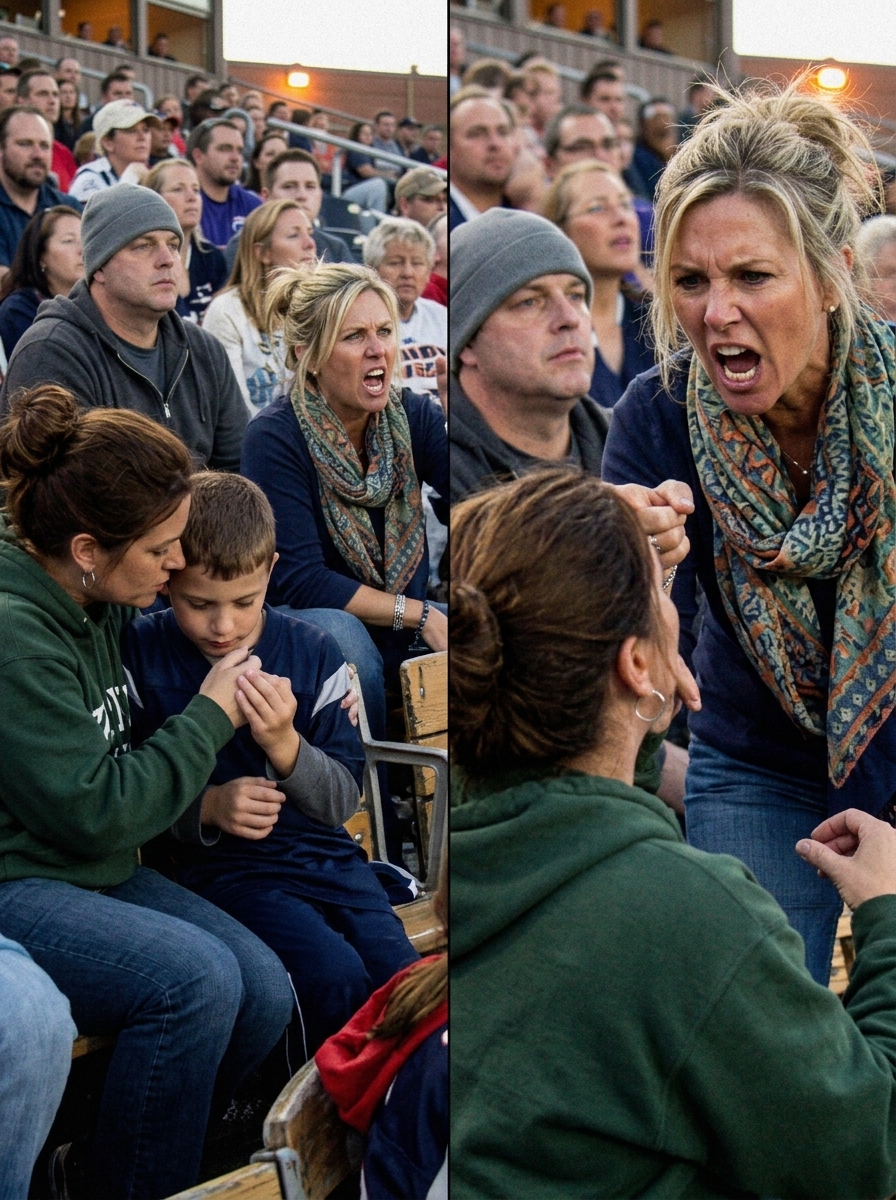
At a sold-out championship game, one mother and her quiet son drew attention for all the wrong reasons. Then an intoxicated spectator told them to leave, and her emotional response shifted the atmosphere of an entire stadium section within moments.
My husband and I have always brought our boys to football games. That has always been our family tradition.
Some families take vacations by the ocean or wear matching pajamas every Christmas morning.
We have stadium snacks, freezing metal seats, overpriced foam fingers, and the kind of shouting that makes your voice disappear the next day.
Our sons grew up believing that a Saturday night beneath stadium lights was just as ordinary as eating dinner together.
So when we managed to get four tickets to the championship game, my husband Dean reacted like he had just hit the jackpot.
“Section 112,” he said, holding the tickets up in the kitchen.
“Great view, close enough to feel the energy, but not so close that someone dumps beer on us.” He said it like that was a rare achievement.
When kickoff arrived, the stadium came alive. Thirty thousand people filled the concrete and steel, creating a wave of noise, movement, and excitement.
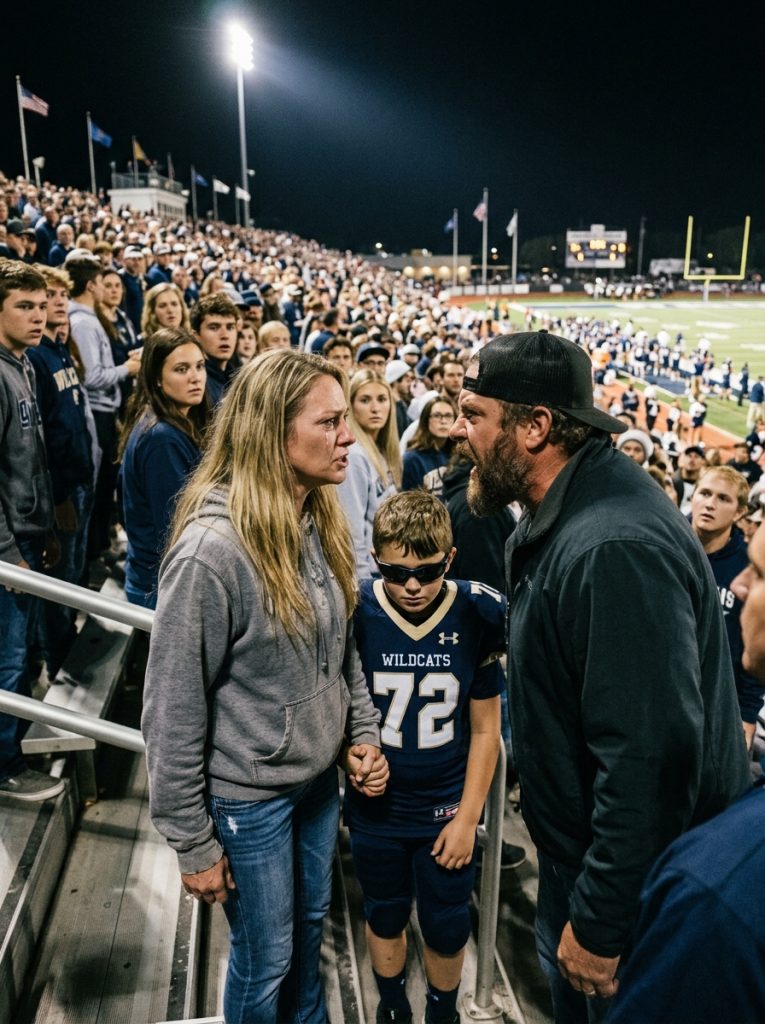
The lights were so intense that the field almost looked unreal, like it belonged on a television screen.
Music exploded between plays. Strangers celebrated with each other like old friends. My younger son could barely sit still because he was so excited.
That was when I noticed the woman and the little boy a few rows ahead.
At first, it was simply because they seemed completely different from everyone around them.
People nearby were standing, waving their rally towels, and screaming toward the field. But the boy remained perfectly still, his hands resting together in his lap and his shoulders pulled inward.
He looked around nine or maybe 10 years old. He wore dark sunglasses even though the stadium lights were shining brightly above and the sky was already completely dark.
He never looked at the massive screen.
He never responded to the cheering crowd.
He only sat there with his head slightly lowered, almost as if he was hearing something the rest of us couldn’t.
His mother sat close beside him, leaning over every few moments to whisper into his ear.
Not occasionally.
Constantly.
And with her other hand, she continued drawing small patterns into his palm.
Again and again.
At first, I wondered if he had sensory challenges. Then I thought maybe the noise overwhelmed him. Maybe she was helping him stay calm through a familiar routine.
Whatever the reason, I found myself unable to look away.
Dean noticed.
“What?” he asked while eating his hot dog.
I nodded toward them. “That little boy.”
Dean looked over. “Hmm.”
“Do you see what she’s doing?”
He watched for about ten seconds. “I see, but I don’t understand what they are doing.”
I looked at him. “Likewise, I hope they are okay.”
The woman never truly watched the game.
She would briefly glance toward the field, then immediately lean back toward her son and whisper while continuing those small patterns across his palm.
I looked around and realized I wasn’t the only person who had noticed them.
A man sitting two seats away from them had been drinking since we arrived.
You could tell from the way he reacted half a second late to every play and applauded far longer and harder than anyone else after exciting moments.
He was large, wide in the shoulders, flushed in the face, and becoming more annoyed with every passing minute.
At first, he only mumbled.
“Why even come if you’re not gonna watch?”
Then his voice grew louder.
“Some people who actually wanted to watch the game could have taken those seats.”
His friends tried to calm him down once or twice, but he had already chosen who he wanted to blame.
By the middle of the second quarter, he was staring directly at the woman every time she leaned toward her son.
The game was intense, messy, and stressful, the kind where every mistake makes people feel personally offended.
Our entire section felt the pressure. So did he.
Then the woman whispered again during an important third down, and he finally lost his patience.
“Hey!” he shouted.
Several people turned around.
The woman froze but didn’t face him.
He stood.
“Lady! Can you shut up?” he yelled. “Some of us are actually here to watch the game, not listen to you babble all night.”
The people nearby immediately became uncomfortable.
Some acted like they hadn’t heard anything, the way crowds often do when they hope a confrontation will disappear without anyone having to step in.
The woman flinched at the harshness of his voice.
But she said nothing.
She simply looked back at the screen, reached for her son’s hand again, and continued tracing patterns in his palm.
The man let out a cruel laugh. “Oh, so now you’re ignoring me, too?”
Dean was already standing beside me, ready to stop the situation from getting worse.
I placed a hand on his arm. “Go.”
He quickly started moving down the steps, but the drunk man was even quicker.
He stepped into the row and towered over the woman and her son.
“I’m talking to you,” he shouted. “If you can’t behave like everyone else, then leave.”
The boy flinched at that. Not in some dramatic way. Just enough for me to notice fear pass through him. His hand gripped his mother’s fingers tighter.
That was when she stood.
She wasn’t tall or intimidating.
She was just an exhausted-looking woman wearing a gray sweatshirt and jeans, placing herself between her child and an angry man who was at least 70 pounds heavier than her.
There were tears in her eyes.
And then she did something that made the entire section go silent.
She turned completely toward him, wrapped one arm around her son, and said in a trembling voice, “My son cannot see the game.”
It wasn’t shouted.
But in that sudden moment of silence, every person nearby heard her.
The man blinked, clearly caught off guard.
Before he could respond, she continued.
“He lost most of his vision three months ago,” she said. “He is having surgery at 6:30 tomorrow morning. They don’t know if it will work.”
The entire section seemed to grow quieter.
She went on, “They don’t know if this is his last night in darkness or the first night of the rest of his life.”
I felt my eyes fill with tears as she finally revealed the truth.
She placed a hand on her son’s shoulder. “His father loved this team more than anyone I have ever known, and he died last winter before he could bring him here.”
Her lips trembled, but she still lifted her chin.
“So I am describing the game to him the only way I know how, so he can feel close to his dad.”
“I am not deliberately trying to ruin your night,” she said. “I am trying to give my son one good memory of his father before the surgery tomorrow.”
A man sitting beside my boys suddenly stood and spoke loudly.
“She is not lying. My cousin’s daughter is deafblind. They do tactile signing. Not exactly like that, but similar.”
The woman’s explanation, along with the man’s words, hit me deeply.
Because suddenly, what had seemed unusual now looked personal.
Necessary.
Like a language created from love and urgency.
And after seeing it, I couldn’t look at it the same way again.
Sadly, not everyone in Section 112 had tried to understand before judging.
The large man who had confronted the woman only stared at her.
The anger was gone.
What replaced it was shock, followed by a slow, painful realization of shame.
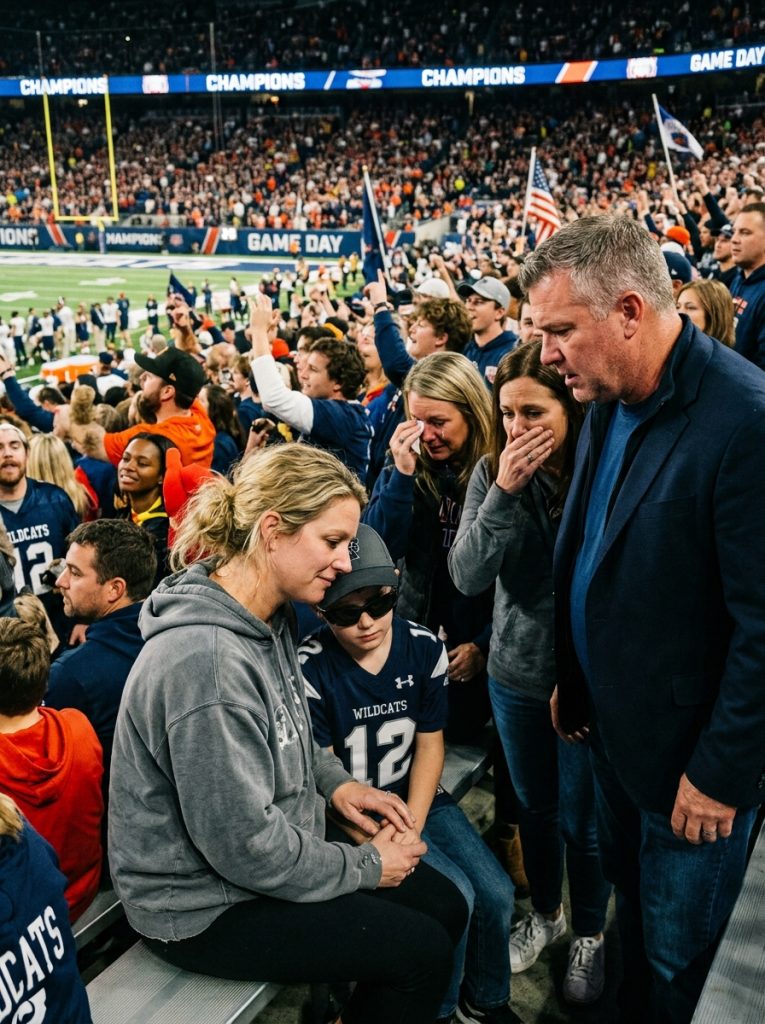
The little boy reached out, searching, and found the sleeve of his mother’s sweatshirt.
“Mom?” he whispered.
Her entire expression softened instantly. She turned toward him and pressed his hand against her cheek.
“It’s okay, baby,” she said. “It’s okay.”
By then, Dean had reached them, but there was no longer anything he needed to do.
Nobody did.
The man who had been shouting moments earlier looked like he wished he could disappear.
He lowered himself heavily into the empty seat beside the aisle.
Then he covered his face with both hands and said quietly, almost impossibly soft compared to before, “Oh my God.”
He looked back up at her.
“Ma’am,” he said, his voice breaking, “I am so sorry.”
She didn’t respond.
I don’t think she had any words left.
But my older son, who had followed Dean halfway down the steps because 14-year-old boys often believe they are emergency backup, looked at me with tears already forming.
His expression showed exactly what everyone in the section was feeling.
We were all affected.
A woman behind me leaned forward and asked, “Do you want us to quiet down?”
The boy’s mother quickly shook her head.
“No. No, please don’t. He liked to hear the cheers, groans, and celebrations.”
An older man wearing a team jacket called down, “What’s his name?”
She wiped beneath her eyes.
“Eli.”
The whole section seemed to breathe again after hearing that name.
I stood and walked down the row before I even had time to think about it.
“Hi,” I said softly when I reached her. “I’m Lana. Do you mind if I sit here for a second?”
She looked overwhelmed, but she nodded.
Up close, she looked even more tired than I had first noticed. The kind of exhaustion that comes from carrying too much for too long.
Her son sat pressed against her side, his sunglasses reflecting the bright stadium lights like two small dark mirrors.
“I’m Paula,” she said.
“Eli,” I said gently, “I’m right here with your mom.”
He turned his face toward where my voice came from.
“Are they winning?” he asked.
That question almost broke me.
I laughed through my tears and answered, “Not enough yet.”
For the first time, a tiny smile appeared on his face.
Then the drunk man stood again, but this time slowly, as though he finally understood the seriousness of what he had done.
“Can I…” He paused and swallowed. “Can I buy the boy whatever he wants? Food, jersey, anything? I know that doesn’t fix—”
Paula looked at him.
For a moment, I thought she might tell him exactly what she was feeling.
Instead, she simply said, tired but sincere, “He likes pretzels.”
The man nodded quickly.
“Pretzels. Got it.”
Then he walked away almost immediately.
Dean came over and crouched beside Paula’s seat.
“Need anything? Water? Space? Someone to keep people back?”
She gave him a weak smile.
“No. Thank you.”
Then she looked at me and said something that made the moment even heavier.
“I almost didn’t bring him.”
I asked, “Why did you?”
She looked down at Eli’s hand resting in hers.
Her thumb gently moved across his knuckles, like touching him was the only thing keeping her steady.
“Because he wanted to feel closer to his dad on the eve of his big surgery,” she said.
For a moment, I couldn’t say anything.
Dean looked away and rubbed his jaw.
Then Paula continued.
“My husband used to do play-by-plays in the living room for both of us. Like he thought he was on the radio.”
She gave a small, broken laugh.
“He’d yell at the TV and then explain every single thing Eli couldn’t quite follow. Tonight I just wanted to do it as well as his father would’ve.”
Right then, the man returned carrying a huge pretzel, two bottles of water, and what looked like every candy choice available at the concession stand.
Eli smiled when Paula placed the warm pretzel in his hands.
“Is it salted?” he asked.
The man, still looking like a child who had been corrected, replied, “Extra salted, buddy.”
Eli nodded seriously.
“Good.”
That was the first laugh our section had shared since the argument began.
After that, people started helping quietly, without turning it into a spectacle.
A college student across the aisle pulled out his phone and raised the brightness so Paula could see her own hands more clearly while signing into Eli’s palm.
The older man in the team jacket began softly explaining changes on the field whenever things became too chaotic.
My younger son decided he was part of the official communication crew and whispered, “Big run coming.”
And Paula continued translating everything for Eli.
“Quarterback drops back.”
“Ball goes left.”
“Everyone is yelling because he almost made it.”
“Now they’re all standing.”
Sometimes she whispered into his ear.
Sometimes she signed into his palm.
Sometimes she did both.
At halftime, Rick returned.
This time, he was calm.
He stood in the aisle and cleared his throat.
“My name’s Rick,” he said. “And I was out of line. Way out of line.”
Nobody spoke.
He looked at Eli, then at Paula.
“My son had surgery last year. To fix his leg. But I remember the night before.”
His voice shook.
“I remember thinking that if anyone so much as breathed wrong near him, I might lose my mind. And then I stood here and did exactly that to you. I’m ashamed of myself.”
Paula’s eyes filled again, but she gave a small nod.
Rick looked relieved just to be forgiven.
Then my husband, who has always believed every problem has a practical solution, asked the question everyone needed answered.
“What hospital?”
Paula hesitated.
“St. Vincent’s.”
“What time?”
“Six-thirty check-in. Surgery at eight.”
The woman behind me asked, “Do you have family coming?”
Paula gave a quiet laugh with no humor.
“No. It’s just us.”
“What about aftercare?” I asked.
That question changed her expression.
“It’ll be fine,” she answered too quickly.
Dean and I exchanged a glance.
That was the silent message married parents understand: there was clearly more behind those words.
So I asked gently, “What does ‘fine’ mean?”
Paula looked uncomfortable, which told me enough before she even answered.
“It means I used the last of our savings to cover our insurance gap so the surgery wouldn’t be delayed another month.”
She let out a tired breath.
“It means I’m supposed to take unpaid leave during recovery, and I haven’t figured out how bills and medicine will be handled during that time.”
There it was.
The burden underneath everything.
Not only the fear of surgery.
The fear of everything afterward.
The appointments, medication, missed work, rent, groceries, and all the small expenses that suddenly become overwhelming during a crisis.
And surprisingly, Rick was the first person to move.
He turned toward the section and said loudly, “We can’t let her handle all that on her own. I’m sure we can help.”
I wouldn’t say Section 112 instantly became perfect people.
But sometimes people become better when they finally understand what someone else is carrying.
The college student already had his phone out.
“I can set up a fundraiser.”
He added, “Then the funds can handle the after-surgery care. I’ll share the link for anyone who wants to contribute.”
Someone else said, “I have cash. I can give my contribution right now.”
Dean said, “Do it.”
Rick pulled out his wallet and placed a hundred-dollar bill into my hand.
“Start there.”
An older woman two rows behind us said, “I’ll match it.”
A man wearing a team beanie added, “I’m putting down fifty.”
Then someone farther up called out, “A hundred from us.”
Within minutes, people throughout the section were passing around phones, cash, Venmo names, and email addresses like we were organizing a fundraiser instead of watching a championship game.
Paula kept repeating, “You don’t have to do this.”
And everyone kept responding with some version of:
“We know.”
Then my son did something I know I will remember forever.
He asked Paula for a picture of Eli and his father from a previous game, and she sent it to him.
I wondered what he was planning, but I was too focused on helping with the fundraiser.
A few minutes later, I realized he had taken the photo to the commentators with a special request.
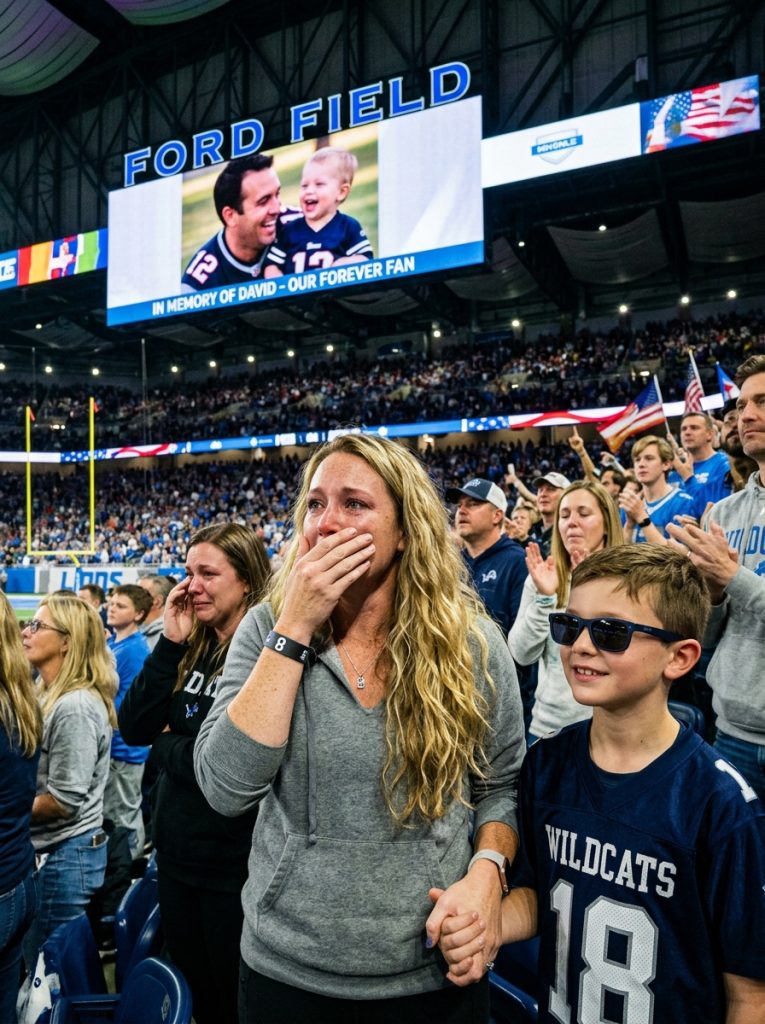
When the massive screen switched to a “fan memories” segment between plays, our entire section became emotional.
A picture appeared of a man carrying a little boy on his shoulders at an earlier game, both of them wearing team jerseys.
Paula made a quiet sound beside me when she saw the image of her husband and Eli.
The caption underneath read: “For Mark, forever part of the crowd.”
The entire stadium erupted in cheers, unaware of the true meaning behind that moment.
But our section understood.
Paula covered her mouth.
Eli turned toward the sound and asked, “Mom? What happened?”
She took his hand and slowly traced each word into his palm, more carefully this time, making sure he felt every letter.
“They put Daddy on the screen,” she whispered.
Eli became completely still.
Then he smiled.
A small, gentle smile that somehow brought tears to every adult watching.
Rick openly cried.
By the fourth quarter, the fundraiser had reached far beyond Section 112.
Someone shared the story online, and then a popular social media account reposted it.
A local sports page shared the photo of Eli and his father with the caption: “Section 112 showed what fandom really looks like tonight.”
The donations came in faster than the college student could refresh the page.
By the time the game ended, there was enough money to help with her time away from work, medication, transportation, follow-up appointments, and more.
When I told Paula the amount, she simply stared at me.
“That can’t be real.”
Dean showed her the screen.
It was real.
She sank back into her seat and cried as Eli held the pretzel in one hand and reached toward her with the other.
As we were leaving, Rick stopped them one final time.
“I know I don’t deserve this,” he said, his voice trembling, “but if you need rides this week, meals, somebody to sit with you at the hospital, whatever, I’m local. Here’s my number.”
Paula accepted it.
Not because everything had suddenly become perfect.
But because maybe something had shifted that night, and for a brief moment, she could allow herself to believe that people could still be kind.
As we walked out with the crowd, my younger son pulled on my sleeve.
“Do you think Eli will be okay?”
I looked back one more time.
Paula was kneeling in front of him near the stairs, holding his face gently in both hands and saying something only he could hear.
I thought about how she had turned an entire football game into something he could experience through her hands, because she refused to let fear become the strongest memory he carried into surgery.
Then I answered, “I think whatever happens, he won’t be facing it alone.”
The following afternoon, Dean sent me a text from work with a screenshot.
Paula had posted an update from the hospital.
Surgery went well. He is resting. Thank you, Section 112.
I sat in my car outside the grocery store and cried.
A drunk spectator had almost taken away Paula and Eli’s special night.
Instead, an entire section of strangers chose to become the kind of memory a frightened little boy could carry with him through the hardest moments and beyond.
And I still think about Paula’s hand moving across his palm.
She signed beneath those bright stadium lights, turning sounds into something meaningful.
Her son couldn’t see the game, but she still found a way to let him experience it, because she wanted him to feel connected to the father he missed.
It was their final game together before he had the chance to see the world again.
To see what his father loved.
To remember him.
To feel close to him through the game, even though he was gone.
Here is the question that stays with me: Do you think people are too quick to judge things they don’t immediately understand, especially in public places like stadiums?
If this story touched your heart, here’s another one you might love: I found an old phone in a taxi and planned to return it without ever unlocking it. Then the screen lit up, the last saved video started playing, and a little girl lying in a hospital bed looked into the camera and said, “Hi, Daddy…”
