

PART 2, THE LITTLE BROTHER IN THE WINDOW
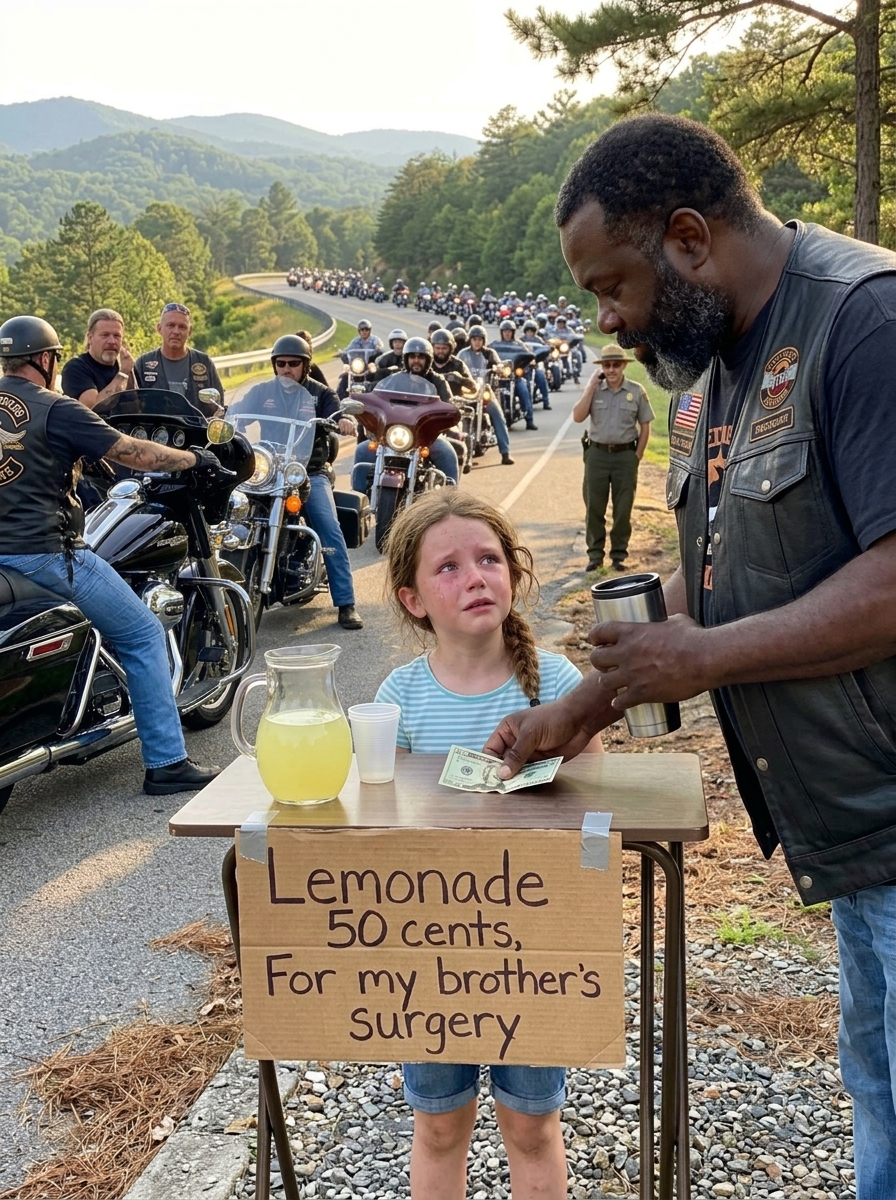
Before the motorcycles came, Emma’s world had become smaller than any eight-year-old’s world should be.
It had shrunk to doctor visits, whispered phone calls, pill bottles lined up behind the kitchen sink, hospital parking stickers on the refrigerator, and the sound of her mother trying to cry quietly in the bathroom while the fan was running.
Emma was not the kind of child who asked big questions in front of adults. She watched first. She listened through walls. She noticed when her mother cut her own dinner smaller so Noah could have more. She noticed when Grace opened an envelope, went very still, then folded it back into the stack without reading it out loud.
Noah was not dying that week, and Grace was careful never to use words that would make Emma think that. But he was sick enough that normal childhood had to make room for fear. He had a congenital heart condition that doctors had been monitoring since he was a baby. There was a surgery coming, one the doctors believed could help him live with more strength, more breath, more days where climbing the porch steps would not leave him pale and shaking.
Insurance covered part of it. Part of it became forms, deductibles, travel costs, missed shifts, medicine, follow-up visits, and numbers that made Grace’s face look older than thirty-four.
Emma did not understand the details.
She understood her brother got tired walking to the mailbox.
She understood he could not always play tag.
She understood her mother said, “We will figure it out,” in a voice that meant she had no idea how.
So Emma made a plan.
She took a notebook from school and wrote “Ways to Help Noah.” The first idea was selling drawings. The second was washing cars, until Grace explained that eight-year-olds should not offer to wash strangers’ cars by themselves. The third was a lemonade stand, because Emma had seen one in a cartoon where a child made lots of money in one afternoon and everyone looked proud.
Grace wanted to say no.
Not because the idea was wrong, but because she knew how cruel the world can be when hope is sitting on a folding table with paper cups and a hand-colored sign. But Emma had already drawn lemons around the edges of the page, already counted the cups in the pantry, already asked if Noah could sit at the window and be the manager. Saying no felt like taking away the one thing Emma believed she could do.
So Grace helped.
They bought lemons with grocery money Grace pretended she could spare. They found an old glass jar and taped a paper label to it that said “Noah’s Surgery Fund.” Emma practiced saying, “Lemonade is fifty cents, thank you,” in the bathroom mirror until she sounded confident enough to scare herself.
Noah watched from the couch while she made the sign.
He said, “What if nobody buys it?”
Emma answered quickly, “Somebody will.”
But by midafternoon, even she was starting to doubt it.
PART 3, THE STREET THAT KEPT DRIVING BY
I was across the street when all this happened.
My name is Linda Carver, and I had lived on Maple Street for twenty-two years by then, long enough to know which families fought with windows open, which men overwatered their lawns, which children learned to ride bikes too fast, and which mothers carried more than they admitted.
Grace Turner had moved in two years earlier, after her divorce, with Emma, Noah, a used sedan that always needed something, and a kind of quiet dignity that made it hard to offer help without making her feel cornered.
People liked Grace.
That was the sad part.
They liked her in the way people like struggling women from a distance. They waved. They asked how Noah was doing if they had time. They clicked heart reactions on posts about hospital appointments. They said things like, “Let us know if you need anything,” which sounds generous until the person in need has to become brave enough to ask.
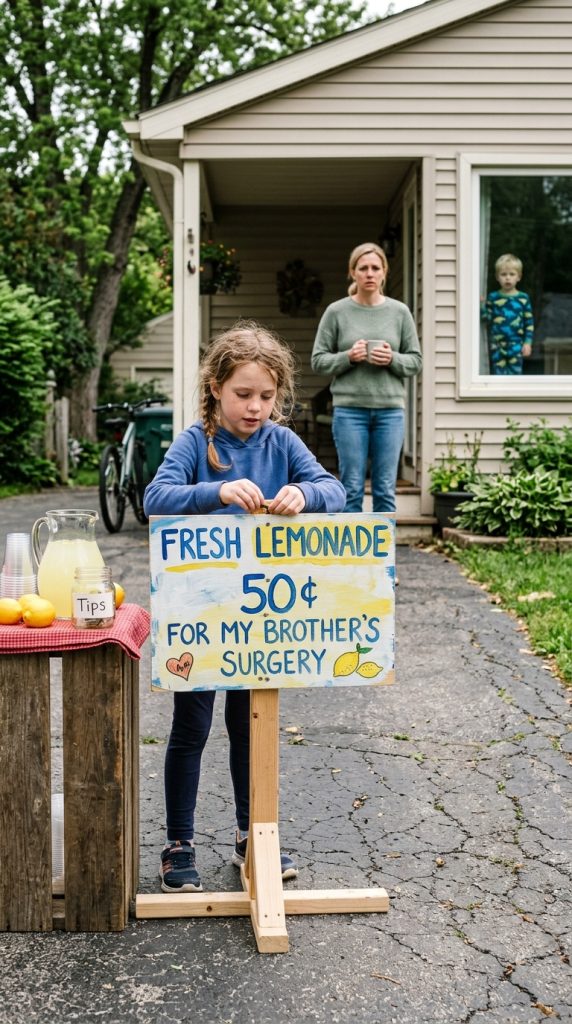
That Saturday, Emma’s lemonade stand sat at the end of their driveway under a beach umbrella that leaned to one side. Noah had helped decorate the sign by drawing a green dinosaur holding a lemon, which made Emma laugh so hard she had to start that part over. Grace set a cooler beside the table and told Emma to come inside if she got too hot. Emma saluted like a soldier.
At first, it was sweet.
The mail carrier bought a cup and made a big show of saying it was the best lemonade on his route. Mrs. Albright from the corner paid a dollar and told Emma she was doing a wonderful thing. Emma wrote the total in her notebook, $1.50, then underlined it twice.
After that, the day stretched.
A white SUV slowed down, then kept going. A jogger smiled and pointed at his earbuds as if lemonade required hearing. A man in a pickup looked straight at the sign, then away. Two teenage boys on bikes stopped long enough to read “For my brother’s surgery,” then one of them laughed awkwardly and said, “That’s depressing,” before they rode off.
Emma pretended not to hear.
Grace heard.
I heard.
Sometimes cruelty is not a shout. Sometimes it is a careless sentence dropped near a child and left there.
By 3 p.m., the pitcher was still mostly full. Emma had started wiping the same spot on the table over and over with a napkin. Every few minutes, she looked toward the front window where Noah sat with his chin on the sill, watching her like she was doing something enormous.
That was what broke me.
Noah still believed in her.
Emma kept standing there because he did.
I was reaching for my purse, already ashamed I had not gone sooner, when the sound came from the far end of the street.
Low engines.
Many of them.
Not wild.
Not careless.
Steady.
The kind of sound that makes every curtain move before anyone admits they are looking.
PART 4, THE BIKERS WHO READ THE SIGN
The motorcycles belonged to the Iron Hollow Riders, a club that most people in our town knew only by noise and leather.
That was unfair, but people are often lazy with first impressions. They saw big men, big bikes, tattoos, skull rings, black vests, and women who looked like they would not tolerate foolishness, then decided the group must be trouble. In truth, they had raised money for veterans, escorted funeral processions, delivered winter coats, fixed ramps for disabled neighbors, and shown up for more quiet emergencies than anybody ever put in the newspaper.
That afternoon, they were not even supposed to be on Maple Street.
They had been riding back from a charity breakfast at the VFW when Denise “Mama D” Carter, a fifty-six-year-old Black American woman with deep brown skin, silver braids, reading glasses, a denim shirt, heavy boots, and a black leather vest, saw Emma’s sign from the back of a sidecar. She tapped Caleb’s shoulder at the stop sign and pointed.
Caleb turned his head.
He saw the crooked blue letters.
Lemonade, 50 cents.
Then the smaller line.
For my brother’s surgery.
Then the little girl standing behind the table with a smile that had clearly been used up hours earlier.
Caleb raised his hand.
The whole line slowed.
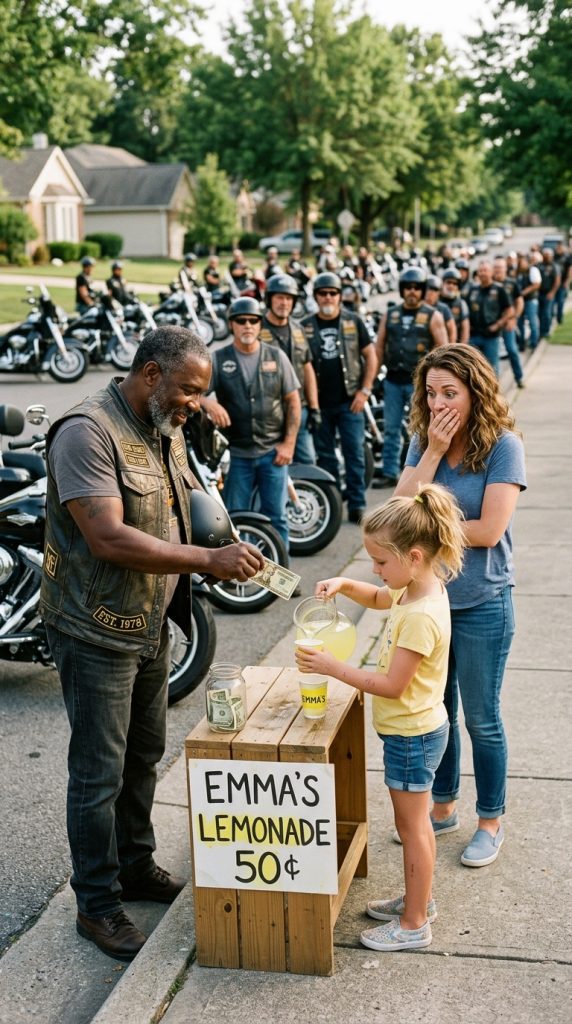
Now, I need to be clear about something. Forty motorcycles stopping near a child’s lemonade stand could have looked terrifying if handled badly. Caleb knew that. He had rules for his club, especially around kids. No revving. No crowding. No touching. No photos without a parent’s permission. No making a child feel like a spectacle. They parked along the curb, engines off one by one, leaving space around the driveway so Emma could still breathe.
Grace came off the porch quickly.
She was not rude. She was scared. Any mother would be, seeing forty leather-vested strangers roll up to her child’s table.
Caleb stopped several feet away and held both hands visible.
“Ma’am,” he said, “we just want to buy lemonade, if that is okay.”
Grace glanced at the group.
Men and women. White, Black, Latino, older, younger, gray-bearded veterans, female riders, mechanics, nurses, one retired teacher, one man holding a helmet covered in stickers from hospitals and toy drives. They looked rough, yes. They also looked oddly careful.
Emma looked at Grace.
Grace looked at the sign.
Then she nodded.
“One at a time,” Caleb told his riders.
That was how it began.
Caleb stepped up first.
Emma straightened.
“Lemonade is fifty cents.”
Caleb placed a twenty-dollar bill on the table.
Emma pushed it back.
“Sir, that is too much.”
He looked at her very seriously.
“Miss Emma, I have ridden through gas station coffee in three states. If this lemonade is cold and made with real lemons, twenty dollars is a fair market correction.”
Emma stared at him.
Denise snorted behind him.
Grace covered her mouth.
Emma poured the cup, hands trembling slightly, and passed it to him.
Caleb took one sip and nodded like a judge at a county fair.
“Worth every penny.”
The first real smile of the day crossed Emma’s face.
PART 5, FORTY CUPS
After Caleb, Denise bought a cup.
She paid twenty dollars too.
Then came Marcus Bell, a fifty-nine-year-old Black American rider with deep brown skin, a gray beard, broad shoulders, and a laugh that made small children trust him faster than adults did. He bought one cup and asked Emma if refills counted as separate business transactions. Emma looked at him suspiciously until he placed another twenty on the table and said, “I respect entrepreneurs.”
Then came Hank Porter, a sixty-three-year-old white American biker with fair skin, a bald head, a white beard, tattooed arms, and boots older than some of the motorcycles. He was so large that Emma had to tilt her head back to see his face. He placed twenty dollars in the jar and whispered, “Best lemonade I have had since 1978.”
Emma asked, “What happened in 1978?”
Hank said, “I do not discuss my emotional lemonade history with strangers.”
Emma laughed.
The sound reached the house.
Noah lifted his head from the window.
Grace turned and saw him smiling.
That was when her face broke.
One by one, the riders came.
A forty-eight-year-old Latina American rider named Marlene Torres bought a cup and asked for extra lemon pulp because she said fancy restaurants charged more for texture. A fifty-two-year-old white American woman named Claire Doyle, gray-blond hair under a helmet, bought two cups, one for herself and one for the “spirit of small business.” A forty-five-year-old Asian American man named Ben Park, tan skin, dark hair, leather jacket, and gentle eyes, paid twenty dollars and told Emma his daughter had run a cookie stand once and fired him as assistant manager for poor display skills.
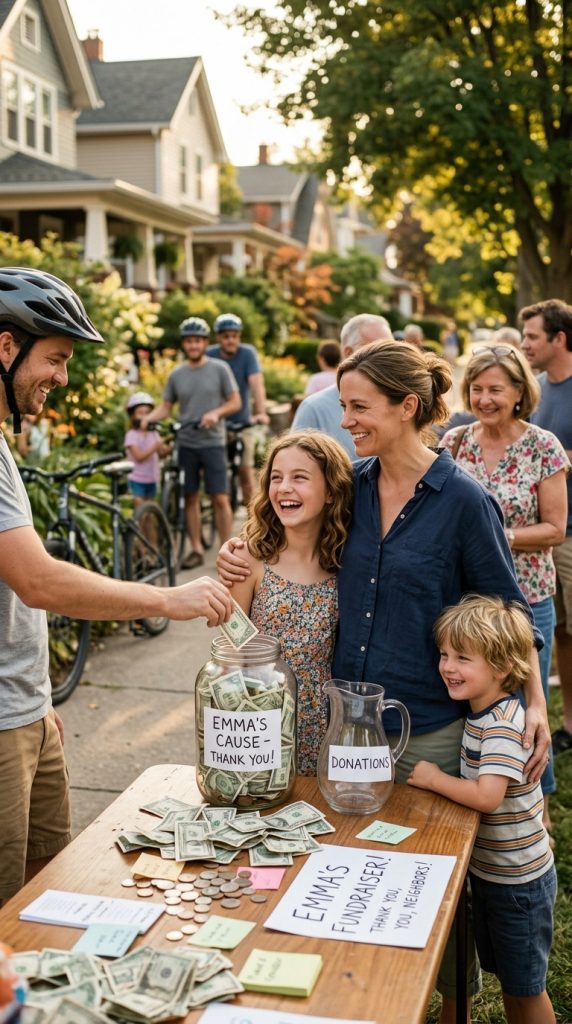
Emma started writing totals in her notebook but gave up after the jar passed two hundred dollars.
The pitcher emptied.
Grace ran inside to make more.
Then Linda from across the street, meaning me, finally stopped being useless and brought over a second pitcher of lemonade from my fridge. Mrs. Albright brought ice. Another neighbor brought cups. Someone brought folding chairs. The bikers stayed in a loose half circle, not surrounding Emma like a wall anymore, but standing like a crowd at a tiny grand opening.
Cars began slowing down.
This time, people stopped.
A man who had driven past earlier parked and bought a cup. A woman walking her dog bought two. The teenage boys who had laughed came back, faces red, and put crumpled dollar bills in the jar without saying much. Emma thanked them anyway because children can be more gracious than adults deserve.
At some point, Noah came to the doorway.
He leaned against Grace’s leg, pale and tired in his dinosaur pajamas, but smiling.
Emma saw him and shouted, “Noah, we’re rich!”
Everybody laughed.
Then Caleb looked at the small boy in the doorway and went quiet.
Not sad exactly.
Focused.
He walked to Grace, staying respectful, and lowered his voice.
“Ma’am, may I ask what kind of surgery?”
Grace hesitated.
Then she told him.
And the afternoon changed again.
