


PART 1 — THE WARNING SHE HAD STRUGGLED TO GIVE ME
My daughter opened her eyes after four months in a coma. I had imagined that moment so often, but nothing had prepared me for what she would say. She did not ask where she was or how long she had been lying there. Instead, she whispered words that sent a chill through my entire body. “Mom, he knows I found everything.” I bent toward her, keeping her shaking hand between mine. “Emily, sweetheart, what are you talking about?” She tried to bring my face into focus, struggling with an effort that made me lean closer.
“The safe… behind the painting. Don’t let Daniel find out.” Her voice was faint, but the warning was unmistakable. Before I could understand what she meant, she said something even more frightening. “He wasn’t trying to help me.” Then the heart monitor sounded an alarm. Doctors and nurses rushed to her bedside, and I was asked to leave the room. I stepped into the hallway with her words still turning over in my mind, unable to separate the joy of hearing her speak from the fear of what she had told me.
Emily’s husband, Daniel Whitmore, stood farther down the corridor. He wore an expensive navy suit and a luxury watch, with the same carefully arranged expression of concern I had watched him display for four months. “What happened?” he demanded. “Emily woke up,” I replied. His face changed at once. I had expected relief, perhaps disbelief followed by happiness. Instead, what crossed his features looked disturbingly like fear. After all those months of waiting, that reaction was almost as unsettling as my daughter’s whispered warning.
Patricia, his mother, appeared behind him. “That can’t be right,” she said sharply. “They told us she might never regain consciousness.” Daniel immediately reached for his phone. I watched him and understood that Emily’s words could not simply be dismissed as confusion after a long unconsciousness. She had been trying to tell me something she was afraid he would discover. Whatever she had found before her injury still mattered now. And the two people who should have welcomed her awakening seemed shaken by it.
Four months earlier, Emily had been discovered unconscious at the bottom of the marble staircase in the mansion she shared with Daniel. He said she had drunk too much wine, slipped, and suffered a terrible fall. I had never felt entirely persuaded by that explanation. My daughter was thirty-five, successful in her work as a financial consultant, and rarely drank alcohol. His account had always been difficult to reconcile with the daughter I knew, especially when I remembered the telephone call she had made the afternoon before everything changed.
“Mom, I need to tell you something about Daniel,” she had whispered. “Something really bad.” Before she could explain, I heard someone come into the room. Her voice grew hurried. “I’ll call you tomorrow.” I waited for a call that never came. The following evening, I learned instead that she had been taken to the hospital with a serious head injury. The conversation she had promised to finish remained unfinished through every day that followed. Now, hearing her speak about a hidden safe, I could not stop remembering how abruptly she had ended it.
Throughout those four months, I visited almost daily. I sat beside Emily, held her hand, read to her, and told her I was waiting for her to come home. Daniel and Patricia never tried very hard to hide how much my presence irritated them. One afternoon, Patricia stood at the end of the bed and sneered. “She can’t even hear you. Why do you insist on making such a performance?” Daniel laughed. “Margaret, you’re making everyone uncomfortable.” I lowered my eyes and kept my hand around my daughter’s.
They saw a grieving mother who refused to accept what had happened. Apparently, that was all they thought there was to me. They did not know that before retiring, I had spent twenty-seven years investigating corporate financial misconduct. Complicated records, questionable transactions, and people who trusted their money to protect them from consequences were familiar territory. I understood the ways evidence could be concealed. I also knew how careless people sometimes became when they decided that nobody around them understood enough to be a threat.
That experience did not make Emily’s warning any less frightening. She was still my daughter, still lying in a hospital bed after months when I had not known whether I would hear her voice again. But it gave me somewhere to begin. Her mention of a safe was specific. So was her fear that Daniel would learn what she had told me. That night, after her brief return to consciousness, I went into the hospital stairwell and called someone whose judgment I trusted: my former colleague, Rebecca Shaw.
Rebecca had worked as a federal financial investigator. She picked up on the third ring. “Margaret? Is everything all right?” I did not soften what I suspected. “I think Daniel may have deliberately hurt Emily.” Her manner immediately became serious. “What makes you believe that?” I told her about Emily’s warning, the safe behind the painting, and the expression on Daniel’s face when I said his wife had awakened. Rebecca listened carefully, allowing me to explain why I could no longer accept his account without questioning it.

When I finished, Rebecca asked what I needed. Through the hallway window, I could see Daniel pacing outside Emily’s room. I watched him as I answered. “First,” I whispered, “I need your help finding out what’s inside that safe.” I could not yet know what Emily had hidden, but she had used her first moments awake to direct me toward it. After everything she had struggled to say, I was not going to leave those words unanswered.
The next morning, Daniel telephoned to announce that he planned to transfer Emily to a private rehabilitation facility. I reminded him that she had only just regained consciousness and remained under hospital treatment. He insisted that her medical team would decide what was appropriate, while he, as her husband, would handle the arrangements. In the background, Patricia made a cruel comment about my finally going home and finding something else to do. I wanted to argue, but I held back. Instead, I calmly agreed and ended the conversation.
That afternoon, while Daniel was at a business meeting and Patricia was away, Rebecca and I went to the Whitmore mansion with an attorney. Emily had signed an authorization permitting us to collect specified personal records. The house looked as lavish as I remembered: polished floors, costly furniture, and large paintings throughout its rooms. Above the fireplace hung an oil painting of the estate. I approached it carefully. Concealed behind the frame was a steel safe, exactly where Emily had said it would be.
My daughter had once given me the combination for emergencies. I entered it, and the lock released. Inside lay three flash drives, a leather notebook, and a thick envelope. Across the envelope, in Emily’s handwriting, were instructions that made my hands begin to shake: “IF ANYTHING HAPPENS TO ME, GIVE THIS TO MOM.” For four months, I had been left with Daniel’s explanation and my own unanswered doubts. Now I was holding something my daughter had deliberately left for me—and I was about to learn what she had been afraid to tell me.
PART 2 — WHAT MY DAUGHTER HAD HIDDEN
My hands were trembling as I opened the envelope. The first documents outlined suspicious transfers amounting to almost eleven million dollars. Money appeared to have moved from accounts connected with Emily’s consulting clients into companies Daniel controlled. These were not merely the vague concerns of an unhappy wife. My daughter had assembled records that could be examined, transactions that could be followed, and amounts substantial enough to demand serious attention. As I worked through the papers, her warning began to take on a much clearer shape.
Other pages included questionable electronic authorizations and records involving a property investment business. Then I came across a draft application for life insurance. Emily was identified as the person to be insured, and Daniel was named as beneficiary. The proposed coverage was eight million dollars, though the application appeared never to have been completed. I kept that distinction in mind. What lay in front of us needed careful examination, not assumptions. Even so, seeing my daughter’s name beside that amount made the discovery deeply unsettling.
Rebecca studied the leather notebook, her expression growing harder as she read. “Margaret, Emily was investigating her husband.” The handwritten entries showed months of effort spent following suspicious withdrawals and transfers. Emily appeared to have discovered that Daniel and Patricia were moving client money through their property company, disguising those movements as ordinary consulting expenses. She had not simply stumbled across one troubling document. She had kept tracing what she found, recording the connections as they emerged.
An entry made shortly before her fall was especially disturbing. Emily had written that Daniel knew she was investigating him. She had also noted that Patricia warned her to stop asking questions and that she no longer felt safe. Then I saw a brief sentence that made my hands tremble again: “He threatened the stairs.” The words were short, but I could not read them without thinking of the marble staircase, the explanation about wine, and the four months my daughter had spent unable to speak for herself.
Rebecca urged us to preserve the material and contact the proper authorities immediately. We recorded where everything had been found and arranged for the original documents to be delivered to investigators against a written receipt. The evidence needed to be protected and handled properly. My years of work had taught me that much. Whatever I felt as Emily’s mother, I understood that the records had to be allowed to speak through a careful investigation rather than through my fear alone.
When I went back to the hospital, Emily was awake. Exhaustion showed on her face, but she knew me immediately. “Mom,” she whispered. “Did you find it?” I held her hand and answered the question she had struggled so hard to ask. “Yes, sweetheart. We found everything.” Tears ran down her cheeks. After months of speaking to her without receiving an answer, I was finally listening as she began telling me what had happened on the night she was injured.
She said she had confronted Daniel about the suspicious transfers and told him she intended to report them. The argument took place upstairs. When she tried to leave, she said, he seized her arm. Then he pushed her toward the staircase. Listening to her, I could scarcely breathe. The explanation I had heard for months was giving way to my daughter’s account, and every part of it was more terrible because it came from her own exhausted voice.
“Emily… are you certain?” She gave a weak nod. “Patricia was there. She saw it happen.” I tightened my hold on her hand as she began to cry. “He told me nobody would believe me.” I leaned down and kissed her forehead. “I believe you. And we’re going to make sure the authorities hear what happened.” She had awakened into the same fear that had surrounded her before the fall. I wanted her to know she would not have to face that fear without me.
Emily subsequently gave investigators a recorded statement after her physician confirmed that she was able to participate. Her account could now be considered alongside the documents recovered from the house. I had spent months waiting for any sign that she could hear me. Now she had spoken, and what she said was no longer confined to a conversation between mother and daughter. The people responsible for investigating what happened had heard her directly.
Later that evening, Daniel came into the room carrying flowers. He approached the bed with an affectionate smile. “My beautiful wife,” he said softly. “You’re finally getting better.” He bent to kiss her forehead, and Emily visibly stiffened. I saw it. So did the nurse nearby. Daniel adjusted her blanket gently. “Don’t worry, darling. I’ll take care of everything.” I met his gaze with a faint smile. “I’m sure you will.” He did not know that his wife had already told investigators what she remembered.

Meanwhile, Rebecca had learned that the suspicious financial activity was continuing. Records suggested Daniel was preparing to move another two million dollars overseas within forty-eight hours. The discovery made it clear that the transactions were not merely something buried in Emily’s past notes. Money was still being positioned to move. He seemed certain that nobody could effectively challenge him, and that certainty was making him less careful.
Three days later, Daniel asked me to come to his office in downtown Chicago. It occupied an upper floor of an expensive commercial building, its enormous windows looking out across the city. Patricia was already seated beside his desk when I arrived. A document had been set out for my signature. Daniel slid it toward me. “We need your cooperation, Margaret.” I picked it up and began reading what they wanted me to put my name beneath.
The statement suggested that before her supposed accident, Emily had suffered confusion, emotional instability, and impaired judgment. Daniel wanted me to endorse those claims. “Why would I sign this?” I asked. Patricia let out an impatient sigh. “Because Emily is making ridiculous accusations. She’s clearly confused.” The daughter whose careful records I had just examined was being portrayed as someone whose judgment could not be trusted. They wanted her own mother to help them make that case.
Daniel leaned forward. “And certain people are encouraging her to believe things that never happened.” I looked straight at him. “You mean me?” He smiled. “Exactly.” I set the statement back on his desk with care. There was no reason to let his attempt at intimidation hurry me into anything. “Daniel, there’s something I’d like to ask you.” His smile disappeared. “What?” I kept my attention on his face. “Did Emily really fall down those stairs?”
Patricia objected at once. “How dare you suggest otherwise?” Daniel rose from his chair. “This conversation is over. Leave my office.” I stayed where I was. Then I spoke two quiet words. “Eleven million.” Daniel went still. Patricia’s expression changed too. Until that moment, they had been asking me to help discredit Emily. Now they had to consider how much of what she had discovered I already understood.
I continued. “Three companies. Questionable authorizations. Client funds transferred through transactions disguised as business expenses.” Daniel stared at me. “How do you know about any of that?” My answer was simple. “Because Emily kept records.” He stepped toward me. “You went through my private documents?” I corrected him without raising my voice. “Documents my daughter specifically authorized me to retrieve.” The authorization mattered, just as the records themselves mattered. Neither was something he could erase by sounding offended.
His expression hardened. “You have no idea what you’re getting involved in.” I stood slowly. “Actually, Daniel, I spent twenty-seven years investigating financial misconduct. I understand this situation better than you think.” For the first time, the fear in his face was unmistakable. The woman he had mocked beside a hospital bed was not as helpless as he had assumed. Then someone knocked on the office door.
PART 3 — THE TRUTH HE COULD NO LONGER SILENCE
Rebecca entered with two investigators carrying a court-authorized search warrant. Daniel stepped backward. “What is this?” She identified herself and explained that the investigators were there to conduct a search relating to suspected financial fraud. The conversation he had tried to end was no longer something he could control by ordering me out of his office. The warrant brought an authority into the room that his anger could not dismiss.
Patricia reached for her phone, but an investigator instructed her not to interfere with the search. I turned to Daniel. “There’s something else you should know.” He stared at me. “Emily remembers what happened on the staircase.” The color drained from his face. I continued. “She remembers the argument. She remembers you pushing her. And she remembers your mother watching.” Those were the memories he had hoped nobody would hear.
Patricia immediately shook her head. “She’s confused! She doesn’t know what she’s saying!” I looked at her steadily. “Then you can explain that to the detectives.” The costly office, with all its space and its enormous windows, suddenly seemed much smaller. The documents they had wanted me to sign could not make Emily’s statement disappear. Nor could Patricia’s insistence that my daughter was confused bring the investigation to an end.
During the months that followed, investigators studied the financial records, interviewed witnesses, and examined the material recovered from the mansion. The papers supported allegations of an extensive financial operation involving both Daniel and Patricia. What Emily had pieced together in private was now being subjected to a much broader review. Her notebook and the records from the safe became part of an investigation that did not depend on either of them agreeing to answer my questions.
Investigators also obtained security footage from a neighboring property. It showed Daniel aggressively following Emily upstairs shortly before emergency services were called. The recording did not show the fall itself, and that limitation remained important. It was not treated as a complete picture of what had happened. Instead, it became one element in a wider case that also included Emily’s statement, threatening messages, and further evidence.
Eventually, Daniel and Patricia were charged in connection with the financial transactions. Daniel also faced a serious assault charge. Their lawyers disputed the allegations, but the evidence continued to accumulate. There was no single conversation that brought everything to an immediate conclusion. The records had to be examined, the accounts tested, and the case built through the work of investigators over time.
Fourteen months later, Daniel pleaded guilty to fraud and aggravated assault. His agreement included a substantial prison term and restitution. Patricia also pleaded guilty to conspiracy-related offenses after investigators established her role in the fraudulent transactions. She received a prison sentence as well. The people who had once stood beside Emily’s bed dismissing my presence now faced consequences neither wealth nor confidence had kept away.
Their financial accounts were restrained. The company collapsed, and the mansion was sold to help repay the people affected by the scheme. Its polished floors, expensive furniture, and large paintings had once seemed like the background to a life Daniel could keep securely under his control. Now the property itself was being used toward repayment. What mattered was not the loss of their luxurious surroundings, but the effort to return money to those harmed.
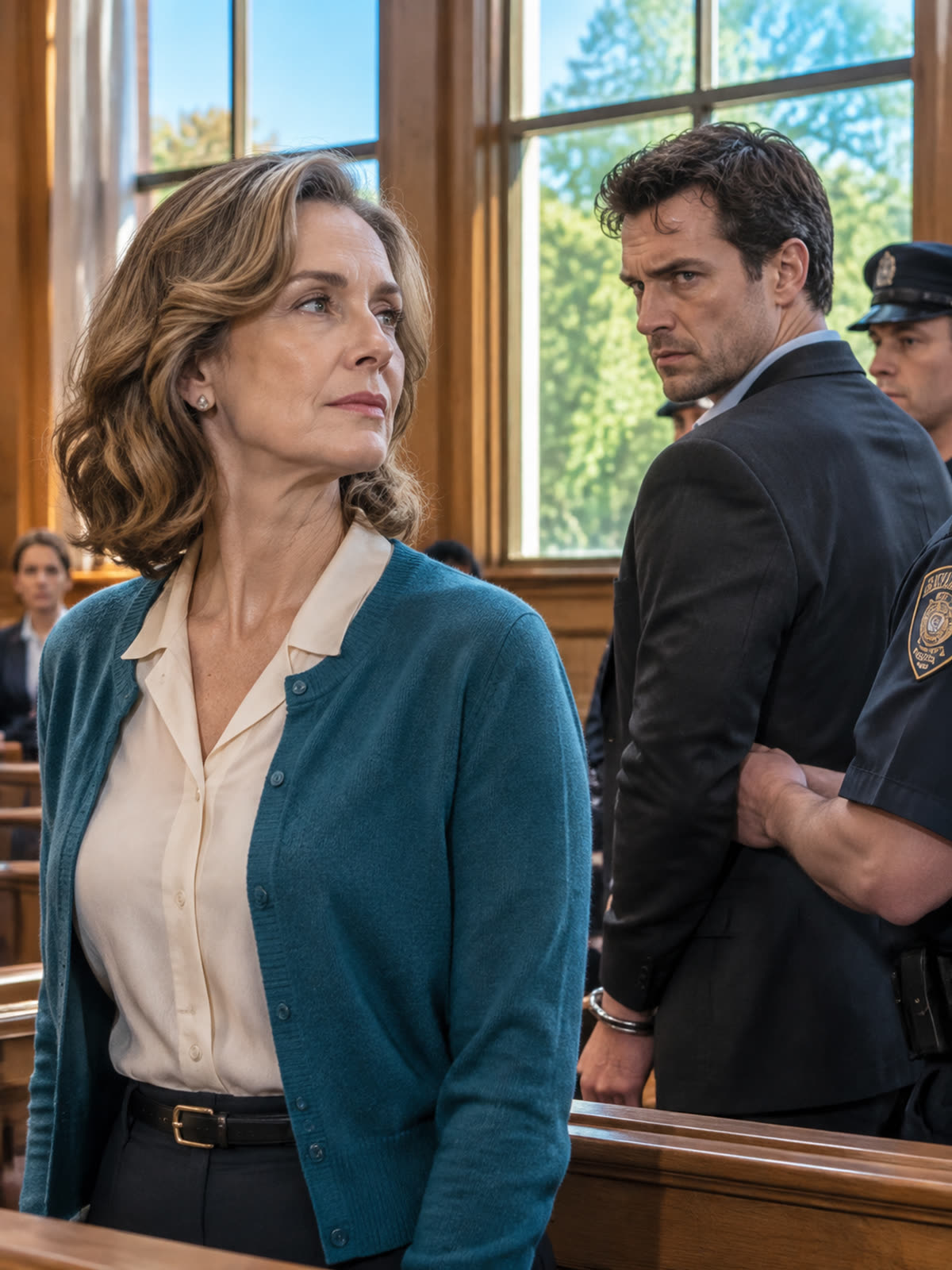
I went to Daniel’s sentencing. He looked thinner and older than the self-assured man who had laughed at me in the hospital. I remembered the expensive suit, the carefully concerned expression, and the way he had told me I was making everyone uncomfortable. None of that changed why I was there. Emily had survived, had spoken, and had been heard. The proceedings were about what he had done, not what he wanted people to believe about her.
As officers prepared to lead him away, Daniel turned toward me. Bitterness filled his voice. “You ruined my life.” I held his gaze. “No, Daniel. I protected my daughter’s.” He offered no reply. There was nothing more I needed to say to him. I had not searched that safe, listened to Emily’s account, or helped bring the evidence forward because I wanted to destroy anyone. I had done those things because my daughter deserved protection and the chance to live her own life.
Six months later, Emily and I were sitting on the porch of a small house beside a lake. She had bought it after gradually returning to work and beginning to recover her independence. It was a different life from the one she had shared with Daniel, and rebuilding it had not been easy. The house was part of that rebuilding, not proof that everything she had endured could simply be left behind.
There were still difficult days. Medical appointments continued, and sometimes she struggled with the weight of what had happened. Recovery had asked more of her than waking up and leaving a hospital bed. Yet she was walking independently again. She was laughing again. Above everything else, she was safe. Those changes meant more to me than the outcome of any argument I had ever had with Daniel or Patricia.
That evening, sunlight shimmered over the lake as Emily rested her head on my shoulder. We sat together, no longer separated by the silence that had filled those hospital months. “Mom,” she said quietly, “can I ask you something?” I looked at her. “Of course, sweetheart.” Her question brought me back to all the days when I had spoken beside her bed without knowing whether any of my words could reach her.
“Why did you keep coming to the hospital when everyone said I couldn’t hear you?” I looked at my daughter and answered with the truth that had never changed. “Because you’re my daughter. That never changes, whether you can answer me or not.” She smiled. “I could hear you sometimes.” Tears filled my eyes. “Really?” She nodded, and I waited as she explained what those long months had been like for her.
“Not everything. But sometimes I heard your voice. It made me feel like I wasn’t completely alone.” I put my arm around her shoulders. For months, I had read aloud, held her hand, and told her I was waiting for her to come home. I had not known whether she could hear any of it. Now she was telling me that sometimes my voice had reached her, even when she could not give me any sign.
Daniel and Patricia had laughed at my visits and my quiet conversations with someone who could not respond. They had taken devotion for foolishness and silence for helplessness. They had also trusted their money and influence to keep them beyond the consequences of their actions. What they failed to understand was a mother’s determination to protect her daughter—and how much the truth could matter once it was given the chance to be heard.
I had never needed their lives to fall apart in order to feel that mine had been repaired. My fight had been for Emily. She deserved to survive what had happened, to recover as far as she could, and to make choices that belonged to her. Seeing her beside me, safe enough to laugh and strong enough to begin again, was the only victory I had ever wanted.
As the sun slipped behind the lake, she squeezed my hand. “Thank you for not giving up on me.” I smiled through my tears. “Never, sweetheart.” For the first time in years, I could look at her without being afraid of what the next day might bring. She had survived. She was healing. She had another chance to build the life she wanted—and the life waiting beyond that sunset was still hers to discover.
Disclaimer: This story is a work of fiction inspired by real-life themes. Names, characters, places and events are fictionalized, and any resemblance to real persons is purely coincidental. Images are for illustration purposes only.
