

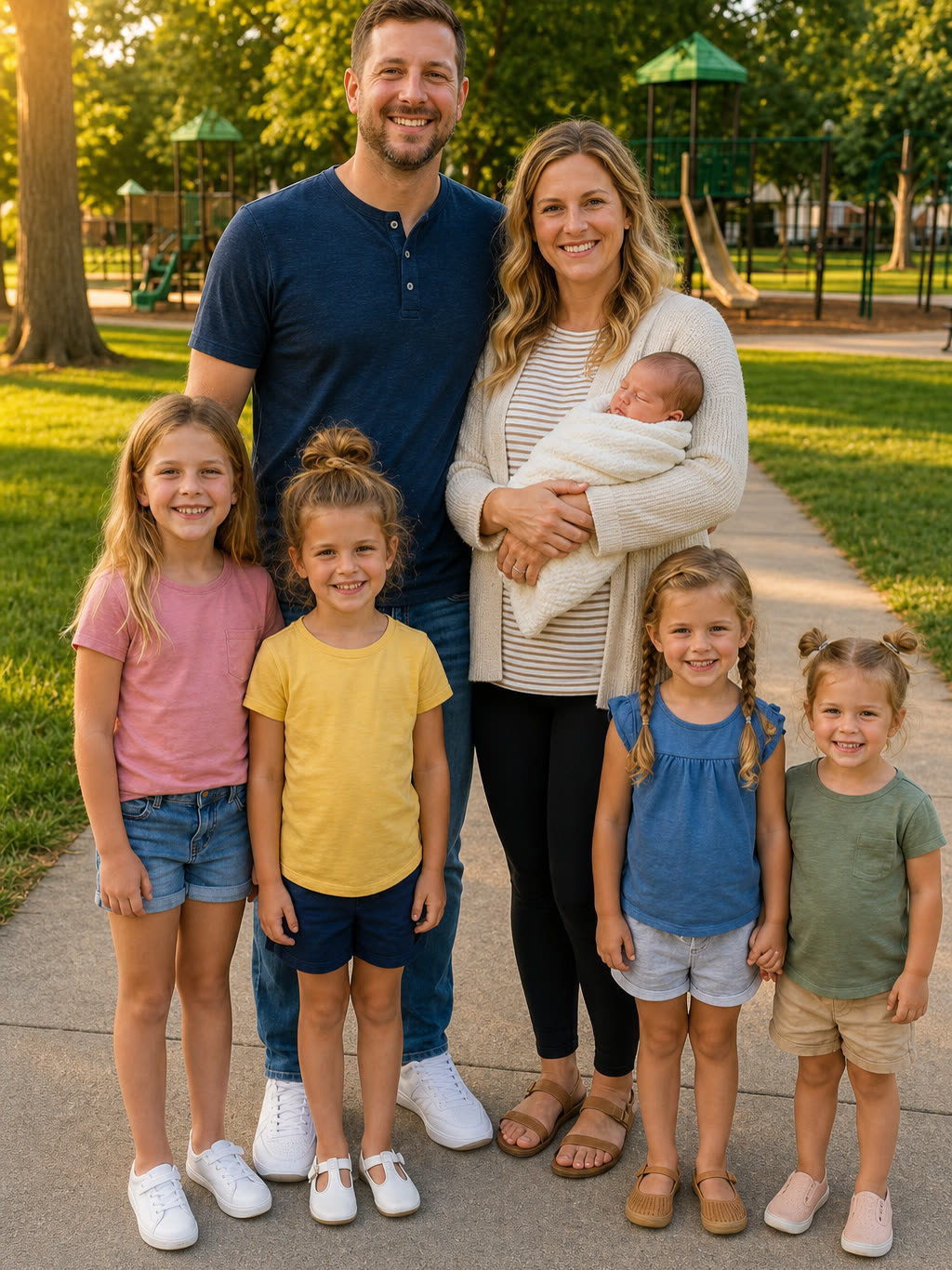
The Son He Had Always Hoped For
By the time the contractions finally stopped, I had been laboring for twelve hours. Twelve long hours of breathing, counting, gripping the bed rails, and bargaining with a body that no longer felt like my own. When the last wave faded, the room fell strangely quiet, and all I could hear was the soft hum of the machines and my heartbeat slowly settling back into something close to normal.
Drained, I sank against the pillows of my hospital bed while my husband, Aaron, drifted toward the window. Afternoon light fell across his shoulders, and he stood there for a long moment, looking out as though the world beyond the glass had changed. After four daughters, he had spent years hoping for a son, and I knew he was carrying that hope with him now, close to bursting.
“Can you believe this, Elena?” he asked, coming back to grip my hand. “After all these years, we finally have our boy.”
“We have a baby,” I reminded him softly. “And he belongs to both of us.”
Aaron smiled, though the smile did not quite reach the part of him that was listening. I understood how much having a son mattered to him. I had understood it for a long time. I just wished, quietly and not for the first time, that the wish had never grown so large that it crowded out every other kind of joy.
After every daughter’s birth, he had hoped that our next baby would be a boy. He never said it cruelly, and he loved each of our girls fiercely. But the hope was always there, tucked behind his congratulations, waiting for the next chance. Eventually, despite my own uncertainty and a body that was already tired, I agreed to try for a fifth child.
The last months had been exhausting in ways I had not expected. I spent weeks on bed rest while four children tumbled through the house needing breakfasts, hair braided, shoes found, and stories read. Through all of it, Aaron’s best friend, Michael, supported us constantly. He delivered groceries without being asked, picked up the girls from school, and drove them to every activity on the calendar.
I had always considered Michael part of our family. He had been at our wedding, at every birthday, and at nearly every holiday table. The girls adored him. When I was too tired to stand, it was Michael who quietly folded laundry in the living room and refused to let me thank him.
Then our boy arrived. He was healthy, seven pounds, four ounces, with a furious little cry that made everyone in the room laugh with relief. Aaron cradled him with tears filling his eyes, his big hands suddenly careful and unsure. “A son,” he murmured. For one moment, I thought everything had finally become perfect. Then the nurse carried the baby away to change his gown, and when she brought him back and laid him in the bassinet, Aaron’s face abruptly changed.
He stared at the baby’s lower back, where the blanket had slipped, and every trace of joy drained from his expression. I pushed myself upright, my heart thudding. “What happened?” I asked nervously. “Is something wrong?” He did not look at me. He only gestured toward the bassinet, his hand shaking slightly. “The baby has Michael’s birthmark.”
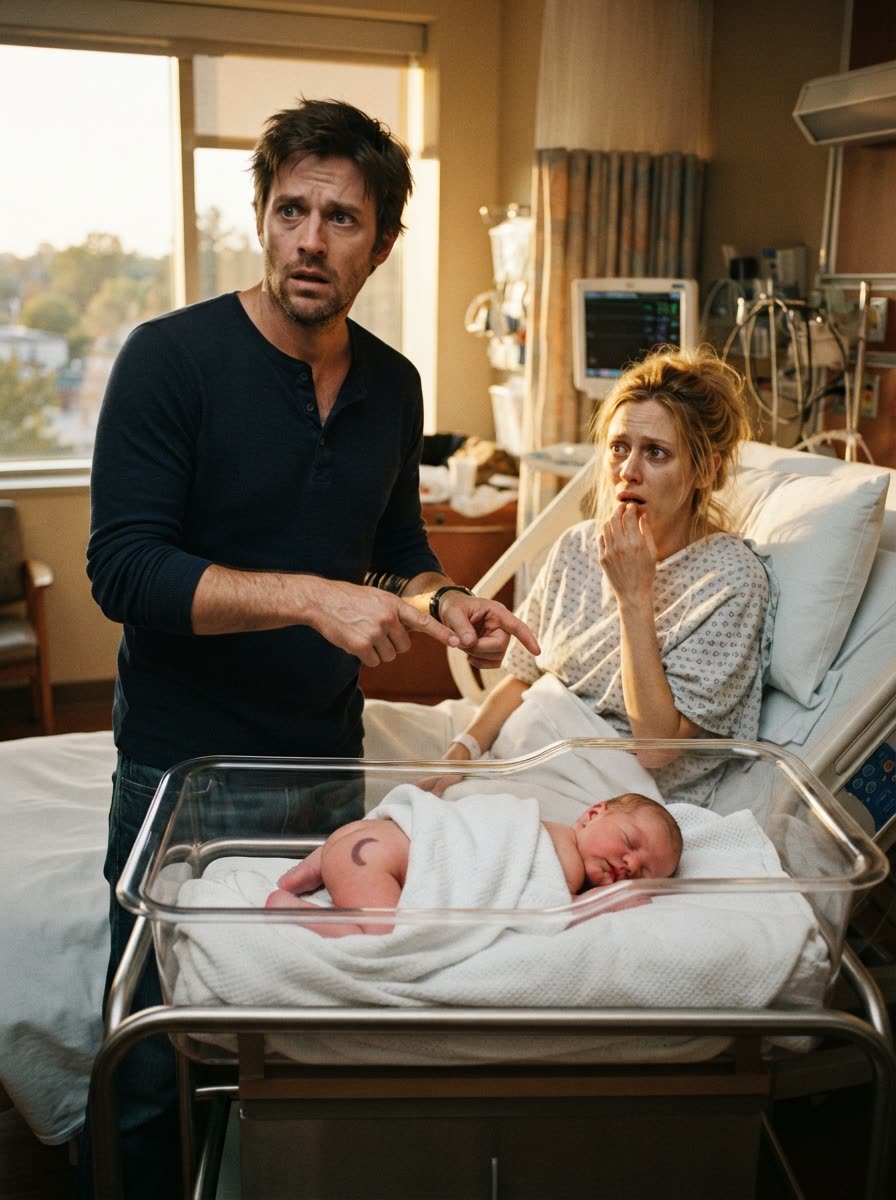
I felt the words land in the room like a dropped glass. Slowly, I remembered the faint crescent-shaped mark I had once noticed on Michael’s lower back, on a summer afternoon at the lake when he had pulled off his wet shirt to help the girls with their life vests. I had barely registered it then. It had meant nothing at all.
“Aaron, that doesn’t prove anything,” I said, keeping my voice as steady as I could manage. I was exhausted and sore, and my whole body wanted to cry. But he had already reached his conclusion. I could see it in the way his jaw set and his eyes turned cold and distant, as if I were someone he had never met.
He started recalling every occasion Michael had visited our home while Aaron was away. The grocery runs. The school pickups. The long afternoons when Michael had stayed to help with the girls. The kindness that had once supported our family suddenly sounded, in his mouth, like proof of betrayal, and each memory he listed seemed to harden him further.
I could not believe what I was hearing. I wanted to scream, but I was too tired and too stunned for anything but the truth. “I’ll sign anything that’s required,” I said. “Please, Aaron. Request a paternity test. Then this ends.” I begged him to do it right there in the hospital, with our son sleeping a few feet away.
“I don’t need a laboratory to tell me what I can see,” he answered.
Those words shattered something inside me. Eight years of marriage, four daughters, and every ordinary and extraordinary thing we had built together suddenly mattered less to him than one small mark on a newborn’s skin. I lay there with my arms aching to hold my baby, and I realized that the man beside me had stopped looking at me altogether.
He told me to bring the baby to my sister Diana’s house after discharge. His voice was flat, almost businesslike, as though he were arranging a delivery. I asked him to stay, to sit down and talk to me, to let the doctors and nurses see us as the family we had been only an hour earlier. He picked up his jacket instead. Then he left, and the door sighed shut behind him.
The next hours blurred together. Nurses came and went with kind, careful faces that told me they had noticed something was wrong. I held Henry against my chest and whispered his name over and over, as if saying it could protect him from whatever was coming. I had chosen it months earlier, and Aaron had agreed to it with a smile.
Three days afterward, Diana drove me and the children back to her home. The girls were quiet in the back seat, sensing something they could not name. Our oldest kept looking at the empty seat beside her where her father should have been. I kept my eyes fixed on the road, afraid that if I looked at them I would break.
Aaron refused my calls. I tried morning and night, leaving messages that grew shorter and shakier every time. His only reply came as a single text message, cold and brief, saying that an attorney would contact me regarding a separation. I read it six times before I understood that it was real.
I tried to call him again, my thumbs trembling over the screen, but Diana crossed the kitchen and gently took the phone out of my hand. “Stop trying to persuade someone who has chosen not to listen,” she said. “You know the truth. Now prove it.” Her eyes were fierce and full of love, and for the first time in days I felt something solid beneath my feet.
That night, after the girls were asleep and Henry was fed and settled, I arranged the paternity test. I filled out the forms at Diana’s kitchen table under a single yellow lamp, my handwriting unsteady, my eyes burning. I told myself that the answer would end everything, that the lab would speak, and that Aaron would have to listen.
I had no idea that the answer I was waiting for would only open a door to a much bigger question, one that was waiting quietly behind a man I had trusted for years.
Proof Changed Everything
Waiting was unbearable. The days stretched out like thread pulled too tight, and every hour seemed to hum with the same unanswered question. I moved through Diana’s house like a visitor in my own life, feeding Henry, folding tiny clothes, nodding at the girls’ questions, and listening for a phone that did not ring.
I revisited every memory involving Michael, although I knew I had never done anything wrong. I replayed the birthday parties, the school pickups, the quiet afternoons in my kitchen. I searched them like a detective searching a crime scene, and each time I found only ordinary kindness. It still hurt that I had been made to look.
Diana’s house had a rhythm of its own, and I clung to it. Mornings smelled of toast and coffee. The girls spread crayons across the dining room table, and our oldest, Ava, quietly took over braiding her younger sisters’ hair, as if she had decided that someone in the family needed to keep things steady.
The nights were harder. Henry woke every few hours, and I sat in the dark guest room with him against my shoulder, feeling his warm breath against my neck. I studied his tiny fingers, his dark lashes, the small furrow of his brow, and I tried to memorize the weight of him in case the world was about to take something from us.
The samples had been collected quickly and quietly, a soft swab inside a tiny cheek, a swab for me, and a sealed envelope that carried our whole future in it. I remember handing it over and thinking how ridiculous it was that a stranger in a white coat now held the power to decide whether my husband believed me.
Aaron stayed silent. There was no call, no apology, not even a message to ask about the baby. I kept expecting a flicker of doubt in him, some sign that he had remembered who I was. Each day without it hollowed me out a little more, until I felt like a shell wearing my own clothes.
Diana watched me closely. She never said much, but she appeared at exactly the right moments with a cup of tea or a warm blanket, and sometimes she simply sat beside me in silence. “You’re allowed to be angry,” she told me one evening. “You’re allowed to be furious.” I told her I was too tired. She said anger would come when I was ready.
On the fourth afternoon, the doorbell rang while I was rocking Henry near the front window. Diana glanced at me and went to answer it. I heard her voice drop, low and wary, and a moment later she came back with an odd expression on her face and said that someone was here to see me.
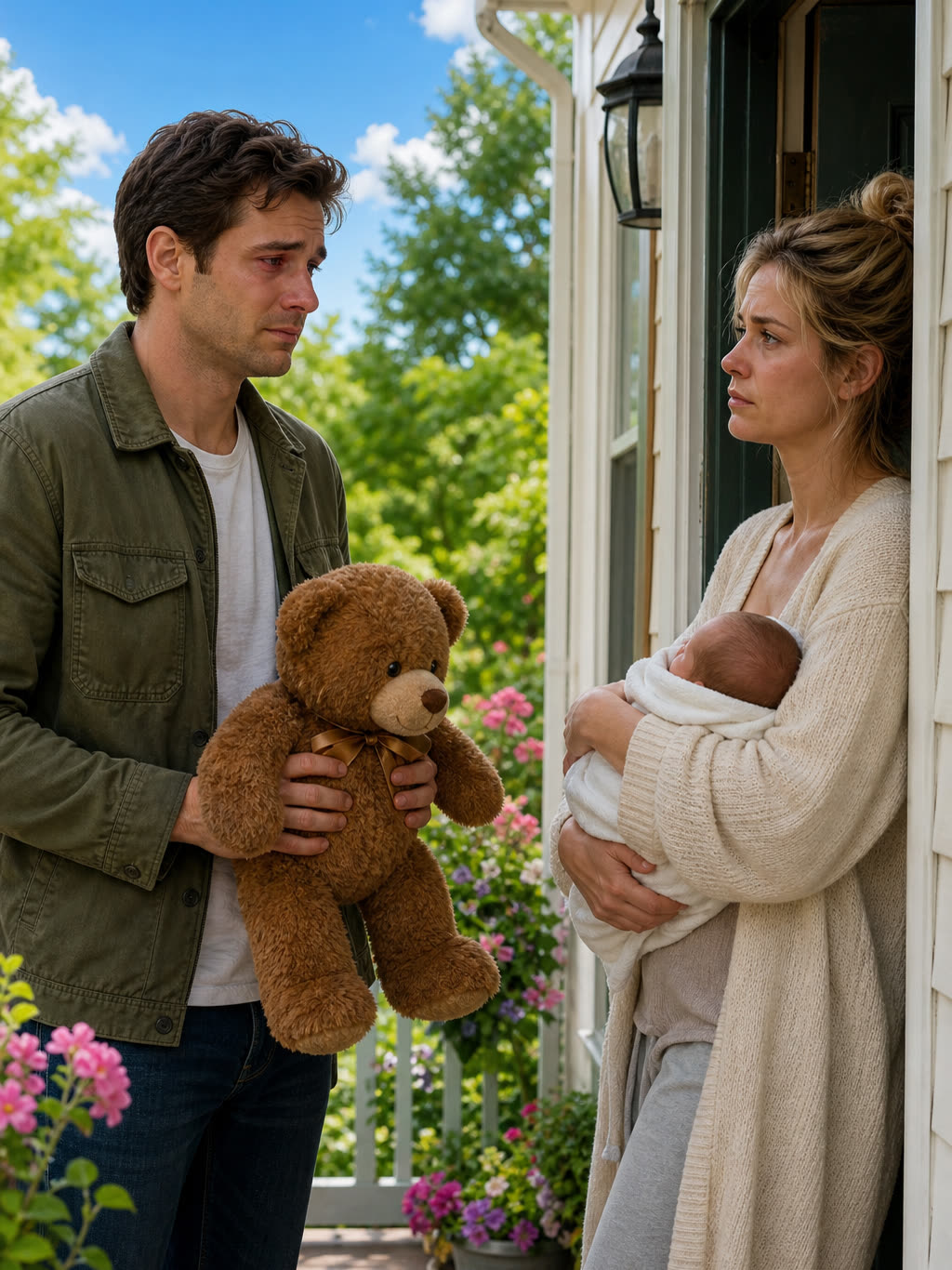
Then Michael arrived at Diana’s home holding a stuffed bear, its soft brown fur still crisp from the store shelf. He stood on the porch with his shoulders hunched and his eyes red, looking like a man who had not slept in days. He couldn’t understand why Aaron had suddenly blocked him, and the confusion was written all over his face.
I couldn’t make myself repeat the accusation. The words stuck in my throat, too ugly and too unfair to say aloud to a man who had spent years carrying groceries into my kitchen. I only told him that Aaron was struggling, that things were complicated, and that I would explain when I could. He nodded slowly and set the bear on the edge of Henry’s bassinet.
Something about the way he looked at the baby stayed with me after he left. It was gentle and almost reverent, as if he were seeing something he had been told he could never touch. I told myself I was imagining it. I was tired, and grief makes the mind see shapes that are not there.
But that night, a memory from Aaron’s father’s funeral suddenly resurfaced. Michael had appeared unusually heartbroken that day, standing quietly apart from everyone else beneath the bare trees, his hands clasped in front of him like a boy waiting to be called. At the time, I hadn’t understood why. He was only Aaron’s friend. Yet his grief had seemed so deep.
I turned the memory over and over, but it refused to settle into any shape that made sense. I only knew that something in it felt unfinished, like a sentence that had been interrupted halfway through. I tucked it away and tried to sleep, with Henry breathing softly against my collarbone.
One week after sending the samples, the results arrived. I opened the envelope standing in Diana’s hallway with my fingers trembling so hard I nearly tore the page in half. The paper was crisp and official, full of tables and small print, and my eyes skipped over it all until they found the one line that mattered.
Aaron’s probability of paternity was 99.99 percent.
Relief came first. It washed through me so suddenly that my knees nearly gave way, and I leaned against the wall and let out a breath I felt I had been holding since the hospital. Henry was Aaron’s son. There had never been any doubt in my heart, but now the whole world could see it in black and white.
Then came anger. It rose slowly, quietly, as if it had been waiting for permission. Every accusation, every cold word, every unanswered call came flooding back. He had needed a laboratory to believe me, after all. I had begged him for a test, and he had told me he didn’t need one. Now the test had spoken, and I wanted him to feel exactly how heavy that silence had been.
I forwarded the results to Aaron without saying anything. No message, no explanation, no anger spelled out in words. I simply pressed send and set the phone face down on the table, feeling oddly calm, as if I had finally handed him something he could no longer ignore.
He reached Diana’s within the hour. I heard his car in the driveway before the knock, and the sound of his footsteps on the porch was uneven and hurried, the footsteps of a man who had run out of excuses. Diana looked at me, and I nodded. I wanted to hear what he had to say.
“Elena, I was wrong,” he said the moment the door opened. His face was gray and haggard, and his eyes were rimmed with red. “Please let me see my son.” I had imagined this moment so many times in the long nights, but nothing prepared me for how small he looked, standing there with his hands hanging empty at his sides.
I stayed in the doorway. I did not step aside, and I did not invite him in. The cool evening air moved between us, carrying the faint smell of cut grass and the sound of the girls laughing somewhere inside. I held on to the door frame because it kept me steady.
“The test answered whether Henry is yours,” I said. “It didn’t explain why he has the same mark as Michael.”
Aaron looked at me, and for the first time, I watched understanding move across his face like a slow shadow. He understood that the birthmark had never proved infidelity. Instead, it had uncovered another mystery, one that neither of us had known to ask about, and one that he suddenly seemed very afraid to touch.
I told him to phone Michael. He hesitated, but I held his gaze until he took out his phone and dialed with a shaking thumb. Michael answered on the second ring, and Aaron put the call on speaker. I could hear the faint sound of a television in the background and then the careful silence of a man who knew he was about to be asked something difficult.
When Aaron asked how Michael got his birthmark, Michael remained silent for several seconds. Those seconds stretched until I could hear my own pulse. Behind me, Diana drew a slow breath. Even the girls’ laughter seemed to fade into some far-off room.
Then he said, “That mark runs through your father’s family. He had it too.”
Aaron frowned. “How could you know?”
Michael’s voice came through the phone, quiet and cracked and impossibly gentle. “Because your father was my father too.”
The Life I Chose to Defend
Aaron stared at the phone, completely stunned. The color had left his face, and his hand shook so badly that I thought he might drop it. The porch light buzzed above us, and for a long moment no one spoke, as if the whole street had paused to listen.
Michael came to Diana’s house that evening, and the three of us sat in the living room while he explained. His mother, he said, had been involved with Aaron’s father long before Aaron and Michael ever became friends. It had been a quiet, hidden thing, and Michael had grown up knowing only fragments of the story, pieced together from the silences of adults.
His father had eventually confessed the truth to him, but he had insisted on secrecy. Michael could stay Aaron’s friend, he had been told, but he could never admit that they were brothers. The man had been terrified of what the truth would cost his family, and so he had chosen silence and asked a young boy to carry it for him.
“I was young,” Michael said. “I was scared he’d vanish completely if I refused.” His voice shook as he said it, and he stared at his hands as though he were still that frightened boy. I felt my chest tighten, because I could see exactly how a child might agree to such a terrible bargain.
For years, Michael kept the secret. He stood beside Aaron at graduations and at our wedding, and he held our daughters when they were newborns, all the while knowing something that could have changed everything. He had learned to smile through it, to laugh at the right moments, and to never let his eyes linger too long on the truth.
At the funeral, he had been grieving his own father while pretending to be nothing more than a family friend. I thought of him standing apart under the bare trees, and finally I understood. “You were the only family I had left,” he told Aaron. “I believed staying silent was the only way to keep you.”
Aaron fell apart. He covered his face with both hands, and his shoulders shook with sounds I had never heard him make before. Within a matter of days, he had discovered a brother, and learned that his father had concealed the truth from both of them. The man he had mourned and honored had left a lie buried beneath his memory.
But he had also almost destroyed his marriage because he had mistaken an inherited birthmark for evidence that I had betrayed him. I watched him realize it, and I felt the room grow heavy with all that had been said and unsaid. I felt sympathy for both men, and I could not deny it, because their pain was real and old and not their own doing.
But understanding Aaron’s fear could not erase what he had done. Their father’s secret explained the birthmark, but it did not explain why Aaron had trusted suspicion instead of me. “I betrayed you,” Aaron murmured. I pulled on my coat. “You and Michael have years of truth to sort through,” I said. “I came for the answer about Henry, and now I have it.” I went back to Diana’s.
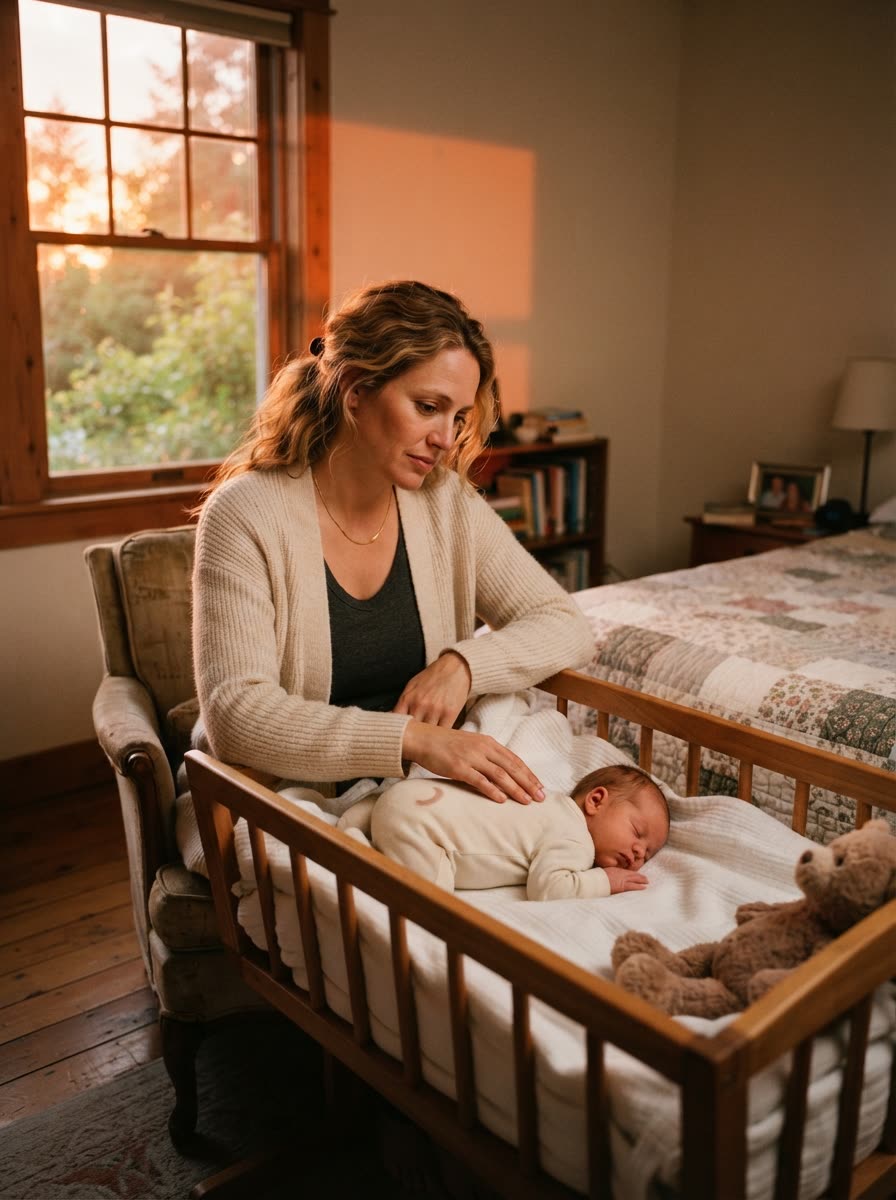
That evening, I sat beside Henry’s bassinet while golden light faded across the guest room wall, and I studied the small crescent on his back. It no longer seemed like a mark of accusation. It was simply part of his family history, a quiet signature passed from one generation to the next, and it belonged to him as much as his small nose or his dark lashes.
Still, I could not forget what had happened. Aaron had never asked questions. He had not waited for facts. He had looked at me when I was most vulnerable, just hours after giving birth, and decided to believe the worst. That memory sat in my chest like a stone, and no amount of explanation could lift it.
The truth about the birthmark had a reason. The way he had treated me did not. I lay awake for a long time that night, listening to Henry breathe, turning over the same thought until it wore smooth. I was not angry only because of what he had said. I was angry because of how quickly he had said it.
Aaron came back the following morning. I heard his car, and I felt my whole body tense. He stood on Diana’s porch with his hands in his pockets, unshaven, wearing yesterday’s clothes, as though he had not slept at all. When I opened the door, he looked at me with raw, hopeful eyes.
He promised counseling, honesty, patience—anything I wanted. He said he loved me and all five of our children, and that he wanted us back home. His voice cracked as he spoke, and I could tell he meant every word. Part of me wanted to trust him, to fall into his arms and let the nightmare dissolve.
But love could not erase that hospital room. “I begged you to stay,” I said. “I asked for a test. You walked away anyway.” The words came out quiet and steady, and I was surprised to hear no tremble in them. I had said them to myself so many times that they had become solid.
He said he had been terrified and wasn’t thinking clearly. He said fear had made him stupid, that the shock of seeing the mark had stolen his reason. I let him finish, because I owed him that much. Then I told him the truth that had been taking shape inside me for days.
“That’s exactly what frightens me,” I replied. “When you were hurt, you punished me for a story you invented in your own mind. You needed evidence before trusting me, but you needed none before accusing me.” He flinched as if I had struck him, but he did not look away.
He asked if one terrible mistake really had to end our marriage. His voice was small and pleading, and for a moment it nearly undid me. I thought of the years, the laughter, the late-night talks in our kitchen, and I let myself feel how much I had loved him, and perhaps still did.
“It wasn’t just one moment,” I said. “The birthmark uncovered years of problems—your disappointment about having daughters, your jealousy toward Michael, and my habit of making myself smaller to keep you happy.” I had never said those things aloud before, and they hung in the air between us, true and unavoidable.
The birthmark had not caused those fractures. It had revealed them. Like a crack in old glass that finally catches the light, it had shown us where we had been breaking for years, and neither of us could pretend not to see it anymore. I told Aaron he would always remain Henry’s father, and we would find a safe, respectful way for him to stay involved in all five children’s lives.
But I would not go home simply to ease his guilt. Forgiveness, if it came, would not necessarily mean reconciliation. Aaron reached toward my hand, and the old instinct tugged at me to let him take it. I moved back. “I spent years choosing whatever would make you happy,” I said. “Now I need to choose what makes me and the children feel secure.”
He lowered his head. There was no dramatic argument. Only the pa!nful silence of two people understanding that an apology cannot immediately rebuild broken trust. A bird sang somewhere in Diana’s yard, bright and oblivious, and the sound seemed to belong to a different world.
I went inside and picked Henry up from his bassinet. He was warm and heavy and wonderfully alive, and he nestled against me with a sleepy sigh. Upstairs, our daughters were starting to wake. I could hear Ava asking Diana about breakfast and Grace reminding everyone about the banner. Their small voices filled the house like sunlight.
For the first time in years, I did not measure my choices by Aaron’s disappointment. The realization startled me with its simplicity. I had spent so long watching his face to decide what I should feel that I had forgotten I was allowed to feel anything at all.
Protecting my family no longer meant sacrificing myself to maintain the appearance of togetherness. It meant creating a home where my daughters would learn that love requires trust, where my son would never be valued more simply because he was a boy, and where I would never need to prove my worth to the person beside me.
I carried Henry toward the voices of his sisters. Behind me, Aaron remained on the porch, confronting the consequences of his choice. I could feel his gaze on my back, heavy with regret, and I did not turn around. I was heartbroken and uncertain about what came next, and I did not pretend otherwise.
But underneath the pain was something steady, something quiet and strong that I had not felt in a very long time. I was no longer abandoning myself to stop somebody else from leaving. This time, I was choosing a life founded on dignity, safety, and truth—for my children, and for me. Whatever waited beyond that porch, I would face it standing on my own two feet.
Disclaimer: This story is a work of fiction inspired by real-life themes. Names, characters, places and events are fictionalized, and any resemblance to real persons is purely coincidental. Images are for illustration purposes only.
