


Part One: Just One More Month
My nine-year-old son set $146 of his birthday savings on our kitchen table and softly asked if he could stay for just one more month. “I can help with the twins until you’re feeling better, Mom. I promise I won’t be any trouble.” My husband’s face drained of color. My mother-in-law froze with the coffee pot tilted over her cup. I had never asked my son to leave. Yet the other adults in the house seemed to know about a plan I had never approved.
“Eli, honey, what are you talking about?” He stood beside the table in his navy-blue baseball T-shirt, patiently squaring the bills into a small, neat stack. “There’s a hundred and forty-six dollars. I counted twice.” “I can see that.” “And I don’t need new shoes yet. The old ones still fit.” That wasn’t quite true. The week before, I had caught him curling his toes inside his sneakers.
“Eli, why would you need money to stay here?” He looked over at my husband, Grant, who slowly slid his chair back. “Buddy, why don’t you go upstairs? Your mom needs to feed the baby.” “No,” I said. Grant stopped at once. Four weeks earlier, I had given birth to twins by emergency C-section. My daughter, Nora, was sleeping against my chest, and her brother, Ben, lay in the portable bassinet beside the refrigerator. I was still healing, bone-tired, and getting about three hours of sleep a night. But I could tell when something was wrong.
“Eli,” I said, “look at me.” He lifted his eyes. “Who told you that you couldn’t stay?” His gaze drifted to his grandmother. Marilyn set her mug down on the counter with great care. “Lauren, don’t make this into something it’s not.” “Then tell me what it is.” “We’ve been discussing some arrangements. Nothing has been decided.” “What arrangements?” Grant pressed a hand to his forehead. “Mom thought Eli might enjoy staying with Aunt Ruth for a while.”
Ruth was Marilyn’s younger sister, and she lived near Toledo, almost three hours from our home outside Dayton. Eli truly liked her. She sent birthday cards with five-dollar bills tucked inside and sometimes let him have pancakes for dinner when we visited. But that didn’t explain the money on my kitchen table. “Since when are we sending Eli to Ruth’s?” I asked. Grant traded a look with his mother. Marilyn folded her arms. “Your husband has been under tremendous pressure, Lauren. The hospital bills, the babies, your leave from work. We’re trying to make things manageable.” “By sending my son away?” “It’s not sending him away.”
Before she could say more, Eli spoke up. “Grandma said three kids cost too much.” My chest tightened. “She said Aunt Ruth has a spare room. And if I go there, you can use my room for the babies.” Marilyn started to answer. “That’s not exactly—” “And Grandma can sleep upstairs,” Eli went on. “So she can help when you go back to work.” I turned to Grant, who would not meet my eyes.
“Eli,” I said gently, “you don’t have to pay us to live here.” “I know.” “Then why did you bring your money?” His lower lip began to tremble. “Because Dad said things are expensive right now.” He nudged the bills closer to me. “I won’t need much. And I can help with diapers. I already know where you keep everything.” “Oh, sweetheart.” “I won’t pick up the babies by myself. I know I’m not supposed to.” His words came faster and faster. “And I can make my own breakfast. And if Ben cries while you’re holding Nora, I can get his pacifier.”
Grant stood up. “Okay, that’s enough. Eli, upstairs.” “Sit down, Grant.” He stared at me. “Lauren, you’re exhausted. We can discuss this later.” “We’re discussing it now.” Nora stirred against my chest, and I smoothed the blanket around her. Eli watched me move and decided I must be hurting. “See?” he said. “It still hurts when you move.” “What?” “Your stomach.” He pointed toward the incision hidden beneath my shirt. “The doctor said it takes time. I thought if I stayed another month, maybe you’d be better by then.”
A sick realization began to creep over me. “Eli, who told you that you had to leave at the end of the month?” He seemed confused by the question. “Dad said I was going to Aunt Ruth’s.” “When?” “Saturday.” I whipped my head toward Grant. “Saturday?” He said nothing. Saturday was only four days away. Eli looked from his father to me. Then he said something that shook me more than anything else I had heard that morning. “Dad said you already agreed, Mom. He said you were just too tired to talk about it.”
I stared at my husband. “I never agreed to anything.” Eli’s face changed slowly, but not into relief. It was doubt. “But Dad said you did.” In that moment I understood that my little boy had spent days getting ready to leave the only home I had ever wanted him to have. I asked Grant to take Nora. He hesitated, glancing from our daughter to the money. “Lauren—” “Take your daughter.” He took her carefully, and I followed Eli upstairs. He walked a few steps ahead, slowing each time I reached another stair. Normally he took them two at a time, but that morning he kept looking back to make sure I was managing.
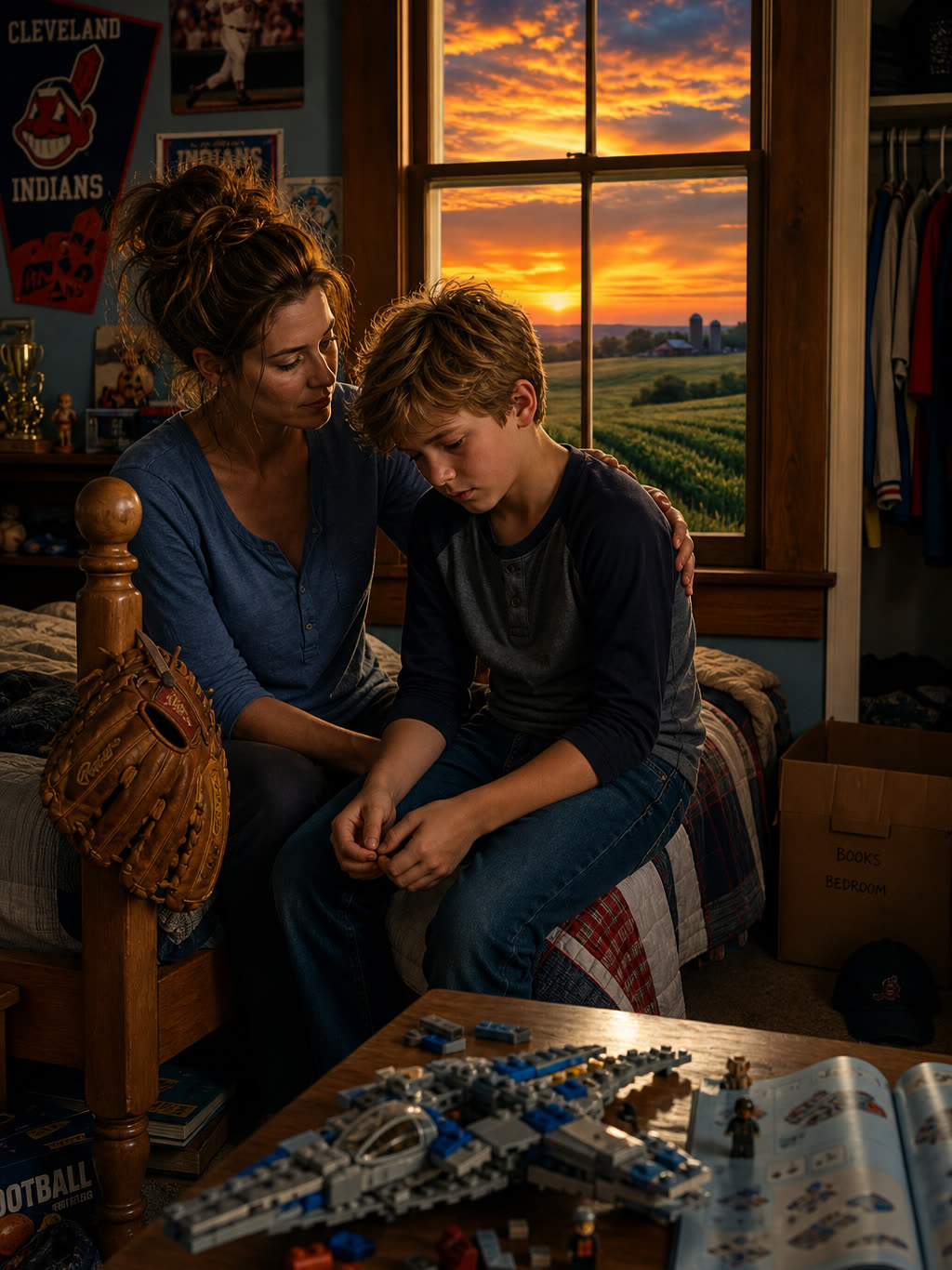
His room looked almost unchanged. His baseball glove hung from the bedpost, an unfinished Lego spaceship sat on the desk, and his Little League team photo stood by the window. But several gaps showed on his bookshelf, and a cardboard box sat beside the closet. “What’s that?” I asked. “Some stuff I’m taking to Aunt Ruth’s.” “Who packed it?” “Grandma started it. I did the rest.” I lowered myself onto the edge of his bed. “Eli, come here.” He stood in front of me, twisting the hem of his shirt. “I need you to tell me exactly what happened.” He glanced at the doorway. “Am I in trouble?” “No.” “Is Dad?” I paused. “Your dad and I have some things to work out. But you haven’t done anything wrong.”
He sat down beside me and studied his hands for a long moment. Then he whispered, “I heard them talking when you were asleep.” “Who?” “Dad and Grandma.” “When?” “That day Ben wouldn’t stop crying. You went upstairs with Nora.” I remembered that afternoon. Both babies had been fussy, and I had cried alone in the laundry room because I couldn’t find a clean sleeper that fit Ben. “Grandma said you have two real babies now,” Eli went on. His words unsettled me deeply. “What else?” “She said you didn’t have enough money for three kids. And that Aunt Ruth could take me because I wasn’t really yours.” His voice dropped. “She said I was adopted.”
For a while I couldn’t speak. Grant and I had adopted Eli when he was four months old. We had been married six years and had gone through several failed fertility treatments. When a social worker called about a baby who needed a permanent family, we said yes at once. Six months later, the adoption was final. I could still see the courthouse, the tiny blue sweater Eli wore, and Grant carrying him proudly to the car. We had always meant to tell him early, so his story would feel natural. Yet we kept putting it off. At three, we told ourselves he was too young. At five, we feared questions we couldn’t answer. By seven, Grant felt we shouldn’t make him feel different when he seemed so happy. Eventually, staying silent became easier than admitting how long we had waited.
Now our son had learned the truth in a conversation about whether he could keep living with us. We had handled something important very badly, and Eli deserved better. “Eli,” I said, “what Grandma said about you being adopted is true.” He turned to face me. “So you’re not my real mom?” “I’m your mom. I adopted you when you were a baby. I didn’t give birth to you, but you’re my son.” “Who did?” “A woman who couldn’t raise you. There’s more to your story, and I’ll help you understand everything we know. We should have told you long ago.” “Why didn’t you?” “Because your dad and I kept making the wrong decision. We thought we were protecting you.” He dropped his gaze to his knees. “You weren’t.” “I know.”
For a few quiet seconds, the only sound was Ben crying downstairs. Then Eli asked, “Can adopted kids get sent back?” A deep ache filled my chest. “No. Adoption isn’t borrowing a child. You became our son legally and permanently.” He thought it over. “Even if you have other babies?” “Even then.” “Then why does Grandma think I have to go?” I wished I had an answer that would make it all make sense. Instead I said, “I’m going to find out.” He nodded, though he still looked unsure. When I stood, I noticed a spiral notebook sticking out of his backpack. “What’s this?” Eli lunged for it. “Nothing.” I waited and did not open it. “May I see?” After a hesitation, he handed it over.
On the first page, in his neat third-grade handwriting, was a heading: Things I Can Do So Mom Can Keep Me. Below it were eight lines. Help fold baby clothes. Don’t ask for new baseball shoes. Give Mom birthday money. Don’t complain when babies cry. Make my own cereal. Help clean kitchen. Don’t need birthday party next year. Be good so nobody gets upset. One last sentence had been erased and rewritten. Maybe if I don’t cost too much, they’ll change their minds. I gripped the notebook so hard that the cover began to bend. “Eli, you don’t have to do any of these things to stay here.” “But Dad says everybody has to help.” “Helping around the house is different from earning a place in your family.” His brows pulled together. “Then why does Grandma say I’m expensive?” “Because adults sometimes say things they should never say.” “Are you mad at her?” “Yes.” “Are you mad at me?” I set the notebook aside. “Never for asking to stay in your own home.”
He leaned against me, and I wrapped my arms around him, mindful of my incision. For a little while, he let me hold him. Then he pulled back. “Mom?” “Yeah?” “If you wanted me to stay, why did Dad tell me you said I should go?” My eyes went to his bedroom door. I couldn’t answer that for him, but I knew who could. Downstairs, Grant was washing baby bottles at the sink, and Marilyn had carried the twins into the living room. I set Eli’s notebook on the counter. Grant glanced at it. “What’s that?” “Something your son wrote because he thinks he has to earn the right to live here.” He shut off the faucet. “Lauren, I know this looks bad.” “Does it?” “That’s not what I meant.” “Then explain it.”
He dried his hands on a dish towel. “We’ve got almost five thousand dollars left from the hospital bills. Your unpaid leave is going longer than we expected. My hours got cut again last week.” “I know things are tight.” “You know they’re tight. You don’t know how bad they’ve gotten.” “Then you should have shown me.” “I didn’t want to pile more on you.” “But you were comfortable piling it onto a nine-year-old?” He lowered his eyes. I kept my voice level. “Eli knows he’s adopted. He knows you think we can’t afford him. And he thinks I agreed to send him away.” Grant leaned against the counter. “I was going to tell you.” “When? After Ruth picked him up?” His face tightened. “It was supposed to be for the summer.” “Supposed to be?” “Mom offered to move in and help with the twins when you go back to work. That’s thousands in childcare we wouldn’t have to pay.” “Why does that mean Eli has to leave?” “Because we have three bedrooms, Lauren. Ours, the nursery, and Eli’s.” “Your mother can sleep downstairs.” “For months? She’s sixty-five.” “Then maybe she shouldn’t move in.” “That’s easy to say when you’re not the one looking at the bank account every night.”
His words stung. I was recovering from surgery and trying to nurse two newborns, doing my best to get through each exhausting day. Grant had taken over our finances after telling me again and again not to worry about the bills. Now he was using my distance from those decisions as an argument against me. “Show me the numbers,” I said. He pulled out his phone, and for twenty minutes we went through our checking account, credit card balances, and outstanding medical bills. Our situation was worse than I had understood. Still, nothing on those screens justified taking our oldest child’s bedroom from him. “What did you tell Ruth?” I asked. “That Eli might stay with her.” “And what did you tell the school?” His finger froze on the screen. “What?” “I saw a message from his teacher on your phone last week. Something about records.” He rubbed his jaw. “I asked what the transfer process would look like.” “Why would he need to transfer schools for a summer visit?” “We didn’t know how long things would take to settle down.” I stared at him. “You were planning for him to stay there during the school year?” “I was looking at options.” “Without telling me?” His voice rose. “I was trying to keep us afloat!”
From the living room came a small, restless sound from Nora. Marilyn stood in the doorway with her in her arms, clearly having heard every word. “You don’t understand the pressure Grant’s under,” she said. I faced her. “Did you tell Eli he wasn’t our real son?” Her expression turned guarded. “I said he wasn’t biologically yours. There’s a difference.” “Not to a nine-year-old who thinks he’s being sent away.” “He was never supposed to hear that conversation.” “So it was fine as long as he didn’t hear it?” “Lauren, you’re twisting my words.” “No. I’m repeating them.” Grant stepped between us. “Can we stop? The babies are right here.” I looked at Nora, then at Ben, asleep against Marilyn’s shoulder, and knew we needed to lower our voices. But I wasn’t going to drop the conversation. “Where are Eli’s things?” I asked. “What things?” “The ones missing from his room.” Neither of them answered, so I went to the garage.
Two cardboard boxes sat beside the lawn mower. One was labeled ELI — SUMMER CLOTHES. The other held books, toys, his old winter jacket, and the little plastic trophy from his first baseball season. Grant was the one who had taught Eli to swing a bat. For years they had spent almost every Saturday morning practicing at the park. Yet now that trophy had been boxed up as if Eli’s place in our home were already shifting. I carried it into the kitchen. “Who packed these?” Marilyn answered before Grant could. “I was helping him get organized.” “For a visit?” “For however long he needs to stay.” I set the trophy on the counter. “He’s not staying anywhere.” Grant let out a frustrated breath. “Lauren, we can’t just pretend the numbers don’t exist.” “I’m not pretending anything. I’m telling you that you don’t get to solve a financial problem by removing our son.” Marilyn shook her head slowly. “You can’t expect everything to stay the same after having twins.” “I don’t.” “Then something has to change.” I met her eyes. “Not Eli’s right to live with his parents.” She pressed her lips together and said nothing.
Just then Grant’s phone lit up on the counter. A new message from Ruth glowed on the screen. Will Saturday at ten still work? I can have the room ready. I turned to Grant. “Saturday at ten?” He reached for the phone, but I had already read it. “You told her to come get him?” “Mom and I were working out the details.” “And when were you going to tell me?” He gave no answer. Only four days remained. They had already arranged for my son to leave our home. And I still had no idea how long they meant for him to stay away.
Part Two: The True Cost Of Raising Three Children
I went into our bedroom and called Ruth. She picked up on the third ring. “Lauren! How are those beautiful babies doing?” “Fine. Ruth, I need to ask you something.” “Of course.” “What exactly did Grant tell you about Eli?” She hesitated. “About him staying with me?” “Yes.” “He said you both thought it would be good for him. With everything going on.” “Did he say I agreed?” “Yes.” I closed my eyes. “Ruth, I didn’t even know about this until this morning.” The line went quiet. Then she said softly, “Oh, honey.” I sank onto the edge of the bed. “How long were you expecting him to stay?” “Well, Grant said we should plan for at least the school year.” My grip tightened on the phone. “The school year?” “He said moving Eli back and forth might confuse him. I thought it sounded like a lot, but he told me you were both comfortable with it.”
For a moment I couldn’t answer. Ruth went on. “I asked whether Eli was okay with the arrangement. Grant said he’d talked to him.” “Did Grant say Eli wanted to go?” “Yes. He said Eli was excited about having his own room here.” I almost laughed in disbelief. Eli had been sleeping with his baseball glove under his pillow. He had even asked whether he could bring our family Christmas photograph. And that very morning he had offered every dollar he owned just to stay home. “Ruth, he’s not excited.” “I’m beginning to understand that.” “He thinks we’re sending him away because he’s adopted.” Ruth gasped quietly. “Who told him that?” “He overheard Grant and Marilyn. And apparently my husband told him I agreed.” “Oh, Lauren.” I pressed my fingertips to my forehead. “I know you were trying to help.” “I thought I was giving him somewhere nice to spend some time. If I’d known you hadn’t agreed, I wouldn’t have made a single plan.” “I believe you.” “Tell Eli he’s welcome to visit me anytime. But I’m not taking that boy out of his home when his mother doesn’t want him to leave.” For the first time that morning, another adult truly understood. “Thank you.” “And Lauren? Make sure he knows I didn’t ask for him because nobody else wanted him.”
After the call, I sat still for another minute. Then I opened the bedroom door. Grant was waiting in the hallway. “Did you call Ruth?” “Yes.” His eyes fell to the floor. “Lauren—” “A whole school year?” He said nothing, which confirmed what I had learned. “Not a month. Not a summer. A whole school year.” “We hadn’t finalized anything.” “But you’d told Ruth. You’d contacted a school. You’d packed his things.” “I was planning ahead.” “For a life without Eli in this house.” He shook his head. “That’s not fair.” “Fair?” My voice wavered. “You told our son I agreed to send him away.” Grant glanced at the staircase. “Keep your voice down.” “Then answer me quietly. Why did you lie to him?” He drew a long breath. “Because I knew you’d say no.” I stared at him. He looked startled by his own admission. “Lauren, I just meant—” “You knew I’d say no, so you decided to make the choice without me.” “I thought if we had everything arranged, you’d see that it could work.” “That isn’t a marriage, Grant. That’s you making a decision and waiting for me to accept it.” He raked a hand through his hair. “Do you think I want this?” “I don’t know what you want anymore.” “I want you to get better. I want the babies taken care of. I want to stop wondering whether the mortgage is going to clear.” “And Eli?” “Of course I want him taken care of.” “Just somewhere else.” He had no reply.
Marilyn appeared at the bottom of the stairs. “Have you talked some sense into her?” I looked past Grant at her. “Ruth knows I never agreed. Eli isn’t going anywhere Saturday.” Marilyn stopped. “Well, I suppose that settles it.” “Yes. It does.” “Then I won’t be moving in.” Grant spun toward her. “Mom.” “No. I’ve offered to give up my time, my privacy, and my own home to help you two. I’m not spending months sleeping on a couch while taking care of newborn twins and another child.” “Eli doesn’t need you to take care of him,” I said. “Someone has to feed him, drive him to school, and deal with everything else. He’s nine.” “Yes. He’s nine. That’s exactly why he needs his parents.” Her face hardened. “Lauren, you have two babies of your own now. You need to think about them.” I studied her for several seconds. “I have three children.” “You know what I mean.” “I know exactly what you mean.” For once, Marilyn had no response. Grant sank onto the bottom stair. “Then tell me what we’re supposed to do. Your leave ends soon. We can’t afford full-time care for two infants. Mom was our plan.” “Then we need another plan.” “With what money?” “I don’t know yet.” He gave a short, humorless laugh. “That’s the problem, Lauren. You don’t know.” I couldn’t entirely dismiss his point. The hospital bills were real. My unpaid leave was real. Our childcare problem was real. But upstairs, my nine-year-old was waiting to find out whether he could keep sleeping in his own bed next week, and I would not let another financial calculation decide his sense of belonging.
That afternoon I found Eli on his bed, slipping his baseball cards into a sandwich bag. “Mom?” “Yeah, buddy?” “Is Aunt Ruth still coming Saturday?” “No.” His hands went still. “Are you sure?” “I’m sure.” He looked down at the cards. “Is Dad mad?” I sat beside him. “Your dad and I are having a disagreement. It isn’t your job to fix it.” He gave a small nod but kept holding the cards. That evening, while I tucked him in, he asked if he could leave his backpack beside him. I said he could. I didn’t simply tell him there was nothing to worry about, not after the adults he depended on had given him so many reasons to feel uncertain. I stayed until he fell asleep. Then I went downstairs, opened our bank account, and began reviewing every number myself. By midnight, my legal pad was crowded with calculations. Grant had gone upstairs, and Marilyn had gone home, declaring she would no longer be helping us. I sat at the kitchen table with a calculator, two hospital statements, and a cup of coffee I had reheated three times. Our savings totaled $2,180. We still owed the hospital $4,760. The credit card balances were higher than I wanted to admit. My next paycheck was weeks away. Grant had lost his overtime in May, and his regular schedule no longer covered what we had once handled without much worry. For the first time, I began to understand his anxiety. What I couldn’t understand was why he had decided Eli should be the solution.
The next morning I called the hospital’s billing department. They couldn’t simply cancel the balance, but they offered to help me apply for financial assistance and set up a payment plan while the application was reviewed. Then I called my manager. My job involved insurance claims at a medical office, and some of it could be done remotely. She said I might return part-time, working a few afternoons a week from home until I could resume my usual schedule. The pay would be lower, but it would help. Next I called three childcare centers. Even the cheapest quote for both twins was more than our budget could carry. One had no openings until January, and another wanted a deposit just to join its waiting list. By lunchtime I was so frustrated I wanted to toss my phone aside and forget everything. My friend Nina called while I sat on the living room floor sorting baby clothes. “You sound terrible,” she said. “Thank you.” “I’m serious. What’s wrong?” I gave her a short version at first. Then I told her everything. Nina went quiet when I described the birthday money. Finally she asked, “What do you need this week?” I looked at the overflowing laundry basket. “I don’t even know where to start.” “Then I’ll come over tomorrow and we’ll figure out what needs doing.” “Nina, you work.” “I know. I have Thursday afternoon free. I’m not offering to raise your children. I’m offering to fold laundry and hold a baby while you shower.” For the first time in two days, I laughed. “That actually sounds amazing.” When we hung up, I wrote Nina’s name on my legal pad. She couldn’t solve everything, but she was one small source of help.
That evening Grant found me at the kitchen table. “Still doing the budget?” “Yes.” He scanned my handwritten notes. “You called the hospital?” “And my manager. And a few childcare centers.” He looked closer. “Working part-time won’t cover what we need.” “Not by itself.” “Then what’s the plan?” “We adjust our schedules. You could handle the twins after your morning shift while I work from home. We’d only need help during the overlap.” “My hours change every week.” “Then we plan around them.” He shook his head. “What happens when they ask me to stay late?” “We find backup care.” “With what money?” I set my pen down. “Grant, every solution you reject is difficult. But the one you proposed required our son to leave his home.” He looked away. “Ruth’s place isn’t some terrible place.” “I know it isn’t. But she’s not his parent.” “We wouldn’t stop being his parents.” “Then why did you tell him I wanted him gone?” He was silent. I waited. At last he admitted, “I shouldn’t have done that.” It was the first time he had owned his mistake without defending himself. But then he added, “I still don’t think keeping all three kids here is realistic.” “You keep talking about three kids like one of them is optional.” “That’s not what I’m saying.” “Then stop making him the only one who has to give something up.” Grant picked up the legal pad and studied the figures once more. “We could lose the house if this gets worse.” His words hit me harder than I expected. I had been focused on reduced income and childcare costs, while Grant was already afraid of losing our home. “We’re not there yet,” I said. “Not yet.” He slid the pad back to me. “I hope you have a better answer by next month.”
Neither of us noticed Eli standing near the hallway until he quietly turned away. I caught a flash of his shirt as he vanished upstairs. “Eli?” He didn’t answer. I was about to follow when Ben began to cry. By the time I had changed him and handed him to Grant, Eli’s bedroom door was closed. I knocked softly. “Buddy?” “Just a minute.” I heard something sliding across the floor. When Eli opened the door, his blue rolling suitcase was standing beside his bed. He had already packed it, and his baseball glove sat on top. “What’s going on?” I asked. Eli glanced at the suitcase. “I think I should go tomorrow instead.” “Why?” He shifted his feet. “I heard Dad say we might lose the house.” “We are not losing the house tomorrow, Eli.” “But if I go to Aunt Ruth’s, you won’t have to buy me stuff.” I stepped into his room. “That’s not how it works.” He lowered his eyes. “I already called her.” I went completely still. “You called Ruth?” He nodded. “I asked if I could come early.” “What did she say?” “She told me to talk to you.” I sat on his bed. “Eli, you don’t have to leave.” He looked at the suitcase, then back at me. “But Mom, I don’t want the babies to lose their house because of me.”
I gently moved the suitcase away from the doorway and lowered myself onto the floor beside it. Eli sat across from me, hugging his knees to his chest. “I need you to understand something,” I said. “We have bills to pay. That’s true. But those bills are not your fault.” He picked at a loose thread on his jeans. “Dad said kids cost money.” “They do.” “So wouldn’t two be cheaper than three?” It saddened me to hear him treat this like arithmetic. “Yes,” I said. “But having children isn’t a shopping trip where you put something back because the total is too high.” His brows pulled together. “That doesn’t make sense.” I almost smiled. “You’re right. That was a bad explanation.” He looked up, so I tried again. “Remember when you broke your glasses at school?” “Yeah.” “And we had to buy new ones?” He nodded. “Did we tell you that you couldn’t live here anymore because glasses were expensive?” “No.” “Would we tell Ben or Nora that?” “No.” “Then we don’t get to say it about you.” He thought it over. “But they’re your real babies.” I drew a slow breath. “You’re all my real children. I gave birth to them. Your dad and I adopted you. Those things are different, but neither makes you less our son.” “Grandma said blood is different.” “Blood is different. That doesn’t mean love or responsibility disappears.” He tugged his sleeves down over his hands. “I wish you’d told me before.” “I wish I had, too.” “I thought maybe something was wrong with me.” I moved closer. “Nothing is wrong with you because you’re adopted. We were wrong not to explain it.”
He nodded, though I could see he was still sorting through everything he had learned. After a while he asked, “Did you like me when I was a baby?” I smiled. “I loved you.” “Even when I cried?” “You cried a lot.” His eyes went wide. “Really?” “Oh, yes. You hated your car seat, and you used to throw your bottle when you were finished.” He laughed quietly. “Dad said I was a good baby.” “Your dad has a selective memory.” For a moment Eli smiled. Then he glanced toward the hallway, where Nora was making restless sounds. “I don’t always like twins,” he admitted. I turned back to him. “What do you mean?” “Sometimes they’re loud. And everybody says I have to be a good big brother.” “You don’t have to like every minute of having babies around.” “Yesterday, I got mad because Ben woke me up.” “That’s okay.” “I didn’t say anything mean to him.” “I know.” “But I thought it.” I rested a hand on his shoulder. “Eli, being frustrated doesn’t make you a bad brother.” Relief softened his face. Then he added, “I still want to help you.” “I know you do.” “I can get the diapers.” “Sometimes.” “And fold the little towels.” “If you want to.” “And I could make you breakfast.” I shook my head gently. “Buddy, you’re nine. You can help around the house like any kid, but you’re not responsible for taking care of me or your brother and sister.” He fell quiet. Then I remembered the very first thing he had asked in our kitchen. One more month. Not the whole summer. Not until his next birthday. Just one month. “Eli, can I ask you something?” He nodded. “Why did you ask for one more month?” He looked puzzled. “Because the doctor said you’d be better soon.” “What?” “When we went to your appointment, you asked when your stomach would stop hurting. The doctor said it could take six weeks or more.”

I remembered that appointment clearly. Eli had sat in the corner of the exam room playing a game on Grant’s phone, and I had assumed he wasn’t listening. “I figured another month would be enough,” he said. “Enough for what?” “For you to be better.” My chest tightened, but Eli kept going. “Sometimes you make that face when you stand up.” “What face?” He showed me, pressing his lips together and narrowing his eyes. Despite everything, I nearly laughed. “That face,” he said. “You did it yesterday when you got off the couch.” “I remember.” “And sometimes both babies cry, and you look like you don’t know what to do first.” I swallowed. “So I thought if I stayed, I could help until you weren’t hurting anymore.” “Eli—” “Then I could go to Aunt Ruth’s.” He said it with such innocent certainty, as though he had been planning a perfectly ordinary visit, as though leaving his own home were just one more task to finish. “I didn’t want to go while you still needed help, Mom.” I reached for him, but he kept talking. “And I thought if I waited until Ben and Nora were bigger, you wouldn’t be so tired.” He looked down at his hands. “Then you wouldn’t need me as much.” For a moment I had no voice. For days I had believed Eli was desperately trying to prove himself useful so we would let him stay. But in his mind, the decision had already been made. He only wanted enough time to be sure I would be okay after he left. I gathered him into my arms, and he began to cry. There was no anger or loud sobbing. It was the same quiet crying I remembered from when he was little and tried not to wake us after a nightmare. “I’m sorry,” he whispered. I held him closer. “For what?” “For making everything harder.” “You haven’t made anything harder.” “Dad said you’re tired all the time.” “I am tired. That’s what happens when you have newborn twins.” “And I keep needing things.” “You’re supposed to need things.” He shook his head against my shoulder. “No, I’m supposed to be the big brother.”
I stayed with him until his breathing steadied. Then I nodded toward his suitcase. “Can we unpack this?” He wiped his cheeks. “Do I have to?” “No. But I don’t want you keeping it packed because you think someone is coming to take you away.” He considered that. “Can I keep the bag in my closet?” “Of course.” “Just in case?” His question saddened me deeply. I wanted to promise he would never again have a reason to doubt his home. But I knew I couldn’t simply undo what he had overheard. So I said, “We’ll take this one day at a time. And I’m going to keep showing you that this is your home.” He gave a small nod. Together we put his clothes back in the drawers, and he set his baseball glove on its shelf. Two stuffed animals he had bought for the twins still sat on his bed. “Are these for Ben and Nora?” I asked. “Yeah. I forgot to give them to you.” “They’ll love them when they’re older.” He picked up the little brown teddy bear. “Mom?” “Yeah?” “If you had the twins first, would you still have adopted me?” I sat beside him. “I can’t tell you what the past would have looked like if things had happened differently. But I can tell you this: having Ben and Nora hasn’t changed the fact that I’m your mother.” He searched my face. “Even if I don’t help with them?” “Even then.” “Even if I get mad?” “Even then.” He turned the teddy bear slowly in his hands. Then he asked a question I knew I would carry with me forever. “Mom, if I’m really your son, why do the babies get to stay without asking?” I looked at the little boy beside me. And I understood that one more reassuring promise wouldn’t be enough. He needed the adults around him to prove their promises could be trusted.
Part Three: You Never Needed Money To Belong
The next morning I called Nina and asked if Eli could spend a few hours at her house. “Absolutely,” she said. “My husband was going to take the kids to the park anyway. Eli can come with us.” Once she had picked him up, I asked Grant and Marilyn to join me at the kitchen table. Grant noticed the folder in my hands. “What’s that?” “Our budget. And a plan for the next few weeks.” Marilyn crossed her arms. “Are we really doing this again?” “No,” I said. “We’re doing it differently.”
I walked them through what I had already lined up. The hospital had offered monthly installments while our financial assistance application was under review. My manager was willing to discuss a temporary part-time arrangement. Nina could lend a hand now and then, and I had found a neighborhood babysitter who might cover certain hours when Grant and I were both working. None of it was ideal. We would have to cut several expenses, put off replacing our car, and watch nearly every dollar. Grant would need to adjust his hours when possible and take on more of the twins’ daily care. But at least we had somewhere to start. Grant studied my numbers. “We still have a gap.” “I know.” “And what happens if your manager changes her mind?” “Then we make another adjustment.” Marilyn shook her head. “This is ridiculous. Ruth has a beautiful home. She lives alone. Eli would have everything he needs.” “Except his parents.” “He’s old enough to understand that families sometimes have to make sacrifices.”
I turned to her. “Would you say that about Ben or Nora?” “They’re newborns.” “Let’s say they were nine years old. And Eli had just been born.” Marilyn looked confused. “What?” “Would you suggest sending one of the twins to live with Ruth for a school year?” “Of course not.” “Why?” “Because they’re Grant’s children.” An uncomfortable silence settled over the kitchen. Marilyn seemed to realize what she had just said. “I mean—” “Because they’re his biological children?” “Lauren, don’t start.” “I want you to hear what you’re saying.” Grant kept staring at the table. I turned to him. “Do you agree with her?” He hesitated. “Grant.” “Of course Eli is my son.” “Then why was he the only child you were willing to send away?” He leaned back in his chair. “Because he’s older. Because Ruth loves him. Because the babies can’t exactly pack a suitcase.” “Neither can Eli. Not without somebody teaching him he has to.”
Grant finally looked up. I kept going. “He was sitting on his bedroom floor yesterday with a packed suitcase, asking whether leaving would save us enough money to keep the house.” His expression shifted. “He said that?” “Yes.” “He knows we’re struggling, but—” “He thinks he’s the reason we’re struggling.” Grant rubbed his hands over his face. “And do you know why he asked to stay one more month?” Neither he nor Marilyn answered. “Because he thought I needed help recovering from surgery. He believed we’d decided to send him away, but he didn’t want to leave until I was strong enough to manage the babies without him.” Marilyn looked down. Grant sat motionless. “He was ready to give up his home,” I said, “but he was worried about leaving me alone.” For the first time, neither of them argued. I took a steady breath. “That’s what your plan did to him.”
Grant stood and walked to the window. He stayed there silently for several moments. At last he asked, “What do you want me to do?” “First, I want you to stop calling this a temporary arrangement that got misunderstood. You lied to me. You lied to Ruth. And you told our son I wanted him gone.” He nodded slowly. “I did.” “Why?” His eyes grew wet. “I was scared, Lauren.” I waited. “I saw what we owed. I saw you barely able to get out of bed some mornings. Mom offered a way to help, and I kept telling myself it would only be for a little while.” “But you planned for the whole school year.” “I know.” “At what point did you decide Eli wasn’t worth the trouble of finding another solution?” He looked straight at me. “I never thought that.” “Maybe you didn’t say those words. But that’s the decision you made.” He returned to his chair. “I don’t know how I let it go this far.” I believed he was finally beginning to see the consequences of his choices. But seeing them wasn’t enough.
“Here’s what’s going to happen,” I said. “Eli is staying here. His bedroom is staying his bedroom. No one is contacting another school, packing his things, or discussing a move behind his back.” Marilyn opened her mouth. I raised a hand. “And you aren’t moving in.” Her expression turned stern. “Fine.” “Until I know you can treat all three children as equally important members of this family, you won’t be making childcare decisions for them.” She pushed back her chair. “After everything I’ve offered to do for you—” “I appreciate the offer. I don’t accept the conditions.” Marilyn picked up her purse. At the doorway she turned to Grant. “Are you really going to let her make these decisions alone?” Grant looked at his mother. Then he looked at me. “Mom, I think you should go.” She stared at him in shock, but he didn’t take it back. Marilyn walked out without another word.
After the front door closed, Grant stayed in his chair with his face in his hands. I waited until he looked up. “There’s something else.” He looked utterly drained. “What?” “I need you to stay somewhere else for a while.” His face changed at once. “Lauren.” “I can’t pretend things are normal. I can’t have Eli wondering every time you talk to your mother whether another plan is being made.” “Where am I supposed to go?” “Your brother’s place, maybe. Or somewhere else nearby. We can work out a temporary arrangement and get advice about our responsibilities.” “What about the twins?” “You’re still their father. You’re still Eli’s father. You’ll help care for them and support them financially. Living somewhere else doesn’t change that.” He glanced toward the hallway. “Are you asking me to leave because I tried to send Eli away?” “I’m asking for space because you made a decision that could have changed our son’s entire life, lied to me about it, and let him believe I didn’t want him.” Tears filled his eyes. “I love that boy.” “Then he needs you to show him.” He wiped his cheeks. “Can I talk to him?” “Not to convince him everything is fine. And not to ask him to make you feel better.” “I know.” “I’ll ask whether he’s ready. If he isn’t, you need to respect that.” Grant nodded.
Later that afternoon he packed a small bag. Before he left, he paused outside Eli’s bedroom. His eyes settled on the little baseball trophy I had put back on the shelf. He picked it up carefully. “Remember this?” he asked softly. I nodded. “He missed every ball in the first game.” “I remember.” “He cried in the car afterward. Told me he was the worst player on the team.” Grant gave a sad smile. “I took him back to the park the next morning. We spent two hours practicing. He caught seventeen in a row.” I looked at my husband. “You were a good father to him, Grant.” He swallowed. “Was?” “You still have the chance to be. But you have to decide what that means when things get difficult.” He set the trophy gently back in its place. Then he walked out of the house.
When Eli came home from Nina’s, he noticed right away that Grant’s car was gone. “Where’s Dad?” I explained that his father and I had decided to live separately for a little while. His face fell. “Because of me?” “No, sweetheart. Because of decisions your dad and I need to work through.” “Is he coming back?” “I don’t know what will happen with our marriage yet. But he’s still your dad, and we’re both responsible for taking care of you.” Eli was silent for a long time. Finally he asked, “Can I still play baseball with him?” “I think that’s something you two can talk about when you’re ready.” He gave a small nod. I thought we were finished, but as I turned to check on the twins, he caught my sleeve. “Mom?” “Yes?” “If Dad comes home again, will I have to go to Aunt Ruth’s?” I crouched to his level. “No. Your dad coming home would not mean you have to leave.” He studied my face. “Promise?” I looked him straight in the eyes. “I promise I’m not going to agree to anyone sending you away because they think you’re less a part of this family.” He wrapped his arms around me. I knew that rebuilding his trust would take far more than one conversation. But for the first time, I could show him my words meant something. His bedroom still belonged to him. His suitcase stayed in his closet. And nobody would arrive Saturday to take him anywhere.
Three months later, our family life looked very different from what I had once imagined. I was working part-time from home. The twins were four months old and had discovered that crying together was a remarkably effective way to get my attention. We kept making regular payments toward the hospital bills. Our savings hadn’t grown. Some weeks every dollar seemed spoken for before it arrived. But somehow, we were managing. Grant stayed with his brother for several weeks before finding a small apartment nearby. He kept helping with household expenses and caring for the twins during the hours we had arranged. We were navigating our separation while seeking professional guidance. I still couldn’t say whether our marriage would recover, and I had stopped believing I had to decide right away. Grant had started counseling. Eli had started as well. His counselor helped our family begin talking about adoption openly, including questions Eli had never been encouraged to ask. Together we revisited old photographs, adoption papers, and memories from his earliest months with us. Some of his questions had clear answers, and others did not. Whenever Eli asked about his birth mother, I shared what we knew without promising information we didn’t have. I also apologized again for waiting so long to explain his adoption. This time he said, “I wish I knew when I was little.” “So do I,” I told him. He thought for a moment. “Can we look at the baby pictures again?” So we did. All forty-three photographs. Twice.

Progress wasn’t always steady. For several weeks, Eli asked permission before taking a snack from the pantry. He stopped asking for toys when we visited stores. And whenever Grant came to pick up the twins, Eli watched quietly from the hallway to see whether his father had brought another suitcase. I never pushed him to hug Grant. I never demanded that he forgive him. I let him feel his feelings at his own pace. Eventually Eli agreed to spend an afternoon practicing baseball with his father at the park. During that visit, Grant apologized. He didn’t offer explanations about money, and he didn’t blame Marilyn. He told Eli he had made a decision no parent should make, that he had misrepresented my agreement, and that Eli had done absolutely nothing to deserve what happened. Eli listened quietly. Then he asked, “Why didn’t you want me?” Grant told him he had always wanted him, but fear and poor judgment had led him to a decision he deeply regretted. Eli didn’t answer right away. Instead he picked up his glove and asked if they could practice. Grant later told me that Eli said very little for the first thirty minutes. Eventually, though, he began correcting his father’s throwing technique. It was a small moment, but it was progress. Marilyn had written a letter, too. Her first apology mostly regretted that Eli had overheard their conversation. I explained that overhearing wasn’t the real issue she needed to face. Weeks later, another letter came. This time she admitted she had treated Eli differently because he was adopted and recognized that her behavior had been wrong. I read it and set it aside until we could decide, with guidance from Eli’s counselor, how to approach future contact. There was no instant family reconciliation, no emotional holiday gathering where everyone apologized and things snapped back to normal. What truly mattered was the behavior that followed.
One Saturday afternoon I found Eli on the living room rug, carefully building a Lego truck. Ben and Nora were both asleep, and for once our home was peaceful. “Eli, want to go somewhere?” He looked up. “Where?” “Maybe the sporting goods store.” His eyes widened. “Why?” “Your baseball shoes are too small.” He glanced at his feet. “They’re okay.” “Eli.” “What?” “You’ve been curling your toes inside them for two months.” He gave me an embarrassed little smile. “Maybe a little.” “Go get your socks.” While he ran upstairs, I opened a kitchen drawer. Behind a few takeout menus lay the white envelope he had put on our table three months earlier. I had left it exactly as it was. Inside were seven twenty-dollar bills, one five-dollar bill, and a single dollar. One hundred and forty-six dollars. I carried it upstairs. Eli sat on his bed, struggling with his socks. “Hey, buddy.” “Yeah?” I held out the envelope. “I think this belongs to you.” He took it and looked inside, and recognition crossed his face. “Oh.” “Remember?” He nodded. “I thought you used it.” “Nope.” “Not even for diapers?” “Not even for diapers.” He studied the bills. “Do you need it now?” I sat beside him. “No. That’s your birthday money. It was always yours.” “But Dad said we didn’t have enough.” “We still have to be careful about spending. But this money was never supposed to pay for your place in our family.” He ran his thumb along the edge of a twenty. “I could buy the shoes with this.” “You could. Or we can buy the shoes and you can save your money.” He weighed both options. “Could I use some of it to buy a baseball bat?” “You already have a bat.” “I know, but mine’s too heavy. The coach said I should try a lighter one.” I laughed softly. “Then let’s see what they have.” He tucked the envelope into his desk drawer, and just like that, our talk turned to baseball. Not the cost of raising him. Not whether our family could afford him. Just baseball.
We were nearly out the door when Eli stopped beside the twins’ bassinets. Nora was starting to stir. He leaned over and made a funny face at her, and she opened her mouth in something that almost looked like a smile. “Mom, look!” “I see her.” “She likes me.” “Of course she does.” He beamed. Then he glanced at Ben, still asleep. “When they’re bigger, do you think they’ll want to play baseball?” “Maybe. Or maybe they’ll like something completely different.” “What if they don’t like baseball?” “Then I guess you’ll have to find something else to do together.” He thought seriously about that. “That’s going to be hard.” I laughed. “Probably.” He headed for the front door, then paused again. “Mom?” “Yeah?” His voice softened. “When the twins get bigger, will I still get to live here?” I set the diaper bag on the floor. Three months had passed, filled with conversations, counseling sessions, bedtime reassurance, and every promise I had been able to keep. Yet that doubt was still there. I knelt in front of him. “Eli, you’re not here because Ben and Nora are little.” “Then why?” “Because you’re my son. This is your home.” “Even when I’m grown up?” “Even when you’re grown up.” He considered it. “Even if I don’t help with the babies?” “Even if you don’t help.” “Even if I get a bad grade?” “Even then.” A small smile appeared. “Even if I don’t have any money?” I brushed the hair from his forehead. “Especially then.” He glanced toward the kitchen. “The hundred and forty-six dollars?” “All yours.” He nodded thoughtfully, as though he had finally finished an important checklist. Then he threw his arms around me. It wasn’t the cautious hug he had given me while I was recovering from surgery, or the worried embrace we had shared beside his packed suitcase. It was the enthusiastic hug of a nine-year-old boy, strong enough to nearly knock me over. “Careful!” I laughed. “Sorry!” “You’re okay.” He grabbed his baseball cap from the hook by the door. “Can we get ice cream after we buy the shoes?” I smiled. “Sure.” “Can I get a large?” “Let’s start with a small.” “Medium?” “We’ll see.” He grinned and ran toward the car.
For a moment I stood watching him through the front window. Three months earlier, my son had offered every dollar he had in exchange for one more month inside his own home. Now he was bargaining over ice cream, looking forward to new baseball shoes, and wondering whether we could stop at the park afterward. He still had unanswered questions. Some days, he still felt unsure. And I knew that telling him I loved him couldn’t erase everything he had been through. But as he stood beside the car, waving impatiently for me to hurry, I noticed something I hadn’t seen in a long time. He wasn’t carrying his backpack. He wasn’t watching for anyone else’s car. He wasn’t asking how many more days he could stay home. He was simply waiting for his mother. And for that afternoon, that was enough.
Disclaimer: This story is a work of fiction inspired by real-life themes. Names, characters, places and events are fictionalized, and any resemblance to real persons is purely coincidental. Images are for illustration purposes only.
