

THE COW THAT WASN’T SOLD
PART 1: The Last Thing They Had Left
The dust rose slowly that morning in San Jacinto del Monte, a small town in northern Mexico where the earth cracked open like dry skin and the people had learned to count the clouds as if they were coins.
From early on, the neighbors had gathered by the auction corral. Low-brimmed hats, boots caked with dirt, subdued voices. It wasn’t unusual to have auctions in hard times, but that day no one was talking much. Everyone knew who was standing by the fence.
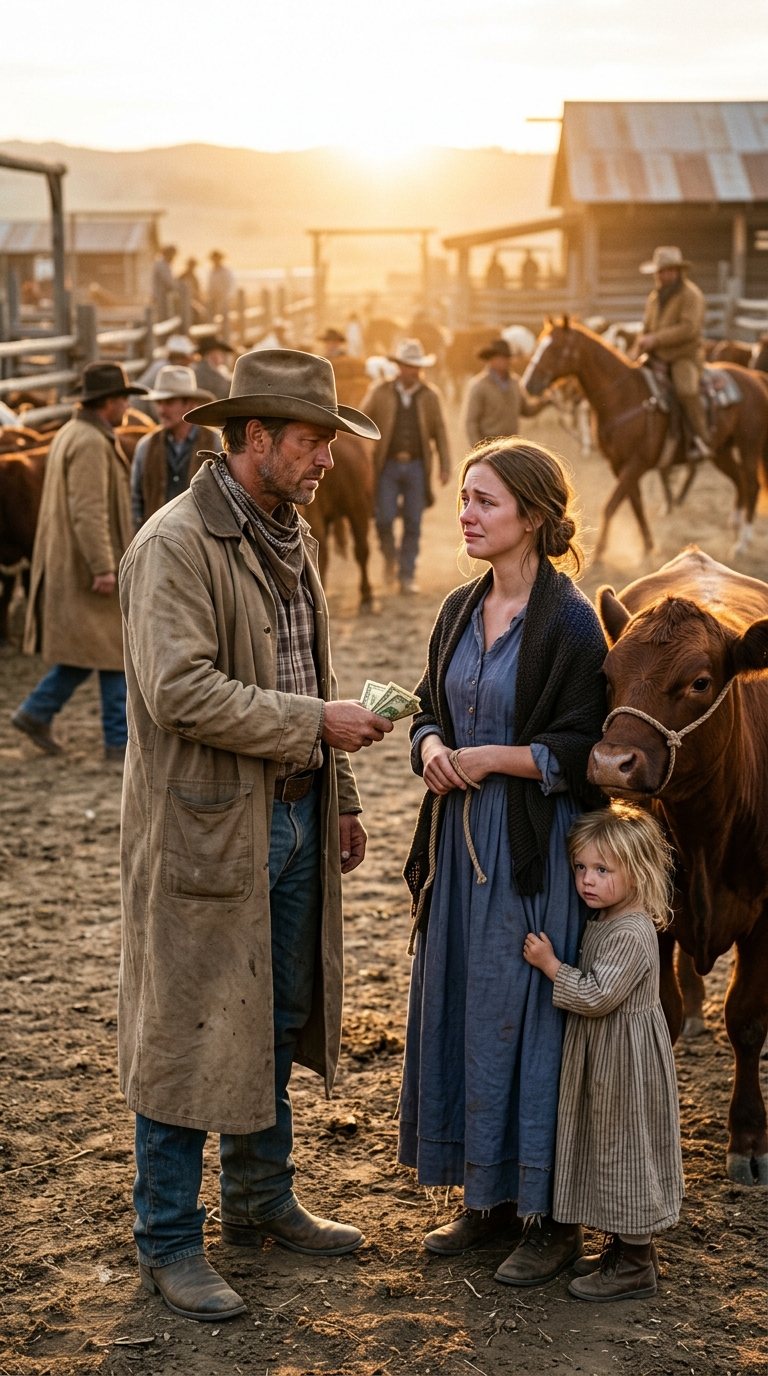
Her name was Rosario Mendoza, a widow for three years now. She was thirty-five, but exhaustion had put the shadows of an older woman in her eyes. Beside her stood Lupita, her eight-year-old daughter—skinny, serious, with enormous eyes that had learned to understand pain before words.
And between the two of them, tied with a worn rope, was Estrella, a small, gentle cow with a light-colored coat and noble eyes.
It was the last thing they had left.
Estrella had given them milk when there was no harvest, cheese when there was no money, and companionship when the house felt too empty since Tomás, Rosario’s husband, had died. But the debts had grown like weeds. The rain had come late. The corn had been lost. The bank was no longer waiting. And Don Aurelio Cárdenas, the richest man in the municipality, had begun circling her land like a vulture over a wounded animal.
Rosario stroked the cow’s neck. “Forgive me, little Estrella,” she whispered.
Lupita heard her and pressed herself against her skirt. “Mom… if they buy her, she won’t come back?”
Rosario swallowed hard. “No, my child.”
The girl looked down. She didn’t cry. That was what hurt Rosario the most. Lupita had already learned to hold back her tears so as not to worry her.
The auctioneer, a fat man with a thin mustache, struck a board with his hammer. “This dairy cow is up for auction! Good for a family, calm, healthy! Who’ll give three thousand pesos?”
A man raised his hand half-heartedly. “Two thousand.”
A few people chuckled quietly.
Rosario felt as if something was being torn from her chest. “Two thousand five hundred,” said another. “Three thousand,” added a third.
The bids rose slowly, too slowly. Men who knew of her misfortune pretended to evaluate Estrella as if she were just any animal. They looked at her legs, her teeth, her back. But none of them looked Rosario in the eyes.
Then he appeared.
He came down the main road, riding a dark horse. He was tall, with firm shoulders, a worn hat, a white shirt, and a denim jacket covered in dust. He didn’t look rich. He didn’t look important. But he walked with a calmness that made several people turn their heads.
His name was Santiago Rivera, though no one in the town knew it yet.
He approached without hurry. He looked first at the cow, then at Lupita, and finally at Rosario. It wasn’t a look of pity. It was something stranger: recognition.
The auctioneer continued: “Four thousand five hundred! Anyone give five?”
Santiago raised his hand. “Ten thousand pesos.”
The entire yard fell silent.
Rosario blinked, thinking she had heard wrong. The auctioneer also stood there with his mouth open. “Did you say ten thousand?” “That’s what I said.”
The murmurs spread like fire through dry straw. “He’s crazy.” “That cow isn’t worth half that.” “He must be a stranger.”
The auctioneer, afraid the man might change his mind, quickly struck the board. “Sold!”
The sound of the hammer made Lupita shudder. Rosario felt her legs weaken. The money would save part of the debt, maybe give them a few more weeks. But Estrella would be gone.
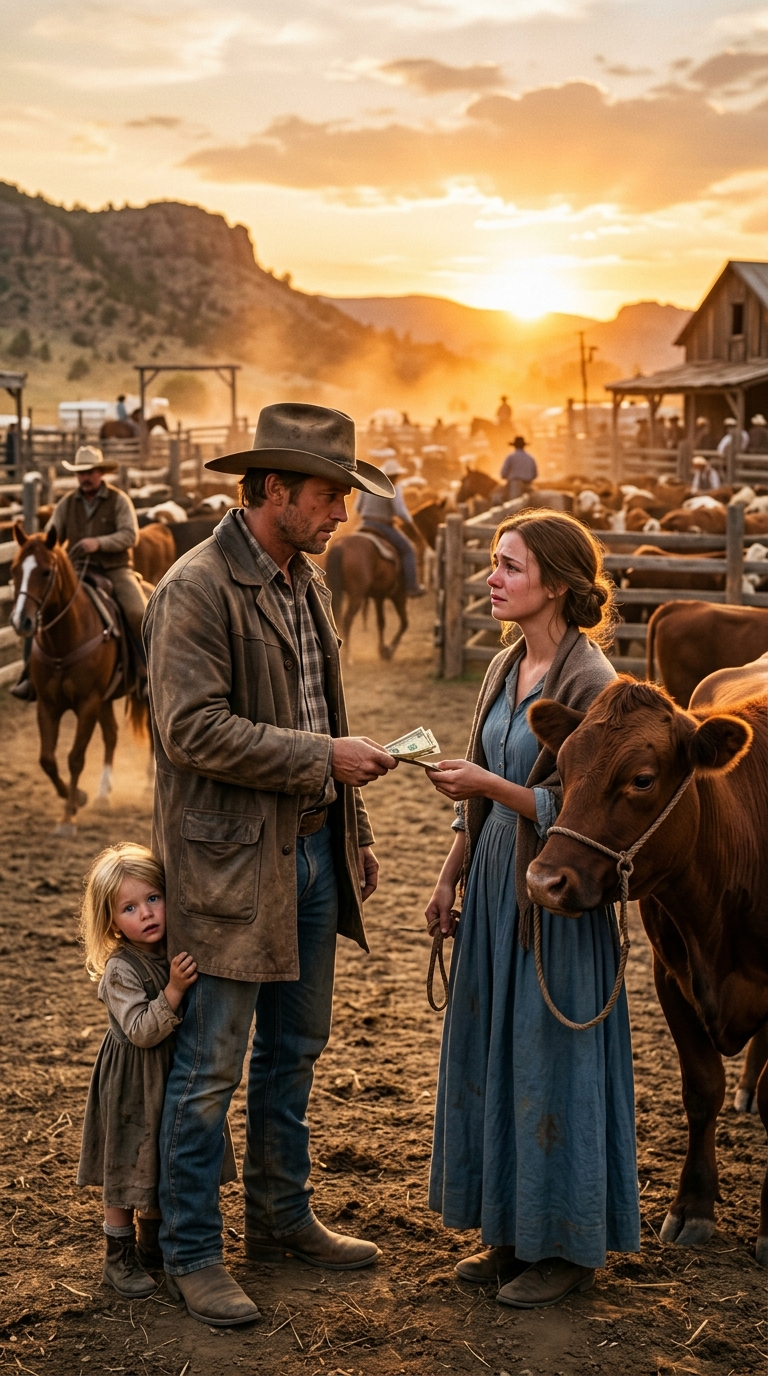
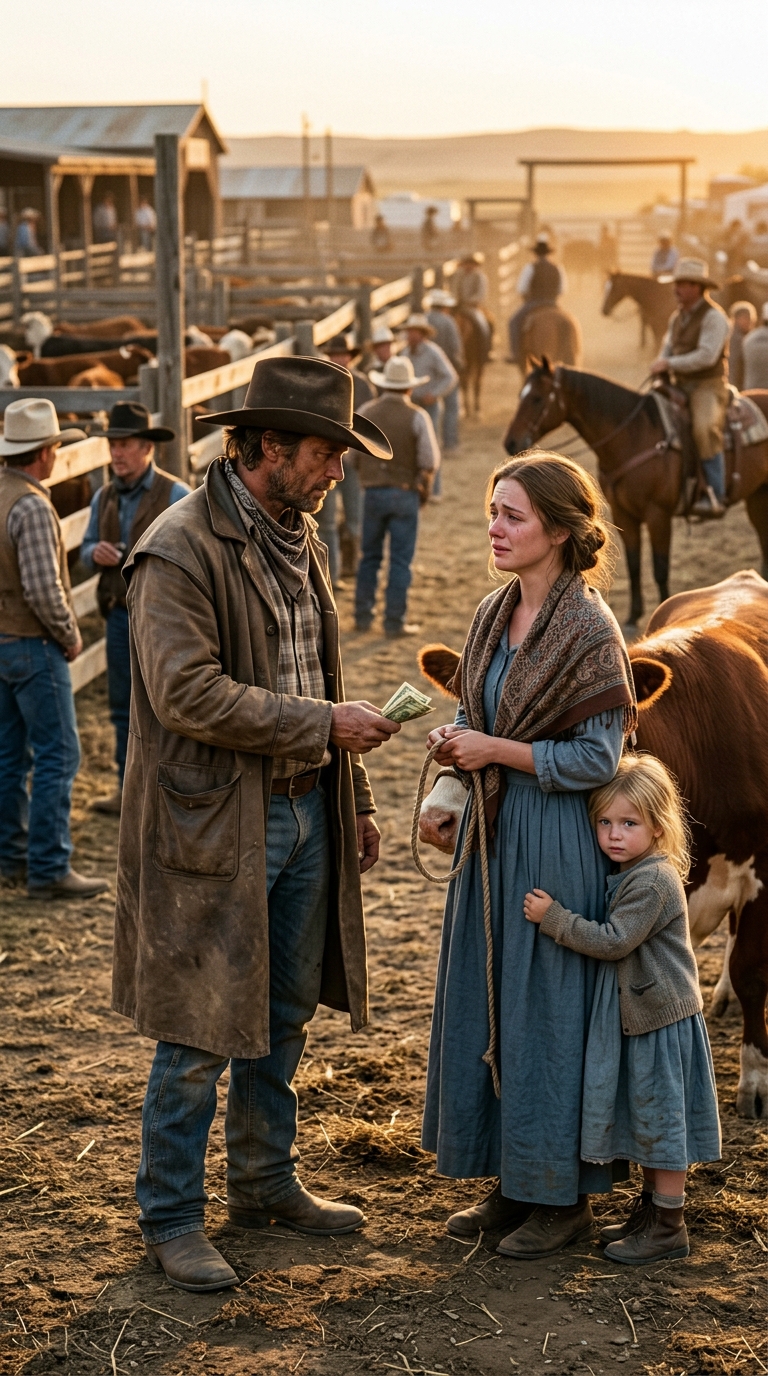
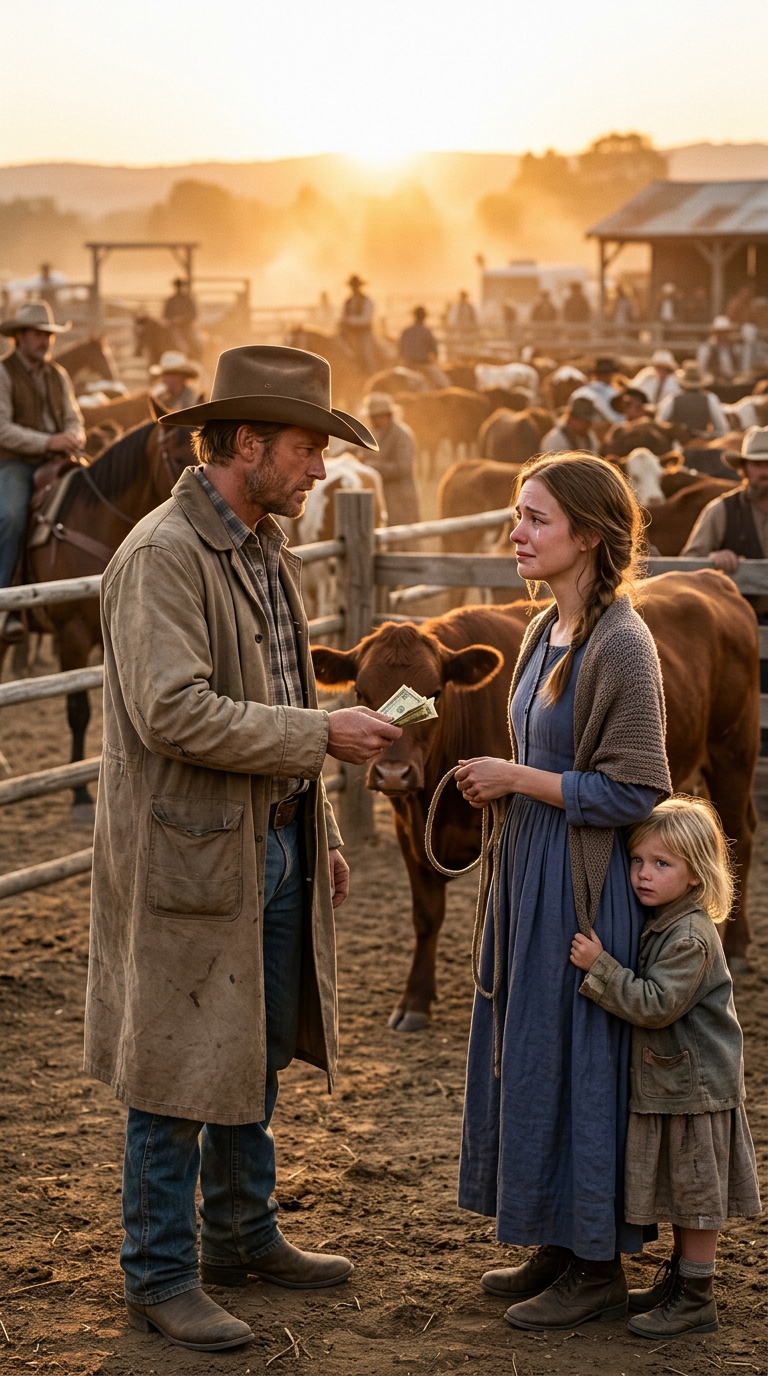
Santiago took folded bills from his pocket and handed them over. Then he walked toward Rosario and took the rope.
For a moment, she didn’t let go.
Their fingers brushed. He looked at her seriously.
Then he did something no one expected.
He placed the rope back in Rosario’s hands. “I didn’t buy her to take her away,” he said clearly. “I bought her so you wouldn’t have to lose her.”
Lupita’s eyes widened.
Rosario couldn’t speak.
The silence was so deep that even the wind seemed to stop.
PART 2: The Man Who Wasn’t Just Passing Through
“Why would you do something like that?” asked Rosario, distrusting kindness more than cruelty.
Santiago adjusted his hat. “Because they were going to pay you a pittance for something that’s worth more than money.”
“You don’t know me.” “I don’t need to know you to see when someone is being pushed to the edge.”
Rosario gripped the rope tightly. “I didn’t ask for help.” “I know,” he replied. “That’s why I gave it before you had to ask.”
Some neighbors were still watching. Others pretended to check tools, sacks, or chickens, but everyone was listening.
Then a heavy voice broke the moment. “What a nice show.”
Don Aurelio Cárdenas appeared by the gate. He was a broad man with a gray mustache and a gold ring. He wore a pressed shirt, expensive boots, and a smile without warmth. Two employees who looked more like bodyguards than workers walked beside him.
Rosario felt a chill run down her back. “Don Aurelio,” she said carefully.
He looked at the rope in her hands. “I understood the cow was being sold to cover part of what you owe.” “It was sold,” said Santiago. “The money has already been paid.”
Don Aurelio smiled. “But the cow is still here.” “Because the buyer decided to give her back to her.” “Things don’t work that way here, stranger.”
Santiago took a step forward. He didn’t raise his voice, but everyone noticed the change in his stance. “And how do they work?”
Don Aurelio took some folded papers from his jacket. “They work with agreements. With signatures. With debts. Mrs. Mendoza is behind. The cow was only part of it. Next comes the plot of land.”
Rosario felt Lupita press even closer to her. “You promised to give me until the end of the month,” said Rosario. “And there’s still time, of course. But the interest keeps running. Your late husband’s land is collateral.”
The name Tomás fell on Rosario like a stone.
Santiago looked at the papers. “May I see those?”
Don Aurelio let out a dry laugh. “And who are you to ask?”
Santiago didn’t answer right away. He reached into his jacket and pulled out an old, yellowish paper, folded carefully.
When he saw it, Don Aurelio’s face changed slightly. It was only for a second, but Rosario noticed it. “I came looking for this,” said Santiago. “And for you.”
The yard grew tense.
Don Aurelio narrowed his eyes. “I don’t know what you’re talking about.” “My mother’s name was Carmen Rivera,” Santiago continued. “She had a plot on the other side of the stream. Twelve years ago she lost it over a debt which, according to you, was never fully paid.”
Several neighbors exchanged glances. Some remembered Carmen: a good, hardworking woman who left the town suddenly one day. “That was legal,” said Don Aurelio.
Santiago held up the paper. “No. This proves the debt was settled. My mother kept the original receipt. But you presented another version, without the complete seal, and took her land.”
The murmuring exploded.
Don Aurelio took a step toward him. “Be careful what you say.” “I was careful for twelve years,” Santiago replied. “Today my patience ran out.”
Rosario felt something ignite inside her. For years she had believed her misfortune was just bad luck. But suddenly she understood the abandoned houses, the neighbors who left in silence, the plots of land that always ended up in the same man’s hands. “I wasn’t the only one,” she said, more to herself than to the others.
Santiago looked at her. “No.”
Don Aurelio tried to put the papers away. “This doesn’t prove anything.”
But then an old woman spoke from the crowd. It was Doña Meche, the town midwife. “I saw Carmen cry when they threw her out of her house.”
Another man raised his voice. “They changed the papers on my brother too.” “And on my compadre,” said someone else.
The fear began to break, piece by piece.
Don Aurelio looked around, realizing he no longer faced a single enemy, but a town that was beginning to remember its own anger. “All of you owe me something,” he threatened.
Rosario took a step forward, with Estrella beside her and Lupita holding her hand. “No,” she said, her voice trembling but firm. “We owe you money. Not our lives. Not our dignity. Not the land where I buried my husband.”
Lupita looked up at her mother as if seeing her become invincible for the first time.
Don Aurelio clenched his jaw. “This isn’t over.”
Santiago folded the receipt and put it away. “You’re right. Tomorrow we’ll go to the courthouse in Saltillo. And we won’t go alone.”
PART 3: What Is Saved When Someone Stays
The next day, San Jacinto del Monte did something it hadn’t done in years: it came together.
They arrived at the courthouse in old trucks, on horses, motorcycles, and even a tractor. Rosario carried a folder with Tomás’s papers. Santiago carried his mother’s receipt. Other neighbors brought contracts, copies, letters, receipts stained with humidity and fear.
Don Aurelio arrived with a lawyer, an expensive suit, and a calm smile. But that calm began to crack when the court secretary reviewed the documents and found the same issues in several cases: altered signatures, impossible interest rates, incomplete seals, changed dates.
The investigation lasted weeks.
During that time, Santiago stayed.
At first, he slept in Rosario’s barn because she didn’t want to accept more help than necessary. He repaired the fence, cleaned the well, fixed the roof before the first rains. He didn’t try to take Tomás’s place or enter the house as if he owned anything. He was simply there, with that quiet way of helping that didn’t humiliate anyone.
Lupita began to follow him around the corral. “Are you a real cowboy?” she asked him one afternoon. “More or less.” “And do you know how to talk to cows?”
Santiago looked at Estrella, who was calmly chewing. “They don’t talk much, but they understand a lot.”
Lupita smiled for the first time without fear.
Rosario watched from the doorway and felt a lump in her throat. It wasn’t love yet. It was something more delicate: the possibility of resting.
A month later, the judge suspended all of Don Aurelio’s claims while the frauds were investigated. Then came more evidence. And then the fall.
Don Aurelio was arrested for forgery, breach of trust, and dispossession. His employees talked. His lawyer stepped aside. The irregularly acquired lands began to be reviewed one by one.
Rosario’s plot was protected.
Carmen Rivera’s land—Santiago’s mother’s—was also recognized as having been stolen. But when they asked if he wanted to recover it to sell and leave, he looked toward the hills, toward the town where he had been born and had suffered, and then looked at Rosario and Lupita. “No,” he said. “I want to farm it.”
That season the rain came late, as always, but it came. The water fell on the open furrows, on the tin roofs, on the earth that had seemed dead and was only waiting for another chance.
Rosario never sold Estrella again.
With the milk they made fresh cheese. With the cheese they paid small debts. With the help of the neighbors, they set up a cooperative so that no one would ever have to sell the last thing they loved because of a powerful man.
One afternoon, as the sun set red behind the mesquite trees, Lupita ran across the corral shouting: “Mom! Estrella is going to have a calf!”
Rosario brought her hands to her mouth and cried. But this time it wasn’t from fear.
Santiago was a few steps away. He didn’t say anything. He just smiled.
Rosario walked over to him. “That day at the auction,” she said, “I thought you had come to take away the last thing I had left.” “And I thought I had only come to seek justice for my mother.” “What did you find?”
Santiago looked at Lupita hugging Estrella, looked at the old house with the repaired roof, looked at the damp earth that smelled of life. “I found a place to stay.”
Rosario looked down, moved. “I don’t promise it will be easy.” “I’ve never trusted easy.”
She smiled.
The wind stirred the dust on the road, but this time it didn’t seem like a sign of abandonment. It seemed like the beginning of something new.
Months later, when the calf was born, Lupita wanted to name it Milagro.
No one argued with the name.
Because in San Jacinto del Monte everyone knew that the story hadn’t started with a cow being sold, but with a woman who thought she had lost everything, a man who decided not to look the other way, and a town that finally remembered that fear becomes small when people stand up together.
And from then on, every time someone passed by Rosario’s corral, they saw Estrella grazing peacefully next to her calf.
And they understood that some things, when defended with the heart, are never sold.
