

The smell of wet earth always reminded her of Aurelio.
It was no longer a memory that tore her apart as it once had. It was no longer an open wound, but an old scar: touching it no longer brought back the pain of the cut, only the memory of having survived.
Mercedes Salinas was forty-two years old. She had a simple house in Atotonilco, a small cornfield, and an eight-year-old daughter named Sofía, who that afternoon was doing her homework in the kitchen while the rain finished dripping from the roof tiles. Three years earlier, Aurelio, her husband, had died of a heart attack in the middle of the field. Since then, Mercedes had learned to keep living without making noise: planting, washing, cooking, paying debts, comforting her daughter, and going to bed each night with the feeling that silence could also weigh heavily.
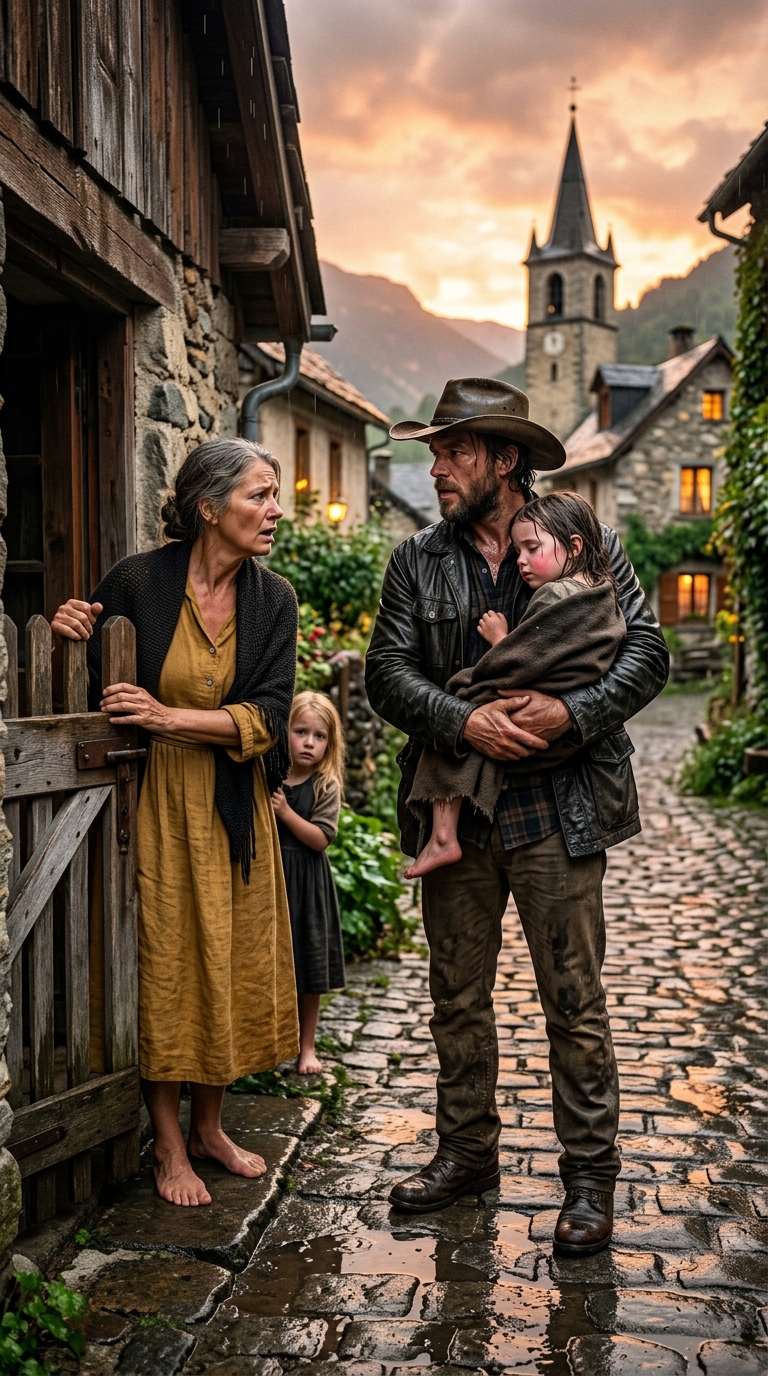
That afternoon, after a storm that had lasted since dawn, Mercedes was hanging clothes in the patio when she heard a knock at the gate.
It was not a loud knock. It was a tired knock, as if the person knocking had used their last strength to get there.
Mercedes left the sheet in the basket, wiped her hands on her apron, and went to open it.
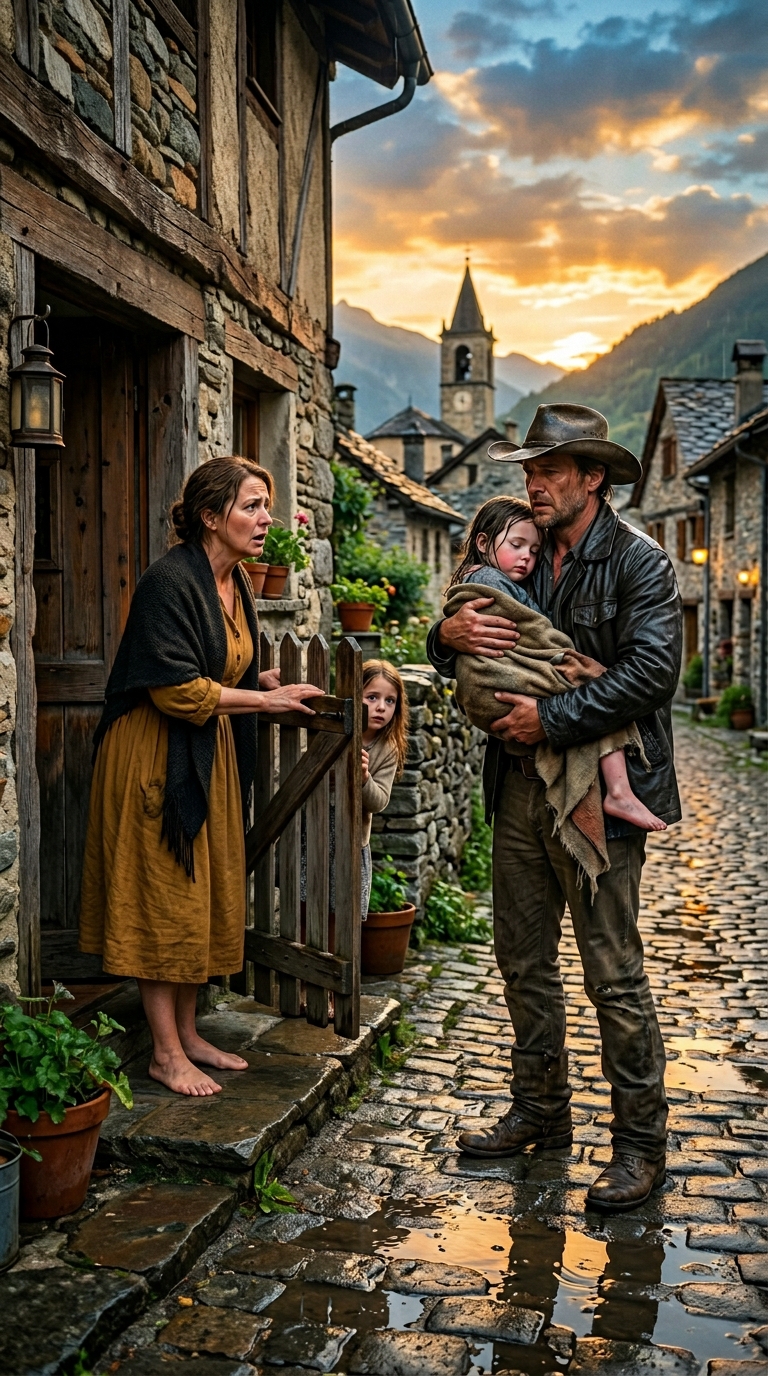
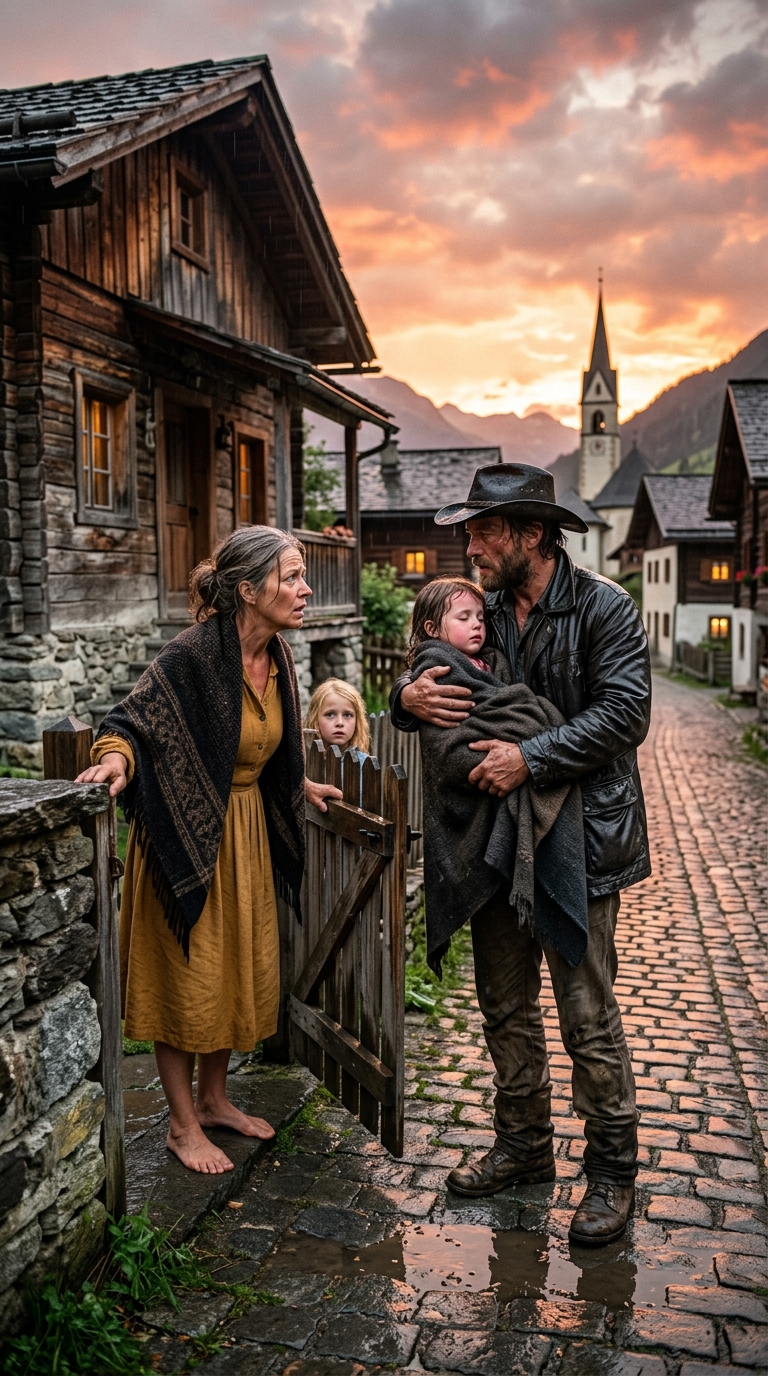
On the other side stood a soaked man.
He looked about forty-five, though exhaustion made him seem much older. He was tall and thin, with several days’ worth of beard and an old backpack slung over his shoulder. But what made Mercedes open the gate wide was the little girl he was carrying in his arms, wrapped in a wet jacket.
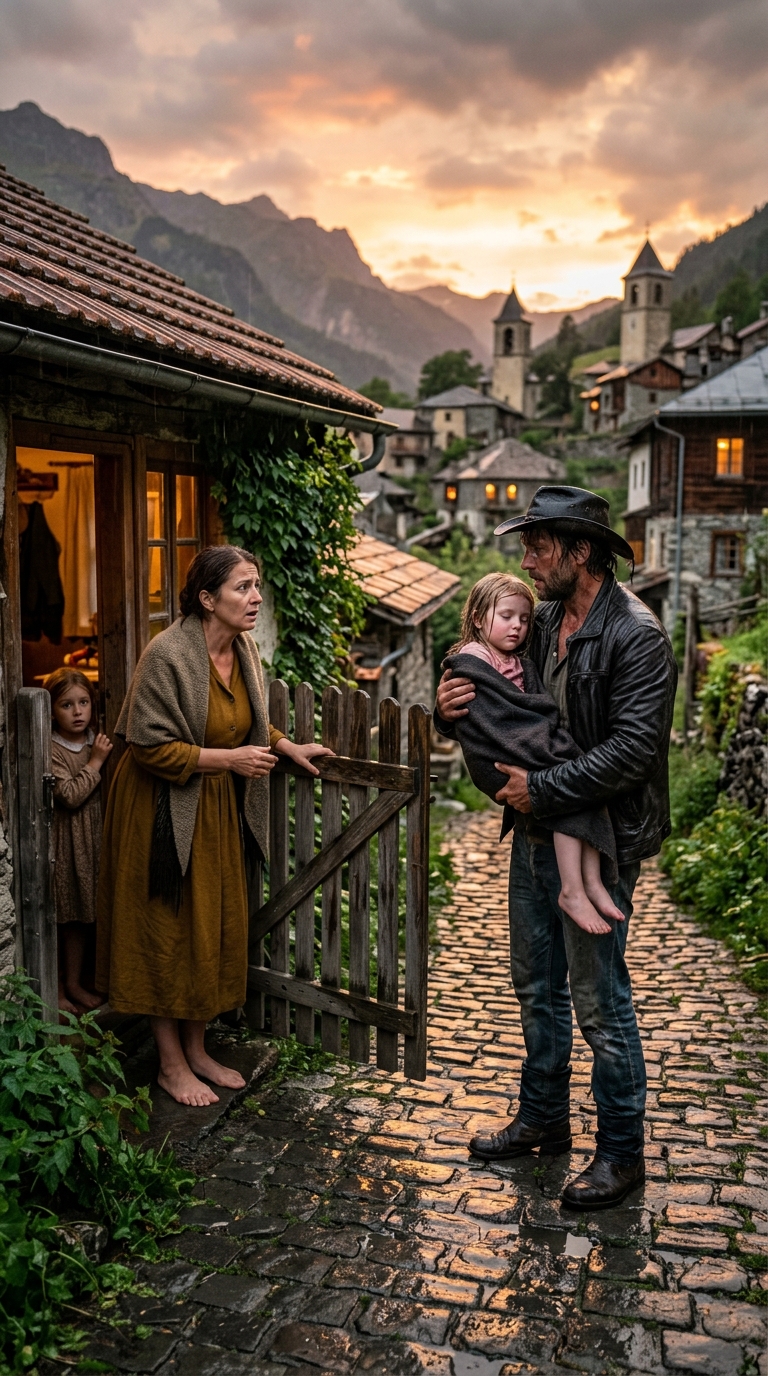
The child had a pale face, black hair stuck to her cheeks, and dry lips. She was breathing quickly, with a trembling that did not seem like sleep but fever.
“Forgive me, ma’am,” the man said in a hoarse voice. “My daughter has been sick for two days. We were coming from San Ignacio to see the doctor, but the stream rose and the bus stopped running. We walked… and the storm caught us. I saw your house and…”
He did not finish the sentence. He did not need to.
Mercedes looked at the girl, then at the man.
“Come in.”
His name was Rodrigo Estrada. The girl’s name was Valentina. She was four years and eleven months old—he said it with the precision of parents who count every month as a victory.
Mercedes took them to the living room, laid Valentina on the sofa, and touched her forehead. She was burning up. She checked her throat, her ears, her breathing. Her right ear was inflamed and the fever was rising too high.
“When did it start?”
“The day before yesterday. First she said her ear hurt. Then the fever came. Today she barely ate.”
Mercedes did not waste time. She heated water, prepared a willow bark infusion with honey, brought a damp cloth, a thick blanket, and a small bottle of warm oil, just as her mother had taught her.
Rodrigo watched her in silence, his eyes fixed on every movement.
“You have a gift for this,” he murmured.
Mercedes placed the cloth on the girl’s forehead.
“I had a mother who knew about plants, a daughter who got sick often, and a husband who used to say that taking good care of someone is a way of loving.”
Rodrigo lowered his gaze.
“Is your husband not here?”
Mercedes kept looking at Valentina.
“He died three years ago.”
Silence fell between them—not awkward, but respectful.
“Valentina’s mother left when she was a year and a half old,” Rodrigo said afterward. “She didn’t die. She left.”
Mercedes understood. There are absences that are buried, and others that keep walking through the world, but hurt just the same.
A short while later Sofía arrived, her shoes full of mud and her backpack hanging from one shoulder.
“Mom, the road is awful…” She stopped when she saw the strangers.
Mercedes explained quickly. Sofía looked at Valentina, then went to her room and returned with her favorite blanket—the colorful one she never lent to anyone.
She laid it over the sick girl.
“So she gets warmer,” she said very seriously.
Something broke in Rodrigo’s face.
“Thank you, sweetheart.”
“My name is Sofía. Are you her dad?”
“Yes.”
“And her mom?”
Mercedes was about to intervene, but Rodrigo shook his head gently.
“Her mom couldn’t stay with us.”
Sofía nodded with a maturity that hurt.
“My dad couldn’t stay either. But my mom says that the people who love us are still here, even if we can’t see them.”
Rodrigo looked at Mercedes.
“Your mom is very wise.”
Sofía smiled sideways.
“Yes, but I don’t tell her that often because then it goes to her head.”
Mercedes let out a laugh—a clean, unexpected laugh that seemed to light up the living room more than any lamp.
As evening fell, Valentina’s fever began to drop. Mercedes knew it before touching her forehead, because the girl’s breathing became calmer. Rodrigo closed his eyes for a few seconds, as if he could finally release the fear he had been carrying for days.
“I don’t know how to thank you,” he said.
“You don’t have to thank me for anything. Anyone would have done it.”
He looked at her with sadness.
“Not anyone.”
And Mercedes understood that before reaching her door, Rodrigo had found other doors closed.
That night, since the road was still flooded, Mercedes let them stay. She gave Rodrigo dry clothes that had belonged to Aurelio and that she still kept in the closet without knowing why. When he came out wearing that blue shirt, Mercedes felt a blow to her chest. Not because Rodrigo looked like Aurelio, but because life sometimes uses old things to open new doors.
They had chicken soup with freshly made tortillas for dinner. Rodrigo told them he had lost his ranch to debts, that he had sold animals, tools, and almost everything he owned. He was coming to town to look for work, any work.
“I know about the land, animals, fences, repairing things,” he said. “I don’t know much else, but I know that well.”
Mercedes listened without interrupting.
“Don Fermín is looking for a helper on his ranch,” she said at the end. “He doesn’t pay much, but he pays fairly.”
Rodrigo looked up.
“And would he accept someone with a little girl?”
“Don Fermín has six grandchildren. I don’t think that would scare him.”
The next morning, Rodrigo went to see him. Mercedes spent the day restless, though she did not want to admit it. Valentina stayed with her and Sofía, chasing chickens in the patio as if the fever had been a bad dream.
At dusk, Rodrigo returned.
He was not smiling, but his eyes carried a different light.
“He gave me the job,” he said. “And a small room on the ranch for Valentina and me.”
Mercedes felt relief. She also felt something else she did not want to name.
“So you’re no longer lost.”
Rodrigo looked at his daughter, who was playing with Sofía.
“No. I think we’re not anymore.”
That was how the mornings began.
Rodrigo would leave Valentina at Mercedes’ house before going to the ranch. Sofía would go to school, and Mercedes would stay with the little girl, who turned out to be a child of endless questions.
“Why do chickens have wings if they hardly fly?”
“Why does the sky change color?”
“Why do you have a photo of a man who doesn’t live here?”
Mercedes looked at the photograph of Aurelio on the table.
“Because he was my husband.”
“Did he leave like my mom?”
“No. He didn’t want to leave. His heart got tired.”
Valentina thought for a moment.
“My dad gets sad about my mom, even though he doesn’t say it. I hear him breathe differently when he thinks I’m asleep.”
Mercedes felt a lump in her throat.
“And does it make you sad?”
The girl hugged her old doll.
“Yes. But less when I’m here.”
Months passed. Rodrigo worked well—so well that Don Fermín soon said that men like him were not easy to find. On Saturdays, Rodrigo would come to Mercedes’ house under the pretext of bringing Valentina to play with Sofía. But he always ended up fixing something: a fence, a faucet, a door, the roof gutter.
Mercedes began preparing coffee for two without thinking about it. Rodrigo began staying longer without announcing it.
And in the town, as always, other people’s mouths woke up before the truth.
Mrs. Remedios, famous for turning gossip into judgment, began saying at the store that Mercedes was letting an unknown man into her house, that a widow should protect her reputation, that who knew what intentions this Rodrigo had.
Mercedes heard the rumor from Doña Lupita, her neighbor, who told her with good intentions and great delight in the drama.
That same afternoon, Mercedes went to the store.
She bought sugar, soap, and coffee. Then, in front of everyone, she looked at Remedios.
“That man arrived at my door with a sick little girl in his arms. I let him in because it was the right thing to do. He comes back because he is a good person and because my daughter and I are happy to see him. If that seems indecent to you, I’m sorry you have so little joy in your life.”
No one said anything.
Mercedes left with trembling hands but with her back straight.
That night she told Rodrigo everything. He listened without interrupting. Then he asked:
“What do you feel?”
Mercedes had expected another question. What did people say? What are you going to do? What are we going to do?
But he asked the only thing that mattered.
“I’m scared,” she confessed. “Not of the people. Of this. Of something starting and then leaving.”
Rodrigo lowered his voice.
“I’m scared too. But I know Valentina sleeps peacefully when she comes here. I know I come to this house and a weight I carry all day lifts. And I know I don’t want to stop feeling that.”
Mercedes looked at him.
“Neither do I.”
Christmas arrived with posadas, fireworks, and the smell of punch. Rodrigo and Valentina spent Christmas Eve at Mercedes’ house. It was not a planned decision. Simply, when the day came, everyone knew they should be there.
After dinner, the girls fell asleep together. Mercedes and Rodrigo went out to the patio under a sky full of stars.
“I want to ask you something,” he said.
Mercedes felt her heart beating slowly.
“I’m not asking you to forget Aurelio,” Rodrigo continued. “I’m not asking you to be Valentina’s mother. She has a mother, even if she’s not here. I’m only asking you to let me stay. Without hurry. Without big promises. Just stay.”
Mercedes smiled with moist eyes.
“You’ve been fixing what breaks in this house for months.”
“It’s what I know how to do.”
“And I’ve been making coffee for two for months without anyone asking me to.”
Rodrigo smiled.
“Then I think we had already decided.”
“We just needed to say it.”
Two years later, Mercedes’ house was still the same: the cream-colored walls, the avocado tree in the patio, the noisy chickens, and the photo of Aurelio in the living room.
But now there was another photo next to it.
Not on top. Not instead of. Next to it.
In the new photo were Mercedes, Rodrigo, Sofía, and Valentina on the day of a posada. No one posed well. Everyone was laughing. It was one of those images where happiness does not seem prepared, but caught by surprise.
Rodrigo had set up a small workshop at the back of the property. He repaired tools, doors, wheelbarrows, engines, and everything the neighbors brought. They were not rich, but they lived with enough, which is sometimes a greater blessing than abundance.
Sofía, at ten years old, said she would be a doctor. Valentina, almost seven, kept asking impossible questions.
One February afternoon, Rodrigo sat down next to Mercedes in the patio.
“Sometimes I think about that storm,” he said. “If you hadn’t opened the gate…”
Mercedes set her sewing on her lap.
“But I did open it.”
“Why?”
She looked at the damp earth near the avocado tree. That smell still reminded her of Aurelio. But it no longer hurt the same way.
“Because there are moments in life when you can do what is safe or you can do what is right. And when the two are not the same, you have to choose the one you can live with afterward.”
Rodrigo took her hand.
“That day I thought I couldn’t go on alone anymore.”
Mercedes rested her head on his shoulder.
“You don’t have to go on alone anymore.”
From inside came the laughter of the girls.
And Mercedes understood, with a deep peace, that loving again did not erase what had been loved before. That some lives do not come to replace, but to accompany what remains. That kindness is not kept; it is passed from hand to hand, like a blanket on a cold afternoon.
Aurelio had taught her to open the door.
She was teaching it to Sofía.
And someday, perhaps, Sofía would teach it to someone else.
Because sometimes the most beautiful life begins like this: with rain, fear, a sick little girl in someone’s arms… and a door that someone decided not to leave closed.
