

The Day a Pair of Shoes Found Their Way Home
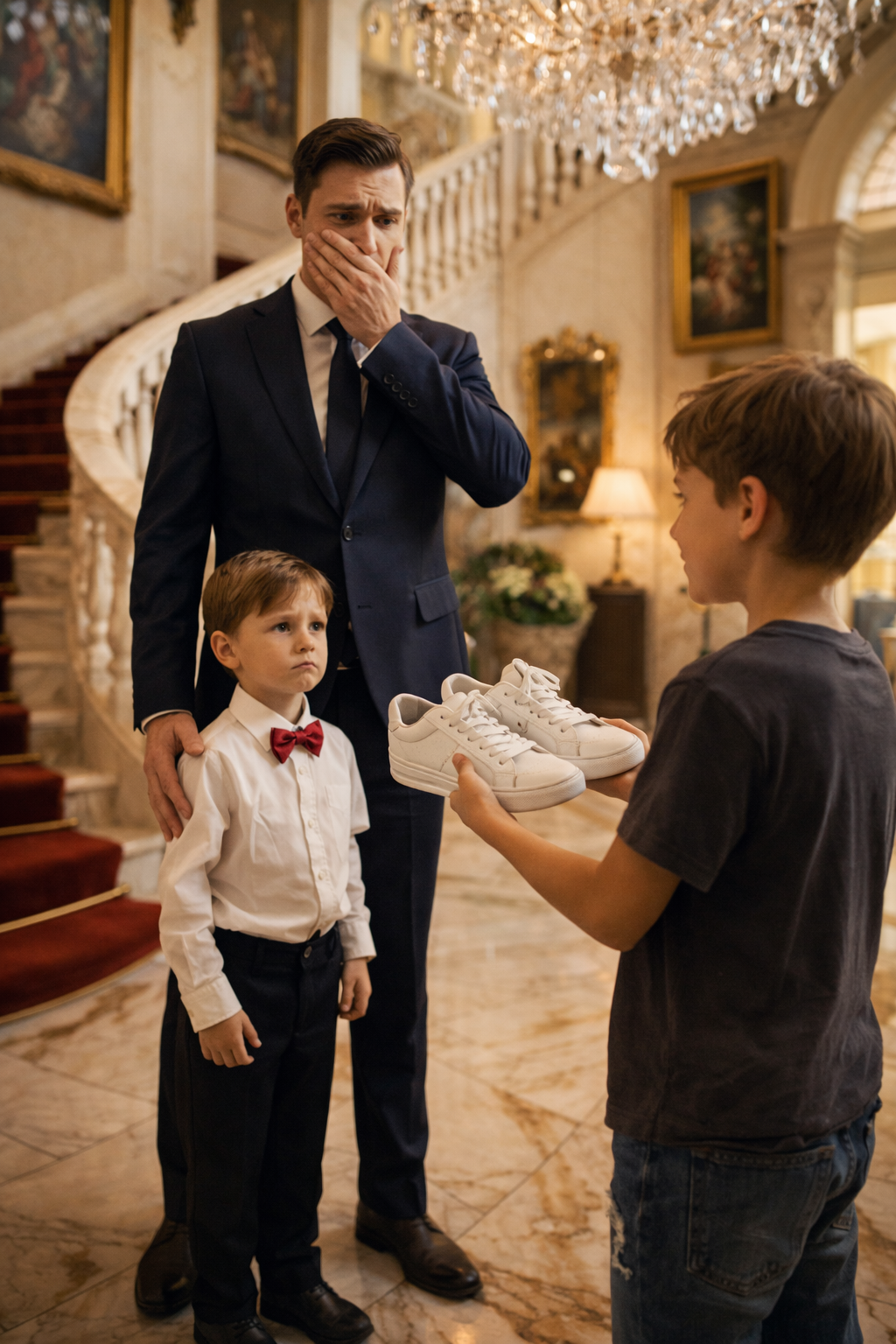
When a knock echoed at the front door, it was so faint and uncertain that Nathaniel Brooks nearly brushed it off as nothing more than the wind moving through the old oak tree outside his entryway—the same oak that had stood long before he ever bought the house. He stood in the marble-floored foyer, still in his tailored suit, a glass of amber liquid warming slowly in his hand. The day’s meetings had blended together, each one empty and repetitive, leaving him drained yet restless. Then the knock came again.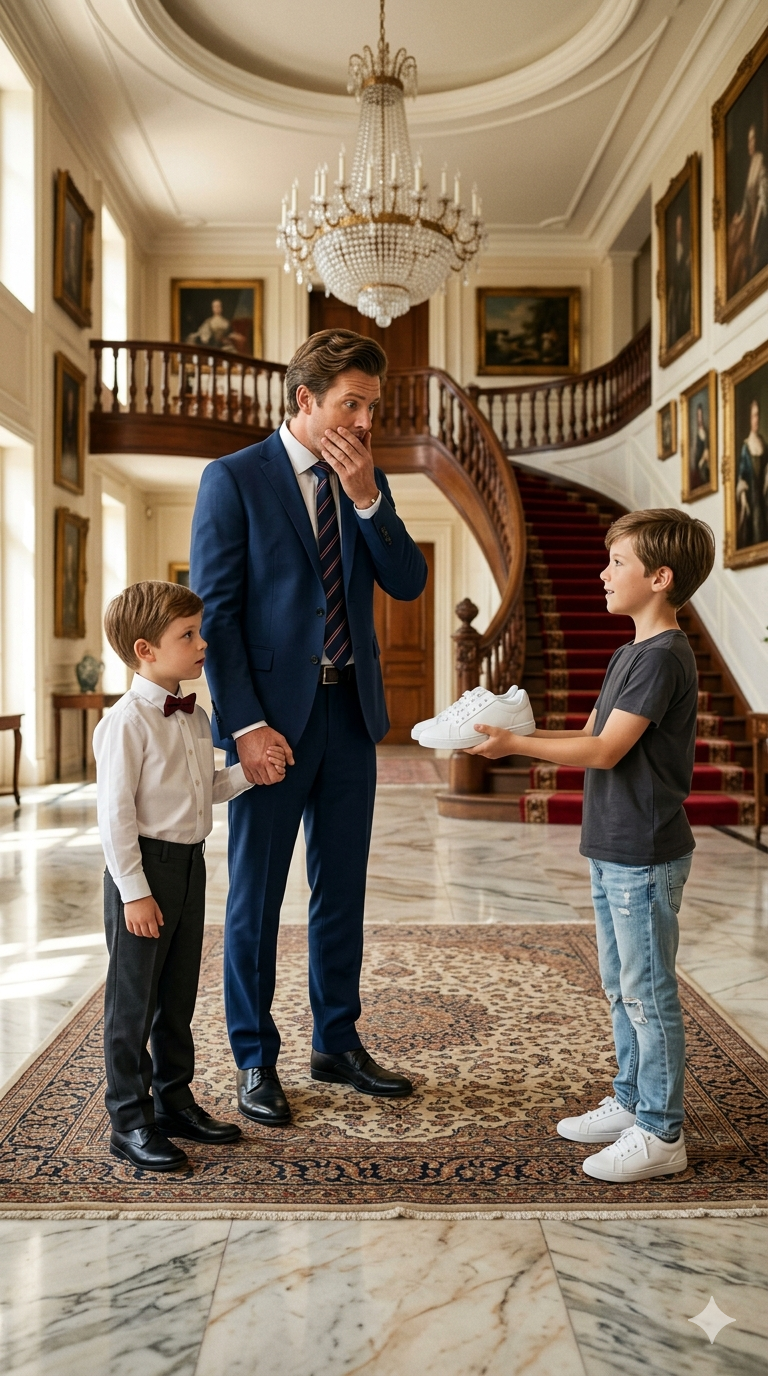
This time, it was clearer—still hesitant, but undeniably real.
Nathaniel walked to the door and opened it. A boy stood on the cold stone steps, no older than nine. He was barefoot. The knees of his jeans were worn thin, and his faded T-shirt was marked with dust and grass. In his hands—held carefully, almost respectfully—was a pair of clean white sneakers. They looked far too new for him. The laces were tied neatly together.
“Sir,” the boy said, his voice steady despite the tension in his shoulders, “your son gave me these at school, but my mom says I can’t keep them.”
For a moment, Nathaniel forgot how to breathe.
It wasn’t the boy’s clothes. It wasn’t the quiet dignity in how he stood there.
It was his eyes.
Warm amber. Framed by lashes too long for any child. Eyes Nathaniel had once memorized in another face, in another life—eyes he believed had been lost forever. His fingers loosened. The glass slipped from his hand and shattered against the marble floor behind him, the sharp sound echoing. Six-year-old Caleb, standing halfway down the hallway, jumped in surprise.
“Dad? What happened?”
Nathaniel didn’t answer.
He couldn’t. His gaze stayed fixed on the boy at the door. “What’s your name?” he asked, the words scraping painfully from his throat.
“Eli,” the boy replied. “Eli Carter.”
The surname hit him like a second shock.
Ten years earlier, his mother had stood in the rain-soaked doorway of his apartment and told him—gently, carefully—that Marianne Carter had left with someone else. That there had been an accident weeks later. That there was nothing left to do but move on. He had believed her.
Believing her had been easier than questioning everything he had been taught about loyalty, family, and obedience. “Dad?” Caleb tugged at his sleeve. “That’s my friend from school. He didn’t have shoes today, so I gave him mine. The teacher said I shouldn’t, but he needed them more than I did.”
Nathaniel looked down at his younger son—the child who had inherited a kindness he himself had buried beneath years of silence and bitterness.
“You did the right thing,” he whispered, kneeling in front of Eli. “You really did.”
He slipped off his suit jacket and gently placed it over the boy’s shoulders, even though the air was mild.
“Where do you live?” he asked softly. “On Maple Row,” Eli replied. “Near the old sewing shop.” Nathaniel closed his eyes briefly.
Maple Row was nearly an hour away—a place most people in his world preferred to ignore.
“Does your mom know you came here?”
Eli blinked quickly and shook his head.
“She’ll be upset,” he admitted. “But I had to bring the shoes back. We don’t take things that aren’t ours.” Something inside Nathaniel broke—quietly, but completely.
“Come on,” he said as he stood. “I’ll take you home.”
A Door That Should Never Have Been Closed
The drive passed in near silence. Caleb kept glancing at Eli through the rearview mirror, curiosity clear in his eyes. Eli spoke politely about school, homework, and the small house with the blue door that once belonged to his grandmother.
Nathaniel barely listened.
His thoughts raced backward—through years he had tried to forget.
When they arrived in front of the modest house, his hands trembled on the steering wheel.
“This is it,” Eli said politely. “Thank you, sir.” Wait,” Nathaniel said, his voice barely above a whisper.
Before he could continue, the front door opened.
She stood there.
Marianne Carter.
Thinner than he remembered. Fine lines traced her face. Her hands showed years of hard work.
But she was unmistakably the same woman who had once laughed with him over burnt coffee and impossible dreams. “Eli!” she exclaimed, relief flooding her voice—only to shift into fear when she saw the unfamiliar car and the man stepping out. “What are you doing here?”
Her gaze locked onto Nathaniel.
All the color drained from her face.
“Stay away from my son,” she said sharply, pulling Eli closer.
“Marianne,” Nathaniel said carefully, “please. I need to understand.”
She let out a bitter laugh.
“Understand? After ten years?”
Eli looked between them, confused.
“Mom, he just brought me home,” he said quickly. “He didn’t do anything wrong.”
Marianne’s jaw tightened.
“Go inside,” she told her son firmly. “Now.”
When the door closed behind him, she crossed her arms as if bracing herself.
“Your mother paid me to disappear,” she said flatly. “She told me you knew. She said you agreed.”
Nathaniel felt the ground shift beneath him.
“That’s not true,” he said. “I never signed anything. I was told you left me.”
Marianne searched his face for deception.
She found none.
Only the same pain she had carried alone for ten years.
“Go,” she said finally. “And don’t come back.”
A Mother’s Lies
Nathaniel didn’t return home that night.
Instead, he drove straight to the estate where his mother, Evelyn Brooks, lived among manicured gardens and quiet judgment.
He found her in the sunroom. Pearls rested neatly at her throat. A porcelain cup of tea sat beside her.
“What did you do to Marianne?” he asked without greeting.
This time, she didn’t pretend.
“I protected you,” she replied calmly. “She wasn’t suitable. When I learned she was expecting, I handled it.”
“You knew?” His voice trembled.
“Of course.”
The truth unfolded simply—and coldly.
Forged signatures.
Paid threats.
Lawyers hired to ensure silence.
“You stole ten years from me,” Nathaniel said, forcing steadiness. “And from my son.”
“You have Caleb,” she replied coolly.
“No one replaces a lost childhood,” he answered.
And then he walked away without another word.
Letters That Refused to Stay Silent
A week later, Marianne found a box on her doorstep.
Inside were letters.
Dozens of them.
Unsent.
Returned.
Marked undeliverable.
Her name written across each envelope in Nathaniel’s unmistakable handwriting.
That night, she let Eli read them aloud.
He read about longing.
About confusion.
About grief that had never settled.
When he finished, he looked up at her.
“He missed you,” Eli said softly. “Just like you missed him.”
For the first time in years, Marianne allowed herself to consider that she might have been wrong.
Choosing Truth
Their meeting at the café lasted for hours.
There were no dramatic apologies.
No easy forgiveness.
Only honesty.
“I want to be Eli’s father,” Nathaniel said quietly. “But only if you let me earn it.”
“Then walk away from everything she gave you,” Marianne replied steadily. “Show me you choose us.”
“I already have.”
When Power Fails
Evelyn’s response was swift—and ruthless.
Legal papers arrived accusing Marianne of neglect, filled with carefully crafted lies supported by bought testimony.
But money leaves evidence.
Their lawyer followed every trail.
And in court, one simple truth could not be denied.
A letter written in uneven handwriting by two boys.
“Dear Judge,” it read, “we want to be brothers.”
The ruling came just days later.
Marianne kept her son.
An official investigation began.
Where Shoes Become Symbols
A year later, the old estate looked nothing like before.
The once-perfect garden grew freely and full of life. The walls echoed with laughter instead of silence.
At the wedding, two boys walked barefoot across the grass, each carrying a red velvet cushion with a ring resting on top.
“Why no shoes?” someone whispered.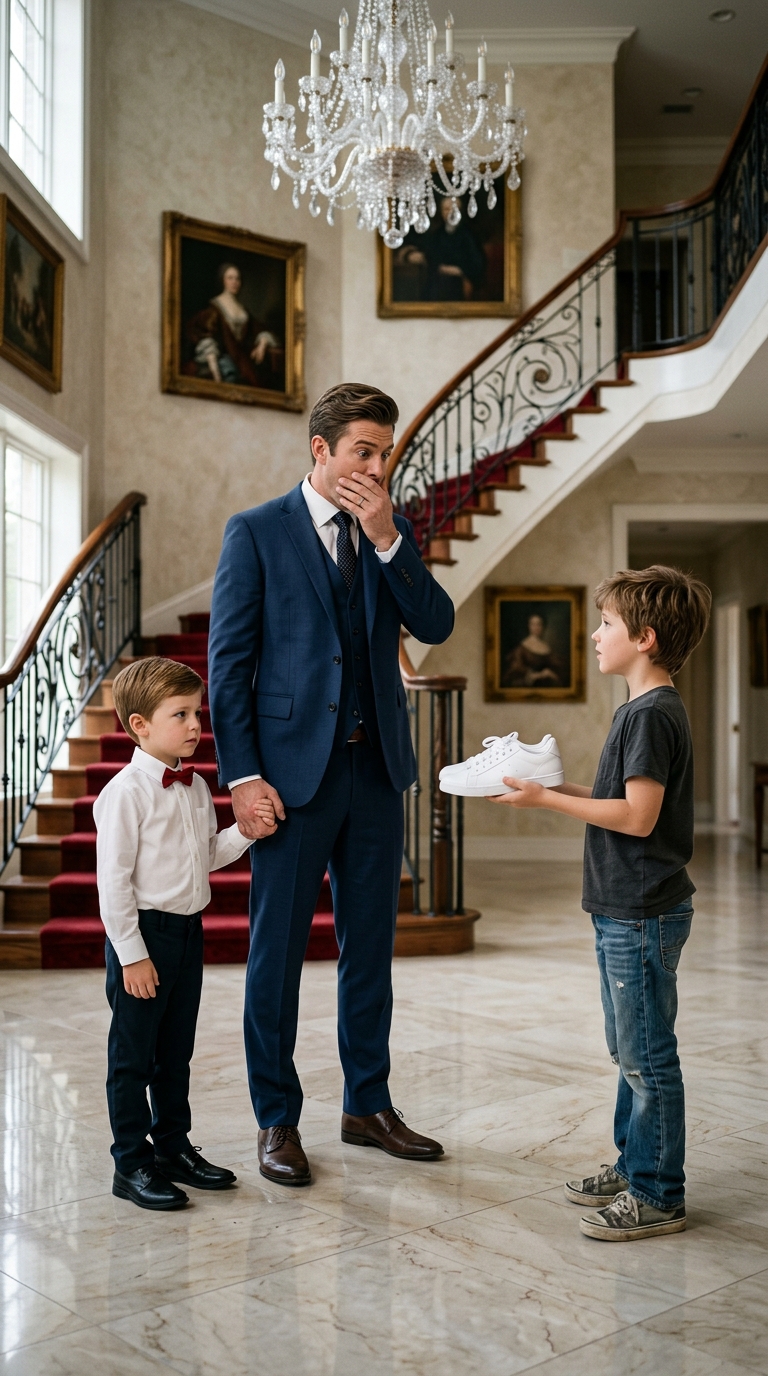
“Because that’s how it all began,” another voice replied gently.
Nathaniel looked at Marianne and smiled.
Sometimes, the smallest gestures find their way back home.
And when they do, they bring with them everything we thought we had lost.
