

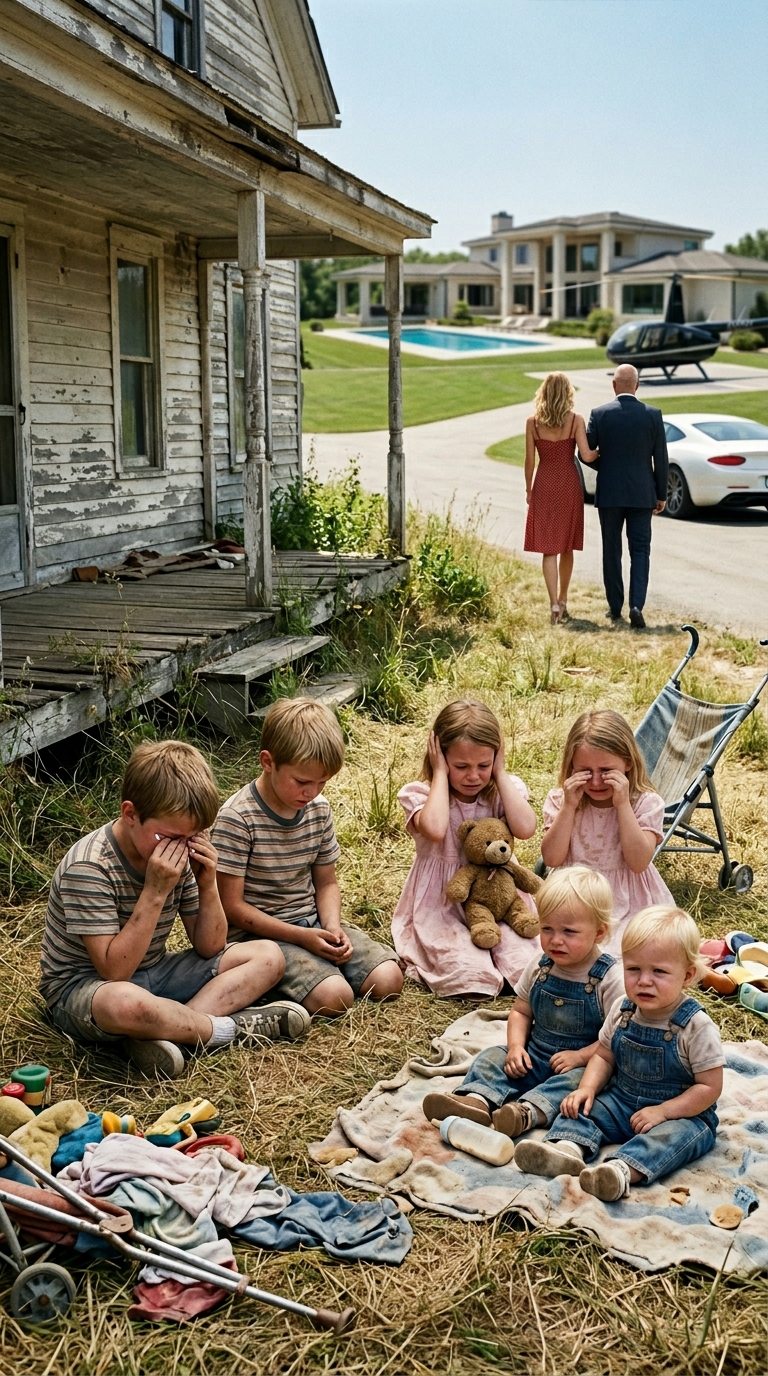
The morning Vanessa Carter walked out, the house still carried the scent of warm milk, toasted bread, and the menthol rub she had applied to the youngest boys’ chests the night before.
No one believed a mother could leave six children in less time than it took to brew a pot of coffee.
In a quiet neighborhood on the outskirts of San Antonio, Texas, everyone knew the small faded blue house—laundry always hanging outside, backpacks scattered on the porch, and the sound of laughter mixed with crying from morning until night.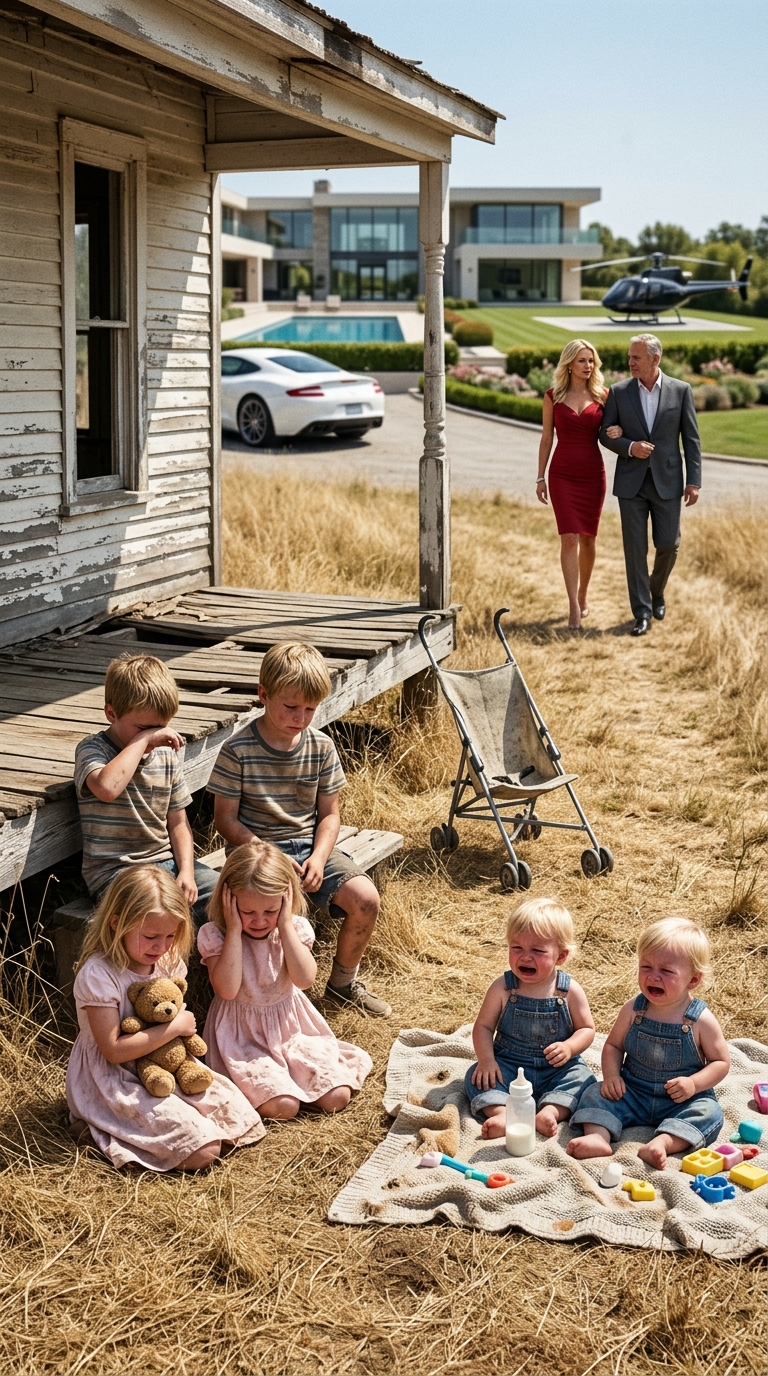
Inside lived Daniel and Emma, the eldest twins, eleven years old.
Then came Sophie and Sadie, seven—so alike even their father sometimes confused them when they ran barefoot through the yard.
And the youngest, Noah and Nathan, just three, still speaking in broken phrases, still reaching for their mother out of habit.
Three sets of twins.
Six children.
One exhausted household.
And a mother who, for years, smiled in photos as though exhaustion wasn’t slowly draining her from within.
That morning, Michael Carter had already left before sunrise for his job at an auto repair shop.
Vanessa stayed home with the children, as she always did.
But something was different.
She didn’t prepare breakfast.
She didn’t braid the girls’ hair.
She didn’t scold Daniel for leaving notebooks scattered across the table.
She didn’t lift Noah when he began to cry.
Instead, she moved through the house wearing a new dress none of them had ever seen, a small suitcase in hand, her phone clutched tightly as she reread messages that lit her face with a kind of excitement that no longer belonged in that home. Daniel noticed first.
“Mom… are you going somewhere?”
Vanessa avoided his eyes.
“I just need to take care of something. I’ll be back soon.”
But children can recognize lies even when they don’t understand them.
It wasn’t just her words.
It was the absence of hugs.
The urgency in her steps.
The expensive perfume that didn’t belong in a rushed school morning beside a missing lunchbox and Noah’s shoes worn on the wrong feet.
On the table, she left an envelope.
No kiss.
No goodbye.
No hesitation.
Just a white envelope—and a key that didn’t belong to their home.
Then came the sound of a car horn outside.
Daniel rushed to the window.
A black SUV idled at the curb, too polished for their cracked driveway.
A man stepped out—dark suit, sunglasses, gold watch, confidence that didn’t belong in their world.
Daniel watched as his mother fixed her hair before getting in, as though stepping into the life she believed she deserved.
The worst part wasn’t that she left.
It was that she never looked back.
When Michael returned early that afternoon—after the school called to say Sophie and Sadie never arrived—he found Nathan asleep on the floor, Noah crying behind a closed bedroom door, and Daniel sitting at the table with Emma, holding the envelope as though it burned.
Michael opened it with grease-stained hands.
The letter was short.
“I can’t do this anymore. I wasn’t made for this life. Julian gives me what you never could. Don’t look for me. The kids will be better off with you. —Vanessa.”
He read it once.
Then again.
Then a third time, as though repetition might somehow change its meaning.
It didn’t.
He sat down in her chair and, for the first time in years, didn’t know what to do with silence.
The girls came home later with a neighbor.
“Where’s Mom?” Sadie asked.
No one answered.
Outside, rain began to fall.
Inside, something far heavier than weather started to break.
That night, Michael didn’t cry in front of them.
He cooked scrambled eggs and beans.
He bathed the younger children.
Checked homework.
Sewed a loose button on Emma’s blouse.
Found Noah’s toy dinosaur beneath the bed.
He moved through everything awkwardly, with quiet desperation.
After he tucked them in, Daniel stayed awake.
“Dad…” he whispered. “Does Mom not love us anymore?”
Michael swallowed hard.
No strength exists for questions like that.
He sat at the edge of the bed.
“Sometimes people lose themselves,” he said softly. “And when they do… they hurt the people who least deserve it.”
“Is she coming back?”
“I don’t know. But even if she doesn’t—you’re not alone. None of you are.”
That became his promise.
And that night, without money, without rest, without any plan, he decided his children would never feel abandoned again.
The days that followed tested everything.
Neighbors whispered.
That Vanessa had left with a wealthy businessman from Dallas.
That he owned hotels.
That she had been seen in Miami, dressed in white, drinking wine by the ocean.
That she had finally escaped poverty.
But inside the blue house, there was no space for gossip.
There were uniforms to wash. Fevers to manage.
School fees to stretch.
Two little girls waking up crying for their mother.
A toddler pointing at the door each night asking, “Mommy car?”
Michael stopped buying meat to save money.
He slept only a few hours a night.
Learned to braid hair from old tutorial videos.
Burned tortillas more than once before Sophie finally smiled and said, “They’re almost as good as mom’s.”
It hurt.
But it also made him laugh.
Help arrived slowly, not as miracles but as people.
Mrs. Alvarez next door watched the boys in the afternoons.
A teacher helped secure partial scholarships for the girls.
Michael’s boss allowed him to bring extra work home.
Emma, still a child herself, began helping without being asked.
And sometimes, Michael cried.
Quietly.
When he found Vanessa’s old clothes.
When Mother’s Day arrived with no one to celebrate.
When Nathan, half asleep, called him “mom.”
Months passed.
Then a year.
Vanessa never called.
Never sent money.
Never asked about birthdays or illnesses.
Nothing.
Only photographs online—luxury, yachts, designer handbags—always beside Julian Vega, the businessman known for replacing women as easily as ties.
Daniel saw one at school.
“Isn’t that your mom?” someone asked.
That night, he locked himself in the bathroom and punched the wall until Michael broke the door open.
“Why does she smile with him?” Daniel cried. “Why didn’t she stay with us?”
Michael held him tightly.
“Some people confuse shine with happiness,” he said. “And by the time they learn the difference… they’ve already destroyed too much.”
Three years later, the phone rang.
Unknown number.
Michael answered, hands covered in flour.
“Michael… it’s me.”
Vanessa.
Her voice was unchanged.
But the brightness was gone.
“What do you want?” he asked.
A long pause.
“I need to see the kids.”
He closed his eyes.
Outside, the boys were playing in the yard. The girls were laughing. Life had continued.
“You don’t get to just come back,” he said.
“Please,” she whispered. “Julian left me. It was all a lie. I have no one.”
Michael exhaled slowly.
“Your children are not your emergency shelter, Vanessa.”
“I know… but please. Even if they hate me.”
That night, he told the children.
Silence filled the room.
“I don’t want to see her,” Daniel said immediately.
“Me neither,” Sadie whispered.
“I do,” Sophie said softly. “I want to ask why.”
Michael nodded.
“This is your choice. Not mine.”
They met at a park.
Not the house.
When Vanessa arrived, no one recognized her at first. She was still beautiful—but faded. Tired. Empty.
“Hi,” she said.
No one answered.
Sophie stepped forward.
“Why did you leave?”
Vanessa’s voice trembled.
“Because I was selfish. Because I thought happiness was somewhere else. Because I was too weak to stay.”
Daniel let out a bitter laugh.
“You left because you wanted luxury.”
She nodded through tears.
“Yes.”
Sadie asked quietly,
“Were we worth less than a rich man?”
Vanessa covered her mouth.
“No,” she whispered. “But I convinced myself you were. And that was the worst mistake of my life.”
Nathan looked at her for a long moment.
“Are you my mom?”
Vanessa collapsed to her knees, sobbing.
But he didn’t run to her.
He stepped behind Michael.
And that said everything.
Healing didn’t happen quickly.
Vanessa didn’t return overnight.
She wrote letters.
Found work.
Helped when allowed.
Accepted distance, silence, and boundaries.
Meanwhile, something stronger had already grown inside the blue house.
Michael and the children turned Sunday cooking into a small food stand.
Then a shop.
Then another.
People came for the food.
But stayed for the warmth.
Years later, at the opening of their second restaurant, little Nathan stood on a chair and said:
“They say a family breaks when someone leaves… but I think sometimes a family finds itself when it chooses to stay.”
Everyone applauded.
Michael wiped his eyes.
Not from sadness—
but because pain had not won.
Vanessa stood quietly in the corner.
No longer claiming a place she hadn’t earned.
Only watching.
And maybe that was justice.
Because not all endings erase scars.
Some simply teach you how to live with them—
without letting them define you.
