

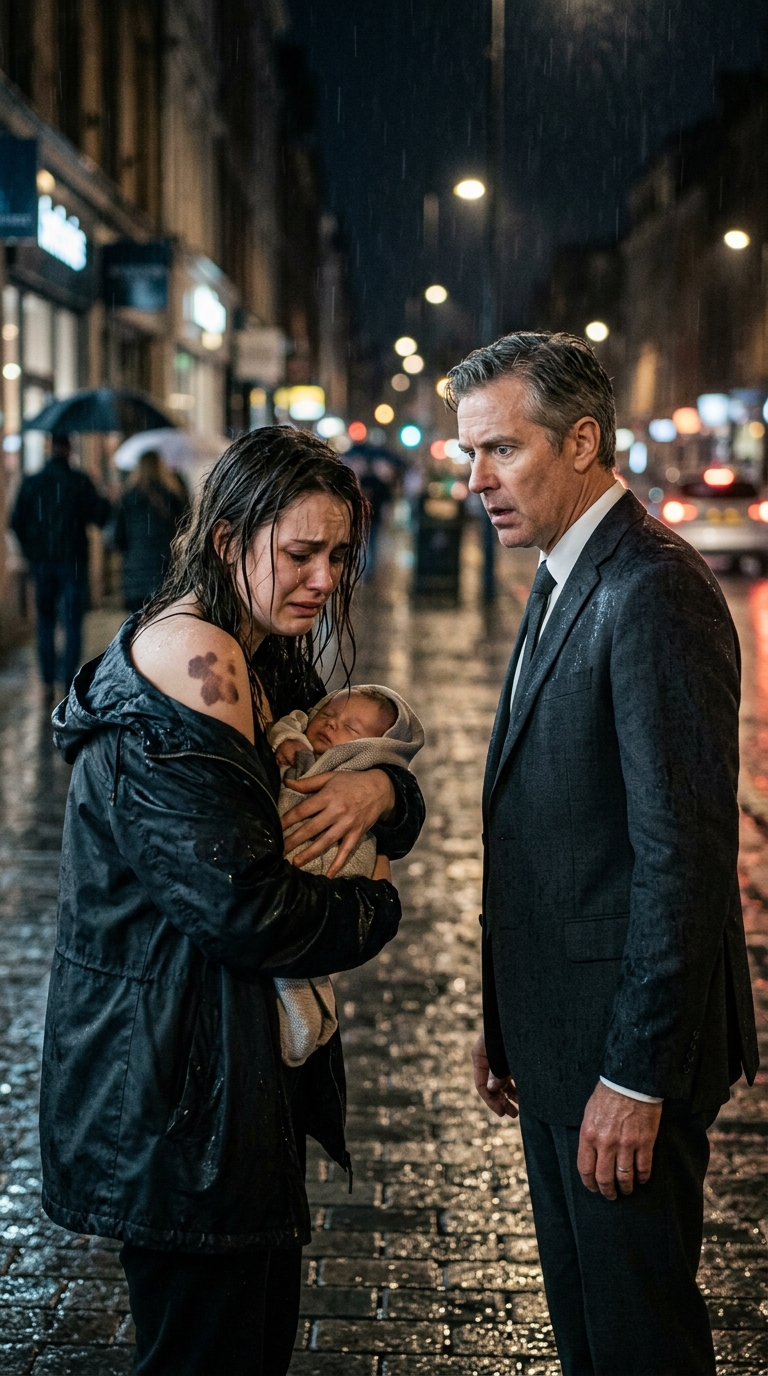
Rain lashed against the Hale estate in sharp, slanted sheets that night—cold enough to sting, heavy enough to blur everything beyond the gates.
It slicked the long stone driveway until it gleamed under the lamps. It rattled the iron fence. It drummed against the roof of the sedan Edward Hale was about to step into. To most people, those gates meant wealth, privacy, separation. To Edward, they meant something simpler.
Control.
At forty-five, his life was built on it. He understood leverage, timing, the weight of silence, the value of a closed door. For two decades, he had shaped himself into a man no one interrupted unless they were ready to face the consequences.
So when a voice called out through the rain, irritation came before he even turned.
“Sir… please.”
Edward paused, one hand still on the car door.
A girl stood just beyond the reach of the headlights, clutching a bundled baby to her chest. She was soaked through, dressed like someone the world had learned to ignore—an oversized coat with a torn pocket hanging loose over mismatched layers, worn jeans stiff with dirt and rain, sneakers caked in mud, dark hair stuck to her cheeks. She looked about nineteen. Maybe younger. Hardship blurred the lines of age.
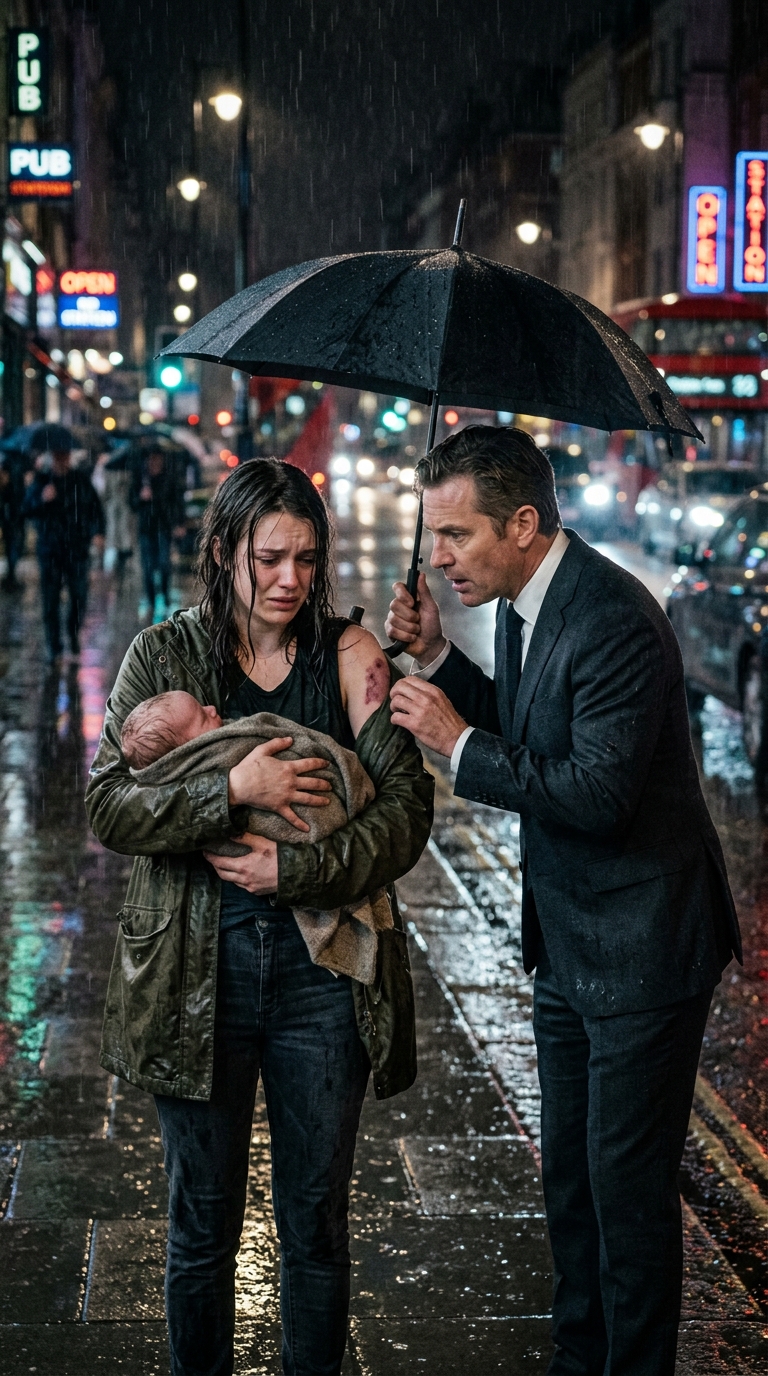
The bundle shifted.
A baby.
Edward’s expression hardened. “If you’re here for money, you picked the wrong place.”
“I’m not asking for money.” Her voice came quickly, practiced. “I’m asking for work.”
He studied her. “Work.”
“Yes, sir. Anything. Cleaning, laundry, dishes. I can cook a little. I learn fast.”
His eyes flicked toward the gatehouse, then back. “Do you usually apply for jobs by walking up to private property in the middle of the night?”
Her jaw tightened. “No. Usually I get turned away before it starts raining.”
In any other situation, that would have been the end of it. Edward would have signaled security, gotten into his car, and moved on. Need was endless. Boundaries were not.
Then the baby coughed.
Not light. Not harmless. Deep. Wrong.
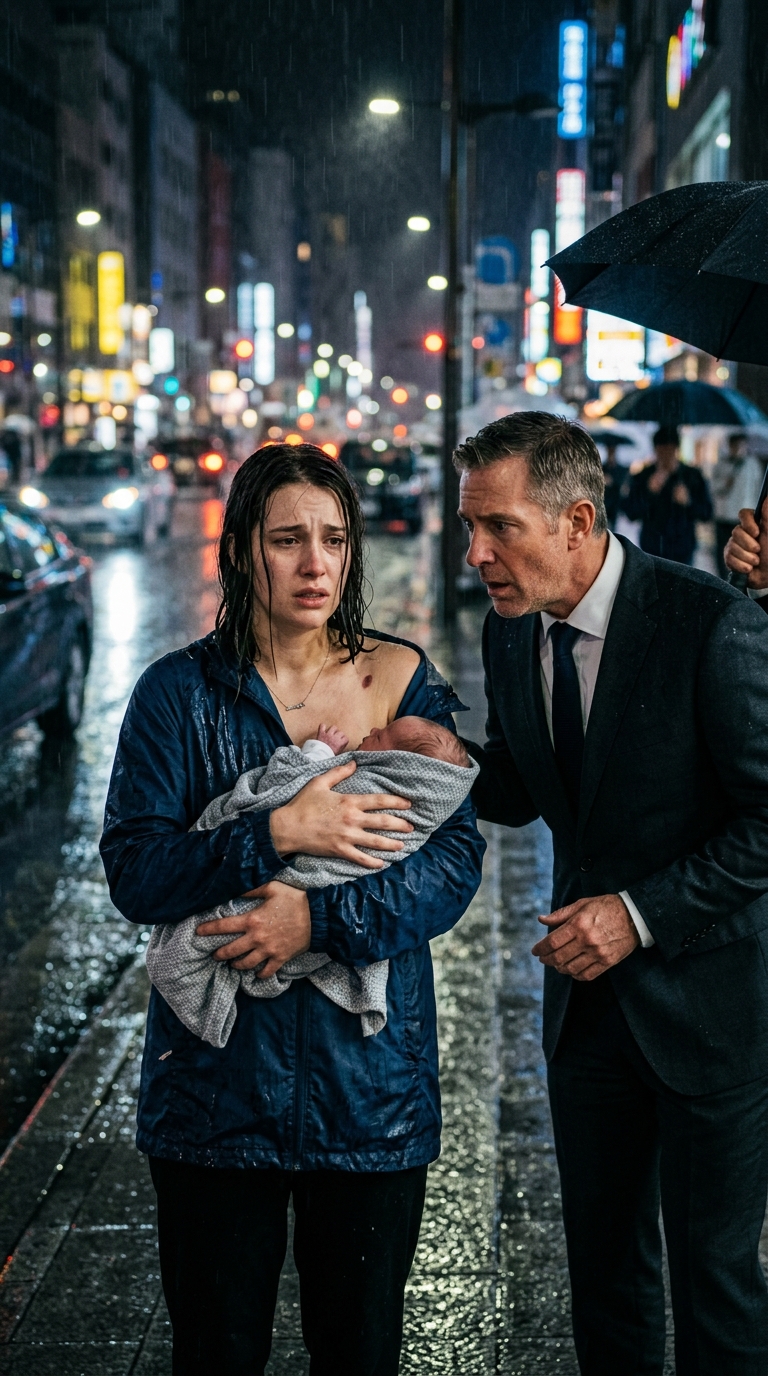
The girl adjusted the blanket, and as she did, the wet collar of her coat slipped off one shoulder.
Edward’s gaze dropped.
There, on the curve of her shoulder, was a birthmark.
Dark brown. Uneven. A thin crescent.
He went completely still.
For one sharp second, the rain disappeared.
He was twenty-five again, standing in a cramped apartment that smelled faintly of baby powder and warm milk. The window was open to the summer heat. Traffic murmured below. His sister, Elena, stood by the couch with a newborn resting against her shoulder, smiling at him like she already knew he was nervous.
“You’re holding her like she’s made of glass,” she had said.
He had looked down at the baby in his arms and noticed the small crescent mark on her shoulder.
“What’s that?”
Elena had smiled. “Birthmark.”
The present snapped back.
Edward looked at the girl again—but differently now, as if the entire night had shifted.
“What’s your name?” he asked.
She tightened her hold on the baby. “Lena Carter.”
“How old are you?”
“Nineteen.”
“And the baby?”
“My sister. Amelia.”
His voice changed, just enough for her to notice. “Your mother’s name.”
She hesitated. “Elena Carter.”
The name hit him like a direct blow.
For a moment, he just stared. Elena. The name his sister had taken when she left. After the argument. After the hospital hallway. After he had stood there with all his pride and certainty, convincing himself she would come back when she was ready.
She never did.
When he spoke again, his voice was quieter. “Did your mother ever use the name Elena Hale?”
The girl’s face lost all color.
“How do you know that?”
Edward didn’t answer right away.
Something sharp flashed in her eyes. “If this is some kind of joke—”
“It isn’t.”
He took a step forward, then stopped. She already looked ready to run.
“How long have you known my name?” he asked.
“Since I was fourteen.”
That unsettled him more than he let on. “Then why are you here asking me for a job?”
A bitter, exhausted laugh slipped out of her. “Because my mother made one thing very clear. If I ever came here, I wasn’t to come asking for pity.”
That landed.
Rain struck the iron bars between them. Water poured from the gutters behind him.
“Who sent you tonight?” he asked.
“No one.” Lena glanced at the house behind him, glowing with warmth. “I knew who lived here. And I heard from a woman at Saint Mark’s that your housekeeper left.”
For the first time, disbelief crossed his face. “So you came here in the middle of a storm to apply for a job.”
She met his gaze, tired but steady. “I came because Amelia’s formula ran out this morning, and after the pharmacy I had six dollars left.” Her grip tightened. “I came because every place I tried said they weren’t hiring. Because my mother is dead. Because my sister has a fever. Because I’ve run out of places to stand and still pretend I have a plan.”
Her voice was quiet.
That made it worse.
Edward looked at the baby. Damp blanket. Flushed skin. A small face worn with exhaustion.
“What happened to your mother?”
Lena looked away into the rain. “Cancer. It moved fast. Amelia came early. My mom held on for a few months after that.” She swallowed. “Then she didn’t.”
He said nothing.
Of course, she took that silence the wrong way.
“Forget it,” she said, shifting Amelia higher. “I shouldn’t have come.”
She turned slightly toward the street.
“Lena.”
Something in his voice made her stop.
Edward walked to the gate and unlocked it himself. The iron opened with a long, heavy creak.
“Come inside.”
She didn’t move.
“I said I don’t want charity.”
He held her gaze through the rain. “Then don’t call it that.”
Her chin lifted, stubborn. “What do I call it?”
His eyes dropped briefly to the baby, then returned to her.
“Responsibility.”
For a moment, Lena just stared.
Then Amelia coughed again—weak, fragile—and whatever pride or doubt Lena held onto had to give way to something smaller, more urgent.
She stepped inside.
The warmth of the house felt almost overwhelming.
Mrs. Alvarez, who had managed the household for years, took one look at Lena and the baby and didn’t ask a single unnecessary question. She disappeared and returned with towels. Someone brought dry clothes. A bottle was warmed in the kitchen. Edward called his doctor and told him not to argue.
By the time the doctor arrived, Lena sat at the edge of a chair in the breakfast room, still in borrowed clothes, still holding herself as if comfort might vanish at any moment.
The doctor listened to Amelia’s breathing, checked her temperature, and frowned.
“She’s right on the edge,” he said. “Early pneumonia. Dehydrated, exhausted, too cold for too long. You brought her in when you did—that matters.”
Lena closed her eyes for a brief second. Only one.
When Mrs. Alvarez brought in a bowl of soup and bread, Lena stood immediately.
“What do you need me to do first?”
Mrs. Alvarez blinked at her. “Nothing tonight, honey.”
“I didn’t come here to sit around.”
From the doorway, Edward replied, “No. You came here carrying a sick baby through a storm. Tonight, you’re going to sit and eat.”
Lena looked at him, as if she couldn’t decide whether she resented his tone—or resented the part of her that wanted to listen.
“I’m not one of your charity cases,” she said.
He leaned casually against the frame, his expression unreadable. “Good. I’m not asking for gratitude.”
For a moment, neither of them moved.
Then Mrs. Alvarez nudged the bowl of soup a little closer and said softly, “Eat before I get offended.”
That was enough.
Lena sat down and finished the soup so quickly it almost hurt to watch.
Edward placed her and Amelia in the blue guest room at the far end of the east wing. Years ago, when Elena had come home from college, that room had been hers.
Later, he stood in the doorway after they had both fallen asleep—Lena still half upright against the headboard, Amelia curled against her chest—and felt something old and rigid inside him shift.
Time hadn’t forgiven him.
It had only made it easier to avoid looking back.
The following days changed the house in small, quiet ways.
Amelia’s breathing improved. Medicine appeared. Formula appeared. Clean blankets, baby clothes, a bassinet no one claimed to have ordered.
Lena, once she stopped expecting to be asked to leave every morning, began helping Mrs. Alvarez in the kitchen. She folded laundry with precise, almost mechanical care. She wiped down surfaces that were already spotless. She thanked people too quickly, like someone who had learned that staying anywhere required constant balance.
Edward kept seeing Elena in her.
Not just the eyes—though they were the same. Not just the stubborn mouth. It was the way Lena carried herself when she was tired or cornered, as if pride was the last thing she had left, and she would protect it at all costs.
On the fourth evening, he found her in the library.
She stood by the fire, holding an old framed photograph. Elena on a windy beach, hair flying across her face, laughing. Edward beside her—young, unguarded, not yet hardened into the man he had become.
Lena didn’t turn when she spoke.
“You should’ve told me the first night.”
Edward closed the door quietly behind him. “I was trying to find the right moment.”
This time she faced him.
“No,” she said. “You were trying to decide how much of it you were willing to feel.”
He didn’t argue. There was nothing to say.
She placed the photo back carefully.
“My mom kept one box through every place we lived,” she said. “Didn’t matter what else got left behind. That box always stayed.” She swallowed. “There was a hospital bracelet. A broken watch. Letters she never sent.”
Edward’s throat tightened. “Letters to me?”
“Your name was on half of them.”
He inhaled slowly. “What did they say?”
Lena crossed her arms, though it looked more like she was holding herself together than guarding herself. “It depended. Sometimes she missed you. Sometimes she was angry. Sometimes she wrote like none of it mattered anymore.” Her eyes met his. “That’s how I knew it still did.”
Edward lowered himself into the leather chair by the fire.
“She should have hated me,” he said.
Lena answered immediately. “She didn’t.”
He let out a breath that felt older than he was.
“I kept choosing work,” he said. “Again and again. She’d call, I’d be in a meeting. She’d need help, I’d send money or advice instead of showing up. When her husband got into trouble, I told her I was done fixing other people’s messes.” His voice roughened. “She said I cared more about control than I did about people.”
“She was right,” Lena said, not harshly.
He nodded once. “Yes.”
The fire crackled softly.
“Our father supported me,” Edward continued. “Not because I was right. Because it was easier for him. And I let that happen. When your mother left after you were born, I told myself she was overreacting. That she’d come back eventually.”
Lena watched him for a long moment.
“She thought the same about you,” she said.
That cut deeper than anger.
He looked at her then, honestly.
“I was her brother,” he said. “And I failed her.”
Silence settled between them. Not cold this time. Just real.
After a while, Lena spoke quietly. “She used to say you weren’t cruel.”
He waited.
“She said you confused distance with strength.”
He closed his eyes briefly.
There was no defense for that.
Weeks passed.
Not easily. Lena still kept a bag packed in the closet, as if she didn’t fully trust staying. Edward still woke some nights with the heavy thought that Elena had died somewhere without hearing his voice again.
But things shifted anyway.
He started rearranging meetings around Amelia’s appointments. He learned how to hold her bottle just the way she liked. He began coming home earlier. He sat with Lena at the kitchen table, going through brochures, financial aid forms, schedules she had stopped letting herself imagine.

“I can’t afford to think that far ahead,” she said one afternoon.
“That part is handled,” Edward replied.
She stiffened. “I don’t want to owe you for the rest of my life.”
He met her eyes. “You don’t.”
“It feels like I do.”
He paused, then said, “Lena, I’m not buying anything. I’m not paying off guilt. I’m trying—late, and imperfectly—to act like family.”
She studied his face, uncertain, as if kindness itself might be unreliable.
After a moment, she gave a small nod.
It wasn’t forgiveness.
But it was something that might grow into it.
Spring arrived slowly. The rain eased. Light returned to the gardens. Amelia learned to crawl and then refused to stop. Laughter began to fill parts of the house that had only ever known polite silence. Even the staff stopped pretending not to notice that Edward had changed.
One Sunday afternoon, he found Lena on the terrace with Amelia in her lap, a picture book upside down in the baby’s hands.
They were both looking toward the gates.
Open.
Lena glanced up. “Mrs. Alvarez said you told security to leave them open during the day.”
“I did.”
She looked back toward the road. “That’s new.”
Edward stood beside them, looking out at the drive. The iron gates were still there—tall, black, expensive. They just didn’t feel like the most important thing anymore.
“I spent a lot of years thinking locked things meant safety,” he said.
Lena was quiet. Amelia chewed thoughtfully on the edge of the book.
Then Lena said softly, “My mom would’ve had something to say about that.”
A faint smile touched his lips. “Your mother had something to say about everything.”
This time, Lena smiled too.
Standing there, beside his niece and the child she had carried through a freezing storm, Edward understood something he should have learned long ago.
What people leave behind is rarely money. Not the house. Not the company. Not the name.
It’s the people they choose to keep. The doors they open in time. The love they don’t let pride take away.
Sometimes that understanding comes too late to repair what was broken.
But not always too late to keep it from breaking again.
