

That night, in his apartment in Polanco, with city lights glowing beyond the glass, Diego couldn’t sleep.
He pulled out a yellowed letter from Ximena, folded so many times it was nearly falling apart. Her delicate handwriting still burned through him:
«My Diego… forgive me for not telling you in person. If I look into your eyes, I won’t be able to leave. I have to go to keep you safe.
My brother Damián got involved with dangerous people… I’m three months pregnant. Don’t look for me. Please…»
For years, Diego had searched—hiring investigators, chasing false leads, even changing identities to get closer to the truth. He never married, never truly loved anyone else, always carrying the feeling that moving on would be a betrayal.
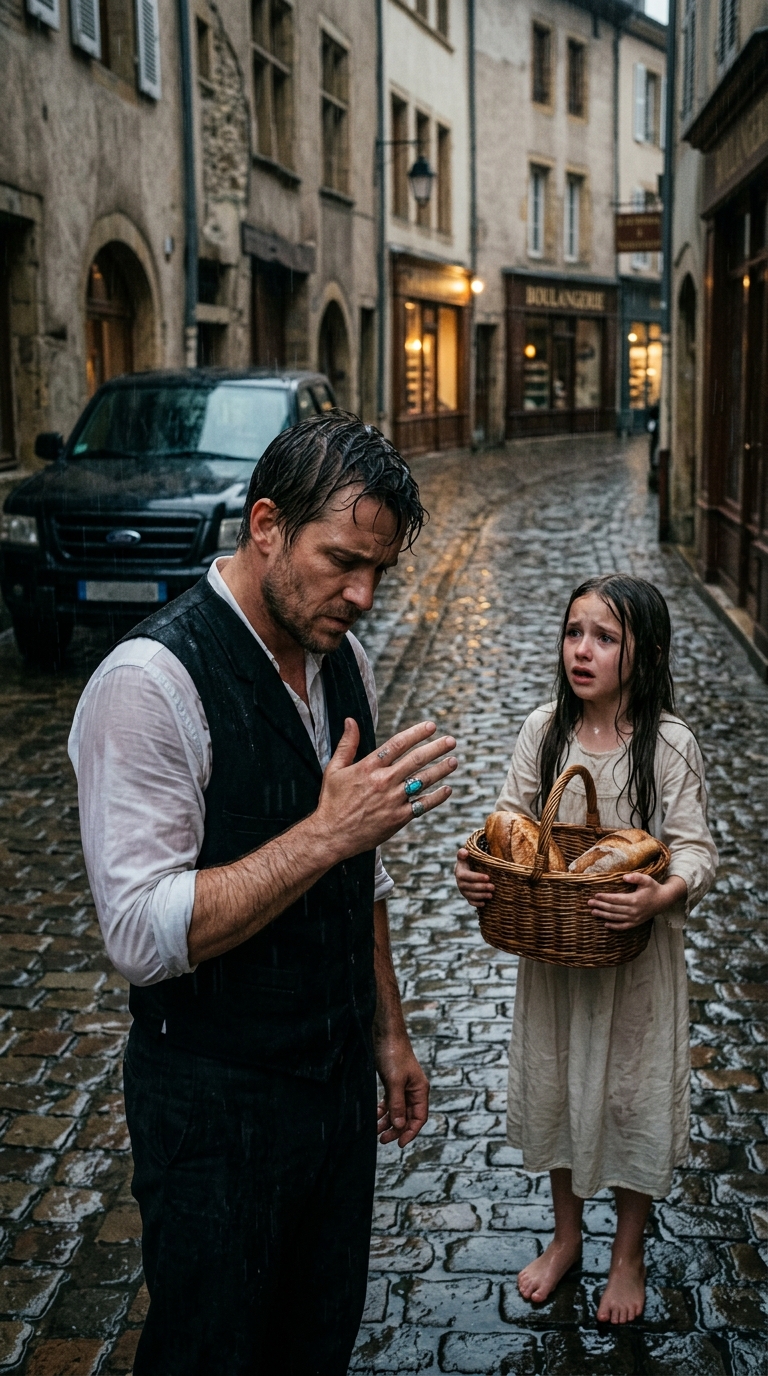
And now, a little girl wearing Ximena’s ring had appeared—selling bread in the rain.
The next morning, Diego made a call to a man who never asked questions.
“Find Cecilia. But carefully. Don’t frighten her. She mustn’t know anything.”
Three days passed like three months.
When the report arrived, his hands trembled. Cecilia lived on the outskirts of San Miguel with her mother—a house cleaner who was ill—and carried the surname Salazar.
The photograph confirmed everything.
Cecilia smiled with the same features Ximena once had.
Diego didn’t wait.
He arrived on a cloudy afternoon. The road was muddy, puddles scattered along the path. Chickens pecked near rusted cans. Yet flowers climbed along the fence, and white roses bloomed in improvised pots.
He knocked on the wooden door.
“You… the bread man?” Cecilia whispered.
“Yes,” he said softly. “I need to speak to your mother.”
Ximena appeared.
Thinner. Weakened. Her face marked by time and struggle, her eyes hollow but unmistakable. She trembled as she held the curtain aside.
Their eyes met.
And the world disappeared.
“Diego…” she whispered.
“Why did you never come back?” His voice broke.
She told him everything—fear, danger, illness. Diego dropped to his knees, taking her cold hands in his.
“You had no right,” he said, his voice shaking. “I’ve been dead inside for sixteen years… and she… she is our daughter.”
Cecilia covered her mouth, the ring catching the dim light.
“I’m Diego,” he said gently. “And if you’ll allow me… I’m your father.”
Cecilia took a small step forward.
Ximena broke into tears.
“You were never a tragedy,” Diego said. “You were the best thing that ever happened to me. And if life is giving us another chance, I won’t lose it.”
From that moment, Diego changed everything.
He moved heaven and earth—transferring Ximena to the best hospital in Querétaro, arranging treatments, clinical trials, and advanced care.
Meanwhile, Diego and Cecilia began to grow close. She studied, created, and read with curiosity and passion, discovering a world she had never been allowed to fully explore.
Months later, the doctor smiled.
The tumor was shrinking.
Ximena cried with relief. Diego held her, and Cecilia wrapped her arms around them both.
They married in a small, quiet ceremony. Ximena wore the same ring. Cecilia stood beside her in a blue dress that matched the topaz.
Diego kissed Ximena and whispered:
“Forever.”
“It’s always been forever,” she replied.
Later, they moved to the coast in Nayarit.
Cecilia had a room overlooking the water, a scholarship for school, and a life filled with possibility. Diego learned the simple things—taking her to class, listening to her stories, being present.
One evening, as the sun dipped into the ocean, they stood together on the terrace.
“Can you imagine if you hadn’t gotten out of the car?” Ximena asked quietly.
Diego shook his head. “I don’t want to think about it.”
Cecilia ran along the sand, laughing, the ring glimmering on her hand.
“Forever,” Diego said softly.
“Forever,” Ximena answered.
And for the first time in sixteen years—
Diego finally felt at home.
