


The Flight That Sent Him Home
Derek Caldwell had spent years constructing a life that appeared flawless from the outside.
He lived in a peaceful neighborhood outside Savannah, Georgia, in a white two-story home with wide windows, neatly cut lawns, and a front porch that softly lit up each evening. Locals knew him as a successful real estate developer—the kind of man who shook hands with certainty, spoke with precision, and always seemed entirely in control.
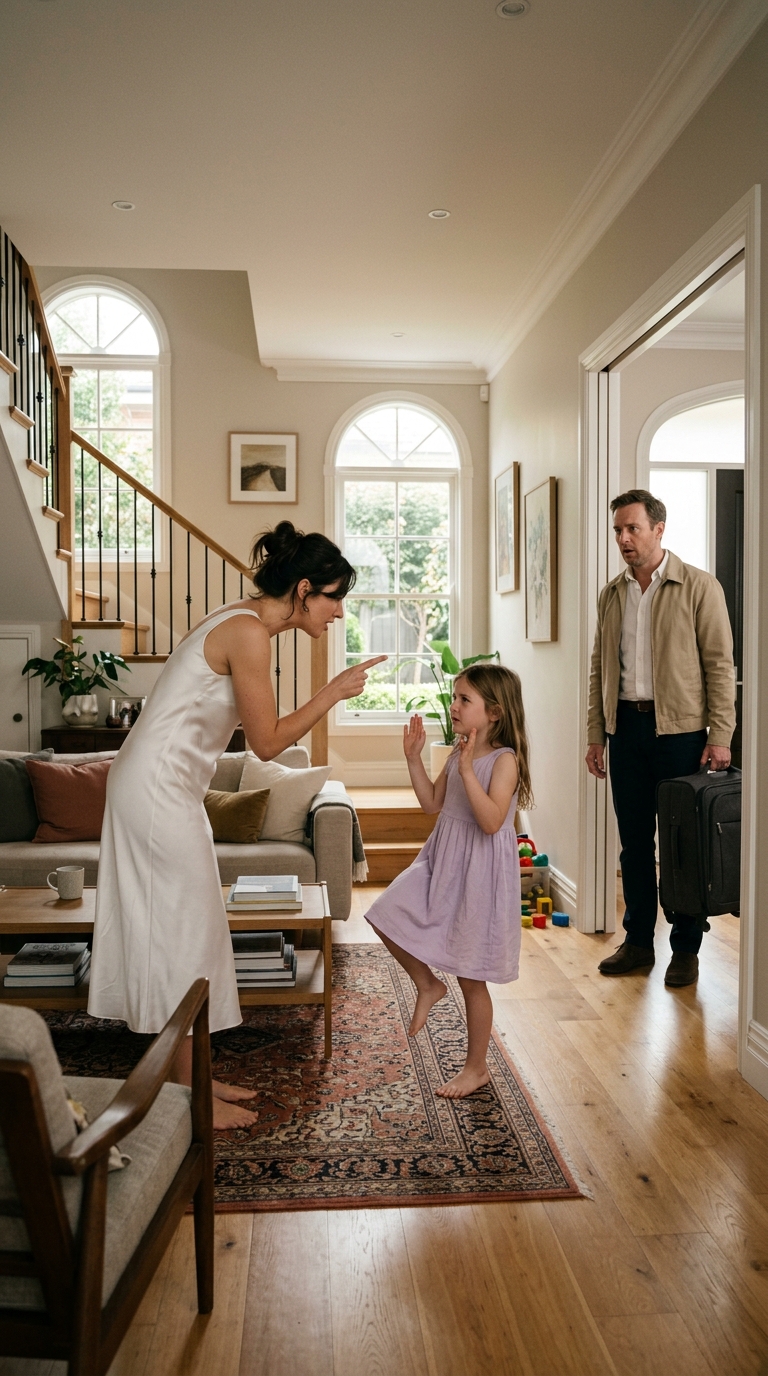
Yet inside that picture-perfect home, something had been quietly breaking.
Derek had lost his first wife, Allison, three years before. She had been warm, patient, and kind—the type of mother who turned ordinary mornings into lasting memories. After her passing, Derek buried himself in work, because staying busy was easier than facing grief.
His daughter, Maisie, was only four years old.
She had her mother’s soft brown eyes and gentle smile, though recently that smile had almost disappeared.
At first, Derek told himself she was simply shy. Then he convinced himself she was grieving. Later, when his new wife, Claire, insisted Maisie had a delicate stomach and needed strict routines, he accepted it—because believing her was easier than the unease growing inside him.
That morning, Derek came downstairs dressed for a business trip to Atlanta. Claire stood in the kitchen in a pale blouse, hair perfectly arranged, pouring a thick green drink into a glass.
Maisie sat at the kitchen island in a cream nightgown, feet dangling, hands tightly clasped in her lap.
Derek bent down and kissed her forehead, then paused.
She felt cold.
“Sweetheart, are you feeling bad again?” he asked.
Maisie lowered her gaze.
“My tummy hurts, Daddy. I don’t want to go to preschool.”
Claire quickly placed the glass in front of her.
“She had another difficult night,” Claire said calmly. “It’s better if she stays home with me. I’ll guide her through her little exercises.”
Derek frowned.
“Exercises?”
Claire smiled gently.
“Breathing, posture, focus. Nothing serious. She needs structure, Derek. Children feel safer when they know expectations.”
Maisie lifted the glass with both hands and drank without protest. Her face tightened briefly, but she finished it all.
From across the room, Mrs. Hattie, the longtime housekeeper, set a tray down a little too firmly. Her eyes met Derek’s for a moment.
There was worry in them.
Maybe even a warning.
But Derek looked away.
Before leaving, Maisie hurried to the hallway barefoot and placed a folded drawing into his hand. It showed a house with dark windows. In the yard stood a small girl without a mouth.
Derek frowned in confusion.
“What is this, baby?”
Maisie opened her mouth, but Claire gently touched her shoulder.
“Come on, sweetheart. Let Daddy get to the airport.”
So Derek left.
An hour later, storms swept across Georgia, grounding flights and filling the airport with delays. Derek’s trip was canceled before he even cleared security.
Instead of frustration, he felt relief.
On the drive back, he stopped at a toy store and bought a soft white bunny with a blue ribbon. He imagined Maisie smiling when he returned early.
But when he stepped into the house, everything was silent.
Too silent.
Then he heard it.
Tick.
Tick.
Tick.
A metronome.
Derek moved toward the family room. The door was slightly open.
Then Claire’s voice cut through—cold and controlled.
“Stand straight. Start again.”
Maisie’s small voice broke through tears.
“Please, Mommy Claire… I’m tired.”
Derek pushed the door open.
And everything he believed shattered.
What He Saw Behind the Door
Maisie stood on a wooden block in the center of the room, balancing on one foot. A heavy dictionary rested on her head. Her arms trembled at her sides, and her face was pale with exhaustion.
Claire sat nearby, watching the metronome.
“If you drop it, you start over,” she said.
Derek could barely breathe.
“Claire.”
Maisie startled at his voice. The book slipped, hit the floor, and she fell to her knees before curling onto her side.
Derek rushed forward.
“Maisie! Baby, I’m here. You’re safe.”
But instead of reaching for him, she pulled away, shaking.
“I’m sorry, Daddy. I’m sorry. I didn’t finish. Please don’t be mad.”
Those words cut deeper than anything he had seen.
His daughter wasn’t afraid of falling.
She was afraid of failing him.
Mrs. Hattie appeared in the doorway with tears in her eyes and knelt beside Maisie, pulling her close.
From her apron pocket, she took out half a biscuit wrapped in cloth.
Maisie grabbed it with shaking hands and ate as though she had been waiting all day.
Derek stared in disbelief.
His daughter, surrounded by luxury and food, was eating hidden scraps.
Claire stood composed.
“This isn’t what it looks like.”
Derek slowly turned to her.
“Then explain it.”
Claire lifted her chin.
“She needs discipline. She is too soft. Too emotional. I’m teaching her strength.”
Mrs. Hattie spoke through tears.
“Sir, this happens when you’re gone. She keeps the child from meals. She says she must earn food. She tells her love depends on perfection.”
Derek went cold.
“She is four years old.”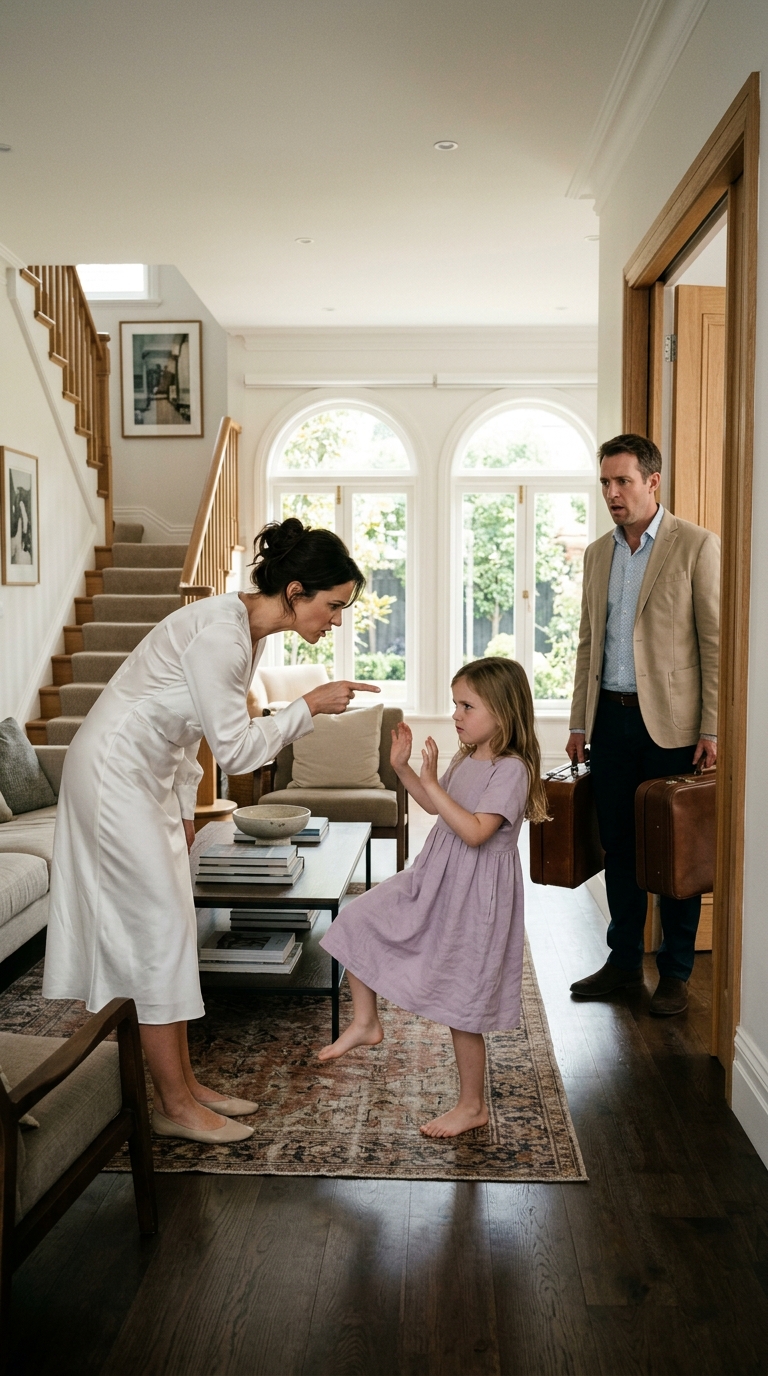
Claire’s expression hardened.
“That’s exactly why she can still be shaped.”
Maisie held the biscuit tighter.
Claire reached out.
“Give it to me, Maisie. Bread upsets your stomach.”
Maisie trembled.
“Please… I’m hungry.”
Derek stepped between them.
“Do not come any closer to my daughter.”
Claire froze for the first time.
The Truth at the Hospital
Derek carried Maisie to the car wrapped in his jacket. Mrs. Hattie rode beside them, soothing her gently.
At the children’s hospital, Derek answered questions in a voice that barely felt like his own.
Doctors were careful—but direct.
Maisie was undernourished, dehydrated, and emotionally strained from constant pressure and fear.
A child psychologist spoke privately.
“Physically, she can recover,” she said. “But emotionally, she has learned that love must be earned. That rest is wrong. That mistakes lead to rejection.”
Derek sat motionless.
Every ignored sign returned at once.
He had missed it—not because it wasn’t there, but because he hadn’t looked closely enough.
When Maisie woke, she studied him cautiously.
Derek held her hand.
“You did nothing wrong.”
Her lip trembled.
“I dropped the book.”
His eyes filled.
“You should never have been holding it.”
She whispered, “Are you still my daddy?”
Derek kissed her hand.
“Always. Nothing can change that.”
She turned away and cried softly.
He stayed beside her, overwhelmed by everything he hadn’t seen.
That night, he returned home—not to argue, but to uncover truth.
The Notebook in the Drawer
The house looked unchanged—lights glowing, floors shining, candles burning.
But now he saw it differently.
It no longer looked perfect. It looked controlled.
He entered the family room.
The block, the metronome, the fallen book—all still there.
He searched until he found a black notebook hidden beneath folded linens.
On its cover were silver words:
The Swan Plan.
Inside were pages of notes about Maisie.
Duration of standing.
Crying counts.
Food restrictions.
Behavior correction methods.
One line read: “Too attached to comfort. Reduce softness.”
Another: “Asked for dessert. Requires correction.”
Another: “Refuses preschool. Emotional resistance must be broken.”
Derek’s hands shook.
This was not parenting.
It was control disguised as discipline.
A photograph fell out—Claire as a child, dressed in performance makeup, holding a second-place trophy while a disappointed woman stood behind her.
Derek understood.
This pattern had been passed down.
But understanding did not excuse it.
Claire appeared in the doorway.
“I can explain.”
Derek placed the notebook down.
“No. You already did.”
Her face changed.
“You went through my things?”
“I went through my home after finding my daughter afraid to eat.”
Tears formed in her eyes.
“I was making her strong.”
Derek shook his head.
“Fear does not create strength. Safety does.”
A Door That Finally Closed
By morning, Derek had contacted lawyers and authorities.
Claire tried to speak again, but he stopped her.
He placed documents on the table.
“You are leaving. You will not contact Maisie. Everything goes through my attorney.”
Claire’s voice rose.
“You’re ending everything over one mistake?”
Derek looked at her steadily.
“No. I am finally choosing my daughter.”
She had no reply.
Weeks later, Derek sold the house.
He chose a smaller home in Asheville, North Carolina, surrounded by trees and quiet mornings.
Mrs. Hattie moved with them.
There was no luxury, but there was safety.
Still, healing was slow.
Maisie apologized too often.
She hesitated before eating.
She feared small mistakes.
Derek met every moment with patience.
One afternoon, he brought ice cream home.
Maisie watched carefully.
“Today,” he said, “we do something important.”
“Is it a lesson?” she asked.
“Yes. A silly one.”
He placed ice cream on his nose.
Mrs. Hattie laughed.
Maisie blinked.
“You made a mess.”
“I did,” he said. “And nothing bad happened.”
She hesitated… then touched the ice cream.
Then smiled.
Then laughed.
Derek nearly broke at the sound.
The Drawing With Open Windows
Spring arrived slowly.
Maisie returned to preschool with gentle support. She began making friends again.
At home, Derek learned presence over perfection.
He left work earlier. He stayed during meals. He played on the floor.
One rainy day, Maisie jumped into a puddle and froze afterward.
“Is that bad?” she asked.
Derek stepped into the rain beside her.
“No,” he said.
He jumped too.
Water splashed everywhere.
Maisie laughed and jumped again.
That night, she gave him a drawing.
A house with open windows, sunlight, a puddle, and a family smiling together.
She now had a smile drawn on her face.
Derek held it tightly.
“That’s our home.”
“Yes,” she said. “That’s our home.”
He finally understood.
A child does not need perfection.
A child needs safety.
A child needs presence.
And from that day forward, nothing mattered more than that.
