

Part 1 — The Dinner That Cost Me Everything
When a couple disappeared from the restaurant without paying their bill, I stood there fighting back tears because I couldn’t afford to cover what they owed.
Their dinner had cost more than four hundred dollars.
At the time, I believed losing that money was one more disaster in a year already filled with them.
I had no idea that the same four hundred dollars would eventually lead me to something I’d been desperately searching for.
And when I discovered what the couple had accidentally left behind, everything changed.
To understand why, you need to understand what four hundred dollars meant in my life.
That amount could buy two weeks of groceries.
It could cover my electricity bill and leave a little money for the following semester’s tuition.
It could mean the difference between calling home and honestly saying I was doing fine, or calling home and pretending everything was all right.
For people like me, four hundred dollars wasn’t an ordinary restaurant bill.
It was survival.
I’d moved to another state to attend college.
Home was close enough that I could visit when I saved enough gas money, but far enough away that every family emergency felt impossible to handle.
For nearly a year, I’d worked as a waitress at Bellamy’s, an upscale restaurant near campus.
Even after months of working there, the menu prices still made me uncomfortable.
I arranged my evening shifts around my classes and sent home as much money as possible.
My mother and I had always been close, although she wasn’t particularly affectionate.
Evelyn was a woman who valued order, discipline, and routine.
She scheduled appointments weeks in advance.
Every receipt went into a labeled folder in a designated drawer.
She called me every Sunday evening at exactly eight o’clock.
Never late.
Never early.
Even the kitchen towels had their own assigned places.
If I hung a dish towel where the hand towel belonged, she would immediately correct me.
I used to think her habits were exhausting.
Now, I would give almost anything to hear her complain about a misplaced towel again.
Because those habits were precisely why her disappearance made no sense.
Four months before that night at Bellamy’s, my mother vanished.
She hadn’t packed a suitcase.
She hadn’t left a message.
Her purse remained hanging beside the front door.
Her phone was still connected to its charger.
Every piece of clothing was in her closet.
Her medication organizer sat on the kitchen counter, each compartment filled beyond the day she disappeared.
A woman who organized her life down to the smallest household detail wouldn’t simply walk away without taking anything.
Everyone who knew her agreed.
Our neighbors.
Her coworkers.
My aunt.
Disappearing without explanation was the last thing Evelyn Mercer would ever do.
When I learned she was missing, I rushed home.
I spent days speaking with police officers.
Then more days calling for updates.
Eventually, I spent most of my time waiting beside my phone.
The investigators weren’t unkind.
They simply had very little evidence.
My mother was an adult.
There were no obvious signs of violence.
No broken windows.
No forced doors.
No blood.
Nothing suggesting a struggle.
Every possible lead seemed to disappear before anyone could follow it.
With no clear evidence of foul play and so many other cases demanding attention, my mother’s disappearance gradually became another unresolved file.
We considered hiring a private investigator.
The man I contacted was honest about his fees.
Unfortunately, the cost was far beyond anything I could afford.
My aunt offered to contribute what little she had.
I told her to keep it.
She needed that money herself.
So I did the only thing I could manage financially.
I made missing-person posters.
Hundreds of them.
I printed them at a twenty-four-hour copy shop.
Each showed my mother’s photograph beneath the word MISSING.
Her description.
The date she vanished.
My telephone number.
I carried stacks everywhere.
I put them in supermarkets, bus stations, laundromats, and diners.
I covered campus bulletin boards.
I attached them to lampposts until campus police removed them.
I kept folded copies in my bag so I could give one to anyone I met.
Before every shift, I checked my phone.
Every single time, I hoped someone had recognized her photograph.
Maybe a stranger had seen her.
Maybe someone remembered a woman matching her description.
Maybe that day would finally bring an answer.
But four months passed without a single useful call.
The search was also draining my finances.
There were trips home.
Printing expenses.
Bills at my mother’s house that continued arriving even though she was gone.
My aunt stayed there to maintain the property, but she lived on a fixed income.
Slowly, the money I sent home increased until almost everything I earned went toward keeping things afloat.
I survived on rice, employee meals, and free coffee at Bellamy’s.
I told myself it was temporary.
I imagined Mom coming home and laughing at how thin I’d become while searching for her.
That was the state of my life when the couple arrived at my section on Friday evening.
It was shortly after seven.
They looked entirely comfortable in an expensive restaurant.
Not because they wore flashy clothes, but because nothing about the place seemed to intimidate them.
The woman wore a green dress.
Her husband had carefully combed silver hair and an elegant watch.
“It’s our anniversary,” the woman told me, smiling, when I brought the water.
They were courteous customers.
They said please.
They looked directly at me when speaking.
They treated me more respectfully than many of our regular guests.
But something about them seemed unusual.
Both appeared distracted.
The husband repeatedly checked his phone beneath the table.
He tried to keep the screen out of sight.
Whenever he looked down, his wife immediately stopped talking and studied his expression.
She didn’t appear irritated.
She wasn’t annoyed that he was checking messages during their anniversary dinner.
Instead, she watched him with concern.
Almost as though both of them were waiting for something important.
I thought it was a strange way to celebrate.
I also assumed wealthy people had private problems that were none of my business.
They ordered an expensive meal.
Oysters first.
Filet mignon for him.
Lobster for her.
Three cocktails between them.
And a bottle of Bordeaux from the locked wine cabinet.
It was the good wine, the kind our manager Jett kept secured because of its price.
I served everything.
Refilled their glasses.
Cleared their dishes.
When I asked whether they wanted dessert, the man checked his phone again.
He declined and requested the bill.
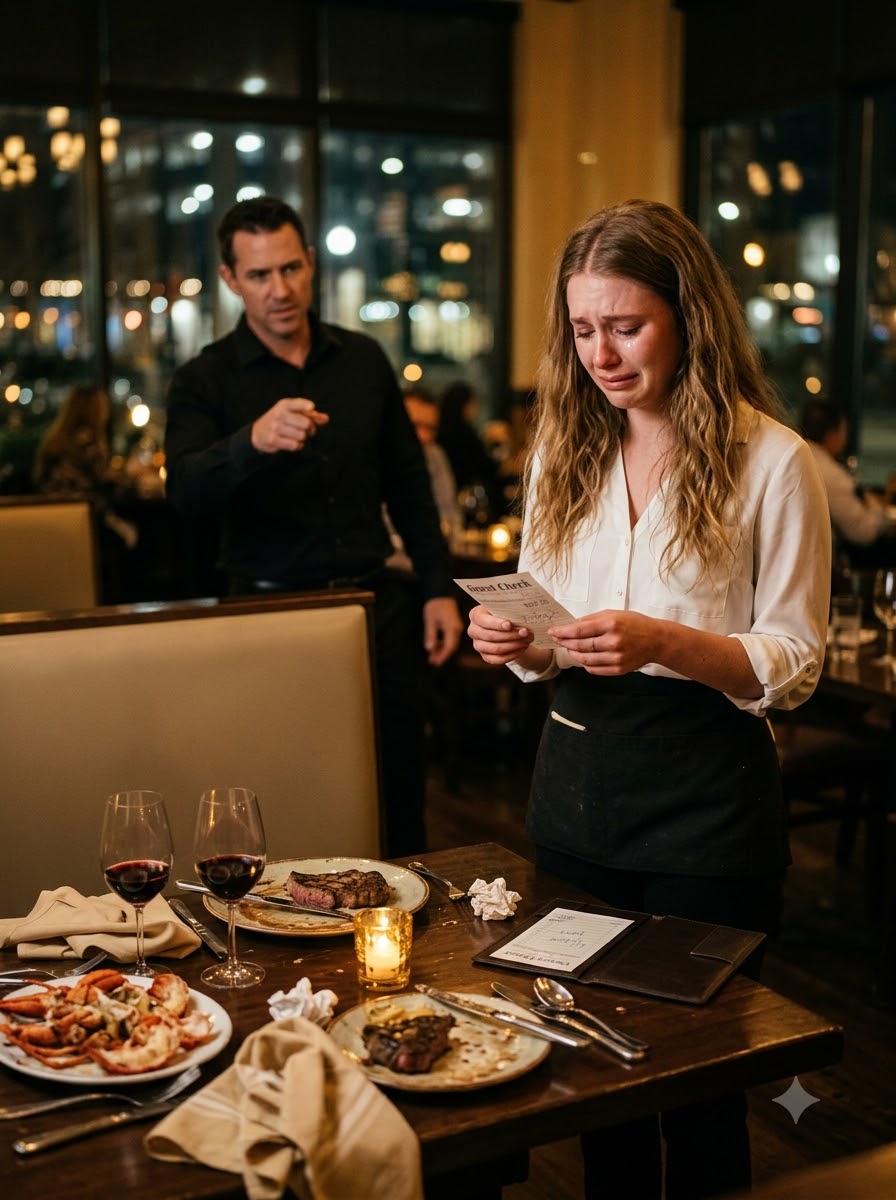
Their total was $407.63.
“Could we have the check?” he asked again, and there was something tight in his voice now, a strain I clocked but didn’t understand.
I placed the leather bill folder beside him.
Then I went to serve another table that had been trying to get my attention.
I remember exactly how long I was away.
Approximately three minutes.
Possibly less.
I delivered two drinks, answered a question about the specials, and turned back toward the couple.
Their booth was empty.
For a moment, I couldn’t understand what I was seeing.
I told myself they’d gone to the restroom.
Both of them.
At the same time.
It was an absurd explanation, but I couldn’t immediately accept the alternative.
I picked up the bill folder.
There was no payment.
No credit card.
No cash.
Nothing.
I checked both restrooms.
I hurried past the host stand and stepped outside.
The valet area was quiet.
Their car was gone.
There was no woman in a green dress.
No silver-haired man.
Only the cold evening air and my breath turning white in front of me.
I went directly to Jett’s office.
He was our manager, a man in his mid-thirties who always seemed stressed.
He wasn’t deliberately cruel most of the time.
But he had become so accustomed to restaurant problems that he rarely considered what they meant for the employees involved.
He barely looked away from his computer.
“Table twelve,” I said. “The couple. They walked out. They didn’t pay.”
He sighed impatiently.
“Maybe they stepped out for a smoke. Maybe they’re in the bathroom.”
“They’re not. I checked everywhere. They’re gone, Jett. Their car’s gone. Can you pull the cameras? You’ll see them leave, you’ll see when—”
“I’m not digging through four hours of footage in the middle of dinner service.”
He finally looked at me.
His expression remained hard.
“You know the policy, Laura. Walkouts come out of the server’s pocket. That’s the rule. It’s the same for everybody.”
My stomach tightened.
“That’s four hundred dollars.”
“Then take it as a lesson. Watch your tables closer next time.”
A lesson.
As though I had encouraged them to leave.
As though I’d personally escorted them outside and told them not to worry about paying.
I felt something inside me begin to collapse.
Four months of fear.
Four months of exhaustion.
Four months of searching for my mother while struggling to keep our lives from falling apart.
And now this.
I knew that if I spoke again, I would start crying in front of him.
So I remained silent.
Somehow, I finished my shift.
I paid the entire $407.63 using my tips and the little money left in my checking account.
Money intended for groceries.
Electricity.
The following month.
My hands shook as I handed it over.
Jett counted the bills and nodded.
To him, the matter was finished.
To me, it was devastating.
I reached the parking lot before I finally broke down.
I sat in my car without starting the engine.
Then I cried.
Not quiet tears.
The desperate, breathless kind of crying that comes after holding too much pain inside for too long.
Four hundred dollars was gone.
My mother was still missing.
And I had no idea how to explain either problem to my aunt, who continued asking every Sunday whether we’d heard any news.
Eventually, I drove home.
I collapsed onto my bed without changing clothes.
I slept for perhaps three hours.
At eight the following morning, my phone rang.
It was Jett.
“Can you come in?” he said.
My eyes were swollen.
My throat hurt.
“My shift doesn’t start until five.”
“I know.”
He sounded different.
Quieter.
Almost uneasy.
“Just, please. Come in as soon as you can. It’s important.”
I considered refusing.
For a moment, I even thought about quitting and never returning to Bellamy’s.
But Jett had said please.
He almost never said please.
Something about his voice made me get dressed.
I put on yesterday’s jeans and drove to the restaurant.
I expected another lecture.
Perhaps paperwork about the unpaid bill.
Instead, I found Jett standing beside table twelve.
He looked pale.
He kept rubbing the back of his neck.
“What is it?” I asked.
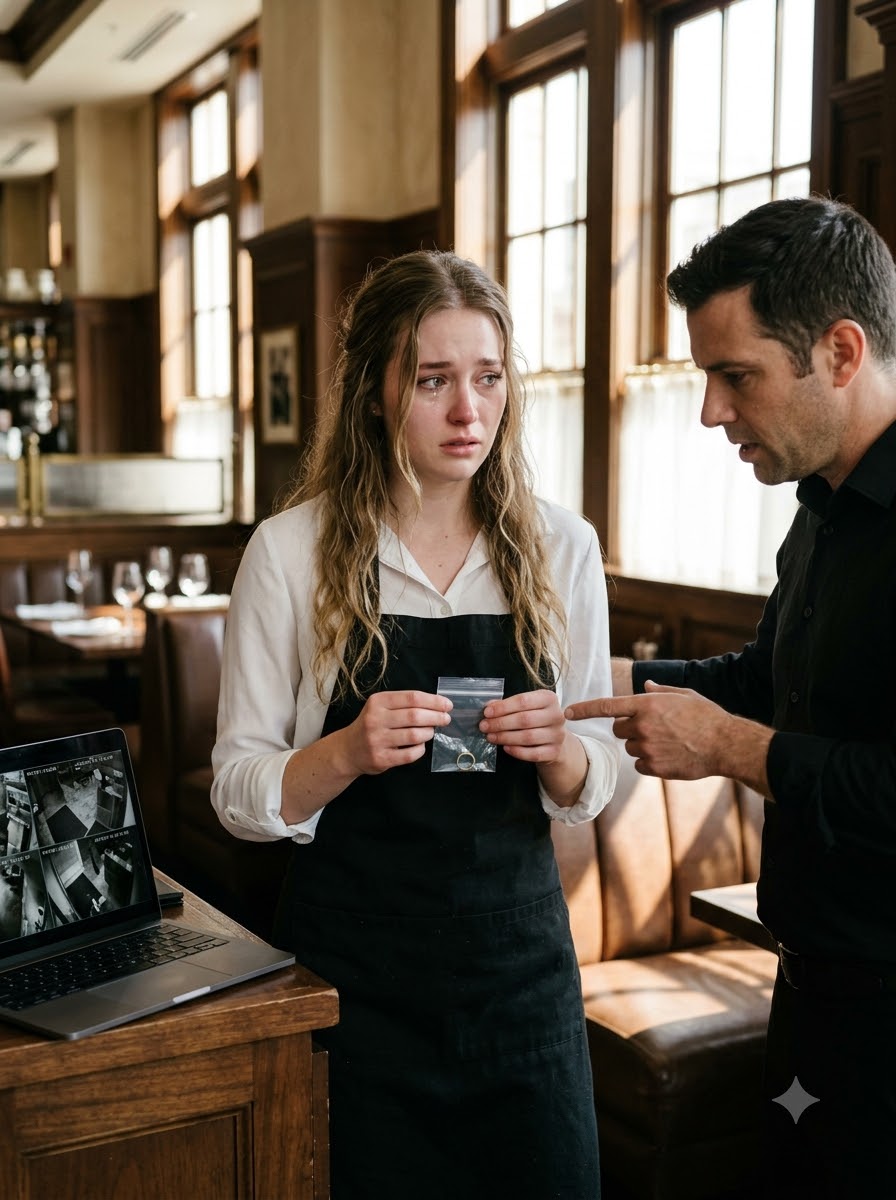
“The cleaners found something this morning. It was wedged down behind the booth, in the gap between the cushion and the wall. They almost missed it.”
He held up a small transparent plastic bag.
“Laura, I pulled the cameras. After they found this, I pulled the cameras.”
Inside the bag was a ring.
I stopped breathing.
The restaurant seemed to disappear around me.
Because I recognized it immediately.
A narrow gold band.
Scratches near the setting.
Three small diamonds surrounding a pale blue aquamarine.
One gold prong bent slightly inward.
I knew exactly how that prong had become damaged.
My mother had once caught the ring against her car door.
She never bothered repairing it because the stone remained secure.
I knew every imperfection.
I’d been staring at photographs of that ring for four months.
It appeared on my mother’s missing-person posters.
It was the one piece of jewelry she had worn every day for twenty-three years.
I’d shown the photograph to my coworkers countless times.
I’d begged them to call if they ever saw it.
“You recognize it,” Jett said quietly. It wasn’t a question.
I nodded.
Words wouldn’t come.
Mom wore that ring while sleeping.
While showering.
Even while kneading bread.
She simply washed the flour from it afterward.
When she disappeared, everything else remained in the house.
Her purse.
Her clothes.
Her jewelry.
But the ring had vanished with her.
Which meant she’d been wearing it when she disappeared.
And somehow, the couple who had abandoned their four-hundred-dollar dinner had possessed it.
The only object I knew my mother still had when she went missing.
I reached for the bag.
My fingers closed around it.
“I’m so sorry about last night,” Jett said, and he sounded like he meant it. “I should have checked the footage the second you asked. And after I saw this, I—”
He swallowed.
“You need to see the video. Come to the office.”
I followed him.
He opened the security footage from the previous evening.
The camera above table twelve clearly showed the booth.
I watched the couple eating.
The husband repeatedly checked his phone beneath the table.
His wife watched his face every time.
Then, midway through the meal, the woman reached into her purse.
As she withdrew her hand, something caught against the metal clasp.
A small object slipped free.
It fell onto the seat cushion.
The ring.
It rolled slowly across the leather and disappeared into the narrow space between the booth and the wall.
The woman never noticed.
Her attention remained fixed on her husband.
“She didn’t notice,” Jett murmured. “She had no idea she dropped it.”
I kept watching.
Several minutes later, the husband’s phone illuminated again.
This time, he answered.
He held the phone against his ear.
Then his entire body went still.
The color drained from his face.
He looked toward his wife.
Her hand flew to her mouth.
They stood so abruptly that her chair shifted sideways.
The man grabbed her coat and purse.
Then they hurried toward the restaurant entrance.
They never glanced back.
Not at the table.
Not at the bill folder.
Not at anything.
“They weren’t running from the bill,” Jett said slowly. “Look at them. They forgot the bill even existed.”
I stared at the screen.
A telephone call had frightened them badly enough to abandon everything.
And somehow, they had been carrying my missing mother’s ring.
Whatever had happened to them that night might lead me to her.
I stood immediately.
Jett went to find the valet.
The man who’d been working the previous evening was off duty, but the morning employee remembered something.
“The couple last night,” I said. “Green dress, older man, silver hair. Did they say anything? When they got their car? Anything about where they were going?”
He frowned thoughtfully.
“Yeah, actually. The guy was real anxious. Told me to hurry with the car. And while he was waiting he was on the phone, and I heard him say—”
He paused.
“He said, ‘Call the hospital. Tell them we’re on our way.’”
The hospital.
My heart began pounding.
Jett grabbed his keys.
“Which one? There are two. I’ll drive you.”
“I don’t know which one. I’ll figure it out.”
“Laura.”
He gently caught my arm.
“You don’t know who these people are. You don’t know what this is. Let me come with you.”
“No.”
“You just watched them run out of here after a phone call about somebody in a hospital, and they had your missing mother’s ring. That could be anything. That could be dangerous.”
“That’s exactly why I have to go,” I said. “And why it has to be me.”
For four months, I’d waited for someone else to find my mother.
The police.
A stranger who recognized her poster.
Anyone who could connect the pieces.
But waiting had given me nothing except sleepless nights and unanswered calls.
Now I finally had something real.
A ring.
A couple.
A hospital.
I wasn’t going to wait another minute.
I put the plastic bag in my jacket pocket and hurried outside.
I chose the larger hospital first.
The one closer to the road leading out of town.
I reached it twelve minutes later.
I barely remembered the drive.
I ran from the parking lot toward the entrance with my mother’s ring clenched in my hand.
I didn’t know what I would find inside.
I only knew that the first genuine clue in four months had brought me there.
And I was terrified of what it might mean.
Part 2 — The Woman in Room 318
A receptionist wearing blue scrubs looked up as I hurried toward her desk.
I was breathless.
My clothes were from the previous day.
My eyes were still swollen from crying.
“I’m looking for my mother,” I said.
I pulled a folded missing-person poster from my bag and spread it across the counter.
I smoothed the creases with trembling fingers.
“Her name is Evelyn. Evelyn Mercer. She’s been missing four months. I think she might be here. I think she might be a patient here.”
The receptionist studied the photograph.
Her expression softened sympathetically.
“I’m so sorry, but I really can’t give out any information about our patients. Privacy laws. I wish I could help.”
“Please.”
I took the plastic bag from my pocket and placed it beside the poster.
“This is her ring. She was wearing it when she disappeared. Last night, two people dropped this ring at the restaurant where I work, and then they came here, to this hospital, right after. Please. Just look.”
She glanced at the ring.
Then at Mom’s photograph.
Something in her expression changed.
She pulled her keyboard closer and began typing.
I watched her face.
Every second seemed unbearably long.
Finally, she spoke.
“I’m not finding anyone admitted under the name Evelyn Mercer,” she said. “Or Evelyn anything, recently.”
My stomach dropped.
I gripped the edge of the counter.
Then she frowned.
“Wait.”
She typed again.
Faster this time.
“We do have—”
She paused carefully.
“Several weeks ago, an unidentified woman was brought in. No ID, no purse, nothing. She was confused, couldn’t tell anyone her name or where she lived. She was transferred to our neurological unit for evaluation. She’s still here.”
My heart hammered.
“Does she look like her? Like the photo?”
“I can’t pull up her picture from this desk, and I couldn’t tell you if I could. But—”
She lowered her voice.
“The age is right. The general description matches. I’m not saying it’s her. But it’s not not possible.”
I could barely stand still.
“That’s her,” I said. “It has to be her. Please, I need to see her.”
The receptionist hesitated.
“I should tell you. The patient had a seizure yesterday evening. She’s stable now, but she’s not in great condition, and she really shouldn’t have a lot of visitors right now. In fact—”
She checked the screen.
“She already has two people with her. A couple. They’ve been listed as her regular visitors for weeks.”
A couple.
The words hit me like a physical blow.
They had Mom’s ring.
They’d been visiting an unidentified woman for weeks.
And they were upstairs with her right now.
My mind immediately filled with frightening possibilities.
What if they’d hurt her?
What if they were responsible for her disappearance?
What if she’d been unable to identify herself because of something they’d done?
“You don’t understand,” I said. “Those people. I think they may have hurt her. I think they may have had something to do with her going missing. Please, you can’t leave her alone with—”
My voice broke.
The receptionist glanced toward the security desk.
I realized I needed to calm down.
If I frightened her, I might be asked to leave.
And I couldn’t leave without seeing that patient.
“Please,” I said, quieter now, forcing myself steady, because I could see that losing control would get me thrown out and calm might get me upstairs. “Just let me see her. If it’s not my mother, I swear I’ll turn around and leave and you’ll never see me again. But if it is her, if she’s been up there for weeks while I’ve been putting her face on every lamppost in two states—please. She’s my mother.”
The receptionist looked at me for a long moment.
Then she picked up the phone.
She spoke quietly to someone, turning partly away.
When the conversation ended, she printed a visitor badge.
She slid it toward me.
“Third floor. Room 318. A nurse will meet you at the desk and take you in.”
I grabbed the badge.
As I turned toward the elevators, she called after me.
“And, honey?”
I stopped.
“Prepare yourself. If it is her, after everything, she may not know who you are.”
I entered the elevator.
It seemed to move impossibly slowly.
I watched the floor numbers change.
One.
Two.
Three.
Finally, the doors opened.
A nurse waited near the desk.
She led me down a quiet hallway.
I could hear my own heartbeat.
We stopped outside room 318.
There was a narrow window in the door.
I looked through it.
And saw the couple from Bellamy’s.
The woman still wore the green dress.
It was wrinkled now, as though she’d slept in it.
Her husband’s silver hair was disheveled.
He looked as if he’d spent hours dragging his hands through it.
At the restaurant, they’d appeared wealthy and polished.
Now they looked exhausted.
They stood on opposite sides of the hospital bed.
Both stared down at the patient with expressions I couldn’t understand.
I pushed open the door.
The woman turned toward me.
Her gaze immediately dropped to the plastic bag in my hand.
Her eyes widened.
“That ring,” she whispered.
I stepped forward.
Without thinking, I positioned myself between the couple and the bed.
“Where did you get this? Where did you get my mother’s ring?”
The man raised both hands.
“Please,” the man said, lifting both hands, palms out. “Please, keep your voice down. The patient needs quiet, she’s very—”
“You stole this from my mother.”
The woman stared at me.
“Your—your mother?”
Then I finally looked at the person lying in the bed.
For four months, I’d imagined finding Mom.
I’d pictured her in countless places.
In every imagined reunion, she looked like herself.
Standing straight.
Hair neatly arranged.
Clothes carefully chosen.
The woman who ironed her bedsheets and organized every kitchen towel.
But the patient in front of me looked nothing like the mother I remembered.
She lay beneath a thin white blanket.
Her face was pale and painfully thin.
An IV was taped to the back of one hand.
Her gray hair spread loosely across the pillow.
She looked impossibly fragile.
But it was her.
I knew it immediately.
“Mom?”
The word barely came out.
Her eyelids moved.
They didn’t open.
My knees weakened.
I grabbed the metal bedrail to keep from falling.
Then I turned toward the couple.
“Who are you? What did you do to her? Tell me right now.”
“Nothing,” the woman said.
To my astonishment, tears filled her eyes.
“We didn’t do anything to her. We found her.”
I stared at her.
I couldn’t make sense of the words.
Then she began explaining.
Her name was Margaret.
Her husband was Thomas.
And the story they told me was completely different from the one I’d constructed in my mind.
Several weeks earlier, they’d been driving home in the evening along a county road outside town.
The sun was almost gone.
They noticed a woman walking along the shoulder.
She had no shoes.
No coat.
She moved unsteadily, sometimes drifting dangerously close to traffic.
Margaret and Thomas pulled over.
“She didn’t know where she was,” Margaret said. “She couldn’t tell us her name. She couldn’t tell us her address, or how she got out there, or where she’d come from. She had no purse, no phone, no ID, nothing at all. Just—”
Margaret gestured helplessly toward the bed.
“Just her. And she was so frightened. We couldn’t leave her out there. It was getting dark, and cars come around those bends fast.”
They called an ambulance.
When the paramedics arrived, Mom grabbed Margaret’s hand.
She wouldn’t release it.
“She held onto me the whole way,” Margaret said, and her voice wobbled. “Every time I tried to step back so the paramedics could work, she’d panic. So I rode with her. And after that we just—we kept coming back. Every day, nearly. Because she’d get so scared when there was no familiar face. And ours were the only faces she had.”
I looked toward the bed.
Mom lay motionless.
I imagined her standing barefoot beside a dark road.
Confused.
Terrified.
Unable to remember where she lived.
Unable even to tell someone her name.
And these two strangers had stopped.
They hadn’t driven past.
They hadn’t assumed someone else would help.
They had brought her to safety.
According to Margaret and Thomas, the doctors believed Mom had experienced some kind of injury or medical event that affected her memory.
Perhaps a fall.
Perhaps something else.
Whatever had happened, she’d lost the ability to explain who she was or how to get home.
The hospital registered her as an unidentified patient.
But Mom had disappeared in one jurisdiction and been found in another.
My police report belonged to a different town.
My missing-person posters were concentrated in another county.
The systems hadn’t connected the information.
So while I searched for Evelyn Mercer, my mother remained in a hospital under no known name.
She had fallen through the gap between two separate investigations.
Just as her ring had fallen through the gap behind the restaurant booth.
I looked down at the bag.
“The ring,” I said. “How did you get the ring?”
Thomas answered gently.
“When they examined her, the nurses took it off. It was loose on her finger, she’d lost so much weight, and it kept sliding around. She kept trying to put it back on, and it would nearly fall off, and she’d get so upset about it. So Margaret offered to hold onto it. To keep it safe.”
Margaret wiped her eyes.
“There are so many people in and out of these rooms,” Margaret said. “Cleaners, nurses, aides, other visitors. I was terrified it would get lost or taken. It clearly meant everything to her. So I kept it in my purse. I meant to keep it safe until—”
She stopped.
Then looked directly at me.
“Until someone came. We kept hoping someone would come.”
For weeks, they’d visited a woman they didn’t know.
They’d sat beside her bed.
Held her hand.
Comforted her when she became frightened.
They’d protected the ring because they understood it mattered to her.
And the previous night had been their wedding anniversary.
After weeks of hospital visits, they’d finally decided to spend one evening together.
They dressed nicely.
Went to Bellamy’s.
Ordered a special dinner.
But they couldn’t stop thinking about the woman in the hospital.
Thomas kept checking his phone.
Margaret watched his face.
They were waiting for news.
Then the hospital called.
“They called to tell us she’d had a seizure,” Thomas said. “That she was stable but it had been serious. And we just—”
He shook his head.
“We didn’t think about the check. I don’t think either of us remembered there was a check. We didn’t even really think about the car. We just had to get here. She didn’t have anyone else. We thought she didn’t have anyone else.”
I stood there feeling my anger disappear.
I’d arrived convinced these people had done something terrible to Mom.
I’d imagined they might be responsible for her disappearance.
But they were the reason she hadn’t been left alone.
They were the reason she’d been cared for while I searched.
And I had accused them of stealing from her.
Shame replaced my fury.
“You stayed with her,” I said. “All this time. You didn’t even know her.”
Margaret looked down at Mom.
“We kept hoping her family was out there somewhere. Looking for her. We couldn’t stand the thought of her being alone if they were.”
My throat tightened.
“I was looking,” I whispered. “I never stopped. Not for one single day.”
Then something moved beside us.
A faint sound came from the hospital bed.
I turned.
Mom’s fingers shifted against the blanket.
Her eyelids slowly lifted.
At first, her eyes were unfocused.
She stared toward the ceiling.
Then her gaze moved downward.
Across the room.
Until it reached my face.
She stopped.
Her brow tightened slightly.
She seemed to be struggling to reach a memory buried somewhere beyond her grasp.
I stood completely still.
I barely dared to breathe.
For four months, I’d imagined this moment.
Now it was happening.
And I didn’t know whether she’d recognize me.
Then her lips moved.
“Laura?” she said.
One word.
My name.
And suddenly, every ounce of strength I’d been using to hold myself together disappeared.
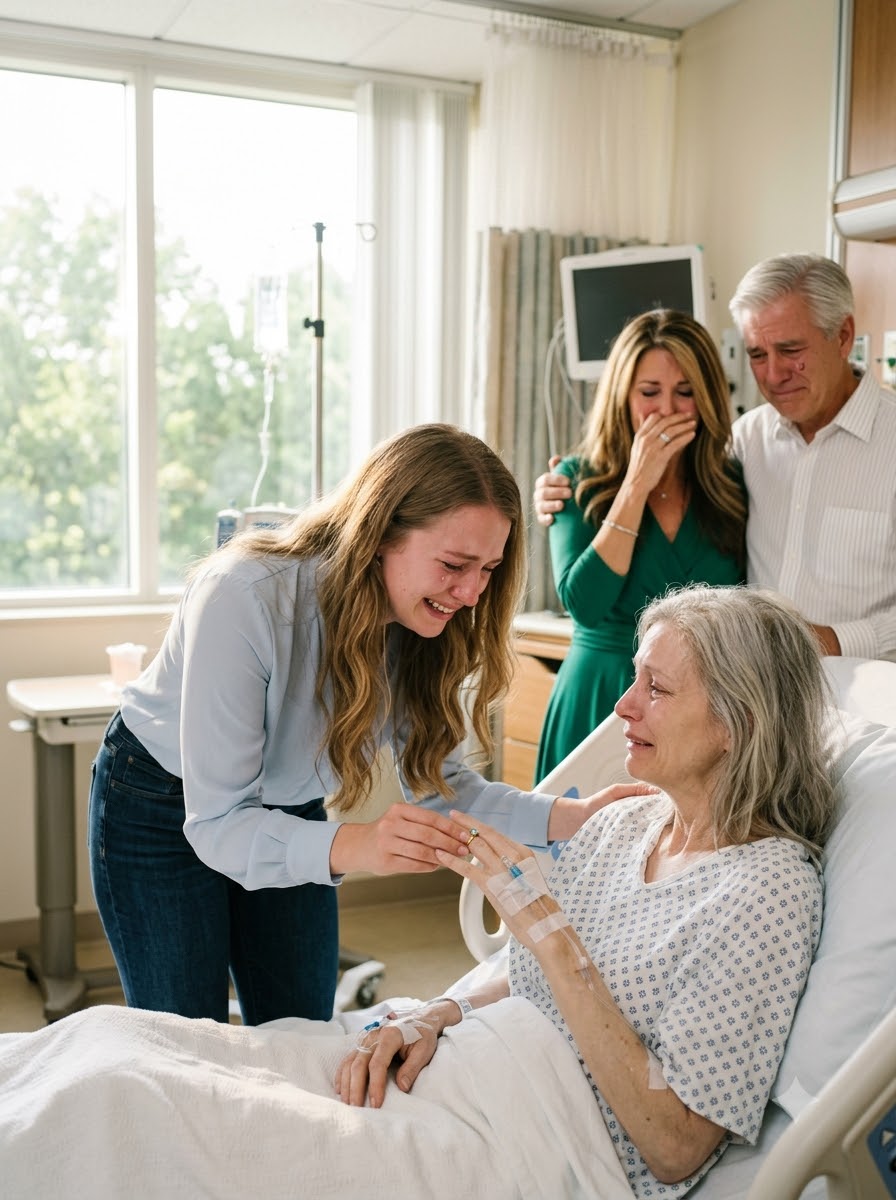
I leaned over the bed and wrapped my arms around her, carefully avoiding the IV.
I was laughing and sobbing at the same time.
“Yes. Yes, Mom, it’s me, it’s Laura, I’m here.”
Her hand lifted slowly.
It came to rest against my cheek.
Her thumb moved once.
The same gentle movement she’d made when I was little and crying about something that seemed unbearable.
“I knew you were somewhere,” she said, so quietly I felt it more than heard it. “I could feel it. I just couldn’t remember the way back to you.”
I took the ring from the plastic bag.
Then I slid it onto her finger.
The band was too large for her thin hand now.
It began slipping.
Mom curled her fingers around mine to hold it in place.
And suddenly, I understood why she’d held Margaret’s hand so tightly on the night they found her.
She’d been terrified of losing the only familiar thing she could reach.
“Take me home, Laura,” she whispered.
“I will,” I told her. “I promise. I’m going to take you home.”
Behind me, Margaret began crying openly.
Thomas wrapped an arm around his wife.
And I finally understood who these people really were.
They hadn’t taken my mother away.
They’d protected her when she couldn’t protect herself.
They’d cared for her without knowing her name.
They’d remained beside her when there was no family to call.
They’d waited for someone who loved her to arrive.
And somehow, through a forgotten restaurant bill and a lost ring, that person had finally found her.
Part 3 — The Luckiest Four Hundred Dollars I Ever Spent
Standing beside Mom’s hospital bed, I kept thinking about the previous evening.
The empty booth.
The unpaid bill.
Jett’s refusal to check the cameras.
The four hundred and seven dollars I’d surrendered.
The tears I’d cried alone in the parking lot.
I’d believed that night was another terrible chapter in a year filled with heartbreak.
But if Margaret and Thomas had paid their bill and left normally, I might never have learned the truth.
The ring could have remained wedged behind the booth.
Perhaps the cleaners would eventually have found it.
Perhaps not.
And Mom might have continued lying in room 318, identified only as an unknown patient.
I could have driven past that hospital a hundred times carrying her missing-person posters without knowing she was inside.
The very thing that had seemed to ruin my life had become the clue that brought her back.
Four hundred dollars wasn’t a loss anymore.
It was the thread connecting everything.
The couple’s anniversary dinner.
The sudden hospital call.
The forgotten payment.
The ring.
The security footage.
The valet’s recollection.
And finally, room 318.
For the first time in four months, I wasn’t wondering where Mom might be.
I was holding her hand.
She was alive.
She had recognized me.
And she wanted to come home.
I looked at Margaret and Thomas.
Only a day earlier, they’d been customers I was serving at Bellamy’s.
Now I understood that they had done something extraordinary.
They had spent weeks helping someone who couldn’t offer them anything in return.
They hadn’t known whether Mom was wealthy or poor.
Whether she had family.
Whether anyone would ever thank them.
They simply saw a frightened woman beside a dangerous road and decided she shouldn’t be left alone.
Then they continued showing up.
Day after day.
They held her hand when she became afraid.
They kept her company when she couldn’t remember her own name.
They safeguarded the ring that meant so much to her.
And when the hospital called during their anniversary dinner, they abandoned everything because they believed she needed them.
I felt ashamed of how quickly I’d assumed the worst.
But I also understood why fear had overwhelmed me.
For four months, I’d lived with the possibility that someone had hurt my mother.
Every unanswered phone call made that fear stronger.
Every failed lead left me imagining another terrible explanation.
By the time I saw the ring, I was desperate enough to believe the couple must have been responsible.
Instead, they were the people who had kept her safe.
I would never forget that.
Mom remained in the hospital while the doctors monitored her recovery.
Her condition was stable, but she was still weak.
Her memory hadn’t completely returned.
Sometimes she recognized familiar things immediately.
Other times, she struggled to remember details that once would have been effortless.
The doctors explained that her recovery could be gradual.
Some memories might return.
Others might remain inaccessible.
There was no guarantee that she would ever remember everything.
But I no longer needed every answer immediately.
For months, I’d been searching for a missing person.
Now I had my mother back.
That was enough.
Three weeks later, she finally came home.
I had imagined that moment so often during her disappearance.
I used to picture opening the front door and seeing her standing there as though nothing had happened.
I imagined her straightening a crooked picture frame.
Checking the kitchen towels.
Asking whether I’d eaten properly.
But the real homecoming was quieter.
Mom was thinner.
She moved slowly.
She tired easily.
Some days, her thoughts were clear.
Other days, she struggled to connect pieces of her memory.
The woman who had once organized every part of her life now needed time to manage ordinary tasks.
And I learned to be patient.
I no longer cared whether the kitchen was perfectly arranged.
I didn’t mind if a towel hung in the wrong place.
I didn’t care whether she remembered what we’d eaten the previous evening.
I was simply grateful she was there.
Sometimes, when she looked confused, I remembered what Margaret had told me.
How Mom had clung to her hand in the ambulance.
How she’d become frightened whenever familiar faces disappeared.
And I understood that the most important thing I could give her wasn’t an explanation.
It was reassurance.
The knowledge that she wasn’t alone anymore.
Her memory returned slowly.
In fragments.
Some days were better than others.
There were things she remembered clearly.
And things she couldn’t explain at all.
Even now, she cannot tell me exactly what happened on the day she disappeared.
She doesn’t remember why she left home without her purse.
Without her phone.
Without a coat or shoes.
She cannot explain how she ended up wandering along that county road.
Perhaps one day those memories will return.
Perhaps they never will.
I have learned to live with that uncertainty.
Because the question that once mattered most was whether she was alive.
And now I know the answer.
She’s here.
She’s home.
And every Sunday evening, my phone rings at exactly eight o’clock.
Never a minute late.
It’s Mom.
That familiar routine, once so ordinary that I barely noticed it, has become one of the most precious parts of my week.
When I see her name on the screen, I still feel a rush of relief.
Sometimes I remember those terrible weeks when I called again and again and nobody answered.
The silence.
The waiting.
The fear that I might never hear her voice again.
Then I answer the phone.
And there she is.
Evelyn Mercer.
My mother.
Still careful.
Still orderly.
Still determined to keep her routines whenever she can.
She may not remember every detail of what happened to her, but she remembers that Sunday evenings are for calling me.
And I never take that for granted.
Margaret and Thomas have become part of our lives too.
Once a month, they come to dinner.
What began as a frightening encounter in a hospital room has grown into something I never expected.
Friendship.
Trust.
Family.
Mom always insists on setting the table herself.
She moves slowly now, carefully placing each fork and spoon in its proper position.
She straightens the tablecloth.
Checks the glasses.
Makes sure everything is arranged the way she likes it.
And she always places Margaret’s seat directly beside her own.
I watch them together and remember the story Margaret told me.
A woman wandering barefoot beside a road.
An ambulance arriving.
Mom reaching for a stranger’s hand.
Margaret staying because she couldn’t bear to leave her frightened.
That stranger became the only familiar face Mom had for weeks.
Now she sits beside her at our dinner table.
Not because anyone asked her to.
Not because she expects a reward.
But because she cared enough to stay.
Thomas sits with us too.
Sometimes I look at the two of them and think about how little I understood when they first walked into Bellamy’s.
I noticed their clothes.
Their expensive meal.
The good watch.
The bottle of Bordeaux.
I assumed they were wealthy people with private troubles.
I never imagined they were spending their evenings at a hospital, comforting a woman whose name they didn’t know.
I never imagined they were watching a phone because they were worried about her.
And I certainly never imagined that the woman they were helping was my mother.
It reminds me how little we truly know about the people we meet.
A distracted customer may be carrying terrible news.
Someone who leaves a restaurant in a hurry may be racing toward an emergency.
And sometimes, the people we suspect most are the very people who have been quietly doing something good.
I think about Jett occasionally too.
The night the couple disappeared, he treated the unpaid bill as though it were entirely my fault.
He refused to check the cameras.
He made me cover a loss I couldn’t afford.
At the time, I thought that was the worst part of the evening.
But the following morning, when the cleaners discovered the ring, he did something different.
He watched the footage.
He recognized its importance.
He called me immediately.
He apologized.
And he helped me discover where the couple had gone.
None of that erased how he’d treated me the night before.
But it mattered.
Because if he hadn’t contacted me, I might not have found Mom when I did.
Life doesn’t always unfold through perfect decisions or perfect people.
Sometimes a terrible mistake leads to the one thing you need most.
Sometimes a moment of cruelty is followed by an unexpected act of kindness.
And sometimes the difference between despair and hope is something as small as a ring slipping from a purse.
I still remember how the ring looked inside that clear plastic bag.
The scratched gold.
The pale blue aquamarine.
The three tiny diamonds.
The bent prong.
For twenty-three years, Mom had worn it every day.
It was so familiar that I’d almost stopped noticing it.
But when she disappeared, that ring became one of the most important details in our search.
I put its photograph on every poster.
Showed it to strangers.
Asked coworkers to remember it.
I never imagined that one day it would fall from a customer’s purse and disappear behind a restaurant booth.
And that its accidental discovery would bring me to Mom’s hospital room.
When I slipped it back onto her finger, it no longer fit properly.
She had lost too much weight.
But she curled her hand around mine and held it in place.
I will remember that moment for the rest of my life.
Her fingers.
Her weak voice.
The way she looked at me after struggling to recognize my face.
And the words she whispered.
“Take me home, Laura.”
For four months, I had dreamed of hearing her voice again.
For four months, I’d feared I might never get another chance to hold her.
Then suddenly, I was standing beside her bed, promising that I would take her home.
And I kept that promise.
The money I lost at Bellamy’s once represented two weeks of groceries.
An electricity bill.
Tuition.
The fragile financial security I’d worked so hard to maintain.
That night, paying the couple’s bill felt unbearable.
I cried in my car because I thought I’d lost something I couldn’t replace.
But looking back, I understand that the money itself was never the most important thing.
What mattered was where it led me.
To the security footage.
To the hospital.
To room 318.
To Margaret and Thomas.
And finally, to my mother.
If someone had told me that I could pay $407.63 to find Mom after four months of searching, I would have paid it without hesitation.
I would have borrowed it.
Worked extra shifts.
Sold whatever I owned.
I would have done anything.
But I didn’t know what that dinner bill would become.
I thought I was losing four hundred dollars.
Instead, I was unknowingly following the first real clue that would bring her back.
And I learned something else from that night.
Family isn’t always limited to the people whose names appear beside yours on a birth certificate.
Sometimes family is a stranger who pulls over when everyone else keeps driving.
Someone who holds your hand in an ambulance.
Someone who returns to a hospital day after day because they cannot bear the thought of you being frightened and alone.
Someone who gives up an anniversary dinner because an unidentified patient needs them.
Margaret and Thomas didn’t know my mother.
They didn’t know me.
They had no reason to believe their kindness would ever be recognized.
But they stayed.
And because they stayed, Mom wasn’t alone during the most frightening weeks of her life.
They are family now.
Not because of blood.
Not because of obligation.
But because they earned that place through compassion.
Sometimes, when we’re all sitting together at dinner, I look around the table and feel overwhelmed by how close I came to losing everything.
Mom sits beside Margaret.
Thomas is across from them.
The silverware is arranged exactly the way Mom likes it.
Every glass has its proper place.
And the kitchen towels are back where they belong.
I used to find those little habits irritating.
Now they make me smile.
Because they mean she’s home.
And whenever I remember the four hundred and seven dollars that left me sobbing in a parking lot, I no longer think about the groceries I couldn’t buy or the bill I struggled to pay.
I think about the woman in room 318.
I think about the ring.
I think about my mother opening her eyes and saying my name.
And I think about the two strangers who refused to leave her alone.
That four-hundred-dollar dinner was the luckiest money I ever spent.
Because what it brought back to me was worth more than anything money could ever buy.
