

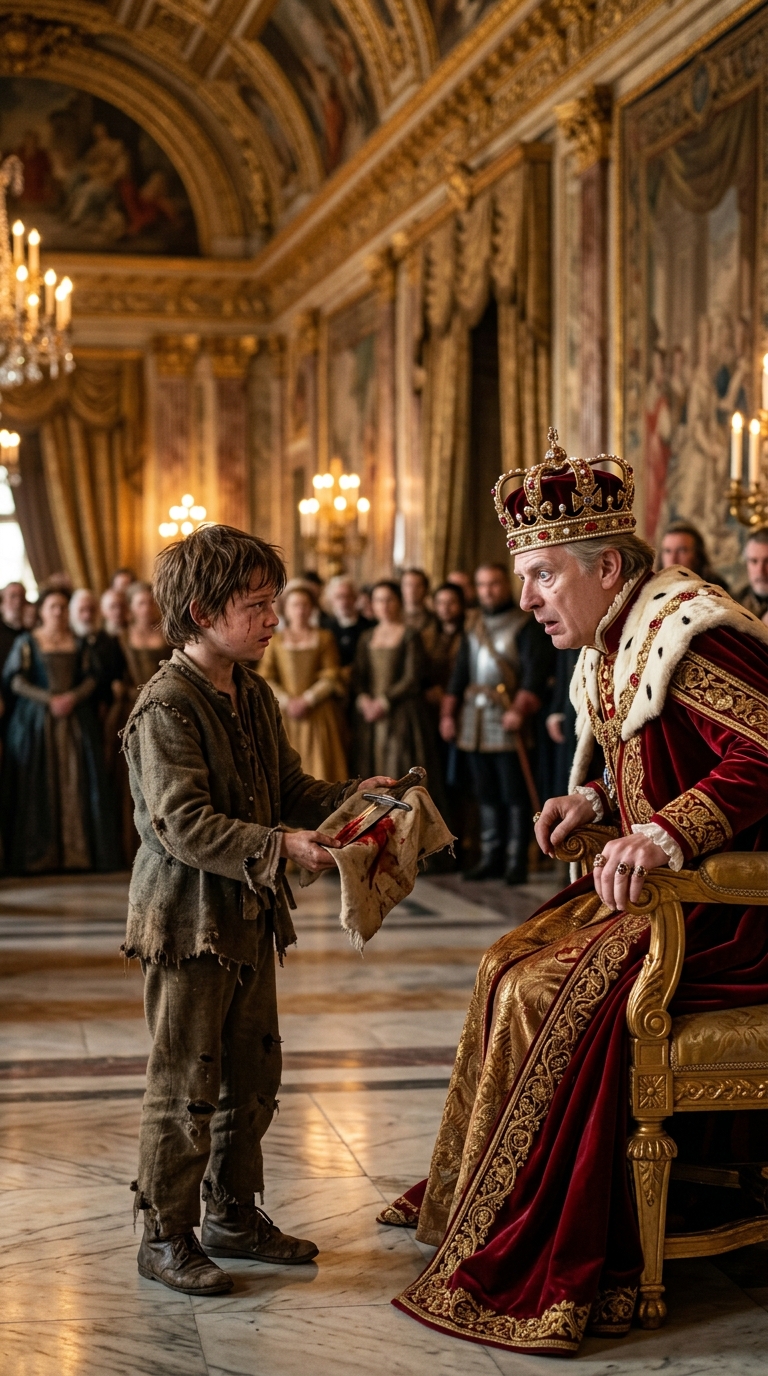
The doors to the throne hall were not meant to open like that.
Not in the final hour of court, when the torches burned low and the day’s petitions were nearly done. Not while nobles stood in measured ranks and guards lined the walls in polished silence. The palace ran on order—and order did not allow panic.
But panic came anyway.
A small boy ran across the hall, breathless and pale, clutching a blood-stained cloth in both hands as if letting go would end everything. He looked too young for the space, too poor for the marble beneath his feet, too afraid to have crossed so many guarded doors alone.
“My king…” he gasped. “My mother is dying.”
The nobles reacted with irritation before concern. A few frowned. One elderly lord muttered about careless guards. But the king, seated high beneath banners of gold and crimson, did not answer immediately.
He watched the child.
There was something in the boy’s eyes—not defiance, not madness—but a kind of desperate certainty, as if he had memorized his words a hundred times, terrified of forgetting them.
“Why come to me?” the king asked at last.
The boy swallowed. His hands shook so badly the cloth nearly slipped.
“She said…” he whispered, “you would understand this.”
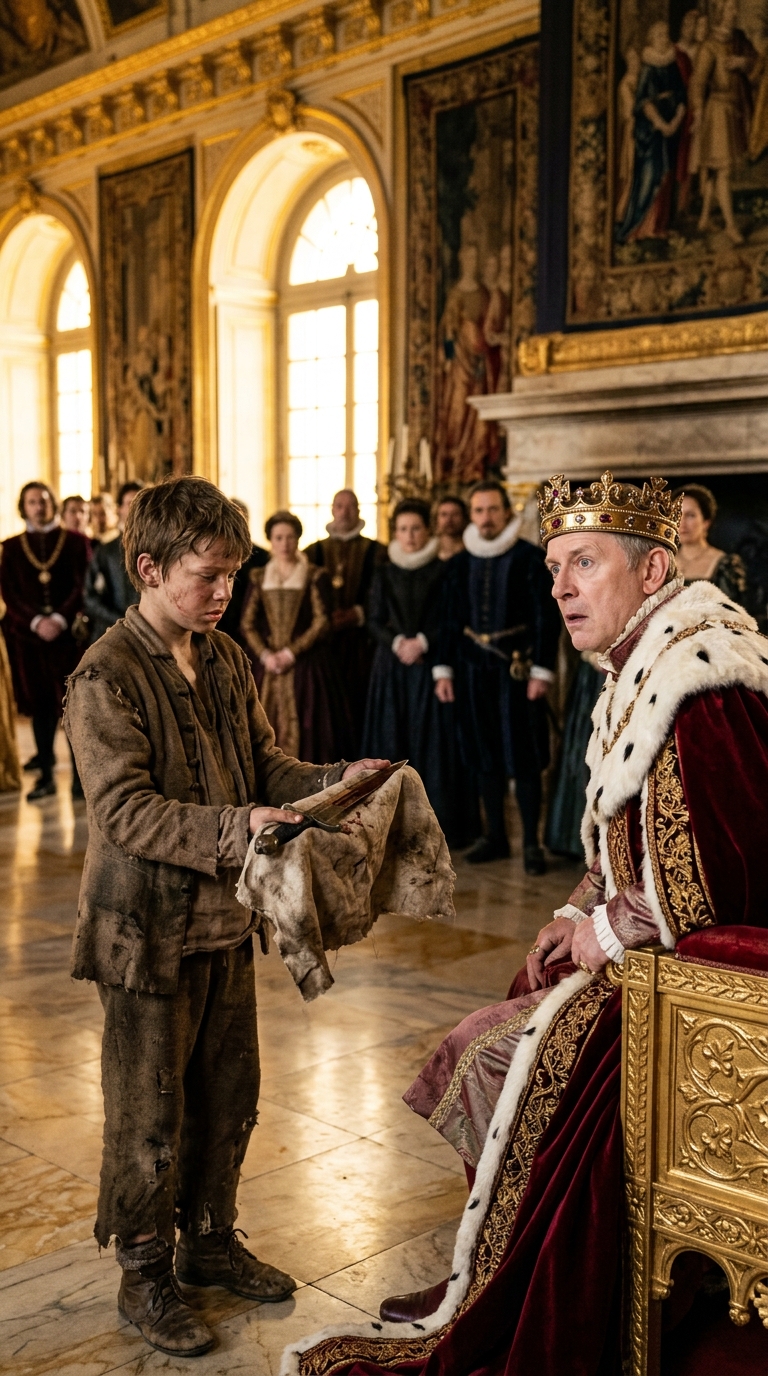
He stepped forward and unfolded the cloth.
Inside was a dagger.
It wasn’t large. It wasn’t decorated. But no one in the room failed to recognize what it meant.
The king went still.
The hilt was dark silver, wrapped in worn black leather. Near the guard, almost invisible unless you knew where to look, was the mark of the old royal guard—used long before the crown, before half the men in that hall had risen high enough to stand near him.
The king knew it instantly.
He hadn’t seen it in seventeen years.
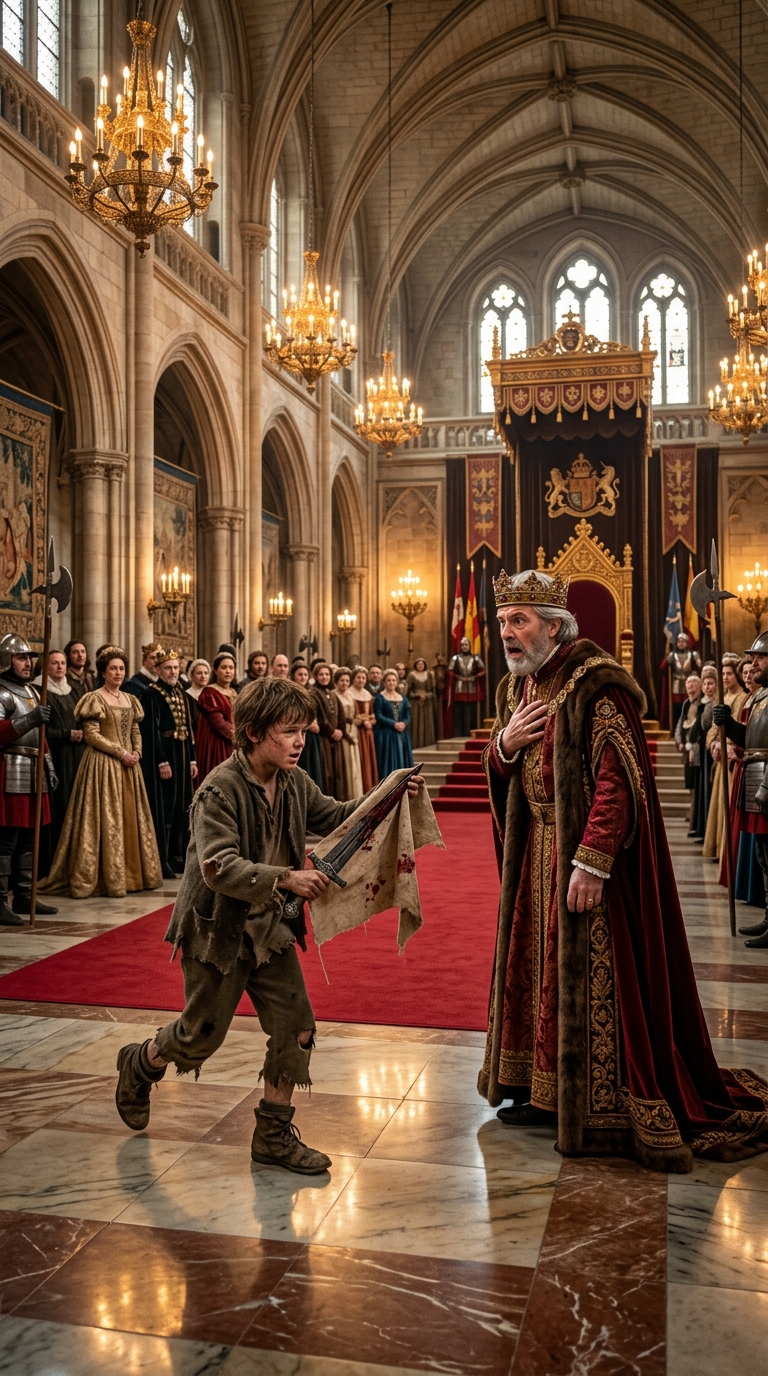
“Where did she get that?” he asked—and for the first time, his voice was no longer that of a ruler speaking to a child. It was a man hearing the past return.
The boy’s eyes filled with tears.
“She said…” he struggled to keep his voice steady, “you left it the night you betrayed her.”
Silence fell across the hall like frost.
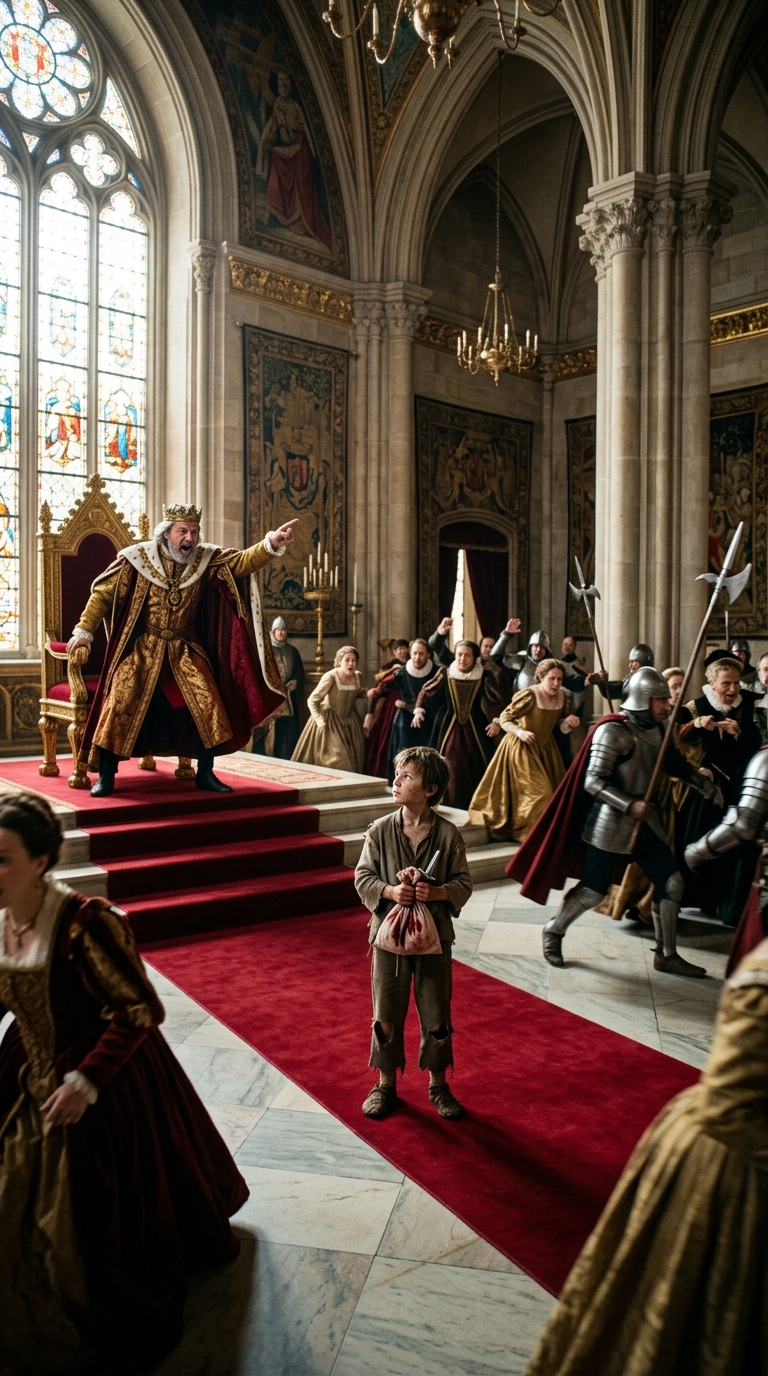
The king rose so suddenly that the nearest guards instinctively reached for their weapons. His composure didn’t fully break—but something beneath it cracked, something no one in that court had seen before.
“Clear the hall,” he said.
No one moved fast enough.
His voice dropped, colder.
“Now.”
The nobles bowed and withdrew at once. Guards ushered servants out. The vast chamber emptied in a rush of fabric, armor, and hushed urgency—until only the king, the boy, and two trusted guards remained by the doors.
The king descended the steps slowly.
He stopped in front of the boy and looked again at the dagger.
Once, long ago, it had been his favorite weapon. Not because it was royal—but because it wasn’t. It had been made for use, not ceremony. Balanced. Practical. Something a man carried when he expected danger, not applause. He used to keep it hidden beneath his cloak on nights when he still believed a prince could walk unseen among his own people.
He had lost it—or believed he had—on the worst night of his youth.
The night he never spoke of.
The boy looked up at him, fear now shifting—not of the throne, but of the man who had stepped down from it.
“What is your mother’s name?” the king asked.
The boy hesitated.
Then, quietly:
“Mirelle.”
The name struck harder than the blade.
For a moment, the king felt unsteady, as if the ground itself had shifted beneath him.
Because Mirelle had once been the only person in the capital who spoke to him as if he were not a future king—but simply a man who could still choose who he would become.
She had been the daughter of a blacksmith in the lower quarter, though that title barely captured her place in the city. Her father repaired armor for palace guards and forged tools for merchants and farmers alike. He was respected, poor, unyielding—and considered far beneath the notice of royalty.
His daughter was impossible to overlook.
She was not refined. Not cautious. Not impressed by rank.
The first time the young prince met her, she stood in the doorway of the forge with soot on her cheek and a temper sharp enough to rival the steel she worked around. He had come in disguise, restless and searching for something beyond the suffocating order of the palace, accompanying a guard captain who needed a blade repaired quietly after a foolish fight.
Mirelle had looked at him once and said, “If you’re not here to work, move. You’re blocking the light.”
No one had ever spoken to him that way.
He came back the following week.
Then again.
At first, he told himself it was for the city—the noise, the movement, the freedom of not being recognized. But it was always for her.
She didn’t laugh often, but when she did, it unsettled him in ways he didn’t understand. She trusted slowly, but once she did, her honesty came without softness—sharp, direct, impossible to ignore. She saw through his disguise long before she said it aloud, and when she finally did, she didn’t kneel or panic.
She simply said, “Then you’re more foolish than I thought.”
He loved her from that moment.
Not the way songs described love. Not something polished or distant. He loved her like a man stepping into fire because the warmth mattered more than the danger.
They met in quiet places—alleys, empty courtyards, forgotten watch paths along the outer wall. He told her dreams he had never spoken to anyone. She told him truths he had spent his life avoiding.
And because youth mistakes intensity for certainty, he believed it would be enough.
It never is.
When the old king discovered the relationship, he didn’t shout. He didn’t imprison anyone.
He didn’t need to.
Men like him rarely raised their voices when they could rearrange the world instead.
The prince had been told, calmly and without room for argument, that the future of the kingdom had already been decided. A royal marriage was in motion. The daughter of a northern house would bring soldiers, grain, and peace along the border. His personal desires meant nothing beside the weight of a crown.
He argued. Refused. Even threatened to abandon everything.
His father listened.
Then he said the words that would follow the prince for the rest of his life:
“You are free to destroy yourself. You are not free to destroy what thousands will inherit after you.”
Within days, everything around him changed. His movements were watched. Guards were replaced. Letters disappeared. Trusted servants were dismissed.
Still, he found ways to reach Mirelle.
They made a plan—to leave the city. Just for a few days at first. Then farther, if needed. He promised he would come for her the night before his father’s envoys arrived to seal the marriage.
He was late.
Less than an hour—but enough.
Delayed by a false summons. Slowed by doubled guards along the western corridor. He escaped through a mix of lies and luck, took a horse, and rode hard through the lower gate.
By the time he reached the old mill where they were meant to meet, it was already empty.
Not quiet.
Broken.
A cart overturned. A shattered lantern. Blood across the wooden floor.
And his dagger—gone.
He searched until dawn. Then for weeks. Then for months, using methods no prince should ever learn.
He never found her.
Eventually, he was told a body had been pulled from the river south of the city. A woman of similar build. Too damaged to identify. No proof—only certainty delivered with the confidence of men who served power.
His father said nothing.
He didn’t need to.
The prince understood.
He stopped searching—not because he believed it, but because every path was watched, and every man he questioned began to disappear.
Time moved forward. His father died. The prince became king. Years passed. Duty hardened around the wound.
But some grief doesn’t fade.
It simply learns to sit quietly behind the eyes.
And now—
A child stood before him, holding the dagger from that night.
“Take me to her,” the king said.
The boy blinked, startled.
“Now.”
The king did not call for a carriage. He did not wear ceremonial armor. He did not inform the council. Within minutes, he was riding through the lower streets with only four guards—and the boy beside him on a second horse.
Word still spread. It always did. Kings did not move unseen, especially not at night.
The boy led them far from the palace—past the market quarter, past the forge district, into the river neighborhood where flood and poverty bent houses toward one another like weary men.
At the end of a narrow lane stood a small cottage, barely holding itself together against time.
Inside, the air carried the scent of herbs, smoke… and blood.
She was there.
Mirelle.
Older. Thinner. Pale with pain—but unmistakably herself.
She lay on a narrow bed by the window, one hand pressed weakly against her side where the bandage had already darkened. A neighbor woman sat near the hearth, silent with fear.
When the king stepped inside, Mirelle opened her eyes.
For a long moment, neither of them spoke.
Years of distance, power, silence, and loss stood between them—and still, he saw her exactly as he had in the forge doorway all those years ago.
Unafraid. Unyielding.
“Mirelle.”
Her lips curved faintly.
“You still say my name,” she whispered.
His throat tightened.
“What happened to you?”
“A robbery,” the neighbor said quietly. “Or so they claimed. Two men. They took nothing.”
Mirelle let out the smallest breath of a laugh, then closed her eyes briefly.
“They weren’t robbers.”
The king understood immediately.
They had come to erase what remained.
Again.
He dismissed the neighbor and guards with a look. Only the boy stayed, near the door, too afraid to move closer.
The king knelt beside the bed.
“I thought you were dead.”
Mirelle turned her face toward him.
“That was the idea.”
There was no anger in her voice. That made it harder to bear.
His eyes shifted to the boy.
“Our son?” he asked—and even then, the word felt fragile, almost unreal.
Mirelle watched him carefully.
“Yes.”
The room seemed to close in around that single word.
He had faced war, rebellion, famine—loss on every scale a ruler could know. None of it struck him like this.
His son.
A child who had lived nearly a decade without knowing his father—only the danger tied to his name.
“Why didn’t you tell me?”
For the first time, something sharp flickered in her eyes.
“I tried.”
He looked at her, startled.
She nodded weakly toward the dagger.
“That night at the mill… I wasn’t alone.”
The truth came slowly, broken by shallow breaths and pauses where pain stole her voice.
She had waited, as they planned—already carrying his child, though she hadn’t yet found the courage to tell him. She had written a letter. Hidden it beneath the grain sacks.
When men arrived instead of him, she recognized one of them—not a stranger, but a palace guard from the old king’s personal watch.
They told her the prince had chosen the crown.
That he had abandoned her.
That if she valued her life, she would disappear quietly.
She didn’t believe them.
So she fought.
One man struck her. Another searched the room. When she tried to run, she hit the wall—and his dagger, dropped in the struggle, slid beneath a broken plank. She grabbed it, not to fight, but to survive long enough to reach the rear hatch and escape into the river reeds behind the mill.
“I waited for you until I heard your horse,” she whispered. “But by then I could already hear them saying I was dead.”
The king’s face tightened, something close to horror breaking through.
“They lied.”
“Yes.”
“Why not come back once I was king?”
At that, Mirelle’s expression shifted.
Not anger.
Something quieter.
“Because by then you had a queen,” she said. “A court. A kingdom. And men like the ones who came for me don’t disappear when a father dies. They just bow to a different crown.”
He had no answer.
Because she was right.
His gaze moved again to the boy.
The child had his eyes. Mirelle’s mouth. And a kind of watchfulness that only came from growing up where love existed—but safety didn’t.
“What is his name?”
“Leo.”
The boy looked at him, uncertain—trying to decide if a king could also be something else.
The king reached out slowly, not quite touching him yet.
Leo didn’t step back.
Mirelle watched them, and for the first time, some of the tension left her face.
“I didn’t send him to you for rescue,” she said.
“Then why?”
“Because they came again.”
The king’s attention sharpened.
“Who?”
“I never knew all their names. Only enough to understand that what started with your father didn’t end with him.” Her voice weakened, but her eyes stayed steady. “Someone has spent years making sure I stayed hidden. Poor. Forgettable. Easy to dismiss. But now…” She looked toward Leo. “Now he’s old enough to ask questions that could get him killed.”
The king understood immediately.
This wasn’t random.
Someone knew.
And if they knew, then the danger had already moved.
He stood at once and called the guards back in.
“Seal this street. Bring me the captain of the city watch. No one enters or leaves without my order.”
Mirelle gave a faint, tired smile.
“You still choose command when you’re afraid.”
He looked at her.
“I’m terrified.”
The truth surprised both of them.
For a moment, something from their past surfaced—not the life they had lost, but the shape of it.
Then Mirelle coughed, and blood touched her lips.
Everything in him went cold.
He summoned the royal physicians himself. They came. They worked. They spoke in low voices. And by midnight, their silence said what words would not.
The wound was too deep.
Too much time had passed.
He stayed beside her until the room was quiet again.
Leo had finally fallen asleep in a chair near the hearth, exhaustion overcoming fear.
Mirelle looked at the boy, then back at the king.
“He needs a father.”
The king lowered his head.
“He should have had one from the beginning.”
“Then give him one now.”
He closed his eyes.
“Mirelle—”
“No.” Her voice was faint, but unyielding even then. “Listen to me. Do not make him a secret. Secrets rot men from the inside. I’ve lived long enough to know that.”
He took her hand carefully. It was colder than he was ready for.
“Come back with me,” he said, though they both knew the words had come too late.
A faint smile touched her lips.
“You always did ask for tomorrow after losing today.”
Tears filled his eyes before he could stop them.
He had not cried when his father died. Not when his queen was taken by fever. Not even when war claimed men he had grown up beside.
But now, with his head bowed over the hand of the woman he had once promised to protect, grief returned like something that had only been waiting.
“I was too late,” he whispered.
Mirelle’s fingers moved weakly against his.
“Yes,” she said.
Then, after a pause:
“But not this time.”
She looked toward the boy.
That was what she gave him in the end.
Not forgiveness.
Direction.
She died before dawn.
Quietly.
With the river wind stirring the curtain beside her bed.
The king remained there long after the physicians stepped away and the candles burned low. When he finally stood, he was no longer only a ruler facing an old wound.
He was a father standing between a child and the same force that had once tried to erase them both.
By sunrise, the lower city was sealed under royal command. Three men from the old palace watch were taken from their homes before the day had fully begun. One fled and was found dead in the stables before dawn. Another broke under questioning before midday. The third held his silence—until the dagger was placed in front of him.
Then he spoke a name the palace had not dared remember.
Lord Carrow.
The old king’s counselor. Supposedly dead six winters earlier. Buried with honor in the royal crypt.
Except when his coffin was opened in secret beneath the chapel, it held no body.
Only stones.
He had never died.
He had disappeared into the shadows of the kingdom with gold, loyal men, and the remnants of the old king’s hidden network. For years, he had made sure certain truths never reached the throne.
The prince’s lost lover.
The hidden child.
The dagger left behind.
All of it had survived only because Mirelle had refused to disappear.
For the next week, the king hunted without rest. Carrow was found at last in a monastery cellar near the northern road, disguised as a dying scholar—his beard white, his hands steady.
When brought before the king, he did not deny anything.
“Your father built stability,” he said. “I preserved it.”
“You preserved your power.”
Carrow almost smiled.
“There is no difference to old men.”
Once, the king might have answered with anger.
Now he said only, “There is to sons.”
Carrow was executed before sunset. No public explanation followed. The records would call it treason. They would not mention Mirelle. They would not mention Leo. Some truths still frightened kingdoms more than swords.
But not this king.
Three days after Carrow’s death, the king stood once more in the great hall.
This time, the doors opened not for petitions—
but into silence.
Leo walked into the hall wearing simple dark clothes—still modest in cut, but clean now—his small hand held firmly in the king’s.
The court watched in stunned silence.
The king did not sit on the throne.
He stood before it.
“This child,” he said, his voice carrying across stone and stillness, “is my son.”
The hall did not erupt.
Shock that deep rarely does.
It shifted instead.
Heads lowered. Eyes lingered. Old alliances quietly began to rearrange themselves.
Leo looked up at the king—afraid, but steady.
And the king, for the first time in years, did not hide the softness in his expression.
Mirelle was buried not in the lower city, but on the hill above the western gate, where the last light of day lingered longest. No royal title was given to her publicly. But the king placed the dagger beside her in the earth, and inside the tomb he ordered a single line carved:
She was told the crown had won. She lived long enough to prove it had not.
Years later, when Leo was old enough to ask if his mother had hated the palace, the king answered without hesitation.
“No,” he said. “She hated what fear made men do inside it.”
And when Leo asked if she had ever forgiven him, the king looked toward the western hill and replied:
“She trusted me with you. That was more than I deserved.”
It wasn’t the kind of ending that stories often choose.
There was no return in time. No life restored. No years given back.
But there was something rarer.
A truth buried by power that refused to stay buried.
In the end, the dagger the king had once left behind on the worst night of his life did not remain a symbol of betrayal.
It became something else entirely.
Proof that even when love is hunted, twisted, and forced into hiding—
it can still find its way back,
carrying a child by the hand.
