

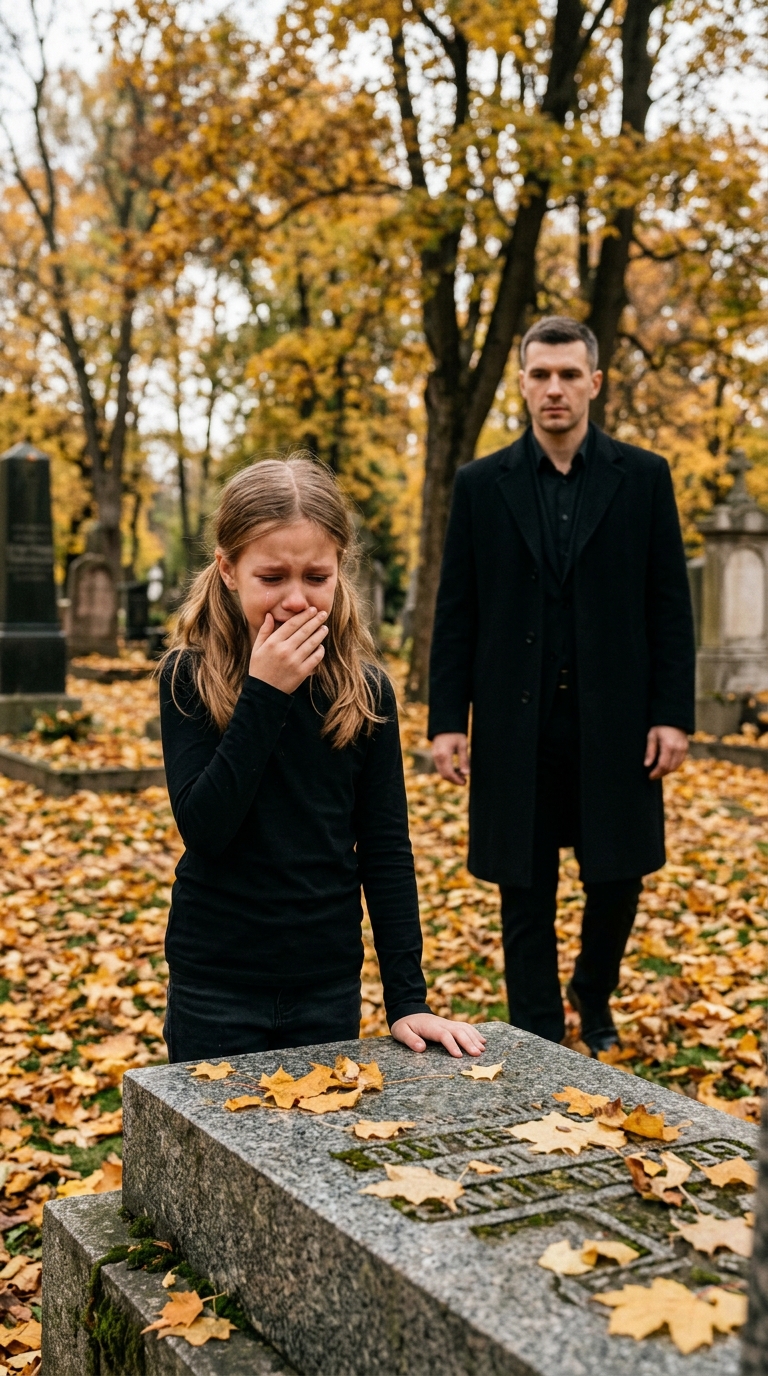
A powerful man stood before his son’s grave. Nearby, an unfamiliar little girl wept quietly beside the headstone. What he was about to uncover would shatter everything he believed about his own family.
Richard Collins had built his empire from nothing. Steel towers, luxury developments, and influence that reached across Chicago. He understood contracts, leverage, and timing. But he did not understand grief.
Still, for four years, every Sunday had belonged to it.
His driver, Samuel, no longer needed directions. The black sedan simply glided through downtown, past the gleaming skyscrapers that carried Richard’s name, past the elegant estates of the North Shore, until it arrived at the quiet order of Evergreen Memorial Park.
Richard stared out the tinted window but saw almost nothing. Sundays were for Andrew.
For the memory of Andrew. For the silence he had left behind.
His only son had died at thirty-two in a senseless accident on Interstate 90 while driving home from a free medical clinic Richard had often criticized.
“You’re wasting your talent,” Richard used to tell him. “Open a private practice. Build something real.”
Andrew would simply smile.
“I am building something real, Dad.”
A semi-truck’s brakes failed. There was no time left to build anything more.
Four years. People had promised the pain would eventually fade.
“Time heals,” colleagues would say.
They were wrong. Time didn’t heal anything. It only deepened the empty space.
“We’re here, Mr. Collins,” Samuel said gently.
Richard stepped out alone, holding white lilies. Andrew had always disliked extravagance.
“It’s wasteful,” he once said. “Spend it on someone who actually needs it.”
The grave rested beneath a maple tree overlooking a small pond. The headstone was simple:
Andrew Collins 1989–2021 Doctor. Son. Friend.
Richard had wanted more written on it. Achievements. Legacy. Andrew had refused.
Halfway up the path, Richard suddenly stopped.
Someone was there.
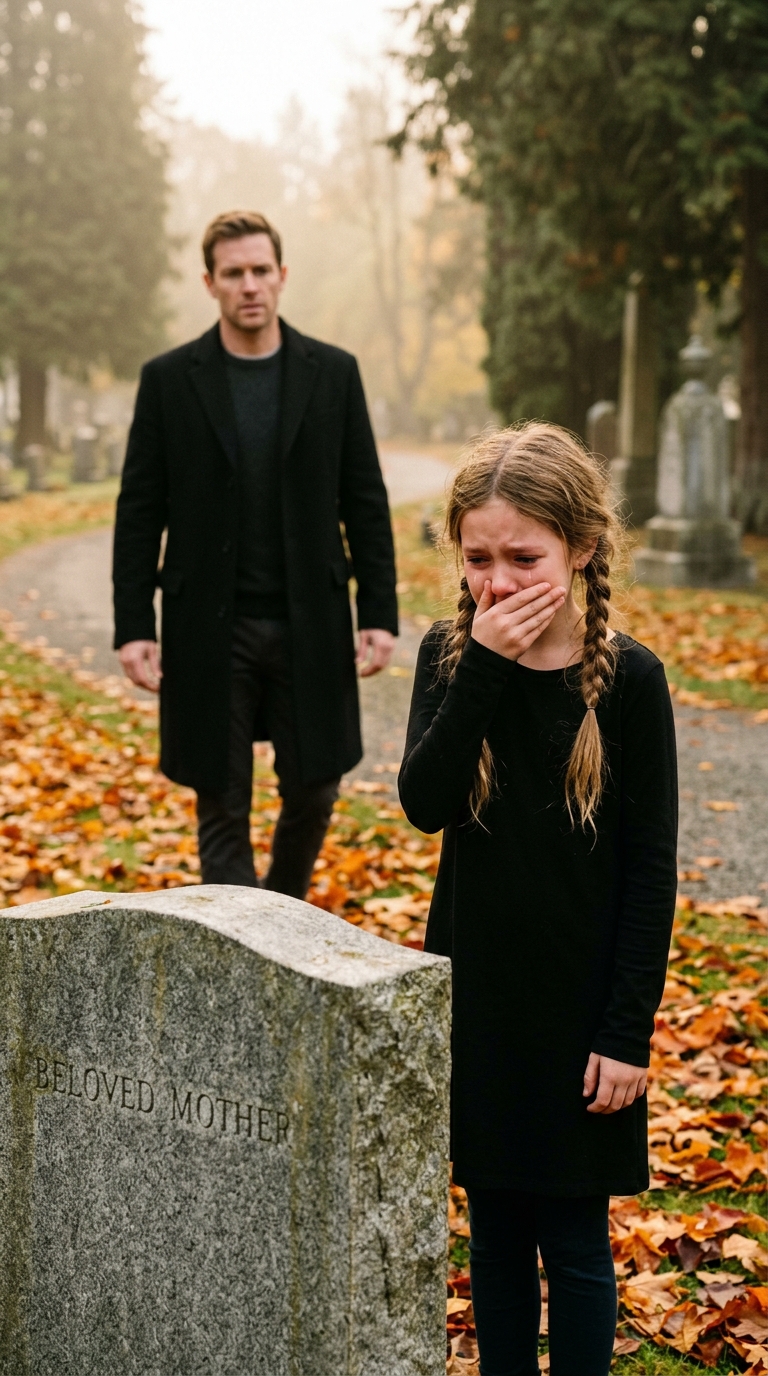
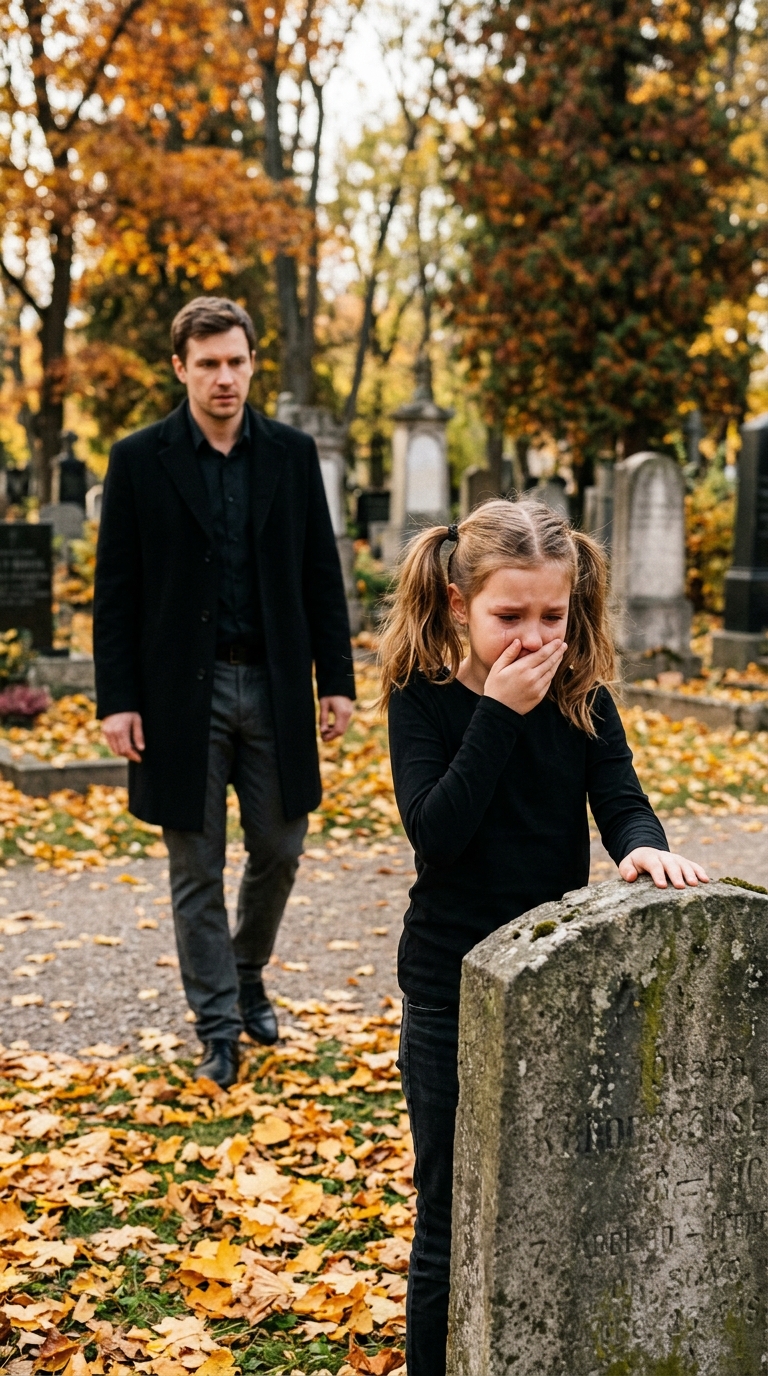
A small girl knelt in the grass beside the stone. Nine, maybe ten. Thin. Wearing a faded pink sweater with worn elbows. Her dark hair was tied in a loose braid. She was crying softly, one hand resting on the granite.
Not loudly. Not dramatically. The quiet kind of crying that comes from deep inside.
Irritation rose first.
This grief belonged to him.
“Why are you here?” he asked, his voice sharp from years of boardroom authority.
She jumped to her feet. A white hospital bracelet slipped from her hand. She quickly grabbed it.
“I—I’m sorry,” she whispered.
“Where are your parents?”
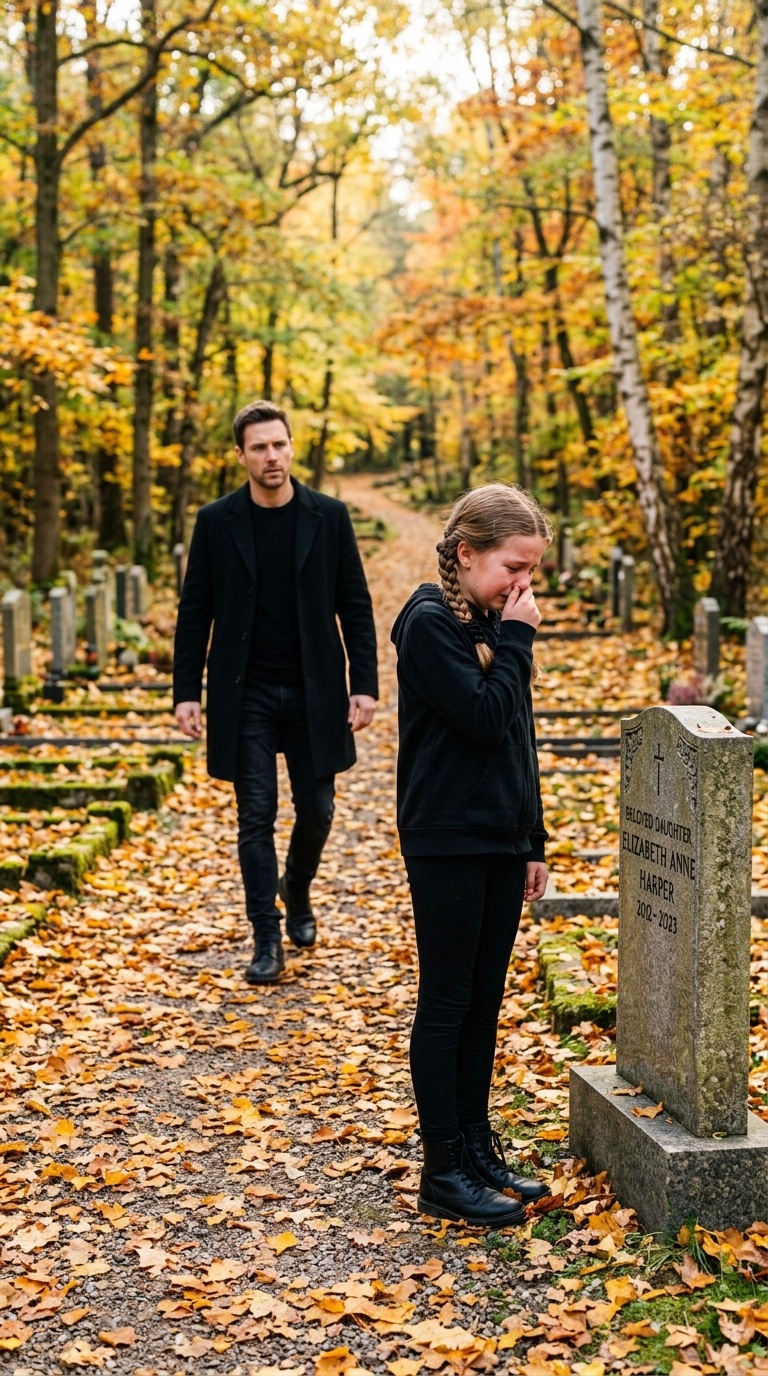
At that question, her expression broke.
“I didn’t mean to,” she murmured before running between the trees.
Richard remained standing there. Then he noticed something left beside the headstone.
A laminated photograph.
He picked it up.
Andrew, wearing his white coat, smiling. Holding a little girl in his arms.
The same girl.
Richard felt his breath tighten.
How did she know his son?
A memory surfaced.
Elena Rodriguez. A quiet housekeeper who had worked in Richard’s home for two years before suddenly leaving six months after Andrew’s death. She had said she was moving away.
Richard had hardly paid attention.
Now he called his investigator, Marcus Delgado.
“Find Elena Rodriguez and her daughter. I want everything.”
That night his mansion felt enormous and empty. Awards lined the walls. Photographs with senators and CEOs. None of it meant anything.
He opened the box of Andrew’s belongings from the hospital.
Inside was another photograph. Andrew. Elena. The little girl—five years old—wearing a toy stethoscope.
On the back, Andrew had written:
“My girls. June 2020.”
Richard’s hands began to tremble.
He discovered a journal.
The first entry read:
“Met someone today at Hope Community Clinic. Elena Rodriguez. Seven months pregnant. Scared. Alone.”
Page after page revealed a life Richard had never known about. Andrew had treated Elena when she was undocumented and too afraid to seek medical help. He stayed after appointments. He helped when the baby, Sofia, was born. He rocked her to sleep. Quietly paid rent. Read her bedtime stories.
Eventually, he arranged for Elena to work in Richard’s house—without revealing the truth about their relationship.
The final entry was dated three days before the accident.
“I’m finalizing adoption papers for Sofia. It’s time to make official what has always been true. I’ll tell Dad on Friday.”
He never reached Friday.
Richard broke down. The grief he had locked away for four years poured out in harsh, shaking sobs.
Marcus called the next morning. Elena and Sofia had been staying at a shelter but had recently left. They were afraid of Richard.
Afraid.
Richard drove himself to Hope Community Clinic on the city’s South Side—a neighborhood he had rarely visited.
There he heard stories about Andrew.
“He treated us like we mattered,” one woman said.
The clinic director confirmed everything. Andrew had loved Elena. He planned to adopt Sofia. He had even listed Richard as legal guardian in case anything happened.
Richard felt something shift painfully inside him.
Despite their disagreements, Andrew had trusted him.
He found the attorney, David Mercer. The adoption papers were complete, waiting only to be filed. Andrew had quietly created a $400,000 trust fund for Sofia.
In the guardianship section, Andrew had written:
“I name my father, Richard Collins, as guardian. He loves deeply, even if he struggles to show it. If anything happens to me, I trust he will see what I see in Elena and Sofia.”
Richard cried openly in the office.
Andrew had believed in him.
Soon, Marcus located Elena in a small town outside Milwaukee, staying with her cousin Miguel.
Richard drove there alone.
The apartment building was modest. Paint peeling. Children’s bicycles scattered in the courtyard.
Miguel opened the door cautiously.
Inside sat Elena and Sofia.
Elena looked exhausted but determined. Sofia held the hospital bracelet tightly.
“I’m not here to threaten you,” Richard said quietly. “I’m here because my son loved you.”
He showed them the journal. The adoption papers. The trust documents.
Sofia stepped closer.
“What does it say?” she asked.
“It says your dad loved you more than anything,” Richard replied softly. “And that he wanted me to take care of you.”
Elena covered her mouth, crying as she read Andrew’s words—about bedtime stories, about Sofia calling him Dad.
Richard swallowed his pride.
“I was wrong,” he admitted. “About what really mattered.”
He didn’t offer control. He offered presence.
“I’d like to know my granddaughter,” he said. “If you’ll allow it.”
“Granddaughter?” Sofia repeated.
“Your father chose you. That makes you family—if you want to be.”
She studied him for a moment, then stepped forward and wrapped her arms around his waist.
The first hug he had felt in years.
Two weeks later, they stood together at Andrew’s grave.
Elena placed daisies. Sofia held Richard’s hand.
“Hi, Dad,” Sofia whispered to the stone. “We’re okay.”
Richard knelt.
“I’m sorry, son,” he said quietly. “I didn’t understand. But I do now.”
Sofia placed the hospital bracelet at the base of the headstone.
They stood together—connected not by blood or wealth, but by love freely chosen.
As they walked back toward the car, Richard felt something unfamiliar.
Not the disappearance of grief. Andrew would always be gone.
But alongside that loss, something else had appeared.
Purpose.
Responsibility.
Hope.
He had lost his son.
