

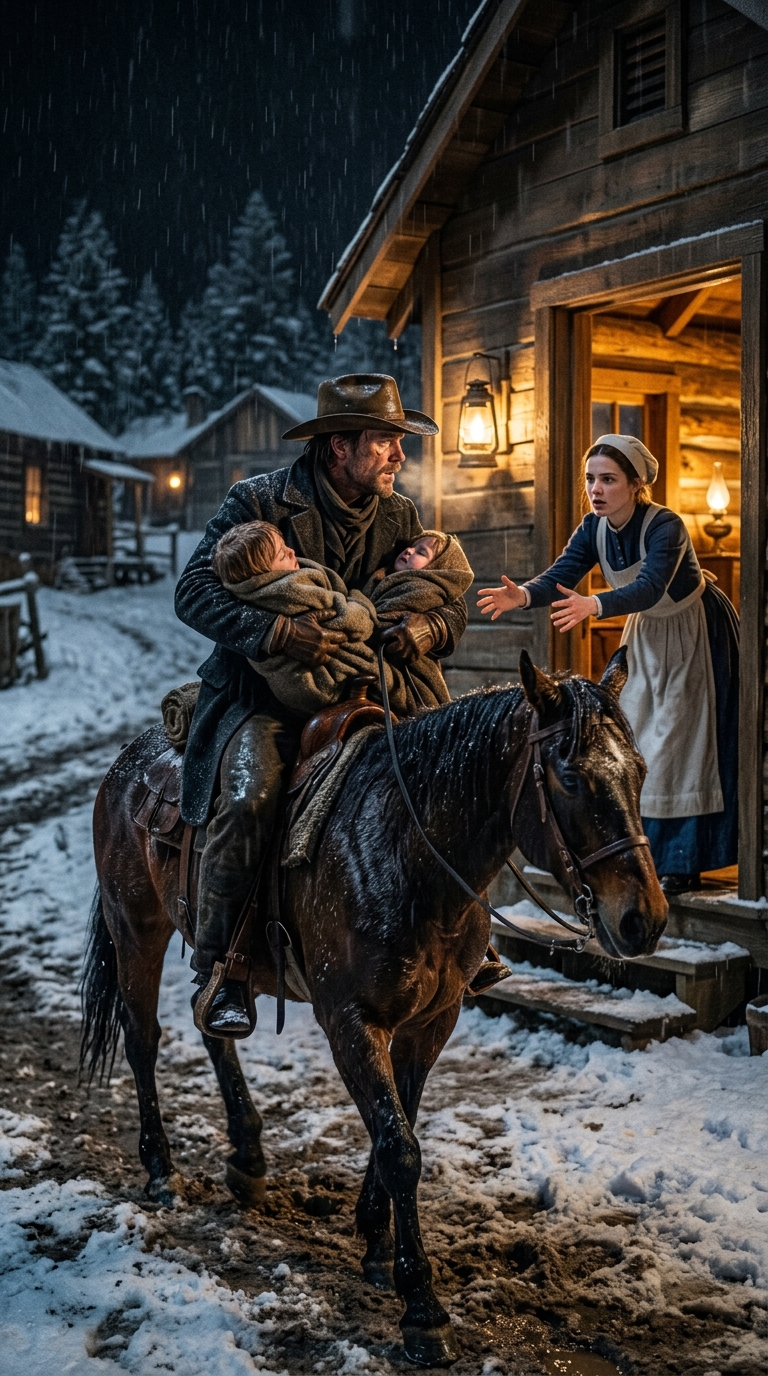
Joaquín Paredes pressed the two children tightly against his chest and kept walking. His boots had split open miles ago, icy water seeped through his torn coat, and he didn’t even know their names. He didn’t know if the boy was still breathing. He didn’t know if the girl was conscious or if the cold had already stolen her strength. He only knew one thing: if he stopped, all three of them would die there.
On the morning of February 14, 1882, a man with no home, no family, and nothing to his name but a few damp coins in his pocket made a decision that seemed absurd. And yet, that decision would change his life.
Joaquín never expected to make it to San Lorenzo alive. He didn’t say it with drama, but with quiet resignation. It was a simple calculation. He had left the north with forty-seven cents, an old horse that went lame halfway, and three days’ worth of dried meat that ran out before the sky even began to turn pale. By the time the storm hit, he was already walking alone, pushed forward by the wind, his head bowed, his body moving more out of habit than hope.
It was among a row of bare poplars that he stumbled.
At first, he thought it was just a log buried in the snow. Then he saw a small, bluish hand barely visible beneath the ice. He dropped to his knees, clawed through the snow with both hands, and found them: a girl and a boy clinging desperately to each other, as if trying to become a single body to avoid freezing to death.
The girl looked about eight years old. The boy, no more than six.
“Hey… look at me,” Joaquín whispered, gently shaking the girl’s shoulder. “Don’t go… come on, sweetheart, open your eyes.”
Her eyelashes fluttered. It was only a tiny movement, but it was enough.
Joaquín removed his coat—the only one he had—wrapped it around their rigid bodies, and lifted them into his arms. The weight nearly overcame him at once, but he gritted his teeth and kept moving.
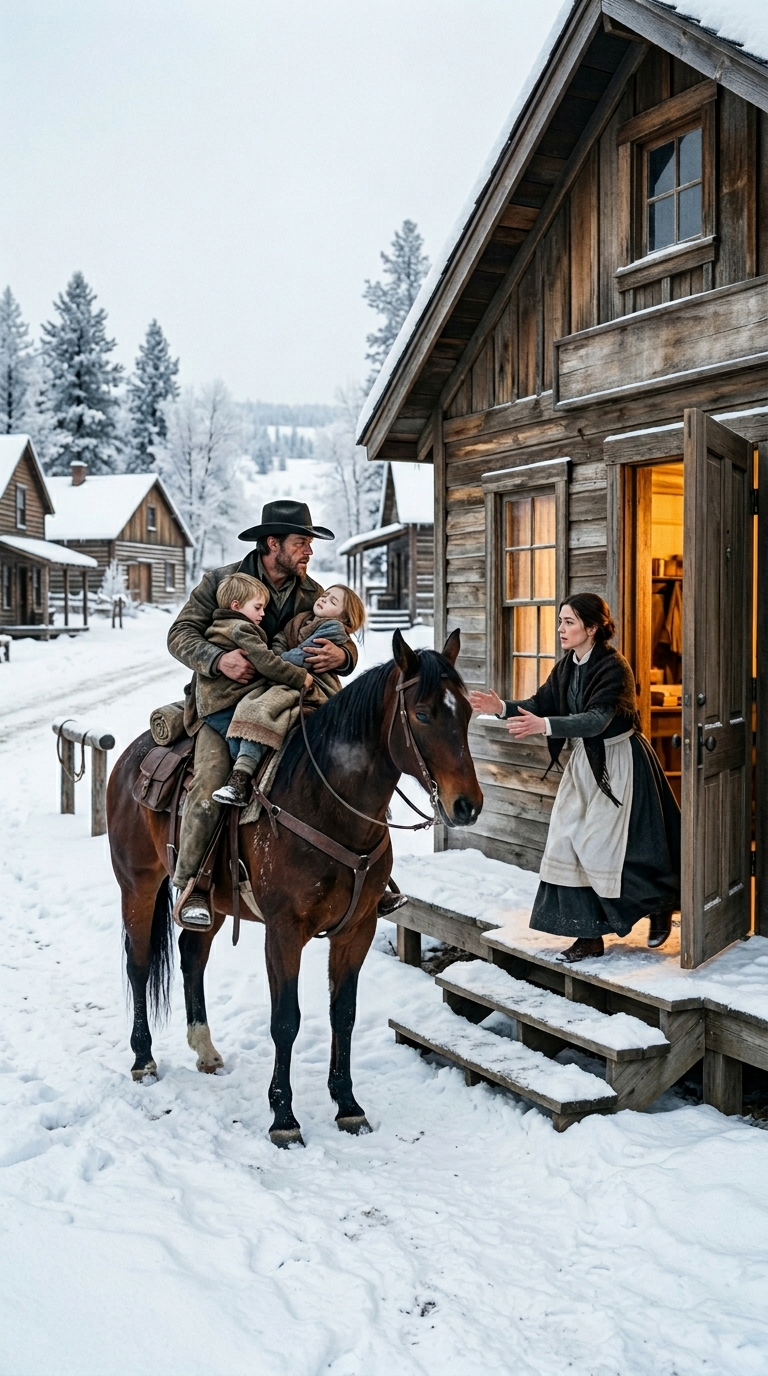
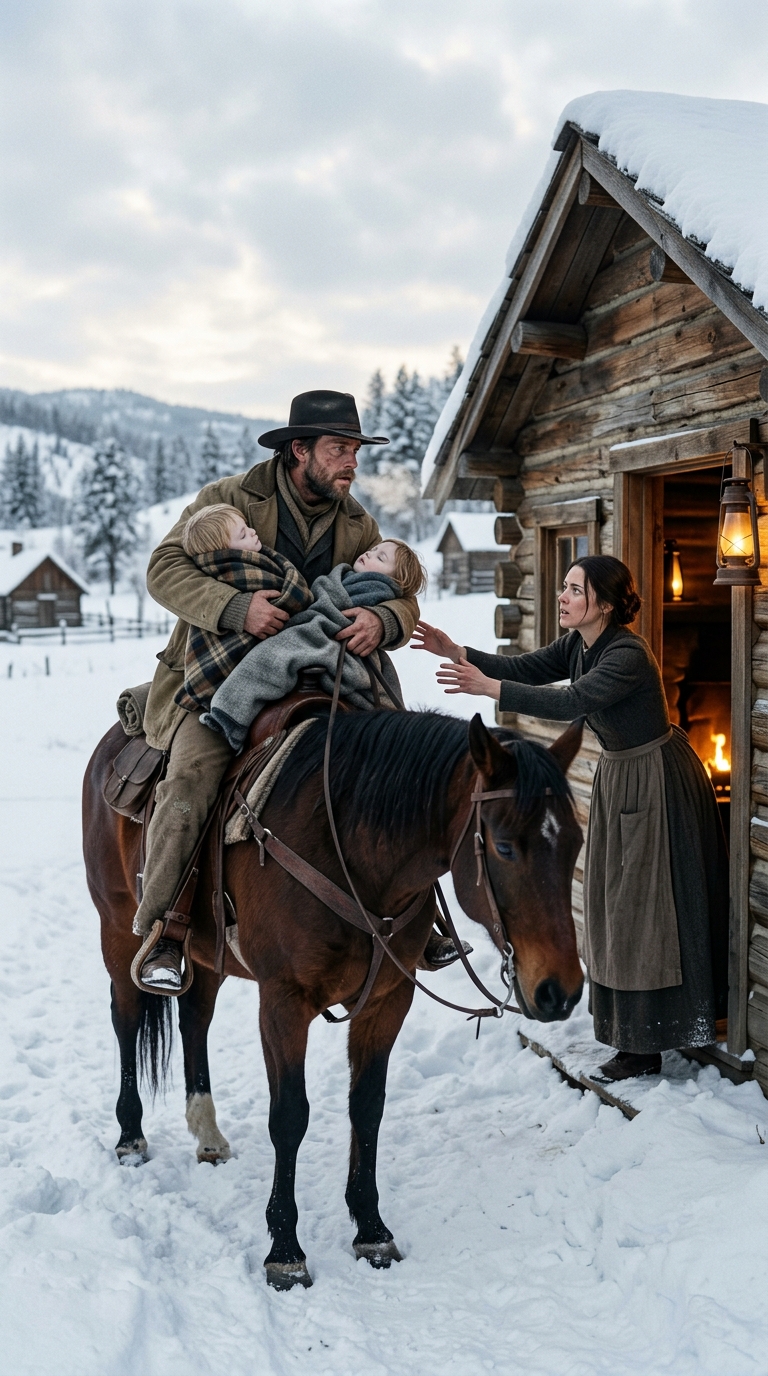
When he staggered onto the main street of San Lorenzo, he looked like a man spat out by the storm. The town was decorated with red ribbons and paper hearts that day. The air smelled of sweet bread and cinnamon. People froze as they watched him arrive, carrying two half-dead children in his arms.
“Where is the infirmary?” he asked, his voice cracked and weak.
At first, no one answered. Then a young man pointed toward the end of the street.
“Miss Villaseñor’s house. The green door.”
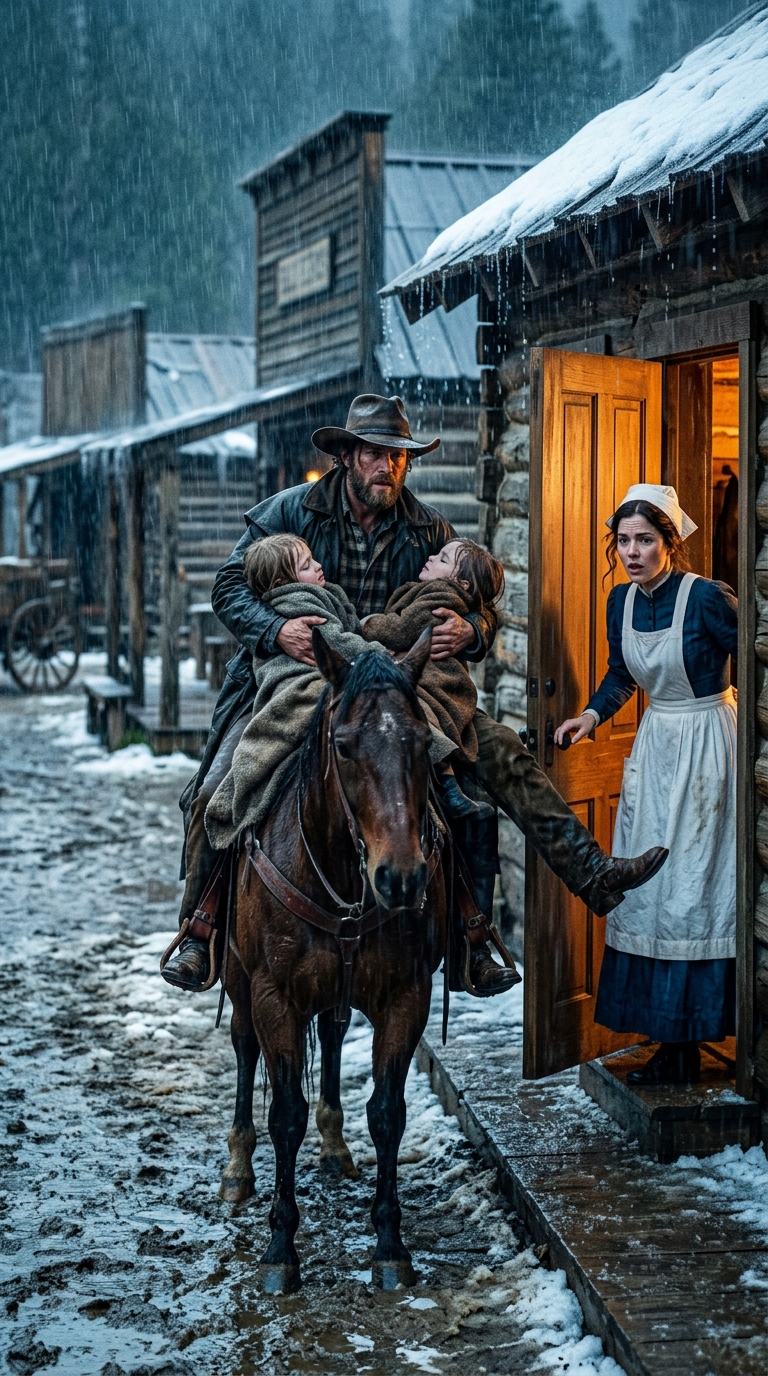
Joaquín made his way there and knocked with his foot, since his hands were full. Once. Twice. Three times.
The door flew open.
The woman who appeared was not old or gentle like he had imagined someone devoted to healing would be. She was young, straight-backed, with dark eyes and a firm voice.
“Bring them in. Now.”
That was how he met Alicia Villaseñor.
Joaquín laid the children on a narrow table. Alicia didn’t waste a second—dry blankets, warm water, steady hands. She listened to their breathing, checked their pulses, and gave orders as if fear did not exist.
“The girl’s heartbeat is weak, but stable. The boy is worse. Light the stove in the back. Now.”
Joaquín obeyed without hesitation. For nearly an hour, he carried wood, heated water, prepared coffee, held containers—doing everything Alicia told him. The boy showed no response. The girl did, barely. Sometimes she clenched her teeth; sometimes she seemed to drift away again.
When she finally opened her eyes, she suddenly sat up.
“Matthew!” she cried, her voice trembling. “Where is Matthew?”
Joaquín stepped closer immediately.
“He’s here. Easy… right here.”
The girl looked at him, then at the boy wrapped in blankets, then at Alicia, who continued watching closely.
“Is he going to die?” she asked.
Alicia didn’t lie.
“I’m doing everything I can to prevent that.”
The girl swallowed hard and gripped Joaquín’s wrist tightly.
“My name is Emilia Olvera. That’s my brother, Matthew.”
Minutes later, between pauses and shaky breaths, Emilia told them what had happened. Their parents had suddenly fallen ill—high fever, weakness, coughing. Both died within days of each other. She and Matthew had tried to reach the village on their own from their farm, but the night, the cold, and exhaustion overcame them.
She didn’t cry as she spoke. That was what hurt Joaquín the most—that a child could talk about death with such calm, like someone too tired to break.
Matthew woke close to nightfall. The first thing he asked for was his sister. The second, with the solemn politeness of a well-raised child, was:
“Did you carry us?”
Joaquín let out a tired half-smile.
“Yeah… I suppose I did.”
“Were we heavy?”
“Like two sacks of corn with bad intentions.”
Matthew nodded, impressed.
“Thank you, sir.”
Alicia said the children should stay the night. Joaquín picked up his hat, looked at the door, then at the siblings—who were staring at him as if he were the only familiar thing left in a world that had just fallen apart.
“Then I’ll stay,” he said.
Alicia raised her chin slightly.
“That’s not necessary.”
“Maybe not for you. But for them, it is. They woke up in a strange place. They lost their parents. I’m not leaving them alone with strangers.”
The answer almost offended her, but when Alicia saw Emilia’s expression, she relented with a short sigh.
“You’ll sleep in that chair. It’s uncomfortable.”
“I’ve slept worse.”
That night, while the blizzard battered the shutters outside, something inside that house began to change.
Matthew’s fever returned in the early hours. Joaquín held the boy while Alicia worked to bring his temperature down. Emilia sat beside the table, never moving, never looking away. Every time fear crept onto her face, she forced it back behind clenched teeth.
At first light, Matthew opened his eyes and murmured:
“I’m hungry.”
Emilia let out a strange sound—half laugh, half sob. Joaquín turned toward the wall so no one would see his face.
The problem arrived that same morning with the sheriff.
His name was Eusebio Saldaña, and he entered with the arrogance of a man who had already made up his mind.
“Orphaned children must be sent to the state home in Chihuahua,” he declared. “That’s the procedure.”
“No,” Joaquín said, before he even had time to think.
The sheriff looked him up and down with clear disdain.
“And who are you to have an opinion?”
“The man who found them—and the one who refuses to watch them be dragged off to a place where they know no one.”
“Regulations aren’t debated with vagrants.”
Emilia listened without moving. She simply placed her hands on the table, very still. That was when Alicia stepped in, her voice calm and measured:
“As long as they are under my medical care, no one is taking them today.”
The sheriff left, but made it clear he would be back.
Not long after, another man arrived—well-dressed, polished boots, a carefully practiced smile. He introduced himself as Roberto Olvera and claimed to be the children’s uncle.
“I’ve come to take them home,” he said with false warmth.
Emilia didn’t hesitate for a second.
“My father didn’t have a brother.”
The man’s smile didn’t break—but his eyes did. Joaquín noticed immediately.
After a few simple questions—their mother’s name, where the family came from, what they called the farm—it became obvious he was lying. He left, promising to return with proof.
That was when Emilia remembered something.
“Dad kept papers in a metal box, under a loose floorboard in the bedroom.”
Joaquín borrowed a horse and rode to the farm. The house was silent, frozen from within, still heavy with the absence of a family. He found the loose board, the box—and inside it, the property deed. The land legally belonged to Emilia and Matthew.
Beneath the title was a letter.
“To whoever finds this after our death,” it began.
Tomás Olvera, their father, explained that if anything happened to them, he had only one request: never separate his children. At the end, he added a warning, written in a different ink—a man named Roberto Cárdenas, who used false identities, had been trying for months to buy their land. He was not family. He had never been family. And he must never be allowed near the children.
Joaquín read that part three times.
When he returned to San Lorenzo, Alicia read the letter with a hardened expression. Then she looked up.
“He’s not just an opportunist. This looks planned.”
That same night, Don Ventura Ríos, a neighbor from the farm, arrived. There was fear in his eyes, but truth in his voice. He confirmed that the man had come several times to pressure Tomás into selling. Then he added something that chilled the room:
“I can’t prove anything… but I don’t believe their illness was just bad luck.”
Alicia decided to leave at dawn for the district capital to register the documents with a judge. Joaquín tried to stop her, worried about the danger of the journey, but she met his concern with the quiet determination he was beginning to recognize.
“I’m going. And you’re staying here to take care of them.”
That day felt longer than any other.
Roberto Cárdenas began spreading rumors through the town—that a single woman and a drifter were no proper place for two children. That he could give them a name, stability, a roof.
Joaquín ignored the provocations. He cooked oatmeal, chopped wood, comforted Matthew, and answered Emilia’s difficult questions as honestly as he could.
“Are we going to lose the farm?” she asked.
“I don’t know,” he admitted. “But I promise I’ll fight until I can’t anymore.”
Emilia studied him for a long moment.
“That’s a careful promise.”
“It’s an honest one.”
She nodded.
By late afternoon, Alicia returned, covered in dust and exhaustion—but holding an official, sealed document.
“It’s registered,” she said. “The judge will have to review everything.”
Two days later, the judge arrived sooner than expected and called for a hearing in the back room of the general store.
Roberto Cárdenas showed up with a lawyer and supposedly notarized documents. Alicia presented the real deed, Tomás’s letter, and Don Ventura’s testimony. The judge, a stern and attentive man, examined each document carefully. When he picked up Cárdenas’s paper, he frowned slightly.
“Curious,” he murmured. “The notary seal on this document belongs to an office that closed two years ago.”
Silence fell over the room like an axe.
Then he read aloud the final paragraph of Tomás’s letter. With every word, Cárdenas stood more exposed.
The ruling was clear: the land belonged to Emilia and Matthew. Cárdenas would be investigated for fraud—and possibly for involvement in the parents’ deaths.
Matthew was the first to break the tension.
“So… we won?”
Joaquín took his hand.
“Yes, kid. We won.”
But one final decision remained: temporary guardianship of the children while everything was finalized legally. The judge announced a thirty-day period to formalize it. Alicia would be their provisional guardian.
Outside, with Cárdenas’s shadow gone, the air felt lighter. Emilia looked at Alicia, then at Joaquín.
“Thirty days,” she said. “And after that?”
Alicia answered calmly.
“If the judge approves it, you and Matthew will stay with me… and the farm will remain yours.”
Emilia turned to Joaquín.
“And you?”
He felt the weight of that question far more than he had felt the children in his arms during the storm.
“I told you I wouldn’t leave,” he said. “And I won’t.”
“That’s not a careful promise anymore,” Emilia replied.
“No.”
She didn’t hug him. Not yet. But she stepped closer—close enough for him to understand.
In the days that followed, Joaquín found steady work at the town’s stable. The owner, who had seen everything, offered him a simple deal: wages, a place to sleep, and the chance to help at the farm when spring came.
Alicia continued caring for her patients—and without realizing it, began leaving an extra cup of coffee on the table. Matthew started laughing again, talking endlessly about a gray mare named Button. Emilia remained cautious, but some nights she finally slept without fear.
One afternoon, sitting on the front step, Emilia spoke without looking at him.
“Matthew asked again if you’re going to be our father.”
Joaquín went still.
“And what did you tell him?”
“That I didn’t know. But now I know something else.”
“What?”
She looked up at him. Her eyes shone—not with tears, but with courage.
“I know you’re not my father. And Miss Alicia isn’t my mother. Nothing will ever be the same. But this…” —she glanced at the house, the quiet street, the warm light glowing through the window— “this can be a family too.”
Joaquín found no words. He simply rested his arm over her shoulders, as gently as one holds something that has survived the edge of an abyss.
Emilia leaned into him, just a little.
Inside the house, Matthew was telling Alicia for the fifth time how Button was the best horse in the world, and Alicia listened as if it were the most important thing in existence.
On the rack by the door hung Joaquín’s hat, Alicia’s coat, and a new coat the baker had gifted him—“because a man can’t keep fighting winter dressed like misfortune.”
And that was how it all began.
Not with a perfect promise, nor a clean miracle—but with a stumble in the snow, a door kicked open, a brave doctor, two children who refused to give up, and a man who arrived with nothing.
Joaquín Paredes walked into San Lorenzo with empty pockets.
And he walked out of that winter with everything that mattered.
