

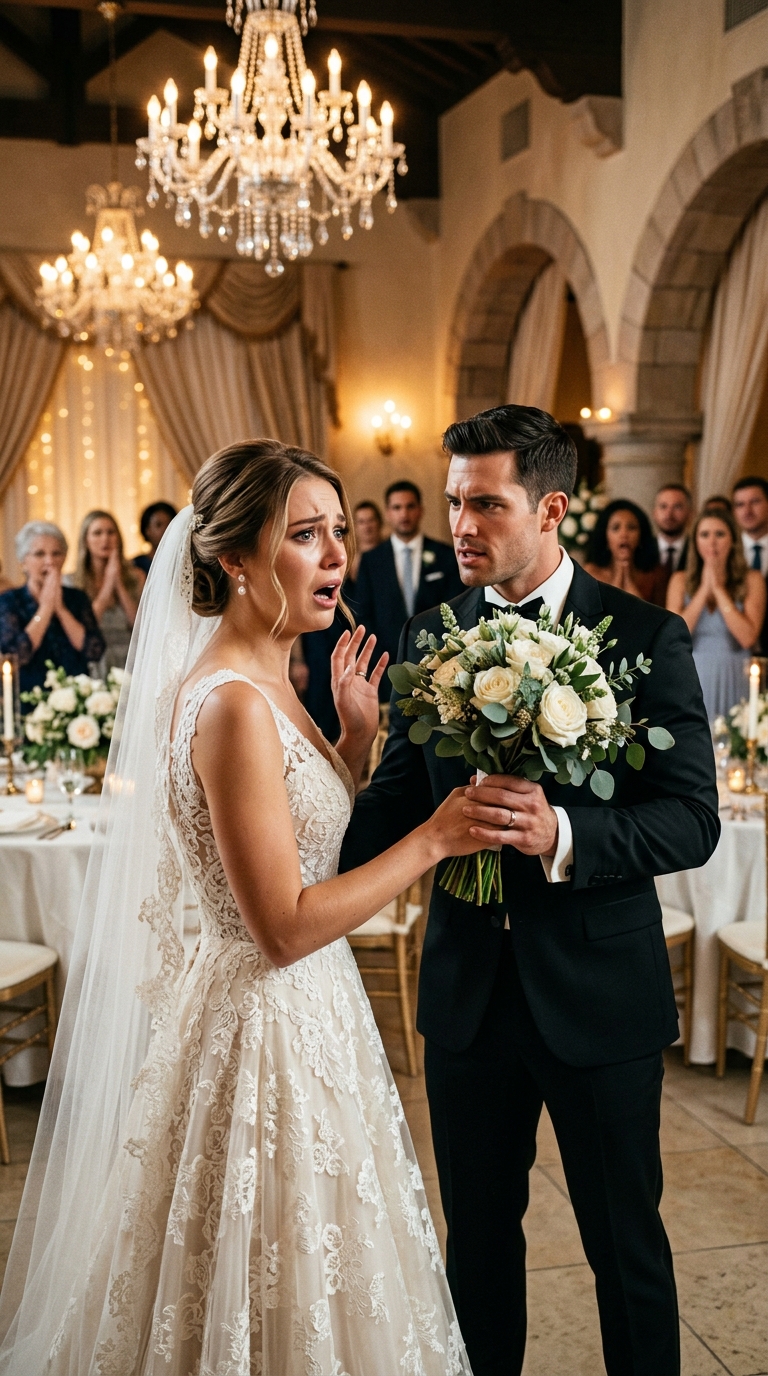
The church had never felt so still.
Candles flickered along the dark wooden walls. Golden light trembled across the bride’s veil. Guests sat frozen in the pews, sensing something was wrong long before the groom finally dropped his mask.
He snatched the bouquet from her trembling hands, looked her up and down with icy amusement, then shoved it back into her chest.
“Did you really think I was going to marry a poor girl like you?” he said with a cruel smile. “I only used you.”
A gasp rippled through the church like wind through dry leaves.
The bride said nothing.
She stood there in white lace, gripping the bouquet so tightly her knuckles turned pale, as if her heart still refused to accept what her ears had just heard.
For two years, she had loved him with the kind of faith that makes a woman forgive what should never be forgiven.
The missed calls.
The secret meetings.
The nights he vanished and returned with excuses that sounded rehearsed.
The way he always tensed whenever she spoke about wanting a simple life, far from ambition and power.
Still, she had believed him when he said he loved her.
Still, she had believed him when he promised the wedding would change everything.
Now she understood.
It had only changed everything for him.
Because this was never love.
It was convenience.
He had needed someone loyal, quiet, easy to control—a bride with no family name, no money, no power, and no one important enough to defend her when he finally decided to discard her.
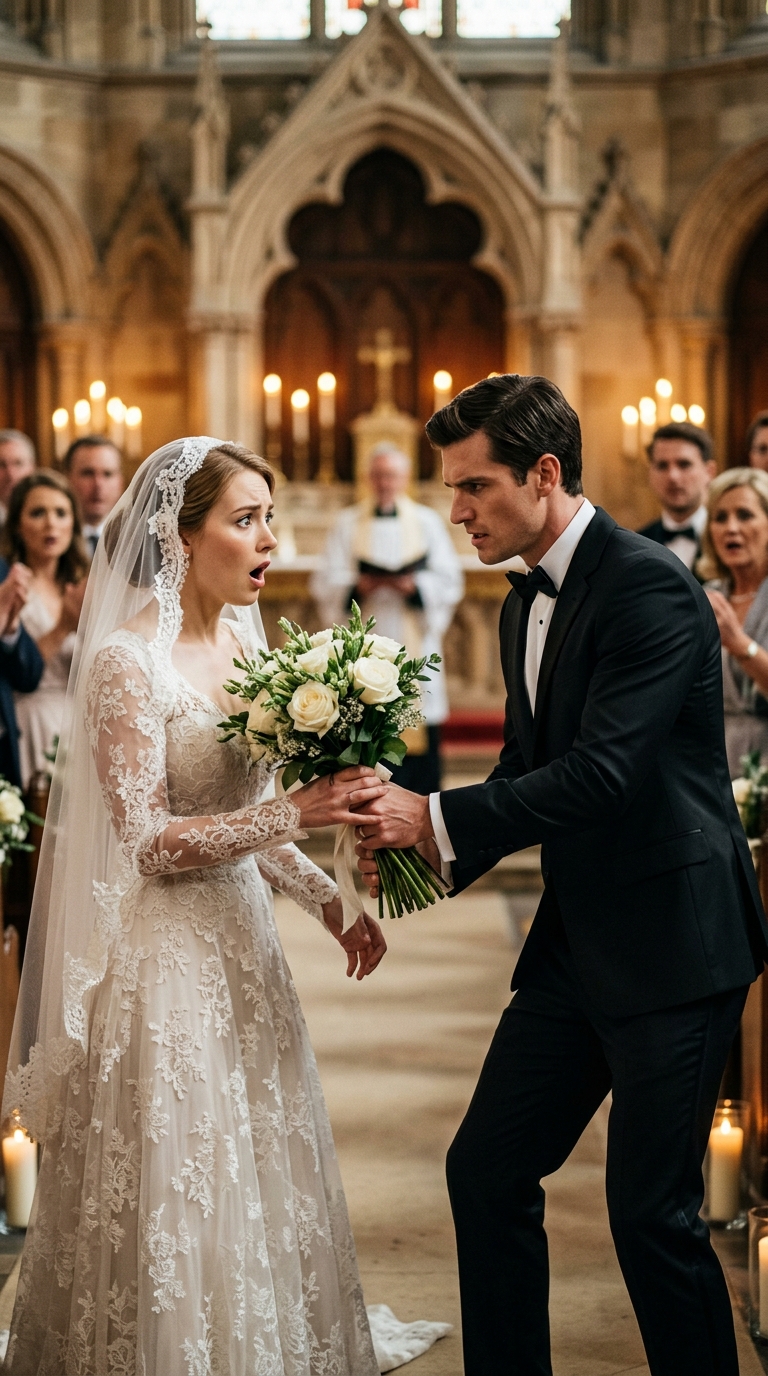
He let out a short laugh and glanced at the stunned guests.
“Come on,” he said. “Did any of you really think I’d tie myself to a girl who has nothing?”
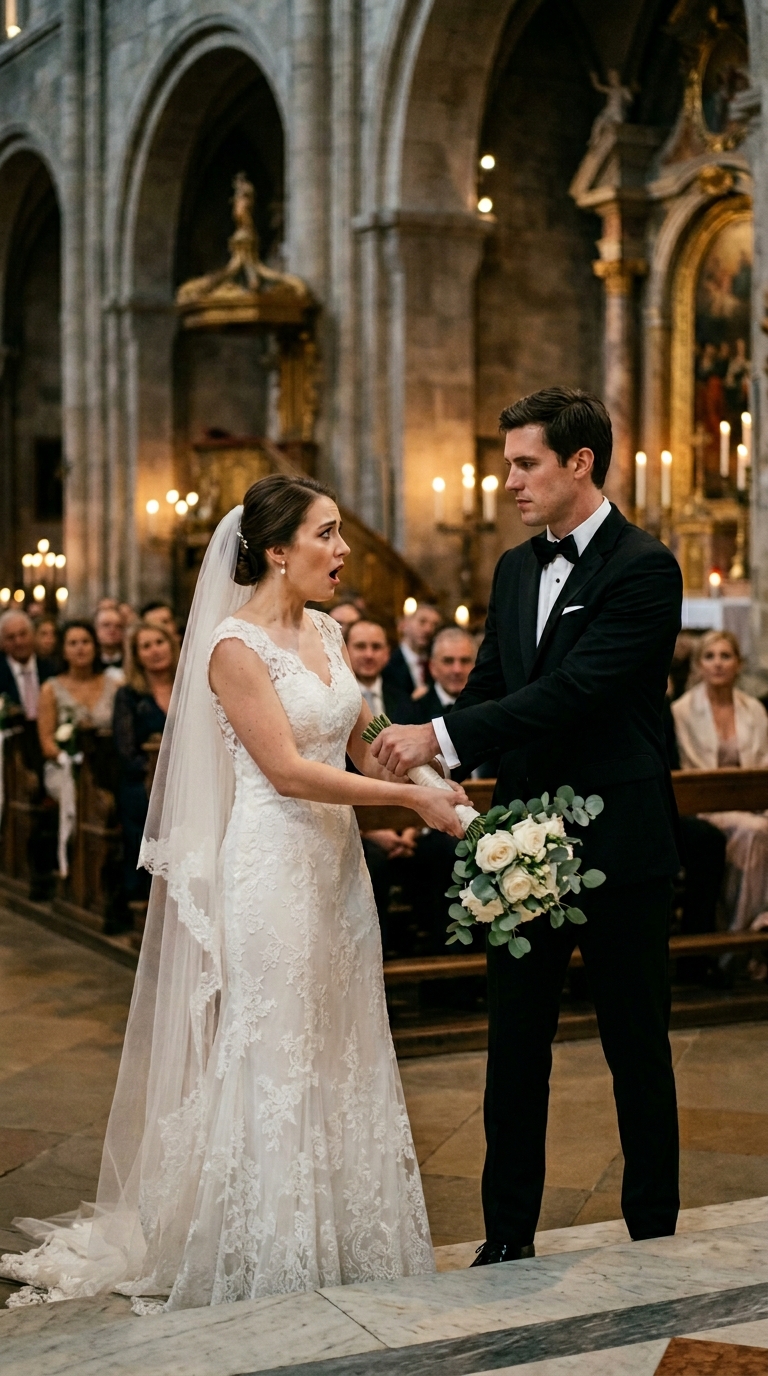
The bride’s tears fell faster now, but she did not break.
She did not beg.
She did not scream.
And somehow, that made it even more brutal.
Because she looked less like a weak woman being rejected…
and more like someone realizing, too late, that she had been standing beside a stranger.
Then the church doors burst open.
Not gently.
Not politely.
They swung wide with a heavy sound that made every head turn at once.
Bright light flooded in from outside, cutting through the golden shadows. And in that light stood a silver-haired man in a navy three-piece suit, calm as if he had stepped into an ordinary afternoon instead of a public humiliation.
He walked down the aisle without rushing.
The groom’s smirk disappeared before the man even reached the altar.
The bride turned, confused, tears still on her cheeks.
The man stopped beside her and looked at her with a warmth that didn’t belong in a room that cruel.
“Sorry I’m late, daughter,” he said. “I was in an important meeting.”
Silence.
Not a gentle silence.
The kind that crushes the air out of a room.
The groom stared at him in horror.
Because he knew that face.
Every employee in the company knew that face.
Every executive feared that face.
This wasn’t just some wealthy father making a dramatic entrance.
This was the owner of the company where the groom had spent four years climbing, lying, flattering, and betraying his way toward promotion.
His boss.
The man who had personally approved the merger that could make or break his entire career.
The groom’s mouth opened, but no words came at first.
Then finally, in a voice stripped of all arrogance, he blurted:
“Boss… you’re her father?”
The silver-haired man looked at him without a hint of surprise.
“Yes,” he said.
Then his gaze dropped to the bouquet crushed in his daughter’s hands.
And his expression changed.
Because tucked beneath the ribbon was something small, folded, and half-hidden.
A document.
The father pulled it free, unfolded it once, and went completely still.
The bride saw the color drain from his face.
“Dad?” she whispered.
He looked up at the groom with a calmness far more terrifying than anger.
Then he said the one sentence that made the groom stumble backward at the altar:
“So this is the man who forged my daughter’s signature.”
The groom looked as if the ground beneath him had cracked open.
“I didn’t forge anything,” he said too fast.
That was his mistake.
Not the denial.
The speed.

The kind of speed that only comes from fear.
The father held the document between two fingers, examining it with the same expression he likely wore in boardrooms just before ending someone’s career.
“This,” he said quietly, “is a transfer authorization.”
The bride looked at him through tears. “Transfer of what?”
He angled the paper so she could see it.
Her name was printed across the top.
Beneath it was a signature that looked almost like hers.
Almost.
Her hands began to tremble more.
“I never signed that.”
“I know,” her father said.
The groom tried to recover, stepping forward, his voice laced with forced charm. “This is a misunderstanding. She gave me permission to handle some paperwork—”
The father stopped him with a single cold look.
“No. She gave you trust.”
That landed harder than any shout.
The guests had gone from shocked to completely still. Even the priest seemed afraid to speak.
The bride looked back at the page and felt the room tilt around her.
“What was he transferring?” she whispered.
Her father answered without looking away from the groom.
“Your shares.”
The church fell into another kind of silence.
Because this was no longer just about humiliation at the altar.
It was about money.
Power.
Planning.
For months, the groom had pushed her to sign documents she never fully read. Small things, he called them. Business formalities. Temporary authorizations. Harmless paperwork until after the wedding.
She had refused more than once.
So he adjusted.
He decided that if she wouldn’t sign willingly, he would marry her first, gain legal advantage, and move the shares afterward.
Only now the wedding had collapsed before the fraud could be fully buried.
The groom’s face hardened. The act was slipping. “You don’t understand how much I’ve invested in this,” he snapped.
The bride looked at him like she was seeing him for the first time.
Invested.
Not loved.
Not built a future with.
Invested.
Her father gave a faint, humorless smile. “Oh, I understand perfectly. You pursued my daughter under a false name, concealed your debt, accessed her trust accounts through joint planning documents, and planned to take control the moment marriage made it easier.”
A murmur spread through the pews.
The groom looked around desperately now, as if someone might still come to his rescue.
No one did.
Then the bride wiped her tears with the back of her shaking hand and finally asked the question that mattered most.
“How long?” she said.
The groom didn’t answer.
That was answer enough.
But her father spoke.
“Long enough,” he said, “that he never realized the girl he called poor was already the largest private shareholder in my company.”
The groom went pale.
Because everything he had mocked about her had been built on a lie he chose to believe.
Her simple clothes.
Her modest apartment.
Her quiet life.
Her refusal to show off wealth.
He mistook privacy for poverty.
And now that mistake stood over his grave.
The father folded the forged document once, slipped it into his pocket, and gave the groom one last measured look.
“You won’t be returning to the office,” he said.
Then, even more quietly:
“And you may want a lawyer before the police arrive.”
The bride closed her eyes for a moment.
Not from weakness.
From release.
When she opened them again, the tears were still there—but the heartbreak had shifted.
Because now she knew the truth.
He hadn’t rejected her because she was beneath him.
He had chosen her because he thought she would be easy to steal from.
Her father extended his hand.
“Come on,” he said gently. “Let’s get you out of here.”
She stepped toward him.
But before they turned away, the groom spoke again, his voice broken enough to stop them both:
“Wait… if she’s your daughter…”
His eyes moved from the father to the bride, panic twisting into a different kind of fear.
“…then who have I really been reporting to for the last six months?”
The father didn’t answer.
The bride did.
And for the first time in the entire church, her voice was steady.
“You,” she said, “have been sending every confidential update straight to the new executive director.”
She paused.
“That’s me.”
