


PART 1: The Signature That Wasn’t Mine
My mother-in-law laughed as I entered divorce court by myself. It was a restrained laugh, deliberately pitched to reach me. Lorraine Kessler occupied the second row of Courtroom 4C at the Philadelphia Family Court on Arch Street, wearing her camel coat and pearls, her silver bob arranged without a hair out of place. Her husband, Gerald, sat beside her, along with her sister-in-law, Diane. All three turned toward the entrance. At the petitioner’s table, my husband, Warren, waited with Russell Pike and two junior associates. Their expensive leather binders formed a neat defensive line across the tabletop.
Their expressions told me they considered the outcome settled. To them, the vacant chair at the respondent’s table confirmed that nobody stood beside me. None of them paid attention to the battered leather briefcase I carried. They certainly knew nothing about the cream-colored folder inside it, or how completely its contents could dismantle the version of our marriage Warren had spent years presenting as fact. Three weeks before that morning, on a Tuesday in October, he had placed an envelope beside my coffee on the kitchen island.
The clock read seven-fifteen. Upstairs, our daughter, Hazel, was getting ready for kindergarten in her dinosaur pajamas, singing “You Are My Sunshine” to Mr. Buttons, her stuffed rabbit. Her voice drifted through the ceiling, a little out of tune, inventing verses as she went. You are my rabbit, my only rabbit. Warren faced me across the island in a navy suit, his coffee already finished and his keys in his hand. “I’ve decided I want a divorce,” he said. “Everything’s prepared. All you need to do is sign.”
Seven years of marriage apparently required neither a chair nor an explanation. He offered no apology, no admission that this hurt, no indication of how long he had been planning it. With one finger, he pushed the envelope nearer my cup, treating the end of our family like another appointment between a board call and lunch. The paper was heavy and cream-colored. Pike, Hollander & Weiss appeared in one corner. I opened it, read the first two pages, and turned to the summary on page four.
Under the proposed agreement, Warren would keep the Chestnut Hill house, our investments, both cars, and Kessler Digital Systems. The cybersecurity software business had been valued, the last time I had seen a figure, at more than thirty million dollars. My portion consisted of my personal possessions and eighty-five thousand dollars. Custody of Hazel would be “shared,” but Warren would become the primary residential parent, “in light of his greater financial stability.” I looked up. “You’re saying I contributed nothing?” I asked. He planted a hand on the granite and adopted the patient look he reserved for clients who misunderstood a contract.
“The business is mine, Juliet,” he said. “My lawyers say this is generous. More than generous. Most women in your situation walk away with a lot less.” I repeated, “Most women in my situation,” I said. “Women who haven’t worked in seven years,” he said. I shut the packet. His patience disappeared. “Think of Hazel,” he said. “Making this difficult will only upset her. A long, ugly divorce. Lawyers. Court. Is that what you want for her?” Our daughter’s bright, five-year-old laughter sounded overhead. He had invoked her name, yet he collected his briefcase and left without even glancing toward the stairs.
After the door shut, Hazel wandered into the kitchen carrying Mr. Buttons by an ear. Still in her dinosaur pajamas, she climbed onto an island stool. “Daddy left without saying bye,” she said. “He was in a hurry, sweetie,” I said. “He’s always in a hurry,” Hazel said, with simple certainty, reaching for the cereal. I slipped the envelope beneath a supermarket flyer, filled her bowl with Cheerios, and remained beside her while she ate. My coffee cooled untouched. After taking her to kindergarten, I returned home and opened the hall closet.
Beyond the winter coats, Warren’s ski jacket, and Hazel’s little pink puffer hung a long black garment bag. I lowered the zipper. Inside was my Army Green Service Uniform: dark olive coat, pale tan shirt, taupe trousers, all pressed and protected by dry-cleaning plastic. A major’s oak leaves rested on the shoulder loops. On the lapels were the Judge Advocate General’s Corps insignia, a sword crossed with a quill inside a laurel wreath. Ribbons sat above the left breast pocket. For a long while, I simply stood there. Eight years earlier, Warren and I had agreed to build a family, and I had stepped away from my active-duty career.
Before his parents reduced me to a quiet wife, I had been Major Juliet Ames Kessler, United States Army judge advocate. An Army ROTC scholarship took me to law school at Penn. During ten years on active duty, I prosecuted courts-martial at Fort Hood, defended soldiers at Fort Bragg, and spent a year advising commanders on contract law in Kuwait. I enjoyed the work and did it well: arranging evidence document by document until the facts could speak for themselves. Leaving active duty had not ended my service. I transferred to the Army Reserve and continued with a legal command in Willow Grove, one weekend monthly and two weeks annually. My Pennsylvania law license remained active, and I completed my continuing education every year.
Warren once entertained dinner guests by saying my wife plays soldier one weekend a month. In recent years, he stopped mentioning that service entirely, and his parents followed his lead. To Lorraine and Gerald, I was a homemaker who had once held some vaguely understood Army job. They also had no idea that I had helped create their son’s company from its first desk. In 2017, the year we married, the business began in the spare bedroom of our rented Fishtown row house. Warren had the engineering talent and an idea for shielding small hospitals and clinics from ransomware. He also had a laptop and considerable confidence. What he lacked was capital. I had it.

My separation payment and the savings accumulated during ten years in the military’s Thrift Savings Plan totaled about two hundred and ten thousand dollars. That money financed the beginning of Kessler Digital Systems. I did not simply turn it over without terms. I was an attorney. I prepared a loan agreement for the full amount, charging four percent interest and requiring repayment from company profits. Warren and I signed, and a UPS Store on Girard Avenue notarized the document. Then, at our kitchen table, often at night after reserve drills, I prepared the Pennsylvania LLC’s certificate of organization, its operating agreement, intellectual property assignments, and employment contracts.
The first three client agreements were mine to negotiate: a community hospital in Lancaster, a pediatric practice in Bryn Mawr, and an urgent-care chain in the Lehigh Valley. While Warren drew system diagrams on a legal pad beside me, I faced their general counsels and worked through indemnification and liability provisions. Hazel arrived in 2019. For the next two years, I continued without a salary, reviewing agreements after midnight with the baby monitor beside my computer. Our original operating agreement identified two founding members. Warren Kessler owned fifty-five percent. Juliet Ames Kessler owned forty-five percent. Back then, he described everything as ours: our company, our customers, our future. Growth gradually changed that word to mine.
My disappearance from the business happened by degrees. In 2021, with twelve employees and offices in a converted Northern Liberties warehouse, Warren began attending client meetings alone. You don’t need to come, Jules. You’ve got Hazel. The following year, he retained outside general counsel in Center City and stopped forwarding contracts for my review. A Philadelphia technology magazine profiled him in 2023 under the headline The Garage-to-Glory Story of Warren Kessler. Not a line mentioned my financing, my negotiations, or the second bedroom where everything began. According to the article, he had launched the company “alone, with nothing but a laptop and a dream.”
That Thanksgiving, at his parents’ large stone house in Gladwyne, Gerald rose with a bourbon glass to honor his son. “To Warren,” he said. “Who built something from nothing. All by himself.” Everyone lifted a glass, including me. Then Gerald smiled down the table in my direction. “And to Juliet,” he said. “Who had the good sense to marry him. Plenty of women would be grateful to marry into a family like ours.” Lorraine smiled at me while Warren continued cutting his turkey. Years had taught me the cost of contradicting his parents: silence for days, Warren moving to the guest room, accusations that I had humiliated him.
So I drank my wine and handed along the cranberry sauce. Later, as I dried dishes in the kitchen, Lorraine took a place beside the sink. “You know, dear,” she said quietly, not unkindly, “making Warren’s life easier is the least you can do. He works so hard. You’re very lucky.” I kept drying the gravy boat without replying. None of them knew who had supplied the first company bank deposit. None of them understood whose labor lay beneath the business legend they repeated so proudly at every family holiday.
On the afternoon Warren delivered the divorce papers, I carried the packet to the little desk in our bedroom, switched off my phone, and returned to the discipline my training had given me. I examined everything. Seven years of joint-account statements came first, followed by the company’s early banking records. I could still reach those accounts because I had established them. I retrieved the annual reports filed with the Pennsylvania Department of State, the early contracts I had negotiated, our loan agreement, and the original operating agreement, including both signatures on page eleven.
Next came seven years of correspondence. Emails from Warren to me, from me to him, and messages dating to 2017 and 2018 in which he had written Jules, you’re a genius, the Lancaster contract is perfect and Couldn’t do this without my partner and We’re going to build something huge, babe. Together. I printed the messages, sorted the pages into folders, and labeled each one. On a legal pad, I constructed the sort of timeline I once prepared for courts-martial at Fort Hood. Dates mattered. Signatures mattered. The first real discrepancy appeared in the company filings.
The Pennsylvania LLC annual reports identified the members who owned the business. In 2018 and 2019, the reports named Warren Kessler and Juliet Ames Kessler. The 2020 filing showed a change: Warren alone, holding one hundred percent. The entries remained the same for 2021, 2022, 2023, 2024, and 2025. I searched the company records for the document that might explain it. There was no amended operating agreement, no transfer of my forty-five percent, no buyout, and nothing bearing my signature that surrendered my ownership. He had merely removed my name from the filings.
The banking records revealed a second omission. In 2018, Warren had made four repayments of two thousand dollars each against my startup loan. After that, nothing. Six years had passed without another dollar. With interest, the balance had reached approximately two hundred and fifty-one thousand dollars. An isolated incorrect filing might have been a mistake; six years of them constituted a pattern. Throughout that time, he had presented himself to Pennsylvania, investors, clients, journalists, his parents, and everybody else as the only owner of a company that remained nearly half mine. His settlement would turn that fiction into reality if I signed it.
Then I examined the final page—not of the packet left beside my coffee, but of the version submitted to the court. That evening, habit had sent me to the Philadelphia Family Court’s electronic docket. You check the filed record, not merely the papers someone chooses to hand you. Warren’s attorneys had submitted the divorce complaint that same day. Attached as Exhibit C was a two-page document titled Marital Settlement Agreement — Interim Stipulation. According to it, I had agreed that Warren should exercise temporary sole control over the house, the investments, and Kessler Digital Systems until the divorce was resolved.
Near the bottom, a paragraph purported to acknowledge that I possessed no ownership interest of any description in the company. The document already carried my signature. Its date was six weeks earlier. Around my chair, the room seemed to contract. I enlarged the signature on the screen. Juliet A. Kessler. At a glance, it resembled mine: familiar loops in the J and K, the same angle across the page. Whoever had produced it had taken time to practice. But I knew the way my own hand moved.
I had signed thousands of documents: court-martial charge sheets, contracts, school forms for Hazel, birthday cards. Since childhood, I had pressed hard on the J, leaving a small indentation in the paper. And the lowercase e at the end of Juliet never closed; I finished it with an open hook my mother used to tease me about. Here, the e formed a closed loop. Whatever resemblance the rest of the handwriting carried, I knew with absolute certainty that I had never signed that page.
Beneath the imitation signature sat a notarial block, complete with stamp and signature. Notarized before me this 4th day of September, 2025, by Brianna Cole, Notary Public, Commonwealth of Pennsylvania. An unfamiliar witness had signed beside it. I studied the notary’s name again. Brianna Cole was not a stranger hired at some distant office. She was Warren’s executive assistant.
PART 2: What the Documents Said
I could establish exactly where I had been on September fourth, not because I trusted my memory, but because I checked the records. In my email was the confirmation for a Pennsylvania Bar Institute continuing legal education course on military and veterans’ law at a Harrisburg hotel, roughly a hundred miles from Philadelphia. I had registered in July. The program ran from 8:30 a.m. until 4:00 p.m., and my check-in time was 8:12. Through the member portal, I downloaded the attendance record showing my arrival, departure, and six earned credit hours. Another email held a River Street Garage receipt: entry at 7:54 a.m., departure at 4:21 p.m., fourteen dollars charged to my debit card.
Brianna Cole’s notary record offered an incompatible account. Pennsylvania notaries must maintain journals recording each notarization, including its date and time, the signer’s name, and the identification produced. Her private journal was not something I could simply open, but I understood the requirements and knew how to request records formally through the Department of State. Four days later, a photocopy of one page arrived. September 4, 2025. 11:00 a.m. Signer: Juliet A. Kessler. Identification: Pennsylvania driver’s license. At that hour, I had been in a Harrisburg ballroom listening to a retired Army colonel discuss the Uniformed Services Employment and Reemployment Rights Act. I printed the attendance record and parking receipt and placed them alongside the journal page.
I also retained Margaret Oyelaran, a retired FBI handwriting analyst with an office in Wilmington, Delaware. I supplied twenty certified, indisputable examples of my handwriting, drawn from my Army commission, Pennsylvania bar admission, passport application, the original operating and loan agreements, Hazel’s birth certificate, and other documents. Alongside those samples, I provided a certified copy of Exhibit C. Nine days later, her report arrived: seven pages of enlarged images, pressure analysis, and comparisons of individual strokes. At the bottom of the final page was her conclusion. In my professional opinion, the questioned signature on Exhibit C was not written by Juliet A. Kessler.
The evening before the hearing, I spread the evidence across our oak dining table. Eight years earlier, at that same table, I had written Warren’s first operating agreement while he sketched network diagrams beside me. We had celebrated the Lancaster contract there with twelve-dollar champagne. There, in 2018, he had told me, We’re partners, Jules. In everything. Now I organized numbered folders in presentation order: the original operating agreement, the loan, annual reports, emails, banking records, the forged stipulation, the notary journal, my Harrisburg attendance record and parking receipt, and Margaret’s examination. Fourteen exhibits. On top rested one cream-colored folder containing a three-page summary, with every fact, date, and document reference accounted for.
My pressed uniform hung on the dining room door. I had not chosen it as courtroom theater. At two-thirty the following afternoon, I was scheduled for promotion from major to lieutenant colonel at the Willow Grove Army Reserve center. Selection had come in the spring, and the ceremony had been fixed for months, well before the divorce envelope appeared. My commander offered to move it; I declined. I checked the regulations. Uniforms cannot be used to obtain an advantage in a personal legal dispute, but travel to and from an official military function in uniform is permitted. The courthouse lay on my route. I would leave directly for the ceremony and explain only if asked.
At nine that night, Hazel appeared in the dining room doorway, although she should already have been asleep. In her dinosaur pajamas, carrying Mr. Buttons by an ear, she approached the uniform and brushed her fingers over its sleeve and brass buttons. “Are you going to work?” she asked. I lowered myself to the floor beside her. “I’m going to talk to a judge,” I said, “about what happens next. For our family.” She tightened her grip on the rabbit. “Did I do something?” she asked. My heart cracked a little as I took both her hands.
“No,” I said. “Nothing that’s happening between the adults is your fault. Not one single thing. You understand?” She gave a slow nod. “Your job,” I said, “is to be five.” She weighed that responsibility with great seriousness, then nodded once more. “I’m good at that,” she said. I laughed, kissed her forehead, and carried her upstairs. The next morning, at nine-fifteen, my friend Dana Okoro met us at the courthouse. We had served at Fort Bragg, where she had been a military police captain. Now a Philadelphia detective, she was the first person I had called after Warren left the envelope. Without being asked, she took the day off and arrived with crayons, paper, and animal crackers.
“You’ve got this, Major,” she said quietly, taking Hazel’s hand. “Lieutenant Colonel at two-thirty,” I said. Dana grinned. “Even better.” Hazel wore her purple coat and held Mr. Buttons, looking impossibly small against the marble hallway. I kissed her forehead. “I’ll be right in there,” I said, indicating the courtroom. “Aunt Dana’s going to take you to the family room. They have toys and a fish tank.” “Okay,” Hazel said. Then, solemnly: “Good luck, Mommy. Be five.” I left the words uncorrected. After watching them head toward the children’s room, I lifted my briefcase and entered Courtroom 4C alone.
Lorraine’s laugh reached me immediately. Warren, in a charcoal suit and blue tie, sat beside Russell Pike and the two associates, their polished binders covering the table. He glanced at me, noticed the uniform, and briefly looked confused before turning away. Gerald offered a satisfied smile from the gallery. Lorraine bent toward her son. “No attorney,” she whispered, loudly enough for everyone. “She really is going to hand it over.” I took the respondent’s seat and placed my briefcase beside the empty chair. It had belonged to my father, a Scranton court reporter for thirty-one years. Its corners were scraped and its brass clasp stubborn. I removed the cream folder and laid it before me without speaking.
“All rise,” said the clerk. “The Court of Common Pleas of Philadelphia County, Family Division, is now in session. The Honorable Theodora Lang presiding.” Judge Lang entered behind the bench. Tall, Black, silver-haired, and in her early sixties, she wore reading glasses on a chain and the composed manner of someone who had spent twenty years observing families unravel. Opening the file, she said, “Kessler versus Kessler,” then, “Petitioner’s motion for approval of an interim stipulation and for expedited final disposition.” Her attention moved from Warren’s table to my uniform and JAG insignia. “Ms. Kessler,” she said. “I see you’re appearing without counsel.” I rose. “Not exactly, Your Honor,” I said. “I’m appearing on my own behalf. Juliet Ames Kessler, Pennsylvania Attorney Identification Number 209417. I’ve been a member of the Pennsylvania bar since 2012.” The room fell quiet. Behind me, Lorraine made a small noise.
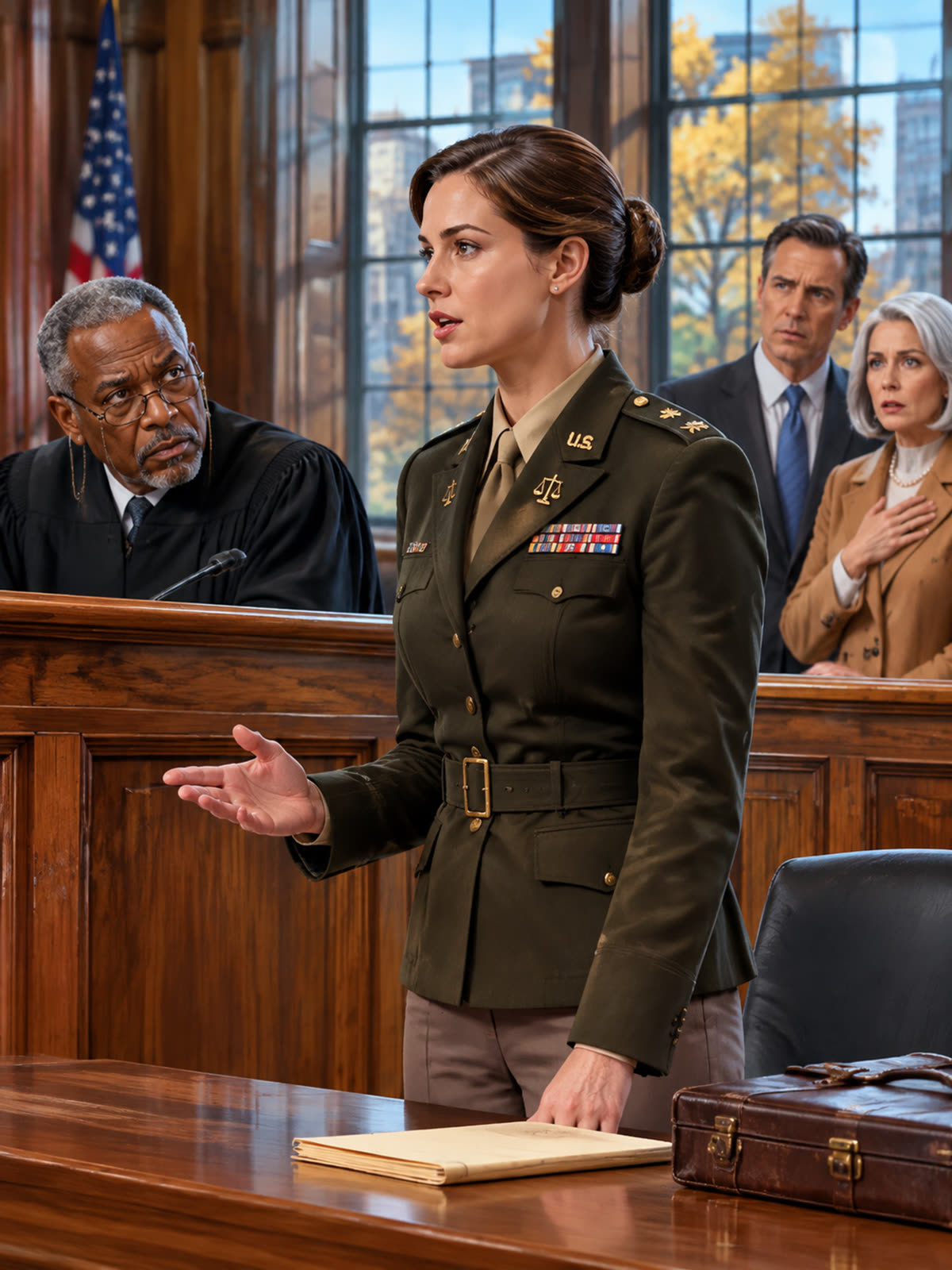
Judge Lang’s eyebrows lifted slightly. “And the uniform?” “I apologize, Your Honor,” I said. “I’m a judge advocate in the Army Reserve. I have a promotion ceremony this afternoon at Willow Grove at two-thirty. I’m traveling directly from here. I’m not wearing it in any official capacity today, and I won’t refer to it.” She regarded me over her glasses for a long moment. “Congratulations on your promotion, Major,” she said. “Let’s get you there on time.” Russell Pike rose next. Handsome and silver-haired, in his sixties and a three-thousand-dollar suit, he had spent thirty years among Philadelphia’s prominent divorce attorneys. He carried himself like a man arriving to collect a victory already secured.
“Your Honor,” he said, “this is a straightforward matter. The parties have been married seven years. Mr. Kessler is the founder and sole owner of Kessler Digital Systems, a business he built through his own efforts. Ms. Kessler, while a devoted mother, has not been employed outside the home since 2017.” He gave me a nearly kindly smile. “As Exhibit C to our complaint demonstrates,” he continued, “Ms. Kessler has already acknowledged in writing that she holds no ownership interest in the business. She executed an interim stipulation on September fourth, before a witness and a notary. We’re simply asking the Court to approve that stipulation and set an expedited schedule for final resolution, so that this family can move forward with as little disruption to the child as possible.”
Pike sat. Warren settled back, and Gerald folded his arms contentedly. “Ms. Kessler,” Judge Lang said. “Your response?” I stood with the cream folder. “Your Honor,” I said, “I’d ask the Court’s permission to approach. I have a summary for the Court and for opposing counsel, and fourteen exhibits.” She nodded. “Go ahead.” I delivered a summary and exhibit binder to the clerk, then placed an identical set before Pike. He regarded the materials with faint amusement, opened them, and read the first page. The smile disappeared. “Your Honor,” I said, “Mr. Pike has told the Court that his client built Kessler Digital Systems alone. I’d like to show the Court how the company was actually built.”
I proceeded as I had at Fort Hood: deliberately, calmly, allowing each document its own weight. Exhibit 1 was the original Kessler Digital Systems, LLC operating agreement, executed March 12, 2017. On page eleven, the membership schedule assigned Warren J. Kessler fifty-five percent and Juliet A. Kessler forty-five percent. Both signatures appeared; every page bore our initials. “I drafted this document, Your Honor,” I said. “At our kitchen table. It’s never been amended. My forty-five percent interest has never been transferred, sold, or waived.” Exhibit 2 was the February 28, 2017 promissory note: two hundred and ten thousand dollars at four percent, Warren signing as managing member, notarized on Girard Avenue.
“That was my military separation pay and my retirement savings,” I said. “It was the company’s entire startup capital. The bank records in Exhibit 10 show the deposit. Four payments were made in 2018. None since. With interest, the outstanding balance is two hundred and fifty-one thousand, three hundred and eighteen dollars.” Pike turned toward Warren, who kept his eyes fixed on the table. I moved through Exhibits 3 through 8, the state reports naming two members in 2018 and 2019, then Warren alone from 2020 through 2025. “For six years,” I said, “Mr. Kessler has represented to the Commonwealth of Pennsylvania that he’s the sole owner of a company in which I hold a forty-five percent interest. There’s no amendment. No transfer. No signature of mine anywhere giving up that interest. He simply stopped listing me.”
For Exhibit 9, I read three emails: Couldn’t do this without my partner. We’re going to build something huge, babe. Together. And, from January 2018: Jules, you’re the reason we got Lancaster. I’m putting you on the website as co-founder as soon as it’s live. “The company’s website has never listed me,” I said quietly. “Not once.” Then I lifted the certified stipulation. “And now, Your Honor,” I said, “Exhibit C. The interim stipulation Mr. Pike referred to. The one in which I supposedly acknowledged, before a witness and a notary, that I hold no ownership interest in the company.” I kept it raised. “I never signed it,” I said.
Absolute silence followed. Pike rose. “Your Honor, I object. That’s a very serious accusation, and…” “It is,” Judge Lang said. “Sit down, Mr. Pike. I’d like to hear it.” He lowered himself slowly. “The stipulation is dated September fourth,” I said. “The notary block states that I appeared before Brianna Cole, notary public, at eleven o’clock in the morning on that date and presented my Pennsylvania driver’s license.” I displayed Exhibit 12. “This is a certified copy of the corresponding page of Ms. Cole’s notary journal,” I said, “obtained from the Pennsylvania Department of State. It records the same thing. September fourth, eleven a.m., Juliet A. Kessler.”
Next, I raised Exhibit 13. “On September fourth,” I said, “from 8:12 a.m. until 4:04 p.m., I was attending a continuing legal education course at the Hilton Harrisburg, one hundred and six miles from Philadelphia. This is the Pennsylvania Bar Institute’s attendance record, showing my sign-in and sign-out and the six credit hours I earned. And this is a parking receipt from the River Street Garage in Harrisburg, paid with my debit card. Entry at 7:54 a.m. Exit at 4:21 p.m.” I placed the pages down. “Ms. Brianna Cole,” I said, “is Mr. Kessler’s executive assistant. She’s employed by Kessler Digital Systems.”
I lifted the last exhibit. “This is the report of Margaret Oyelaran,” I said, “a forensic document examiner who spent twenty-two years with the Federal Bureau of Investigation. She compared the signature on Exhibit C with twenty certified exemplars of my signature.” Turning to its conclusion, I read, “Her conclusion: In my professional opinion, the questioned signature on Exhibit C was not written by Juliet A. Kessler. ” I set the report aside and faced the bench. “Your Honor,” I said, “I’m not here to ask for anything that isn’t mine. I’m here to ask the Court to see what’s actually in the record. Not the story. The documents.” Then I sat.
For a long interval, nobody spoke. Judge Lang worked through the binder one page at a time. She studied the journal, the garage receipt, and all seven pages of Margaret’s report. Finally, she removed her glasses and let them drop against their chain. “Mr. Pike,” she said quietly. “Did you prepare Exhibit C?” Pike stood with a gray face. “Your Honor,” he said, “my office received Exhibit C from my client, already executed and notarized. I had no reason…” He broke off and looked at Warren. “I had no reason to question it.” “Did you ever speak to Ms. Kessler about it?” Judge Lang asked. “Before you filed it?” “No, Your Honor.”
“Did you send it to her? Did you confirm her signature with her in any way?” “No, Your Honor.” The judge shifted her attention. “Mr. Kessler,” she said. “Stand up, please.” Warren obeyed. Confidence had drained into pallor and then into an expression I had never witnessed during our marriage. He resembled a man watching his house go up in flames. “Mr. Kessler,” Judge Lang said. “Before I say anything else, I’m going to advise you that you have the right not to answer any question that might incriminate you. You may wish to consult with your attorney. Do you understand?” He looked toward Pike, who stared straight ahead. “Yes, Your Honor,” Warren said quietly. Behind him, Lorraine sat motionless with a hand against her pearls. Gerald’s arms were no longer folded. His face had turned red.
Judge Lang wrote for several minutes. Her pen and the old radiator beneath the windows supplied the room’s only sounds. Then she raised her head. “Petitioner’s motion to approve the interim stipulation is denied,” she said. “The Court finds substantial evidence that the signature on Exhibit C is not the respondent’s. The Court is referring this matter to the Philadelphia District Attorney’s Office and to the Pennsylvania Department of State’s Bureau of Notaries Public for investigation.” Pike closed his eyes. “Further,” Judge Lang said, “the Court is entering an emergency order. Effective immediately, Mr. Kessler is enjoined from selling, transferring, encumbering, or otherwise disposing of any interest in Kessler Digital Systems, LLC, or any of its assets outside the ordinary course of business, pending further order of this Court.”
She looked directly at Warren. “That includes, Mr. Kessler,” she said, “the pending acquisition of your company by Halverson Security Group, which I see referenced in your own financial disclosures on page fourteen.” I had discovered that acquisition only the previous week, while reading those disclosures. Halverson, a national cybersecurity firm in Virginia, had agreed to pay thirty-eight million dollars for Kessler Digital Systems. Closing was six weeks away. In the purchase agreement, Warren had identified himself as the company’s sole owner. At last, the urgency behind the envelope made sense. Before Halverson’s lawyers looked closely, he needed a court document declaring that I owned nothing.
PART 3: The Names Left Off the Papers
Judge Lang continued. “The Court is appointing a forensic accountant,” she said, “at petitioner’s expense, to conduct a full review of Kessler Digital Systems’ ownership, finances, and the repayment status of the 2017 promissory note.” She turned to another page. “Finally, the custody of the minor child. Petitioner has requested primary residential custody based on his greater financial stability.” Her gaze settled on Warren over her glasses. “Given the evidence before this Court regarding petitioner’s candor, and pending a full custody evaluation, the Court is granting respondent temporary primary physical custody of the minor child, with liberal visitation to petitioner as the parties agree.” Putting down her pen, she added, “We’ll reconvene in thirty days,” then, “Ms. Kessler, you’re free to go. Congratulations again on your promotion.”
Without rushing, I returned the folders to my father’s briefcase. At the other table, Pike spoke to Warren in a furious undertone. Among the words I caught were withdraw and conflict and I am not going to jail for you. The junior associates collected their binders without meeting anyone’s eyes. I lowered the briefcase lid. As usual, the brass clasp resisted. I pressed it with my thumb until it caught, then started toward the courtroom doors.
Passing the gallery’s second row, I saw Gerald staring at the floor. Diane covered her mouth with one hand. Lorraine raised her eyes to me, taking in the uniform, the JAG insignia, the ribbons, and my father’s scarred briefcase. Her mouth opened as though she intended to speak. Then it shut. I kept walking. Outside the family room, Dana waited in the hallway. Inside, Hazel slept curled on a small vinyl couch beneath Dana’s jacket. Mr. Buttons rested under her chin, and a crayon remained enclosed in her fist.
A drawing lay on the coffee table: a smiling green stick figure beside a smaller figure holding a rabbit. Above them, Hazel had printed MOMMY IS BRAVE. “How’d it go?” Dana asked quietly. Looking at my sleeping daughter, I answered, “I showed them the documents,” I said. Dana grinned. “That’s my Major.” I lifted Hazel without waking her. She sighed, looped her arms around my neck, and settled her head against my uniformed shoulder as she had when she was a baby. I supported her with one arm and carried the briefcase in my other hand.
As I headed toward the elevators, the courtroom doors opened behind us. Warren emerged with Gerald, Lorraine, Diane, Pike, and the associates. Seeing me, they all stopped. I did not. I carried my daughter through the long marble corridor, past the people who had spent seven years underestimating me, while they stood silently watching. I reached the Willow Grove promotion ceremony with nine minutes remaining. The Reserve center was an ordinary brick building with a flagpole outside. Inside its assembly hall, folding chairs had been arranged for perhaps forty people.
Colonel Patricia Whitfield, my commander and mentor of ten years, was there, tough and kind as ever, along with members of my unit and Dana holding Hazel. My daughter had awakened in the car and was delighted by the flags. When the time came to attach my silver lieutenant-colonel oak leaves, Colonel Whitfield addressed the audience. “Traditionally,” she said, “a family member pins on the new insignia.” Looking toward Hazel, she asked, “Would you like to help, young lady?” Hazel’s eyes widened. “Can I?” she whispered. “Yes,” I said. Dana brought her forward, and the colonel knelt to show her what to do. With her tongue poking from one corner of her mouth, Hazel carefully fastened the oak leaf to my right shoulder loop. She stepped back to inspect it. “It’s a little crooked,” she said. Forty soldiers laughed. “It’s perfect,” I said.
Four days later, Brianna Cole confessed. Accompanied by her own attorney, she went to the district attorney’s office and explained that Warren had brought the already-signed stipulation into his office on September fourth. He said I had signed at home and lacked time to appear. It was routine, he told her, a mere formality. If she wanted to retain her position and her stock options in the Halverson sale, she should not complicate it. She notarized the page and entered my name in her journal. The act had sickened her ever since. The witness proved to be a junior engineer whom Warren had intercepted on his way to the break room and asked to “sign here as a witness, real quick”. He had never seen me and had not understood the document.
In January, Warren was charged with forgery, tampering with records, and false swearing. Following his attorney’s advice, he pleaded guilty to forgery in April and received two years of probation, two hundred hours of community service, and a fine. Brianna relinquished her notary commission and received a reduced sentence for cooperating. Halverson’s attorneys needed only an afternoon with Judge Lang’s order before suspending the acquisition. Six months later, after the forensic accountant verified my evidence, negotiations resumed. The revised agreement named two sellers: Warren J. Kessler, fifty-five percent, and Juliet A. Kessler, forty-five percent. The transaction closed in October, a year after the envelope arrived beside my coffee. My proceeds, together with repayment of the loan and interest, exceeded anything I had imagined possessing. Halverson’s board did not renew Warren’s CEO employment contract.
Lorraine telephoned in November. Seeing her name still tightened my shoulders, and I nearly let the call pass unanswered. But Hazel was at school and the house was quiet, and I picked up. “Juliet,” she said, sounding smaller than I remembered. “Would you have lunch with me?” We met at a small café on Germantown Avenue in Chestnut Hill. She had arrived first and occupied a window table in her camel coat. Without her pearls, she seemed older and worn down. An apology did not come immediately. She ordered tea and watched people outside before speaking. “I laughed at you,” she said. “In the courtroom. When you walked in alone.” “I remember,” I said. “I laughed,” Lorraine said, “because I thought you were going to do exactly what I did.”
I looked at her. “In 1981,” Lorraine said, “Gerald and I started Kessler Hardware. Two stores, in Conshohocken and King of Prussia. Everyone thinks Gerald built it. He tells the story at every party.” She moved her spoon through the tea. “My father gave us the money for the first store. Eighty thousand dollars. I did the books. I hired the staff. I picked the inventory. I worked the register at Christmas with Warren in a playpen behind the counter.” Meeting my eyes, she continued, “When we sold the business in 2004,” she said, “Gerald’s lawyer drew up the papers. My name wasn’t on them. I’d never been on them. Gerald said it didn’t matter, it was all ours. Then he put the money in accounts in his own name. And I signed whatever he put in front of me, because that’s what wives did. That’s what my mother did.”
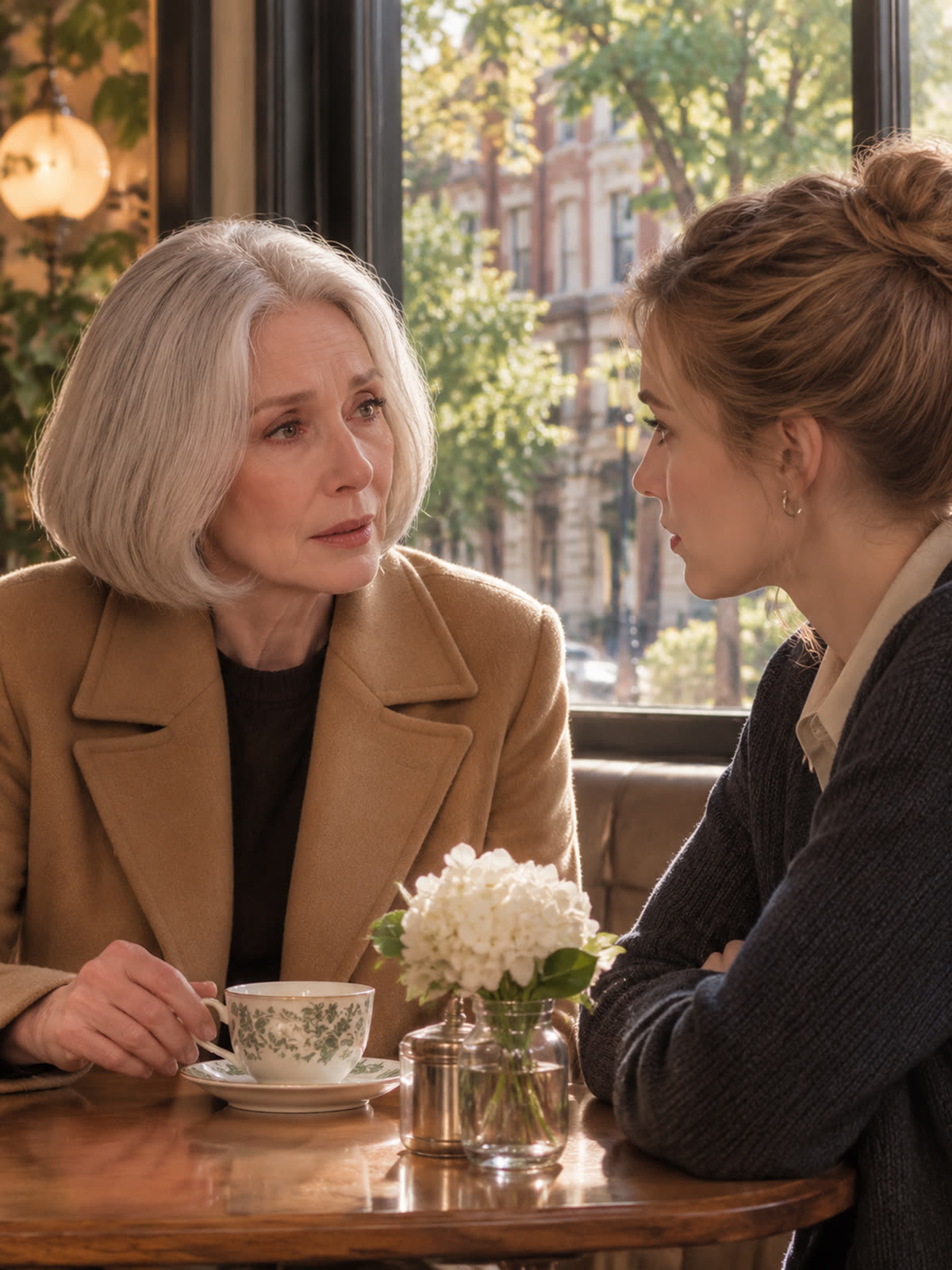
“I spent forty years being grateful,” Lorraine said quietly. “Grateful to be married into the Kessler family. Grateful for the house. Grateful for the allowance Gerald gives me every month, like a child.” Her voice broke. “And when I watched my son do the same thing to you, I thought, Good. Let her find out. Let her learn what I learned. ” She lowered her eyes to the cup. “And then you walked into that courtroom,” she said, “in that uniform, with your father’s briefcase, and you opened a folder. And you didn’t sign anything.” Shaking her head, she added, “Forty years, Juliet. It never once occurred to me that I could just not sign.” For a long time, I could find nothing to say.
“Lorraine,” I said finally. “It’s not too late.” She lifted her head. “Pennsylvania doesn’t care how long it’s been,” I said. “If your father’s money went into that business, if your labor built it, there are records. There always are. Bank statements. Tax returns. Payroll. Employee files.” I reached over and covered her hand with mine. “Dates matter. Signatures matter.” She stared at me. Then, for the first time in the eight years I had known her, Lorraine began to cry.
In January, I opened a law office of my own. It occupies two rooms above a bookstore on the second floor of an old brick building on Germantown Avenue. The window faces the trolley tracks. My father’s briefcase rests on a shelf behind my desk, and simple brass lettering on the door reads Juliet Ames, Attorney at Law. I reclaimed my maiden name. When Hazel asked whether hers had to change as well, I told her she could keep whichever name she wished. After considering the question for a week, she chose Hazel Ames Kessler because she wanted to have everybody.
Most people who come to me are women: women whose work helped create businesses, farms, medical practices, and restaurants while their names remained absent from the records. They surrendered savings, inheritances, separation pay, evenings, and weekends, only to be informed later that they had contributed nothing. Some received an envelope alongside their morning coffee and the instruction, All you need to do is sign. At the first consultation, I offer each the same advice. Sliding a legal pad across the desk and placing a pen in her hand, I say, “Don’t sign anything yet,” I say. “First, let’s look at the documents.”
Lorraine became one of my earliest clients. On a Tuesday in February, she arrived carrying a cardboard box packed with Kessler Hardware ledgers in her own handwriting, covering the years 1981 through 2004. There were payroll records bearing her signature, bank deposit slips, and a copy of her father’s eighty-thousand-dollar check, endorsed Lorraine M. Kessler. Every other week, she now sits at my conference table with reading glasses and a highlighter, examining her history a page at a time. “Dates matter,” she says to me whenever she discovers something. “Signatures matter,” I say back.
Warren’s schedule with Hazel settled into alternate weekends and one evening each week. In the beginning, the visits felt awkward. He collected her in his new apartment building’s parking garage, chose expensive restaurants she disliked, and brought her home sooner than planned. He did not know her preferred foods, the name of her stuffed rabbit, or that her class had spent three months studying dinosaurs. Then spring brought a change. After one Saturday together, she returned with painted hands and a story about the Philadelphia Zoo. Her father had lifted her to see the giraffes, bought a stuffed tiger, and asked which animal Mr. Buttons liked best.
“I told him rabbits, obviously,” Hazel said, rolling her eyes. “Mr. Buttons is a rabbit.” After thinking for a moment, she continued, “Daddy said he didn’t know that,” she said. “He said he didn’t know a lot of things he should’ve known.” She frowned. “He said he’s trying to learn.” That evening, Warren came to the door instead of remaining in his car. With his hands in his pockets, he stood on my porch looking older and thinner, his shoulders stripped of their former assurance. He avoided my eyes. “Jules,” he said. “I’m sorry.” I waited.
“I convinced myself I built it alone,” Warren said. “I told the story so many times. To my parents. To investors. To the magazine.” He shook his head. “By the end, I actually believed it. I couldn’t even remember the second bedroom.” At last, he looked at me. “I remember it now,” he said quietly. “The kitchen table. The Lancaster contract. You drafting the operating agreement at midnight with Hazel in the baby monitor.” He swallowed. “I’m sorry I made you invisible. I’m sorry I tried to make it legal.”
I did not forgive him that evening. Perhaps complete forgiveness would never come. Still, I said, “Thank you for telling me.” And the gratitude was genuine. He nodded and started away, then paused on the porch steps. “Jules,” he said. “In the courtroom. Why didn’t you hire a lawyer?” I considered the question. “I didn’t need one,” I said. “I had the documents. And I knew what was in them, because I wrote most of them.”
Occasionally, clients ask about Courtroom 4C. Someone’s friend or sister has told them the story, and now they sit opposite me wanting to know whether entering alone frightened me, whether I felt everyone laughing. I answer honestly. Hearing Lorraine, seeing Warren and three lawyers behind their expensive binders, and facing that vacant chair, I felt precisely as isolated as they believed I was. Yet I had not truly been alone.
That chair held the nineteen-year-old ROTC cadet studying contract law at Penn on scholarship. It held the young JAG captain who learned at Fort Hood to establish the truth one document at a time. It held the woman who invested her savings, negotiated three early contracts, and prepared an operating agreement at midnight with a baby monitor beside her. The woman who worked two years unpaid and kept a law license current for eight years, through diapers and dinner parties where her husband joked about her playing soldier. Everything he had attempted to rub out remained beside me. It was in my father’s briefcase and that single cream folder. All I had to do was open it.
Last week, Hazel turned six. We celebrated in the backyard of our new home, a small brick twin in Mount Airy with a large oak and a swing Dana had hung from its lowest branch. Hazel invited her entire class. Dana came, and Colonel Whitfield. Lorraine brought a rabbit-shaped cake she had stayed awake until two in the morning decorating. Warren visited for an hour with a dinosaur book. Hazel hugged him, and he cried a little. Nobody remarked on it.
Once the guests had left, the paper plates were thrown away, and the leftover rabbit cake was in the refrigerator, Hazel climbed onto my lap on the back steps in her party dress. “Mommy,” she said. “Can I ask you something?” “Always.” “When you went to talk to the judge,” she said. “Were you scared?” I paused before answering. “Yes,” I said. “I was scared.” Surprise crossed her face. “But you were brave,” she said. “I drew a picture. Mommy is brave. ” “I know,” I said. “I still have it. It’s on my office wall.”
“How can you be brave if you’re scared?” she asked. I looked at my six-year-old daughter, frosting on her chin, her rabbit tucked beneath one arm. “Being brave doesn’t mean you’re not scared,” I said. “It means you’re scared, and you show up anyway. With everything you know is true.” I tapped her nose. “And you don’t sign anything you didn’t write.” She gave the matter the same solemn consideration she gave everything. “Okay,” she said finally. “I’ll remember that.” “Good,” I said. “But not yet. Right now, you have a more important job.” She grinned. “Being six,” she said. “Being six,” I said. “I’m good at that,” said Hazel.
Gerald and Lorraine were separated now. Unlike my own divorce, her case had not reached its conclusion. After so many years, the matter was complicated—and it was still ongoing.
Disclaimer: This story is a work of fiction inspired by real-life themes. Names, characters, places and events are fictionalized, and any resemblance to real persons is purely coincidental. It does not represent any person or organization and does not encourage inappropriate behavior. Images are for illustration purposes only.
