

PART 1 — The Place She Called Home
My name is Walter. I’m sixty-two, and for thirty years I coached high school wrestling in Springfield, Missouri. My son, Tucker, is nineteen and has Down syndrome. Nobody I have ever known has been happier than that boy. He loves country music, bagging groceries at the supermarket where he works, and Duke, our old dog. Tucker’s mother died when he was five. For ten years afterward, I brought him up on my own.
Four years ago, I married Brenda, a widow I knew through church. She appeared to have patience with Tucker, and she told me she loved him as though he were her own son. Then, in September, I suffered a stroke. I spent two weeks in the hospital before being transferred to a rehabilitation center in Kansas City for another six weeks of treatment. Things I had once done without thinking became things I had to learn again: walking, holding a fork, and speaking Tucker’s name clearly.
Brenda assured me she would look after him. Every evening, I called the house, and at first Tucker always came to the phone. After the third week, however, there was usually a reason he couldn’t speak to me. Brenda said he was sleeping, taking a shower, or “out with friends.” That last explanation stayed with me. Tucker didn’t really go out with friends.
During my fifth week at the center, my therapist told me I was progressing faster than they had anticipated. I could leave five days ahead of schedule. I kept that news from Brenda because I wanted Tucker’s homecoming surprise to be me. My brother drove me back. With my cane taking some of my weight, I climbed the front steps slowly, concentrating on each one before attempting the next.
When I opened the door, I called, “Tucker! Buddy, I’m home!” Nothing answered me. I made my way to his bedroom and stopped. There were no sheets on the bed. The posters had disappeared from the walls, his country music CDs were missing, and his closet stood empty. Brenda came into the room behind me. “Walter! You’re early!” I asked her, “Where is Tucker?”
She let out a sigh and crossed her arms. “He’s an adult now, Walter. He’s nineteen. I found him a group home. A nice place out in the country. He has friends there.” I looked at her. “You moved my son out without asking me?” Her answer came back plainly. “You were in the hospital. Somebody had to make a decision. I can’t take care of a grown man with special needs. And you can barely walk. Be realistic.”
“Where is this place?” I asked. Brenda paused before answering. “It’s called Sunny Acres. Out on Route 13.” I didn’t raise my voice. Although my hands were trembling, all I said was, “Okay.” There was something she didn’t know. When Tucker turned eighteen, I had gone before a court and become his legal guardian. I was his guardian alone. Brenda wasn’t. She had never bothered to ask, and she had no legal authority to send him anywhere.
My brother drove me to Route 13. What we found at Sunny Acres bore no resemblance to a group home. An old farmhouse stood beyond a muddy yard, its porch sagging and some of its windows broken. There was a barn, but no sign identifying the place and no license displayed on a wall. Rain was falling over all of it.
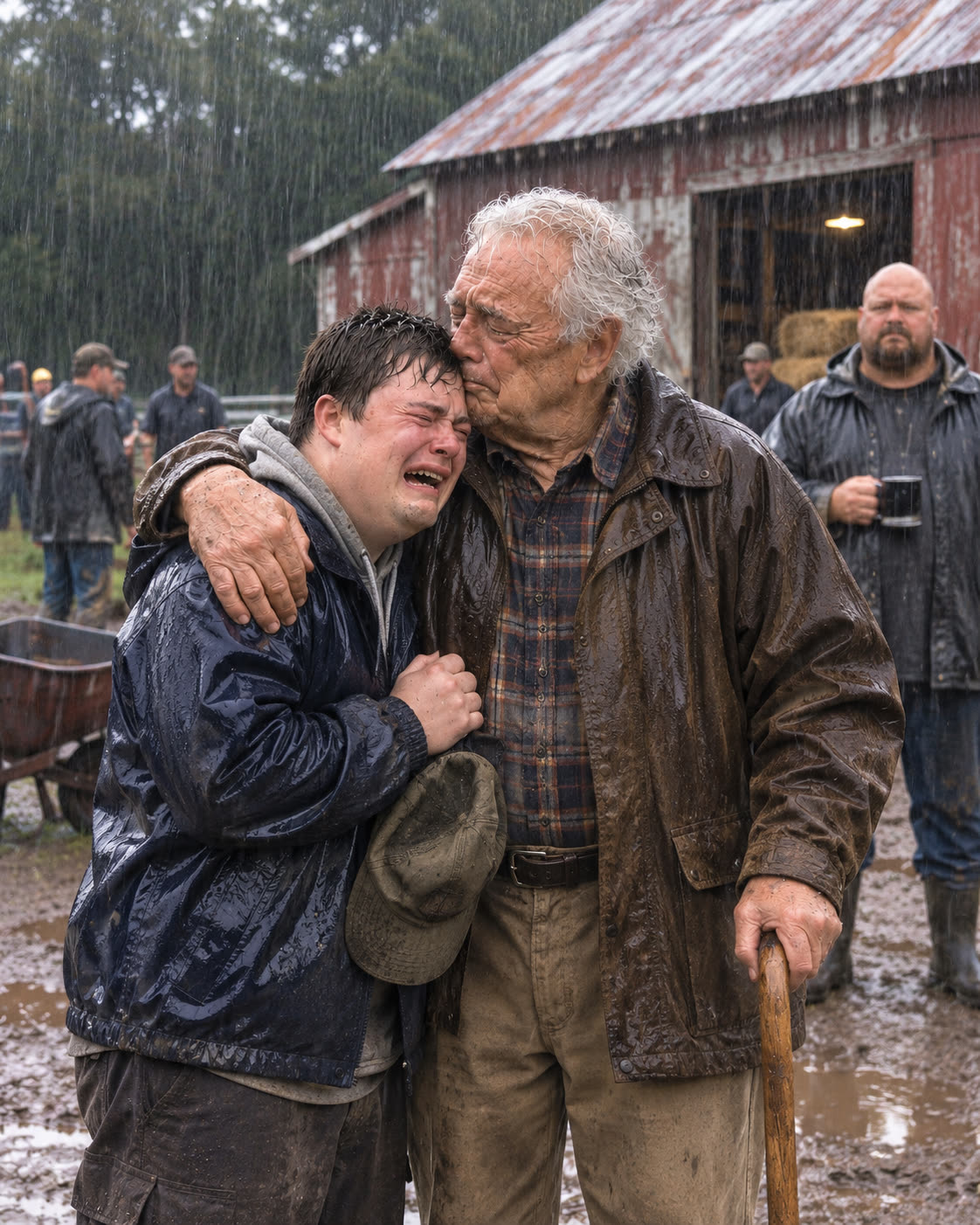
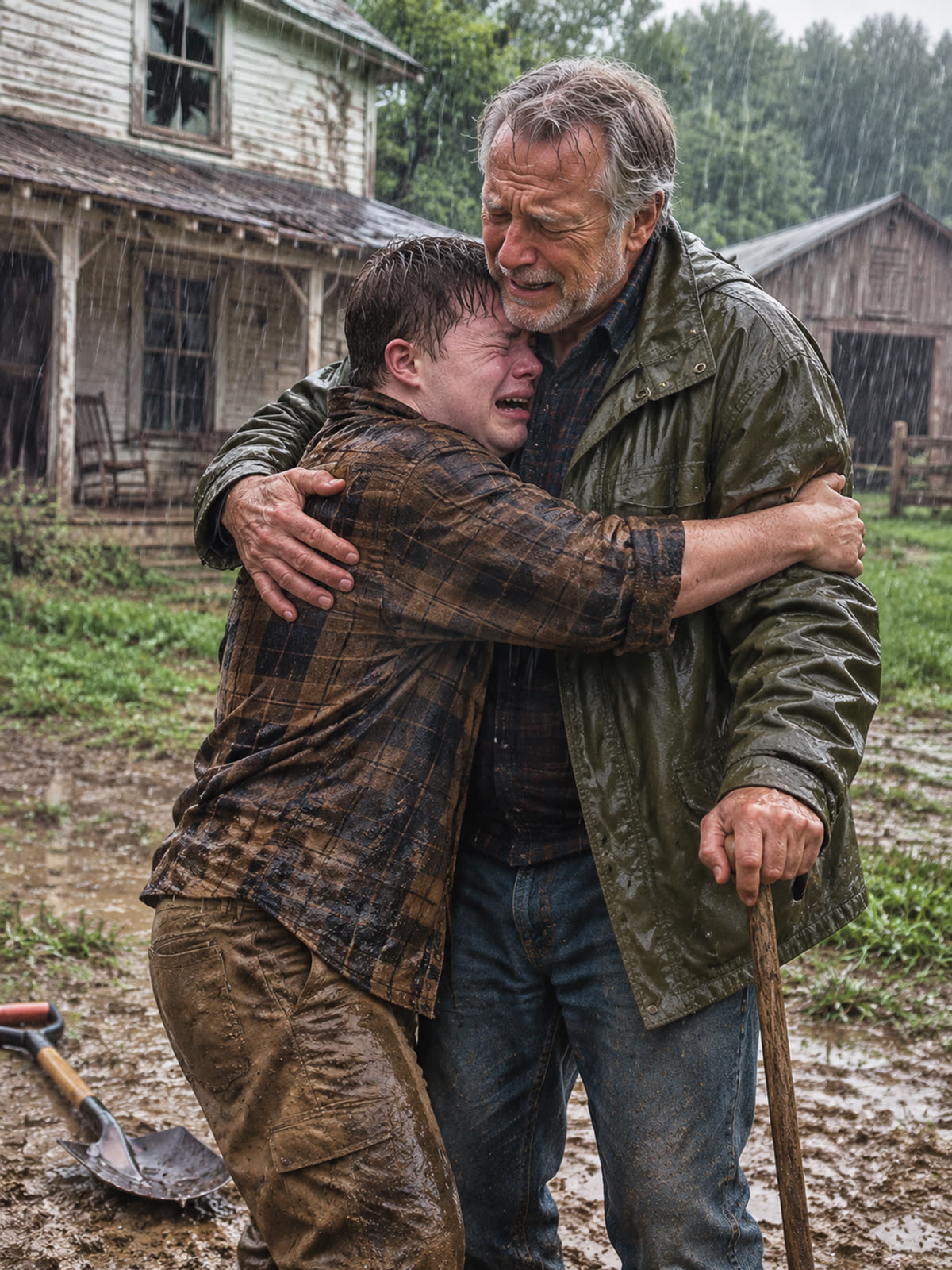
Three young men were out in that rain, digging a ditch with shovels. None had a coat. I recognized one of them immediately. My son stood in the mud, drenched and thinner than when I had last seen him. He still wore the shirt he had been wearing when I left six weeks before. I shouted, “TUCKER!” His head came up, and the shovel fell from his hands.
“DAD!” He came running through the mud and flung himself against me. The force of his embrace nearly knocked me off my cane. “Dad, I was good. I was so good. Mr. Pruitt says if I’m good and I finish digging, I get dinner.” He was soaked through, and he held on to me while I struggled to keep my balance.
A large bald man stepped out of the farmhouse with a coffee mug in his hand. “Can I help you?” I told him, “I’m Tucker’s father. I’m taking him home.” He laughed at that. “No, you’re not. Your wife signed the papers. He lives here now. He works for me.” I answered, “He’s not your employee.”
“Room and board, mister. He digs, he eats. That’s the deal. Your wife gets his disability check, I get a cut, everybody’s happy.” The man smiled before adding, “She’s got three of my boys on her paperwork, actually. Good business partner, your wife.” My blood turned cold. Then Pruitt glanced at the cane supporting me and shook his head. “Go home, old man. You can barely stand up.”
After thirty years coaching wrestlers, I knew when a man was trying to shake my confidence. I also knew that the person who remained calm generally had the advantage. I took my phone out of my jacket. My right hand still didn’t reliably do what I wanted, and unlocking the screen took three attempts. “Who’re you calling?” Pruitt demanded. “The sheriff. I’m Tucker’s court-appointed guardian. My wife had no authority to sign anything, and neither do you.”
His smirk disappeared. “You’re bluffing.” I told him, “The guardianship papers are in my brother’s truck. Want to read them?” He offered no answer. Instead, he retreated into the farmhouse and slammed the door hard enough to shake the porch. Three patrol cars arrived within twenty minutes. Through every minute of waiting, Tucker stayed against my side, shivering, his fingers fastened around my sleeve.
The deputies entered the house. A few minutes later, the youngest came outside again, walked to the edge of the yard, and vomited in the weeds. Nine adults with disabilities had been living inside. Some had Down syndrome, autism, or cerebral palsy. One was a woman in her fifties who couldn’t speak. Their beds were bare mattresses on the floor. The only bathroom had a broken toilet. A padlock kept the refrigerator shut.
A deputy discovered a ledger on the kitchen table. It recorded nine names and nine monthly disability payments, nearly all of which Pruitt kept. Another column identified “referral fees” paid to whoever had brought each resident there. Brenda’s name was written in that column three separate times. Every resident went to the hospital that night. Tucker and I rode together in an ambulance, his hand holding my good one throughout the journey.
“Dad, are we going home?” he asked. I answered, “We’re going home, buddy.” Pruitt was arrested that same night on charges of operating an unlicensed care facility, abusing vulnerable adults, and fraud. Before the week was over, the state closed Sunny Acres permanently. Two days after his arrest, the police arrested Brenda.
At first, she cried. She insisted she hadn’t realized conditions were so terrible and had only wanted a little rest. Then the detective pushed the ledger across the table. It showed three referral payments, each for six hundred dollars. Bank records also showed Tucker’s disability money being deposited into her private account every month. Her tears stopped. I later signed the divorce papers in a hospital hallway while waiting for a follow-up appointment.
At home, Tucker stayed in the bath longer than he ever had before. Afterward, he ate three plates of spaghetti. Then he entered his bedroom and faced the stripped bed and empty walls. He lowered himself onto the mattress without crying. He simply became quiet. Somehow, watching that silence settle over my son was worse.
PART 2 — The Words He Had Waited to Say
The following morning, I started making calls. By that afternoon, eleven men I had once coached were gathered in my driveway. I remembered them as skinny fifteen-year-olds. Now they were mechanics and teachers, a firefighter and an attorney—grown men with lives and work of their own. They had come because I called.
They brought in a new bed, clean sheets, a stereo, and enough country music posters to cover Tucker’s walls again. Gus, who owned a furniture store across town, carried a recliner inside and placed it beside the window. “For watching the birds,” he told Tucker. “Best seat in the house.”
Tucker wrapped his arms around every one of those men. The silence that had frightened me the night before was gone. Webb, the attorney, also helped the other eight families submit claims and regain control of their loved ones’ benefits. Every family recovered the money they were entitled to, and every resident was moved into a safe, licensed setting.
That was a year ago. Tucker returned to the supermarket, where his manager welcomed him back with a party and a sheet cake. He is the fastest grocery bagger they have ever employed, and he is well aware of it. I still depend on my cane. On certain mornings, the shaking in my right hand is so bad that holding a coffee cup is beyond me.
Every morning, though, Tucker and I walk Duke around the block. We take our time, moving one step after another. Whenever we reach a curb, Tucker takes my arm. “I got you, Dad,” he says. And he does.
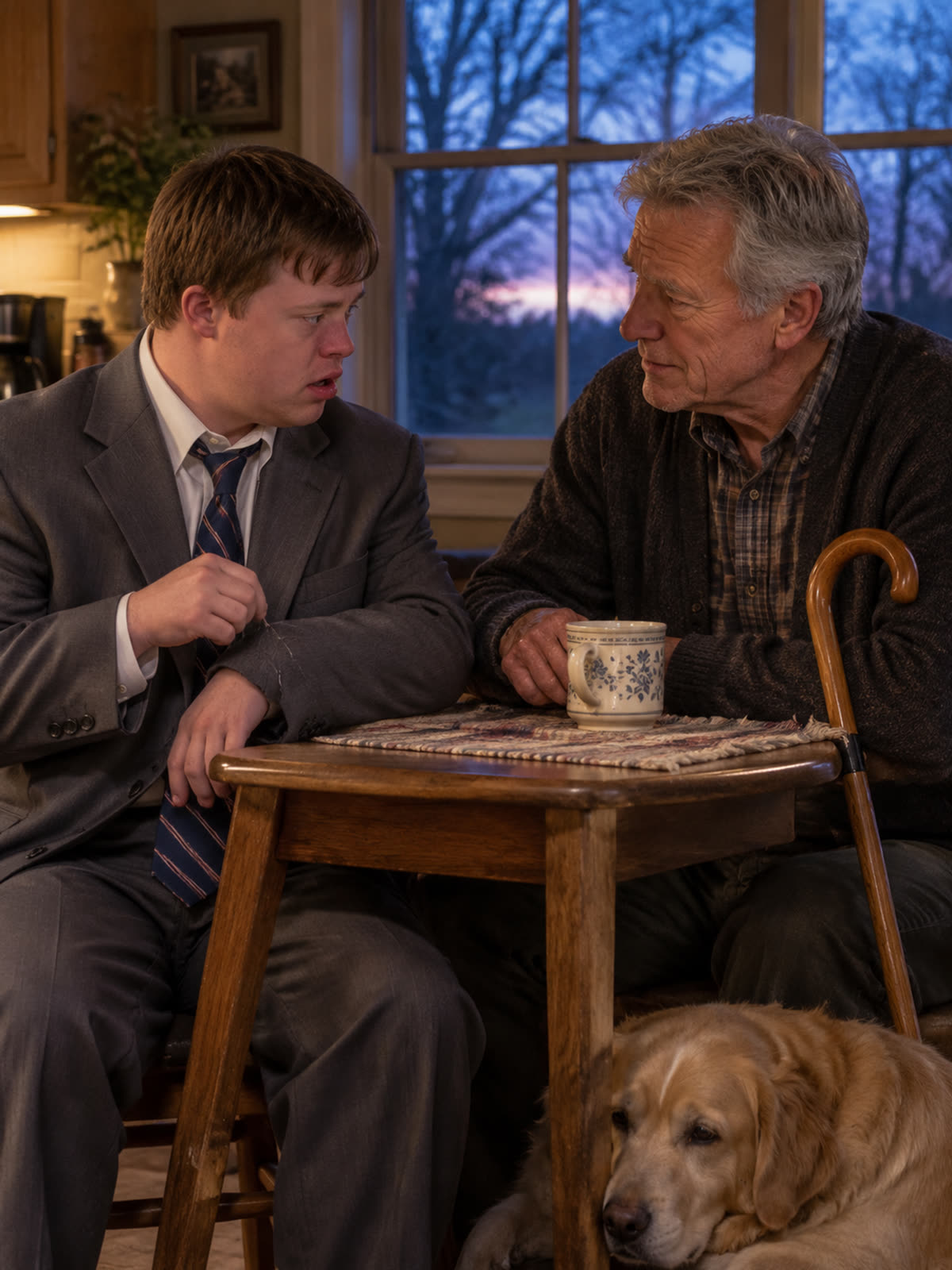
The trial was scheduled for the following spring, fourteen months after the night we found Sunny Acres. I got no sleep the night before. At four in the morning, I sat at our kitchen table, my cane hanging from a chair and my right hand closed around a cup of coffee. I was trying to stop it from shaking.
Duke lay beside my feet, looking up at me through his cloudy old eyes. Then Tucker spoke from the doorway. “You’re up early, Dad.” He was already wearing his good gray suit, the one Gus had bought for the occasion.
His tie sat crooked at his collar. He was nineteen, almost twenty, but in that suit he reminded me of a little boy dressed for church. “Couldn’t sleep, buddy. You?” I asked. “Nope.” He took the chair opposite mine.
I had known there would be difficult questions that day. The prosecutor, Ms. Okafor, a sharp woman who looked tired, had explained that Tucker might be called as a witness. She didn’t need him to describe financial records or the ledger. She wanted him to explain what living at Sunny Acres had been like. The jury, she said, needed to hear from someone who had lived through it.
Across the kitchen table, Tucker asked the question I had been dreading. “Do I have to look at her?” I told him, “You don’t have to do anything you don’t want to. We can tell Ms. Okafor no.” He began picking at a loose thread on his sleeve. “Rosalie can’t talk,” he said. “She can’t tell them what happened. So I should.”
Rosalie was the woman in her fifties who couldn’t speak. For seven weeks, her mattress had been beside Tucker’s. Once, he had told me that she held his hand during thunderstorms. I needed to turn toward the window for a moment before answering him. “Okay,” I said. “Then I’ll be right there. First row. You look at me the whole time.” Tucker said, “Like a wrestling match.” I told him, “Exactly like a wrestling match.”
The Springfield courthouse smelled of floor wax and aging paper. Frank drove us there and walked alongside me up the steps, keeping one hand close to my elbow without actually taking hold. He knew not to grab me. Eighteen months spent learning to walk again had left me hating that.
All eleven of my former wrestlers were waiting in the hallway. There was Gus, and Webb, and Dale, who taught high school science. Rudy, the firefighter, still had a neck as thick as a tree trunk. They had taken time off work without anyone asking. “Coach,” Gus said, clasping my hand in both of his. I told him, “You didn’t have to come.” He answered, “Coach, you drove forty minutes every day for four years to watch my sorry self lose matches. We’re coming.”
Brenda was seated at the defense table in a navy blouse. She had grown thinner, and her hair was drawn back. With her hands folded, she might have been sitting in church. She glanced toward me, then toward Tucker, before quickly looking away. Beside her, Pruitt sat in an orange jumpsuit, the fluorescent lights reflecting from his bald head. He kept his gaze straight ahead. Inside that courtroom, he seemed smaller.
Ms. Okafor’s first witness was the young deputy who had been sick outside the farmhouse. In a restrained, even voice, he described the mattresses, the locked refrigerator, and the ledger. Several members of the jury lowered their eyes. A bank investigator followed him and explained fourteen months of deposits into an account bearing Brenda’s name. The printouts traveled along the jury row. A heavy man in the second seat slowly shook his head, as though trying to dislodge something.
Then Ms. Okafor announced, “The state calls Tucker Whitfield.” Tucker got to his feet and looked my way. I nodded. He approached the witness stand with his shoulders squared and his chin lifted, the way a wrestler approaches the mat. When the bailiff opened the little gate, Tucker said, “Thank you, sir,” because that was how I had brought him up.
“Tucker,” Ms. Okafor began gently, “can you tell the jury where you were living last fall?” He answered, “Sunny Acres.” She asked, “What was it like there?” Tucker considered the question. He always takes time to think before speaking. People who talk down to him seldom wait long enough to discover that. “Cold,” he said. “We slept on the floor. We had one blanket for two people. I shared mine with Rosalie because she didn’t have one.” A woman in the front jury row covered her mouth.
“What did you do during the day?” the prosecutor asked. “Dig. Mr. Pruitt said the ditch was for pipes. But we dug the same ditch two times.” Tucker frowned. “I think the ditch wasn’t real.” Pruitt tightened his jaw. Ms. Okafor asked, “Were you fed?” Tucker answered, “If we finished digging. If we didn’t finish, no dinner. One time Marcy didn’t finish. She’s got cerebral palsy and her hands don’t work good. She didn’t get dinner for two days. I gave her half of my bread.”
His voice broke on the final word. He stopped and found me in the first row. I met his gaze and gave him the small nod I used to give a wrestler who was exhausted and frightened in the corner—the one that told him he still had more in him than he realized. Tucker drew a breath. “I told Mr. Pruitt I wanted my dad. He said my dad didn’t want me anymore. He said Brenda said so.” Not a sound moved through the courtroom.
PART 3 — A Door Nobody Would Lock
“Was that true, Tucker?” Ms. Okafor asked. “No.” His answer was plain and certain, as simple as stating the color of the sky. “My dad never stopped wanting me. He was learning to walk. He had to learn how to say my name again. He told me that on the phone. He said, ‘I’m going to say it right, buddy, just wait.’ So I waited.” I covered my face with my hand. Frank slipped an arm around my shoulders. This time, I didn’t resist.
Brenda’s lawyer rose for cross-examination. He was young and looked as though he wished he were somewhere else. He asked only one question. “Tucker, isn’t it true Mrs. Whitfield told you the group home was a nice place?” Tucker studied him. “She told me it was a surprise,” he said. “She said a surprise was a good thing.” Tilting his head, he added, “It was not a good surprise.” The lawyer said quietly, “No further questions.”
The jury took less than three hours to reach its decision. Pruitt was found guilty on every count: operating an unlicensed facility, abuse and neglect of vulnerable adults, fraud, and exploitation. Judge Halloran, a gray-haired woman who had remained almost motionless throughout the trial, sentenced him to twenty-two years.
That morning, before the verdict was returned, Brenda accepted a plea agreement. Her attorney had recognized which way things were going. She admitted fraud and exploitation of a disabled adult. Judge Halloran imposed eight years in prison and ordered her to repay every dollar. Before the gavel fell, Brenda requested permission to speak. She stood, and her voice sounded thin. “Walter,” she said. “I never meant for it to go that far. I was tired. I thought—I truly thought it was a real place.”
For a long moment, I looked at her without answering. Finally, I said, “You never visited him once. Not once in seven weeks. Real places have visiting hours, Brenda. You didn’t ask because you didn’t want to know.” Her mouth opened, but no words followed. She sat again. As the deputies escorted her out, she turned in the doorway to look at Tucker.
I watched my son. There was no anger in his face. He simply seemed tired, as though he were watching somebody depart from a place he himself had left long before. “Bye, Brenda,” he said softly. Nothing more. To me, those were the most dignified words spoken in that room all day.
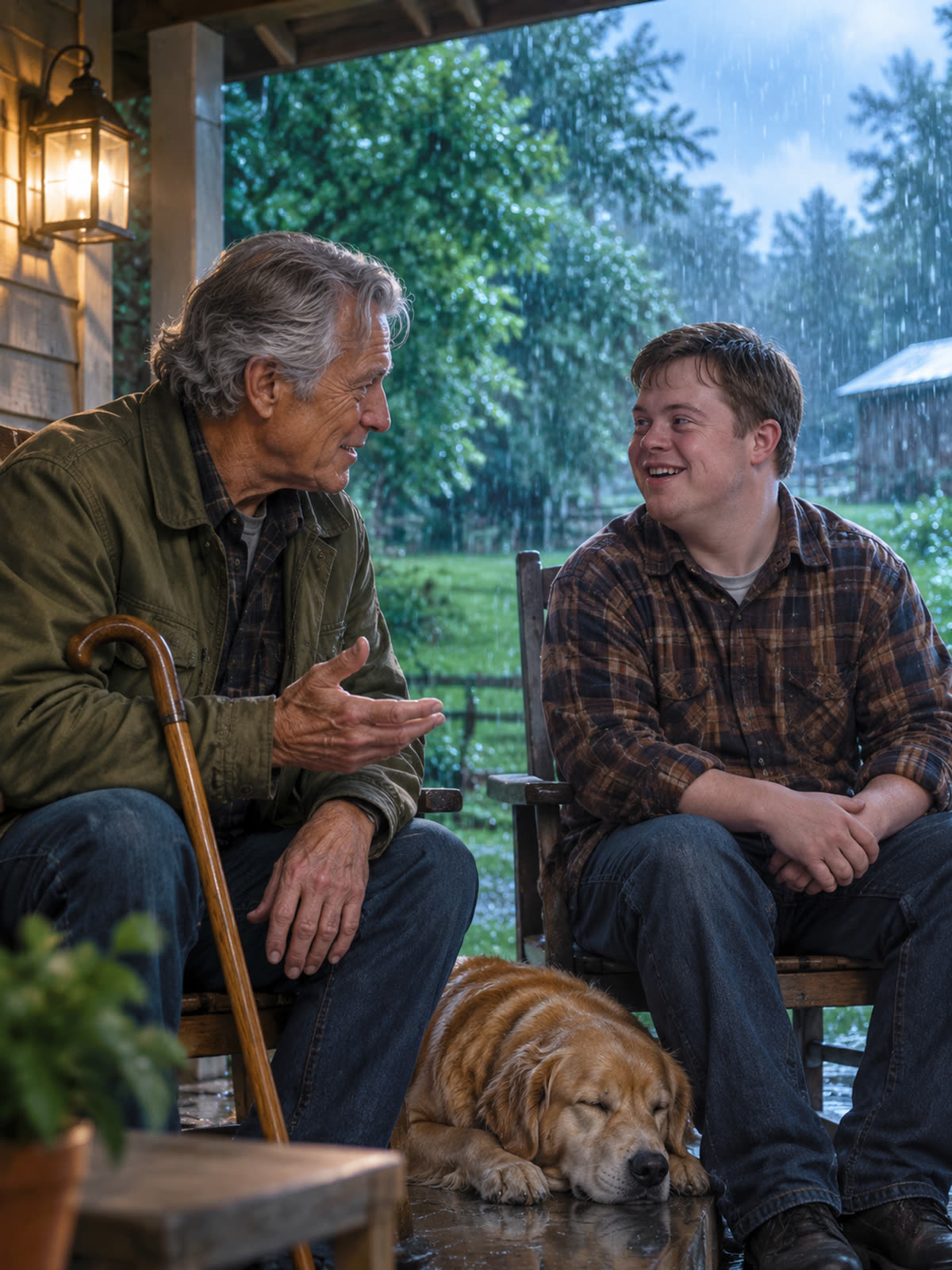
Rain returned that evening. Tucker and I sat beneath the porch overhang while Duke slept between us. We watched water stream through the gutters and collect in the yard. “Dad?” Tucker said. “Yeah, buddy?” He asked, “Is it over now?” I considered my answer. I had spent thirty years giving teenagers the truth. I wasn’t about to give my own son anything less.
“The trial’s over,” I said. “The mean part’s over. But there are still people out there who think someone like you can’t make his own choices. We’ve got work to do about that.” Tucker asked, “What kind of work?” I hadn’t intended to explain the idea yet. It had been taking shape for months, ever since the day Gus brought that recliner into Tucker’s bedroom.
“Eleven guys showed up in our driveway because I called them,” I said. “What if there was a place where that was the normal thing? Where families like ours didn’t have to be lucky to have a wrestling team?” Tucker frowned as he worked through it. “A real group home?” I answered, “A good one. Licensed. Clean. With real beds and a real fridge nobody locks. Where the residents have a say. Where they pick their own jobs and their own music.”
“With country music?” he asked. “Mandatory country music.” For the first time that day, Tucker grinned. “I want to help,” he said. “I can pick out the posters.” I told him, “You’d be in charge of posters.” We remained beneath the overhang, with the rain falling beyond us and Duke asleep between our chairs.
During the next two months, Webb worked through the finances. Dale located a ranch-style house on four acres outside town. It had stood empty since its former owner moved to Arizona. Rudy inspected it for fire safety without charging us and produced a repair list as long as my arm. Gus supplied furniture. Marvin Okafor organized the fundraiser at his church. He wasn’t related to the prosecutor, although the coincidence made them laugh.
When Brenda’s restitution payment finally arrived, I deposited it into a separate account. None of it would pay my personal bills. Every dollar she had taken from Tucker went back into the house. We called the place Rosalie House.
Rosalie attended the opening herself. The state investigation had located her family, and her niece drove six hours to see her. In the sunshine, Rosalie sat in a wheelchair on the new porch while Tucker held her hand and described the building, room by room. She couldn’t speak, but words weren’t necessary. When he took her to the bedroom with her name on its door, she cried and squeezed his fingers so tightly it must have hurt.
Eight residents arrived during that first month. Every person had a bed, a closet, and a key of their own. I made certain there was no lock on the refrigerator. Instead, Rudy installed a bell above the door, so people could come and go for themselves.
I don’t work at the house. I’m sixty-three now, and the trembling in my right hand has never stopped. But each Saturday morning, I drive there with Tucker and Duke. I sit in the kitchen over coffee while Tucker visits everyone. He asks what they need and who could use a hand. He knows every resident’s favorite song.
Last Saturday, a new resident named Colby came. He was nineteen, said very little, and flinched whenever someone lifted a hand. His mother brought him in crying and apologizing, saying she didn’t know what else she could do. Tucker approached him slowly and gave him space. Then he extended a hand, palm down, the way someone might approach a nervous dog.
“Hi, Colby. I’m Tucker. I know this place feels weird. It felt weird to me too, the first time I got somewhere new.” Colby stared at him. Tucker continued, “But it’s okay here. Nobody’s going to make you dig a ditch. And if somebody tries, you tell me, and I’ll tell my dad.”
Colby looked toward me. I was standing in the doorway, leaning on my cane. “Your dad?” he asked. Tucker answered proudly, “He’s a wrestling coach. He doesn’t lose.” I nearly laughed. Over thirty years coaching and sixty-three years living, I had lost plenty. I had lost a wife, my health, and almost my son. But every time, I had stood back up.
Tucker caught Colby gently by the sleeve and guided him toward the kitchen. “Come on. You like grilled cheese? I make the best grilled cheese.” I watched the two of them walk away, my son beside that nervous young man, both looking small in the long hallway. Duke followed, his tail moving back and forth.
My hand shook against the cane. My knees hurt. Sunlight poured through the window and stretched across the floor in long golden bands. I remembered the rehabilitation center in Kansas City and all those days spent struggling to pronounce a single word without slurring. Tucker.
Standing alone in the doorway, I spoke his name aloud. Every letter sounded clear and true. “Tucker.” From the kitchen, his voice answered, “I got you, Dad!” I stayed there a little longer, smiling like a fool, before following him inside.
Disclaimer: This story is a work of fiction inspired by real-life themes. Names, characters, places and events are fictionalized, and any resemblance to real persons is purely coincidental. It does not represent any person or organization and does not encourage inappropriate behavior. Images are for illustration purposes only.
