

PART 1: Thirteen Minutes and Thirty-Two Buttons
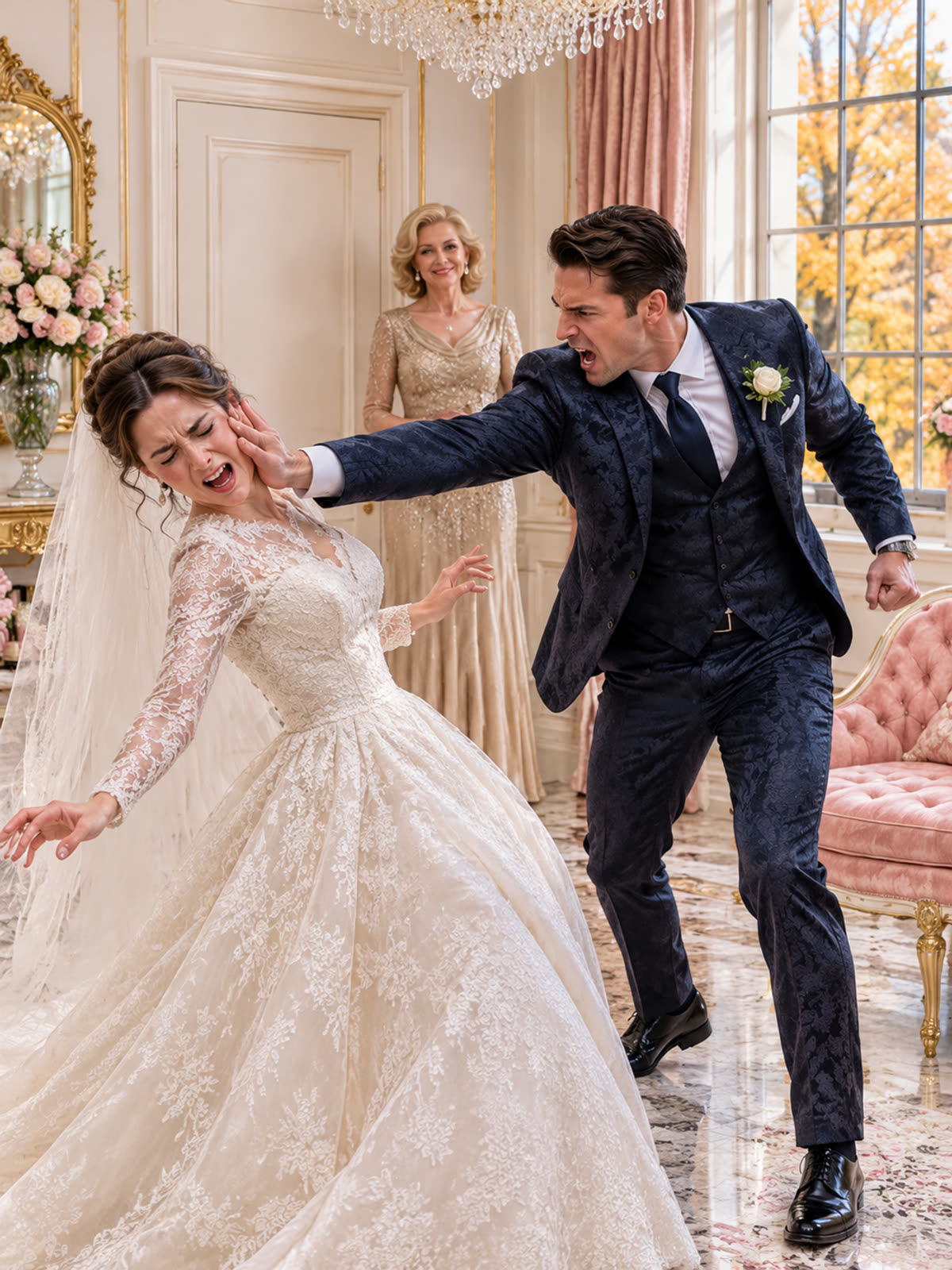
Thirteen minutes before I was supposed to walk down the aisle, my fiancé ordered me out of my late grandmother’s wedding dress. He wanted me wearing his mother’s gown instead. When I refused, he slapped me while his mother watched with a satisfied smile. Until that moment, I had still believed the wedding would happen.
My name is Hazel Reyes. On October 17, I was meant to marry Grant Whitaker at Hollister House in Worthington, Ohio. Downstairs, 164 guests waited for the ceremony, knowing nothing about what was unfolding in the bridal suite. The relationship I had spent five years defending was coming apart above their heads.
Forty minutes earlier, my father had stood behind me, carefully fastening the thirty-two silk-covered buttons on Nana Ruth’s ivory gown. His fingers shook a little, and he counted in Spanish as he worked so that he wouldn’t overlook a single one. That quiet moment had held everything I wanted to carry into my wedding.
Nana had worn the dress when she married my grandfather in 1962. She died two years before my wedding, leaving the gown to me along with a handwritten reminder to choose someone patient enough to appreciate its thirty-two buttons. Wearing it was how I intended to keep her close that afternoon.
Grant’s mother, Lorraine Whitaker, had never accepted that decision. When Grant came into the suite, he was carrying her old gown inside a transparent garment bag. Its discolored sequins, exaggerated sleeves, and rigid satin were nothing like my grandmother’s delicate dress. Lorraine followed him and stationed herself against the closed door.
“Take that dress off, Hazel. You’re wearing my mother’s gown, or there won’t be a wedding.”
Lorraine folded her arms over her champagne-colored dress. She knew exactly why Nana Ruth’s gown mattered to me, but she made no attempt to interrupt him. “Grant, please. The ceremony starts in thirteen minutes, and this dress belonged to Nana Ruth.”
He told me I was insulting his mother. According to him, Lorraine had cried all morning because I would not respect their family tradition. I reminded him that I had explained my choice politely months before. Instead of listening, he stepped closer, leaving me trying to defend a decision that should never have required permission.
“My mother sacrificed everything for me. You could show her some respect for once.”
Before I had the chance to reply, his hand struck my left cheek hard enough to jerk my head sideways. One pearl earring dropped onto the wooden floor. I remained where I was, stunned, trying to understand how the man I was about to marry had just done that to me.
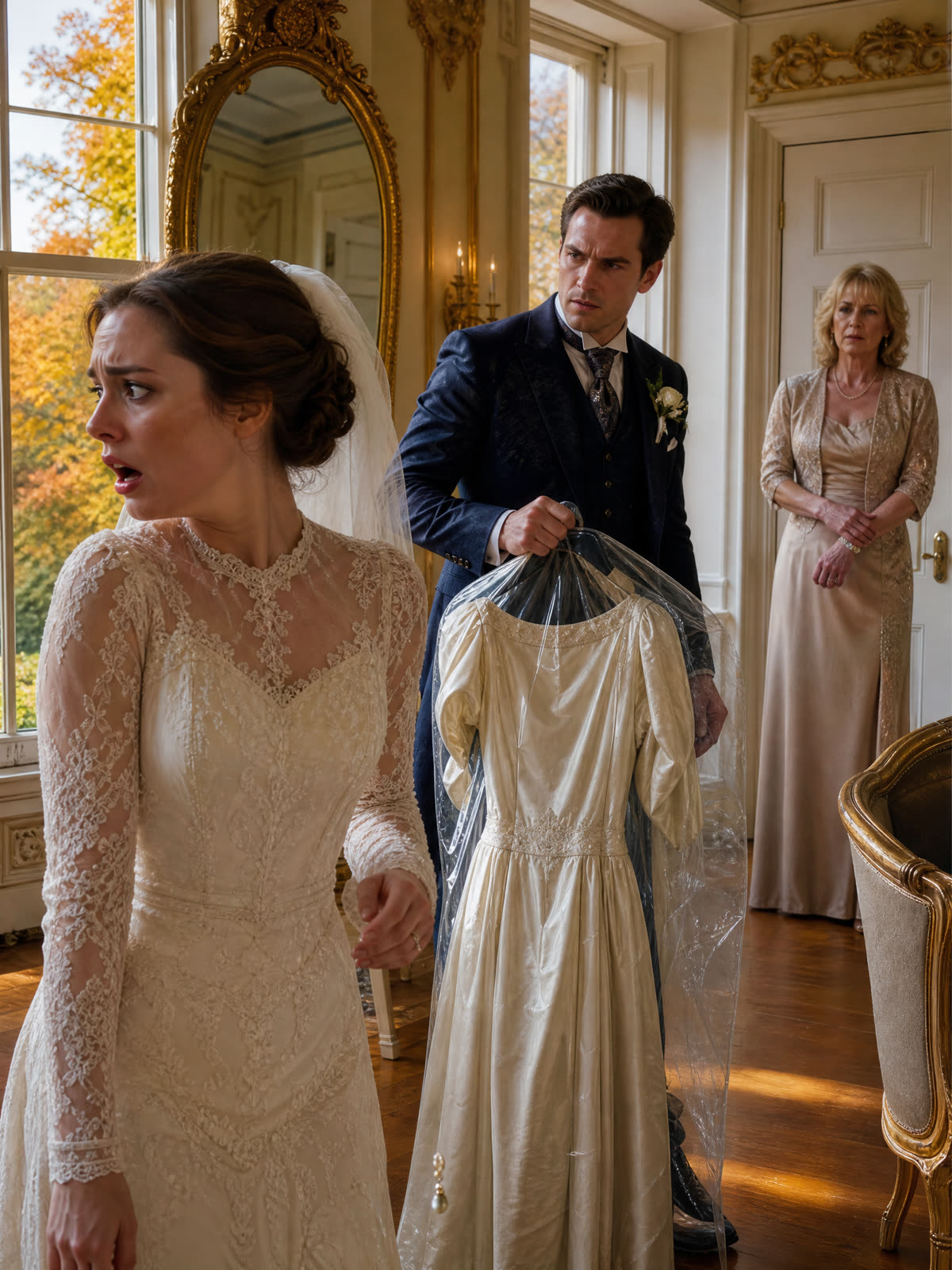
In the mirror, I caught sight of Lorraine behind him. She was smiling. There was no alarm on her face, no sign that her son’s behavior had surprised her. Seeing that expression forced me to understand something I had avoided for years: this confrontation had been about humiliating me, not honoring a dress.
I had spent five years explaining away Grant’s control and his mother’s interference. I kept believing that if I was patient, accommodating, and careful enough, they would eventually respect me. Standing there with my cheek burning, I finally stopped believing it. I slipped off my engagement ring and let it fall onto the garment bag in his hands.
Grant stared at the ring, unable to accept what I had done. Then he warned me about the life I would supposedly lose by leaving. “You’ll have no husband, no house, and no family. You’ll have nothing!” I looked at him and answered, “Time will tell.”
Gathering Nana Ruth’s skirt, I went to the door. Lorraine had to move aside to let me through. Neither of them followed me into the corridor. On my way toward the grand staircase, I remembered the small black camera on the bookshelf and the red light I had noticed after Grant hit me. It had been recording.
Lorraine had arranged a wedding livestream, apparently without realizing that the bridal suite camera was already running. I didn’t know who might have witnessed our confrontation. I also knew something neither of them understood about forty-seven pages I had signed eleven months earlier. Grant had ignored those papers while talking to his mother in a parking lot. Walking away would not leave me with nothing.
Five years earlier, I had been a twenty-four-year-old physical therapist at a sports rehabilitation clinic in Columbus. Grant arrived with a shoulder injury and an entertaining account of saving a neighbor’s barbecue grill during a storm. Later, I learned that he had hurt himself playing company softball. At the time, the exaggeration seemed harmless. He was twenty-eight, a successful regional sales director at Talbot Mechanical, and effortlessly confident.
He remembered my coffee order, delivered soup when I was ill, and picked up Spanish phrases to impress my father. Each morning brought the same affectionate message: “Good morning, my girl.” I felt cherished. It never occurred to me that the possessiveness hidden inside those words would become something I needed to escape.
Five months into the relationship, I met Lorraine. She was fifty-six, worked as a hospital billing supervisor, and had raised Grant alone after her divorce. Her condominium held forty-one framed photographs of him. Over dinner, she repeatedly called me Haley, despite my correcting her twice. She kept using that name for another eight months. “You’re adorable, sweetheart. Grant always did have a soft spot for a project.”
Grant laughed, and I acted as though her remark hadn’t hurt. That evening established a pattern: Lorraine would insult me, and Grant would dismiss my reaction. After we moved in together, he secretly gave her an apartment key. She came and went as she pleased, rearranged our things, and even discarded homemade salsa my mother had made. Our home never quite felt private.
She tracked his location, interrupted our anniversary dinner, and expected instant responses to her messages. Whenever I objected, he turned the complaint back on me. “She raised me alone, Hazel. Why can’t you appreciate everything she’s done?” Meanwhile, he insisted on knowing my location while guarding his own phone, chose my clothes for business dinners, and made embarrassing jokes about me around his colleagues.
Two years into our relationship, I suggested Easter with my parents rather than Lorraine. Grant gripped my wrist so tightly that faint marks were still visible the next morning. He cried when he saw them, apologized again and again, and bought me a silver bracelet. I accepted his explanation, promising myself that another incident would be the last. Somehow, the promise remained easier to make than to act on.
Through those years, Nana Ruth’s memory remained a refuge. She had helped raise me, taught me cooking and sewing, and shown me the importance of kindness and patience. When I was sixteen, she let me try on her wedding dress. As we admired its lace, she told me how carefully Grandpa had undone its buttons on their wedding night. “Any man who has the patience for thirty-two buttons has the patience for a marriage.”
Nana died at eighty-four. Along with her gown, she left me $138,000 from the sale of her home and a note saying I should wear the dress only if it truly made me happy. When Grant proposed on our fourth anniversary, I knew which gown I wanted. Lorraine, secretly sitting nearby and recording, immediately announced that she had helped choose my engagement ring.
Two days afterward, she offered me her yellowed wedding dress. I thanked her and explained that I had always planned to wear Nana’s. Her expression tightened beneath her smile. “Of course, Hazel. Your family’s traditions always seem to matter more.” Grant said nothing. I thought I had simply disappointed her. I had no idea that my answer marked the beginning of an eleven-month effort to make me surrender.
PART 2: The Papers He Never Read
For the rest of our engagement, Lorraine refused to let the dress issue disappear. She showed relatives old photographs, complained about my decision, and claimed I had insulted her gown. By the time the invitations went out, several people in Grant’s family believed I had deliberately embarrassed her. Grant helped keep that story alive by asking why I couldn’t wear the dress for a single hour.
While that argument continued, we started looking for a house. Lorraine insisted that whichever property we bought needed separate living quarters for her. Eventually, she found a four-bedroom colonial on Brookside Lane in Hilliard, priced at $465,000. I fell for the bright kitchen and the maple tree. Grant seemed pleased that his mother approved, and we moved forward with the mortgage application.
Our mortgage officer, Phil Gentry, reviewed our financial information and asked to speak privately with Grant. When Grant returned, he looked mortified. Phil explained why: Grant’s credit score was 538, he owed about $41,000 in delinquent debt, and a pickup truck had previously been repossessed. He had kept every one of those problems from me throughout our relationship.
With his financial history, the loan could not be approved with him listed as a borrower. Grant offered what sounded like a temporary solution. “Put the house in your name for now, Hazel. We’ll refinance after we’re married.” I agreed and put $93,000 of Nana Ruth’s inheritance toward the down payment. He promised to repay his portion. He never did.
At the closing office on Sawmill Road, I read and signed forty-seven pages. Grant stayed in his truck, talking to Lorraine and complaining that legal paperwork gave him headaches. The deed described the owner without any ambiguity: “Hazel Marie Reyes, a single woman.” Neither of them asked to see it. They simply assumed the property would ultimately belong to us both.
Nine days before the wedding, Lorraine moved into the basement suite without asking me. She had sold her condominium, and Grant had decided that taking her in was our obligation. “Where else is she supposed to go? She sold her home for us!” I tolerated it reluctantly, still holding on to the hope that marriage would somehow improve the boundaries neither of them respected.
Before that move, three weeks ahead of the ceremony, I had opened Nana Ruth’s cedar chest and discovered that the gown was gone. Grant seemed unconcerned. He said his mother had taken it to be professionally cleaned, as though there was nothing strange about removing something so precious without speaking to me.
That evening, Bettina Krauss called. She was the seamstress who had already restored the dress, and there was alarm in her voice. Lorraine had brought it to her shop, but cleaning was not what she had requested. The changes she wanted would have permanently erased the gown’s original appearance.
“She wanted the sleeves removed, all the lace stripped away, and the skirt shortened above the knee. I refused to touch it without your permission.”
I went to collect the gown immediately. The alteration request carried Lorraine’s own signature. Only Bettina’s refusal had kept the dress intact. When I showed Grant the written instructions, he brushed aside both the evidence and my distress. “Mom was only trying to help. Why do you always assume the worst?”
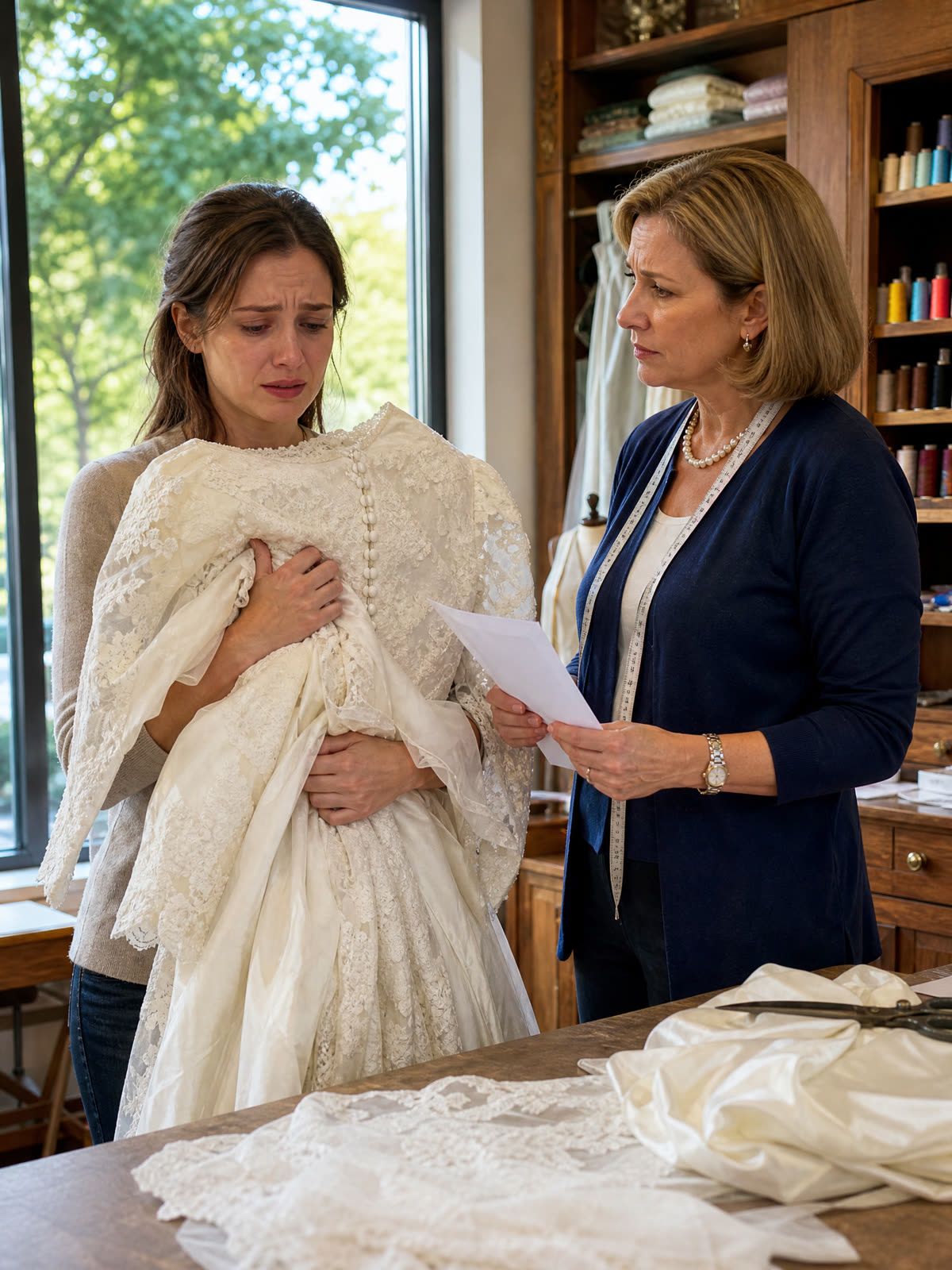
Afterward, I took the dress to my maid of honor, Tasha Green, and left it at her apartment until the wedding morning. I considered calling everything off. Grant responded with apologies and renewed affection, behaving so lovingly over the following days that I allowed myself to hope again. I gave him the chance I had already given him too many times.
On October 17, I arrived at Hollister House to get ready. Lorraine had hired Ravi Desai to livestream the ceremony and show photographs on a twelve-foot screen in the grand hall. She also insisted that a camera be placed in the bridal suite. At first, I objected. Then I thought of my eighty-eight-year-old Great-Aunt June in Arizona, recovering from surgery and desperate to see Nana Ruth’s dress.
Ravi told me Lorraine had instructed him to turn on the bridal suite camera at 3:58 p.m. and send its feed downstairs. Aunt June wanted an earlier look, so I asked him to begin a private stream at 3:31 instead. It seemed like a small accommodation for someone who could not be there. Neither Grant nor Lorraine knew the schedule had changed.
At 3:41, Lorraine sent Tasha downstairs to handle a supposed floral emergency. At 3:45, Grant entered with the garment bag. At 3:47, he slapped me. The camera had already been broadcasting for sixteen minutes. As I descended the stairs afterward, I knew someone might have seen what had happened, but I still didn’t understand how many people were watching.
The musicians stopped when I entered the grand hall alone. Guests turned toward me. My father saw the mark on my face immediately, and my mother raised a hand to her mouth. I went to Pastor Glenn Hartley, took the microphone, and told everyone there would be no wedding. Then I explained why.
“Grant demanded that I remove my grandmother’s wedding dress. When I refused, he struck me, and his mother watched.” Before the room could respond, Lorraine stepped forward with an explanation of her own. I had fallen in the bathroom, she insisted. Wedding preparations had overwhelmed me, and all I needed was a little time to recover.
Grant arrived soon afterward, wearing an exaggerated expression of concern and repeating her account. Some relatives appeared to believe them. Those were the same people who had already listened to Lorraine describe me as emotionally unstable. Even there, with the mark on my face, mother and son were trying to replace what had happened with a story that protected them.
I did not argue. Instead, I asked Ravi when the bridal suite camera had started recording. He confirmed the 3:31 start time and told us that 143 people were watching online. Then I gave him a simple request. “Ravi, please show everyone what happened at 3:44.”
Lorraine’s slideshow vanished from the twelve-foot screen. In its place appeared the bridal suite: Grant entering with his mother’s dress, Lorraine standing against the door, and me still wearing Nana Ruth’s gown. The guests heard his demand. They watched my refusal. Then, in front of the people who had come to celebrate our marriage, they saw him strike me.
The recording did not end with his hand falling. It showed me standing motionless afterward, and it showed Lorraine behind him, smiling for several seconds. Ravi paused on her expression. There was no explanation she could offer that would make the image resemble concern for an overwhelmed bride who had supposedly slipped in a bathroom.
Grant immediately insisted that someone had manipulated the video. Ravi answered that the confrontation had been broadcast live. What they had tried to deny had already happened in front of witnesses far beyond the room. Their explanation could not survive the recording, and Lorraine’s smile remained frozen above the guests.
Then Gary Talbot, Grant’s employer, got up from his seat and walked toward him. Grant had threatened that leaving would cost me everything. With the recording still visible behind us, the consequences were beginning to move in a very different direction—and Gary had something to say.
PART 3: Fifty-Three Calls and One Name on the Deed
Gary stopped in front of Grant after watching the footage. “Don’t bother coming in on Monday.” He left the hall, followed by five Talbot Mechanical employees. Lorraine dropped into a chair while relatives and people from her church began questioning the stories she had told them. The room she had expected to control was no longer accepting her version.
Before I could leave, two police officers arrived. Great-Aunt June had seen the confrontation from Arizona and called emergency services. Officer Paula Kent approached Grant and directed him to put his hands behind his back. Lorraine protested that I had provoked him, but the officer explained that the police had already reviewed the video.
They escorted Grant away. My father wrapped his jacket around my shoulders, and Tasha brought my phone, the pearl earring I had lost, and an ice pack. She accompanied me to Riverside Emergency, where Dr. Helen Brandt documented the injuries to my cheek and lip. The following morning, attorney Monica Hale reviewed the recording and helped me request a protective order.
By Monday, the footage had spread widely online. Lorraine’s smile was the detail people kept discussing. Gary formally dismissed Grant, and the court issued an order forbidding him from contacting or approaching me. The account they had tried to dismiss as wedding-day confusion was now supported by a recording, medical documentation, and witnesses.
That weekend, I also heard from Alyssa Moore. She said she had once been engaged to Grant, a fact he had never shared with me. Lorraine had demanded that Alyssa wear the same gown, and Grant had shoved her during an argument before their wedding. Alyssa ended the engagement. Afterward, Lorraine told people she had cheated.
Alyssa revealed something else: Grant’s father had described marrying Lorraine at a courthouse in 1991. Lorraine had worn a navy-blue skirt suit. Then Tasha found a faded label inside the lining of the supposed family heirloom. The gown had come from Second Chance Bridal Resale in March 2011. Its price had been $85.
The dress was not the treasured wedding gown Lorraine claimed it was. From what we had uncovered, it appeared to be something she used to test whether Grant’s partners would obey her. What she called tradition had been imposed on another woman before me, with the same demand for submission and the same punishment for refusing.
On Tuesday morning, I made arrangements regarding the house on Brookside Lane. By that afternoon, Grant had learned about them. His first call came at 4:12 p.m., the day after the protective order was issued. Following Monica’s advice, I let it ring. Then I ignored the next call, and the next.
At 9:38 that evening, my phone showed fifty-two missed calls. Nine minutes later, he tried again. This time, I answered and preserved a recording of the conversation. After everything that had happened, he was still contacting me despite an order that explicitly prohibited it.
“Hazel, please don’t hang up. I’ve lost everything!” He said Gary had fired him, the company truck had been taken back, and millions of people had viewed the footage. Lorraine had lost her position leading the church prayer chain. He was facing criminal charges. The life he had threatened to take from me was the one unraveling around him.

He begged me to convince the prosecutors to drop the case. I explained that it was not my decision. The authorities already had medical records, witness accounts, and the recording. Then he asked whether I had known the camera was on during our confrontation. I told him I had noticed its red light after he hit me.
Even then, he tried to defend Lorraine. She had only wanted me to honor an important family tradition, he claimed. I finally told him what Alyssa and Tasha had discovered. “Your mother married your father in a navy-blue suit, Grant. That dress came from a resale shop, and it cost eighty-five dollars.”
When I mentioned Alyssa, he went quiet. I explained that his mother appeared to have used the same invented tradition to control both of us. He had never admitted that another fiancée existed, much less that she had faced the same demand. There was no cherished wedding gown behind the confrontation, only another story neither of them had expected me to question.
At last, he reached the reason he had called so relentlessly. Lorraine had gone back to Brookside Lane. Her key no longer opened the door, her possessions were gone from the house, and a legal notice had been posted. With legal help, I had arranged for her belongings to be transferred to a climate-controlled storage unit. The first month was paid, and she had the information needed to collect them.
“That’s our house, Hazel! You can’t take it away!” I reminded him of the mortgage meeting and the forty-seven pages he had chosen not to read. Nana Ruth’s inheritance had supplied the entire $93,000 down payment. The purchase had been made in my name alone. “The deed says Hazel Marie Reyes, a single woman. Your name isn’t on it.”
He began pleading again. I reminded him that contacting me violated the protective order and that Monica would receive the missed-call records and this conversation. Then I repeated his own promise back to him. “Three days ago, you promised I’d have no husband, no house, and nothing if I walked away.” I gave him a moment before adding, “You were right about the husband.”
I ended the call and switched off my phone. The next morning, Monica submitted the call records and supporting evidence to the court. After determining that Grant had violated the protective order, the court revoked his bond. Three months later, he pleaded guilty and received nine months in county jail, followed by probation and mandatory counseling.
His professional reputation had fallen apart, and he struggled to find another job in commercial heating and cooling. Lorraine faced consequences too as the recording circulated through her workplace and church. The hospital put her on administrative leave, and she eventually took early retirement. Much of the money from selling her condominium went toward Grant’s legal expenses.
She moved into a small apartment outside Columbus. Later, I heard that Grant had stopped accepting her calls from jail. The relationship they had held up as proof of unwavering family devotion had deteriorated beneath the consequences of their own choices. For once, I was not the person being asked to absorb those consequences for them.
When spring came to Brookside Lane, I began making the house feel like mine. Lorraine’s basement suite became a bright studio and guest room. In place of her photographs, I hung a framed picture of Nana Ruth and Grandpa Walt on their wedding day. Bettina cleaned and preserved the gown before returning it to its cedar chest, its lace and thirty-two buttons still intact.
I wore red lipstick again. I stopped sharing my location. I learned to enjoy choosing things without preparing an explanation or waiting for someone’s approval. For years, I had mistaken constant surrender for compromise. Now I understood that love should never require me to erase myself, abandon my boundaries, or accept being mistreated.
I no longer felt obliged to decide whether I would ever marry. If someone entered my life, I wanted respect, not extravagant promises: someone who understood my choices and valued the people who had shaped me. Nana Ruth had already given me the measure of what mattered. What I still didn’t know was whether I would ever meet someone with the patience for thirty-two buttons.
Disclaimer: This story is a work of fiction inspired by real-life themes. Names, characters, places and events are fictionalized, and any resemblance to real persons is purely coincidental. It does not represent any person or organization and does not encourage inappropriate behavior. Images are for illustration purposes only.
