


PART 1: THE LITTLE GIRL WAITING AT GATE D22
The airport security officer asked a question that seemed to pull the floor out from beneath me. “Ma’am, did you give your parents permission to leave your four-year-old daughter alone at Gate D22?” I was in a supply room at Mercy General Hospital, where I worked as a pediatric nurse. My daughter, Lily, should have been traveling to Orlando with her grandparents and two cousins. Nothing about that question belonged to the morning I thought we were having.
“That can’t be right. My daughter is flying to Florida with my parents.” The officer paused, then explained that Lily was safe in the airport security office. My parents, however, had boarded without her. They had known exactly where she was when they left. Before I could make sense of that, I heard a familiar little voice trembling in the background. “Did my mommy say I was a bad girl?”
My name is Clara Vance. I was thirty-two, and until that Tuesday, I had thought my parents were unfair and difficult rather than capable of deliberately putting my child in danger. My mother, Eleanor, had always preferred my older sister, Victoria. When Victoria made mistakes, there was an explanation. When I struggled, I was expected to try harder, complain less, and accept whatever my family decided I deserved.
Lily had just turned four. She had curly brown hair, boundless energy, and a stuffed rabbit named Barnaby who accompanied her everywhere. Excitement brought an endless stream of questions, while unfamiliar crowds sometimes made her anxious. Two days before the flight, my parents offered to take her to Florida for five days with Victoria’s twins. I had several demanding hospital shifts ahead, and Eleanor described the vacation as a lovely chance for the cousins to spend time together.
I said yes because I wanted my daughter to see the beach and come home with happy memories. Only afterward did I understand how much of that decision rested on hope. I wanted to believe my parents would finally offer Lily the easy affection they gave Victoria’s children. On the morning of departure, Eleanor arrived immaculately dressed, while Arthur waited outside in their silver SUV. The twins were already settled inside, absorbed in their tablets.
Lily came downstairs with her ladybug suitcase. “Look, Nana! I’m strong like a superhero!” Eleanor offered little more than a faint smile before reminding her that they could not miss the flight. I helped Lily into her jacket, tucked my emergency contact information into her pocket, and gave Arthur her allergy medication. “Please keep her close, Dad. She gets frightened when places are too crowded.” He answered, “Don’t worry, Clara. We’ll take good care of her.”
Before they left, Lily hugged my neck and asked whether we could look at the same moon that night. I promised that we could, even from different places. Four hours later, an airport officer was telling me that surveillance cameras had recorded my parents returning to the spot where she sat. They had looked at her, turned away, and boarded. There had been no emergency and no accidental separation. They had knowingly left her there.
I told my supervisor I had to leave and rushed toward the hospital exit. In the lobby, a message from Victoria appeared on my phone. “Mom says you changed your mind and picked Lily up. Thanks for ruining the vacation.” My parents had already supplied an explanation that made me responsible. Hannah, my nursing supervisor, insisted on driving because I was too shaken to do it safely. During the forty-minute journey, I called both my parents repeatedly. Neither answered.
Victoria finally picked up as her plane prepared to depart. “Mom said Lily threw a tantrum at security and you called to say you were picking her up.” Her irritation made the conversation feel unreal. “Airport police have my daughter, Victoria! She’s four years old, and they left her alone!” I heard Eleanor telling her to stop listening to my complaints. Then the call ended. At the airport, Officer Hayes met us near security and led me to a private office, explaining that a custodial worker had found Lily by the charging stations.
She had been holding Barnaby and watching the boarding door shut. She had not screamed or chased anyone because she thought she was supposed to stay where her grandmother had put her. Inside the office, she sat beside a female employee, coloring a butterfly. The moment she saw me, her crayon fell. “Mommy!” I dropped to my knees and gathered her into my arms. She clung to me while I told her, over and over, that she was safe.

Eventually, she leaned back far enough to search my face. “Nana told me to wait by the blue chairs until you came. I stayed there, Mommy. I was good.” There was no accusation in her voice, only the frightened need to know whether she had done what was expected. “You did everything right, sweetheart. The grown-ups made a terrible mistake, not you.” Holding her, I understood that she had spent that time trying to earn safety by following an instruction.
Hayes explained that Eleanor had told airline employees I was already inside the terminal and would collect Lily. Since Lily’s boarding pass had never been scanned, the airline believed the changed arrangements were authorized. No one had come looking because the adults responsible for her had made her absence sound deliberate and harmless. A worker had noticed her alone, and the contact information in her pocket had allowed security to reach me.
The cameras also showed Arthur returning to her before boarding. Eleanor approached him, spoke to him briefly, and led him away. Lily remained behind. That detail stayed with me: my father had gone back. He had been close enough to take her with him, and instead he had left again. His promise outside my house had lasted only until keeping it became inconvenient.
Hannah took us home. I spent the afternoon comforting Lily, staying near her until she finally slept. Then I sat beside her bed and stared at the child my parents had abandoned. The possibilities I had avoided imagining at the airport crowded in now. She had been four years old in a busy terminal, trusting that the adults who loved her had a reason for leaving her alone.
At about two o’clock, a Facebook notification appeared on my phone. Eleanor had posted about me. Her account portrayed me as an irresponsible young mother who could not manage her daughter’s behavior. She claimed I had refused to cooperate with the vacation and had forced my parents to leave Lily behind. Attached was a photograph of Eleanor, Arthur, and Victoria’s family smiling at the Orlando airport.
They had reached Florida, posed for a picture, and begun defending themselves while I sat beside my sleeping daughter. I wanted to answer immediately. I wanted everyone reading that post to know where Lily had actually been and why. Before I responded, however, a private message arrived from my father’s estranged sister, Aunt Beatrice. “Clara, don’t respond publicly yet. Your father left a message on my answering machine. You need to hear it.”
Beatrice forwarded the recording. Arthur apparently believed his message would persuade her to support the family’s account. I played it beside Lily’s bed, watching her sleep while my father’s voice filled the quiet. “We left her,” my father admitted. He sounded worn down and ashamed, but there was no uncertainty in what he said. It was not a misunderstanding. It was an admission.
He explained that the crowded terminal had frightened Lily and she had asked him to hold her hand. Victoria was worried about missing the flight. Eleanor grew increasingly angry at Lily’s behavior and ordered her to sit near a blue charging station until she could behave properly. My daughter’s fear had been treated as disobedience, and her need for reassurance had become an inconvenience.
Arthur said he had gone back and found her waiting patiently. “She asked if she could come with us. I had her backpack in my hand.” I looked at Lily, asleep beside me, and tried to absorb that image. She had not demanded anything extravagant. She had asked to go with the family who had brought her there. My father had held her backpack, already close enough to bring her along.
Then came the part that stripped away the last possibility of an innocent explanation. “Your mother said Clara needed to learn a lesson. She told me to leave Lily there, so I put the backpack down and walked away.” The recording ended. My parents had not merely lost patience or failed to notice she was missing. They had abandoned my child to punish me—and now I had the evidence they did not know I possessed.
PART 2: THE MESSAGE I NEVER SENT
By the following morning, relatives and acquaintances were filling my phone with messages about Eleanor’s post. Some were sympathetic. Others criticized me for supposedly expecting my parents to manage Lily’s behavior and then blaming them when the vacation went wrong. My mother’s version had traveled farther than the truth. She had presented herself as the injured party, and people who had not seen my daughter waiting alone were already deciding what kind of mother I was.
The accusation was carefully constructed. Eleanor wanted everyone to believe I had approved a change in arrangements, then turned against her when it became embarrassing. I called Denise, a close friend and licensed child psychologist, and asked her to spend time with Lily. While they played in the living room, I began assembling every record connected to the Florida trip. I needed something sturdier than an argument with my mother.
Eleanor had organized the vacation in a shared Google Drive folder. It contained the reservations, hotel confirmations, and packing lists. I had contributed fifteen hundred dollars toward Lily’s expenses, money earned through additional overnight shifts at the hospital. I had worked those hours believing I was giving her a happy experience. Now I was opening the same documents to understand how my parents had decided she could be left behind.
Among the files was one called Vacation Code of Conduct. According to its revision history, Eleanor had created it the night before departure. One section allowed the grandparents to remove any child from the itinerary for disrupting the trip or requiring excessive attention. It also claimed I had already been warned about that condition. I had not. The words gave a formal appearance to a decision no responsible adult should have considered.
I read the section again. My mother had prepared an excuse before they reached the airport. She had given herself permission to exclude Lily if caring for her became inconvenient, then written that I knew about it. What had happened at Gate D22 could no longer be dismissed as a single moment of impatience. The folder showed how willing Eleanor was to make her own version look established and reasonable.
Another notification arrived, this time from the family group chat. Eleanor had shared a screenshot that appeared to show a message from me. “I’m sorry she’s acting up. Just leave her. I’m on my way to get her. Go enjoy the flight.” For a moment, I could only stare. I had never sent that message about the airport. Yet there it was, offered to the family as if it settled everything.
I searched my phone until I found the original conversation from two weeks earlier. We had been at a grocery store, where Lily had accidentally knocked over cereal boxes. Eleanor offered to watch her while I paid for the damaged items. My message referred to leaving Lily near the registers because I was coming to collect her, after which Eleanor could continue with her day. It had nothing to do with an airport or a flight.
Eleanor had removed the date and changed the wording. She had taken a real exchange and reshaped it into permission I had never given. The lie was no longer confined to a Facebook accusation. It now looked like something written by me, something a relative could forward without questioning, something my mother could point to when anyone asked why a four-year-old had been left at a gate.
Before I finished organizing the records, Officer Hayes called. “Ms. Vance, your mother has submitted a screenshot claiming you instructed her to leave your daughter. We need to establish whether that message is genuine.” My mother had put the altered image before the police. I explained that I had the original conversation and its timestamps. I also told him about Arthur’s recorded admission and the document Eleanor had created the evening before the trip.
“I’m sending you everything, Officer Hayes. My parents didn’t misunderstand my instructions. They deliberately left Lily behind.” I forwarded the records: the actual messages, the altered screenshot, the vacation document, and my father’s confession. What Eleanor had presented as proof against me could now be compared with the conversation it came from. While my daughter played nearby with Denise, I handed over the evidence that showed how deliberately my mother had tried to shift the blame.
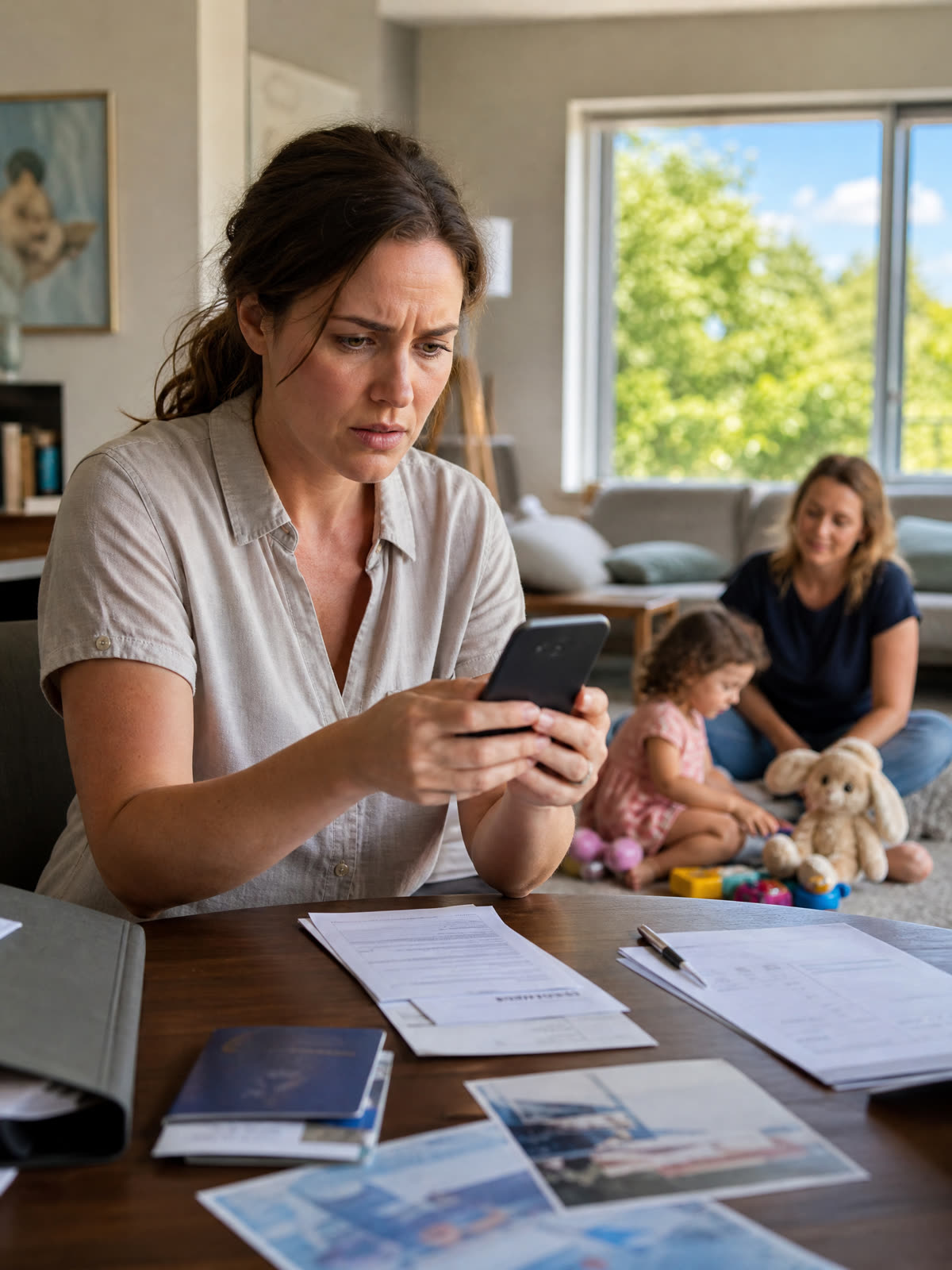
I also contacted a family law attorney, Ms. Sterling. After hearing what had happened, she agreed that protecting Lily from further interference had to come first. At her office overlooking Chicago, I laid out the screenshot, the original messages, the vacation records, and Arthur’s recording. There was something deeply unsettling about seeing my family reduced to a collection of documents, but those documents said what my mother would not.
Ms. Sterling explained that the material could establish both the deliberate abandonment and Eleanor’s effort to make me responsible. She began seeking a protective order to prevent my parents from approaching Lily. She also prepared to recover the fifteen hundred dollars I had paid toward a vacation my daughter never received. I had once worried about provoking my mother. Now the greater danger was allowing her to keep controlling the account of what she had done.
By Thursday, the family was home from Florida. Neither parent had contacted me to ask whether Lily was all right. I called Victoria and told her that Arthur’s recording contradicted Eleanor’s claims. At first she accused me of lying. Her certainty changed when I explained that the police and my attorney had the evidence. “Mom showed me a message saying you agreed to pick Lily up!”
“She altered an old message, Victoria. You need to decide whether you’re going to keep defending her or tell investigators what actually happened.” I could not make my sister choose the truth. I could only refuse to let her continue treating our mother’s account as the only one worth hearing. The evidence was no longer something Eleanor could dismiss merely by saying I was difficult.
That evening, Lily and I were building a fort out of sofa cushions when someone started pounding on the front door. Through the peephole, I saw Arthur in the pouring rain. He looked exhausted and frightened. I opened the door only as far as the security chain allowed. He had not come to ask how Lily was doing. He had come with another warning.
“Clara, your mother is hiring lawyers. She’s using your old medical records to try to take custody of Lily.” I stared through the narrow opening. Four years earlier, after Lily was born, I had experienced postpartum depression. I had sought professional treatment, worked through therapy, and recovered. Eleanor now intended to turn that history into a claim that I was not fit to raise the child she had abandoned.
Arthur said he had tried to stop her. When he challenged the plan, Eleanor ordered him out of their home, and he claimed he had finally separated from her. I told him to stay with Aunt Beatrice and not contact me again. The warning mattered, but it did not undo his part in what happened. He had returned to Lily, heard her ask to come, and walked away.
Over the next forty-eight hours, Ms. Sterling worked to keep Eleanor from interfering with my custody. She sought emergency legal protection, submitted material from the airport investigation, and requested the relevant airline and security records. We also pursued information about Victoria’s communications with Eleanor. My attorney wanted to establish how the false account had spread and whether my sister had knowingly helped it along.
By Sunday, Aunt Beatrice had arranged a family meeting at her house. I agreed to go only with Ms. Sterling beside me and Lily safely with Denise. When we entered the dining room, Eleanor occupied the head of the table. Victoria looked distressed. Arthur avoided everyone’s eyes. My mother’s position in the room was familiar, but I was no longer there to accept whatever version of events she chose to announce.
Eleanor objected as soon as she saw my attorney. “This is a family matter, Clara. I won’t discuss private family business with a lawyer.” Ms. Sterling put a folder on the table. “It stopped being a private disagreement when a four-year-old child was abandoned at an airport and false evidence was submitted to the police.” Everything my mother had tried to conceal was inside that folder, and we were about to open it.
PART 3: THE TRUTH SHE COULD NO LONGER CONTROL
Eleanor began by insisting that Lily had been disruptive and that I could not control her behavior. She described my parents’ actions as an effort to keep the whole family’s vacation from being spoiled. Even there, with my attorney at the table, she spoke as though a frightened child had created the problem. My daughter’s safety remained secondary to the inconvenience my mother believed she had caused.
I did not argue. I opened the folder and laid out a still from the airport surveillance footage. Lily sat on the floor with Barnaby in her arms. Beside her, Eleanor was pulling Arthur away. The photograph made the scene impossible to soften into a vague story about confusion. There was my child, waiting where she had been told to wait, while the people responsible for her turned away.
Victoria stared at the image in disbelief. Apparently, she had believed Eleanor’s explanation that Lily became separated from the family amid the confusion. I then placed the original grocery store conversation beside the screenshot my mother had circulated. The timestamps and complete message history showed that I had never told anyone to leave Lily at the airport. The supposed permission had been manufactured from an unrelated exchange.
Eleanor accused me of stealing her personal information. I continued to the last piece of evidence instead of following her into another argument. I played Arthur’s recording. His voice filled the dining room as he described returning to Lily, hearing her ask whether she could come with them, and leaving because Eleanor wanted to teach me a lesson. Everyone at the table heard the words I had first heard beside my daughter’s bed.
Victoria began to cry. She turned to our mother, no longer defending the account she had repeated to me. “You told me Clara agreed to everything. You made me believe she was responsible.” The accusation came from the daughter Eleanor had always favored. For once, I did not have to persuade my sister that our mother’s explanation could be wrong. She had the evidence directly in front of her.
Eleanor became furious. She maintained that she had been protecting the family from Lily’s difficult behavior and refused to apologize. Even with the photograph, the messages, and Arthur’s confession before her, she insisted my daughter had created unnecessary problems for everyone. The truth had been established, but my mother still treated the child she endangered as the person who should have behaved differently.
Arthur finally spoke. “You abandoned your own granddaughter, Eleanor. I’m filing for divorce.” His statement did not absolve him. He had admitted his own involvement in the recording, and I could not forget it merely because he now challenged her. Still, he was no longer helping maintain the story that nothing deliberate had happened. The family agreement Eleanor expected was breaking apart in front of her.
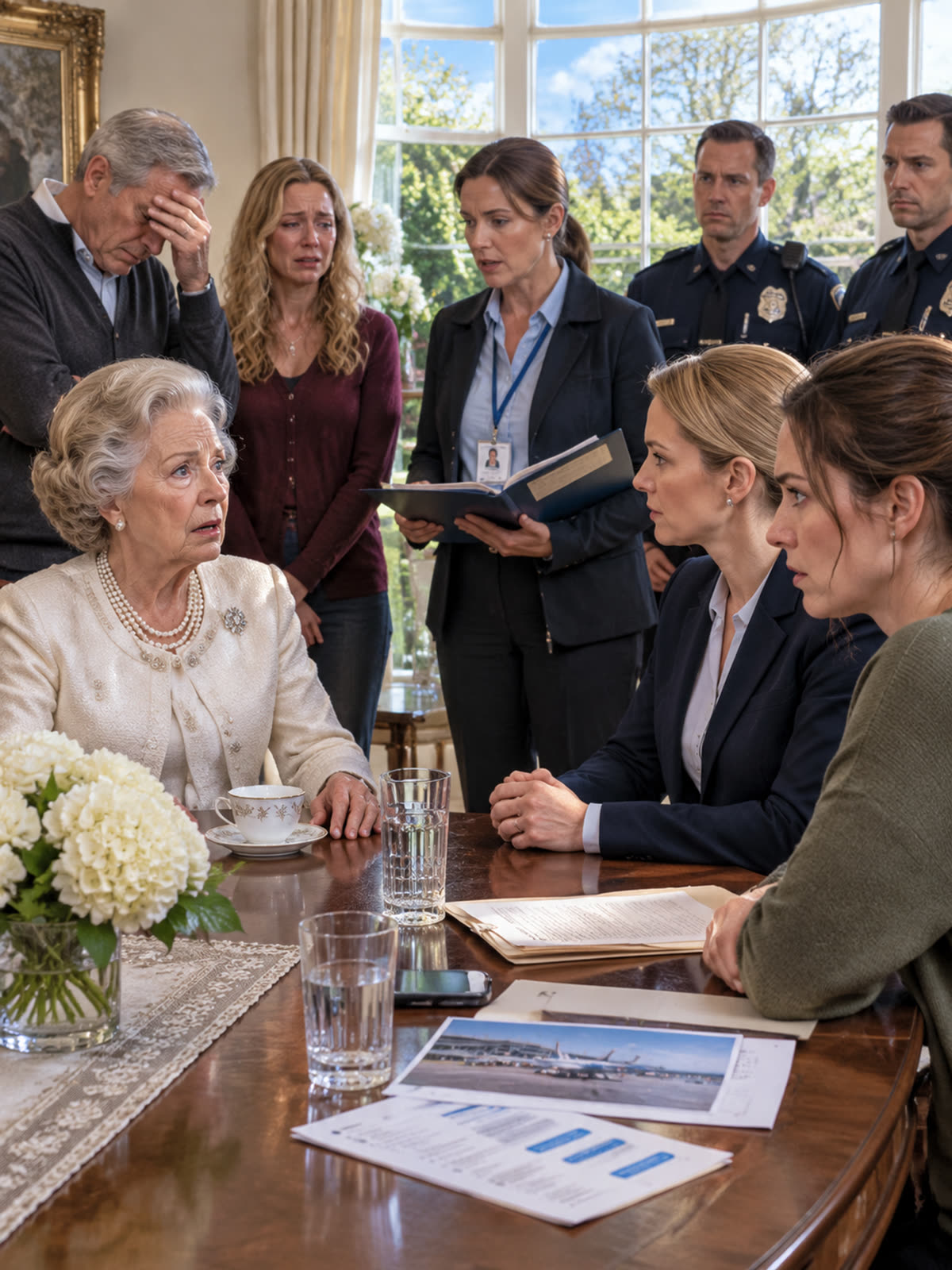
Before she could answer him, the doorbell rang. Aunt Beatrice left the room and returned with a woman carrying official documents. Two uniformed police officers accompanied her. The confrontation was no longer limited to relatives comparing stories around a dining table. The investigation had reached the room where my mother was still trying to defend herself.
The woman identified herself as a representative of the Department of Child and Family Services working with state police. “Which one of you is Eleanor Vance?” My mother looked around the table. The people she had expected to support her had heard the recording and seen the evidence. There was no convincing explanation left to offer on her behalf.
Nobody came to Eleanor’s defense. For the first time, the version of events she wanted us to accept could not protect her. The photograph of Lily, the original messages, and Arthur’s own words had followed her into a room she could not control. My mother sat facing the officials while the family she had tried to turn against me remained silent.
The investigation moved quickly afterward because the authorities already had substantial evidence. Airport surveillance, the genuine messages, the altered screenshot, and Arthur’s recording established what had occurred at Gate D22. Arthur and Victoria eventually cooperated with investigators. Their statements further weakened Eleanor’s claim that I had authorized the arrangement. What she had portrayed as my failure was documented as her decision.
Eleanor was formally charged with reckless endangerment of a minor and filing a false police report. As the details spread through her social circle, the reputation she had guarded began to deteriorate. Friends who had defended her withdrew, and she lost her country club membership. Arthur proceeded with the divorce. She was left alone in the large house where she had once expected to direct every family decision.
A civil court also ordered her to repay the fifteen hundred dollars I had contributed toward Lily’s trip. I put the recovered money into a protected trust for my daughter. The legal consequences brought some relief, but they could not repair what had happened inside Lily. Proving the truth was much faster than helping a four-year-old believe she would not be left again.
For months, Lily became anxious whenever I left a room without explaining where I was going. She stored snacks in her ladybug suitcase and sometimes asked whether she was allowed to make noise. Each question showed me another part of what she had taken away from that airport: the fear that ordinary needs or frightened feelings could make the people caring for her decide to leave.
Whenever those worries surfaced, I reminded her that she had done nothing wrong. “You can be as loud as you need to be, sweetheart. I love you, and I’m not going to leave you behind.” With Denise’s help, I arranged regular play therapy. Progress came slowly, but Lily began learning that she could show her feelings without losing the care and affection she needed.
I cut off contact with Eleanor. Preserving a relationship with my mother mattered less than protecting my child from someone who had knowingly endangered her and then tried to blame me. Victoria and I eventually managed an occasional, polite exchange of messages. We were not suddenly close, but I appreciated that she had finally acknowledged the truth instead of asking me to accept our mother’s account.
Arthur began sending birthday cards to Lily. I read them before letting her see them, making sure they did not pressure either of us to forgive him. He seemed to regret what he had done, but regret was not the same as restored trust. Any possibility of rebuilding a relationship would take more than apologies. Lily’s safety came before anyone else’s wish to be welcomed back.
The following spring, on a bright Saturday, I packed the familiar ladybug suitcase and told Lily we were going somewhere special. I kept the destination to myself while helping her into the car. When Midwest International Airport came into view, she recognized it immediately. Her grip tightened around Barnaby. “Mommy, are the bad people going to be there?” I answered, “No, sweetheart. It’s just you and me today.”
We did not enter the passenger terminal. Instead, we attended an aviation exhibition near the airport, where visitors could view cargo aircraft, helicopters, and private planes from designated areas. Lily was nervous at first, particularly when the engines sounded. I stayed beside her, answered her questions, and let her explore at a pace she could manage. She did not have to hide her fear to remain beside me.
Watching an aircraft prepare for takeoff, I brought up a question she had once asked. “Remember when you wanted to know what the clouds look like from the other side?” She nodded with Barnaby pressed against her chest. “Next week, we’re going to find out together. Just you and me. We’re flying to California to see the ocean.” She studied my face as though making certain the promise was real.
Then her expression brightened. “Can Barnaby come too?” “Of course. Barnaby has a first-class ticket.” Lily laughed and slipped her hand into mine. Together, we watched a silver airplane climb into the clear sky. For the first time since Gate D22, the airport offered her something beyond the memory of being left behind. There was room for excitement there again, even if the fear had not entirely disappeared.
I knew there would still be difficult moments. Recovery did not mean pretending the abandonment had never happened. It meant helping Lily understand that love was not a reward for silence or perfect behavior. My parents had tried to punish me through my child and protect themselves with lies. Instead, they had exposed the cruelty I had spent years explaining away.
I could not change what happened at Gate D22. I could choose the boundaries that followed it, protect my daughter, and build a life in which she never had to wonder whether she was wanted. As the airplane disappeared, Lily squeezed my hand and smiled. I squeezed back. Whatever came next, we would face it together—and no one, not even my parents, would be allowed to make her feel unwanted again.
Disclaimer: This story is a work of fiction inspired by real-life themes. Names, characters, places and events are fictionalized, and any resemblance to real persons is purely coincidental. It does not represent any person or organization and does not encourage inappropriate behavior. Images are for illustration purposes only.
