

PART 1: THE WORDS IN RED
Tessa Hayes seldom raised her hand to speak before her third-grade class. At eight, she was more comfortable quietly doing her work than standing where everyone could watch her. The “Real-Life Hero” assignment was different. For days, she had looked forward to telling Room 3B about her father, Staff Sergeant Garrett Hayes, a Marine Corps dog handler, and his working partner, Duke. This was a story she knew, about two heroes she loved.
Palm Crest Elementary stood outside Camp Pendleton, and many of the children had parents in the military. Tessa nevertheless wanted to explain what made her own father’s work special. Over five unreliable video calls from his desert field site several hours away, she interviewed Garrett and carefully recorded his answers. Sometimes the picture froze, but she kept listening, collecting unfamiliar terms and asking how to spell them.
Garrett described his work in language his daughter could follow. She learned about passive alerts and kennel masters, along with the military tradition that working dogs hold a rank above their handlers. DUKE OUTRANKS MY DAD, she wrote in large capital letters. She spent three nights on Duke’s portrait, shading the pale training scar above his right ear. He had caught that ear on training wire and still completed the obstacle course. Tessa made certain the scar appeared in her drawing.
On Thursday, she brought her blue project folder to the front of the classroom. She had the report, the drawing, and the handwritten notes from her interviews. What she did not expect was to be interrupted before she could finish. Ms. Vance took the report and read through it, her expression changing as she encountered the military vocabulary and the claim that a dog outranked a Marine. To her, the work sounded too advanced for an eight-year-old.
Tessa tried to explain where the information had come from. “I talked to my dad,” Tessa pleaded. She offered the notes she had written during their calls. “He helped me fix some of the words.” But Ms. Vance would not accept the explanation. She decided Tessa could not have produced the report herself and accused her of making up parts of it. The notes that could have answered her questions remained unheeded.
Then Ms. Vance removed the cap from a red pen. Across the title page, in letters Tessa could not overlook, she wrote NOT VERIFIED. The project would not join the other assignments on the classroom wall. Tessa went back to her seat, struggling to keep herself from crying. All the time she had spent interviewing her father and drawing Duke had ended with two words written across the front of her work.
That evening, Megan sent a measured message through the school portal. She explained Garrett’s military service and his work with Duke, offered official unit documentation, and suggested a telephone conversation with him. At 7:02 the following morning, Ms. Vance saw the message preview. Rather than opening it or answering, she dismissed the notification. Tessa’s mother had offered a way to check the report, but the teacher did not use it.
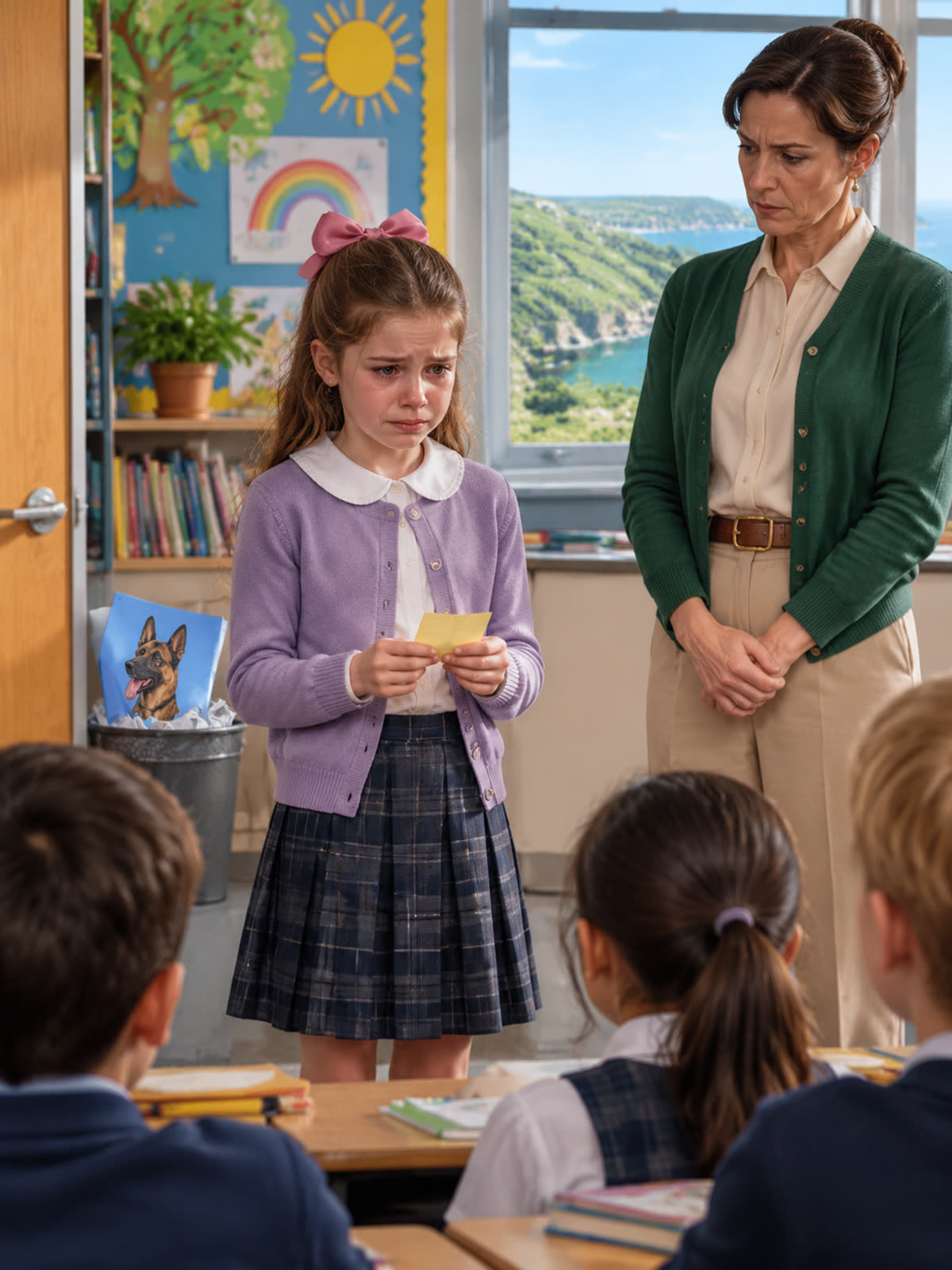
By 8:47 a.m., the blue folder was back in Ms. Vance’s hands. In front of Tessa’s twenty-two classmates, she carried it across Room 3B and let it fall into the wastebasket beside the door. It struck the pencil shavings with a soft, flat sound, among discarded worksheets and pieces of construction paper. Several children looked toward Tessa. No one laughed. Somehow, the silence made the humiliation harder to bear.
Ms. Vance wrote on a yellow sticky note and held it out. “Come up here, Tessa. Read this to the class.” Tessa did not rise immediately. “Come to the front.” With her face burning, she made her way past the desks. Her teacher handed her the note. “Read it.” Tessa lowered her eyes to the sentence written there: I am sorry I gave the class information I could not prove.
Her fingers shook around the yellow paper. For several seconds, she could not make herself speak, while Ms. Vance waited. Then she read the apology aloud, her voice trembling almost from beginning to end. It broke on prove, and the teacher required her to repeat it more loudly before returning to her seat. Tessa folded her hands on her desk and held back her tears, remembering her father’s rule about keeping her feet under her when everything inside wanted to collapse.
When the last bell sounded, Tessa stayed behind until the classroom emptied. Only then did she approach the wastebasket and lift out her folder. Its corners were bent, pencil marks stained the paper, and a dark smear crossed Duke’s picture. The red verdict still stood on the cover. Mr. Mensah, the custodian and a former Army dog handler, helped remove a wad of gum from the back and noticed the carefully drawn scar.
“Something that’s true doesn’t stop being true just because somebody put it in the trash,” he told her. Tessa gathered the damaged pages and held the folder against her chest on the way home. She had brought the report to school because she was proud of her father and Duke. Now she carried it as carefully as though keeping it close could protect what remained of that pride.
Megan understood immediately that something was wrong when she saw the folder. “What did she do?” Tessa tried to describe what had happened without crying. She managed the red writing and the wastebasket, but her voice broke when she reached the apology she had been forced to read before the class. Megan looked at the ruined project. Her first shock gave way to something quieter, firmer, and much angrier.
That evening, mother and daughter sat together at the kitchen table. Megan leaned her phone against the sugar jar, and at 8:02 p.m. they reached Garrett by video call. His face occasionally stopped moving on the screen, but he heard everything. Tessa held up the red writing, showed him the crushed folder, and finally explained the yellow note. For several seconds, her father did not answer. His expression went still, and his jaw tightened.
“Dad?” Tessa asked. “I’m here, sweetheart.” She looked at him through the uncertain connection. “She said I made it up.” Garrett turned away for a moment before facing the screen again. When he spoke, his voice remained calm. “You told the truth?” Tessa nodded. “Then you have nothing to apologize for.” He had heard about the wastebasket and the class, but he wanted his daughter to understand that neither had made her report untrue.
“The truth is enough,” he told Tessa softly. “Sometimes it just needs help getting through the door.” Garrett did not shout at the screen or threaten Ms. Vance. He did not telephone the school to demand her dismissal. Once the call ended, he took the matter to his commanding officers and explained what had happened. Then he went to his kennel master, Gunnery Sergeant Ray Thibodeaux, with a request that required unusual approval.
Garrett asked for an official early release and authorization to bring Duke to the school for a morning K-9 demonstration. Such arrangements were not ordinarily made at that notice. There were conversations and a review of the circumstances before an answer came. By 9:01 p.m., the request had been approved. The situation would not be answered with another ignored message. Garrett and his partner could go to Oceanside.
He called Megan again immediately. Tessa had already changed into her pajamas when she appeared on the screen. This time her father smiled. “Get some sleep.” She studied him. “Why?” Garrett gave her the reason without raising his voice or making any threat. “Because Duke and I have somewhere to be tomorrow morning.” For a moment, Tessa simply stared at him, trying to understand what he meant.
Then her eyes widened. “You’re coming home?” Garrett answered, “We’ll be in Oceanside before sunrise.” He drove three and a half hours through the desert night, arriving at 4:38 a.m. The journey brought the two subjects of Tessa’s disputed report back within reach of her school. The Marine she had interviewed and the dog she had drawn were no longer just names on pages her teacher had refused to believe.
At 7:05 a.m., already in uniform, Garrett called Principal Dr. Priya Sharma. She checked the school portal records and confirmed that Megan’s message had gone ignored. Ms. Vance, meanwhile, entered Room 3B believing the matter had been settled. Other children’s reports hung neatly on the wall. Tessa’s damaged folder was no longer lying on her desk. The lesson the teacher believed she had delivered appeared, to her, to be over.
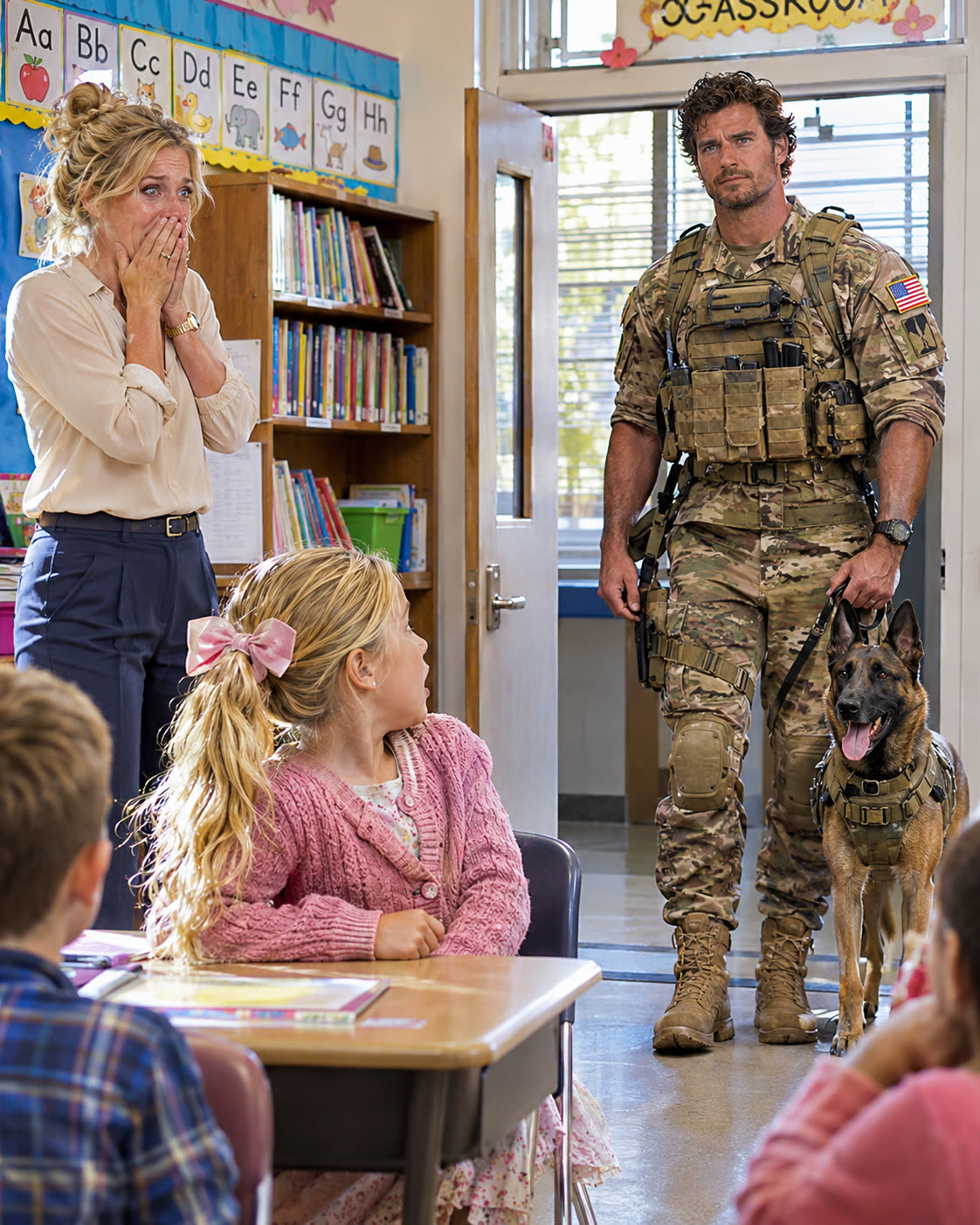
Shortly after the morning bell, the school secretary glanced through the glass entrance doors and stopped what she was doing. A Marine in uniform stood outside with a Belgian Malinois at his side. Above the dog’s right ear lay the same faint scar Tessa had worked so carefully to reproduce. Ms. Vance had demanded proof, and it had arrived at the front entrance. Now only a hallway stood between that proof and Room 3B.
PART 2: WHEN THE TRUTH ENTERED
Dr. Sharma met Garrett and Duke at the front office. Megan and Tessa were there, too, with the battered blue folder. Before proceeding, the principal examined the report. There was the drawing, with its pale mark above Duke’s right ear. Beside Garrett stood the real dog, bearing the matching scar. The details Ms. Vance had rejected could be checked simply by looking from the paper to the partner waiting at the Marine’s side.
The portal records told another part of the story. Megan had not refused to help verify her daughter’s assignment. She had offered documentation and a conversation with Garrett before the folder went into the trash. That opportunity had been overlooked. The principal now had both the school’s record of the message and the report itself, along with the father and dog whose existence had been questioned in front of Tessa’s classmates.
Together, Dr. Sharma, Megan, Tessa, Garrett, and Duke started down the corridor toward Room 3B. Tessa’s project was coming back to the classroom, but not as it had left. Its corners were still crushed, and the red writing had not disappeared. This time, however, she did not have to carry the truth by herself. Her mother was there, her father was beside her, and Duke walked with them.
Inside, Ms. Vance stood at the whiteboard. When she turned, she froze at the sight of the uniformed Marine and the Belgian Malinois beside him. Her dry-erase marker slipped out of her fingers and rolled beneath her desk. The father she had treated as an unproven claim was standing in her classroom. So was the dog whose military rank she had found too unlikely to accept.
Garrett did not enter with the anger Tessa had feared might follow her humiliation. His voice stayed level. “I’d like my daughter to finish her presentation,” Garrett said calmly. He was not asking Tessa to defend the apology she had read or repeat the embarrassment she had endured. He was asking that she be allowed to complete the assignment she had prepared: her report about her real-life heroes.
Tessa stood beside Duke and began reading. The same classroom that had watched her struggle through the sticky note now listened to her own work. She went through the report from beginning to end, using the information gathered during those difficult video calls. The military terms remained in it. So did the details her father had helped her spell and understand. She did not have to replace the truth with something easier to believe.
When the children recognized the scar above Duke’s ear, they gasped. Tessa’s drawing had shown it exactly where it belonged. What had been dismissed as part of an invented story was visible before them. Her careful work had mattered after all. The pale mark on the paper and the pale mark on the dog answered the doubt more clearly than another argument about the report ever could have.
Garrett also confirmed the detail that had helped make Ms. Vance suspicious: Duke technically outranked him. The class cheered. Tessa’s capital-letter discovery had not been a childish exaggeration. Her father could explain it himself, with his partner sitting beside him. The children were finally seeing why she had been so eager to choose the pair for her assignment, and why she had spent so much time making the report accurate.
After the presentation came the authorized demonstration. Garrett showed the class how Duke worked, including the passive alert Tessa had learned about during her interviews. A hidden training scent waited in Xavier’s backpack. The demonstration gave the children a chance to see a piece of the work behind Tessa’s vocabulary. Those unfamiliar words were no longer merely terms written in a third-grader’s folder; they described something happening in their classroom.
Duke found the scent in eight seconds. He did not bark. He gave the passive alert Tessa had described, locating the hidden training scent while the class watched. Afterward, each child had an opportunity to greet him politely. The dog from Tessa’s carefully shaded drawing was there among them, calm enough to meet the children and skilled enough to show exactly why Garrett trusted him as his working partner.
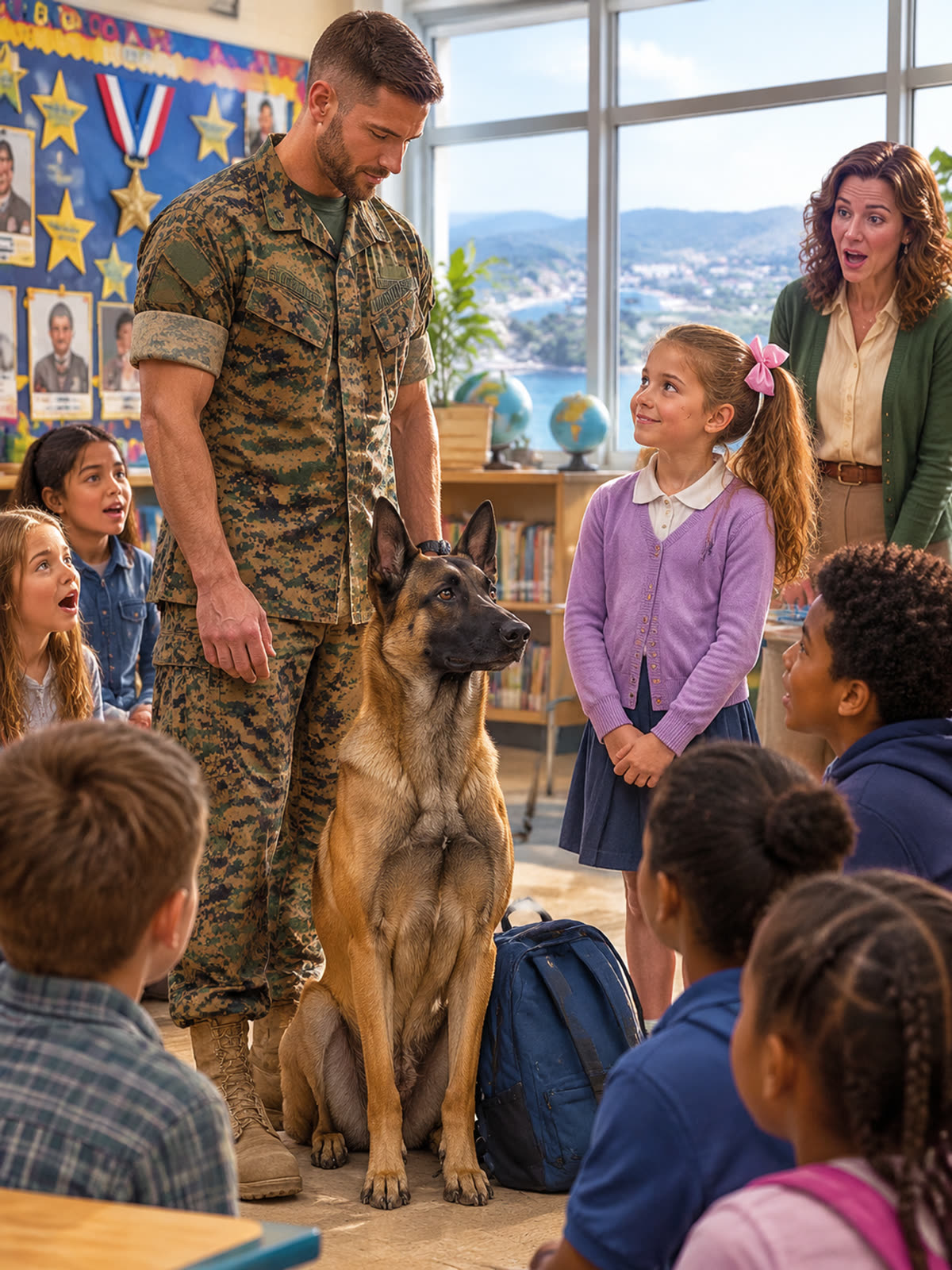
At the end of the lesson, Ms. Vance knelt before Tessa so their eyes were level. Tears stood in the teacher’s eyes as she apologized in front of the same classmates who had witnessed the accusation. She acknowledged that she should have believed her. Tessa handed the yellow sticky note back. Ms. Vance closed her hand around it, crumpling the paper that had carried the apology Tessa never should have been required to make.
Then the teacher picked up a green pen. Beneath NOT VERIFIED, she wrote: VERIFIED IN PERSON by Staff Sergeant Garrett Hayes and MWD Duke. Everything in this report is true. The red words stayed on the page, but they no longer stood alone. Ms. Vance took the blue folder to the Hero Wall and pinned it in the center, where it belonged among the other children’s work.
Later, in Dr. Sharma’s office, the teacher explained through tears why she had reacted as she had. As a child, she had believed her own father’s claims that he was a decorated war veteran. Those stories had been lies. The discovery had left her afraid of accounts that seemed too extraordinary to trust. Tessa’s report had met that old fear, and Ms. Vance had judged before taking the trouble to verify.
Garrett responded with quiet grace. Her explanation did not change what had happened to Tessa, but he did not answer it with cruelty. He reminded Ms. Vance that children deserve adults who look before passing judgment. His daughter had supplied notes. Megan had offered records. There had been ways to ask questions without accusing a child, discarding her work, or making her apologize publicly for information that was true.
Ms. Vance was reassigned to a district curriculum position. The next Monday, Room 3B felt different before lessons even began. Dr. Sharma stood at the front beside a tall, lively young man whose bright yellow bow tie carried tiny smiling suns. “Good morning, third graders,” Dr. Sharma said warmly. “For the remainder of the semester, Mr. Mercer will be your teacher while Ms. Vance transitions to a new position at the district office.”
The children whispered excitedly, but Tessa remained quiet with her hands folded on her desk. Over the weekend, Megan had offered to move her to another third-grade classroom, somewhere the children had not seen the wastebasket or heard the yellow note. Tessa had considered it during Sunday pancakes and decided against leaving. “My Hero Wall is in 3B,” she had told her parents simply. “And Mateo is in 3B. I want to stay.”
Mr. Mercer soon proved very different from the teacher he replaced. Instead of glasses hanging from a chain, he carried three differently colored whiteboard markers behind his ear. When he dropped his clipboard during roll call, he laughed easily. During silent reading, he paused beside the Hero Wall and gave a low whistle at Tessa’s folder. Its bent corners and red-and-green lettering were still plainly visible in the middle of the display.
A little later, he stopped at her desk. “So you’re the famous Tessa Hayes,” Mr. Mercer said quietly. “I heard MWD Duke visited on Friday. Tell me honestly—did he really find the scent in Xavier’s backpack in under ten seconds?” For the first time since Thursday, Tessa’s shoulders relaxed. “Eight seconds,” she corrected seriously. “And he didn’t even bark. Just a passive alert.”
“Impressive,” Mr. Mercer grinned. “If you ever want to present that report again, just say the word.” Tessa answered with her usual politeness. “Thank you,” Tessa replied politely, “but everybody already saw the real thing.” She did not need another presentation to prove that her father and Duke were real. Her classmates had watched them, listened to them, and seen the report confirmed in person.
For the remainder of spring, the blue folder stayed at the center of the bulletin board, surrounded by its gold-star border. Fourth- and fifth-graders sometimes looked through the doorway window during passing periods to glimpse the picture of Duke and his pale scar. No one whispered again that Tessa invented stories. The project that had been excluded from the wall had become the one children from other classrooms hoped to see.
Three weeks later, on a warm Friday afternoon, Tessa returned home and checked the mailbox by the porch. Between grocery advertisements and utility bills, she discovered a clean white envelope with careful cursive across the front: Miss Tessa Hayes. She stared at Miss. No one had ever addressed mail to her that way. This envelope was not another school assignment or a notice for her parents. It belonged to her.
At the kitchen table, Megan sliced strawberries while Garrett, home from Camp Pendleton on a weekend pass, poured iced tea. Tessa slipped a finger beneath the flap and drew out one sheet of lined stationery. She unfolded it carefully. Ms. Vance had already apologized before the class, and the school had already made its decision. Yet the letter in Tessa’s hands began by telling her that the apology had not been complete.
PART 3: THE FOLDER THAT KEPT THE TRUTH
Dear Tessa,
I know I already apologized to you in front of your class, and Dr. Sharma has ensured I will not be returning to Palm Crest Elementary. Still, I have thought about you every single day since that morning, and I realized my apology was incomplete.
When I was a little girl, someone I loved very much told big, exciting stories that turned out not to be true. When the truth came out, I was deeply embarrassed, and I grew up believing that extraordinary stories were always tricks meant to fool people. That fear made me close my eyes when I should have kept them open.
You taught me something I should have learned decades ago: truth isn’t measured by how believable it sounds to an adult—it’s measured by having the courage to look closely and listen.
I hope you never stop writing, Tessa, and I hope you never let anyone make you apologize for telling the truth. Standing beside your father and Duke that morning, you showed more grace and strength than most adults ever will.
With sincere respect, Barbara Vance
P.S. Please give my regards to MWD Duke. I am told he outranks us all.
Without speaking, Tessa read the letter a second time, then passed it to Garrett. He worked through it slowly, his brow creased, before placing the page beside his glass. “How does reading that make you feel, bug?” Garrett asked gently. Tessa supported her chin in her hands and considered the question. The letter had given her something more to think about than whether Ms. Vance was sorry.
“I think Ms. Vance was scared,” she said finally. “Just like I was scared when I had to read that yellow note. Being scared made me say something that wasn’t true. Being scared made her throw my folder away.” She lifted her eyes to her parents. “I don’t think being scared is bad, Dad. I just think it’s bad when you let it make you mean to somebody else.”
Megan and Garrett looked at one another across the table. Neither could immediately find anything to say. Finally, Garrett cleared his throat. “Well,” Garrett said softly, clearing his throat, “I’d say you’re already wiser than half the folks in my battalion.” Tessa placed the letter in the back pocket of her blue folder. The teacher’s explanation would stay with the project, alongside the evidence of what had happened and the words that had corrected it.
When the school year ended, Mr. Mercer removed the Hero Wall and returned the assignments. Tessa’s folder came home with four small pinholes in its corners. Megan offered to print a clean cover so the smudges and red lettering would be gone, but Tessa would not agree. “No, Mom,” she said, smoothing the wrinkled corner. “If we fix it, it won’t be the real story anymore.” She kept it safely in her dresser drawer.
Over the next two years, Tessa grew taller, replaced her pink sneakers with worn canvas high-tops, and entered fifth grade. Garrett and Duke stayed together through deployments, field exercises, and the family’s many weekend visits to the base kennels. Then, on an autumn Tuesday, Duke reached seven. Years of clearing walls, jumping from helicopters, and searching rocky desert trails had begun to leave his hips stiff.
During his final annual certification, Duke located every hidden training device on the course with the same exactness that had defined his work. When he finished, he went to a patch of shade under a eucalyptus tree, lay down with a heavy sigh, and slept for three uninterrupted hours. Gunnery Sergeant Thibodeaux watched him resting. “He’s given the Marine Corps his best years, Hayes,” Gunnery Sergeant Thibodeaux said later that afternoon, watching Duke rest his chin on his paws. “Time to let him retire and just be a dog.”
Handlers had the first opportunity to adopt their retiring military working partners, under a policy veterans had fought to secure. Garrett did not hesitate. Duke had served beside him for years; now the family could give him a home beyond his working life. The dog Tessa had once presented as her father’s partner would become part of their household, no longer waiting for the next exercise or assignment.
On a crisp afternoon in October, Tessa waited on the front porch steps with her backpack beside her and a new red tennis ball held tightly in her hands. She had been there since getting home from the school bus. When Garrett’s pickup entered the driveway, she watched him lower the tailgate and open the kennel crate. Duke stepped onto the truck bed, then hopped down. Silver edged his muzzle, and he moved more slowly, but his ears remained straight and attentive.
Now ten, Tessa came down the steps and knelt on the driveway. She held her hand low and flat, the way she had learned when she was five. “Hi, Duke,” she whispered, her voice thick with excitement. “Can I pet you?” Her father leaned against the truck fender and chuckled. “He’s off duty forever now, Tessa-bug. He’s a civilian. You don’t have to ask anymore.”
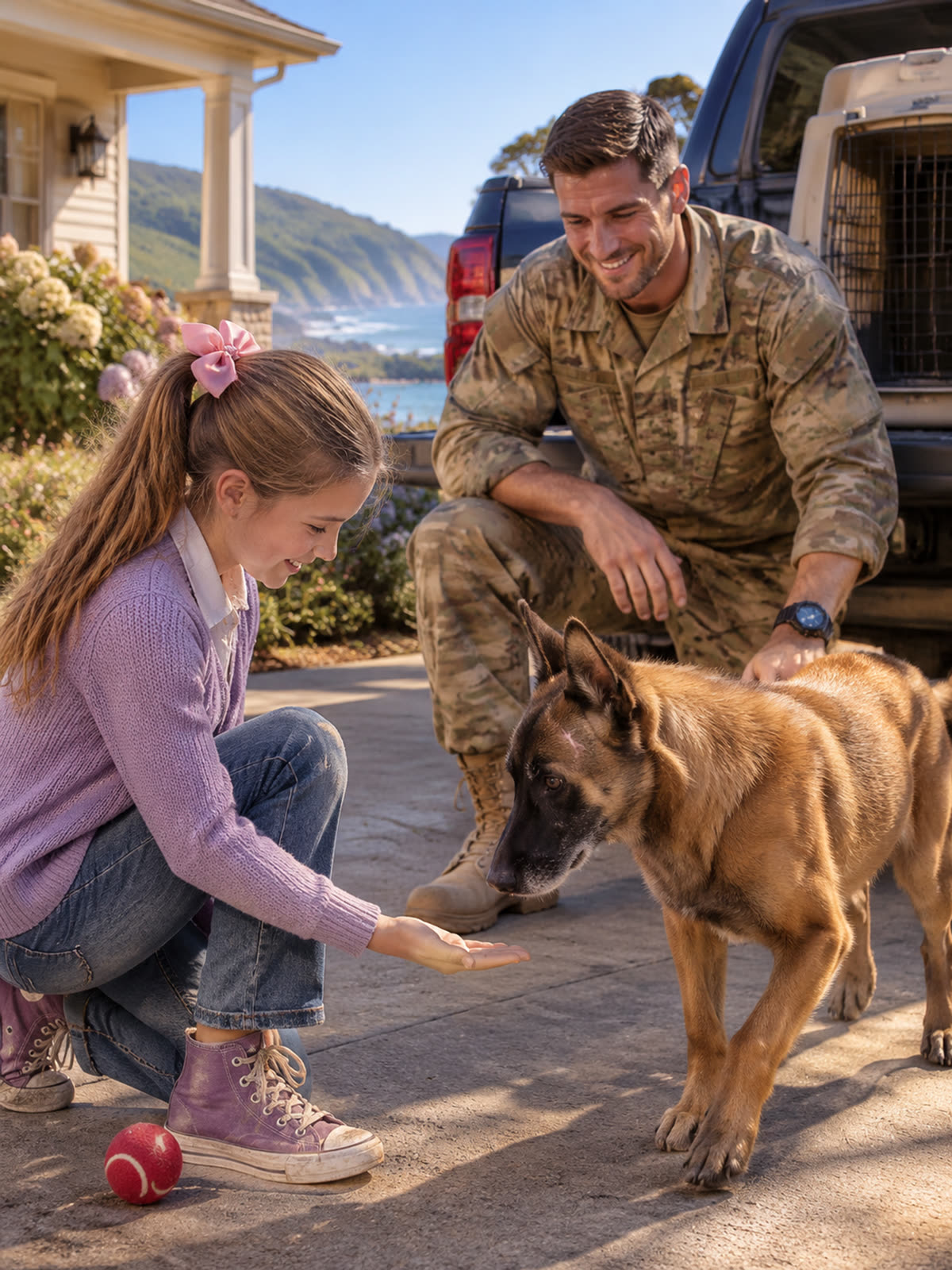
Tessa looked up at Garrett and then back at the Belgian Malinois waiting before her. “I’m still going to ask,” she said softly. “He earned it.” Duke leaned toward her open palm, sniffed it with his familiar solemnity, and slipped his warm head beneath her hand. Her fingers met the place above his right ear where the pale scar still showed—the same small mark she had refused to leave out of her drawing.
That evening, the family celebrated with spaghetti, while Duke received steak scraps. After dinner, he spent twenty minutes checking the house, looking through the hallways and closets before choosing the braided rug beside Tessa’s bed. It became his new post. There was no classroom watching him now and no report waiting to be verified. He could settle beside the girl who had known all along who he was.
Later, Garrett passed Tessa’s bedroom and noticed a strip of warm light reaching into the hall. He quietly opened the door. Tessa sat cross-legged on the rug beside Duke with her old Hero folder open across her lap. The report had come out of the dresser again. Its cover still held both colors of ink, the red accusation and the green confirmation, neither erased to make the other easier to look at.
Garrett entered and lowered himself to the floor beside his daughter. Duke briefly raised his head, gave a small grunt of approval, and set his muzzle across Garrett’s boot. The working partnership had not disappeared with retirement. It was simply resting somewhere different now, between a father and daughter on a bedroom rug, with the dog free to remain there for the night.
Tessa moved a fingertip along the cover, in the space between the faded NOT VERIFIED and VERIFIED IN PERSON. “Do you ever think about that day in third grade, Dad?” she asked quietly. Garrett did not pretend he had forgotten. “Every now and then,” Garrett admitted. “What about you?” She leaned her head against his shoulder before answering, the folder still open in front of them.
“Sometimes,” Tessa said, leaning her head against his shoulder. “I used to wish she hadn’t written the red part. Now I’m glad she did. Because if she hadn’t, you wouldn’t have driven all night through the desert, and Mr. Mensah wouldn’t have helped me clean my folder, and nobody would have seen how awesome Duke really is.”
Garrett put an arm around her and looked at Duke, whose silver-edged muzzle rested peacefully between them. Tessa had not forgotten the humiliation. The folder made certain that part remained visible. But she could also see the people who had stood with her afterward: the custodian who helped clean the damage, the mother who listened, and the father who brought his partner through the school doors.
“You know what I told you back then about the hardest part of my job?” Garrett asked softly. “Trusting my partner even when I couldn’t see what he saw?” Tessa remembered. “Yeah,” Tessa smiled. “And believing.” Garrett kissed the top of her head. “That’s right,” Garrett murmured, kissing the top of her head. “And you taught an entire classroom—and one very stubborn teacher—what happens when someone refuses to back down from the truth.”
Duke released a long, satisfied sigh between them. It was a slow, unhurried breath, like a soldier finally able to rest after the march was over. The years had changed the color around his muzzle and the ease of his movements, but the scar above his ear remained. So did the place he held in Tessa’s story, from the carefully shaded drawing to the real dog lying beside her.
Tessa closed the folder and returned it to the top dresser drawer. Ms. Vance’s letter remained tucked inside. The corners were still creased, the cover still marked, and the pinholes still recorded its place on the Hero Wall. Nothing had been replaced with a cleaner version. Then Tessa stretched out on the rug beside the dog who still outranked her father and rested her hand gently above his right ear.
Both of them drifted to sleep, Duke finally home for good. Inside the drawer, the red words remained beneath the green, preserving the moment the story could have ended in a wastebasket—and the moment it had changed instead. To open that folder was still to stand outside Room 3B, just before Ms. Vance turned from the whiteboard, with Garrett and Duke at the door and the truth about to walk in.
Disclaimer: This story is a work of fiction inspired by real-life themes. Names, characters, places and events are fictionalized, and any resemblance to real persons is purely coincidental. It does not represent any person or organization and does not encourage inappropriate behavior. Images are for illustration purposes only.
