


PART 1 — THE PASSPORT THEY THOUGHT WOULD KEEP ME PRISONER
“Your husband reported his credit card stolen three hours ago, Mrs. Whitaker. Unless you can settle the $27,600 balance immediately, I will have to contact the Tokyo police.” The manager delivered the warning from the entrance to my presidential suite. Two security guards stood beside him, obstructing the way out. Barefoot and wrapped in a silk robe, I held the handwritten message that had brought my five-year marriage to an end. You’re on your own now. Below it were eight more words, unmistakably written by my mother-in-law. Let’s see how far your intelligence gets you. My name is Maren Whitaker. I was thirty-five, and until that morning, I had considered my husband selfish and his mother overbearing. It had never occurred to me that they were criminals.
“Mrs. Whitaker?” the manager repeated. “I need an answer.” I looked up from the note. “First, tell me whether a man named Graham Sloane and a woman named Blythe Sloane checked out this morning.” He answered without hesitation. “They departed at approximately four fifteen.” “With six suitcases?” “Yes.” “And did either of them mention that I was still sleeping?” The manager maintained his formal expression. “Your husband informed our staff that you had made separate travel arrangements.” That was a remarkable description of stealing my passport, telephone, payment cards, and emergency money before leaving me stranded on the opposite side of the Pacific. “Please come inside,” I said. “Madam, this is a serious financial matter.” “Then you’ll want to hear what I’m about to tell you.”
He followed me into the sitting area, where I indicated the open safe. “My passport was in there last night. So was my emergency cash. Both are missing.” Then I showed him the empty compartment inside my handbag. “My phone and every payment card I brought to Japan are gone.” He studied me. “Are you suggesting your husband robbed you?” “I’m telling you he did.” He opened the leather portfolio he was carrying. “Regardless of your domestic circumstances, the outstanding account must be addressed.” “You think I’m refusing to pay?” “I am explaining our position.” “Then explain why you’re standing in the doorway threatening a woman whose identification has just been stolen.” “Mrs. Whitaker—” “Call the police,” I interrupted. “In fact, I insist.”
I turned toward the desk telephone rather than waiting for his response. “Before you do, I need to make two calls.” “To whom?” “The American embassy. And my attorney.” Yet another discovery followed when I asked the hotel’s reservations staff to verify my flight home. “Mrs. Whitaker, your reservation for the New York flight was canceled at three twelve this morning.” “Canceled by whom?” “The booking was modified through the original purchasing account.” “Was the refund issued?” “Yes, ma’am.” “Where?” “To the payment method belonging to Mr. Graham Sloane.” My husband had done more than walk away from me in a foreign country. He had deliberately removed the means by which I was supposed to leave it.
Just three weeks before, Graham had been enthusiastic about planning the vacation. “Tokyo will be our fresh start,” he’d promised, kissing my forehead. “No business calls. No lawyers. Just us.” Then his mother announced that she would accompany us. Over the course of our marriage, Blythe had treated me as an unfortunate attachment to her distinguished son. My profession was “number crunching,” and the company I had built was “that little software project.” She regularly implied that Graham ought to have married someone who understood what joining an old-money family required. I tolerated her because I loved him. Now, standing in a Tokyo suite with my belongings missing, I could finally recognize what their pleasant behavior had concealed.
The expensive dinners, outings, affectionate promises, and even Blythe’s unexpected friendliness had been part of a performance. I remembered the documents Graham had brought me before we left New York, and my stomach tightened. He had described them as routine acquisition papers. I had declined to sign anything before my attorneys finished reviewing it. He had responded with a kiss, a smile, and a suggestion that we deal with it once we got home. But he had never intended for me to reach home before Monday. My software company’s $418 million acquisition was scheduled to close that day. The missing passport, the canceled reservation, and the empty handbag suddenly belonged to the same plan. They were trying to take my company.
“I need privacy for my calls. Your security officers can remain outside.” The manager began another objection. “Mrs. Whitaker, we cannot simply—” “Then stay,” I said. “But understand that this conversation may become evidence.” I dialed an international number I had memorized years earlier. After four rings, a woman answered. “Ellery Legal Group. Emergency response.” “This is Maren Whitaker. I need Tessa Ellery.” “May I ask what this concerns?” “Tell her Blue Lantern has been activated.” Her manner changed immediately. “One moment, please.” In fewer than twenty seconds, my attorney was on the line. “Maren? What happened?” Hearing someone who knew me, rather than another person questioning whether I would pay a bill, gave the morning a different shape.
“My husband stole my passport in Tokyo. He canceled my flight home, took my phone, and reported our hotel payment card stolen.” Tessa’s first concern was not the acquisition. “Are you physically safe?” “For the moment.” “Where’s Graham?” “On his way to New York.” “Does he know you have access to the emergency instructions?” “No.” “Good. Don’t tell him.” Then she asked a question that made the missing belongings seem like only the beginning. “Maren, have you seen the acquisition documents Graham submitted to the buyer’s legal team last night?” “What documents?” Her response was measured. “Maren,” she replied, “someone has submitted a notarized power of attorney bearing your signature.” “I never signed one.” “I know.” “Who submitted it?” “Your husband.”
Tessa lowered her voice. “He’s claiming you’re mentally incapacitated and have permanently surrendered control of your founder shares.” They had taken my passport so that I could not return, and they had forged my identity so they could take my assets. Somewhere above the Pacific, Graham was probably congratulating himself. He and Blythe had forgotten something fundamental about the woman they had left behind: I had devoted twelve years to uncovering financial falsehoods that other people assumed would stay hidden. “Maren, listen carefully,” Tessa said. “The acquisition attorneys are demanding confirmation that you’re unavailable. Graham’s already supplied a supposed medical statement from a private clinic in Tokyo.” “A medical statement?” “According to the document, you suffered an acute psychiatric crisis and require supervised treatment.”
They were manufacturing a reason for everyone to doubt anything I said. “Is the clinic real?” “We’re checking. But here’s what matters. You need to report the passport theft, preserve everything in that room, and get your identity verified through the embassy. I’ll begin emergency court proceedings here.” “Can you stop Monday’s closing?” “Yes, if we move fast enough and establish that the signature is fraudulent.” The fraudulent documents exposed a side of my husband that our five years together had never forced me to confront. “There’s something else,” I said. “I think Graham and Blythe may have been planning this longer than we realized.” “Why?” “Because Graham asked to see the original shareholder records before Tokyo. And Blythe suddenly became interested in our corporate insurance.”
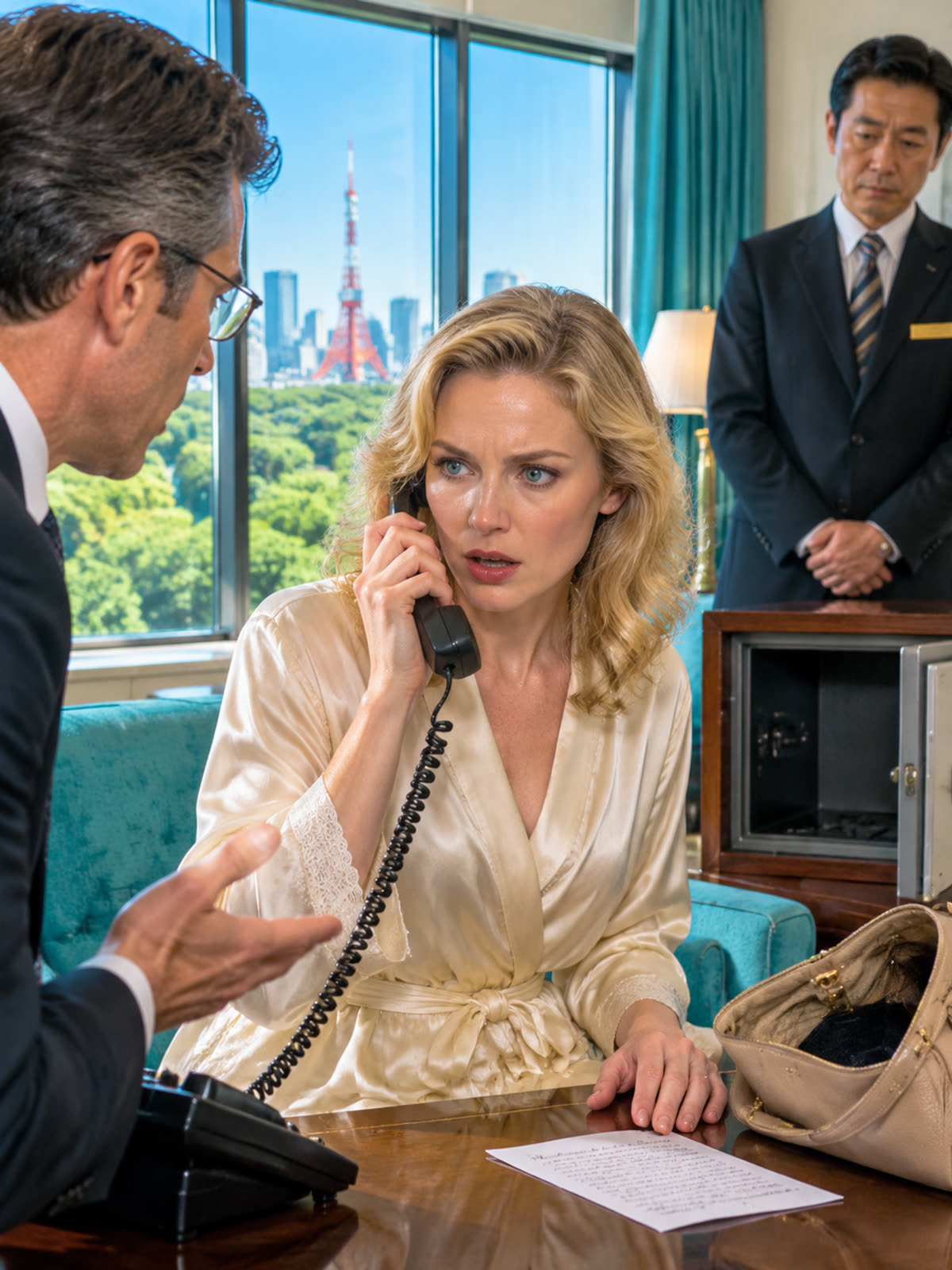
“Don’t discuss that with anyone else yet. We’ll investigate through the proper channels.” After speaking with Tessa, I turned back to the manager. “My attorney is arranging payment from an account that my husband cannot access. I also need your assistance with a criminal report.” His response was considerably more accommodating. “We certainly wish to assist you, madam.” “Then preserve the lobby and elevator recordings from three until five this morning. And please give me the contact information for your hotel’s legal department.” Within fifteen minutes, English-speaking members of the hotel staff were helping me reach Japanese police and the U.S. embassy. The outstanding $27,600 was paid. What had seemed like an immediate catastrophe at my doorway had become the least consequential problem I faced.
For years, Graham had appropriated credit for what I accomplished. When we met, I was twenty-nine and working out of an office above a café. I had created a system capable of identifying suspicious transactions buried in complex corporate accounting networks. Its original purpose had been to serve a regional auditing firm. By the time I was thirty-two, my venture-backed business employed twenty people, and its technology generated licensing opportunities worth millions. I called it VerityGrid. Graham entered my life while the company was expanding. He was a sophisticated, charming corporate-development consultant who appeared successful. He knew which restaurants to choose, remembered birthdays, and could make an audience out of a room full of strangers. I fell in love with the man who brought dinner while I worked late writing code.
Six months before our wedding, Blythe insisted on a prenuptial agreement. “The Sloane family’s assets must remain separate,” she declared. What neither of them sufficiently considered were the matching protections my attorneys insisted upon. My stock, VerityGrid itself, and its intellectual property remained my separate legal assets. Graham held an advisory position in the business; he had no ownership. That distinction irritated him throughout our marriage. He wanted to be chairman, wanted his own office, and wanted acknowledgment as the man who had “transformed Maren’s technical brilliance into a business.” I agreed to the office but not the title. That refusal remained a source of resentment, even as he continued presenting himself as essential to achievements that had begun before I knew him.
During acquisition discussions, he frequently interrupted me with corrections. “What Maren means,” he’d say, interrupting. Sometimes it was, “Let me explain the commercial side.” At home, his mother reinforced the same message. “A brilliant woman still needs a man who can manage the world around her.” Eventually, exhaustion made me stop resisting every slight. They had mistaken that exhaustion for surrender, and now they were staking $418 million on the assumption that I would remain compliant. That afternoon, with an interpreter assisting, I made my statement to Japanese police. I provided the notes they had left, showed the emptied sections of my bag, and supplied the confirmation that my flight had been canceled. The hotel gave investigators the relevant security recordings from that morning.
A consular official explained the process for obtaining a replacement passport. Verifying my identity took time, even though my attorneys had forwarded identification copies and supporting documentation. By evening, emergency travel documents were in progress. Meanwhile, the supposed power of attorney had given us a particularly useful inconsistency. It was dated two days before our departure for Tokyo and carried the name of a New York notary. On that date, I had been attending a conference in California with more than three hundred other people. “That’s excellent evidence,” Tessa told me. Someone willing to fabricate a notarization might also be willing to fabricate the instructions accompanying it. Graham’s proposed directions for the acquisition sent the proceeds from my founder shares to an entity I had never heard of.
Its name was Ashbourne Strategic Holdings. “Who owns that company?” I asked. “We’re tracing it.” “Does it have anything to do with Blythe?” “We believe so.” Millions of people were returning to their families that evening, with no knowledge of the day I had just endured. My own family had arranged it. “Find the ownership records,” I told her. “We’re working on them.” “And Tessa?” “Yes?” “Don’t warn Graham.” I wanted him to have no reason to alter his plans before we understood them. “Not yet,” I continued. “Let him believe I’m still trapped.” For the moment, his confidence was more useful to me than his fear would have been. He thought I had no resources beyond the ones he had stolen.
That night, I moved into a smaller suite reserved by my legal team. What remained of my possessions had been recorded and secured. For the first time in years, no one criticized what I wore to dinner. Nobody supervised my telephone calls or delivered a lecture about the privilege of marrying into the Sloane family. I was alone at last. The silence was different from the isolation Graham had planned for me. He had meant to leave me without options; instead, I was acting without his interference. At six the following morning, Tessa called with the development I had been waiting for. “Your travel documents are ready. I’ve booked you on the earliest suitable flight through Newark.”
“Will I arrive before Monday?” I asked. “Yes.” I would have a chance to reach the acquisition before Graham completed whatever he had prepared. But Tessa was not finished. “Maren, there’s one more thing. We identified Ashbourne Strategic Holdings.” “Who owns it?” “Not Graham.” For a moment, the answer made the scheme feel even larger than the one I had already uncovered. “Then who?” “His mother.” The instructions did not merely place Graham between me and the company I had built. They directed the entire $418 million to Blythe’s holding company, an arrangement my board had never authorized. My husband had stranded me in Tokyo, but his mother was waiting at the other end to receive everything.
PART 2 — THE CELEBRATION BUILT ON MY DISAPPEARANCE
The first account of Graham’s panic reached me through his brother-in-law. Drew Calder had been married to Graham’s younger sister, Lena, for seven years. At forty, he was broad-shouldered and reserved, with no interest in the wealth or luxuries that consumed the Sloanes. He operated a nonprofit youth center in Mount Vernon, New York, where teenagers could find meals, tutoring, and somewhere safe to spend the hours after school. Blythe loathed him. At benefit dinners, she introduced him as “our family’s wonderful little community project,” laughing as though belittling him were entertainment. Drew endured it because her charitable organization owned the building his center occupied. She also controlled the funding that paid for three full-time employees. Standing up to her could hurt the children who depended on him.
A delayed connection kept Graham and Blythe from reaching New York until late Saturday. Their first problem arose at JFK, when Graham attempted to arrange an expensive vehicle and discovered that his corporate card no longer worked. The transaction was declined. After Tessa’s urgent warning about possible fraud in the acquisition, the finance department had suspended his company spending privileges. He called our chief financial officer, then tried calling me. But the telephone he had stolen was identified in my Japanese police report, and its service had been suspended. His next attempt was the Tokyo hotel. The details of that conversation eventually became one of my favorite parts of the entire ordeal. For once, Graham was the person being denied information he believed belonged to him.
The hotel manager refused to reveal where I was staying. He also explained that the complaint about my missing belongings was now connected to a police investigation. Graham demanded to know whether the account had been paid. The manager confirmed that the balance was settled. “With whose money?” Graham shouted. “I’m not authorized to disclose another guest’s financial arrangements, sir.” “She’s my wife!” “Then perhaps you should speak with her directly.” At last, Graham understood that I had found a way out without calling him for help. At his mother’s Bedford mansion, Blythe was no happier. On Sunday afternoon, Drew came by to collect materials for a charity event and heard them arguing in the drawing room.
“She must have found someone to lend her money,” Blythe snapped. “That doesn’t explain the company’s lawyers,” Graham replied. “Then call the board.” “I did! Nobody will give me a straight answer!” His mother still believed the passport had settled the matter. “The woman is sitting somewhere in Tokyo without a passport. She can’t get to New York in time. That’s the whole point.” Graham added, “You should’ve seen her handbag after we emptied it. She didn’t have enough cash left to buy breakfast.” Drew could no longer remain outside the conversation. “What did you do to Maren?” Graham dismissed him. “Private family business, Drew.” “You stole her passport?” “Don’t be dramatic.” “You left her stranded in Japan?” “She’s not a child. She’ll figure something out.”
“She’s your wife.” Graham answered with the resentment he had spent years concealing beneath helpfulness. “And she has spent five years treating me like an employee in a company I helped build!” “That company existed before you met her.” “You have no idea what you’re talking about.” “I know enough to call the police.” Blythe then redirected the threat. “Then perhaps we should discuss the lease on your youth center.” She made certain he understood what she meant. “Funding renewals are coming up. I’d hate for your little organization to discover how difficult life becomes without the Sloane family’s generosity.” Drew later told me that this frightened him more than any threat against himself. She was using the eighty-three children who attended each week as leverage.
Drew left without arguing further. But instead of allowing Blythe to silence him, he called Lena. His wife finally admitted that she had lived in fear of her mother since childhood. She also knew about the acquisition plot. She had watched Graham practice forging my signature. Drew could no longer regard them as merely cruel, unpleasant relatives with too much money. By the time I reached Newark, the scheme was revealing consequences beyond my marriage. Tessa met me at the airport with a driver and a replacement phone, then handed me a file. “We have a serious complication.” “Another one?” “Your mother-in-law’s holding company has financial connections to several entities associated with your husband’s family manufacturing business.” I climbed into the waiting vehicle.
“What kind of connections?” I asked. “Transfers from a trust involved in employee retirement benefits.” “How much?” “At least thirty-one million dollars is under review.” I remembered an elderly man named Russell Pike challenging Blythe at a family dinner two years earlier. Retired factory employees needed pension statements that had not arrived, and he wanted answers. Blythe had brushed him aside as confused. Later, she described him to me as an embarrassment. “Tessa, that money belongs to retired workers.” “I know.” “Does anyone else know?” “The Department of Labor has been investigating irregularities in the plan for months. An independent benefits administrator raised concerns. Our preliminary findings may connect those irregularities to Ashbourne.”
For years, Blythe had boasted about her charitable work. She supported museums, purchased places at benefit dinners, and smiled for photographs while speaking contemptuously about working people. Now investigators suspected that retirement money had helped pay for her luxurious life. “Tell the investigators everything we can lawfully document,” I said. “They’re already expecting our materials.” “And Graham?” “There’s a reception tonight at his mother’s estate.” “A reception?” “For selected investors and prospective acquisition partners.” “What are they celebrating?” “The transition of leadership.” “Whose leadership?” Their party was intended to announce that I could no longer run the business I had created. They expected guests to applaud Graham for coming to my rescue. After five years of allowing them to define me, I decided their control would end that night.
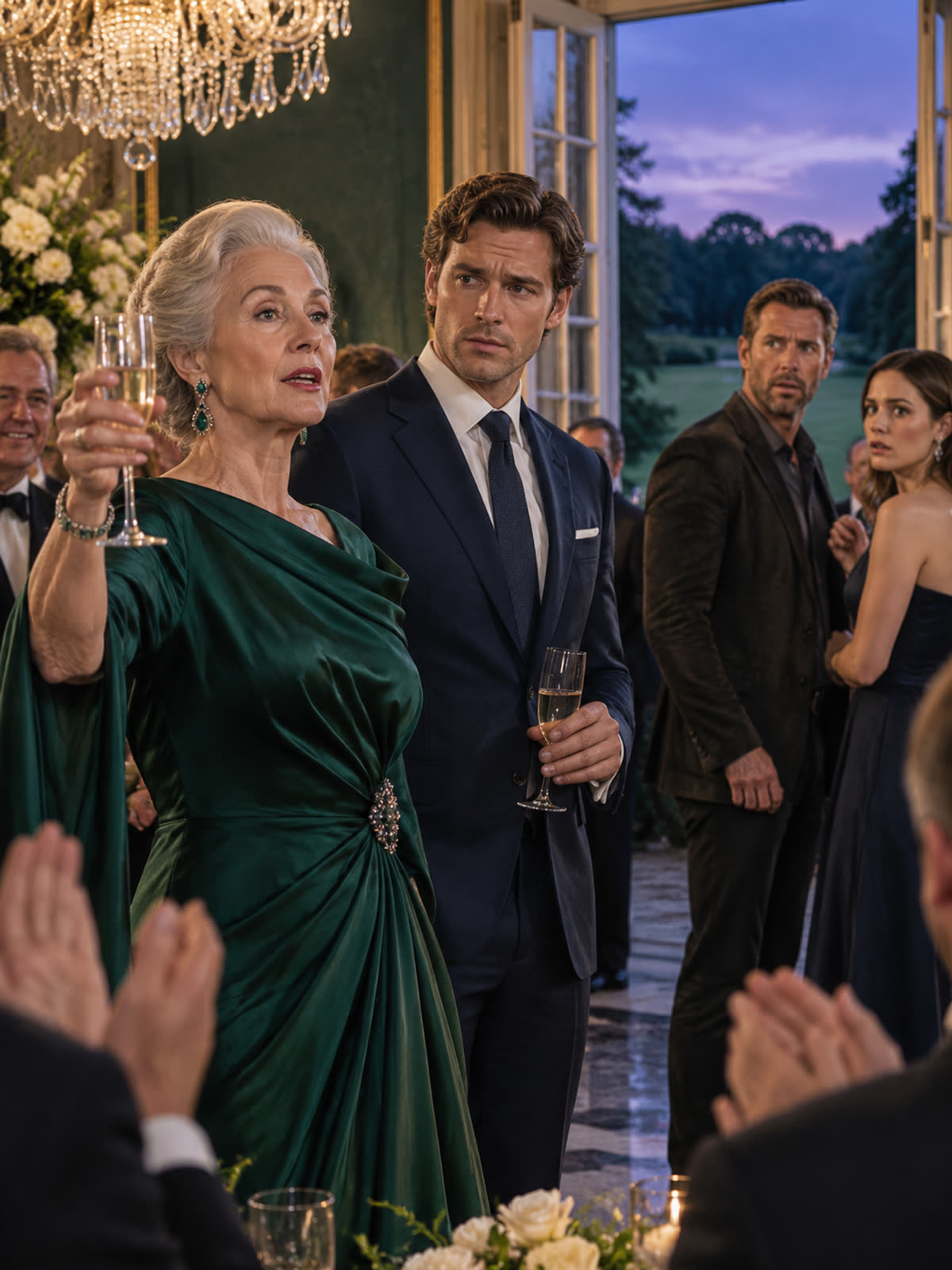
By eight on Sunday evening, Blythe’s estate looked ready to host a billionaire’s wedding. Chandeliers illuminated the marble entrance hall, a string quartet performed near the stairs, and servers offered champagne to people wearing jewelry worth more than ordinary homes. I was not there. I was in a small conference room near Bryant Park with Tessa, two corporate litigators, and our forensic accounting consultant, assembling materials for an emergency hearing. At 8:17, my new telephone vibrated with Drew’s message: She’s about to make the announcement. He and Lena were inside the mansion. Everything that followed reached me through his messages, his later account, and a recording of Blythe’s public toast. She stood beneath a chandelier in an emerald evening gown, with Graham beside her looking as solemn as a grieving husband.
“Thank you, everyone. Tonight is bittersweet for our family.” Blythe began describing the crisis she and her son had invented. “As many of you know, my daughter-in-law has been struggling under tremendous professional pressure.” Then she gave their guests the lie she wanted repeated. “Unfortunately, during our recent trip to Japan, Maren experienced a serious mental health crisis.” People gasped. “We are ensuring she receives appropriate care overseas. In the meantime, my son has agreed to assume responsibility for the company.” Graham accepted his role. “I’m doing this for Maren,” he replied. “And for the employees and investors who depend on VerityGrid.” The audience gave him a standing ovation. An attempted theft had been presented as an act of devotion, and the room had rewarded him for it.
Lena joined Drew in the corridor. “We can’t let them do this,” she whispered. “Then help me stop it.” “My mother will destroy us.” “Your mother is already destroying people.” Lena knew where they might find more evidence. “Graham keeps a folder in his study. I saw him putting documents inside it before they left for Tokyo.” “What documents?” “I don’t know. But one of them had Maren’s name across the top.” They went into the study together. Graham had previously given Lena the entry code so that she could collect business correspondence while he was away. In a desk drawer, they found a thick file containing the forged power of attorney. Behind it lay something that made the intended takeover even more disturbing.
The document was titled Proposed Medical Guardianship Petition. My signature had been reproduced on an attached declaration, and a physician’s name appeared below a purported medical report. A separate page ordered that the proceeds from my equity go to Ashbourne Strategic Holdings. Graham had not stopped at planning to steal the company. If the power of attorney failed, he intended to seek legal authority over my personal affairs. Drew photographed the pages. Among them was an email dated three weeks earlier: Once she’s isolated in Tokyo, keep all communications directed through you. The clinic statement should support the incapacity narrative. We need the board to believe intervention is necessary before Monday. The timing left no room to pretend this had been an impulsive decision made during our trip.
The message continued: If she refuses to cooperate after we return, make it clear that access to her passport and transportation will depend on her signing the required documents. “They were going to blackmail her,” Lena whispered at last. Drew restored the documents to their original order. “We need to get this to Maren.” They left without disturbing the remaining papers. At 9:06, the photographs reached my phone. Tessa then contacted our litigation team. The fabricated medical report supported evidence of an additional fraud, while the email connected the theft of my passport to a deliberate plan of coercion. The photographs strengthened the emergency-hearing application already underway. But I also needed Drew’s direct account of what he had heard when he challenged Graham and Blythe.
At ten thirty, I met Drew beneath the covered entrance of a Midtown parking garage. “Lena knows everything,” he replied before I could speak. “How is she?” “Terrified. But she’s finally ready to testify.” “She doesn’t need to make herself a target tonight.” “She wants to help.” Listening to him, I understood that my mother-in-law had discussed taking my passport with the same casual certainty she might have used to arrange catering. “Why are you doing this, Drew?” I asked. “What do you mean?” “Blythe could take away your funding.” “She probably will.” “Then why risk it?” His answer was simple. “Because those kids need someone who doesn’t back down every time a rich person threatens them.”
Drew had another reason as well. “I’ve spent seven years watching that family humiliate you. You never treated me like I was beneath you. You helped my center anonymously when the heating system broke last winter.” I had not realized he knew. “Our bookkeeper figured it out. We never told Blythe.” The repair had cost fourteen thousand dollars. Blythe had refused to help because she considered replacing the old heating equipment a waste. “So now it’s my turn,” Drew said. Then he told me about evidence beyond the photographs. “And there’s something else. When I confronted them yesterday, I recorded part of the conversation on my phone. I asked why they’d stolen your passport. Graham answered. Blythe threatened the center.”
Tessa had advised that the original recording and its metadata be preserved, leaving its proper evidentiary use to the attorneys and investigators involved. “That recording could make a difference.” “I hope so.” Drew wanted to know what I intended to do next. “Are you going to confront them?” “Tomorrow morning.” “At the closing?” “Yes.” “They think you’re still in Tokyo.” “Then they’ll be very surprised.” For nearly two days, Graham and his mother had relied on distance, missing identification, and the assumption that no one would challenge their version of my condition. They did not know that their documents had reached my lawyers or that Drew and Lena were prepared to describe what they had seen and heard.
Before midnight, my attorneys filed the emergency materials: affidavits, travel records, photographs, and proof that the named notary had never witnessed my signature. A judge approved an expedited hearing before the acquisition could go forward. Counsel also informed the buyer that any attempt to transfer my shares was formally disputed. The takeover now faced the possibility of failing before Graham could finish it. I did not call to warn him. Instead, I silenced my telephone and laid out a tailored white suit for the morning. He had counted on me spending those hours powerless in a hotel room thousands of miles away, unable to identify myself or explain why every convenient source of money had vanished.
At 8:52 on Monday morning, Graham Sloane would take my chair and try to claim authority over everything I had spent twelve years building. He would have his papers, his practiced concern, and the version of my disappearance that his mother had presented to a room full of applauding guests. He would believe that my passport was still the difference between his success and my defeat. Eight minutes later, the woman he had abandoned in Tokyo would be standing outside the boardroom. The evidence was ready. My attorneys were with me. All that remained was to let him tell the room exactly what he intended to do—and then open the doors.
PART 3 — THE WOMAN WHO WALKED BACK INTO HER OWN LIFE
At nine on Monday morning, Graham Sloane informed eleven executives that his wife was mentally incapable of managing her own business. I stood outside the conference room, listening through an authorized connection to the company’s meeting system that counsel had arranged. He had worn his best navy suit and brought the silver pen I had given him for our second wedding anniversary. “Under these unfortunate circumstances,” he announced, “I have no choice but to act in Maren’s best interests.” Across the table, Keaton Briggs, our lead investor, frowned. “Where exactly is Maren?” “Receiving treatment in Tokyo.” “At which facility?” “That information is confidential.” “Then how did she sign a power of attorney?” “During a period of medical stability.”
Keaton was not satisfied. “Graham, this transaction involves four hundred and eighteen million dollars. We cannot proceed on vague assurances.” Graham took out the forged document and laid it before the others. “Everything is legally executed. My wife’s wishes are clear.” Then he made the declaration that would finish his career. “I am authorized to transfer her controlling sixty-two percent ownership interest and direct all proceeds according to the accompanying instructions.” He slid the papers toward corporate counsel. “Let’s finalize this before anyone creates unnecessary complications.” The conference room doors opened. I entered in my white suit, holding a leather folder, with Tessa and two attorneys behind me. “Good morning, Graham.” His reply was barely audible. “Maren?” “Yes.” His eyes flicked toward the windows.
“How did you—” “Get home without my passport?” I finished for him. “That was inconvenient. But not nearly as inconvenient as discovering my husband has been impersonating me.” Someone at the table spoke. “Maren, thank God. We’ve been told you were hospitalized overseas.” “I’m aware.” I looked at the papers Graham had brought. “Apparently I was too ill to operate my company, but perfectly healthy enough to sign away two hundred and fifty-nine million dollars in founder equity.” He reached for the explanation that had served him so often before. “This isn’t what it looks like.” “Then explain it.” He turned toward the room. “She doesn’t understand. She’s been under enormous stress—” “Graham.” I raised the original note he had left in Tokyo.
“Did you write this?” “Where did you get that?” “From the nightstand beside the bed where you left me.” I passed copies of the police report and supporting materials to our attorneys. “On Saturday morning in Tokyo, my husband and his mother stole my passport, telephone, money, and payment cards. They canceled my flight to New York and left me responsible for a twenty-seven-thousand-six-hundred-dollar hotel bill.” Graham leaped up. “That’s a lie!” “Then perhaps you’d like to explain why your name appears on the canceled reservation and why investigators have preserved footage of your departure with my belongings.” The assurances he had offered only moments earlier now sat on the table beside documents showing precisely what he had tried to conceal.
Our counsel addressed the room. “Our client also denies executing the purported power of attorney. The named notary has provided a sworn statement confirming that no such notarization occurred.” There was more. “Furthermore, the company and acquiring party have been notified of a temporary restraining order prohibiting any transfer of Ms. Whitaker’s founder shares under the disputed document.” I added the answer to his invented account of my treatment. “The clinic named in the supposed medical statement has also confirmed it has no record of treating me.” Someone asked, “Graham, what have you done?” He abandoned his mother immediately. “It was my mother!” Then came the rest of his defense. “She planned it! She said Maren would never give me what I deserved!”
“And you believed stealing it was the answer?” I asked. His explanation turned into pleading. “Please, Maren. We can fix this.” “No, Graham. We can’t.” I turned to the business he had attempted to seize. “I recommend the immediate termination of Graham’s advisory appointment and preservation of every relevant corporate record.” “Agreed.” The board directed counsel to complete his removal according to the company’s governance requirements. His access was revoked, and the closing was halted until the documentation could be put right. Graham started to cry. “Maren, please. Five years. You can’t throw away five years!” I looked at the man who had left me without identification in another country. “You did that when you stole my passport.” Security escorted him out.
When I left the room with counsel, the private elevator opened. Blythe stepped out, furious, a designer handbag clutched in her hand. She saw Graham between two security officers. “What is going on?” Then she noticed me. “You!” “Good morning, Blythe.” “How did you get here?” “Airplane.” “This is impossible.” “Apparently not.” Her disbelief gave way to the indignation I knew so well. “You have no idea what you’re interfering with! My son has worked too hard to have you ruin everything!” She turned to her daughter. “Lena, tell these people your brother has done nothing wrong!” For once, Lena refused the role her mother assigned her. “No, Mother.” “What?” “I saw the documents. The fake medical report. The forged signature. Your emails.”
“You ungrateful girl!” Blythe snapped. Lena held her gaze. “You taught us that being a Sloane meant we could do whatever we wanted. You were wrong.” “You’ll regret speaking to me this way.” “No,” Lena replied. “I regret staying quiet.” Drew also refused to retreat. “And I remember what you said about my youth center.” Blythe responded with the same threat. “You’ll be lucky if that place stays open another week.” “I’d rather lose the building than let you use those kids to control me.” She had always assumed there was a price attached to everyone’s obedience. Now the people she had dismissed or intimidated were standing together, refusing to pay it.
At the other end of the corridor, two federal investigators approached with a building security representative. “Blythe Sloane?” “Who wants to know?” “I’m Special Agent Nathaniel Price. We’re conducting an investigation involving the Sloane industrial retirement-benefits trust.” She tried to separate that inquiry from the scene unfolding around her. “That has nothing to do with this company.” “We have an arrest warrant and additional orders relating to records and assets involved in the investigation.” He continued, “You’re under arrest in connection with an alleged conspiracy involving employee-benefit funds and fraudulent financial transfers.” Blythe looked at me. “You did this?” “No,” I answered. “The people whose retirement savings disappeared helped bring this investigation about long before I knew what you were planning.”
The agents put Blythe in handcuffs. “Maren, tell them this is a misunderstanding.” “It’s not.” “Think about the family!” “I am.” She began crying as they led her toward the elevator. Graham watched, trembling. Soon afterward, another investigator approached him about the stolen passport, forged papers, and related financial transactions. He was detained for questioning and later arrested on a separate warrant. Before the elevator doors closed, Blythe shouted one last accusation. “You’ve destroyed everything!” I stood with the people she had spent years trying to dominate. “No, Blythe,” I said quietly. “You did.” The doors closed on the woman who had expected to receive my company’s sale proceeds while I remained trapped across the ocean.

Fourteen months later, Blythe stood before a federal judge with no protection left in her family name. She wore a conservative gray suit. Investigators had established that she and her associates diverted more than thirty-one million dollars through interconnected companies associated with the Sloane manufacturing business. Some of the money moved through offshore structures; other amounts maintained expensive properties or paid personal debts. Retired factory workers had spent years trying to understand why their pension statements did not reflect the benefits they had been promised. Blythe pleaded guilty to several financial offenses and received an eleven-year federal prison sentence, together with substantial restitution and forfeiture orders. The wealth she had treated as proof of superiority had included money belonging to people she considered beneath her.
Graham eventually acknowledged his part in the attempted company theft, the fabricated documents, and the passport scheme. His negotiated plea brought a six-year sentence. I went to his sentencing, not because I wanted revenge, but because I needed to hear him take responsibility. When the judge invited him to speak, he looked in my direction. “Maren, I thought you were going to leave me behind once your company sold.” Then he admitted, “I was afraid I’d become irrelevant.” For years, I had confused jealousy with an insecurity that enough love might soothe. He had not wanted an equal marriage to a successful woman. He had wanted possession of the success itself.
Later, after he requested a final conversation through our attorneys, I answered him. “You were never irrelevant to me,” I said later, when he requested one final conversation through our attorneys. “You made yourself my enemy because being my husband wasn’t enough for you.” “I still love you.” “Love doesn’t steal someone’s passport.” I kept my company, my savings, and the sense of self I had nearly allowed his family to wear away. The acquisition survived too. After further due diligence and changes to the closing procedures, VerityGrid completed its $418 million sale four months after the attempted takeover. My founder shares transferred on my authorization, with my attorneys examining every document. There was no husband beside me claiming responsibility for work he had not done.
Once the transaction closed, I cried alone at work. For so long, I had been encouraged to believe that whatever was valuable in my life had come from the Sloanes. I was finally free of that dependence. Drew’s center still needed help. Soon after Blythe’s arrest, her foundation had attempted to end its lease. My lawyers secured temporary protections, and I supplied an emergency operating grant while a lasting solution was developed. “Those kids need a reliable future,” I told him. “Not another temporary favor from someone wealthy.” “Then let’s build something that belongs to them.” A year after the arrests, Blythe’s Bedford estate became available through a court-supervised sale. Part of the proceeds would go toward restitution for those harmed by the pension fraud.
I submitted a lawful offer to buy it. On a clear October morning, I stood outside the enormous iron gates with Drew and Lena. “Why would you want this place?” Drew asked. “Because I remember what Blythe said to you here.” “She threatened the center.” “Exactly.” Lena looked toward the house where she had grown up. “I spent my whole childhood feeling like every room in that house belonged to my mother.” Then she admitted, “I never thought I’d want to come back.” Inside were preliminary plans for a nonprofit educational campus. The main house would be adapted into classrooms, a library, computer laboratories, and vocational training spaces. Its future would have very little resemblance to the purpose Blythe had given it.
The formal dining room, where she had humiliated so many guests, would become a community dining hall. The grand ballroom would accommodate academic programs, performances, and youth gatherings. A residential wing would be converted for supervised educational retreats, while athletic fields and outdoor learning areas would occupy the grounds. I had arranged a substantial endowment to help pay for staff, transportation, maintenance, and long-term operations. “Maren, this is enormous.” “Then let’s make it worth something.” Drew asked, “What about the property?” “The deed will be transferred to the nonprofit once the closing and charitable arrangements are complete.” Lena looked at me. “You’re giving away my mother’s house?” “No,” I said gently. “I’m giving it a purpose.”
Six months later, the students started arriving. I stood near the entrance as a bus came through the gates. Teenagers climbed down with backpacks and nervous laughter. A boy in an oversized sweatshirt paused beside the fountain. “Is this seriously our school?” “Part of it.” He looked around the estate. “Who lived here before?” “Someone who thought this place made her important.” “Did it?” “No.” That afternoon, Drew spoke to everyone in the renovated ballroom. He talked about education, opportunity, and creating communities that were not dependent on wealthy people who used generosity to control others. Then he asked me to say a few words. Standing in the room, I thought about the morning in Tokyo that had made all of this possible.
I remembered the empty safe and the canceled flight, the hotel manager in my doorway and the note declaring that I was on my own. Then I looked at the people who had helped me take my life back. “I learned something important last year,” I told the students. “Sometimes people will try to convince you that your future belongs to them. It doesn’t. Your future belongs to you. Don’t let anyone make you forget that.” A teenage girl approached afterward. “Ms. Whitaker?” “Yes?” “Mr. Calder said you built a technology company.” “I did.” “Do you think somebody like me could do that?” “Absolutely.” She hesitated. “But I don’t know anything about computers.” “Neither did I when I first became interested in them.” “Really?” “Really. Come back tomorrow. I’ll show you where to start.”
Two years after the ordeal began, I returned to Japan. This time, traveling alone was my decision. I purchased my own flights, carried my own passport, and chose a quiet hotel with a garden view. On the final morning, I drank coffee as sunlight passed through the trees. Drew had sent a photograph: the first students from our technology program had graduated. Then I opened the small envelope I had brought across the Pacific. Inside was Graham’s original message from the hotel nightstand. You’re on your own now. For so long, those words had represented the worst morning of my life. Sitting thousands of miles from New York, I found that they no longer frightened me.
Being on my own meant that I could choose my relationships, my work, and the direction of my life. It did not erase the people who had stood beside me; it ended the authority I had allowed others to claim over my future. I folded the paper and dropped it into the hotel recycling. The message that was supposed to make me feel powerless no longer deserved a place among the things I carried. For once, nobody was waiting to decide what I would do next. My future was finally mine—and the question of where I would take it was still unanswered.
Disclaimer: This story is a work of fiction inspired by real-life themes. Names, characters, places and events are fictionalized, and any resemblance to real persons is purely coincidental. It does not represent any person or organization and does not encourage inappropriate behavior. Images are for illustration purposes only.
