

PART 1: The Sentence They Thought Would Silence Me
The trial at the Manhattan Federal Courthouse lasted six hours. At its conclusion, the judge sentenced me to eighteen years in prison for my father’s death and corporate obstruction. I listened without speaking, fully aware that the case against me rested on evidence deliberately manufactured by people I had once trusted with every important part of my life. They had turned my grief into an accusation, and the court had accepted their version.
My name is Vivienne Vance. At thirty-four, I had been vice president of Vance Global, the multibillion-dollar logistics company my father, Alistair Vance, had founded. Only six months before that afternoon, I had believed my marriage to Julian Mercer was stable. I had also assumed that the business my father had built would remain protected within our family. By the time the officers approached me, both beliefs had been destroyed.
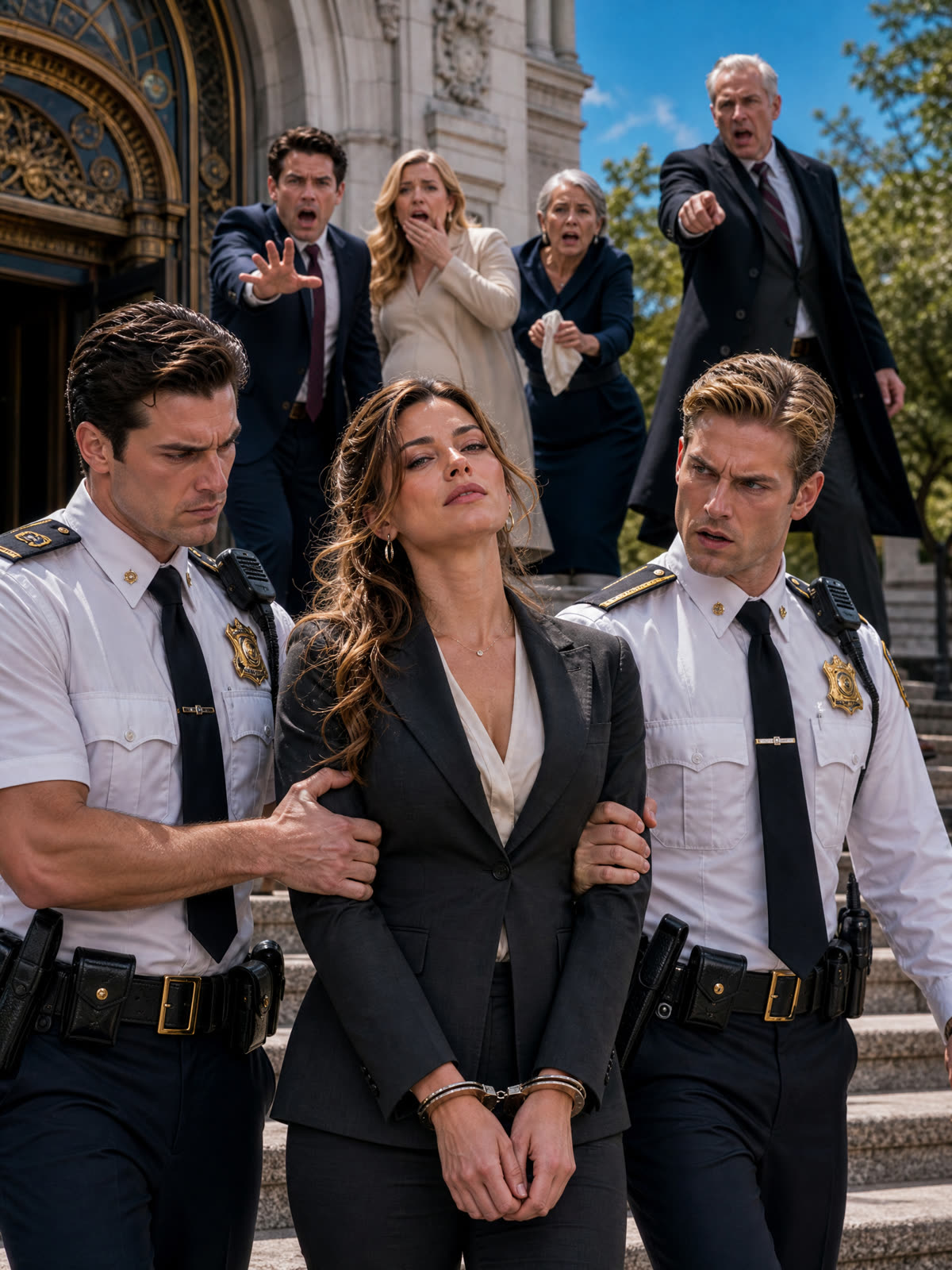
Two officers escorted me onto the courthouse steps, where reporters pressed toward us. Beyond them stood my mother-in-law, Evelyn Mercer, beside Julian and his pregnant mistress, Sienna Brooks. Evelyn dabbed at her eyes in a performance of sorrow. Julian made no effort to conceal his satisfaction, keeping an arm around Sienna’s waist as though my conviction were an occasion they had gathered to celebrate.
Sienna had once been the young assistant I recruited myself. For three years, I had supported her education, encouraged her career, and taught her how to handle complicated corporate transactions. Now she was six months pregnant with my husband’s child and dressed in the coat I had given her for her birthday. Neither of them showed remorse as the officers guided me toward the waiting prison transport.
Seeing them together brought back the night my father died. His heart had deteriorated quickly, and I had spent three exhausting days at his bedside in our Greenwich estate. Around eleven that evening, Julian came into the bedroom carrying a small amber bottle. He said the contents were a specialized compound from my father’s physician, intended to steady his heart. “Dr. Sterling’s courier just delivered this, Vivienne. He said your father needs two capsules tonight.”
I believed him. I gave Dad the capsules with warm water, trusting that my husband was helping us through a terrible night. Three hours later, my father’s heart stopped. Four days after his death, investigators found a dangerous level of an unprescribed beta-blocker in his system. My fingerprints were on the medication bottle. At the time, I had no idea that my ordinary act of care had been made part of a calculated deception.
The prosecutors also produced an audio recording that seemed to establish my intent. “I can’t keep doing this anymore. He’s holding everything up. It would be easier if his heart just gave out tonight.” I had never spoken those sentences together. Julian had secretly saved fragments of conversations in which I was exhausted and overwhelmed, then arranged for someone to assemble them into a confession I had never made.
A falsified corporate memorandum supplied the supposed financial motive: my father allegedly planned to postpone my inheritance. Together, the memorandum, the bottle, and the recording persuaded the court that I had killed him. Near the van, Julian offered me a satisfied smile. He believed my imprisonment would clear his path to Vance Global. What he did not know was that I had spent months investigating him, and my attorney had scheduled the release of crucial evidence.
Before stepping into the transport, I turned toward Prosecutor Helena Morales. “Before you celebrate, ask your audio expert why he received four hundred thousand dollars from a Zurich shell company before authenticating that recording.” She stopped addressing the reporters. I continued before anyone could cut me off. “Then ask Julian why the medication bottle’s batch number matches a veterinary supply order sent to a property in Vermont, where his first wife, Lydia Mercer, disappeared six years ago.”
Julian’s expression changed. Evelyn dropped the handkerchief she had been using to imitate grief. I told Morales that an encrypted evidence package had just reached the Department of Justice, the SEC, and the New York Times. It contained forty-one illegal transfers approaching two hundred million dollars, the original audio files, material concerning Lydia, and an order freezing the Vance Trust. Morales checked her phone, went pale, and ran toward the closing van. “STOP! DON’T LET HER LEAVE!”
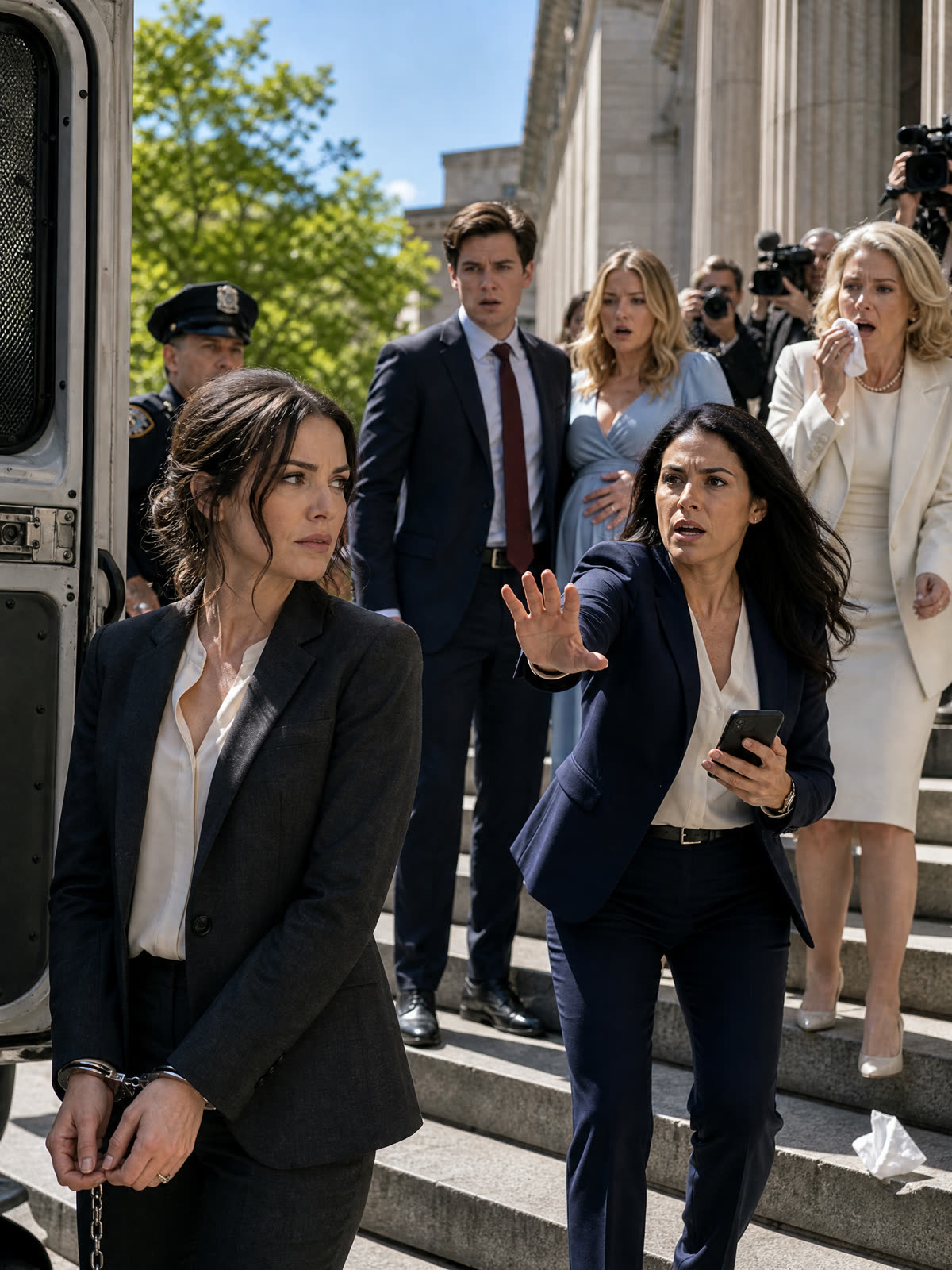
Through the narrow opening in the door, I saw Julian seize Sienna’s wrist and search desperately for a way toward a waiting vehicle. He had devoted months to making certain I disappeared into prison. Now, with reporters watching and the prosecutor rushing toward me, he was beginning to understand that the secrets he had buried might be the very things that brought him down.
Twenty minutes later, I sat inside a secure courthouse conference room without handcuffs. My attorney, Graham Thornton, spread financial records across the table while Morales examined the conspiracy she had unknowingly helped advance. Her anger was immediate. She wanted to understand why we had allowed the trial to reach a verdict when we possessed information that could have altered everything. Her question was direct. “Vivienne, you had this evidence for months. Why didn’t you give it to us before the trial?”
“Because Julian controlled people inside the company, and I couldn’t risk having the evidence destroyed before we secured it.” Graham explained that disclosure during the proceedings would have given Julian’s attorneys access to the documents. That warning could have enabled the people involved to drain offshore accounts, erase records, and assist their associates in escaping. We had needed the evidence secured before the conspiracy learned how much of it we had uncovered.
Among the records was a $400,000 payment to Dr. Arthur Pendelton, the forensic audio expert whose testimony had helped convict me. The payment traveled through Aegis Consulting, a shell company linked to Zurich, shortly before he certified the false recording as authentic. Morales examined the transactions with increasing concern. She had treated Pendelton’s testimony as independent professional judgment, unaware that the conclusion on which she relied had been bought.
My suspicions had begun three weeks before my father died. I returned unexpectedly to our Manhattan townhouse while Julian was supposedly at a Boston business conference and Sienna had reported herself sick. Instead, I heard them laughing in Julian’s study. Before I could confront them about being together, Evelyn spoke. What she said made it clear that the affair was only one piece of something far more dangerous.
“Keep your voice down, Sienna. Vivienne is too distracted by her father’s illness to notice anything. Once the next medication delivery arrives, we’ll be almost finished.” Evelyn then referred to Sienna’s pregnancy and told her to keep it concealed until the board meeting. I understood that they were discussing my father’s medication, my husband’s mistress, and control of Vance Global as parts of the same plan.
Rather than accuse them without proof, I quietly approached Graham and Nadia Lin, a retired federal cyber-auditor my father had once helped. Using an overlooked administrative access key, Nadia began tracing unusual activity inside Vance Global. She uncovered forty-one unauthorized transfers amounting to approximately $198 million. The funds had passed through shell companies in the Cayman Islands and Zurich, obscuring both their source and the people ultimately benefiting from them.
Special Agent Caleb Cross joined us in the conference room and confirmed the financial findings. He also brought news that Pendelton had been stopped at JFK Airport while trying to board a flight to Panama. I then showed Cross an old newspaper report about a Chicago tower collapse twenty-one years earlier. Fourteen people had died in that disaster. One of them was my mother, Clara Vance.
The tower had been built by Mercer Construction, the business owned by Julian’s father. Investigators found serious construction violations, and my father spent years helping regulators pursue accountability. Mercer Construction eventually failed, leaving Julian’s family financially ruined and publicly disgraced. Evelyn held Alistair responsible. The evidence suggested she had encouraged Julian to marry me as part of a revenge scheme that extended far beyond taking money from my family.
Lydia, Julian’s first wife, had discovered troubling records connected to that same Chicago disaster. Six years earlier, she vanished. Julian insisted she had chosen to move overseas, but investigators had found nothing that supported his account. Morales arranged an emergency stay of my sentence while federal authorities reopened the investigation. Then Nadia called with a warning: “Julian is preparing to transfer $1.5 billion from Vance Global into a holding company in Singapore. The board will approve it at the anniversary gala in forty-eight hours.”
Even with my conviction under review, my father’s company was still within Julian’s reach. He intended to strip it of its reserves before investigators could stop him, and the missing answers about Lydia and the medication shipments might be waiting at the same abandoned property. I turned to Agent Cross. There was no time left to let Julian decide what happened next. “Get the warrant for the Vermont property. We’re going there tonight.”
PART 2: The Lockbox, the Confession, and the Woman Waiting on Stage
At two the next morning, Graham, Agent Cross, and I reached the abandoned Mercer property outside Stowe, Vermont. Federal investigators had secured a search warrant after connecting suspicious pharmaceutical shipments to the estate. The farmhouse had been neglected for years, and the carriage house nearby looked almost forgotten. Yet the shipment records had brought us there, and Lydia’s disappearance made every unanswered question about the place more disturbing.
Cross instructed me to wait outside while the forensic team searched the carriage house. He did not want my presence to compromise anything they found. About twenty minutes passed before an investigator noticed loose floorboards beside a drainage grate. Underneath them lay a steel lockbox protected by a wrapping of oilcloth. Whatever someone had concealed there had been deliberately sheltered from the years the building had stood neglected.
The contents included Mercer Construction accounting ledgers, Lydia Mercer’s passport, a small recording device, two USB drives, and a handwritten notebook. The documents appeared to have been hidden for years. Lydia’s final journal entry explained that she had uncovered the Mercer family’s Chicago financial records. Afterward, Julian had taken her passport, restricted her access to money, and threatened to have her placed in a psychiatric facility if she reported what she knew.
Lydia had secretly prepared to flee to Montreal with cash and a bus ticket. Her notebook contained something even more unsettling: Evelyn and Julian had already been discussing a marriage into the Vance family as a means of destroying my father’s company. “She knew about their plan before Julian ever met me,” I whispered. The marriage I had once considered secure had been part of their scheme before I even knew Julian.
Investigators also recovered pharmacy receipts connected to Veritas Holdings, a shell company under Evelyn’s control. Those records linked the company to suspicious medication purchases, including the substance associated with my father’s death. The discovery strengthened the case, but it could not, on its own, halt the corporate restructuring. Then Cross learned that Julian had advanced the anniversary gala. Instead of waiting another day, he intended to hold it the following evening.
A private aircraft was scheduled to leave Teterboro Airport for Zurich shortly after the celebration. Julian planned to approve the transfer to Singapore and depart before investigators could finish assembling their case. I suggested a way to obtain a direct confession. His arrogance had always made him eager to demonstrate that he was cleverer than everyone around him. If he believed I had finally surrendered, I thought he might explain exactly how he had defeated me.
The following afternoon, I waited in Suite 1408 at the St. Regis Hotel while federal agents monitored events from the adjoining room. The settlement papers in front of me were false, but they appeared to surrender my remaining voting shares. They were meant to give Julian what he wanted most: the impression that my resistance had ended and that his control of Vance Global was almost complete.
When he arrived, I let him see exhaustion and fear. I said my legal challenge was falling apart and offered to abandon the investigation if he would help reduce my sentence. “I’ll sign everything, Julian. I just want to understand why you did this to my father.” At first he appeared suspicious. Then he studied the documents, and his familiar confidence began returning.
He started boasting about the Chicago disaster and the destruction of the Mercer business. In his telling, my father had ruined his family, and marrying me had provided a convenient route to revenge. I asked about the bottle, acting as though I still believed Dr. Sterling had supplied it. Julian laughed. With the agreement before him, he no longer seemed to think there was any reason to conceal his role.
“My mother ordered the concentrated beta-blocker through her laboratory contacts. I changed the label, removed my fingerprints, and handed you the bottle.” He also admitted commissioning the altered recording through an audio engineer in Prague and paying Pendelton to certify it. I listened while he supplied the direct admission we needed: he had deliberately used me to administer the medication, then arranged the evidence that made me appear responsible for my father’s death.

Once he finished, I told him that federal investigators had recovered Lydia’s hidden records in Vermont. His confidence vanished as he understood that our conversation had been recorded. “You set me up!” I met his accusation with the truth. “No, Julian. I simply gave you the opportunity to tell the truth.” Agent Cross and several federal marshals entered with an arrest warrant. Julian tried to escape into the hallway, but they apprehended him near the service exit.
For a moment, I thought we had finally stopped the conspiracy. Then Graham arrived carrying another urgent message from Nadia. Julian had quietly assigned his emergency corporate voting authority to Evelyn. She was already at the Grand Astoria Hotel with Chief Financial Officer Victor Kaine, preparing to authorize the $1.5 billion transfer. Taking Julian into custody had not removed the person now positioned to complete his plan.
Four hundred investors, executives, and journalists had gathered at the Grand Astoria for Vance Global’s anniversary celebration. Evelyn stood on the ballroom stage in an expensive velvet gown, wearing the sapphire jewelry that had belonged to my mother. My father had preserved those pieces for me after Clara died. Evelyn’s decision to wear them showed just how completely she believed my family’s inheritance had become hers.
Near the stage, Sienna waited in a silver maternity gown for Julian to arrive, unaware that federal agents had already arrested him. Evelyn told the guests that my conviction had created an urgent leadership crisis. She presented the proposed movement of the company’s international reserves as a necessary protective measure. Beside her, Kaine readied the authorization system, while supportive board members behaved as though Julian’s faction had secured permanent control.
Before the transaction could be completed, Nadia activated the presentation we had prepared. Financial records filled the ballroom’s enormous screen, documenting forty-one unauthorized transfers totaling $198 million. Photographs followed: the Vermont lockbox, the old construction ledgers, and the pharmacy receipts connected to Evelyn. Then Julian’s recorded voice came through the sound system. “My mother ordered the medication. I changed the label and gave Vivienne the bottle. The recording was fabricated.”
Disbelief spread through the room. Evelyn demanded that security shut down the presentation, but the financial authorization had already been interrupted. I entered with Cross, Morales, and the federal marshals. Evelyn stepped away from the podium and insisted the recording was false. “Vivienne, this is a misunderstanding. Where is Julian? Call my attorneys!” I answered her without leaving room for reassurance. “Julian is already in federal custody, Evelyn. Your plan is over.”
Cross announced that she was being arrested on charges connected to my father’s death, financial fraud, and obstruction of justice. Reporters recorded the collapse of the reputation she had guarded so carefully. Before the marshals escorted her away, I asked for my mother’s sapphires. Reluctantly, Evelyn allowed me to recover the necklace and matching earrings. “Those belonged to my mother. You never had the right to take them.”
After Evelyn was led away, Sienna approached me crying. She claimed Julian had misrepresented my mental health and insisted she knew nothing about the plan involving my father. I reminded her that I had supported her education, trusted her work, and helped build her career for three years. She had still attended secret meetings and assisted Julian in undermining me. “Tell the investigators everything you know, Sienna. That’s the only advice I have left for you.”
The next morning, I returned to Vance Global’s Sixth Avenue headquarters. An emergency shareholder meeting had invalidated Julian’s proxy authority, restoring my ability to lead the company. In the boardroom, I confronted Kaine and five executives who had supported the unauthorized restructuring. All six received termination notices, and their access to company systems was withdrawn. For the first time in months, I sat in my father’s executive chair.
I had scarcely begun to absorb what it meant to have the company back when Cross called. “Vivienne, we’ve discovered another automated transfer. Julian arranged for the company’s proprietary logistics algorithms and shipping patents to move to a shell company in Macau.” Disabling Julian’s executive credentials had triggered the mechanism. According to the cyber investigators, the transfer would execute automatically in twenty-two hours.
Nadia traced the hidden mechanism to Kaine’s administrative credentials. Removing him from his job had not removed the threat; he still possessed the information necessary to stop it. Julian had prepared another attack against the very assets that made Vance Global valuable. We had recovered the company’s leadership and interrupted the movement of its reserves, but unless we obtained Kaine’s authorization code, my father’s legacy could still be stripped away.
PART 3: The Last Authorization and the Legacy Beyond the Verdict
Nadia confirmed that Victor Kaine had installed the patent-transfer mechanism shortly before my trial. Preventing the transaction required his biometric authorization and a sixteen-digit override phrase. We had less than a day to obtain them. The threat was no longer a proposed restructuring that could be exposed before a roomful of investors. It was an automated process already counting down toward the loss of the company’s proprietary systems and patents.
Her investigation also uncovered a payment of $2.4 million to Kaine through Aegis Consulting. He had received it after substantial losses on risky private investments. The same financial network that paid the corrupt audio expert had rewarded Vance Global’s chief financial officer. Those records showed that his involvement extended well beyond obeying questionable instructions from Julian. They gave investigators a direct financial connection between him and the wider conspiracy.
That evening, Kaine came to the federal courthouse to answer questions about the offshore accounts. During a recess, I approached him with the transaction records while Cross and Morales remained nearby. The evidence connected his financial troubles, the payment, and the mechanism Nadia had found. We needed his cooperation before the deadline, and I wanted him to understand that denying his role would not make those records disappear.
“Your financial records show exactly what happened, Victor. We know you created the Macau transfer.” At first, he denied any involvement. Then he examined the documents, and the confidence behind his denial faded. He admitted that Julian had learned about his trading losses and threatened to expose them unless he cooperated. The explanation placed his decisions within the conspiracy, but it did not undo the damage those decisions had made possible.
“Julian said he’d destroy my career if I refused. I didn’t have a choice.” I would not allow him to turn coercion into an excuse for everything that followed. “You had a choice, Victor. Now you can cooperate with investigators and help prevent further damage.” Whatever Julian had threatened, Kaine still had a choice in that courthouse. He could continue protecting the mechanism or help us stop it before the remaining hours expired.
I explained that Nadia needed the override information immediately. The transfer was approaching execution, and we could not protect the intellectual property without the required authorization. Eventually, Kaine provided his hardware authorization key and the sixteen-digit phrase. He had been removed from his position and confronted with the payment records; now he finally surrendered the information that could prevent the last part of Julian’s corporate attack.
Nadia entered the credentials and confirmed that the automated transfer had been terminated. The logistics algorithms, patents, and proprietary systems remained under Vance Global’s control. The company would not lose those assets to the Macau shell company. We had stopped the attempt to empty its reserves and, at last, the concealed transaction designed to take away the intellectual property on which its value depended.
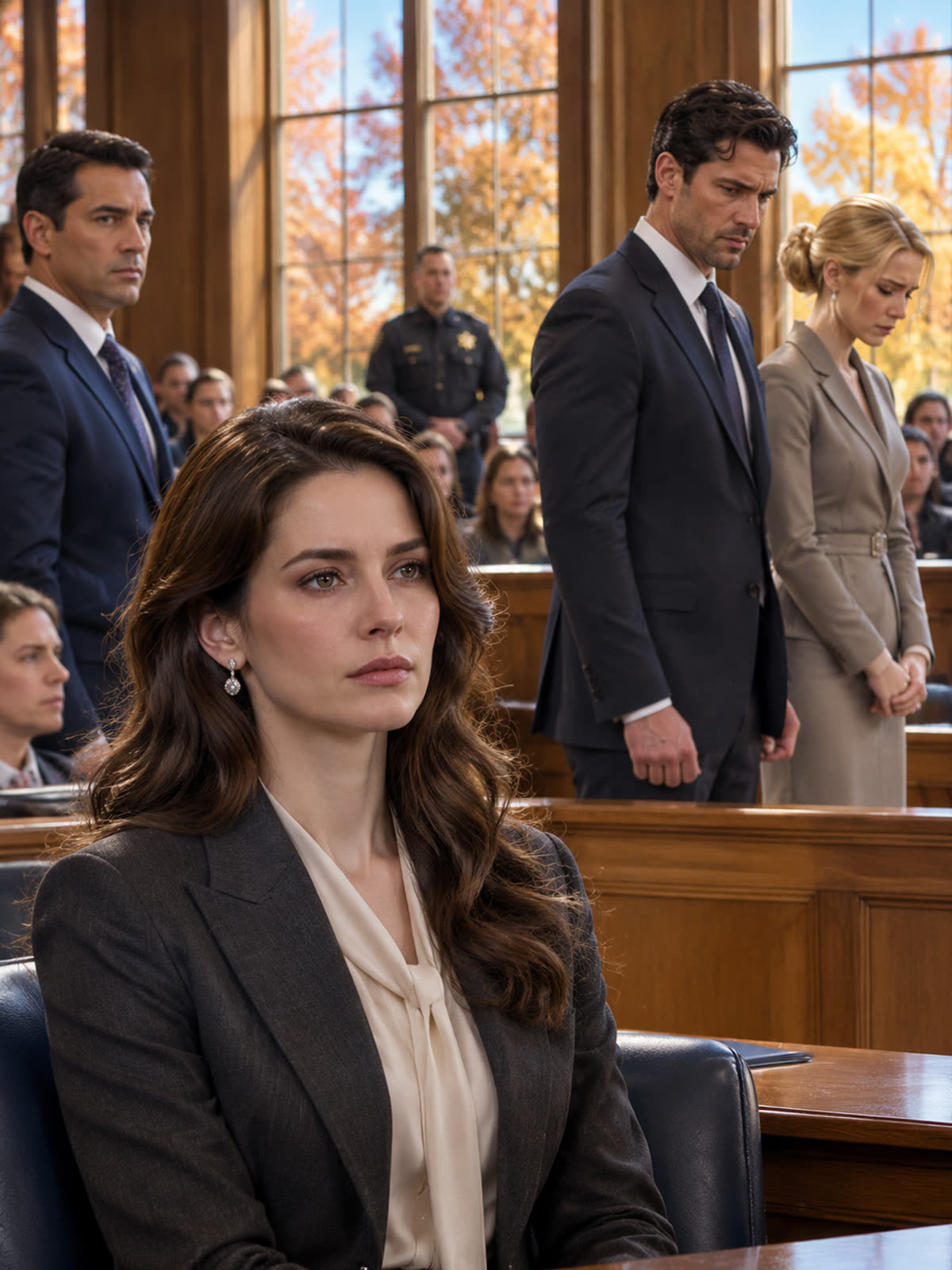
Five months later, Julian and Evelyn’s federal trial reached its conclusion. The courtroom drew reporters and regulators, along with relatives of those who had died in the Chicago tower collapse. The case brought together the crimes against my father, the financial conspiracy, and the history Evelyn had used to justify revenge. People affected by that history now sat in the same room as the mother and son who had exploited it.
Sienna testified under a plea agreement concerning her participation in the corporate fraud. She described the private meetings, the fabricated records, and conversations in which Julian and Evelyn discussed destroying Vance Global. The woman I had recruited and trained now gave investigators the account I had told her to provide. Her testimony joined the financial documents, recovered materials, and recorded admissions that had exposed the conspiracy.
Evelyn tried to place responsibility for the medication scheme on Julian. Julian, in turn, accused his mother of manipulating him. Their mutual accusations showed how completely their relationship had deteriorated once cooperation no longer served them. The jury found both defendants guilty on the charges presented. Julian received forty-five years in federal prison. Evelyn was sentenced to twenty-eight. The people who had arranged my eighteen-year sentence now faced the consequences of what they had done.
Their hidden financial assets were seized. Through the legal proceedings, Evelyn lost her Manhattan property, her art collection, and her remaining trusts. Kaine received a nine-year prison sentence, lost his financial licenses, and faced substantial civil penalties. The money and positions that had helped sustain the conspiracy no longer protected them. Each outcome reflected a different part of the network that had tried to turn my father’s company against me.
Sienna avoided prison under her plea agreement, but she received three years of federal probation and a felony conviction. Without her professional reputation or the security Julian had promised, she struggled to rebuild her life. Despite what she had done, I established an educational trust for her infant son through an independent trustee. A child should not have to surrender his future because of the decisions his parents had made.
During the next two years, I focused on restoring Vance Global and improving its internal controls. Nadia took responsibility for developing a new cybersecurity division. Our legal and financial teams worked to recover the money diverted through offshore accounts. Reclaiming leadership had been only the beginning; the company also needed safeguards against the failures that had allowed Julian and his associates to operate inside it.
The restructuring brought significant improvement. By the end of the following reporting period, Vance Global had grown thirty-two percent compared with its earlier position. The business my father had built was no longer being drained through concealed transactions. We had protected its intellectual property, strengthened oversight, and recovered diverted funds. Its progress gave me something tangible to set against the months in which its destruction had seemed so carefully arranged.
I also founded the Lydia Initiative to help people affected by financial coercion and identity fraud. Private investigators working with the organization eventually located Lydia Mercer in a small coastal community in Nova Scotia. She had survived by abandoning her former life and avoiding the people who had threatened her. Her disappearance had not been the voluntary move overseas Julian claimed, but an escape from the life he had made dangerous.
Once she was assured that Julian and Evelyn were imprisoned, Lydia began using her real name again. Later, she traveled to New York to speak at the foundation’s first charity gala. In its first year, the Lydia Initiative helped forty-two families obtain assistance and begin rebuilding their independence. The records she had hidden in Vermont had helped expose the conspiracy; the foundation bearing her name now supported others facing similar forms of control.
One autumn morning, I brought white lilies to the memorial garden behind our Greenwich estate. The marble monument bore both my parents’ names: Alistair and Clara Vance. “The company is doing well, Dad. We’ve recovered the missing money, strengthened our security, and protected everything you worked so hard to build.” I placed the flowers beside the monument and thought about the distance between that quiet morning and the courthouse steps.
“We found Lydia, too. She’s safe, and the foundation is helping families who thought they had nowhere to turn.” For years, I had confused loyalty with unquestioning trust in the people closest to me. Julian and Evelyn had taken advantage of that belief, using my marriage, my father’s illness, and my grief to construct their conspiracy. Their actions had cost me my father and had come close to costing me my freedom.
I could not bring my parents back or recover the time I had lost. I could protect what they had left behind, support people facing similar exploitation, and refuse to make my future dependent on someone else’s approval. After a few quiet moments beside the memorial, I returned to the waiting car. A board meeting awaited me in Manhattan that afternoon. I had a company to lead and a life that finally belonged entirely to me—and everything I would choose to do with it still lay ahead.
Disclaimer: This story is a work of fiction inspired by real-life themes. Names, characters, places and events are fictionalized, and any resemblance to real persons is purely coincidental. It does not represent any person or organization and does not encourage inappropriate behavior. Images are for illustration purposes only.
