

PART 1 — The Morning Everything Broke
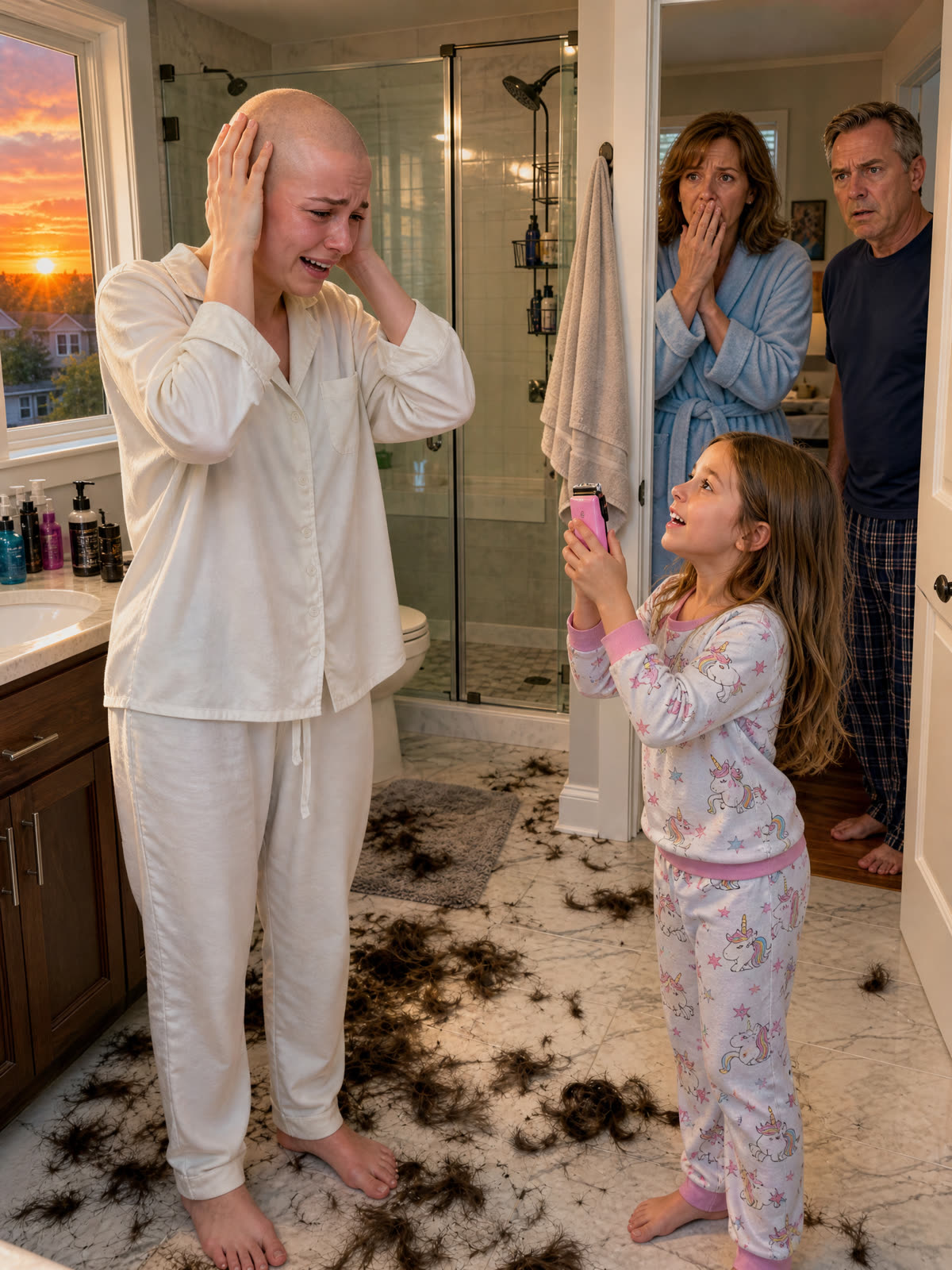
Kayla’s scream dragged me out of sleep at 6:13 a.m., before daylight had climbed above the rooftops lining our suburban street. Cold coffee lingered in the kitchen, and the smell of lavender shampoo drifted from the hallway bathroom. Somewhere outside, a neighbor slammed an SUV door, an everyday Saturday sound that belonged to a world still moving normally. Inside our house, my oldest daughter was making a sound I would never forget. I ran toward her bedroom so quickly that my shoulder struck the doorframe.
She was upright in bed, both palms pressed against her head. Her prom dress remained suspended from the closet door inside its protective plastic, with her little silver shoes arranged beneath it, as though the evening were still waiting patiently for her. But beneath her hands there was no hair. The blonde hair she had gone to sleep with covered the pillow, caught in the sheets, and lay scattered over the carpet in soft, destroyed handfuls. It looked as though somebody had tried to rub away part of her while she slept. Prom was that night.
Before I can explain the razor, the pink recorder, and the truth that proved far worse than a ruined hairstyle, I have to explain our family. My name is Rachel Adams. David and I had been married sixteen years, and our daughters were seventeen-year-old Kayla and eight-year-old Reese. Nine years separated them, yet they shared a closeness I rarely saw between siblings. From the beginning, Kayla had treated loving her little sister as both a pleasure and a responsibility. She protected Reese, entertained her, and made room for her in places where other teenagers might have wanted distance.
Kayla had braided Reese’s hair before kindergarten and allowed her to come along to the mall even when her friends rolled their eyes. She had listened to more imaginary radio programs than I could count, all recorded in our laundry room on the little pink machine Reese received for her seventh birthday. David managed projects for a regional construction company. He was methodical and dependable, a man who reread assembly instructions and checked the locks repeatedly before bed. For years, I had admired his habit of quietly resolving problems. That Saturday would show me what could happen when quiet became more important than the truth.
Steven Whitfield entered Kayla’s life at the beginning of junior year. They met in AP Chemistry, where he sat two rows away. When she described him at our kitchen table, she called him “actually funny, not like try-hard funny.” He was a senior, a year older than she was, and captain of the debate team. Teachers appreciated his polish. Parents saw his confidence and assumed it meant he was trustworthy. His father owned a successful contracting business two towns away, and Steven carried himself with the assurance of somebody who had seldom been denied anything.
I liked him initially, and admitting that remains uncomfortable. He remembered his manners, thanked us, and asked about my day with enough patience to seem interested in the answer. After his third or fourth visit, we gave him the spare-key code. Soon he was letting himself in on Saturday mornings and calling upstairs about movies or corsage colors. We let him drink David’s soda from the garage refrigerator and drape his hoodie over a dining chair. He addressed me as Mrs. Adams in that respectful tone adults too easily confuse with character. Sometimes misplaced trust arrives wearing clean clothes and excellent manners.
By February, Kayla had become quieter. The running commentary that usually accompanied dinner gradually thinned out, and I accepted explanations I should have examined. When she wore longer sleeves as the weather warmed, I thought it was a style choice. When she canceled on Priya and Devon, her two closest friends, I accepted that she was tired or needed to study. Her grades stayed steady. Only afterward did I recognize how often that exhaustion followed time with Steven. The signs had been there, but I had placed them in harmless categories instead of asking what they might mean together.
I did not know what was happening, and I have revisited that ignorance more times than I can count. I have wondered what a more direct question might have changed, or whether another version of me would have understood sooner. What I eventually learned was that my daughter had spent months becoming frighteningly skilled at concealment. Meanwhile, she talked for three months about her dress, the pictures, the corsage, and walking into prom beside Steven. People at school kept telling her she was certain to be crowned queen. The permission slip stayed on our refrigerator, and she circled the date on the calendar in pink.
That morning, she staggered into the bathroom, saw herself in the mirror, and screamed until I feared she could no longer breathe properly. David found Reese sitting on the edge of her bed in unicorn pajamas. His electric razor rested on her nightstand. Her face was drained of color, yet she did not look remorseful. “Reese,” I said, struggling to steady my voice, “what did you do?” She raised her enormous brown eyes toward mine. “I saved her the only way I could.” I wanted an explanation large enough to match the devastation in the next room.
This was the child who climbed into Kayla’s bed when thunder shook the house, who followed her around asking about mascara and the loud laughter of teenage girls. Then the front door opened. Steven called upstairs about corsage colors, as comfortably as he always did. At the bathroom doorway, he stopped when he saw Kayla beneath the vanity lights. His expression went blank for half a second before concern settled over it. “Baby, don’t cry,” he said, reaching toward her. “We can fix this. Maybe a wig. You’ll still be the prettiest girl there.” Kayla collapsed against him, trembling, her fingers buried in his sweatshirt.
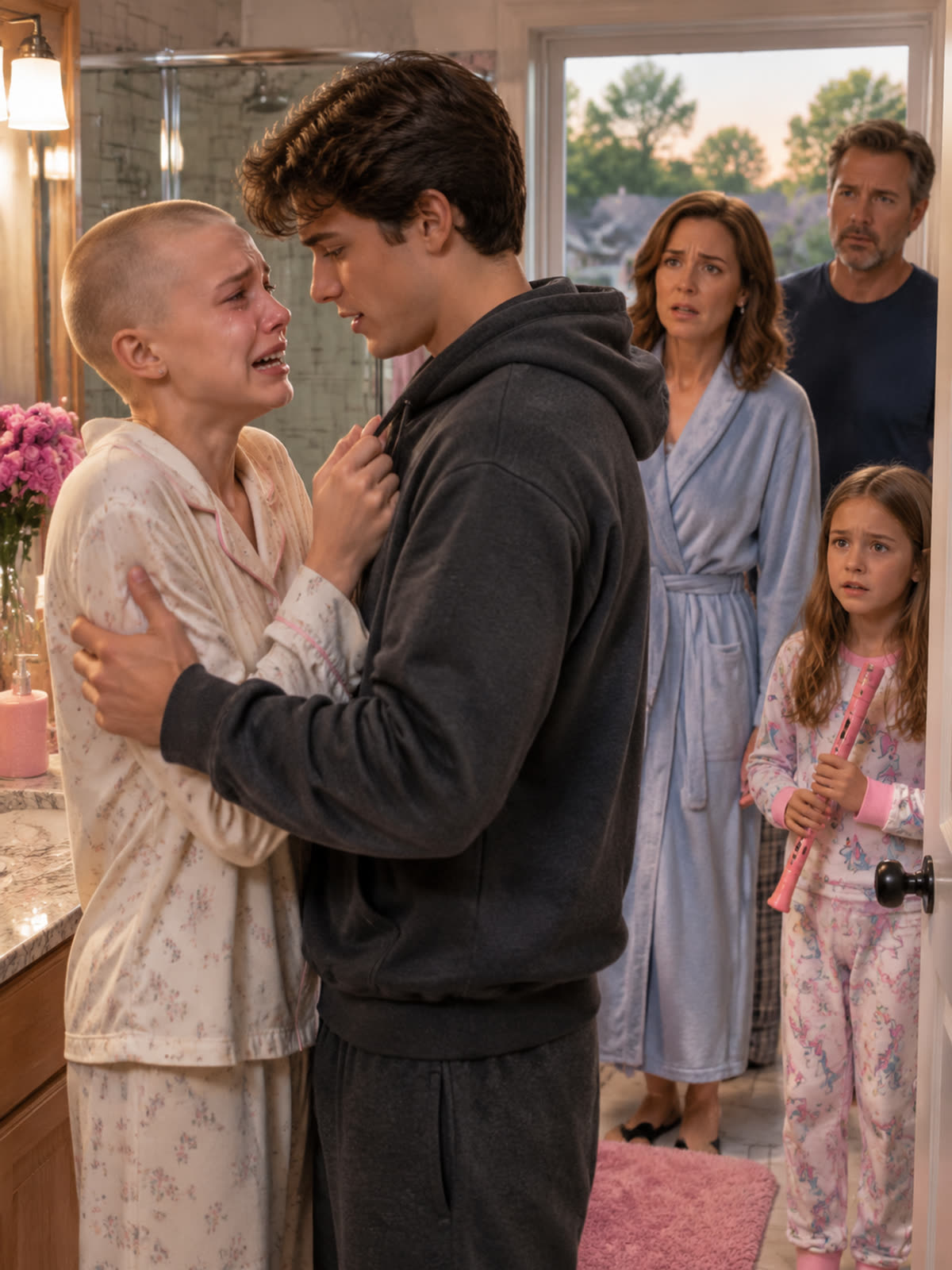
Reese appeared in the doorway. “I cut it so she couldn’t go to prom with you,” my little girl said. Steven gave a single laugh, far too loud and sharp for that small room. Reese stayed exactly where she was. “You hurt my sister all the time. I saw the purple marks where you grab her.” Silence settled over us so completely that the faucet’s lone drip seemed enormous. In my memory, even the razor sitting in the other room seems to make a sound. Kayla stopped crying. Steven tightened the arm he had wrapped around her shoulders.
He looked at me with a smile that never reached his eyes. “Kids make up crazy stories, Mrs. Adams,” he said. “Tell her, Kayla. Tell your mom how good I am to you.” My daughter stared down into the sink. Reese crossed to the counter, picked up my phone, and opened the photographs with the practiced certainty of someone who already knew what she needed to show us. I saw timestamps: 11:48 p.m. Tuesday, 7:02 a.m. Thursday. Then I saw Kayla’s arms, marked by bruises shaped like fingers.
There were photographs of her ribs, too, dark discolorations spreading beneath the skin, and of her back, yellow and purple in places her clothing had kept hidden from me. The longer sleeves were no longer a fashion choice. They were part of a disguise my daughter had learned to maintain. My stomach dropped, and I caught the towel rack to keep myself steady. “Kayla,” I whispered. “Is this true?” Steven reddened. “Those could be from anything. She plays sports. This is insane. I spent hundreds on tonight. I got a limo.” What surfaced first was not guilt or fear. It was the bill.
Reese reached into her pajama pocket and brought out the pink tape recorder from her make-believe radio shows. She pressed play. Steven’s voice emerged from the small speaker, faint but unmistakable. He was laughing with somebody in our living room, discussing the afterparty. He talked about getting Kayla drunk, about putting something in her drink so she would not be able to resist him or leave. Then he said that getting her pregnant would keep her from going away to college. Kayla made a sound that has never left me. I still hear it with terrible clarity.
David stepped all the way into the bathroom. “Let go of my daughter right now.” Steven dropped his arm and began backing toward the hallway, but David moved in front of him. For an instant, the polished confidence vanished, and Steven looked like a frightened boy. Then his gaze changed. He studied my husband and smiled. “I really don’t think you want to do that, Mr. Adams,” Steven said. “And I think you know why.” The color left David’s face so abruptly that the room seemed to shift beneath my feet.
With shaking hands, I raised my phone and started recording. The little red light appeared. Steven noticed it, then looked past me toward David. “Ask him what he said to me behind the garage.” My husband remained motionless. Steven’s smile widened just enough to tell me this was not an accusation he had invented in panic. He had been keeping it ready. Kayla drew her arms around herself, seeming suddenly smaller in the middle of the bathroom. Between the sink and the doorway, Reese held her pink recorder tightly against her chest.
“Tell her,” Steven said. “Tell your wife how you already knew I was a problem.” David swallowed. His arms hung at his sides with his hands open, but his fingers shook. “I saw him grab Kayla by the driveway Tuesday night,” he said. “By the SUV. I told him if he ever touched her again, I would make sure he regretted it.” Kayla’s knees gave slightly, as though the floor had shifted. “I begged him not to tell you,” she whispered. “I didn’t want prom ruined. I didn’t want everybody to know.”
Her admission struck David harder than Steven’s challenge had. He looked at our daughter rather than at me, and the father who had been ready to fight suddenly looked like a man beginning to understand the seriousness of his own mistake. He had seen something. She had been frightened enough to beg for secrecy. Somehow, between them, that fear had remained hidden from me. All those ordinary days since Tuesday rearranged themselves in my mind. I had been living beside a truth my husband already knew existed, even if he had not understood its full extent.
Before I could make sense of that betrayal, Reese lifted the recorder again. “That’s not the part I meant,” she said. There was a second side to the tape. Across its tiny plastic label, she had written two crooked words: AFTERPARTY PLAN. Steven stopped smiling. The change was immediate enough that I could see it without looking directly at him. My eight-year-old found the button with her thumb, and I realized I did not even know how long she had been moving through our house with this machine, collecting what the rest of us had failed to hear.
I had been trying to understand a shaved head, then bruises, then a recording, then my husband’s silence. Every answer had opened into something worse. Reese stood in the same bathroom where she ordinarily asked about makeup and watched her sister get ready. Now she was the one holding the information the adults needed. I could not reconcile the smallness of her hands with the weight of what they carried. There had been nothing imaginary about these recordings. Whatever she had heard had frightened her enough to believe she had to stop prom herself.
Before I could ask another question, a girl’s trembling voice came through the speaker and whispered Kayla’s name. It was not my daughter’s voice. David covered his mouth. Kayla slid down against the bathroom cabinet. The dress still hung in the bedroom, and the silver shoes remained beneath it, belonging to the evening we had all believed was coming. Reese looked from one of us to the next, holding the recorder as though she could not afford to let it go. Then she said, “And she isn’t the only one.”
PART 2 — What the Recorder Knew
No one spoke. Reese drew the recorder closer to her chest, and the other girl’s voice came again, trembling so severely that parts of the sentence almost disappeared. “Kayla… if you can hear this, I’m sorry. I should have told you sooner.” From her place against the cabinet, Kayla raised her head. “Who is that?” Reese looked directly at her sister. “Emily.” The name changed Steven’s face. For a second, his certainty simply vanished, as abruptly as a light being switched off. I saw it. David saw it. Kayla did, too.
Emily continued through the tiny speaker. “Steven told me not to say anything. He said nobody would believe me. He said if I told anyone, he would make sure everyone at school knew things about me that I didn’t want them to know.” Kayla pressed a hand over her mouth. Beside me, David whispered, “Oh God.” I stared at the boy we had welcomed into our home, the boy whose manners I had mistaken for goodness. “What did you do?” Steven immediately shook his head. “She’s lying.” His denial came much too quickly.
Reese turned toward me. “He said that before too.” I looked down at her. “What do you mean?” Once more, she reached inside her pajama pocket. This time she produced a folded sheet of paper. “I wrote down the times.” When I opened it, I found dates, names, locations, and small observations set down in an eight-year-old’s uneven handwriting. Tuesday, Kayla had come home crying. Wednesday, Steven had waited outside school. Thursday, Kayla had bruises. Friday, Emily had called and sounded afraid. At the bottom, Reese had written that Mom did not know yet.
My throat tightened around the question. “How long have you known?” Reese looked toward Kayla. “Long enough.” My older daughter began crying again, but her hair was no longer the reason. Someone had finally believed what was happening to her. Someone had seen enough to understand that it mattered. That realization was unbearable in its own way. My younger daughter had kept a record while I had kept accepting ordinary explanations. The notes did not look impressive or official. They looked like a child trying to make sure the truth would not disappear.
Steven edged toward the doorway. David blocked him. “Don’t.” Steven stopped moving. “You don’t understand.” My husband answered in a low voice. “No,” he said. “I understand now.” Steven narrowed his eyes. “You’re going to regret this.” David reached for his phone. “No. You are.” The laugh Steven gave then was unsteady. “You think you’re going to call the police over some recordings?” David held up the phone. “I already did.” Steven went still. The emergency call remained connected. The operator had been hearing the threats, the admissions, and the words we were only beginning to absorb.
“You wouldn’t.” Steven stared at him. David’s reply was level. “You threatened my daughter in my house.” Steven backed away again. “You don’t know what you’re doing.” My husband did not move aside. “I know exactly what I’m doing.” In the distance, sirens became audible. Steven looked toward the window, then toward the back door, and finally at me. For the first time since arriving that morning, he seemed genuinely frightened. Not inconvenienced or insulted, not angry about the money he had spent. Afraid. The sound outside was getting closer, and his confidence had nowhere left to settle.
He suddenly turned and ran. David caught his arm, and Steven jerked free. In the confusion, Reese’s pink recorder was knocked from her hands. It struck the floor, its battery cover came loose, and the recording cut off. “Don’t touch her!” Kayla screamed. Steven stopped and looked at her. Something crossed his face that chilled me completely. It was not simple anger or embarrassment. Whatever it was, I did not want my daughter anywhere near it. David stepped between them. “You’re done.” The front door opened sharply downstairs, and officers came into the house.
Two officers entered first, with another behind them. Steven immediately lifted his hands. “I didn’t do anything.” One of the officers looked at me. “Ma’am, are the girls safe?” I nodded automatically, then looked at Kayla. What did safe mean after everything we had heard? We were no longer alone with him, but that did not undo what had happened. “No,” I said quietly. “But they will be.” It was the only answer I could give without pretending that a police presence could restore the morning we had lost or erase the months that had come before it.
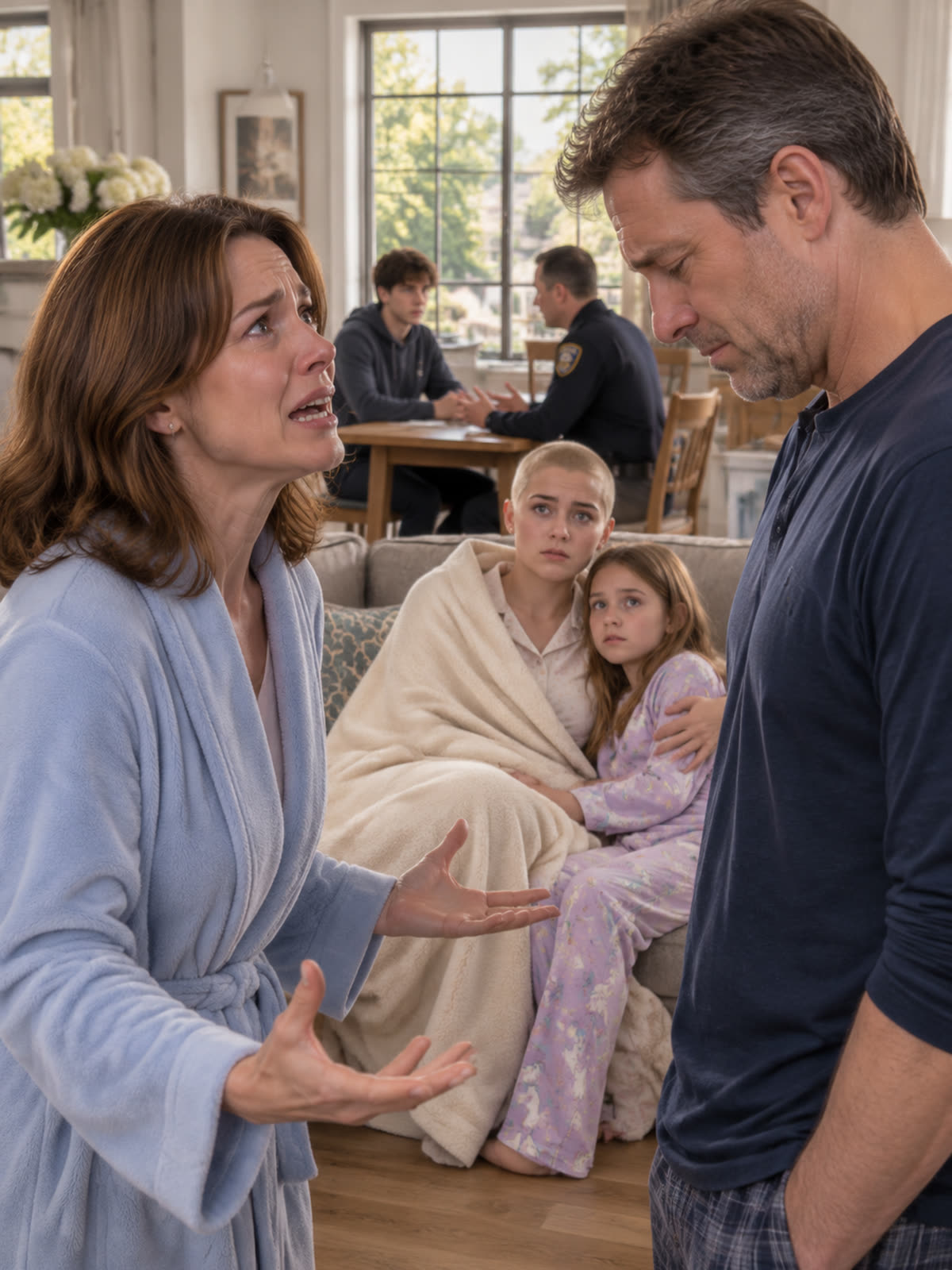
The officers separated us. Kayla and Reese went into the living room, and I remained beside them. Steven sat at the kitchen table while an officer questioned him. David stood near a doorway, looking as though the morning had aged him ten years. I went over to him. “You knew.” He closed his eyes. “I suspected.” I could not let that distinction stand untouched. “You knew enough to confront him.” He answered, “I didn’t know everything.” I looked at him. “You knew he was hurting her.” He said nothing. His silence supplied the answer he would not give.
From where we stood, I could see Kayla on the couch beneath an oversized blanket an officer had given her. Reese had an arm around her. My older daughter’s shaved head made her look painfully small. “How long?” I asked David. He swallowed. “Tuesday.” I stared at him. “Tuesday?” He explained, “I saw Steven grab her outside. I followed them to the driveway. I told him to stay away from her.” I asked, “And then what?” He looked toward Kayla. “I asked Kayla if she wanted me to tell you.” Then he admitted, “She begged me not to.”
I closed my eyes. At the beginning of the morning, I had believed the worst thing that had happened was an eight-year-old taking a razor to her sister’s hair. Now I understood how wrong I had been. My daughter had been frightened enough to plead with her father to keep a secret about somebody hurting her. He had agreed, not because he did not love her, but because he had confused protecting her with avoiding the upheaval that telling me would bring. He had tried to preserve peace in a situation where peace was already an illusion.
That misunderstanding had nearly cost us everything. I looked again at the two girls on the couch, the younger one’s arm around the older one, and felt the full distance between David’s intentions and what his silence had actually allowed. There was no comfort in knowing he had meant well. Kayla had still been left carrying something she could not manage, and Reese had still decided that stopping prom was a task that belonged to her. A quiet solution had not made the danger smaller. It had only kept me from seeing it.
An officer approached me. “Mrs. Adams?” I turned. “We found something in his phone.” My stomach tightened again. “What?” The officer glanced toward the kitchen table. “Messages.” I asked, “How many?” His answer was brief. “Enough.” He showed me only the opening lines. There were conversations about the party and about Kayla, including plans to make certain she could not leave early. Another person appeared in the messages, someone whose name I recognized: Steven’s older cousin. I looked at David. He understood before I said anything. “This wasn’t just Steven.”
The officer nodded. “We’re going to need everyone’s devices.” I gave him my phone, and David handed over his. When I turned toward Kayla, she hesitated. “Mom?” I wanted there to be something solid beneath the words I gave her. “You don’t have to be afraid anymore.” She placed her phone in my hand. Then Reese stood up. “I have another recording.” Every person nearby turned toward her. The officer lowered himself beside her. “Another recording?” She nodded. “I made it yesterday.” David stared at our youngest daughter. “How?”
Reese pointed toward the kitchen. “I left the recorder in the laundry basket.” The officer exchanged a look with his partner. “Can you play it?” Reese nodded. When the recording started, footsteps came first. Then we heard Steven, followed by another man and a woman. My blood went cold. There were three people discussing Kayla’s plans for prom. Three people knew she was afraid. Three people had been talking about separating her from her family. The room where we stood seemed to grow smaller as the voices continued, giving shape to something far beyond the explanation we had begun with.
Then Steven said something that made David sit down. “If her parents find out, everything falls apart.” The other man laughed. “They won’t.” Steven answered, “Her dad already suspects me.” After a pause, the woman spoke. “Then deal with him first.” The tape ended. Nobody moved. The officer slowly looked from one of us to the other. “Do you recognize those voices?” David nodded. I did not recognize them. I watched my husband, trying to understand what else his expression might mean, and felt another layer of uncertainty settle between us.
From across the room, Steven spoke. “You’re making a mistake.” The officer turned toward him. Steven’s voice shook now. “You don’t understand who you’re dealing with.” The officer held his gaze. “That sounds like a threat.” Steven looked at me. “No.” Then his eyes shifted to David. “It means you should ask him why he never told you about the money.” My husband went utterly still. I turned toward him. “What money?” He did not answer. I said his name. “David.” When he finally met my eyes, I understood there was more he had kept from me.
He reached slowly into his pocket and withdrew a folded envelope. “I was going to tell you.” I stared at it. “When?” He lowered his eyes. “After prom.” The words tightened something in my chest. “What is it?” He handed me the envelope. Inside was a bank statement showing a payment of $8,000, sent three weeks earlier to Steven’s father. I looked from the paper to my husband. “Why?” He rubbed his face. “Because Steven’s father contacted me.” I asked, “For what?” David answered, “He said Steven was dangerous.”
My hands began to shake around the statement. David continued. “He asked me for money to keep Steven away from Kayla.” I could scarcely take in what he was saying. “You paid him?” He answered, “Yes.” I looked at him. “And you never told me?” His explanation was the same kind of explanation that had been hiding beneath everything else. “I thought it was handled.” The room seemed to fall silent. Three weeks. Eight thousand dollars. A warning that Steven was dangerous, followed by another confrontation on Tuesday. All of it had existed beside our ordinary family life.
The pieces fitted together in a way that made me feel sick: the warnings, the threats, the secrecy, the money, and the strange fear that had crossed Steven’s face. I understood why David had gone pale when Steven mentioned the garage. My husband had known enough to fear something larger, and he had convinced himself that he could settle it privately. What I had always admired as competence had become concealment. He had tried to solve a danger to our daughter without bringing me into the room, and every quiet decision had left us knowing less than we needed to know.
Steven suddenly laughed. We all looked toward him. “You still don’t get it.” The officer stepped closer. “Enough.” Steven shook his head. “You think my father was protecting Kayla?” He smiled. “He was protecting himself.” The officer’s expression changed. “What does that mean?” Steven leaned back. “It means he knew what I was planning.” Silence followed. Then he added, “And he wanted his money.” The admission settled over the room. David’s payment had never been the protection he thought he had purchased. Even the bargain itself had been another part of the deception.
The officer moved immediately. “Stand up.” Steven’s smile vanished. “Turn around.” The handcuffs closed with a click. Kayla watched from the couch, and I stepped in front of her. “You don’t have to look.” She buried her face against my shoulder. Reese climbed up beside her. “I told you I saved her.” Kayla reached toward her little sister. “Yes,” she whispered. “You did.” Then Reese began to cry. Kayla pulled her into an embrace, and for the first time that morning, the two of them held each other without fear.
I stayed close while the officers prepared to take Steven out. The relief in that embrace did not erase what the recordings had revealed. Emily’s voice was still in my head. So were the other man’s laugh and the woman’s instruction. Steven had arrived that morning acting as though the only problem was finding a wig before prom. Now we knew the plans had reached beyond him, and we knew my husband had paid money to a man who already understood his son was dangerous. As the handcuffs carried their consequence into the room, another question remained unanswered: how far did this go?
PART 3 — What Listening Would Cost Us
The officers took Steven outside. His car was towed, and his phone became evidence. By the afternoon, detectives had reached Emily’s family and several other students. Those practical steps mattered, but they did not make the day feel finished. Our house had become the place where we learned how much had been happening without our knowledge. The boy who had moved through our kitchen as though he belonged there was gone, yet the recordings and photographs had changed how every familiar room felt. We were only beginning to understand what would have to happen next.
I want to be clear about the days that followed, because an arrest is not the same thing as a neat ending. Detective Sarah Mendoza came that afternoon and patiently explained the next stages. Her thoroughness helped steady us. She told us that the messages recovered from Steven’s phone, Emily’s recorded statement, and Reese’s careful notes gave them more than enough to proceed with charges. Other girls had already started coming forward as word spread that somebody had finally acted. What Reese had uncovered was no longer something Steven could dismiss inside our bathroom.
Emily’s mother called that evening. Her voice trembled as she thanked me, though the gratitude did not feel like something I had earned. I had not been the one collecting dates or noticing what an adult should have stopped sooner. In truth, she was thanking Reese. My eight-year-old was in the next room watching cartoons, looking like the ordinary child she should have been allowed to remain throughout all of this. It was difficult to hold those two images together: the little girl watching television and the little girl whose persistence had helped bring a predator to account.
Steven’s father was questioned in the following days, and what emerged was ugly in a different way. David had believed that $8,000 would buy protection for Kayla. Instead, it had bought silence, and only briefly. Steven’s father knew enough about his son’s behavior with earlier girlfriends to recognize that trouble was approaching. Rather than take meaningful steps to stop him, he had found a way to profit from another father’s fear. David had paid because he was frightened for our daughter, and the man who accepted the money did nothing to prevent what his son was planning.
That knowledge did not excuse David’s decision to keep me uninformed. It made the consequences clearer. He had tried to handle the danger as though it were a problem that could be settled through a private arrangement and a firm warning. But Steven’s father had not been an ally. There had been no dependable promise beneath the transaction, no real protection for Kayla in exchange for the money. The payment belonged to the same web of secrecy that had kept our daughter isolated. David’s intention and the reality of what he had done remained painfully far apart.
News moved through the school before sunset, but it did not travel in the way Steven had intended. Nobody laughed at Kayla. Nobody called her the girl who had destroyed prom. They called her brave. I wanted that response to reach the places in her where fear and shame had settled, though I knew people’s kindness could not make the damage vanish. She had spent months hiding what was happening, and now others knew. The difference was that the truth was no longer being used against her. For once, the attention did not belong to Steven to control.
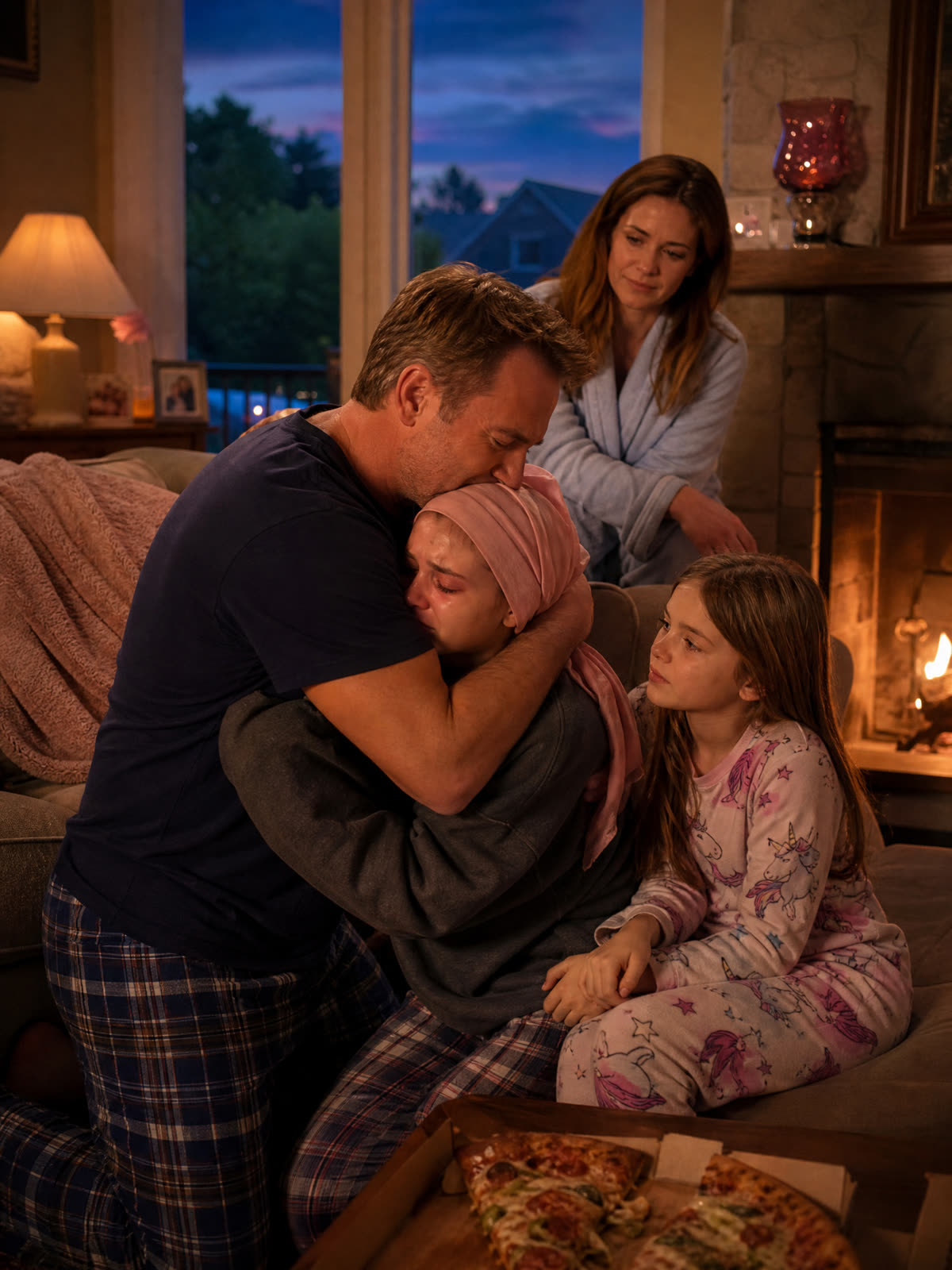
Kayla did not go to prom. Reese did not go anywhere that evening, either. We stayed home. I ordered pizza, and David lit the fireplace. Kayla settled on the couch in an old sweatshirt, a soft pink scarf wrapped around her shaved head. Reese sat close beside her. The evening that had occupied three months of excitement became something much quieter. There was no dress, no limousine, no entrance beside Steven. There were the four of us in the living room, trying to sit together with everything we had learned.
For a while, nobody said anything. After the morning’s revelations, silence no longer felt simple. Earlier in our lives, it might have meant comfort or ordinary tiredness. That night, I could not separate it from all the things we had failed to say. Yet we were together, and there was a difference between sitting quietly beside one another and keeping the truth hidden. Kayla had Reese next to her. David sat across from us. I could see how much remained unresolved without pretending that being in the same room had already repaired it.
Eventually, Kayla looked at me. “Mom?” I answered, “Yes?” She glanced at her little sister. “Are you mad at Reese?” Reese immediately lowered her eyes. I sat beside them. “I was.” Tears rose in Reese’s eyes. “But not anymore.” I touched her cheek. “You should never have had to protect your sister from something this big.” She nodded. “But I did.” There was no way to deny that she had acted when the rest of us had not understood what needed stopping. “Yes.” I drew both girls into my arms. “You did.”
Across from us, David spoke. “I failed you.” Kayla looked toward him. He swallowed. “I thought keeping quiet would protect you.” She watched him for a long time before answering. “I needed you to tell Mom.” David lowered his eyes. “I know.” Kayla continued, “You should have believed me enough to tell her.” His eyes filled. “I know.” After another silence, she reached for him. He crossed the room and held her as though he feared she might disappear. “I am sorry,” he whispered. Kayla did not tell him it was all right. She simply held him, and that was more honest.
That embrace mattered precisely because it did not pretend forgiveness was automatic. Kayla had named what she needed from him, and he had heard it without defending the secrecy that had failed her. I watched them together and understood that love was not the missing part of our family. David loved our daughter. I loved her. Reese loved her with the fierce certainty of a child who could not bear to see her hurt. What had failed was our understanding of protection, and what it demanded from the adults who were supposed to provide it.
Healing did not arrive in one clean moment after the sirens and handcuffs. In the weeks afterward, Kayla began therapy twice a week with Dr. Alicia Fenn, a warm, direct woman who worked with adolescents recovering from trauma. The first sessions were difficult. Sometimes there were long silences. More than once, Kayla came home and shut herself in her bedroom for hours. We could remain available to her, but there were things she was working through that we could not reach simply by wanting to understand. Her recovery did not follow the convenient pace any of us might have wished for.
David and I started therapy as well, separately at first and eventually together. We had to work through the specific harm his silence had caused. It was not a question of whether he loved Kayla. I had never doubted that. It was a question of how an old habit of handling trouble privately had overruled the more urgent need to tell me the truth. His instinct had been to contain the problem, to settle it without upheaval. We had to face the fact that keeping me outside his decisions had also kept our daughter from the protection of both her parents.
There was no way to discuss that honestly without returning to Tuesday, and then further back to the payment three weeks earlier. Those were not small omissions. They had shaped what I knew and what I was able to do. David’s quiet approach had once made our life feel secure because he was careful and steady. After that morning, we had to examine the point where steadiness had turned into secrecy. Repairing trust required more than his regret. It required us to understand why he had believed that withholding something so serious could possibly keep our family safe.
I carried guilt of my own, and at first I struggled even to describe it. I kept revisiting the long sleeves, the canceled plans, the dinners when Kayla barely spoke. Each detail seemed painfully clear once I knew what it meant. I wondered what sort of mother could watch her child withdraw and fail to understand why. The fact that I had not known did not stop me from feeling responsible for all the questions I had not asked. I could remember my ordinary explanations too easily, and none of them offered comfort afterward.
At Kayla’s invitation, I eventually joined one of her sessions. Dr. Fenn told me something I continued to think about long afterward. Abusers are skilled at using the space between a child’s fear and a parent’s trust. A child learning to hide abuse from a loving parent does not prove the parent never cared or that the child was not suffering enough to be noticed. It shows the calculation of the person creating the fear. Hearing that did not remove my guilt completely. It helped me understand it without confusing my failure to see with Steven’s deliberate choice to harm.
I needed that distinction, even though it did not relieve me of the responsibility to listen better. There was a difference between admitting I had missed something and making the entire story about what kind of mother that made me. Kayla had been the one enduring it. She needed room to recover, not the added burden of managing my remorse. Dr. Fenn’s words helped me carry what I felt more honestly. They did not rewrite the past or make me wish any less that I had understood sooner.
Three months passed, and the investigation remained open. Steven was no longer at school. Several adults had been questioned. Emily had started counseling. Kayla’s hair had begun growing again. Reese no longer took her pink recorder everywhere she went, though she kept it in a drawer beside her bed. Those changes were not dramatic in the way that morning had been dramatic. They were the slower markers of what came afterward. Our lives were continuing, but continuing was not the same as forgetting, and nobody in our house could mistake one for the other.
One Saturday morning, I found Reese looking at the recorder. “What are you thinking about?” I asked. She shrugged. “I think it saved Kayla.” I smiled. “No.” She looked up at me. “Kayla saved herself.” Reese frowned. “But I cut her hair.” I answered, “Yes.” She asked, “You’re not mad?” I let out a quiet laugh. “I wish you had told me first.” The wish held everything I could not change about that morning: the fear she had carried, the choice she had made, and the possibility of asking an adult to act.
Reese smiled. “Would you have believed me?” I thought about it rather than offering the easy answer I wanted to give. After everything that had happened, she deserved more than reassurance spoken too quickly. “I hope so.” She nodded. “Me too.” It was a brief exchange, but there was nothing small about the question beneath it. Reese had watched things we had not understood and concluded that she had to do something drastic. I could wish she had come to me first while still recognizing why the answer mattered to her.
That afternoon, Kayla came downstairs in a baseball cap and stopped beside her little sister. “Come on.” Reese looked up. “Where?” Kayla answered, “I’m teaching you how to do makeup.” Reese’s eyes widened. “Really?” Kayla smiled at her. “Really.” They headed toward the bathroom together, and I watched them disappear around the corner. For so long, that room had belonged in my memory to the morning everything broke. Now the girls were going there for something as ordinary as makeup, returning to a piece of their relationship that fear had not managed to take away.
David came up behind me. “You know,” he said quietly, “I used to think the worst thing that happened that morning was losing her hair.” I looked down the hallway. “So did I.” He took my hand. “But she lost something much more important.” I asked, “What?” He looked at me. “Her belief that the adults around her would protect her.” I squeezed his hand. “She got some of it back.” He asked, “How?” I smiled. “Because this time, we listened.” It was not a claim that everything had been restored, only an acknowledgment of where restoring it had to begin.
Reese’s laughter came from upstairs. Then Kayla called out, “Mom! Reese put glitter everywhere!” I closed my eyes, and David laughed. For the first time in weeks, his laughter did not sound forced. I started toward the stairs. Just before I reached them, Reese yelled, “It’s for prom!” Kayla screamed, “PROM IS OVER!” I laughed so hard that I had to hold the railing. After so many days of hearing that morning inside my head, the sounds of my daughters being sisters again carried a kind of relief I could hardly explain.
On the night Kayla had expected to wear a crown, she lost her hair instead. But that was never the whole story of what happened to her. She also found a sister who would not look away, a mother who finally understood what had been hidden, and a family forced to learn the difference between silence and protection. It was a lesson we had learned painfully, and one none of us could afford to forget. Nothing about the way it arrived was what we would have chosen. That did not make the truth it revealed any less necessary.
Sometimes the smallest person in the room is the one willing to be brave. Sometimes the voice everyone needs to hear belongs to somebody they have not thought to ask. Saving someone does not always arrive in a form anybody recognizes as heroic. In our house, it looked like an eight-year-old standing in a bathroom doorway with a pink tape recorder held in both hands, refusing to let her sister vanish behind another person’s lie. That image stayed with me, along with everything it said about what we had overlooked.
And even after the laughter returned, after counseling began, after Kayla’s hair started growing and Reese put the recorder away, I kept returning to the question my youngest daughter had asked beside that drawer. I had answered as honestly as I could, but honesty did not make it comfortable. The memory left me looking again at all the ordinary moments when a child might be trying to tell an adult something difficult. Beneath every lesson our family had learned, Reese’s question remained: “Would you have believed me?”
Disclaimer: This story is a work of fiction inspired by real-life themes. Names, characters, places and events are fictionalized, and any resemblance to real persons is purely coincidental. It does not represent any person or organization and does not encourage inappropriate behavior. Images are for illustration purposes only.
