

PART 1 — The Words That Silenced the Yard
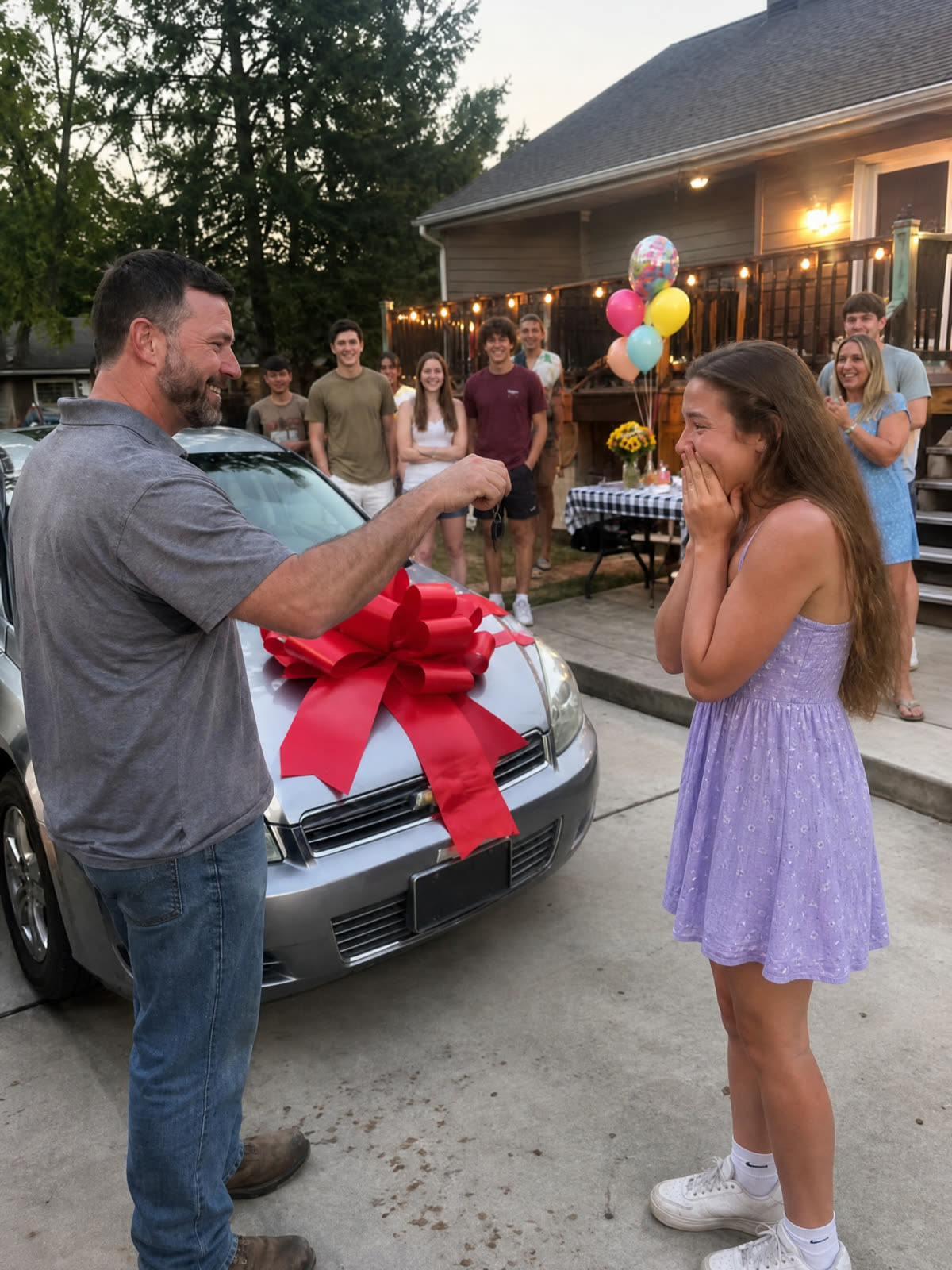
Teenagers crowded beneath the strings of lights in our backyard. It was a June evening, with daylight beginning to fade, and the air carried the smells of freshly mown grass, charcoal, and the inexpensive body spray sixteen-year-old boys around Blount County seemed to pour on. I was still wearing my gray work shirt. Earlier, I’d answered a call in Alcoa for a broken heat pump at the home of a woman with three children and a sick dog. I’d promised twenty minutes and needed an hour and a half. Changing clothes hadn’t happened. In the driveway, a silver Corolla waited beneath an enormous red bow. Before work, I’d washed it twice, vacuumed the mats, cleaned the dashboard, and hung a pine tree air freshener from the mirror. Then I’d removed it because it reminded me of a gas station restroom, only to hang it back up because the mirror looked bare.
Kaylee approached in a lavender sundress, her hands clasped beneath her chin. She used to hold them that way as a little girl whenever she wanted something so badly she hardly dared ask. “Is that mine?” I extended a ring holding a single key. “Rules first,” I said, smiling. “Home by ten on school nights. Eleven on weekends.” Her friends laughed. Hunter, a skinny boy whose haircut resembled a mushroom, said, “Strict.” From the back porch, Crystal answered. “You don’t get a say in that, Austin.” She hadn’t raised her voice. Crystal grew quieter as she grew angrier, and her voice that evening was almost impossibly quiet. “You’re not her father.” Everything in the yard stopped. Twenty-something kids went silent. Someone switched off the bass-heavy song playing through a phone speaker. A moth kept striking a string light. Tick. Tick. Tick.
There were things I could have said. Ten years’ worth were waiting inside me: bills, appointments, school pickups, fevers at three in the morning. But Crystal was Kaylee’s mother, and legally I had no place to stand. On paper, I was only the boyfriend. That was all I’d ever been. Besides, an argument at a sixteen-year-old’s birthday party would hurt the birthday girl most. I kept my eyes away from the porch and looked at Kaylee instead. For a decade, I’d lived in that rented brick ranch in Maryville, Tennessee. The carport leaked, and the back fence contained so many repairs there was hardly any original fence left. Crystal had lived there about a year when we met. Her landlord had ignored her complaints about the air conditioning for two weeks. By the August afternoon I arrived to repair it, the house was ninety-six degrees inside.
That was also the afternoon I met Kaylee. She was six, with both front teeth missing, sitting on the kitchen floor in a Dora the Explorer swimsuit because nothing else she owned felt as cool. Through the open back door, she watched me dismantle the condenser. “What’s that?” she said. “That’s a capacitor.” “What’s it do?” “It gives the motor a little kick to get it started.” “Like a cup of coffee?” I laughed. “Yeah. Exactly like a cup of coffee.” After considering that, she said, “My daddy drinks coffee. He lives in Texas. Or Florida. Mama says Texas.” With no idea how to answer, I showed her the worn-out part instead. Its top bulged like a soda can left in the freezer. “See that? That’s what happens when they wear out. They just give up.” She studied it solemnly. “Can I keep it?” I handed it over. For the next three years, it stood on her bedroom windowsill.
Her father, Travis Doyle, had left when she was two. I’d encountered him once, in a Walmart parking lot when Kaylee was eight. He was visiting for a funeral. Beside his truck, he talked with her for eleven minutes, handed her twenty dollars, remarked on how tall she’d grown, and drove away. She gripped that bill all the way home without speaking. He never contributed anything else. No support, birthday cards, or Christmas presents. Crystal brought him to court twice. After the first judge ordered payments, he relocated to Arkansas. The second time, nobody could locate him. So I covered things. Nobody asked me to. I simply started doing it. Her braces cost five thousand four hundred dollars, paid in automatic installments of two hundred and twenty-five dollars on the fifteenth for two years. When they came off, the Knoxville orthodontist sent a card featuring a cartoon tooth giving a thumbs-up. It was still in my truck.
There were three pairs of glasses, too. At band camp, a tuba player named Garrett sat on one pair. Kaylee called me in tears from a pay phone, which I hadn’t realized still existed. On a Tuesday, I drove two hours to Sevierville and passed her spare glasses through a band-bus window. There were marching band trips: Gatlinburg twice, Orlando once. She played clarinet, and she wasn’t especially good. She knew that and loved it regardless. That was what I admired most. I never requested repayment from either of them. When she was seven, she asked whether I would still be around at Christmas. It was September, or close to it. She was eating cereal while I made coffee. “Austin? Are you still going to be here at Christmas?” I looked over. “Yeah,” I said. “I’ll be here.” “Okay.” Then she returned to breakfast.
The following year, after seeing her father in that parking lot, she asked again. A different month, the same question, spoken more softly. “Are you still going to be here at Christmas?” “Yes, kiddo. I’m going to be here.” She nodded without lifting her eyes. By ten, she no longer asked. Nothing anyone had ever said to me meant more than that silence. For her car, I put aside forty dollars every Friday for three years. The money went into a coffee can beneath the socket wrenches in my truck’s toolbox. Crystal handled the banking, and I didn’t want her noticing. It wasn’t exactly secrecy. I wanted this gift to come from me. A hundred and fifty-six Fridays produced six thousand two hundred and forty dollars, enough for a 2013 Toyota Corolla with a hundred and twenty-six thousand miles.
I bought it from Opal Hensley, a widow in Friendsville. Her husband, Ray, had driven it to the paper mill for eight years before dying in February. Her eyesight had become too poor for driving. She sat on her porch in a housecoat and questioned me before allowing me anywhere near the car. “Who’s it for?” “My girlfriend’s daughter. She’s turning sixteen.” “Your girlfriend’s daughter.” “Yes, ma’am.” “Not yours.” “Not on paper.” For a while, she regarded me through thick glasses. “Ray changed the oil every three thousand miles,” she said. “Not five. Three. You’ll do the same?” “Yes, ma’am.” “And she’ll take care of it?” “She’ll take care of it.” “How do you know?” I considered my answer. “Because she kept a broken capacitor on her windowsill for three years,” I said. “Because I gave it to her.” Mrs. Hensley didn’t know what a capacitor was, but something in the answer satisfied her. She lowered her asking price by a thousand dollars.
Crystal knew I was considering a car. In March, we’d had something resembling a conversation about it. “I’m thinking about getting her something to drive.” Her answer had been, “We’ll see.” That was how she responded to things she didn’t want to debate. What she didn’t know was how I’d handled the title. I’d made that decision alone. Standing in the backyard, with her words hanging between us, I understood there would be a price for it. I placed the key in Kaylee’s palm and gently folded her fingers over it. “Happy birthday, kiddo.” Then I reached into my back pocket for a folded white envelope. “One more thing. Read it.” She opened the envelope and unfolded the blue-and-white title with the Tennessee seal. As she read, her lips moved silently.
Then Kaylee spoke the names aloud. “Kaylee Doyle or Austin Rademacher.” Her eyes lifted to mine. “Why is my name first?” “Because it’s your car,” I said. “I’m only on there till you’re eighteen.” At the county office, the clerk had explained that a minor could appear on a title if an adult appeared with her. Putting “or” between our names meant either of us could sell it. Using “and” would require both signatures. I’d considered that distinction for a long time before choosing “or.” If a truck hit me on a service call, or something else happened and I wasn’t there anymore, I didn’t want my signature standing between her and ownership of her own car. Surrounded by her friends, she read her name once more. Here was something legally hers. A girl toward the back began clapping, then stopped when no one joined in. Everyone remained painfully aware of the porch.
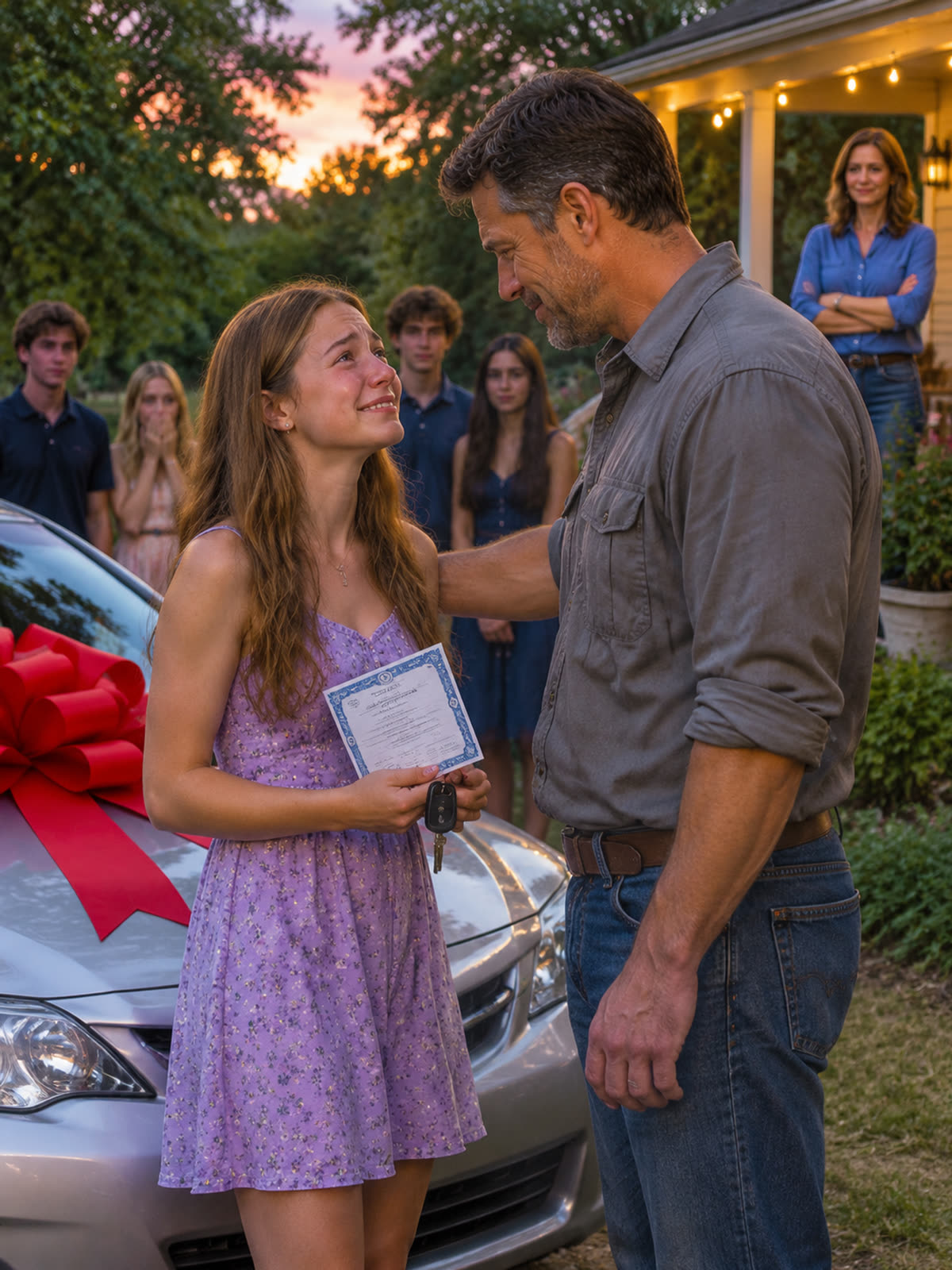
Kaylee refolded the title along its crease, handling it like a letter worth saving. She pressed it and the key to her chest. Without turning, I could still see Crystal beside the screen door. Her arms were crossed over the blue blouse she’d ironed that afternoon, her face shaded beneath the porch light. Kaylee had earned her learner’s permit two days earlier. I’d taken her to the Knoxville DMV because Crystal was working a double at Blount Memorial. She was a unit secretary on the cardiac floor, often working twelve-hour shifts that left her feet so swollen she slept with them propped on a pillow. I’d taken time off and waited in a plastic chair for two hours and forty minutes. Kaylee passed the written test with a ninety-four and emerged waving the paper overhead. “I missed the one about railroad crossings,” she said. “That’s so stupid. When am I ever going to be at a railroad crossing?” “There’s one on Lamar Alexander Parkway.” “Oh,” she said. “Okay. Fair.”
Now she asked, “Can I drive it right now?” Every friend watched, including Hunter and Maddie, her best friend, who already had her phone raised to record. “On a permit, you need somebody twenty-one or older in the front seat,” I said. “I know. You made me read the booklet twice.” She glanced toward the porch, toward her mother, and then back at me. I readied myself without knowing what for. A sixteen-year-old could change like weather. More importantly, she loved her mother. In ten years, I’d never tried to come between them or criticized Crystal in front of her, not during arguments or difficult stretches. I expected Kaylee to choose her mom. With everyone watching after what Crystal had said, asking her mother seemed the decent thing. It was what I would have advised.
Kaylee drew a breath. “Okay,” she said. “I know who I want.” She passed me and crossed the grass, her lavender dress moving as she walked. The title and key stayed in her hand. She went by Maddie and Hunter, heading straight for the steps and her mother. Something shifted inside my chest. It wasn’t exactly pain. Perhaps relief, mixed with something I preferred not to examine. I told myself she was doing the right thing. At the foot of the steps, she stopped and looked up. “Mama,” she said. “Will you come with us?” Crystal blinked. “With us?” “I want Austin in the front seat,” Kaylee said. “He’s the one who’s been teaching me in the church parking lot. He knows how I brake. He knows I turn too wide on the left. He’s the one I want.” There was no cruelty in it. She was simply telling the truth.
“But I want you in the back,” she continued. “I want you both. It’s my first drive. In my car.” Her voice began to tremble. “I don’t want to pick.” For a moment, it seemed nobody drew breath. Crystal looked down at her daughter. The light behind her kept her expression hidden, but I saw her reach for the porch post and grip it. Then she descended the steps. Without meeting my eyes, she walked past, opened the Corolla’s rear door, climbed inside, and shut it. Kaylee turned toward me with enormous eyes. I went around to the passenger side and got in. Beneath the pine air freshener, the interior still carried traces of Ray Hensley: Old Spice and something resembling pipe tobacco.
Kaylee settled behind the wheel and held it at ten and two, just as I’d shown her. Her knuckles had gone white. “Seat,” I said. “Right.” She worked the lever, slid too far forward, then eased back. “Mirrors.” “I know, Austin.” As she adjusted the rearview mirror, Crystal appeared in it, sitting in the middle of the back seat with crossed arms. She was looking through the side window at the teenagers gathering along the driveway, their phones raised. Kaylee saw her, too, but said nothing. “Foot on the brake,” I said. She obeyed and turned the key. The engine caught immediately. Of course it did. Ray Hensley had changed the oil every three thousand miles. Outside, every kid in the yard began screaming.
Our first trip was only around the block. We followed Wilkinson Pike, turned left onto Montvale, left onto Sevierville Road, then left again toward our street. Perhaps a mile and a half, all of it at twenty-five miles an hour. She signaled for every turn. At every stop sign she stopped completely and counted aloud, continuing the little ritual I’d taught her. “One, two, three. Clear left. Clear right. Go.” Her left onto Montvale swung slightly too wide. “Wide,” I said. “I know, I know.” Otherwise, nobody spoke. Behind me, Crystal’s silence felt physical, the way an approaching storm changes the pressure in the air.
The teenagers were still cheering when we returned, and someone had restarted the music. Kaylee shifted into park, shut off the engine, and remained gripping the wheel. She breathed as though she’d run the route rather than driven it. “I did it,” she said. “You did,” I said. Turning, she asked, “Mama? Did I do okay?” Crystal kept her eyes on the window. “You did fine, baby,” she said quietly. Then she stepped out and went inside. The screen door slammed behind her. Kaylee looked over. “Is she mad at me?” “No,” I said. “She’s not mad at you.” “Is she mad at you?” I studied the screen door. “Yeah,” I said. “Probably.” “Because of what she said? Or because of the title?” “Both,” I said. “Maybe. I don’t know, kiddo. Go enjoy your party. This isn’t yours to fix.”
For a while, she kept looking at me. “You didn’t argue with her,” she said. “When she said you weren’t my dad. You could’ve. You didn’t.” “It’s your birthday.” “I know,” she said. “I noticed.” The remaining hours went well, especially for Kaylee. They ate the chocolate cake with strawberry filling from Kroger, the same cake she’d requested since she was seven. They photographed her beside the Corolla and inside it. Maddie had her hold the title as if it were a diploma. When Hunter asked to sit behind the wheel, Kaylee answered, “Absolutely not,” and everyone laughed. I stayed by the grill, scrubbing something that didn’t need scrubbing because my hands needed an occupation. Crystal emerged once with more ice, carefully avoiding my eyes.
Around ten, parents began arriving. Kaylee accompanied each departing friend to the curb, showing off her car again. The last guest left at ten-forty. In the driveway, she put her arms around my neck and gave me a genuine, wholehearted hug. “Thank you,” she said into my shoulder. “Thank you, thank you, thank you.” “You’re welcome, kiddo.” “I’m going to take care of it. I swear. I’m going to change the oil every three thousand miles.” “I know you will.” Pulling away, she searched my face. “Is it going to be okay?” she said. “You and Mama?” I’d never lied to her, and I wouldn’t begin then. “I don’t know,” I said. “But it’s not your job to worry about it. Go to bed.”
Inside, Crystal sat at the kitchen table. Only the stove light was on. An untouched glass of iced tea stood in front of her, and her bare feet rested on another chair. I sat opposite her. For a long time, neither of us spoke. Down the hallway, Kaylee showered and sang off-key. Her singing resembled her clarinet playing: enthusiastic, cheerful, and wrong. “You put your name on her title,” Crystal said. “Yes.” “Without telling me.” “Yes.” “Why?” “Because she’s a minor,” I said. “Somebody had to be on it.” “I could’ve been on it.” I stayed silent. “I’m her mother, Austin,” she said. “If anybody’s name goes next to hers on a legal document, it’s mine. Not yours. Mine.” “I paid for the car,” I said. The words escaped before I could catch them.
Her expression changed. “There it is,” she said. Very quietly. “That’s not what I meant.” “That’s exactly what you meant.” Her feet came down, and she straightened. “Go ahead. Say it. Say the whole thing. The braces. The glasses. Orlando. Say it.” “Crystal—” “Five thousand four hundred dollars,” she said. “Two hundred and twenty-five a month, on the fifteenth. I know, Austin. I know every penny. You think I don’t know? You think I don’t lie awake doing the math?” “I never once asked you to pay me back.” “No,” she said. “You never did. You never once asked. You just paid. And paid. And paid. And every time you paid, I got a little smaller.” I could only stare. “What are you talking about?”
She gave a laugh with no humor in it. “Do you know what it’s like,” she said, “to stand at the orthodontist’s front desk with your debit card in your hand, and the girl says, ‘Oh, it’s already taken care of’? Because you set it up on automatic. Without asking me. Do you know what that feels like?” “I was trying to help.” “I know you were. That’s the worst part.” Her voice broke. “You’re always trying to help. You never once did anything mean. And every single time, I had to stand there and say thank you. For my own daughter. For things I should’ve been able to give her myself.” I had no answer. “Gatlinburg,” she said. “The first time. The band trip. I’d been saving. I had two hundred dollars in an envelope in my underwear drawer. I was going to give it to her the night before. Then she came home and said, ‘Austin already paid for it.’ And I went in my bedroom and looked at that envelope and cried.”
“You never told me.” “Because you’d have looked at me exactly the way you’re looking at me now,” she said. “Like I was crazy. Like I was ungrateful.” Silence stretched between us. In the hall, the shower stopped. “I didn’t know,” I said. “I know you didn’t.” “Why didn’t you ever say something?” “Because how do you say that?” Crystal said. “‘Please stop being so good to my kid’? Who says that? What kind of mother says that?” She covered her face. “And then tonight,” she said through her fingers. “Rules. Home by ten. In front of all her friends. Like you were her daddy. And she looked at you like you hung the moon. And I was standing on that porch in the blouse I ironed, and I’d made the potato salad, and nobody even looked at me.”
“So you said I’m not her father.” “So I said you’re not her father,” Crystal answered. “Because it’s the only thing I’ve got left that’s only mine.” I can’t put into words how that landed. For ten years, I’d repaired that fence, paid bills, and driven to appointments. Not once had I considered the view from her side. I’d believed I was keeping the family standing. It had never occurred to me that I might also be making her feel smaller. “I should’ve asked you about the title,” I finally said. “You’re right. I should’ve asked.” She uncovered her face. “Why didn’t you?” I forced myself past the convenient explanation toward the honest one. “Because I was afraid you’d say no,” I said. “And because I wanted to give her something that was mine to give. Just once. Without anybody’s permission.”
Crystal watched me. “You know I asked you to marry me twice,” I said. Her eyes closed. “Two thousand eighteen,” I said. “In the truck at the Dairy Queen. And two thousand twenty-one. On her fifteenth birthday. After she went to bed. Right here at this table. You said ‘We’ll see’ both times.” “Austin.” “I’m not saying it to throw it at you. I’m saying it because it’s true. Ten years. I’m not her father because you won’t let me be anything on paper. Not her father. Not your husband. Nothing. I’m the guy who pays the orthodontist.” She began crying, quietly, the same way she did everything painful.
“My mama,” she said. “Had four boyfriends. Before I was twelve. Four. Every one of them moved in. Every one of them was good to me at first. Took me to the fair. Bought me shoes. One of them, Dwayne, taught me to ride a bike.” She wiped her cheeks. “And every one of them left,” she said. “Dwayne left on a Tuesday. While I was at school. I came home and his truck was gone and his recliner was gone and Mama was sitting on the couch smoking and she said, ‘Well, that’s that.’ And I went out back and I looked at the bike. And I couldn’t ride it for a year. Because every time I got on it, I thought about him.” I listened without interrupting.
“When Travis left,” she said, “I promised myself. I promised I would never let another man become Kaylee’s daddy. Not unless I was sure. Not unless he couldn’t walk away. Because she’d already lost one. I wasn’t going to let her lose two.” “I haven’t walked away.” “Not yet,” Crystal said. It struck like a punch. “Ten years, Crystal.” “Dwayne was four,” she said. “Four years. I thought he was forever too.” “I’m not Dwayne.” “I know you’re not.” She trembled. “But every time she looks at you like that, like tonight, I think, what if? What if he leaves? What if he meets somebody? What if he just gets tired? Then it’s not a boyfriend leaving. It’s her daddy. And it’ll kill her. And it’ll be my fault. Because I let it happen.”
Her gaze dropped to the table. “Saying you’re not her father,” she said, “was me trying to keep her from getting hurt. That’s all it ever was.” “And what about tonight?” “Tonight,” she said. “Tonight was me being jealous. I’m not proud of it.” Then, down the hall, Kaylee’s bedroom door clicked closed. Both of us turned toward the sound. Neither of us knew how much she had heard—or how long she had been standing there.
PART 2 — The Promise That Followed Me Out
For the next three weeks, I slept on my brother’s couch. Dean lived ten minutes away in Alcoa, in a duplex shared with a dog named Moose and a refrigerator apparently stocked for a diet of hot sauce and Miller Lite. He didn’t interrogate me. He tossed over a blanket. “Bathroom’s on the left. Don’t use my towel.” Crystal and I insisted we hadn’t broken up. The morning after the party, we sat at the kitchen table and discussed it with the careful calm of adults trying hard to be reasonable. “I think we need some space,” she said. “I think so too.” “Just to think.” “Okay.” “It’s not—” She stopped herself. “It’s not over. I don’t think. I just need to think.” “Okay,” I said.
I filled a duffel with work shirts, boots, my good jacket, and my toothbrush. Everything else stayed behind. I told myself leaving most of my belongings meant I would return. Kaylee stood in the hall in her pajamas as I headed for my truck. “Where are you going?” “Uncle Dean’s. For a little while.” “Why?” Crystal and I looked at each other across the kitchen doorway. “Your mama and I need to think about some things,” I told her. Her face drained. “Is it because of me?” she said. “Because of the car? Because of what I said? I’ll give it back. I’ll give the car back. Austin, I’ll give it back—” I lowered my bag and held her shoulders. “Hey. Hey. No.” I made sure she could hear me. “This is not because of you. This is grown-up stuff. This is me and your mama. You hear me? This is not your fault.”
She was crying. “You said you’d be here,” she said. At first, I missed what she meant. Then the old Christmas question came back to me. “It’s June, kiddo,” I said. “Christmas is a long way off.” She held my gaze. She didn’t ask anything else, but the question was there, exactly as it had been when she was seven and eight. Finally, she turned, went into her bedroom, and closed the door. That ten-minute trip to Alcoa was the worst drive I’d ever made. Twice, I had to pull over.
Work kept going. Summer HVAC calls in East Tennessee didn’t leave much room for heartbreak. Equipment failed everywhere, and every overheated customer had a baby, an elderly mother, or a dog who supposedly couldn’t survive another twenty minutes without me. I worked twelve-hour days, sometimes fourteen. The exhaustion helped. Crawling through an attic at a hundred and thirty degrees left little space for thinking. But I continued seeing Kaylee. Before I left the house, Crystal and I had agreed on that much: whatever happened to us, my relationship with her daughter would not simply disappear. “She needs fifty hours,” I’d said. “For her permit. Six months and fifty hours before she can get her license. Ten of them at night.” “I know,” Crystal said. “Who’s going to do that?” She paused. “You will,” she said. “If you still want to.” “I want to.” “Then you will,” she said.
Three or four evenings a week, I drove to the little brick ranch after work and honked once. Kaylee came out holding her permit and the state driving log. She took the Corolla’s driver’s seat, and I climbed into the passenger side. Then we drove. We started at Mount Olive Baptist on Highway 411, which had the largest empty church parking lot in Maryville on a weeknight. First came parking between lines, then backing into spaces. For parallel parking, I brought two orange traffic cones from my truck. The first evening, she flattened them nine times. “I hate this,” she said. “Who even parallel parks? Nobody in Maryville parallel parks.” “Knoxville does. Market Square.” “I’m never going to Market Square.” “You’re going to want to go to Market Square someday.” “Then I’ll park in a garage.”
She hit the cones three more times before finally slipping into position perfectly, two feet from the curb. Once she shifted into park, she screamed loudly enough that a man walking his dog turned to stare. “I did it! Austin! I did it!” “Write it down,” I said. “Twenty minutes.” In the log, she wrote PARALLEL PARKING!!!! in enormous letters, complete with four exclamation points. For the first couple of weeks, Crystal wasn’t a subject we touched. Everything else was fair game: band, school, friends, and the correct way around a roundabout. Counterclockwise, always. Kaylee described Paige, the clarinet section leader, as “a dictator with a reed.” Maddie’s latest boyfriend was “a sentient energy drink.”
About two weeks into the lessons, we stopped at a red light on Washington Street. Without warning, she said, “She cries in the shower.” I turned toward her. “Mama,” she said, keeping her attention fixed on the signal. “She thinks I can’t hear. She turns on the water and she cries. Every night.” I didn’t answer. “Do you?” she asked. “Cry?” The light changed. She checked both directions before carefully moving forward. “Sometimes,” I said. “Where?” “In my truck,” I said. “Mostly.” She nodded. “Me too,” she said. “In the car. When I’m parked at band practice. Before I go in.”
There is something unusual about driving lessons. Two people sit beside each other, their eyes trained on the road rather than on one another, and difficult words seem to find their way out. As the weeks passed, Kaylee told me more. She’d heard the entire conversation from the hallway after her birthday: Dwayne, the money in the underwear drawer, and both marriage proposals. “I didn’t know about that,” she said. “The marrying thing. You never told me.” “It wasn’t yours to know.” “Why did she say no?” “She didn’t say no,” I said. “She said ‘we’ll see.’” A small laugh escaped her. “That’s no. When Mama says ‘we’ll see,’ that’s no.” “Yeah,” I said. “I figured that out eventually.”
She also admitted she was angry with her mother. “She embarrassed you,” she said. “In front of everybody. On my birthday.” “She was hurting.” “So? I’m hurting all the time. I don’t stand on porches and say mean stuff in front of twenty people.” “No,” I said. “You don’t.” “So why do you keep taking her side?” I took time with my answer. “Because I’m not on a side,” I said. “Your mama raised you alone for four years before I ever showed up. She worked two jobs. She went to court twice to try to get money from your daddy. She went without things so you’d have things. I know you know that. But I don’t think you know it the way I do.” She stayed quiet.
“When I met you,” I continued, “you were wearing a swimsuit in the kitchen because it was ninety-six degrees and the landlord wouldn’t fix the air. Your mama had been calling him for two weeks. She called him every single day. She was the one who finally found my company’s number in the phone book and called me. She was the one who paid for that first service call. A hundred and sixty dollars. I found out later she didn’t eat lunch for a week to pay it.” Tears collected in Kaylee’s eyes. “I’m not saying what she said was okay,” I said. “It wasn’t. But don’t you ever think she doesn’t love you more than anything in the world. Everything she does is about you. Even the dumb stuff. Even the stuff that hurts.”
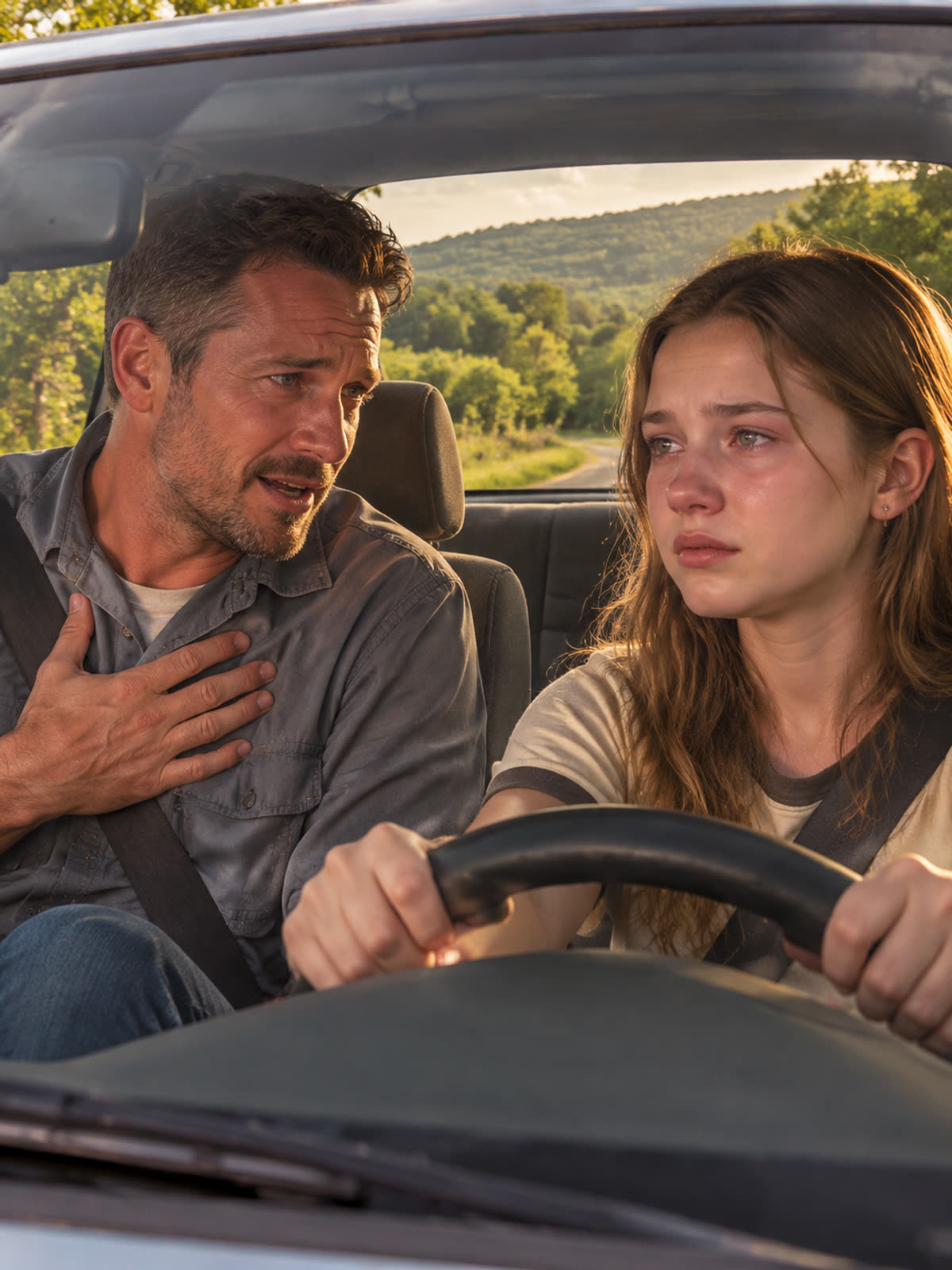
She didn’t speak for a while. On Lamar Alexander Parkway, she slowed as we approached the railroad tracks and checked left and right. “See?” I said. “Railroad crossing.” “Shut up,” she said, though a little smile had appeared. At the end of July, she asked to drive out to Friendsville to thank Mrs. Hensley for the Corolla. I wasn’t certain about the visit, but Kaylee had decided. We went one Saturday morning, taking the back roads for twenty-five minutes. She handled the curves well, slowing before them instead of braking in the middle, as I’d taught her.
Mrs. Hensley occupied her front porch in either the same housecoat or another just like it. When the Corolla rolled onto the gravel, she slowly pushed herself out of her chair and held the railing. Kaylee stepped out carrying a plate wrapped in aluminum foil. She’d gotten up at six to bake chocolate chip cookies, burned the first batch, and made Crystal eat those anyway. “Mrs. Hensley?” she said. “I’m Kaylee. I have your car.” Through her thick lenses, the old woman studied her, then looked toward me. “Is this the capacitor girl?” she said. Confused, Kaylee glanced back. “Yes, ma’am,” I said. “This is her.”
We spent an hour and a half on the porch while Mrs. Hensley talked about Ray and the paper mill. For eight years, he’d left in that Corolla at five-thirty each morning, returned at four-fifteen, and sat listening to the radio in the driveway for ten minutes before coming inside. “What was he listening to?” Kaylee asked. “The ballgame,” Mrs. Hensley said. “In the summer. In the winter, gospel. He liked the Gaithers.” “Why’d he sit in the driveway?” Mrs. Hensley smiled. “I asked him that once,” she said. “He said it was the only ten minutes of the whole day that was just his. Not the mill’s. Not mine. Not the church’s. Just his.” Kaylee looked toward the silver car. “That’s why you asked where it was going,” she said. “When Austin bought it.” “I wanted to know it was going to somebody who’d sit in the driveway,” Mrs. Hensley said.
For much of the return trip, Kaylee said nothing. Then she asked, “Austin? Do you ever sit in the driveway?” “Sometimes.” “Before you come in? At home?” I considered all those years of late service calls, arriving home at nine or ten and switching off the truck beneath the carport. Five minutes in the quiet. Ten. Sometimes twenty. “Yeah,” I said. “I guess I do.” “Why?” The answer wasn’t ready. Eventually I said, “I think,” then finished, “it’s the only time I’m not doing something for somebody.” She nodded slowly. “Mama sits in the driveway too,” she said. “After her shifts. I watch her from my window. She just sits there.”
Then came a Friday in September. That was the night things changed. At about eleven-twenty, I was asleep on Dean’s couch, with Moose stretched across my feet, when my phone rang. Kaylee. I shot upright so quickly the dog landed on the floor. “Kaylee? What’s wrong?” She was crying. Loud music and shouting came through behind her voice. “Austin,” she said. “Austin, can you come get me? Please? I’m sorry. I’m so sorry.” “Where are you?” “A party. Out on Six Mile Road. Somebody’s house. Maddie drove. And Maddie’s drunk, Austin. She’s really drunk. And she’s saying she’s fine to drive. And I can’t drive because I’m on a permit, and it’s after eleven, and it’s not my car here anyway, and I don’t know what to do.”
“Don’t get in that car,” I said. “You hear me? Don’t you get in that car with Maddie. I’m coming. Send me the address.” “Okay. Okay.” “Kaylee. Did you call your mama?” Nothing. “Kaylee.” “No,” she said. “I called you.” I was nearly through the door when I stopped. On Dean’s front steps, still in my socks, I stood holding my keys. Then I called Crystal. She answered immediately, sounding wide awake as she always did after twelve years of night shifts. “Austin? What’s wrong?” “Kaylee’s at a party on Six Mile. Maddie drove her, and Maddie’s drunk. Kaylee called me to come get her. I’m on my way. I wanted you to know.”
A pause followed. I could hear everything inside it: the birthday porch, the reminder that I wasn’t her father, the fact that Kaylee had called me instead of her mother. “I’ll meet you there,” Crystal said. “Crystal—” “Send me the address.” The call ended. I arrived first, fourteen minutes later. I couldn’t tell you my speed, only that it was too fast. The house was large, at the far end of a long gravel driveway crowded with cars. Music rattled the windows. Teenagers wandered the lawn, and some were throwing up into bushes. At the driveway’s end, Kaylee sat alone on the curb with her arms locked around her knees. Maddie lay nearby in the grass, flat on her back and singing.
When Kaylee recognized my headlights, she jumped up and ran toward me. Her arms went around my neck. She shook all over. “I didn’t drink,” she said against my shoulder. “I swear, Austin. I didn’t drink anything. I had one sip of something and it tasted like nail polish remover and I spit it out. I swear.” “I believe you.” “I’m sorry. I’m so sorry. I should’ve called Mama. I should have—” “Hey,” I said. “You called somebody. That’s what matters. You didn’t get in that car. That’s what matters.” Another pair of headlights turned into the drive. Crystal’s old Malibu pulled in behind my truck.
Crystal stepped out wearing her scrubs. Her shift had ended two hours before, and she still hadn’t changed. As she walked toward us, Kaylee released me and stood in the headlights, looking suddenly very small. “Mama,” she said. “I’m sorry. I’m sorry I didn’t call you. I just—” Crystal reached her and wrapped her in such a fierce hug that Kaylee’s feet almost lifted off the ground. She didn’t speak. With her eyes closed, she simply held her daughter for a long time. Then she opened them and looked at me over Kaylee’s shoulder.
I have no idea what she saw on my face. I know what I saw on hers. It wasn’t the look from the porch, or the jealousy, or that guarded fear. Something had opened. She looked exhausted and exposed, like someone who had spent ten years bracing a door shut and finally stepped away. “Thank you,” she said softly to me. “She called me,” I said. “I’m sorry. I didn’t—” “I know,” Crystal said. “She called you. Because she knew you’d come.” Tears ran down her face. “And you called me,” she said. “You didn’t have to. You could have just come and got her and brought her home and told me in the morning. You called me first.” “She’s your daughter,” I said. She held my gaze for a long, long moment. “She’s ours,” she said.
PART 3 — The Name She Wanted to Keep
We brought Maddie home before doing anything else. Her parents were furious. Her father answered the door in boxer shorts, and Maddie threw up on the porch while Kaylee held back her hair. Crystal then took Kaylee home in the Malibu. I drove Maddie’s car back from Six Mile Road because it couldn’t stay there, and Crystal followed me before returning me to my truck. By the time I pulled into the brick ranch’s driveway behind her, it was almost two in the morning. I hadn’t intended to stay. The plan was to drop off Maddie’s keys and return to Dean’s. Instead, Crystal came to my window. “Come in,” she said. “Just for a minute.”
We returned to the same kitchen table, the same chairs, and the same small light above the stove. Kaylee had gone to bed. Through the wall, we could hear her speaking quietly on the phone, not crying. Probably Maddie, or Maddie’s mother. At two in the morning, Crystal made coffee. “I’ve been thinking,” she said. “Okay.” “For three months. Every night. In the driveway, after my shift.” She looked at me. “Kaylee told you I sit in the driveway?” “Yeah.” “She tells you everything.” “Not everything,” I said. “More than she tells me,” Crystal said. She placed a mug of black coffee in front of me without asking how I wanted it.
“I was wrong,” she said. I looked up. “On the porch,” she continued. “I was wrong. What I said. In front of her friends. It was the cruelest thing I’ve ever done. And I did it to the one person who’s never once been cruel to me. Or her.” “You were scared.” “I was jealous,” she said. “Let’s not dress it up. I was jealous of you. Jealous that you could give her things I couldn’t. That she looked at you like that. And instead of saying it to you, like a grown woman, I said the meanest true thing I could think of. In front of everybody.” Her hands closed around her mug.
“You’re not her father,” she said. “That’s true. On paper. But you know what Travis Doyle is? He’s her father. On paper. He’s on her birth certificate. He’s the one who gave her that twenty-dollar bill in the Walmart parking lot.” She shook her head. “And you’re the one she called at eleven-twenty on a Friday night when she was scared,” she said. “Not me. Not Travis. You.” “That doesn’t mean she loves you less,” I said. “I know.” “She called me because I’m the one who drives with her. Because I was in the front seat. That’s all.”
“I know,” Crystal said. “I know. I’m not mad about it anymore. I’m glad. You understand? I’m glad. When I got that call from you, I was so scared, and then I realized she’d called you, and the first thing I felt was relief. That she had somebody. That she had two of us.” Her eyes met mine. “I’ve spent ten years trying to protect her from getting a daddy who might leave,” she said. “And all that time she already had one. Who didn’t.” I couldn’t find words. Across the table, she reached for my hand. “I don’t want you on your brother’s couch anymore,” she said. “I want you home.”
I looked down at her hand covering mine. “What about Dwayne?” I said. “What about ‘not yet’?” She came close to laughing. “Dwayne taught me to ride a bike,” she said. “And then he left on a Tuesday. And I couldn’t ride for a year.” Her fingers tightened around mine. “You taught my daughter to parallel park,” she said. “And then you went to Six Mile Road at eleven-twenty on a Friday night. And you called me first.” Slowly, she shook her head. “You’re not Dwayne,” she said. “I don’t know why it took me ten years to see it.”
The following weekend, I moved back. Nothing transformed overnight. We weren’t suddenly perfect. But we talked more than we had in ten years, particularly about money, the orthodontist, and the envelope she’d hidden in her underwear drawer. We agreed that any purchase for Kaylee over a hundred dollars would be discussed first. Both of us would be included. Both of us would have a voice. “Even if it’s something good?” I asked. “Especially if it’s something good,” Crystal said. “I want to get to be part of the good things too, Austin. Not just the bills.” I carried that sentence with me.
In October, I took Kaylee onto the interstate for the first time. On I-140 toward Knoxville, she gripped the steering wheel as though she might break it loose. “You can breathe,” I said. “I’m breathing.” “You’re not breathing.” “I’m breathing internally.” A passing semi rocked the little Corolla. She let out a short scream but kept the car steady in its lane. “Good,” I said. “That’s good. Just keep it in your lane.” “How do you do this every day?” “I don’t think about it anymore.” “I’m never not going to think about it,” she said.
After we’d driven a while, she spoke again. “Austin? Can I ask you something?” “Sure.” “Are you going to ask her again?” I glanced toward her. “Ask who what?” “Don’t play dumb,” Kaylee said. “Mama. Are you going to ask her again? To marry you?” I said nothing. Carefully, without taking her eyes from the road, she continued. “Because I think,” she said, “if you asked again, she wouldn’t say ‘we’ll see.’” “How do you know?” “Because she’s been sitting in the driveway less,” Kaylee said. “And she sings in the shower again instead of crying. And she bought a new dress at Belk last week and didn’t tell anybody and hung it in the back of her closet.” She checked the mirror and executed a perfect lane change. “Just saying,” she said.
December arrived. On the twenty-second, a Sunday, Kaylee had forty-eight hours in her driving log and needed two more before taking her test in January. At six that evening, with darkness already down, we drove out to finish them. Christmas lights covered Maryville. In places, entire streets shone. We cruised through a neighborhood off Montvale where seemingly every house had committed itself to Christmas: inflatable Santas, music timed to flashing decorations, and one display bright enough that it probably showed up from an airplane. Kaylee pulled over in front of it and shifted into park. For a while, we watched the lights blink along with “Carol of the Bells.” “Austin,” she said. “Yeah?” She kept looking at the lights. “Are you still going to be here at Christmas?”
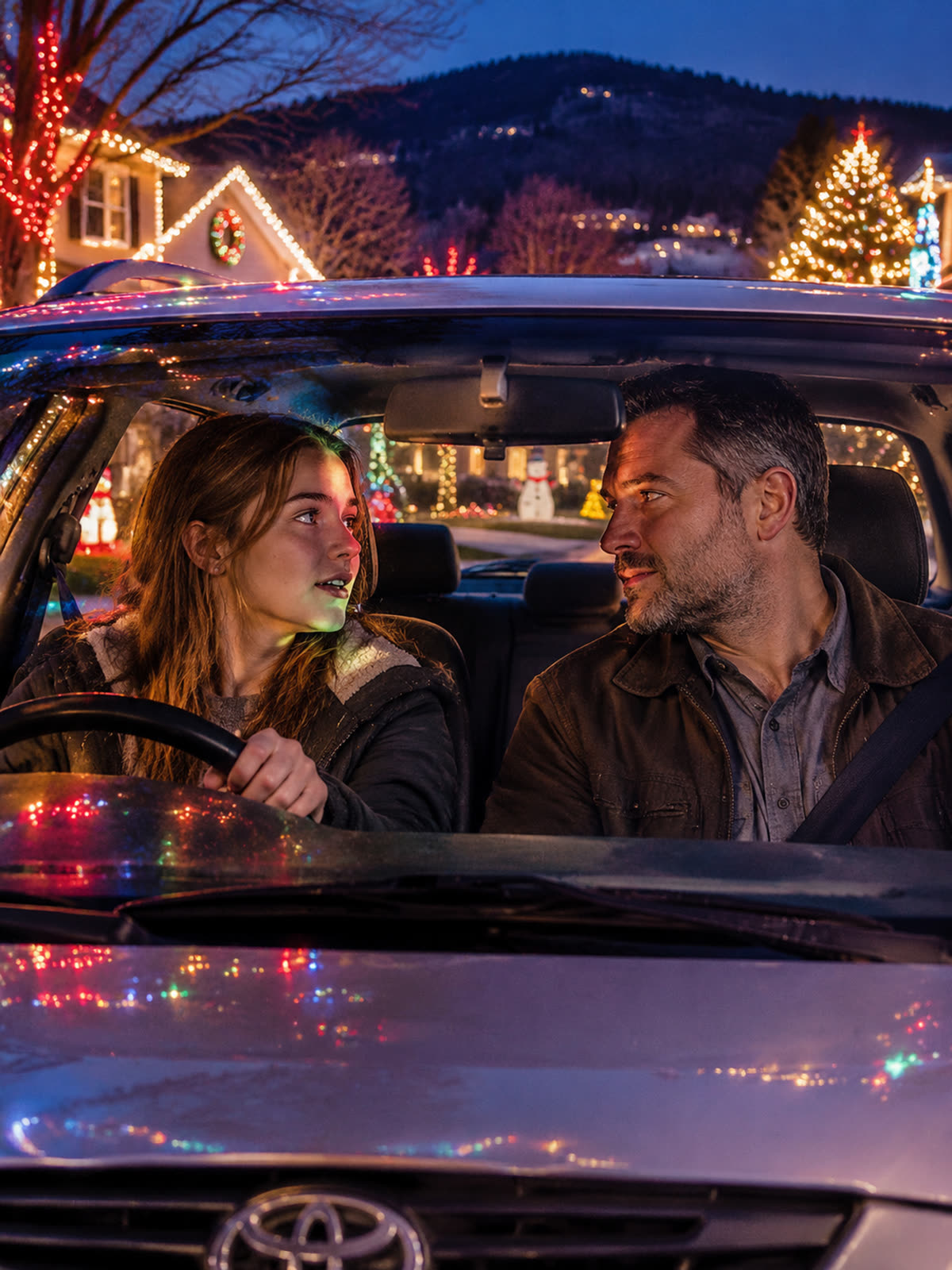
I turned toward her. She was sixteen, six months away from seventeen. The braces were gone. She wore glasses I’d bought and drove a car with her name listed before mine on its title. She had handled interstate traffic, learned to parallel park, and called me from a curb on Six Mile Road. Now she was asking exactly what she’d asked at seven over a bowl of cereal. Yet this time, I could hear the difference. Fear wasn’t shaping the words. She sounded as though she knew the answer and simply wanted to hear it. “Yeah, kiddo,” I said. “I’m going to be here at Christmas.” She nodded. “Okay,” she said.
Then she broke into a wide smile, showing every tooth I’d paid five thousand four hundred dollars to straighten. “Good,” she said. “Because Mama’s going to say yes this time. Don’t screw it up.” I asked on Christmas Eve. We were at the kitchen table again, beneath the stove light, with two cups of coffee between us. This time, however, Kaylee sat there in her pajamas. Crystal had said she belonged with us. This was a family matter, and family meant everyone. I hadn’t prepared a speech. The previous two proposals had come with carefully planned speeches. This time, I simply set the ring box on the table and slid it toward Crystal.
She looked at the box, then at me, then at Kaylee. Our girl held both hands together under her chin, the way she had on her birthday and when she was little and afraid to ask for something she desperately wanted. “Well?” Kaylee said. “Say something, Mama.” Crystal opened the box and studied the ring for a long time. Then she closed it. “Yes.” No “we’ll see.” Just yes. Kaylee screamed so loudly that the neighbor’s dog began barking.
We married in April at the courthouse in Maryville. It was a small wedding. Dean stood beside me as best man. Maddie and her mother attended, along with Crystal’s sister from Chattanooga. Mrs. Hensley came, too. Kaylee drove the Corolla to Friendsville to collect her, then escorted her up the courthouse steps, carefully holding her arm. Kaylee served as maid of honor in the lavender sundress from her birthday. Afterward, she drove us to dinner: Crystal in the rear seat, me beside her in the front, and Kaylee at the wheel with the intermediate license she’d earned in January. She’d passed on her first attempt. Her parallel parking had been perfect.
At a red light on Broadway, Kaylee found her mother in the rearview mirror. “Mama,” she said. “Can I ask you something?” “Anything, baby.” “Home by ten on school nights. Eleven on weekends.” Crystal looked puzzled. “What?” “The rules,” Kaylee said. “The car rules. From my birthday. Austin said them, and you said he didn’t get a say.” Silence filled the Corolla. Crystal looked at me. I kept my eyes on the windshield. Then she laughed. Not a strained laugh, but the real one I’d fallen in love with in that unbearably hot kitchen ten years earlier, when she discovered the capacitor cost thirty dollars rather than three hundred.
“Ten on school nights,” Crystal said. “Eleven on weekends. That’s the rule.” “So he gets a say?” Crystal leaned forward and rested a hand on my shoulder. “He’s always had a say,” she said. “I just didn’t want to admit it.” The signal changed to green, and Kaylee drove on. She is eighteen now. Her birthday was last month, in June, and we celebrated in the backyard again beneath the string lights. There was another Kroger cake, chocolate with strawberry filling. Next year she graduates from Heritage High School. She wants to attend UT and study engineering. She says she wants to understand how things work. She says an old capacitor started it.
The morning after her eighteenth birthday, I knocked on her bedroom door with the title in my hand. I’d taken it from the fireproof box in the hall closet. It was still blue and white, still stamped with the Tennessee seal. “Hey, kiddo,” I said. “You’re eighteen. You don’t need me on this anymore. We can go to the county office today and take my name off. Make it all yours.” From her bed, she looked up and extended a hand. I passed her the paper. Once again, her lips moved while she read, just as they had the first time. Kaylee Doyle or Austin Rademacher.
She folded it along the original crease, now worn soft as cloth after two years, and handed it back. “Leave it,” she said. “Kaylee—” “It’s my car,” she said. “I know it’s my car. I don’t need it to say so.” For a long moment, she looked straight at me. “I like the ‘or,’” she said. I returned the title to the fireproof box in the hall closet. Then I went outside and climbed into my truck under the carport. With the engine off, I sat in the driveway. Five minutes. Ten.
Through the kitchen window, I watched Crystal make pancakes. Kaylee came in, stole one directly from the spatula, and received a swat from a dish towel. Both of them were laughing. Above the sink, an old swollen capacitor sat on the windowsill. It had moved there from Kaylee’s bedroom when she was nine and had remained ever since. Crystal dusted around it. I stayed there watching them through the glass, then got out of the truck. Not because I had finished sitting in the driveway. Because I no longer needed to. And I went inside.
Disclaimer: This story is a work of fiction inspired by real-life themes. Names, characters, places and events are fictionalized, and any resemblance to real persons is purely coincidental. It does not represent any person or organization and does not encourage inappropriate behavior. Images are for illustration purposes only.
