

PART 1 — The Promise Across the Road
We gave my husband’s uncle nine thousand dollars to harvest our peanuts. That was our arrangement, the same one we had followed for fifteen years: Hoyt handled the digging, and Lamar handled the picking. Fifty dollars per acre on 180 acres, settled with the usual August handshake over Lamar’s tailgate. Only this time, Lamar wanted payment before the work. He had never asked for that before. “Got some things to settle,” he said. “I’d sure appreciate it, son.” Hoyt wrote out the check. Lamar creased it once, tucked it into his work-shirt pocket, and gave the pocket a pat. “Friday,” he said. “Ten o’clock. Soon as the dew burns off.”
By Friday morning, our peanut vines had spent four days turned over in their windrows. A field looks peculiar after a peanut digger has crossed it. The entire plants come out of the earth and roll upside down, leaving their roots and pods facing the sky in straight lines over the sandy red soil. It resembles the aftermath of an enormous comb being drawn across the ground. Those exposed pods need sunshine to dry and cure. Four days had brought ours to the proper point—not green anymore, but not overly dry. Lift a pod and shake it, and the nuts would rattle inside. They were ready. Lamar was supposed to arrive at ten. At nine-thirty, I was filling a cooler in the kitchen with ham sandwiches, sweet tea, and a sleeve of peanut butter crackers that Hoyt considered funny. Twenty minutes later, he was outside with his coffee, watching the road.
At precisely ten, Lamar’s combine came to life. That machine could be heard a mile away: a huge red self-propelled combine, its cab sitting above the machinery and its bin behind. He had bought it new in 2011, and there wasn’t another like it in our end of the county. We heard the engine catch, then settle into the deep, even roar of harvesting. But it was across the road. In Lamar’s field. Hoyt remained in the yard with his cup in his hand, standing so still that I finally spoke. “Maybe he’s just running it a minute,” I said. “Warming it up. Checking something.” He offered no answer. The engine kept its rhythm as the combine traveled one row and returned along another. Hoyt placed his coffee on his truck’s hood. “I’m going over there,” he said.
From the porch, I watched him cross the road, park beside Lamar’s field, and approach the moving combine on foot. Lamar neither stopped nor slowed. He opened the cab door and leaned out while Hoyt walked beside him through the dirt. They had to speak over the machine. I was too far away to make out anything, but afterward Hoyt repeated every word. “Uncle Lamar. You were supposed to be at our place at ten.” “I know it, son.” “Our vines are ready. They’ve been ready since yesterday.” “So are mine.” “Uncle Lamar.” “This is my last crop, son,” Lamar said. “You know that. I want mine safe first.” Hoyt continued alongside the cab. “You cashed our check, Uncle Lamar.” Lamar kept his eyes on the field ahead. “I’ll get to you when I get to you,” he said. Then he closed the door. Hoyt stopped in the row and watched the combine pull away. Back in his truck, he sat without starting it. Even from our porch, I could see his hands fixed on the steering wheel.
Eventually, he returned and climbed the porch steps as though each one required thought. He lowered himself into the rocker beside mine. “He’s doing his first,” he said. “I heard.” “He said he’ll get to us when he gets to us.” My husband was fifty-one, with a sunburned neck and hands worn tough as leather. He had worked this land since nineteen, ever since his father died. Never had I seen that particular look on him, as though a blow had emptied his lungs. “How many acres does Lamar have?” I asked, although I knew perfectly well. “Two-forty.” “How long will that take him?” I watched him calculate. “Four days,” he said. “If nothing breaks. Five, if it does.” I opened the weather on my phone, though the entire county already knew the forecast. Since Tuesday, the news had been following Pilar, a tropical storm in the Gulf. It was expected to make landfall near Apalachicola before curving through our part of Georgia on Monday evening.
Rain ordinarily does little harm to peanuts still underground. Most of the time, a farmer welcomes it. But digging changes everything. Once the plants are turned over, time begins running against you. A downpour can pound the pods loose, burying them in soil where the picker cannot reach them. Those that remain attached get soaked, stay damp, grow mold, and eventually rot. Too much mold means a rejected load at the buying point, or a grade so poor the crop scarcely pays anything. One night can take a farmer’s entire year. We had 180 acres exposed—nearly two hundred thousand dollars. Seed, fertilizer, diesel, rent, the tractor loan: everything was out there in those rows. Sixty acres belonged to Hoyt’s mother. Inez Harrell was eighty-one and lived at the end of our road in the little white house her husband built in 1962. She walked with a cane because of her hip and carried a pistol in her apron for snakes. She had buried her husband, two brothers, a child, and four Spring Creek Baptist preachers. Those acres supported her. There was hardly any Social Security; Wendell had farmed all his life without paying much into it. At his death, he left the house, the land, and a pickup with two hundred thousand miles. Every fall, Hoyt brought her share of the peanut money in a cashier’s check. She deposited it in Donalsonville and stretched it through twelve months of groceries, electricity, heart medication, and appointments with her hip doctor in Dothan. All of that was waiting in the field for Lamar.
Later, people wanted to know why we hadn’t sued him. It was a fair question. He had accepted payment and failed to deliver the work. But Hoyt would never take his dead father’s brother into court. When Wendell died in a tractor accident, Hoyt was nineteen. His father had been bush-hogging a ditch bank when the tractor overturned; they found him that evening after he failed to come home for supper. Hoyt’s acceptance letter from Abraham Baldwin, the agriculture college in Tifton, was still on the refrigerator. He never attended. His mother and little sister needed looking after, and somebody had to work the farm. He understood only half of what that required. Lamar came every morning at five throughout that first year. He taught him planter calibration, soil tests, and how to scrape a peanut hull with a thumbnail to judge the color underneath. When nobody else would, Lamar co-signed his first operating loan. He had become the nearest thing to a father Hoyt still had. No, there would be no lawsuit. Besides, legal papers couldn’t harvest peanuts. Long before a judge could hear us, Pilar would have passed through and left our crop decaying.
That Friday, the four of us gathered in the kitchen: Hoyt, me, and our sons. Beau was twenty-two and had finished at ABAC in May—the college his father never got to attend. He was helping us through harvest before beginning an October job with the extension service in Colquitt. Clayton, eighteen and a senior at Seminole County High, had taken the week off for harvest, as plenty of local boys did. “We could call around,” Beau said. “Somebody’s got to have a combine free.” “Everybody’s picking,” Hoyt said. “Everybody heard the same weather we did. Every combine in three counties is running right now.” “What about the Daniels boys? Over in Iron City?” “Called them yesterday when I first saw the storm track. They’re booked through Tuesday.” “What about Pritchett?” “Pritchett’s combine’s broke down. Been in the shop a week.” Beau dragged a hand through his hair. “So what do we do?” We had no answer. Standing at the sink, I looked beyond the yard, the barn, and the pecans. My eyes stopped on my father’s shed.
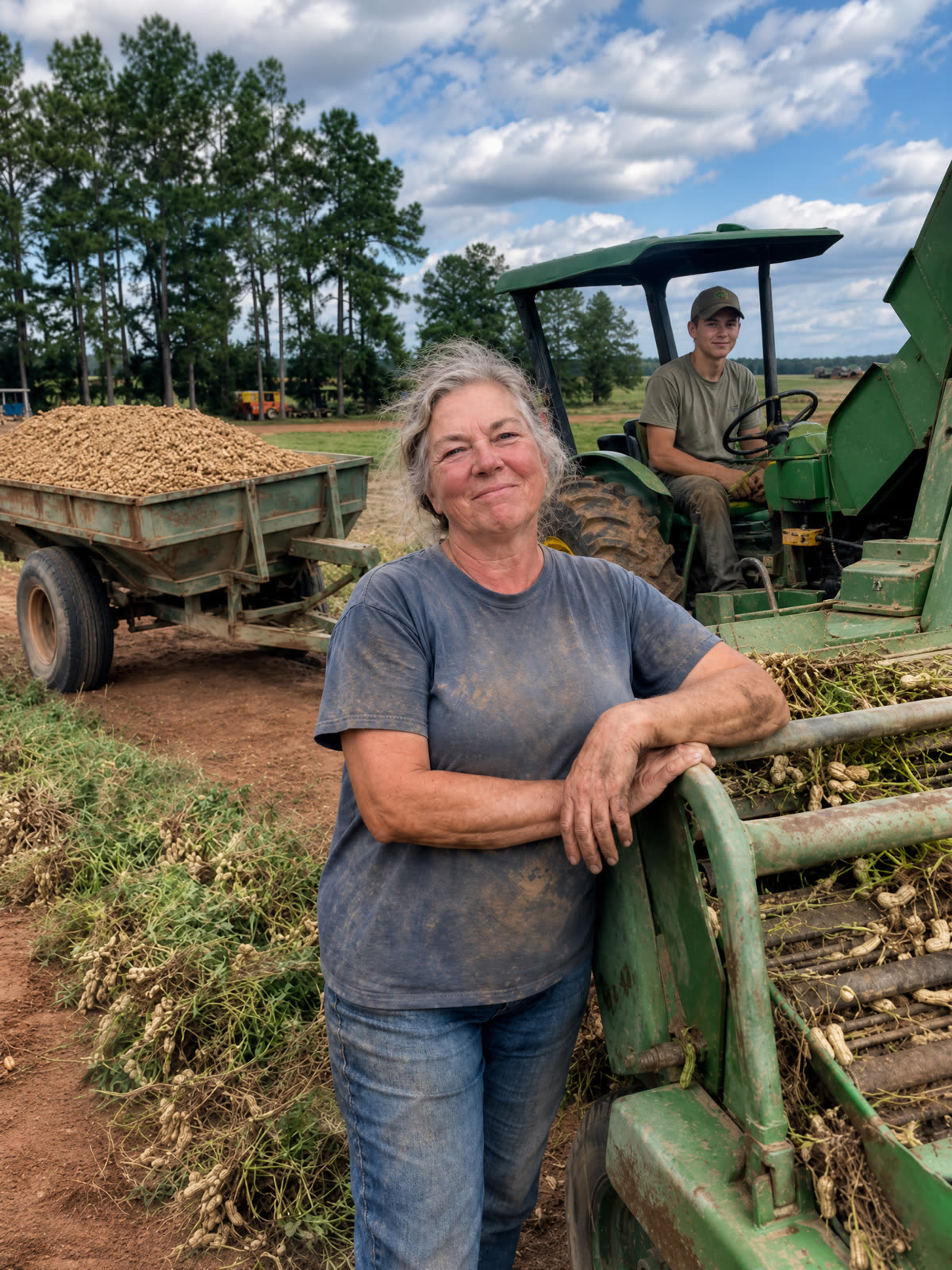
Daddy’s name was Earl Bledsoe. For fifty-one years, he grew peanuts, cotton, and some corn on four hundred acres near Seminole State Park. He was short, with arms thick as fence posts and a laugh that carried into the next field. Pancreatic cancer took him six years earlier, in only four months. We sold his acreage because my brother Rusty, who worked with computers in Atlanta, didn’t want it, and I couldn’t manage both farms. Most of the machinery went at a December auction. I held on to one thing: his 1985 two-row peanut picker. It was a pull-type machine, dragged behind a tractor, lifting vines, shaking off peanuts, and blowing them into an overhead basket. Its green paint was worn, and most of the white stripe along its side had peeled away. It harvested two rows while Lamar’s combine handled six. Two-rows were mostly left to old men and farmers who couldn’t buy anything else. The auctioneer reckoned it might bring four thousand dollars. I kept it anyway. Hoyt hauled it home and put it beneath a tarp in the shed, where it had stayed for six years. “Daddy’s picker,” I said. Everybody turned. “What?” Hoyt said. “Daddy’s picker,” I said. “In the shed.” He stared. “Della,” he said. “That thing hasn’t run in six years.” “It ran fine the last time Daddy used it.” “That was six years ago.” “It ran fine.” “It’s a two-row,” Hoyt said. “We’ve got a hundred and eighty acres. With Lamar’s combine, that’s three days. With a two-row?” He calculated again. “That’s eight days. Nine. If nothing breaks.” “Then we don’t sleep,” I said. Beau looked toward him; Clayton looked toward me. Hoyt planted his hands on his hips. “Della.” “We have three days,” I said. “Until Monday evening. Daddy used to pick a hundred acres with that thing in four days. Him and one hired man. He told me so.” “Your daddy was a legend.” “And he’s not here,” I said. “So it’s us.” After a long look at me, Hoyt fetched his work gloves from beside the back door. “All right,” he said. “Let’s go look at it.”
Daddy’s shed was a small tin-roofed building behind the barn. The door caught as usual, and I had to shove it with my shoulder. Inside came the familiar smells of old oil, dust, and mouse nests. A narrow shaft of sunlight entered through a hole overhead, bright with drifting dirt. Beneath the tarp sat that bulky green outline. Beau caught one corner and pulled. Six years of dust rose around us. Both boys coughed, and a disturbed wasp circled through the air. Then we could see what we had: faded paint, a rusty hitch, a flat left tire, webs everywhere, and a bird’s nest in the basket. Beau waved the cloud away from his face. “Mama,” he said. “This thing is older than me and Clayton put together.” “Then it’s had plenty of rest,” I said.
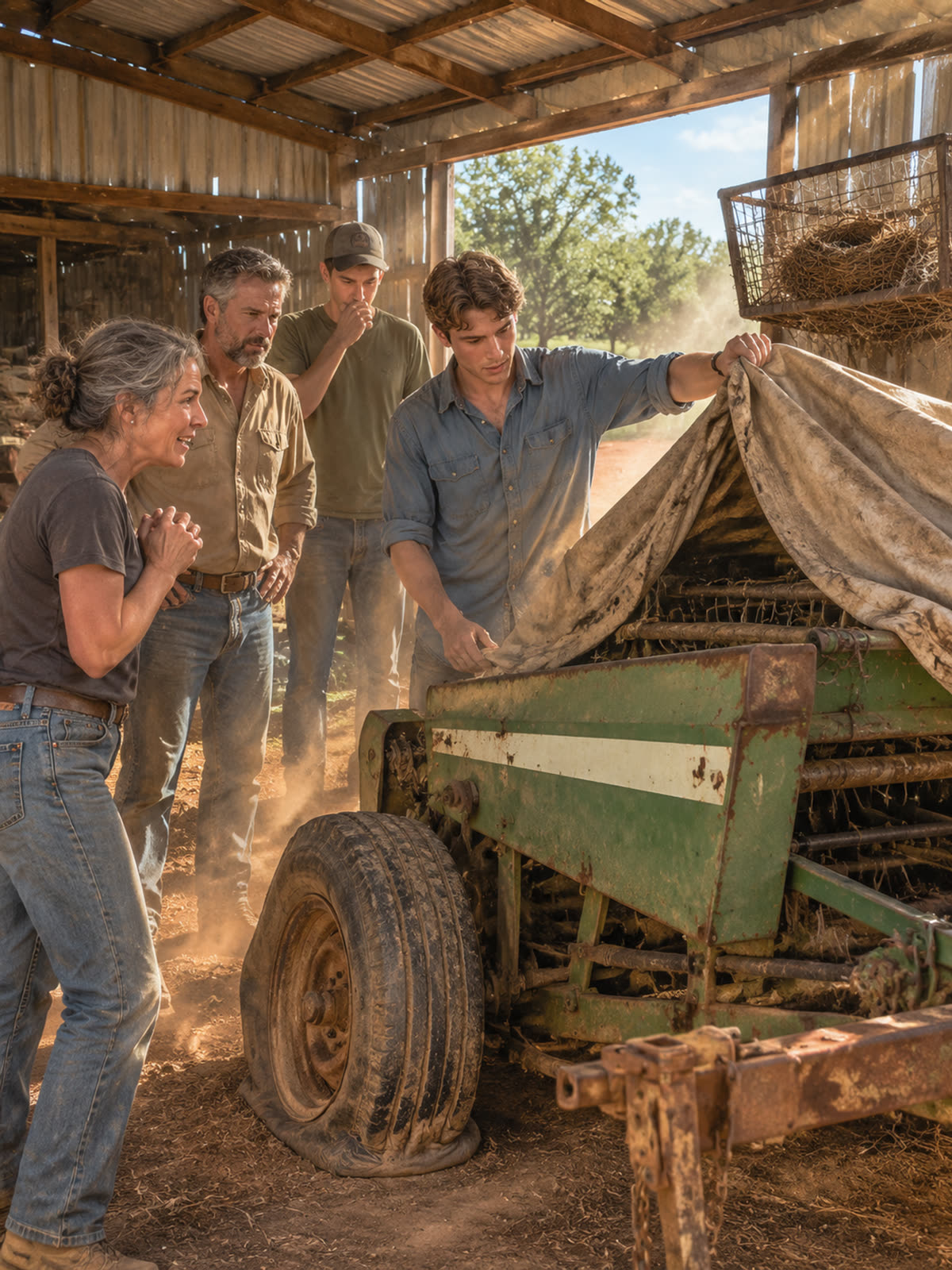
Hoyt moved around the picker slowly, inspecting with his eyes and hands. Then he lay on the dirt and slid underneath with a flashlight. He stayed there long enough that we waited without speaking. When he emerged, dust covered him. “Belts are shot,” he said. “Both main drive belts. Rotted. And a bunch of the picking fingers are broke. The rest of it…” He ran his sleeve across his face. “The rest of it doesn’t look too bad. Honestly. Your daddy took care of it.” “He always did.” “Tire needs air. Probably needs a new one. Every bearing on it needs greasing. Every fitting.” He shook his head. “But it might run.” “Might,” Beau said. “Might,” Hoyt said. His search for parts took him first to the John Deere dealership in Donalsonville, then to the Kubota place in Bainbridge. Neither had the necessary belts for a machine that old. Finally, he reached Dewey’s salvage yard outside Colquitt, a field of abandoned equipment slowly rusting among weeds. Dewey had the belts and a coffee can filled with picking fingers. “Whose picker?” Dewey asked. “Earl Bledsoe’s.” Dewey studied him. “Earl’s old two-row? The ‘85?” “That’s the one.” He disappeared into the back and returned with a used tire on a rim, exactly the size we needed. “Take it,” he said. “No charge. Earl pulled me out of a ditch in 1997 and never let me pay him for it.”
At home, the boys worked through every grease fitting. There were forty-something of those little nipple-shaped points around the bearings, and each needed fresh grease until the old stuff squeezed out black and hardened on the other side. Beau took the left, and Clayton took the right. I went into the shed for another grease gun. One hung from a nail beside a Farm Bureau calendar that still showed the month Daddy died. When I lifted it down, I noticed the letters scratched into its barrel: E.B. They were deep and uneven, cut with a nail into something he had intended to keep. For a moment, I couldn’t move. I saw him kneeling beside the picker’s left wheel before sunrise, cap tipped back, October breath showing in the gray air. He would grease each fitting slowly and carefully while humming an old hymn. As a little girl, I had stood beside him in my nightgown and rubber boots, gripping a flashlight with both hands. “Little more to the left, Della Mae. Little more. There. That’s my girl.” I hadn’t remembered that in years. Clayton came up behind me and looked from the initials to my face. My baby was eighteen, six foot two, with the same arms everybody remembered on my father. Without another word, he gently took the grease gun. “I’ll carry this one, Mama,” he said. Then he returned to the machine and knelt beside the left wheel.
Hoyt fitted the replacement belts and changed fourteen broken picking fingers. He aired the tires and mounted Dewey’s on the left. Beau climbed up to remove the abandoned nest from the basket. Inside were three small speckled eggs. He couldn’t bring himself to discard them, so he placed them in a coffee can on the shed shelf. By two-thirty, Hoyt had backed our 2004 Deere up to the picker. It was older than I wished, but dependable. Clayton fastened the hitch while Beau connected the PTO shaft. From the tractor seat, Hoyt glanced back at us. “Here goes nothing,” he said. He engaged the PTO. The picker trembled and groaned like something waking after years asleep. Its belts shrieked. Something clanged once inside. Then the mechanism caught. The shaft turned, the cylinder spun, and the fan began blowing. That whole old machine shook and rattled and roared—and ran. Beau let out a whoop. Clayton sent his cap into the air. Hoyt sat with his hand on the lever and his eyes closed. I stood in the dust, crying.
We entered the field at three that afternoon. Clayton took the tractor because nobody in our family could hold a windrow better. He drove smoothly and steadily, keeping the wheels centered for a mile without wandering. I stood on the little side platform Daddy had built onto the picker, one hand wrapped around its railing. An old two-row needed a rider to watch the vines feed, spot blockages, and keep the basket from overflowing. When it filled, a lever released the load. I watched the pickup reel lift vines from the dirt and draw them inside. Peanuts shook loose and blew upward into the basket while stripped vines dropped out behind. The noise surrounded me. Dust worked into my eyes, my mouth, and my hair. Red dirt coated everything. I had not felt anything that good in six years.
Hoyt and Beau kept the trailers moving. Whenever the basket filled, I pulled the lever and emptied it into a drying trailer beside us. Once a trailer was loaded, one of them hitched it to a truck and drove twelve miles to Donalsonville. There was the scale line to wait through, unloading to finish, and another twelve miles home. A round trip took two hours, sometimes three. Every truck and trailer in Seminole County seemed to be running. Pilar’s forecast had put all of us into the same race. Peanut harvesting runs on moisture, not determination. Morning dew must lift before vines can move through a picker. Once evening dew settles, wet vines wrap the cylinder and stop it cold. Usually that leaves the hours between roughly ten in the morning and nine at night. We worked every usable minute.
That first afternoon gave us twenty-two acres. At ten that night, Hoyt sat at the kitchen table with a pencil and the back of an envelope. “Twenty-two acres in six hours,” he said. “If we get twelve hours tomorrow, that’s forty-four. Forty-four Sunday. Forty-four Monday, if we get the full day.” He raised his eyes. “That’s a hundred and fifty-four. Plus today’s twenty-two.” “A hundred and seventy-six,” Beau said. “We’ve got a hundred and eighty.” Silence settled over the table. “Four acres short,” Clayton said. “We’ll be four acres short.” “Then we pick faster,” I said.
PART 2 — The Last Row Before the Rain
Inez took charge of feeding us without being asked. At six Saturday morning, before the rest of the house had stirred, I heard a vehicle outside. Her old pickup stood in the yard after the quarter-mile drive from her house. She entered through the back door on her cane, moving in a way that told me her hip was especially painful. The Dothan doctor had recommended replacement the previous month. She had told him she would consider it after harvest. “Inez,” I said. “You don’t have to—” “Hush,” Inez said. “Where’s your big skillet?” Bacon and eggs followed, then buttermilk-and-lard biscuits from her mother’s recipe and enough grits for a church supper. She filled a gallon container with sweet tea for the cooler. Lunches were wrapped in wax paper: ham sandwiches, pimento cheese sandwiches, boiled eggs, pickles, and pound cake. Pointing her cane toward Clayton, she gave him instructions. “You eat,” she told Clayton, pointing her cane at him. “You’re driving that tractor twelve hours. You eat everything in that bag.” “Yes, ma’am.” Then she eased herself into the porch rocker, wincing as she lowered her weight.
She spent the day there, her cane resting across her lap, watching us pass. Whenever the picker reached the end of a row, I could see her beneath the porch roof. Occasionally she lifted a hand. Sometimes she only watched. Around four, she rose with difficulty and disappeared inside. A few minutes later, she emerged carrying a tray. With the cane in one hand and the tray in the other, she crossed the yard toward the field, one careful step after another. She had brought mason jars of ice-cold tea with lemon. Clayton stopped, and I climbed off. “Inez,” I said. “You shouldn’t be walking out here. Your hip.” “My hip’s been bad for six years,” Inez said. “It’s going to be bad whether I sit in that rocker or walk out here. I’d rather it be bad out here.” She passed me a jar. Nothing had ever tasted better. She looked across the waiting windrows. “Sixty acres of this is mine,” Inez said, looking out at the windrows. “I’m not sitting in that house watching TV while y’all save it.”
Saturday gave no outward warning of the storm. The sky was cloudless blue right down to the tree line, and the temperature reached eighty-nine. But we managed forty-one acres, not forty-four. Twice the picker stopped us. Wet vines from a low patch wound around the cylinder, forcing Hoyt to crawl inside with a knife and cut them free. Later, a belt jumped off. Beau spent three hours at the buying point because of the queue. At nine, the dew ended our day. Sixty-three acres harvested; 117 still waiting. Back at the kitchen table, Hoyt worked the figures again. This time he kept the answer to himself. None of us needed him to say it.
After everyone went to bed, sleep refused to come. I went outside in my nightgown and sat in the porch swing. Across the road, Lamar’s combine lights shone over his field. He had installed powerful lights years earlier for working after dark, but lights couldn’t change what dew did to peanut vines. Whatever he was doing, he wasn’t picking. Still, the engine ran, and I watched. Lamar was seventy-four. His wife, Bonnie, had died of breast cancer the previous spring after three years of illness. They had never had children because she couldn’t, and for all those years it had been just the two of them in the brick house. After her death, he told Hoyt he would sell the farm and combine and move near his sister in Albany. “This is my last crop,” he’d said, standing in our yard in July. “After this one, I’m done.” I had pitied him then. Sitting in that swing, I felt no pity. Something hot and hard had settled in my chest. He had accepted our check, money tied to Inez’s living, from his own dead brother’s boy. He had folded it, patted it in his pocket, and left us to fend for ourselves.
Hoyt joined me in his undershirt and boxers and slipped an arm around my shoulders. “Can’t sleep?” he said. “No.” Together we watched the lights. “I keep thinking,” Hoyt said, “about the first year after Daddy died. Lamar came over every morning at five. Every single morning. For a whole year. He never missed one.” “I know.” “He showed me everything. Everything I know about farming, Lamar showed me.” “I know, Hoyt.” “So how does a man do that,” Hoyt said, “and then do this?” There was nothing I could tell him. We stayed there listening to that engine until it finally went quiet sometime after midnight.
On Sunday morning, distant clouds lined the sky beyond the pines. They rested low on the southern horizon, gray-blue as a bruise, seeming to wait for us. We missed Spring Creek that morning, my first missed Sunday in nineteen years. Inez stayed away too. At six, she telephoned Brother Toby to explain. Two hours later, he drove into our yard wearing his church clothes. He was fifty, short, round-faced, and wore wire glasses. He studied our field, the old picker, and the clouds. “I’ll preach to an empty church this morning,” he said. “Whole congregation’s out picking. Figured the Lord would understand. What can I do?” “Can you drive a truck?” Hoyt asked. The preacher smiled. “Son, I was a cotton farmer before I was a preacher.” He removed his jacket and tie, rolled up his sleeves, and spent the day driving our old Ford between the farm and the buying point alongside Beau.
At noon, Ronnie and Gene Pruitt arrived in two more trucks. Their place was down the road, and they had finished their own harvest Saturday night. News of Lamar had reached them at the gas station that morning. “We ain’t got a combine,” Ronnie said. “But we got two trucks and two trailers. Where do you want ’em?” Hoyt stood in the yard without speaking for a moment. “Thank you,” he said finally. “Don’t thank us,” Gene said. “Your daddy helped us move our mama’s house in 1988. With his tractor. In the rain.” Four trucks instead of two changed the whole day. Until then, a full basket sometimes left us sitting with the engine running for twenty or thirty minutes while we waited for a trailer to return. Now, whenever we needed one, it was there. The picker kept moving.
Sunday brought forty-eight acres, more than we had ever picked in one day. At nine, as dew began settling, Hoyt left his truck and walked over to the machine. He rested a hand on its worn green side. “Earl,” he said quietly. “Your old picker’s doing all right.” A breeze arrived that night from the south. It was warm and damp, carrying the Gulf’s smell of salt and decay. In bed, I listened to it traveling through the pecans. We had brought in 111 acres. Sixty-nine remained. We had one day.
I woke Monday at four and gave up on sleeping. From the porch, I saw a yellow-gray sky hanging above air that felt thick, heavy, and unnaturally still. That stillness troubled me more than wind. On the radio, the forecast had changed. Pilar was moving faster. Landfall was now expected early that afternoon, and its first rain bands might reach Seminole County by four. Not evening. Afternoon. Yet the dew clung on until almost ten. We could do nothing but wait in the yard. Clayton repeatedly walked into the field, lifted a vine, tested it, shook his head, and returned. At nine-fifty, he raised another vine and shook it. The nuts rattled. “It’s dry,” he said. “Mama. It’s dry enough.” We set off. The hours that followed survive in my memory as scattered pieces: machinery roaring, red grit in my eyes, my knuckles white around the railing, and legs trembling after four days on that platform. Clayton stayed bent over the wheel. At noon, Inez carried him a sandwich, and he ate one-handed as he drove. Hoyt, Beau, Brother Toby, and the Pruitts ran their trucks up and down the highway like a line of ants. Between passes, I saw Inez in the rocker, watching with her cane across her lap.
At one, the wind shifted. I felt the steady southern flow turn southeast and then east, breaking into gusts. The yellow-gray overhead darkened to plain gray, and the pines began to bend. At two-thirty, twenty-six acres remained. By three-fifteen, eighteen. At three-forty, Hoyt pulled his truck beside the picker and shouted through the engine noise and wind. “Radio says the first band’s crossing the state line! Twenty minutes!” I looked over twelve acres of untouched windrows. “We can’t do it,” I said. To nobody. To myself. “We can’t do twelve acres in twenty minutes.” Clayton turned in his seat and looked back at me. Then he pushed the throttle all the way forward. The old picker had never been built for that speed. It bucked, clattered, and groaned beneath me. Every bolt seemed to strain. Belts screamed, and vines flew, some passing through without being completely stripped. I didn’t care. “Faster,” I said. Clayton couldn’t hear me, but he didn’t have to. Wind howled through pines bent nearly sideways. Dirt, leaves, and pieces of vine struck past my face. My cap blew away. At the far end of the field, rain advanced in a gray curtain, swallowing trees one at a time. Four acres became three, then two. We reached the final row as the first heavy drops hit the machinery, my arms, and Clayton’s neck.
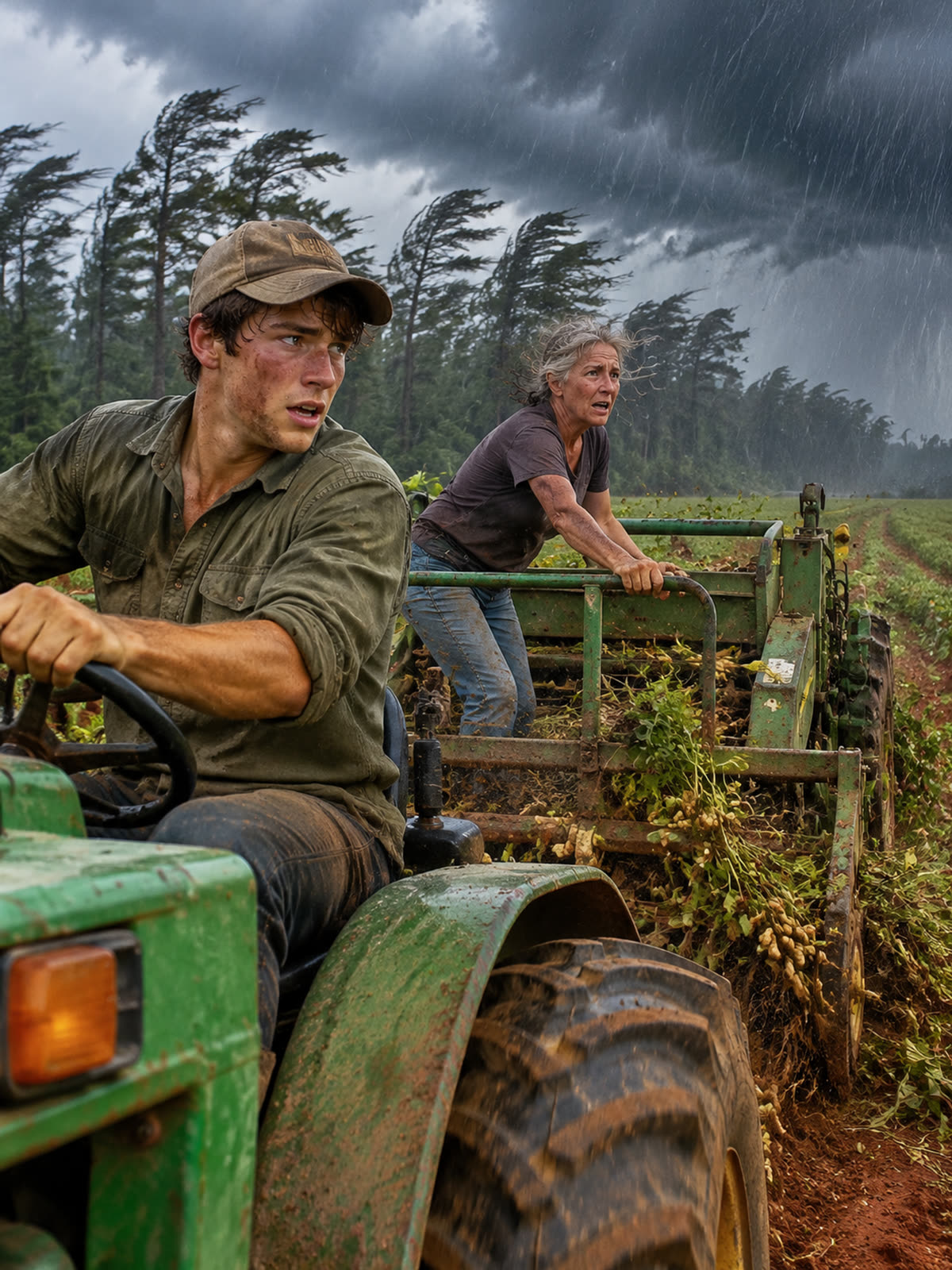
Clayton held his speed. Fifty yards remained. Thirty. Rain thickened into sheets, and the vines ahead turned dark as they soaked it up. Ten yards. The pickup reel caught the final vine at the end of the final row and drew it inside. Its peanuts blew into the basket. We were finished. Clayton switched off the tractor. The engine stopped, the picker slowed, and its roar faded until all I could hear was rain hammering metal and earth. Behind us, empty vines lay with nothing left for the storm to destroy. Clayton bent forward and rested his head on the steering wheel. He stayed there. When I stepped down, my legs folded beneath me. I sat in wet red dirt beside the wheel while rain soaked my shirt. Looking back across the field, I knew every acre was off the ground.
Hoyt came jolting toward us in his truck and jumped out before it had completely stopped. Beau followed in the other truck. My husband ran over, lifted me from the mud, and held me so tightly I could scarcely breathe. “We did it,” he kept saying. “Della. We did it. We did it.” Beau climbed onto the tractor and wrapped his arms around Clayton. My youngest was crying; I could see his shoulders shaking. Beau held him without speaking. Through the rain, I finally looked toward the house. Inez was no longer in the rocker. She stood at the porch edge, cane in one hand and the other pressed over her mouth. Wind drove rain beneath the roof and soaked her clothes. She wouldn’t step back. She stood watching her sixty acres come in.
Pilar poured over us all night with gusts reaching sixty miles an hour. It peeled tin from one corner of Daddy’s shed, brought down two pecans, and left us without power for nine hours. We ate Inez’s leftover biscuits by candlelight in the dark kitchen and listened. Exhaustion left little room for conversation. Around midnight, Clayton fell asleep with his head on his folded arms at the table. Hoyt lifted him—six foot two and 185 pounds—as if he were still a little boy, and carried him to bed. At some point, I heard an engine across the road. I went to the window but could make out nothing through the darkness and rain. I recognized Lamar’s combine by its sound. Suddenly it stopped. It never started again.
On Tuesday morning, I took in our final trailer myself. Everyone else remained asleep, and I let them rest. I made coffee on the gas stove, hitched the trailer, and drove toward Donalsonville with the wipers moving. The downpour had dwindled into drizzle. Everything looked green and soaked, with branches scattered over the highway. Near Spring Creek, somebody had already cut through a fallen tree and pushed it into the ditch. Twelve miles later, I reached a buying point crowded with trucks. The line stretched toward the road, and more farmers gathered in the parking lot wearing rain jackets and muddy boots, gas-station coffee cups in their hands. Their storm stories drifted through my open window. The Wheelers had thirty acres still out when the rain arrived. Mr. Sumner lost all forty-two of his after digging Thursday and developing a hydraulic leak in his combine on Saturday. The Thompsons lost twelve acres, the Barkleys twenty, and the Harpers a barn. Nobody asked about our fields. I offered nothing.
When my turn came, I drove onto the scale. After the loaded trailer was weighed, a worker climbed on top carrying a long metal probe. He pushed it into six different spots and emptied the samples into a bag, which went into the grading room. I parked and walked into the scale house to wait. It was a little cinderblock building, with a ticket window on one side and an indoor counter where farmers collected their grades. A coffee pot stood on a card table. Notices for pesticide training, a missing dog, and a church fish fry covered the bulletin board. Ardith Coker presided over it all. She had weighed our peanuts for twenty years and Daddy’s for twenty before that. At sixty-eight, she had short gray hair, reading glasses on a beaded chain, and a cardigan she wore in every season because she claimed the air-conditioning could freeze a turkey. She knew our names, our farms, our yields, and our business. “Della,” she said. “Morning, Ardith.”
Six or seven drivers waited along the scale-house wall, all men I had known forever. Ronnie Pruitt had brought his own final load. A couple of Wheeler boys were there, along with Mr. Sumner, who looked as though the last week had added ten years to him. They nodded, and I took my place at the counter. Ardith went into the grading room. When she returned several minutes later, she was studying my sheet with an odd expression. Halfway across the room, she stopped and read it again. Then the outside door opened. Lamar entered carrying his old, sweat-stained Pioneer seed cap in both hands against his stomach. His face looked gray, his eyes were red, and mud reached the knees of his khakis. He appeared not to have slept. He paused just inside and saw the waiting drivers. Every one of them had heard what he had done; the realization showed on his face. In a county that small, they probably knew by Friday afternoon. Nobody greeted him. Then he turned and noticed me. For a long moment, we simply looked at each other while his hands twisted the cap around and around.
Ardith set my grade sheet on the counter, removed her glasses, and let them fall against their beaded chain. Her gaze passed along the drivers, over Mr. Sumner and Ronnie, and finally to Lamar. “Y’all listen here a minute,” Ardith said. She didn’t need to shout. Years of calling weights above scale-house noise had taught her how to carry a room. Everyone quieted. “This here’s Della Harrell’s last load,” she said. “Off a hundred and eighty acres on Spring Creek Road.” Her finger tapped the paper. “Seventy-six percent sound mature kernels,” she said. “Less than one percent damage. Moisture right where it ought to be. No mold. Not a speck.” She surveyed us again. “That’s the best grade I’ve put on a sheet all season,” she said. “Best in this county. Better than anybody in this room.” Nobody answered. She put her glasses back on. “And I want every one of y’all to know,” she said, “that she picked all hundred and eighty acres with her daddy’s 1985 two-row. The one Earl Bledsoe used to bring in here every October. The one that sat under a tarp for six years after he passed.” Looking over the frames, she continued. “Her husband and her two boys and her. And Hoyt’s mama, eighty-one years old with a busted hip, cooking for all of ’em off a cane. Four days. And they got the last row off the ground as the first band of that storm was crossing the field.” After a pause, she added, “I know, because Brother Toby told me. He brought four trailers through here on Sunday in his church shirt.” One of the Wheeler boys whistled softly. Mr. Sumner’s eyes shone as he looked toward me.
Ardith turned to Lamar. “Lamar Harrell,” she said. “You’re in line. Behind all these folks.” She indicated the wall. “Take a seat.” He did not sit. After standing in the doorway a while longer, he crossed the room past the waiting men and the coffee pot and stopped beside me at the counter. His eyes stayed lowered. Reaching into his shirt pocket, he brought out a check folded once. He opened it and placed it beside my grade sheet. Hoyt’s handwriting. Nine thousand dollars, payable to Lamar Harrell. Our check. It hadn’t been cashed.
PART 3 — What We Chose to Save
I stared down at the paper. “You said you cashed it,” I said. My voice sounded thin and strange. “Hoyt said I cashed it,” Lamar said. “Friday morning. In my field. I didn’t correct him.” He kept looking at the counter. “I never took it to the bank,” he said. “I took it out of my pocket every night. And looked at it. And put it back.” In the silence, I could hear the coffee pot ticking. “Then why,” I said, “did you take it at all?” He took a long time to answer. “So I’d have to come back,” he said finally. “I figured if I had his check in my pocket, I’d have to come pick his peanuts. I’d have no choice. I’d make myself.” His eyes dropped to the check. “Didn’t work,” he said. I couldn’t find anything to say.
He continued in a voice aimed at the countertop. “Combine threw a rod about one o’clock this morning,” Lamar said. Quietly. To the counter. “In the rain. I was out there trying to pick in the rain. Like a fool. Forty-one acres left on the ground. They’re gone now. All of ’em. Laying out there in the mud.” He swallowed before going on. “Should’ve done yours first,” he said. “Should’ve done yours Friday at ten like I said I would. Mine would’ve waited. I could’ve gotten ’em Saturday. Sunday.” He rotated the cap between his hands. “I got scared,” he said. “Saw that storm on the TV Thursday night. And I sat there in Bonnie’s chair. And I thought, this is the last one. This is all I’ve got. After this there’s nothing. No more crops. No more Bonnie. Just a little apartment in Albany. And if I lose this one, I go up there with nothing.” His voice broke. “So I thought about me,” he said. “Just me. For the first time in fifty years. And I went and picked mine.”
For the first time since entering, Lamar raised his eyes to mine. “Hoyt’s daddy would’ve been ashamed of me,” he said. “Wendell. My own brother. He’d have been so ashamed.” I looked at that seventy-four-year-old man, gray-faced and muddy to the knees, holding his cap before half the county. He had laid down a check he hadn’t been able to bring himself to cash. In my mind, Hoyt was nineteen again, standing in a field after losing his father, unable to calibrate a planter. Lamar’s truck was arriving at five in the morning, as it had every morning for a year. Then I saw Inez at the porch edge with her hand over her mouth, and Clayton bent over the steering wheel. I thought of the grease gun and the E.B. carved into its barrel. I lifted the check and studied it. Then I folded it once and offered it back.
Lamar stared. “Della—” “You’re not going to need this,” I said. “Not after today. Hoyt’s going to tear it up anyway.” “I don’t understand.” “Forty-one acres,” I said. “On the ground. In the mud.” “They’re gone.” “Maybe,” I said. “Maybe not all of ’em. Some of the vines on the high ground might dry out. Some of them might still have something on ’em. If somebody got out there fast enough. When the ground dries. Thursday, maybe. Friday.” He looked as though he couldn’t understand my language. “Your combine’s broke,” I said. “Thrown rod. You won’t get that fixed for two weeks. Not in harvest.” “No.” “So you need a picker.” He stayed silent. “Daddy’s two-row,” I said, “is sitting in our yard. Still hooked up to the tractor. Covered in mud.”
His face changed in a way I had never witnessed. That hard, broad, weathered face, familiar from twenty-six years of Christmas meals, funerals, and Fourth of July gatherings, simply collapsed. He covered it with his hat and began to cry there at the counter. Nobody spoke. Without looking up, Ardith took a box of Kleenex from beneath the counter and slid it toward him. Ronnie rose, crossed the room, and briefly rested a hand on Lamar’s shoulder before returning to his chair. Then Mr. Sumner cleared his throat. The man had lost every one of his forty-two acres. “If y’all are going out to Lamar’s Thursday,” he said, “I got a truck.”
My grade sheet lay on the passenger seat during the drive home. Hoyt was on the porch with coffee when I arrived, still in his undershirt, his hair sticking up from sleep. He saw my expression through the windshield. “What happened?” he said. “Bad grade?” I climbed out, went up the steps, and handed over the paper. His eyebrows rose as he read. “Seventy-six?” he said. “Della. That’s the best we’ve ever done. That’s the best your daddy ever did.” “I know.” “Then why do you look like that?” I settled into the swing. “Sit down,” I said. “I have to tell you something about Lamar.” I gave him all of it: the cap held in both hands, the uncashed check, the thrown rod at one in the morning, forty-one acres in mud, Bonnie’s chair, and Lamar saying Wendell would have been ashamed. I told him, too, what I had offered.
Hoyt listened without interrupting. Afterward, he held his coffee and stared across the road. From the porch, Lamar’s unpicked windrows were plainly visible, dark and flattened, with loose pods scattered over wet red earth. “You told him we’d pick his peanuts,” Hoyt said finally. “I told him we have a picker.” “With your daddy’s two-row.” “Yes.” “After what he did.” “Yes.” He turned toward me. “Why?” I thought before answering. “Because when your daddy died,” I said, “Lamar came over at five o’clock every morning for a year. And never asked for a thing.” He said nothing. “And because that’s what my daddy would’ve done,” I said. “He’d have been mad. He’d have been so mad he couldn’t see straight. And then on Thursday he’d have hooked up that picker and driven it across the road. And he wouldn’t have said one word about it. Not then. Not ever.” Hoyt placed his cup on the porch rail and studied the damaged field. “I want to be mad at him,” he said. “Be mad at him.” “I am.” “Then be mad at him,” I said, “and pick his peanuts anyway.” After a moment, a short, weary, surprised laugh escaped him. “That’s the most Bledsoe thing I ever heard,” he said.
Inez arrived that afternoon already informed. Ronnie’s wife had called before I even made it home. She came through the back door with her cane, sat across from Hoyt at the kitchen table, and skipped any greeting. “You’re going to pick Lamar’s peanuts,” she said. “Yes, ma’am,” Hoyt said. “If there’s any left to pick.” She regarded him for a long time. “He took my money,” she said. “My sixty acres. He took a check for my land and he left it in the field and went and saved his own.” “I know, Mama.” “I’ve known that man sixty years,” Inez said. “Since I was twenty-one and married his brother. He was a skinny boy with big ears who used to steal my biscuits off the stove.” “I know.” “He sat on that front pew with me at Wendell’s funeral,” Inez said. “Held my hand the whole service. Didn’t let go once. Not even for the hymns.” She looked at her age-spotted, arthritic hands. “I’m so mad at him,” she said. “I’m so mad at him I could spit.” “Me too, Mama.” A long silence followed. “His Bonnie’s buried right next to Wendell,” she said finally. “At Spring Creek. They’re right next to each other.” She lifted her gaze. “I’ll make the biscuits,” she said.
By Thursday afternoon, enough ground had dried to work. The lower areas remained wet, but the sandy ridge along the field’s north side had drained quickly. Vines on the higher ground rattled when shaken. At two, Clayton drove across the road with Daddy’s two-row following our tractor. I stood on the platform. Lamar waited near the field entrance in clean clothes, freshly shaved, with his Pioneer cap on. He said nothing as we came through. Clayton stopped beside him, and Lamar studied the worn green paint and the surviving scraps of white stripe. “Earl’s picker,” he said quietly. “Yes, sir,” Clayton said. Lamar approached and rested a hand against its side, just as Hoyt had Sunday evening. He left it there for a long while. Behind us, trucks entered in a line: Hoyt, Beau, Brother Toby in work clothes, Ronnie and Gene, and Mr. Sumner driving an old Chevy with a borrowed trailer. Inez brought up the rear in her high-mileage pickup, biscuits in a basket on the seat. She parked beside the field, rolled down her window, and stayed behind the wheel. When Lamar saw her, he removed his hat.
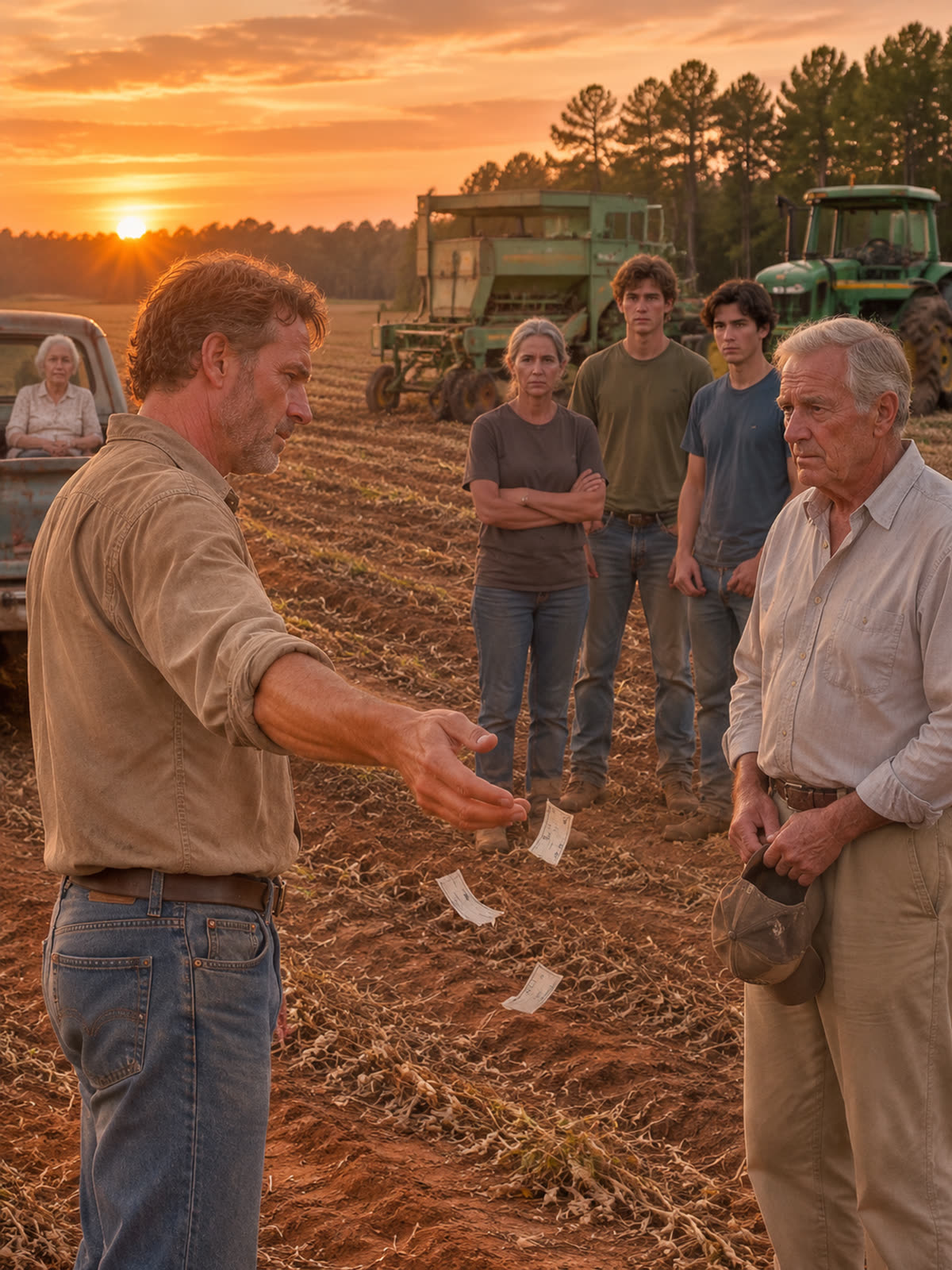
We saved nineteen acres that afternoon out of the forty-one. The rest had stayed soaked too long. On the low ground, pods had rotted away, leaving nothing worth picking. Nineteen acres wasn’t much, and the grade was poor—damage and some mold. Ardith later called it the worst load she had graded that week. But it was nineteen acres Lamar would otherwise have lost. At sundown, he walked out to where we had stopped and looked at all of us: Hoyt, the boys, me, Brother Toby, the Pruitts, Mr. Sumner, and Inez in her truck. He opened his mouth. Hoyt shook his head. “Don’t,” Hoyt said. “Don’t say anything, Uncle Lamar. Not tonight.” Lamar closed his mouth and nodded. Then he reached into his shirt pocket and withdrew our once-folded check. He held it toward Hoyt, who looked at it before taking it. My husband tore it in half, then again, then into smaller and smaller pieces. He released them into the wind above the empty field and its windrows. They drifted away into the dark.
Lamar left for Albany in December. A large Bainbridge operation bought his land to plant cotton. The combine went for parts, and a young couple from Tallahassee who taught at the high school bought the brick house. The day before the move, he came to see us at five in the morning. It was still dark when I heard his truck and stepped onto the porch in my robe. He stood in the yard looking at Daddy’s shed and the fresh tin Hoyt had installed where Pilar tore the roof. “Morning, Della,” he said. “Morning, Lamar.” “Hoyt up?” “Not yet.” He nodded and stayed there a while. “I used to come over here every morning at five,” he said. “After Wendell. You know that?” “I know.”
He looked toward the porch swing. “Hoyt was so scared,” Lamar said. “Nineteen years old. Didn’t know how to do anything. Couldn’t sleep. I’d pull in and he’d already be sitting on that porch in the dark. Waiting for me.” He considered the porch for another moment. “I used to think I was the one doing him a favor,” he said. “Coming over. Teaching him.” Then he shook his head. “It was the other way around,” he said. “After Wendell died, I didn’t know what to do with myself. He was my big brother. I’d followed him my whole life. And then he was gone. And every morning, coming over here at five o’clock, that was the only thing that got me out of bed.” His eyes found mine. “Hoyt saved me that year,” he said. “He just didn’t know it.” I remained quiet.
From his truck cab, Lamar brought something wrapped in a feed sack and handed it to me. I unfolded the sack around an old, rusty grease gun whose paint had worn away. Two letters had been scratched into the barrel with a nail: W.H. Wendell Harrell. “It was his,” Lamar said. “I took it out of his shed after the accident. I never gave it back to Inez. I don’t know why. I just kept it. Forty years.” He looked toward Daddy’s shed. “Figured it ought to hang next to Earl’s,” he said. Holding it, I found myself unable to speak. Lamar put on his old cap and climbed into his truck. He lowered the window. “Tell Hoyt I said bye,” he said. “You could tell him yourself,” I said. “He’ll be up in twenty minutes.” He studied the dark house. “I know,” he said. “That’s why I came at five.” Then he drove away.
Wendell’s grease gun now hangs beside Daddy’s, each on its own nail in the shed: W.H. and E.B., side by side. Their owners had known each other mostly through church, the scale house, and the feed store in Donalsonville. The picker lives there too, beneath a new tarp. In November, Hoyt replaced the remaining belts. Clayton found the exact shade of green at the John Deere dealer and touched up the paint. Using a small brush and a ruler, he restored the white stripe along its full length. It occupied three of his Saturdays.
Beau began work at the Colquitt extension office in October. Now he travels through three counties helping farmers interpret soil tests and deal with pests. Last month, he called from a peanut field in Early County. “Mama,” he said. “This old man out here has a two-row. A ‘79. Same kind as Granddaddy’s. Runs like a top.” “Did you tell him about ours?” “I told him,” Beau said. “He wants to know if we’d sell it.” “What’d you tell him?” “I told him it’s not for sale,” Beau said. “I told him it’s had plenty of rest.”
Clayton graduated in May and will attend ABAC in Tifton this fall, finally following the college road his father had to leave untaken. He wants to study agriculture, then return home to farm. At his graduation party in our backyard, Inez gave him a small package wrapped in brown paper. She settled back into her lawn chair with the cane across her knees while he opened it. Inside was a brass equipment plate, engraved: EARL BLEDSOE’S PICKER. 1985. 180 ACRES IN 4 DAYS. CLAYTON HARRELL, DRIVER. He studied it for a long time. “Mamaw,” he said. “Where’d you get this?” “Ardith Coker’s nephew does engraving,” Inez said. “In Bainbridge.” She looked straight at him. “You put that on there,” she said. “Right by the hitch. Where everybody can see it.” He attached it that night.
Inez had her hip replaced in January. Her sixty acres paid every penny of her share of the procedure. Seventy-six percent sound mature kernels—the best grade Ardith recorded that year. She walks better now. She still carries the cane, although these days it serves mostly for show. And snakes. The storm passed, the peanuts sold, and the check became scraps of paper over a field that now grows cotton. People still occasionally stop us at church, the feed store, or the scale house and ask why we never sued. My answer remains the truth: a lawsuit doesn’t pick peanuts.
Nor does a lawsuit bring a man into a scale house at seven in the morning with his hat clutched in his hands. It doesn’t persuade him to place an uncashed check before half the county or return his dead brother’s grease gun so it can hang beside my father’s. People accomplished those things. Not a judge. Ardith did, by standing up and speaking what everyone knew. Ronnie did, with his hand on Lamar’s shoulder. Mr. Sumner did, arriving with a borrowed trailer despite losing everything himself. Inez did, carrying a basket of biscuits in her truck.
Daddy had a part in it too. Though he was gone, he remained with us—in that worn green machine, in the initials on his grease gun, in every bearing he had tended before sunrise while quietly humming a hymn. He had prepared that picker so it would work when somebody needed it. Sometimes after supper, I go out to the shed. The door still sticks, and I push it open with my shoulder. In the dusty quiet, I look at the tarp-covered picker and the two grease guns on the wall. W.H. and E.B. I think about something sitting untouched for six years, appearing finished. Then someone pulls away the tarp, greases the fittings, and installs two belts. And it runs.
Last Sunday after church, Inez asked me to take her to Spring Creek cemetery. We stood before Wendell’s black granite marker: WENDELL ALTON HARRELL. 1944–1993. HE PLOWED STRAIGHT. Beside it stood Bonnie’s newer stone, with fresh flowers someone had placed in its vase that week. “Lamar drives down from Albany,” Inez said. “Every other Sunday. He brings her flowers. And then he stands at Wendell’s grave a while.” “Does he talk to him?” “I imagine so,” Inez said. “I imagine he’s got a lot to say.” She contemplated the neighboring stones for a long time.
Then she told me something else. “Lamar called me last week,” she said. I waited. “He said he heard Clayton put a plate on Earl’s picker,” Inez said. “With his name on it. He asked me what it said.” “Did you tell him?” “I told him,” she said. “A hundred and eighty acres in four days.” “What did he say?” A small smile crossed her face. “He said he’d like to see it sometime,” she said. “Next harvest. If it’s all right.” She looked at me. “I told him,” she said, “he’d have to ask Hoyt.”
Disclaimer: This story is a work of fiction inspired by real-life themes. Names, characters, places and events are fictionalized, and any resemblance to real persons is purely coincidental. It does not represent any person or organization and does not encourage inappropriate behavior. Images are for illustration purposes only.
