


PART 1: THE MONEY WAS ALREADY GONE WHEN HER MESSAGE ARRIVED
When my daughter-in-law told me I no longer belonged in my grandchildren’s lives, I was at my kitchen table wrapping their birthday presents. The gifts lay unfinished in front of me, small expressions of a love I had never imagined I would need permission to give. Only recently, I had contributed $300,000 toward my son’s new house. Now, while preparing something as ordinary as birthday packages, I was discovering that the family I had helped so willingly had decided there was no longer room for me.
“Mark and I have decided that you’re no longer welcome in our lives. Don’t call, don’t visit, and don’t try to see the children. We need to protect them from your toxic behavior.” I read Stephanie’s message over and over, trying to understand how she had reached such a cruel decision. Mark was included in the conversation. He could see every word she had written, yet there was no objection from him, no explanation, and nothing to suggest that he disagreed.
My name is Barbara Hayes. I was sixty-eight, a widow, and the grandmother of Emma and Lucas. Since losing my husband, David, I had given much of my time to Mark’s family. Being available to them had become an important part of my life, and I treasured the ordinary moments that came with being their grandmother. Emma had recently wanted me at her school concert. Five-year-old Lucas loved listening while I read his bedtime stories. Nothing about those relationships had felt disposable.
I looked from the message to the presents, unable to reconcile the children I knew with the decision their parents had made. I had been thinking about birthdays, wrapping paper, and the pleasure of watching them open their gifts. Suddenly, I was wondering whether I would be permitted to share another birthday with either of them. I sent Mark a private message and asked whether he had known Stephanie intended to exclude me. He read it, then left me waiting several minutes before answering.
“Mom, please don’t make this more difficult than it already is. Stephanie just needs some space.” His words devastated me. I had raised him, helped him through difficult years, and paid for his college education. When David died, Mark had held my hand through the funeral. I had carried the memory of that support as proof that whatever changed around us, our bond would remain. Yet when I needed him to acknowledge my hurt, he treated my question as another problem he wished would disappear.
For months, he and Stephanie had been arranging the purchase of a $1.5 million house in an expensive suburb outside Charlotte, North Carolina. Stephanie loved the enormous kitchen, the carefully landscaped backyard, the excellent school district, and the separate guest suite. It was the kind of property that had become much more than a potential address to them. Unfortunately, their excitement did not change the financing. They could not qualify for the arrangement they wanted without substantial help, and that was how my savings entered the conversation.
Mark had come to see me one evening carrying a folder of mortgage estimates. “Mom, we need some financial help to get us across the finish line.” When he explained the amount, I could hardly take it in. “Three hundred thousand dollars? Mark, that’s an enormous amount of money.” Stephanie reminded me that I had always wanted Emma and Lucas to have opportunities their parents had not experienced. Looking at photographs of the children, I persuaded myself that helping secure a beautiful family home justified the sacrifice.
David and I had spent forty-one years building our savings. There had been no inheritance to make life easier, only careful budgets, long working hours, and luxuries we repeatedly postponed. Since his death, I had guarded that retirement security closely because I understood exactly what it represented. Nevertheless, I agreed to contribute $300,000 and join a lender-approved guarantee arrangement. My thirty-five years in banking compliance and risk management meant I understood the seriousness of the commitment. I insisted that the necessary documents receive proper review before everything was completed.
On Tuesday, I transferred the money into the closing attorney’s escrow account. Two days later came Stephanie’s message. The timing was impossible to ignore, however much I wanted to believe there was some explanation that would make it less painful. Then I noticed the calendar. Their closing was scheduled for the following afternoon. My contribution was already in escrow, but the lender still needed my final signature on outstanding guarantee documents. There was a difference between money already transferred and financial obligations I had not yet formally accepted.
I opened my laptop and told Mark that I needed independent legal advice before assuming any further obligations. My phone rang within thirty seconds. “Mom, what are you doing? We’re supposed to close tomorrow!” I answered as plainly as I could. “Your wife just told me I’m no longer part of your family, Mark. I need to understand exactly what I’m agreeing to.” His irritation only increased. He warned that the children were counting on the house, but he did not ask what it had felt like to read Stephanie’s message.

That conversation forced a painful distinction into the open. Apparently, my family could decide I was unwelcome while still expecting me to help purchase the life they wanted. My presence could be rejected, but my financial commitment was supposed to continue without interruption. I had not planned to turn a mortgage closing into a family confrontation. I simply could not pretend that the circumstances were unchanged when my relationship with the people I was helping had been abruptly severed. Before signing anything else, I needed to understand my position.
Shortly after eight the next morning, I went to my bank. Sarah Jenkins, a manager I had mentored years before, brought me into her office and examined the mortgage paperwork. I showed her Stephanie’s message so she would understand why I was suddenly reconsidering an arrangement I had previously supported. Sarah explained that the $300,000 had already reached the closing attorney’s escrow account. The bank could not simply take the money back because I requested it. Whatever happened next would have to follow the proper process.
The outstanding guarantee documents, however, had not been signed. Sarah strongly advised me to consult an independent attorney before accepting any additional responsibility. By ten o’clock, I was sitting with Rebecca Collins, the attorney she recommended. Rebecca studied the agreement and asked whether I had been promised any ownership interest in the property. “No. I was simply trying to help my son and grandchildren have a better home.” Saying it aloud made the arrangement sound as straightforward as I had once believed it was.
Rebecca then asked the question that mattered most. “Are you still comfortable accepting the financial obligations associated with this guarantee?” I thought about David and the decades we had spent accumulating our retirement savings. I remembered the decisions we had made together, the things we had gone without, and the security that money was meant to provide. Then I thought about Stephanie telling me never to contact the children, and about Mark’s refusal to defend me. “Not under these circumstances.” There was nothing more complicated about my answer.
Rebecca explained that an approaching closing did not require me to sign additional documents. She was equally careful not to promise that recovering my contribution would be simple. That would depend on the escrow instructions and what happened under the purchase agreement. With my authorization, she contacted the lender and the closing attorney to confirm that I would not execute the remaining guarantee documents. She also asked that my contribution be reviewed before any funds were disbursed. For once, someone was considering my obligations separately from everyone else’s expectations.
Calls from Mark and Stephanie soon began arriving repeatedly. My hands trembled so badly that holding the phone comfortably was difficult, and I accepted Rebecca’s offer to handle communications. At 12:30, the closing attorney confirmed that the lender could not proceed on the anticipated financing terms. The three o’clock closing was postponed. I understood why, but there was no feeling of triumph. A house purchase had stalled, my relationship with my son was unraveling, and all I could think about was how far we had fallen from being a family.
When I eventually answered Mark, he immediately wanted me to fix the situation. Stephanie was devastated, he said, and the seller might not agree to wait. “Mom, why are you doing this to us?” I asked him the question he kept avoiding. “Mark, did you read the message your wife sent me?” He answered, “Yes, but Stephanie was angry.” That explanation did nothing to address his silence. “And you said nothing while she told me I could never see my grandchildren again.”
Mark complained that my financial assistance sometimes left people feeling indebted to me. The accusation hurt because that had never been what I wanted. I had believed I was helping, not purchasing obedience or keeping accounts of what anyone owed me emotionally. Still, if my involvement had become something they resented, it made even less sense for me to assume more financial risk. “If helping you makes you feel that way, perhaps I shouldn’t be financing this house.” After that, he was quiet for a long time.
When he finally spoke again, he admitted there was something about the house he had not told me. Stephanie had wanted the information kept from me until after they moved in. “Her parents are going to live with us, Mom. They’re taking the guest suite.” I remembered the way that private wing had been described: a playroom for the children and somewhere relatives could stay when visiting. Those descriptions had helped shape my understanding of the home I was contributing so much money to purchase.
I asked how long her parents expected to remain there. Mark reluctantly explained that the arrangement was permanent. They would have their own rooms, a private entrance, and an established place in the household. Meanwhile, I had just been told that I could not even visit the grandchildren whose future had been used to persuade me to help. Before I could make sense of the unfairness, I needed one answer from my son. “Did you know about this before I transferred the money?”
PART 2: THE FAMILY THEY HAD MADE ROOM FOR
“Yes.” That single word changed what I understood about everything that had happened. Mark had known before my money entered escrow. This was not a new plan that had emerged after I agreed to help, nor was it information he had only just learned himself. While I was considering the risks to my retirement and imagining the home my grandchildren would enjoy, he had already known that Stephanie’s parents would be living there permanently. He had allowed me to make my decision without telling me.
I struggled to absorb the contrast. Her parents would have rooms of their own, a private entrance, and a permanent place in the family household. I would help finance that household while being forbidden to visit it. Mark admitted they had concealed the arrangement because they knew I would have questions. Stephanie had not wanted another disagreement before the house was secured. “You let me risk the savings your father and I worked our entire lives to build, and you deliberately kept this from me.”
He insisted that the purchase was still intended to give the children a better life. I asked why I was the only grandparent being excluded, but he had no explanation. When the call ended, I was left with something harder to accept than his earlier silence. He had not merely failed to challenge Stephanie when she rejected me. He had knowingly let me undertake a huge financial commitment while withholding information he understood would matter. The next morning, before I had found any peace with that realization, Stephanie appeared at my door.
She arrived without warning in her expensive SUV, carrying the designer handbag she had brought to our last family dinner. Her expression was furious. As I opened the door, I felt the familiar impulse to apologize simply to keep an argument from getting worse. “Barbara, do you have any idea what you’ve done? You’ve ruined our closing!” I resisted that impulse and answered carefully. “I declined to accept additional financial obligations. Your lender made the decision to postpone the purchase.”
Stephanie accused me of choosing the last possible moment to punish her and Mark. I reminded her that I had reconsidered my involvement only after she told me I was no longer allowed to see my grandchildren. Until that message, I had been preparing to help them complete the purchase. She spoke as though the interruption had come from nowhere, as though her decision to remove me from their lives had no connection to my willingness to guarantee their financing. I could not accept that version of events.
She said I believed giving money entitled me to unlimited access to Emma and Lucas. That was not what I was asking for, and I tried to make the distinction clear. I had never demanded authority over their household or the right to control their family. I wanted the ordinary chance to remain their grandmother, to share the kinds of moments I had always cherished with them. Helping with a house was not supposed to buy a relationship, but neither had I expected it to accompany the deliberate destruction of one.
Stephanie said my questions about their spending, parenting, and financial decisions made her feel continually judged. I acknowledged that advice I intended as helpful might sometimes have been unwelcome. Still, they had asked me to accept a substantial financial risk, and that request could not be separated entirely from questions about money. “If I’ve made you uncomfortable, we could have discussed it. Instead, you told me to stay away from the children.” There had been room for a conversation before things reached the point of shutting me out.
“We needed boundaries, Barbara.” I understood the word, but not the timing she wanted me to overlook. “Then why did those boundaries appear immediately after I transferred the money?” She did not answer. Instead, she returned to the fact that I had promised to help. It seemed that my promise was meant to remain binding regardless of what changed around it, while the family relationship that had prompted my generosity could be withdrawn without discussion. I stood there trying to explain why those two things could not simply be separated.
When I said I needed to protect my remaining retirement security, Stephanie dismissed the concern. According to her, I had plenty of money. She spoke with a certainty that made my own future sound like something she was better qualified to assess than I was. “You don’t know what I have, Stephanie. You only know what I’ve been willing to give.” My willingness to help had apparently become evidence that helping cost me nothing. Yet every dollar represented part of the life David and I had worked to secure.
Then I brought up her parents and the guest suite. Her expression changed as soon as I mentioned their permanent move. She explained that they were getting older and deserved somewhere comfortable to live. I did not object to her wish to care for them. What hurt was the care taken to protect their place while mine was being erased. “I understand wanting to look after your parents. I only wish you’d remembered that Mark has a mother, too.” It was the difference between those two arrangements that she would not acknowledge.
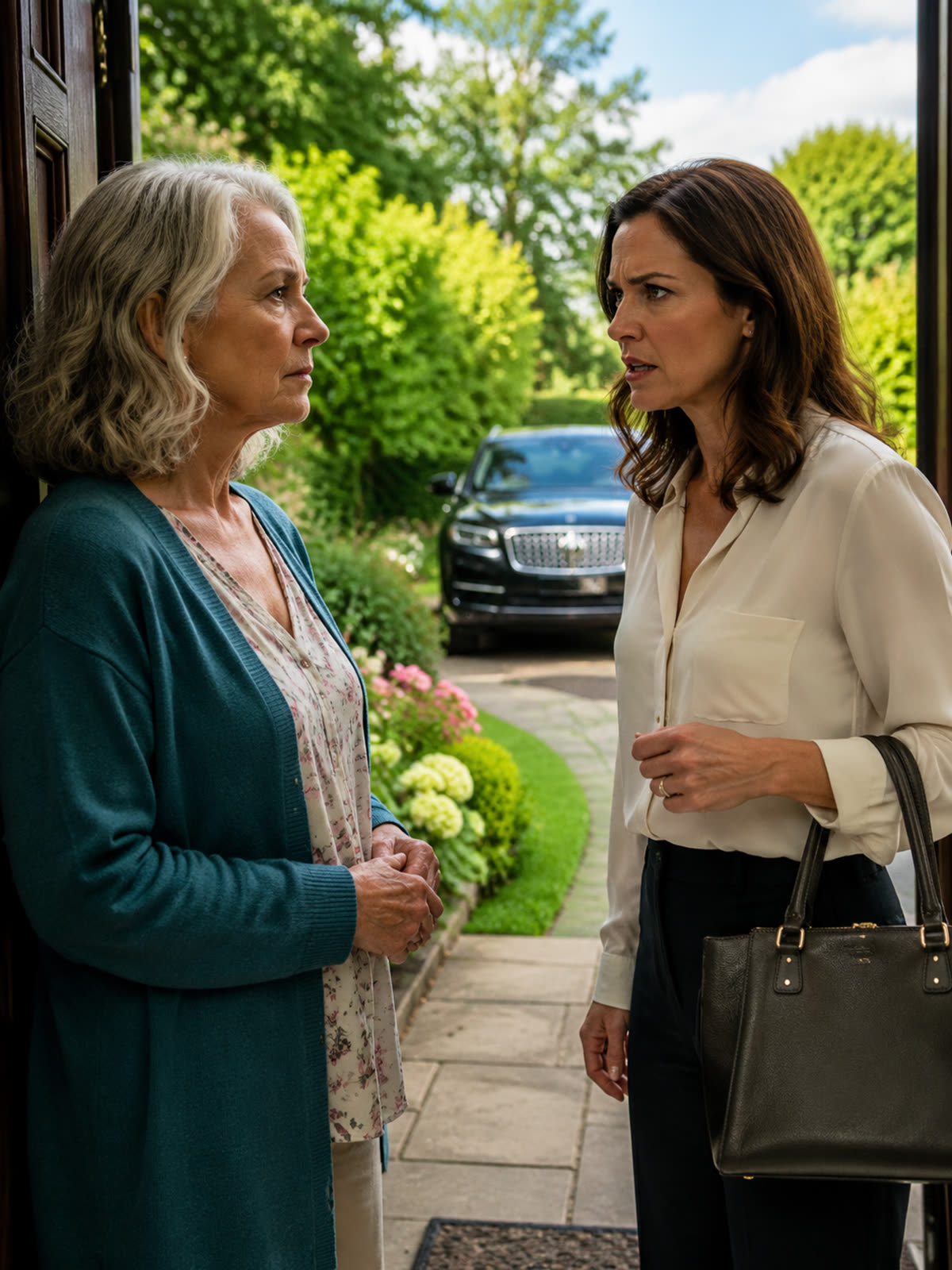
Stephanie accused me of making the situation about myself. Then she warned that losing the house would devastate the children. I reminded her that Emma and Lucas had neither selected the property nor decided their grandmother should be excluded. They were not responsible for any of this, and I would not let their disappointment become an answer to every question I raised. I ended the conversation and asked her to direct future questions about the purchase to our attorneys. There was nothing useful left for us to settle at my front door.
After she drove away, I sat beside the birthday presents in my spare bedroom and cried. I missed David terribly. More than anything, I wished I could ask him whether I was doing the right thing, whether protecting myself could still be right when it hurt so much. Looking at his photograph, I remembered the time he refused to buy Mark an expensive car when our son was sixteen. He had understood then something I was only beginning to face again.
“Barb, we can’t give him everything he wants just because we’re afraid he’ll be disappointed. Eventually, he’ll have to learn to stand on his own.” His words stayed with me. I had wanted to spare Mark difficulties whenever I could, and helping had often felt like the clearest way to express my love. Now I was confronting the possibility that repeatedly shielding him from disappointment had also shielded him from responsibility. Remembering David’s advice did not stop the tears, but it gave me something steadier than guilt to hold on to.
During the following week, Mark’s messages shifted between angry accusations and desperate appeals for me to change my mind. Rebecca continued dealing with the legal questions while the seller waited for him and Stephanie to obtain alternative financing. I could not make that process painless, and I could not know whether the purchase would ultimately survive. What I could do was leave the legal matters with the attorney rather than allow every urgent message to pull me back into a commitment I no longer felt comfortable making.
Eventually, the seller refused another extension, and the purchase fell through. After the applicable escrow conditions were resolved, the title company returned my full $300,000 contribution. Sarah called to tell me the money had reached my account. I thanked her, grateful that the funds David and I had worked so hard to save were back where they belonged. But when she asked whether I was all right, I could only say I believed I would be financially secure. That was true. It was not the same as being happy.
Emma’s birthday came and went without a visit. Lucas’s followed two weeks later. I honored Stephanie’s instruction not to contact the children, although doing so was painful in ways I could not explain through bank balances or legal paperwork. Their wrapped presents stayed in the spare bedroom. I had recovered the money, but I still did not know whether I would recover the simple privilege of watching them open those gifts. The packages remained reminders of the afternoon when an ordinary grandmother’s task had been interrupted by the message that changed everything.
My friend Eleanor eventually came over with homemade soup. She reminded me that missing my family did not require me to sacrifice my security. She also encouraged me to stop trying to solve every problem for Mark and let him decide what kind of son he wanted to be. Her advice stayed with me because it asked something different of me than either rescuing him or giving up on him. I could still love him without taking responsibility for every consequence of his decisions.
Even so, I worried that the relationship with my grandchildren might never mend. Financial security could not answer that fear, and neither could knowing why I had refused to sign. Then, about a month later, I was tending the roses David had planted along our back fence when Mark called. I stood in the garden looking at his name on the phone for several moments. I was afraid the call would bring another demand for money or another argument about the house we could no longer buy.
When I answered, his voice sounded tired rather than angry. “Hello, Mom.” I asked the question that mattered most to me. “Hello, Mark. How are Emma and Lucas?” He replied, “They’re doing okay. They miss you.” Tears came to my eyes. Knowing that the children still thought about me reached somewhere the arguments had not touched. I told him how deeply I missed them. After a short silence, he said the words I had almost stopped expecting to hear. “Mom, I’m sorry.”
I sat on the garden bench, trying to find a response that would not dismiss either his apology or what had happened. I wanted to hear those words, but I needed to understand what he meant by them. Rather than immediately accepting, I asked him to explain what he regretted. Mark admitted that he should not have allowed Stephanie’s hurtful message to pass without speaking up. He also acknowledged that asking me for $300,000 toward a house they could not afford independently had been unfair.
There was still the secret about her parents. “You knew Stephanie’s parents were going to live there permanently, didn’t you?” He answered without trying to avoid it. “Yes, Mom. I knew.” I continued, “And you deliberately let me believe the guest suite was meant for the children and occasional visitors.” Mark admitted that he had concealed the truth because Stephanie loved the house and he desperately wanted to make her happy. He had persuaded himself that once they moved in, the family disagreements would somehow resolve themselves.
I reminded him that when Stephanie forbade me from seeing the children, he had remained silent. His first urgent concern had been the mortgage closing, not the pain her message had caused. “I kept waiting for you to call and defend me. I couldn’t believe my own son would let that happen.” He did not offer another excuse. “I know, Mom. I should have called you.” For several moments, neither of us spoke. I could hear him crying quietly, and the silence felt different from the one he had left me with before.
He explained that he was not calling to ask me to solve another problem. He wanted to acknowledge that he had been wrong. It was our first conversation in months that did not lead toward a request for financial assistance. When he asked whether we could begin rebuilding our relationship, I wanted to say yes immediately. But wanting my son back did not erase what I had learned. An apology mattered, yet it could not do the work of changed behavior all by itself.
I told him I was willing to try if he respected my boundaries and never made the children feel responsible for our disagreements. “We can work toward that, Mark, but I need to see things change. I can’t go back to pretending nothing happened.” He answered, “I understand, Mom.” Then he asked whether I would like to see Emma and Lucas the following weekend. After weeks of untouched presents and missed birthdays, the possibility I had been afraid to hope for was suddenly waiting on my answer.
PART 3: THE SEAT I WOULD NO LONGER BUY
Mark explained that he and Stephanie had discussed the visit, and I agreed without hesitation. I had needed time before accepting that our relationship could be rebuilt, but there was no uncertainty about wanting to see Emma and Lucas. They had never stopped being the children I loved. The arguments, the failed house purchase, and the painful silence had all belonged to the adults. Whatever work remained between Mark and me, I wanted the children to know that my love for them had not changed during the weeks we were apart.
That Saturday, I watched Mark’s car turn into my driveway and felt almost too nervous to open the door. I had imagined seeing the children again so often that the actual moment seemed difficult to believe. For weeks, I had been trying to accept that I could not force this reunion or know when it might happen. Now they were outside my house, close enough for the waiting to end. Emma saw me through the window and immediately ran toward the porch, with Lucas hurrying behind her.
“Grandma!” I knelt to gather them into my arms, holding both children as tightly as I dared. After everything that had happened, that embrace was wonderfully ordinary. There was no mortgage agreement to discuss, no demand to answer, and no need to defend why I wanted them in my life. There were simply my grandchildren, coming toward me as they always had. I had missed their presence with a depth that every quiet birthday and every untouched package had made harder to bear.
Emma looked up and explained that her mother had said I had been busy. I listened without making her responsible for a different explanation. She was a child trying to understand an absence the adults had created, not someone who needed the details of their disagreement. Whatever I felt about Stephanie’s message, I did not want Emma carrying that pain away from our visit. The important thing was that she knew she had remained in my thoughts, even when I could not be there.
“I had some things to take care of, sweetheart, but I never stopped thinking about you.” That was what I wanted her to understand. Time apart had not meant I loved her less, and silence had not meant I had forgotten her. I could not undo the missed birthdays or explain the entire situation in a way a child should have to absorb. I could, however, give her the reassurance that belonged to her: whatever had happened among the grown-ups, she had never stopped being precious to me.
Lucas proudly showed me a plastic stegosaurus he had saved to share with me. His excitement drew us back into the familiar world of a grandmother and her grandchildren, where a toy could be the most important thing that needed attention. I listened to him, grateful for the chance to do something so simple again. The house purchase had once filled every conversation with urgency. Now there was room for a little boy’s dinosaur, and I could not imagine anything I would rather have been asked to care about.
We spent the afternoon baking cookies, drawing pictures, and listening to Lucas explain his elaborate ideas about prehistoric animals. None of those activities was unusual, and that was precisely what made them matter. They were the ordinary pleasures I had feared losing when Stephanie’s message arrived. I did not need an expensive house to share them with the children. I needed time, their company, and the freedom to be their grandmother without every moment being overshadowed by what the adults expected me to provide.
I deliberately avoided discussing their parents’ disagreement or the house purchase that had fallen through. Emma and Lucas deserved an afternoon untouched by financial questions and grown-up accusations. I was not going to ask them to take sides, carry messages, or reassure me about anything that had happened. The boundaries I had described to Mark applied to me as well. Protecting my relationship with the children meant allowing it to remain their relationship with their grandmother, rather than turning it into another place where the adults’ conflict continued.
Before they left, I brought out the birthday presents that had been waiting for weeks. Seeing the packages in their hands was very different from seeing them untouched in the spare bedroom. They were finally becoming what I had intended them to be when I began wrapping them: gifts for the children I loved, not reminders of everything I feared I had lost. Emma noticed the loose pink ribbon on her package and asked whether I had wrapped it myself. Her attention went straight to the small detail that had mattered to her.
“You always make the prettiest bows, Grandma.” I answered, “Well, this particular bow gave me a little trouble.” She hugged the present and told me it was perfect. I turned away briefly to hide my tears. After weeks of arguments about a vast amount of money, it was a child’s delight in a ribbon that overwhelmed me. I had missed these small exchanges more than I could have explained. Being there for them again mattered more than the package looking exactly right or the bow holding its shape.

For the first time since Stephanie’s message, I began to believe our family might eventually heal. That belief was not the same as deciding everything was fixed. I knew rebuilding trust would take time, and I did not want to confuse one good afternoon with the end of every difficulty. Still, seeing my grandchildren again had shown me something I needed to understand. Protecting myself had not required giving up my love for them. Those two things could exist together, even after I had spent so long fearing I would be forced to choose.
Over the next several months, Mark and Stephanie found a smaller house they could afford without my help. It did not have the grand staircase, enormous kitchen, or luxurious guest suite of the property they had lost. But it offered something the other purchase had not: a home they could maintain without putting my retirement at risk. I no longer had to look at their housing decisions and calculate what might be required of me. Their household could rest on what they were able to support themselves.
Stephanie eventually apologized for the message that had hurt me so deeply. I appreciated the acknowledgment, but our relationship remained cautious. I stopped pretending that a pleasant family dinner could erase everything that had happened or make trust return all at once. We could be civil, share time with the children, and move forward without acting as though the past had never occurred. Accepting an apology did not require me to forget why I had needed boundaries in the first place.
I also began noticing real differences in Mark. He no longer called every time he needed money. He started taking responsibility for his own household expenses and decisions instead of treating me as the person who would eventually make the difficult parts manageable. When he wanted the children to visit, he arranged the plans himself rather than leaving everything to Stephanie. These were practical changes, not grand declarations, and that made them easier for me to trust. They showed up in the way he conducted his life.
Most importantly, he began treating my help as something I was free to offer, not something he was entitled to receive. I loved him as deeply as ever, but I could finally see how protecting him from every disappointment had kept him from taking responsibility for his choices. David had understood that years earlier. I wished I had remembered his advice sooner, though wishing could not change the decisions already made. What mattered now was that loving Mark no longer had to mean preventing every consequence from reaching him.
With my financial security restored, I began considering plans that had nothing to do with solving someone else’s problems. Eleanor and I finally took the short coastal trip we had discussed for years. We had repeatedly postponed it because my family always seemed to need me. Going did not make me less devoted to them. It simply allowed me to recognize that there was still a life of my own to enjoy, and that I did not need another emergency to disappear before I was permitted to live it.
We walked on the beach, enjoyed meals without rushing, and talked for hours without arranging everything around somebody else’s schedule. I bought an absurdly large sunhat and spent an entire afternoon reading. There was a peace in those ordinary pleasures that I had almost forgotten how to notice. I was not continually checking my phone or waiting to discover what needed fixing next. For once, the day did not have to be justified by what I accomplished for my family. It could be worthwhile simply because I enjoyed it.
When I returned, Mark came to see me with flowers and asked about the trip. “How was your vacation, Mom?” I told him, “Wonderful. Your father would have loved it.” He listened while I described the coastline and the places Eleanor and I had explored. He did not interrupt to turn the conversation toward his own difficulties. Then he said, “I’m glad you finally went.” Those words were simple, but they showed an interest in my happiness that I had missed during the months when every conversation seemed to involve his needs.
He probably did not realize how much that visit meant. For once, we were talking about the life I was still entitled to enjoy rather than the help I might provide. He had come with flowers, listened, and let my experience be the subject of the conversation. It was another small change, like arranging the children’s visits himself, but the smaller changes were becoming the evidence I had asked for. I did not need him to make a perfect speech about respecting me. I needed to see that respect in practice.
At Christmas, he invited me to dinner at their smaller home. Emma had decorated the windows with paper snowflakes she made herself. Lucas proudly showed me a toy dinosaur he had named after his grandfather. The house was crowded, and the kitchen was far noisier than the one Stephanie had once imagined owning. Yet the gathering felt warmer than any I could remember from the previous year. The features missing from the house no longer seemed important beside what was happening inside it.
Mark opened the front door, stepped aside, and smiled. “Come in, Mom. We’ve saved you a seat.” I looked toward the dining room, where Emma and Lucas were already calling for me. There was no grand staircase or private guest suite, no beautifully landscaped courtyard to admire. There was a chair waiting beside my son. After everything that had happened, that simple welcome reached me more deeply than any description of a dream house ever could have done.
Later, Emma asked me to tie a pink ribbon around a present she had made for her teacher. As I worked, she watched carefully and explained that both sides of the bow needed to be the same size. “Grandma, you have to make the loops match.” I replied, “I know, sweetheart. Your grandfather always said I was terrible at tying bows.” She giggled and leaned against my shoulder, entirely confident that I was good at everything, however uneven the ribbon might suggest otherwise.
I kissed the top of her head and finished the bow. It was not quite symmetrical, but Emma was delighted. Across the room, Mark was helping Lucas put together a new toy. He looked toward us and smiled, and I smiled back without feeling that either of us had to explain the moment. There had been enough difficult conversations to make that quiet exchange meaningful. We were not pretending the hurt had never happened. We were sharing something gentle in the life that had continued afterward.
I still remembered the Thursday afternoon when the message arrived while I was wrapping birthday presents. I remembered the ribbon slipping from my fingers and the fear that I might never hold my grandchildren again. Those memories had not vanished, and some of the hurt would stay with me for a long time. But I no longer believed I had to keep giving away my savings to prove I deserved a place in my family. The place I wanted could not be secured by a transfer into an escrow account.
I had protected the retirement David and I spent decades building. I had also learned that loving my family did not require surrendering my independence. Mark was beginning to understand that responsibility and respect mattered more than the size of the house he could buy. When Emma ran to show him the finished present, I watched with quiet gratitude. There was a seat for me among the people I loved, and this time, I had not paid $300,000 to belong there. Then Mark called everyone to dinner, and I turned toward the place waiting beside him.
Disclaimer: This story is a work of fiction inspired by real-life themes. Names, characters, places and events are fictionalized, and any resemblance to real persons is purely coincidental. Images are for illustration purposes only.
